


Can You Freeze Spinach Leaves?
May 15, 2026
Leave a message

Yes, you can freeze spinach leaves. For the most reliable household result, select young leaves, wash them thoroughly, water-blanch them for 2 minutes, cool them immediately, drain them well, portion them and freeze them in airtight packaging. This follows the spinach-specific direction from the National Center for Home Food Preservation.
You can put clean, dry raw spinach in the freezer, but that shortcut comes with a tradeoff. The leaves will collapse after thawing, and color and flavor are less predictable during storage because a household freezer does not stop enzyme activity as effectively as blanching. Raw-frozen leaves are best treated as a convenience ingredient for dishes that will be cooked, not as a substitute for fresh salad spinach.
For foodservice and manufacturing, the same question becomes more specific. A buyer is not simply choosing "frozen spinach." The decision may involve 10 mm chopped spinach, 30–50 mm cut leaf, IQF pieces, balls, cubes or a block format. Blanching level, stem ratio, sand and foreign-material control, water release, drained yield and cooking performance all affect whether the ingredient works in soup, sauce, dumplings, pasta filling or retail packs.

Frozen spinach no longer behaves like a fresh salad leaf; its value comes from controlled preparation and performance in cooked products.
The Short Answer: Should Spinach Be Blanched First?
Blanching is the recommended route when you are intentionally preserving spinach for later use. The two-minute hot-water treatment is long enough to slow the enzyme reactions that otherwise change color, flavor and texture, but short enough to avoid unnecessary cooking. Rapid cooling then stops the residual heat, while careful draining limits the amount of free water that becomes ice in the package.
Raw freezing is possible in a practical sense: clean leaves will freeze solid. That does not mean the result is equal to blanched spinach. It is a less controlled option for a user who plans to move the leaves directly from the freezer into a hot pan, soup or sauce. It should not be sold as the "better" method merely because it saves a few minutes.
| Method | Best reason to choose it | Main limitation | Suitable later use |
|---|---|---|---|
| Water-blanch, cool and freeze | More predictable color and flavor during frozen storage | Adds a preparation and draining step | Soups, sauces, fillings, sides and meal preparation |
| Freeze clean raw leaves | Fast way to prevent immediate waste | Less predictable color, flavor and storage quality | Cooked dishes where leaf structure is unimportant |
| Commercially processed frozen spinach | Defined format, controlled process and repeatable batch handling | Must be matched to the recipe and specification | Foodservice, retail packs and industrial production |
How to Freeze Fresh Spinach Leaves: The Tested Household Method
Start with spinach that is still fresh enough to cook today. Freezing cannot repair yellowing, slime, decay, sour odor or damaged leaf tissue. Tender leaves give a cleaner result than coarse, overmature material. If the bunch includes thick, woody stems, remove them before blanching.
1. Sort and wash thoroughly
Discard damaged leaves and separate the remaining spinach so water can reach the folded surfaces. Spinach can trap grit close to the stems and between wrinkled leaves. Wash in clean cold water, lift the leaves out rather than pouring settled grit back over them, and repeat with fresh water if needed. "Prewashed" labeling should be followed as directed on the retail pack; do not introduce unnecessary handling to a ready-to-use product.
2. Water-blanch for 2 minutes
Bring enough water to a vigorous boil so a small batch of spinach can be submerged without cooling the pot for a long period. Place the leaves in the boiling water, cover if necessary to restore the boil and count 2 minutes. Work in manageable batches; an overloaded pot heats unevenly and makes the nominal time meaningless.
This is a preservation step, not a serving recipe. A casual instruction such as "blanch briefly" leaves too much room for underprocessing or overcooking. The NCHFP direction gives spinach a defined two-minute water-blanch time. Commercial processors establish their own validated time-temperature conditions for the equipment, throughput, cut form and product target; the household time should not be copied into a factory specification.
3. Cool immediately
Move the leaves straight into a large bowl of ice water or very cold water. Use enough water to cool the spinach quickly, stir so warmer pockets do not remain and drain as soon as the leaves are cold. Leaving the spinach warm after blanching keeps softening the tissue and can produce a dull, overcooked result.
4. Drain without turning the spinach into pulp
Drain the cooled spinach thoroughly. Gentle pressing removes free water, but excessive twisting can destroy the leaves before they ever reach the freezer. For a future soup, a little retained water is manageable. For quiche, dumplings, ravioli or bakery filling, stronger moisture control will be needed after thawing because free water weakens binding and dough structure.
5. Portion, pack, label and freeze promptly
Divide the spinach into the quantities you normally use. Flat freezer bags save space and thaw more evenly; small containers protect delicate portions; molds can create recipe-sized units that are transferred to an airtight bag after they freeze. Remove excess air without squeezing out all recognizable structure. The NCHFP method calls for 1/2 inch of headspace in a container. Label the pack with the product, preparation method and date.
Spread new packages in a single layer until frozen solid instead of building one warm stack. Rapid freezing produces smaller ice crystals than slow freezing and reduces, but does not eliminate, cell damage. Once solid, the packs can be stacked for storage.
Can You Freeze Raw Spinach Without Blanching?
Yes, provided you understand that this is a convenience choice rather than the tested quality-first method. Select sound leaves, wash them as appropriate, dry the surfaces very well, remove damaged material and pack in small airtight portions. Surface water makes the leaves clump and adds avoidable ice.
Plan to cook raw-frozen spinach. Freezing does not sanitize a leaf or turn fresh spinach into a ready-to-eat frozen product. The USDA explanation of freezing and food safety notes that freezing inactivates many microbes but does not destroy them; they can become active again after thawing. Washing, clean utensils, cold handling and later cooking still matter.
This point is especially important for smoothies. A frozen green ingredient should not be assumed safe to eat without heating merely because it came from a freezer. With a commercially frozen product, check whether the specification and package identify it as ready to eat or require cooking. If cooking is required, a blender is not a substitute.

Portion-controlled cubes avoid thawing a full block when only a small amount is needed.
What Happens to Spinach Texture, Color and Water After Freezing?
Fresh spinach owes its crisp-tender character to intact plant cells filled with water. During freezing, water forms ice crystals. The crystals disrupt cell walls, and the damaged tissue can no longer hold water in the same way after thawing. The leaf collapses and releases liquid. A faster commercial freezing process can limit crystal growth, but no process returns thawed spinach to a fresh salad leaf.
Blanching deliberately softens the leaves before freezing, so the product is expected to be a cooked ingredient. Its advantage is not fresh crispness; it is more stable color and flavor during frozen storage. Poor blanching control can cause two opposite problems. Too little treatment leaves more enzyme activity, while too much treatment creates unnecessary softening and cooked flavor.
Water release must be judged by application. Liquid that disappears into soup may be harmless. The same amount can separate a dairy dip, weaken pastry, prevent dumpling filling from binding or change the declared yield of a factory formula. Household users can squeeze the thawed portion. Commercial buyers need a repeatable test: thaw a defined sample under a defined condition, drain it for a defined time and record both drained yield and application performance.
Can You Freeze Baby Spinach, Cooked Spinach or Spinach Puree?
Baby spinach: yes. It is tender and packs easily, but it loses leaf structure quickly. Use the same two-minute water-blanch method when preserving it for dependable quality. Raw-frozen baby spinach remains an optional short-route ingredient for later cooking, not a salad product.
Cooked spinach: yes, if it has been handled safely and cooled promptly. Plain cooked spinach freezes more predictably than a finished dish containing a sauce that may separate. Remove excess cooking liquid, divide it into shallow portions and freeze promptly. If the spinach has been sitting at room temperature for an unsafe period, freezing does not reset the clock.
Spinach puree: yes. Puree can be portioned into small units for soups, sauces and formulation trials. The relevant quality questions shift from leaf appearance to color, consistency, ingredient declaration, water content and dosing accuracy. For commercial puree, confirm whether it is plain spinach or includes water, salt, oil or another ingredient.
Should Frozen Spinach Be Thawed Before Cooking?
Use spinach directly from frozen when the dish can absorb or evaporate its released moisture. Soup, stew, curry and many sauces can accept a measured frozen portion. A thin layer of IQF chopped spinach also heats faster and distributes more evenly than a dense block.
Thaw first when the formula must stay dry or hold a shape. Dumplings, ravioli, quiche, savory bakery products, dips and stuffed pasta usually need thawed, drained and squeezed spinach. Weighing the spinach after draining is more useful than relying on the frozen weight, because the formula receives the drained solids rather than the discarded liquid.
Detailed thawing instructions belong in our safe frozen-food thawing guide. For more meal and production ideas, see what to do with frozen spinach. Keeping those subjects on their own pages prevents this freezing-method article from turning into another recipe list.
Home Freezing and Commercial IQF Spinach Are Not the Same Process
A home method starts with the quantity available and uses a pot, ice bath, colander and static freezer. It can work well, but batch size, leaf maturity, blanch recovery, draining and freezing speed vary. The user generally accepts a soft cooked ingredient as long as it looks and tastes satisfactory.
Commercial processing starts with a product specification and planned throughput. Raw spinach is selected, trimmed, washed and sorted; blanching and cooling are controlled; excess water is removed; the spinach is cut or portioned; freezing, detection, packing and cold storage follow. The purpose is not simply to make the vegetable cold. The purpose is to deliver repeatable form, color, moisture behavior, foreign-material control and pack weight across production lots.
Our deeper article on blanching in frozen vegetables explains why a buyer should ask about process suitability rather than requesting one universal time. Household directions are built for a pot of whole leaves. Industrial settings depend on equipment, bed depth, feed rate, cut form, target enzyme control and the intended cook step.
| Control | Household method | Commercial supply decision |
|---|---|---|
| Raw material | Choose tender, sound leaves | Define variety, maturity, leaf/stem balance and defect tolerance |
| Blanching | Two-minute water blanch | Validated time-temperature process matched to line and SKU |
| Water control | Drain or press by hand | Dewatering target, drip loss and drained-yield verification |
| Freezing | Static household freezer | IQF or block process selected for portioning and cost |
| Release | Visual and sensory judgment | Specification, sampling, records, documents and application trial |
Which Commercial Frozen Spinach Format Fits the Application?
The word "leaves" can hide major differences in a quotation. GreenLand-food's frozen spinach range includes multiple formats for different handling systems. The format should be selected before price comparison, because a free-flowing chopped ingredient and a compact block solve different production problems.
| Format | Typical handling advantage | Application fit | Approval focus |
|---|---|---|---|
| IQF chopped, commonly around 10 mm | Easy dosing and distribution | Sauces, soup, fillings and ready meals | Cut tolerance, free-flowing condition and water release |
| Cut leaf, commonly around 30–50 mm | More visible leafy identity | Foodservice, meal kits and visible vegetable applications | Leaf/stem balance, length distribution and cooked appearance |
| Balls, cubes or tablets | Fixed portion and convenient retail use | Central kitchens, foodservice and consumer packs | Unit weight, breakage, thaw rate and dose consistency |
| BQF or bulk block | Efficient full-batch use | Large kettles and factory formulas | Block weight, thaw plan, liner integrity and drained yield |
| Puree-style material | Uniform blending and color distribution | Sauces, soups and processed blends | Consistency, ingredient statement, color and solids behavior |

A buyer-approved format needs measurable cut and condition checks, not only an attractive sample photo.
How Commercial Buyers Should Evaluate Frozen Spinach
Begin with the finished product. A soup plant may accept soft leaf pieces but need strong color distribution. A dumpling factory may care more about drained yield, short fiber and filling stability. A retail brand may prioritize portion appearance, simple cooking instructions and package presentation. The sample trial should reproduce the buyer's actual thawing, mixing, heating, holding and reheating steps.
Use a written specification that names the form, cut range, stem allowance, color target, defect tolerance, foreign-material expectation, moisture or drip behavior, unit weight where relevant, pack configuration and storage condition. "Good quality spinach" cannot be measured at receiving. A defined attribute and test method can.
The USDA frozen leafy greens grade standard provides a useful voluntary reference for brightness, flavor, odor, character, stem material, blemishes and other defects. It is not a universal contract requirement and should not be copied blindly into an international specification. Use it as a vocabulary benchmark, then agree the actual tolerances and sampling plan with the supplier.
| Check | Why it matters | Useful evidence or test |
|---|---|---|
| Leaf/stem balance and cut | Changes appearance, bite and mixing behavior | Representative thawed sample and size distribution |
| Sand, grit and foreign material | Leafy vegetables are difficult to clean and complaints are serious | Process controls, inspection plan and agreed defect limits |
| Drained yield and free water | Affects usable cost, filling stability and declared batch yield | Controlled thaw-and-drain test plus application trial |
| Color after heating | Frozen color alone may not predict the finished meal | Cook test under the intended time and sauce conditions |
| Food-safety status | Determines whether a validated cook step is required | Specification, label direction, process description and microbiological criteria |
| Packing and cold chain | Protects net weight, condition and usable shelf life | Pack list, carton check, loading record and temperature history |
Blanching Is Not Sterilization: Confirm the Intended Cook Status
Blanching supports enzyme control and can reduce some surface microorganisms, but it should not be described as sterilization. A commercial frozen spinach product may be designed for further cooking. If the buyer wants to use it in a smoothie, chilled dip or another no-cook product, that intended use must be disclosed before approval.
The supplier and buyer should agree the microbiological requirements, sampling logic, destination-market rules and label directions. A certificate of analysis is useful only when it represents the agreed batch and relevant tests. It does not replace process validation, hygienic handling or the buyer's own risk assessment.
At home, keep raw and cooked foods separate, use clean hands and utensils, cool prepared spinach promptly and follow package cooking instructions. If a frozen product has thawed during transport or storage, the decision is not based on appearance alone. Time and temperature history matter.
Packing, Cold Chain and Receiving Checks
A correct freezing process can still be undermined by weak packing or temperature cycling. Household users should remove excess air, keep seals clean and store spinach at 0°F / -18°C or below. Detailed storage-duration guidance is covered on How Long Can You Freeze Spinach?, so this page does not repeat a competing shelf-life article.
For bulk orders, confirm inner-bag material, seal integrity, declared net weight, carton strength, pallet plan and whether the format is intended to remain loose or arrive as a block. During receiving, check container and product temperatures according to the agreed plan, carton damage, wet or crushed cases, liner failure, unusual ice buildup and signs of partial thawing or refreezing.
Temperature records should be interpreted together with product condition. One acceptable spot reading does not prove that the whole shipment remained stable. Conversely, frost on a bag is not enough to diagnose abuse without examining seal integrity, loading pattern, temperature history and the product inside.
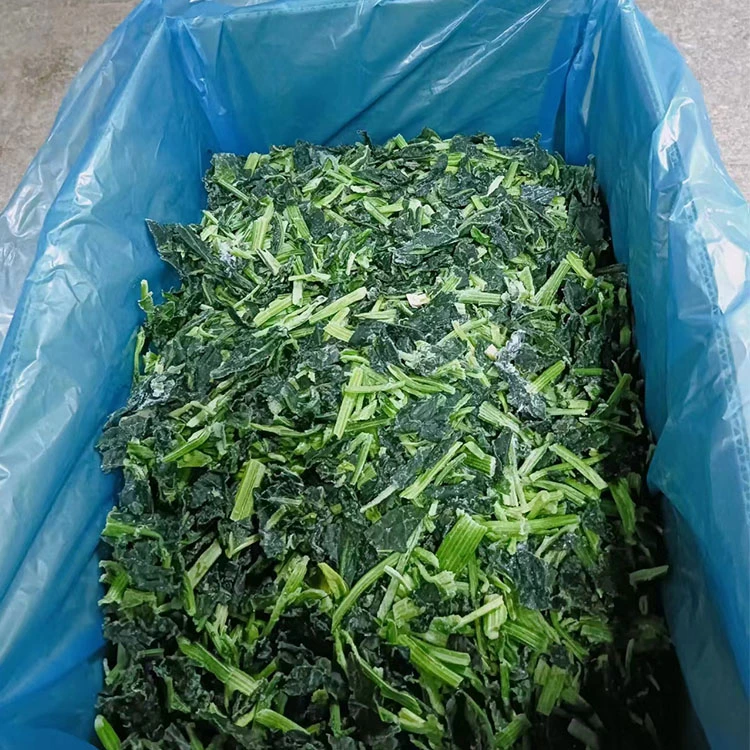
Bulk format and liner condition influence handling, thaw planning and protection during shipment.

Cold-chain evidence completes the quality story that starts with washing, blanching and freezing.
Common Mistakes When Freezing Spinach Leaves
- Freezing tired spinach: yellow, slimy or decaying leaves do not improve in the freezer.
- Guessing the blanch time: use the tested two-minute water-blanch direction for household spinach rather than waiting for an undefined color change.
- Overloading the pot: a large cold mass delays heat recovery and creates uneven treatment.
- Cooling slowly: residual heat continues softening the leaves after blanching.
- Packing wet spinach without a plan: excess water increases ice and creates a watery ingredient.
- Freezing one oversized block: the user is forced to thaw more than the recipe needs.
- Expecting salad texture: freezing changes leaf structure even when the process is well controlled.
- Treating frozen as ready to eat: check the product status and cooking instructions; freezing is not a kill step.
- Buying by price per kilogram alone: drained yield, foreign material, stem level, cut consistency and application performance determine usable cost.
How GreenLand-food Supports Frozen Spinach Buyers
We supply frozen spinach for importers, distributors, foodservice kitchens, retail programs and food manufacturers. Our role is to help the purchasing and technical teams choose a format that fits the recipe and production flow, then confirm the product details before quotation and sample approval.
Our IQF chopped spinach page shows chopped, cut-leaf and portioned options. We can discuss the required cut, stem balance, color, moisture behavior, packing, order quantity, destination and documentation according to the project. Availability and final tolerances must be confirmed in the quotation and specification rather than assumed from a general article.
A useful inquiry tells us the intended product, annual or trial volume, required format, cut size, pack size, destination port, whether the spinach will be cooked or used in a no-cook application, target drained yield, microbiological requirements, certificate needs and expected delivery window. That information lets us assess feasibility and prepare a relevant sample instead of sending a generic spinach product.
Share your application, format, cut, pack, quantity and destination. We will help you compare the practical options and confirm the details that need specification approval.
FAQ About Freezing Spinach Leaves
Can you freeze spinach leaves?
Yes. For reliable household quality, wash young leaves, water-blanch for 2 minutes, cool immediately, drain, portion, pack and freeze.
Can you freeze raw spinach leaves?
Yes, but raw freezing is a convenience compromise. Dry the leaves well, pack airtight and plan to use them in a cooked dish. Blanching gives more predictable storage quality.
How long should spinach be blanched before freezing?
The NCHFP household direction is a 2-minute water blanch for spinach, followed by immediate cooling, draining and packing.
Can you freeze baby spinach?
Yes. Baby spinach freezes well for cooked applications, but its tender leaves become soft after thawing and will not suit salad use.
Can frozen spinach be eaten raw in a smoothie?
Do not assume that frozen means ready to eat. Household freezing does not destroy all microbes. For commercial frozen spinach, follow its ready-to-eat status and package cooking instructions.
Why does spinach become watery after thawing?
Ice crystals damage the leaf cells, so water escapes during thawing. Drain or squeeze it for fillings, and test drained yield in commercial formulas.
Do you need to thaw frozen spinach before cooking?
Not for soup, stew or many sauces. Thaw and squeeze it first when excess water would weaken a dip, dumpling, pastry, quiche or pasta filling.
Can frozen spinach be used for salad?
No. The leaves lose their crisp structure during freezing and thawing. Use fresh spinach when visible raw-leaf texture is required.
What is the difference between IQF chopped spinach and a frozen spinach block?
IQF chopped spinach is easier to dose in smaller quantities. A block can be efficient when a factory uses the whole unit in one batch but requires a planned thaw or kettle process.
What information should a frozen spinach RFQ include?
Include the application, format, cut size, pack, quantity, destination, cook status, drained-yield expectation, microbiological and document requirements, and delivery plan.