


IQF vs Block Frozen Vegetables: Pros, Cons & Use Cases
Jan 19, 2026
Leave a message

IQF vs Block Frozen Vegetables: How B2B Buyers Should Choose the Right Freezing Format
I am Jacky from GreenLand-food. If you source frozen vegetables, you will eventually face one practical question: should you buy IQF frozen vegetables or block frozen vegetables?
The answer is not that one method is always better than the other. IQF and block frozen formats solve different problems. IQF is usually stronger when buyers need free-flowing pieces, portion control, retail convenience, restaurant speed and accurate industrial dosing. Block frozen formats can be suitable when the product will be thawed and used in full-batch processing, puree, soup, sauce, fillings or industrial formulations.
This guide helps importers, distributors, foodservice buyers, retailers, prepared food factories and private label teams compare IQF and block frozen vegetables by application, texture, thawing method, labor, waste, storage, cost and quality-control requirements.
Core message: Do not choose IQF or block frozen vegetables by habit. Choose by final application, portioning method, thawing plan, texture target, cost model and inspection rules.
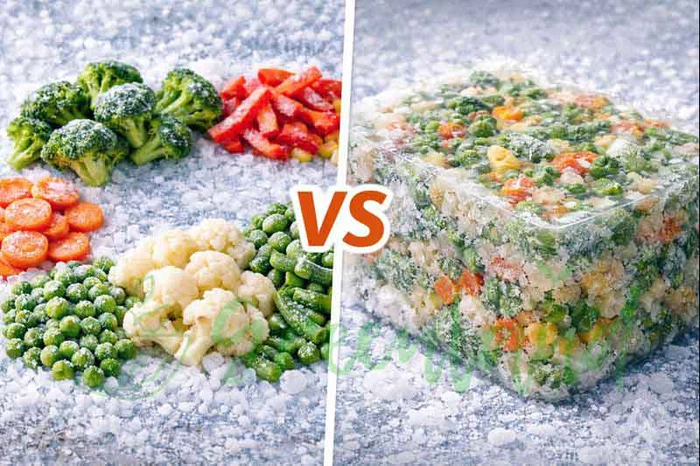
1. The Basic Difference: Separated Pieces vs Frozen Mass
IQF means Individually Quick Frozen. The product is frozen quickly and separately, so each piece can remain free-flowing under proper frozen storage and handling conditions.
Block frozen vegetables are frozen as a compact block, mass or portion. In some markets, buyers may also hear terms such as BQF or block quick frozen. The key point is that the product is not meant to be poured piece by piece like IQF. It is usually thawed and used as a larger unit or full batch.
| Freezing Format | What It Means | Main Buyer Value |
|---|---|---|
| IQF | Individual pieces are quickly frozen separately and should remain free-flowing under proper frozen conditions. | Portion control, easy handling, dosing accuracy and retail convenience. |
| Block frozen | Vegetables are frozen into a compact block, mass or portion rather than separated pieces. | Bulk processing, full-batch use, compact storage and cost-sensitive applications. |
2. What Is IQF Freezing?
In IQF processing, prepared vegetable pieces move through a freezing system and are frozen individually. The purpose is to keep pieces separate and reduce the risk of forming a solid mass. This makes the product easier to pour, weigh, blend, cook and repack.
| IQF Strength | Buyer Benefit | Buyer Still Needs to Check |
|---|---|---|
| Free-flowing pieces | Users can take only the quantity needed. | Clumping, frost, thaw-refreeze signs and storage condition. |
| Portion control | Restaurants and factories can weigh 50g, 500g or 5kg without thawing a whole batch. | Piece size, cut tolerance and free-flow performance. |
| Fast cooking and dosing | Suitable for stir-fry, retail packs, ready meals and automated dosing lines. | Cooking test, water release and broken pieces. |
| Visible product form | Better for products where customers see pieces directly. | Color, defects, size distribution and packaging appearance. |
Buyer note: IQF does not mean "zero clumping forever." Free-flowing condition still depends on freezing quality, packing, storage temperature, transport and receiving handling.

3. What Is Block Frozen?
Block frozen vegetables are frozen into a compact block, sheet, slab or portion mass. The product may be packed in a carton, liner bag, tray or mold before freezing, depending on product type and factory process.
Block frozen is not automatically a lower-quality choice. It is a different format. It works best when the buyer does not need separated pieces and plans to thaw or process the product as a full batch.
| Block Frozen Strength | Buyer Benefit | Buyer Still Needs to Check |
|---|---|---|
| Compact format | May support efficient bulk storage and handling for some factories. | Carton weight, block size, pallet loading and thawing workflow. |
| Lower processing complexity | Can be cost-effective for bulk applications. | Final cost after thawing, water loss, labor and rework. |
| Full-batch use | Suitable when the whole block will be thawed and used at one time. | Thawing time, hygiene control, temperature control and production schedule. |
| Functional applications | Works for puree, sauce, soup, fillings and industrial mixing where visible piece separation is not required. | Texture target, drain loss, ingredient ratio and microbiological control. |
4. Quick Decision Matrix: IQF or Block Frozen?
Use this table as a first screening tool before requesting samples.
| Buyer Requirement | Usually Better Fit | Reason |
|---|---|---|
| Retail frozen vegetable bag | IQF | Consumers expect pourable pieces and convenient storage after opening. |
| Restaurant portion control | IQF | Kitchens can use exact portions without thawing the full pack. |
| Ready meal tray dosing | IQF | Separated pieces support dosing accuracy and visual consistency. |
| Soup factory full-batch cooking | Block frozen or IQF depending on formula | If the whole product is cooked into a batch, separated pieces may not be necessary. |
| Puree, sauce or filling | Block frozen may fit | Visible piece separation is less important than yield, flavor and food safety. |
| Automated blending line | IQF | Free-flowing pieces are easier to meter and blend consistently. |
5. Quality Comparison: Texture, Water Release and Appearance
IQF often has an advantage when piece integrity and visual appearance matter. Fast freezing and separated handling can help reduce structural damage when raw material, pre-treatment and cold chain are controlled well.
Block frozen products may release more water or show softer texture after thawing in some applications, but this is not always a problem. For soup, puree, sauce or filling, the buyer may care more about flavor, solids, microbial control and total usable yield than visible piece integrity.
| Quality Area | IQF Tends to Support | Block Frozen Can Still Work When |
|---|---|---|
| Texture | Better piece-level texture in visible or lightly cooked applications. | Final product is cooked, blended, pureed or processed further. |
| Water release | Lower drain-loss risk when processing and cold chain are well controlled. | Formula can absorb or tolerate water release. |
| Appearance | Separated, recognizable pieces for retail and foodservice. | Appearance is not the primary value driver. |
| Cooking repeatability | More uniform heating when size and cut are controlled. | Factory uses full-batch SOP with validated thawing and cooking time. |
6. Cost Comparison: Do Not Only Compare Price per Kg
Block frozen products may look cheaper by unit price. IQF products may look more expensive because the processing and handling requirements are higher. But the real decision should be based on cost per usable kg or cost per finished serving, not only invoice price.
| Cost Item | IQF Cost Logic | Block Frozen Cost Logic |
|---|---|---|
| Unit price | Often higher because process, separation and packaging demands are higher. | May be lower for bulk or full-batch applications. |
| Labor | Lower portioning and preparation labor when pieces remain free-flowing. | Requires thawing plan, block handling and batch scheduling. |
| Waste | Can reduce unnecessary thawing and leftover waste. | Can create waste if a full block is thawed but not fully used. |
| Storage and loading | Needs good packaging and temperature stability to maintain free-flow condition. | Compact blocks may support efficient storage for some factories. |
| Claims and complaints | Risk comes from clumping, frost, broken pieces and free-flow failure. | Risk comes from thawing abuse, water release, microbial control and partial-use problems. |
Buyer rule: IQF is not automatically expensive, and block frozen is not automatically cheaper. Compare labor, thawing loss, usable yield, storage, waste, complaints and production efficiency.
7. Thawing Risk: The Block Frozen Question Buyers Often Miss
Block frozen products usually require a more deliberate thawing plan. A large block takes longer to thaw than separated IQF pieces. If thawing is poorly controlled, the buyer may face texture loss, water release, hygiene risk, production delays and inconsistent batch performance.
| Thawing Control Point | Buyer Should Define | Why It Matters |
|---|---|---|
| Block size | Carton weight, block dimensions and whether the block fits equipment. | Controls thawing time and handling feasibility. |
| Thawing method | Cold-room thawing, direct cooking, controlled water thawing or validated factory method. | Prevents uncontrolled temperature exposure. |
| Use window | How soon the thawed product must be used. | Reduces waste and food safety risk. |
| Batch plan | Whether the entire block is used in one production batch. | Avoids partial thawing and leftover product problems. |
8. Best Applications for IQF Frozen Vegetables
IQF is usually the better choice when the buyer needs convenience, visible pieces, portion control or flexible use.
- Retail frozen vegetable bags: consumers expect separated pieces that can be poured and stored after opening.
- Foodservice kitchens: chefs can use smaller quantities without thawing a full pack.
- Restaurant chains: portioning and cooking consistency are easier to standardize across stores.
- Ready meals: separated pieces support visual consistency and dosing accuracy in trays.
- Stir-fry and quick-cook applications: pieces can be added directly into cooking systems according to the recipe.
- Industrial blending: free-flowing product improves metering, mixing and recipe repeatability.
9. Best Applications for Block Frozen Vegetables
Block frozen formats may be suitable when the buyer does not need separated pieces and plans to use the product in bulk processing.
- Soup factories: full-batch cooking can use thawed or directly processed blocks if the process is validated.
- Puree and sauce production: visible piece integrity is less important than flavor, solids, yield and food safety.
- Fillings and formulated products: chopped or processed vegetable mass may be suitable for dumplings, bakery fillings or mixed fillings.
- Industrial cooking: factories that use full cartons in a single batch may not need free-flowing pieces.
- Cost-sensitive bulk applications: block frozen may support a lower-cost raw material strategy when quality requirements match the final use.
Buyer note: Block frozen is not a shortcut for poor quality. It should still have clear raw material, microbiology, contaminant, net weight, thawing and traceability requirements.
10. Buyer Testing SOP: How to Compare IQF and Block Frozen Samples
Do not choose based only on supplier explanation. Test the samples under your real operating method.
| Test Item | IQF Test Method | Block Frozen Test Method |
|---|---|---|
| Handling | Pour, weigh and dose product while frozen. | Check block size, thawing feasibility and batch handling. |
| Cooking performance | Cook directly from frozen if that matches your SOP. | Cook after controlled thawing or direct processing according to factory SOP. |
| Water release | Measure drain loss after cooking or thawing. | Measure thaw loss and process loss after full-batch use. |
| Texture | Score bite, firmness, color and shape retention. | Score texture only according to final application, not retail appearance. |
| Usable yield | Calculate usable kg after cooking and portioning. | Calculate usable kg after thawing, draining and processing. |
11. Specification Clauses Buyers Can Copy
The following clauses can be adapted into RFQs, supplier specifications and quality agreements.
Clause 1: Freezing format
"Product freezing format shall be IQF / block frozen as agreed in the approved specification. Supplier shall not change freezing format without written buyer approval."
Clause 2: IQF free-flowing condition
"For IQF products, pieces shall remain free-flowing under proper frozen storage and handling conditions. Excessive clumping, thaw-refreeze signs or blocks shall be evaluated according to the buyer-agreed receiving inspection method."
Clause 3: Block frozen thawing plan
"For block frozen products, block size, carton weight, thawing method, use window and batch-use plan shall be approved before purchase confirmation."
Clause 4: Product performance
"Product shall meet buyer-agreed performance requirements for texture, water release, cooking behavior, yield and final application test. Testing method and acceptance limits shall be defined before shipment."
Clause 5: Sampling and acceptance
"Lot inspection shall follow the current ISO 2859-1 or another buyer-agreed AQL sampling plan. Sample size, acceptance number, rejection number and retest rules shall be agreed before shipment."
12. IQF vs Block Frozen Buyer Checklist
Use this checklist before choosing IQF or block frozen vegetables.
- Application: retail bag, foodservice, restaurant chain, ready meal, soup, sauce, filling, puree or industrial processing.
- Freezing format: IQF, block frozen, portion block or buyer-specific format.
- Handling method: pour and dose, full-batch thawing, direct cooking or controlled thawing.
- Product form: whole, florets, diced, sliced, cut, chopped, kernels, leaf or puree-grade material.
- Texture target: visible bite, soft texture, blended texture, low water release or formula-specific behavior.
- Cost basis: invoice price, usable yield, labor, waste, thawing loss, storage and complaint risk.
- Quality criteria: free-flowing condition, clumping, broken pieces, fines, color, defects, EVM and foreign matter.
- Food safety: microbiology, residues, heavy metals, COA, traceability and thawing hygiene control.
- Cold chain: storage temperature, reefer set point, loading photos, seal number and receiving inspection.
- Acceptance plan: current ISO 2859-1 or buyer-agreed AQL sampling plan.
13. IQF vs Block Frozen RFQ Template
Use this RFQ template when asking suppliers to recommend IQF or block frozen formats.
| RFQ Item | Buyer Should Specify |
|---|---|
| Business type | Importer, distributor, retailer, foodservice buyer, restaurant chain, central kitchen or food factory. |
| Target vegetable | Broccoli, cauliflower, carrots, green beans, edamame, peas, corn, okra, spinach, mixed vegetables or other SKUs. |
| Preferred freezing format | IQF, block frozen, portion block or supplier recommendation based on application. |
| Application | Retail pack, foodservice, ready meals, stir-fry, soup, sauce, filling, puree or industrial processing. |
| Handling method | Direct-from-frozen cooking, portion dosing, full-block thawing, direct cooking into batch or controlled thawing. |
| Quality target | Texture, water release, free-flow condition, block integrity, color, defect tolerance and yield. |
| Documents | Specification, COA, microbiology, residue / heavy metal tests, certificates, traceability and loading photos. |
| Packaging and shipment | 10 kg carton, 1 kg bag, foodservice pack, block size, carton weight, MOQ, lead time and destination port. |
Need help choosing IQF or block frozen vegetables?
Send us your target frozen vegetable product, final application, handling method, product form, texture target, packaging format, destination market, annual volume and document needs. GreenLand-food can discuss suitable IQF or block frozen options, samples, specifications, COA support, traceability and shipment planning.
Request Freezing Format Support14. GreenLand-food Frozen Vegetable Knowledge Support
For a broader topic structure, visit our Frozen Vegetables Topic Directory.
For a complete buyer framework, you can also read our Ultimate Guide to Frozen Vegetables.
For a deeper look at IQF production steps, visit our IQF Processing Explained: From Harvest to Packing.

15. FAQ
What is the difference between IQF and block frozen vegetables?
IQF vegetables are frozen as individual pieces and are usually intended to remain free-flowing under proper frozen storage. Block frozen vegetables are frozen into a compact block or mass and are usually thawed or processed as a larger unit.
Is IQF always better than block frozen?
No. IQF is usually better for portion control, visible pieces, retail bags, foodservice and accurate dosing. Block frozen can be suitable for soup, sauce, puree, fillings and full-batch industrial processing.
Why is IQF usually more expensive?
IQF processing usually requires stronger process control, freezing performance, separation control, packaging and cold-chain management. The invoice price may be higher, but buyers should compare total cost, not unit price only.
When should foodservice buyers choose IQF?
Foodservice buyers should choose IQF when they need fast handling, portion control, direct-from-frozen cooking, consistent servings and less leftover thawed product.
When should factories consider block frozen vegetables?
Factories can consider block frozen vegetables when the product will be thawed and used in full-batch cooking, puree, sauce, soup, fillings or industrial formulations where separated pieces are not needed.
Does block frozen have more food safety risk?
Not automatically. The main issue is thawing control. Block frozen products need a clear thawing method, use window, hygiene procedure and batch plan to avoid uncontrolled temperature exposure and unnecessary waste.
Can GreenLand-food support both IQF and block frozen sourcing discussions?
GreenLand-food can discuss suitable freezing formats, product forms, specifications, samples, COA support, packaging, traceability and shipment planning according to your application and destination market.
Conclusion
IQF and block frozen vegetables are not competing answers to the same question. They are different freezing formats for different B2B needs. IQF is usually stronger for free-flowing separation, portion control, retail convenience, foodservice speed and accurate dosing. Block frozen can be suitable for bulk processing, puree, soup, sauce, fillings and full-batch production.
For buyers, the safest decision is application-based. Define your final use, handling method, texture target, thawing plan, cost model, quality tolerance and inspection method before choosing the freezing format. When those points are clear, both IQF and block frozen vegetables can be used effectively in the right commercial setting.