



Frozen Potato Balls
Description
Technical Parameters
IQF Potato Specialty · Bulk · Foodservice · Private Label
Frozen Potato Balls Defined by Product Type, Piece Size and Cooking Performance
We supply peeled frozen potato balls for importers, foodservice distributors, central kitchens, ready-meal factories, repackers and retail frozen brands. Our main product is a whole-cut or whole-piece potato specialty: sound potato flesh is peeled, trimmed or rounded, heat-treated as specified, individually frozen and packed as free-flowing pieces.
We keep this item separate from formed mashed potato noisettes. A whole-cut IQF potato ball can use a potato-only ingredient statement, while a formed noisette may contain vegetable oil, salt, dextrose, seasoning, stabiliser, emulsifier or coating ingredients. We state the product identity, ingredient list, process and allergen status in the commercial specification so your team receives the format it priced and tested.
For each inquiry, we align the named product with a measurable piece range, defect grade, heat treatment, final-cook target and packing format. This gives purchasing, quality assurance and kitchen teams one shared basis for sample approval, contract review, incoming inspection and repeat-order comparison.

Whole-cut peeled frozen potato balls shown in the frozen state; the visible angular rounding is different from a smooth formed-mash noisette.
What Frozen Potato Ball Buyers Are Actually Comparing
A quotation headed only "frozen potato balls" can hide major cost and performance differences. The raw material may be a small whole potato, a larger potato mechanically rounded into a ball, a pre-fried Parisienne specialty, or mashed potato formed into a smooth sphere. Piece weight can range from approximately 6 g to 50 g, while formed noisettes commonly sit near 7–8 g and 25 mm diameter. We therefore define the construction first and then price size, processing, grade, packing and documents.
| Sourcing question | Commercial risk | Our written control | Buyer result |
|---|---|---|---|
| Whole potato or formed mash? | Different ingredient, allergen, oil and texture profiles. | Identity, formula, process and allergen statement appear as separate fields. | No substitution between potato-only balls and formulated noisettes. |
| Diameter or grams per piece? | Two suppliers can quote the same name with different portion counts. | One primary acceptance method, stated range and minimum in-range percentage. | Repeatable portion count, cook time and plate appearance. |
| Blanched, steamed or pre-fried? | The same ball can brown, soften or absorb oil differently. | Process route, oil type, oil addition and application test are written into the SKU. | A product matched to the buyer's heating system. |
| How round and clean? | Peel, eyes, black spots, green tissue and broken pieces reduce usable yield. | Separate defect limits and roundness criteria for Grade A and Premium. | A measurable appearance standard rather than a vague grade name. |
| What does the COA report? | Specification limits may be copied into the result column. | Specification and batch Actual Result remain separate. | Lot-specific inspection and laboratory values. |
Four Product Constructions, Four Different Specifications
Whole-Cut IQF Ball
Our main plain program. Peeled potato flesh is trimmed or rounded, blanched as specified and individually frozen. Standard ingredient: potato; an approved anti-browning aid is declared if used.
Steam Pre-Cooked Parisienne
A peeled potato ball with a controlled pre-cook for faster foodservice finishing. Firmness and centre texture are tested under an agreed heating method.
Whole-Cut Pre-Fried Ball
Potato is lightly pre-fried for color development and faster crisping. A commercial starting formula is 98–99% potato and 1–2% vegetable oil, with total fat ≤3.0%.
Formed Mashed Potato Noisette
A separate formulated product, normally about 7–8 g and Ø25 mm. Potato, oil, salt, dextrose, seasoning, stabiliser, emulsifier and coating status follow the signed formula and allergen file.
The formed product is not automatically gluten-free, dairy-free or allergen-free. Breadcrumb coating can introduce wheat; dairy ingredients can introduce milk; seasoning and shared-line conditions can change the declaration. We provide the ingredient list, additive function, allergen statement and nutrition panel for the exact formula rather than borrowing the plain potato statement.
The image beside this text shows whole-cut potato balls in a clear inner bag. Their irregular natural geometry is visible through the film and should not be described as a smooth mashed-potato sphere.

Whole-cut frozen potato balls in an unprinted bulk inner bag.
Size Programs: Use One Primary Acceptance Method
Diameter screening and grams-per-piece are both used in the market, but they are not interchangeable. Potato density, natural shape and trimming profile change the relationship between weight and diameter. We specify either diameter or piece weight as the primary acceptance method, then use the other only as descriptive information. Grade A requires at least 90% in range; Premium requires at least 95% in range.
| Program | Primary range | Typical channel | Specification focus |
|---|---|---|---|
| Mini weight-sorted | 6–10 g/piece | Foodservice garnish, meal kits, small retail portions | Piece-count consistency and low breakage. |
| Standard weight-sorted | 13–18 g/piece | Ready meals, catering and plated sides | Even centre heating and portion count. |
| Large weight-sorted | 40–50 g/piece | Large-format foodservice and industrial meal assembly | Longer cook time, centre firmness and shape retention. |
| Parisienne small | 20–30 mm diameter | Classic foodservice potato side and pre-fried specialty | Diameter screen, roundness, surface defects and fry color. |
| Parisienne large | 30–40 mm diameter | Catering, roasting and visible ready-meal components | Roundness, internal texture and uniform finishing. |
| Formed noisette | 7–8 g/piece; approximately Ø25 mm | QSR, catering, snack and retail frozen programs | Formula, oil, shape uniformity, crust, bursting and finished bite. |
Commercial Product Specification
| Product | IQF Frozen Potato Balls / Frozen Parisienne Potatoes / Frozen Potato Noisettes, with construction stated on the SKU. |
|---|---|
| Botanical raw material | Solanum tuberosum; mature, sound processing potato selected for solids, low greening, low sprouting and suitable texture. |
| Ingredient - plain whole-cut | Potato. Any anti-browning treatment is declared by compound name and use level. |
| Process | Washed, peeled, trimmed/rounded, blanched or steam pre-cooked as specified, cooled, dewatered, individually frozen, sorted and packed. Pre-fried and formed products are separate process routes. |
| Appearance | Free-flowing, peeled, near-round potato pieces; natural white to pale yellow color; no abnormal frost, thawing evidence or foreign odor. |
| Dry matter | 18–22% starting range for whole-cut programs; application projects can set a minimum of 18.0%. |
| Reducing sugars | ≤0.30% for a selected light-fry-color program, measured by the agreed method. Non-fried plain programs can use a cooked-color reference instead. |
| Oil / salt | Plain IQF: no added oil or salt. Whole-cut pre-fried: oil addition 1–2%, total fat ≤3.0%. Formed noisette starting limit: total fat ≤8.0%, salt 0.4–1.2%, governed by formula. |
| Packing | 1 × 10 kg, 4 × 2.5 kg, 10 × 1 kg, 20 × 500 g, 25 × 400 g, 6 × 2.5 lb; industrial tote up to 625 kg for compatible programs. |
| MOQ | 11 MT for one standard bulk SKU; from 15 MT for a new printed private-label format; mixed reefer plan from 3–5 MT per compatible SKU. |
| Loading guide | 11–12 MT/20RF and 23–25 MT/40RH based on non-palletized 1 × 10 kg cartons. Pallets, carton dimensions and route limits change final payload. |
| Shelf life / storage | 24 months from production at −18°C or below in unopened packaging under continuous frozen storage. |
| Lead time / port | Normally 20–25 days for standard packing. Loading port: Xiamen, China, or another contracted China port selected for the shipment route. |
| Trade terms | FOB, CFR or CIF. |
| Intended use | Not ready-to-eat unless a separate RTE program is specified. Whole-cut and formed products require the cooking instruction stated for the SKU. |
Grade A and Premium Defect Limits
The limits below are commercial starting values for peeled whole-cut frozen potato balls. Percentages are by weight unless the inspection method states piece count. The total-defect limit does not replace the individual limits: a lot must pass both.
| Inspection item | Grade A | Premium | Definition |
|---|---|---|---|
| Pieces inside primary size range | ≥90% | ≥95% | By the selected weight range or diameter screen. |
| Near-round pieces | ≥85% | ≥92% | No major flat cut, deep gouge or elongated profile. |
| Total visual defects | ≤5.0% | ≤3.0% | Aggregate of permitted visual defects. |
| Remaining peel and eyes | ≤1.0% | ≤0.5% | Visible peel or untrimmed eye area. |
| Black spots / bruised tissue | ≤1.5% | ≤0.8% | Visible internal or surface dark tissue. |
| Green tissue | ≤0.5% | ≤0.2% | Any visible green area after peeling and trimming. |
| Broken, split or heavily chipped pieces | ≤3.0% | ≤1.5% | Loss of a substantial part of the round profile. |
| Soft or mushy pieces | ≤2.0% | ≤1.0% | Assessed under the agreed thawed or cooked method. |
| Non-separable clumps | ≤2.0% | ≤1.0% | Pieces not separable by normal hand pressure while frozen. |
| Loose ice and frost | ≤2.0% | ≤1.0% | Free ice not forming part of the potato piece. |
| Decay, mould, live infestation and foreign material | Absent | Absent | Lot rejection item. |
Potato Processing Flow and Risk Controls
We connect each process step to a defect the buyer can measure. The normal whole-cut route is intake, washing, peeling, eye and green-tissue trimming, ball cutting or size selection, blanching or steam pre-cooking, cooling, surface dewatering, IQF freezing, frozen sorting, foreign-material control, weight check, sealing and frozen storage.
1. Intake & Wash
We reject rot, heavy sprouting, excessive greening, severe bruising and unsuitable solids, then wash away soil and visible surface matter.
2. Peel & Round
Peel, eyes, black tissue and green tissue are trimmed before weight or diameter grading.
3. Heat Treat & Cool
Blanching or steaming is set for enzyme control and application texture; cooling and dewatering reduce over-softening and surface ice.
4. Freeze & Release
IQF freezing, frozen inspection, metal control, pack weight, seal inspection and batch release complete the process.

A general potato washing and pre-processing line showing whole potatoes, washing equipment and related potato handling; it is not presented as a potato-ball-only line.

General IQF tunnel equipment supporting rapid freezing and piece separation; the image does not claim a dedicated potato-ball line.
Application Testing: Measure the Result After Heating
Frozen appearance alone cannot predict production performance. We structure samples around the buyer's actual heating system and record input weight, thaw status, time, temperature, oil or steam condition, hold time, finished yield and damaged-piece rate. Whole-cut products are judged for centre tenderness and shape retention; formed noisettes are also judged for crust integrity, bursting, oil pickup and uniform browning.
| Channel | Starting format | Performance test | Purchasing focus |
|---|---|---|---|
| Foodservice / HORECA | 20–30 mm or 13–18 g, pre-cooked or pre-fried | Fryer, oven or combi-oven cycle plus hot holding | Speed, browning, centre texture and portion count. |
| Ready meals | 6–10 g or 13–18 g whole-cut | Full sauce, bake, chill/freeze and reheat cycle | Shape retention, moisture release and sauce compatibility. |
| Catering / plated side | 30–40 mm or 40–50 g whole-cut | Steam or roast cycle with service hold | Large-piece centre cooking and visual roundness. |
| QSR / snack | 7–8 g, Ø25 mm formed noisette | 175°C fryer reference, normally 3–4 minutes | Crust, bursting, oil pickup, color and internal mash texture. |
| Retail private label | Selected whole-cut or formed SKU | Cooking-instruction validation for declared appliances | Ingredient list, allergens, nutrition, net weight and repeatable consumer result. |
Microbiological and Chemical Starting Panel
These limits form a clear non-ready-to-eat starting panel. The destination, product construction and intended use can require different sampling or methods. Formed or coated products also need formula-specific allergen and additive review.
| Microbiological item | Commercial starting limit |
|---|---|
| Total plate count | ≤100,000 CFU/g |
| Enterobacteriaceae | ≤1,000 CFU/g |
| Coliforms | ≤100 CFU/g |
| Escherichia coli | <10 CFU/g |
| Yeasts | ≤1,000 CFU/g |
| Moulds | ≤1,000 CFU/g |
| Staphylococcus aureus | ≤100 CFU/g |
| Salmonella | Absent in 25 g |
| Listeria monocytogenes | Absent in 25 g |
Lead and Cadmium
For an EU-oriented peeled-potato specification, lead (Pb) ≤0.10 mg/kg and cadmium (Cd) ≤0.10 mg/kg apply on the wet-weight edible portion. Processed or compound-product classification must also account for the finished formula.
Pesticide Residues
Residues must comply with the destination-market MRLs. For EU programs, each active substance follows its potato MRL; the general 0.01 mg/kg default applies where no specific MRL is set.
Fry-Color Risk
For pre-fried products, variety, storage condition, reducing sugars, blanching and final cooking instruction are controlled together. A cooked color reference is more meaningful than describing every raw potato as "low sugar."
COA: Specification Limit Versus Batch Actual Result
We use one column for the acceptance limit and another for the value measured or observed on the released production lot. "6–10 g/piece" is a specification range; the COA Actual Result should state the measured conformity percentage and sample result, not repeat the range as though it were a test result.
| COA line | Specification example | Actual Result | Release frequency |
|---|---|---|---|
| Identity / process | Whole-cut, blanched IQF | Lot identity and process record | Each lot |
| Piece-size conformity | 6–10 g; Grade A ≥90% | Measured in-range percentage | Each lot |
| Roundness / defects | Ordered grade limits | Inspection percentages | Each lot |
| Dry matter / reducing sugars | ≥18.0% / ≤0.30% when ordered | Measured analytical values | Lot or agreed crop schedule |
| Microbiology | Ordered organism limits | Laboratory results | Each lot or defined sampling plan |
| Pb, Cd and residue screen | Destination limits | Laboratory report values | Risk-based periodic plan or ordered lot test |
Buyer QA and Shipment File
The document package can include the product specification, batch COA, microbiological report, pesticide-residue report, heavy-metal report, ingredient list, allergen statement, nutrition panel for retail/formulated items, process flow, packing list, commercial invoice, bill of lading, certificate of origin and destination-specific health documents.
Certificate copies are provided within the valid scope of the supplying facility and order. A company certificate display is general documentation evidence, not proof that every certificate covers every frozen potato SKU or production site.

General certificate display for the document module; validity, site and product scope are reviewed for the supplying facility.
Packaging, OEM and Container Planning
Industrial Bulk
1 × 10 kg carton; optional food-grade liner and outer carton selected for frozen storage and stacking.
Foodservice
4 × 2.5 kg, 10 × 1 kg or 6 × 2.5 lb; bag size can match one service period or kitchen batch.
Retail / Private Label
400 g, 500 g, 750 g and 1 kg; printed film, barcode, label language, nutrition and cooking instructions follow the destination.
Mixed Reefer
From 3–5 MT per compatible SKU, with aligned temperature, packing, production and destination-document requirements.
For OEM packing, we state net weight, film structure, bag dimensions, carton count, carton strength, date coding, lot coding, barcode, language, storage statement, origin marking, pallet pattern and case marks. A printed film project normally needs more time than plain bulk packing because artwork, print material and packing-line setup must be completed before production.

General frozen-food cold storage illustrating −18°C warehousing; the stored bags are not identified as potato balls.

General container loading image showing carton arrangement; final potato-ball case count depends on the approved packing plan.
Traceability and Frozen Export Release
Each finished lot is linked to raw-potato intake, processing date, shift or line, heat-treatment route, size program, packing-material batch and finished-goods code. The carton and inner pack carry the agreed product identity, net weight, production date, best-before date, lot code, storage condition and origin/destination marks. For formed products, the formula batch and allergen status form part of the traceability chain.
Raw Potato Record
Supplier or field lot, variety, intake date, sprout/green condition, solids and raw-material inspection.
Process Record
Peeling/trimming, size method, heat-treatment route, freezing, inspection and foreign-material control.
Shipment Record
COA, test reports, packing batch, storage status, case count, container/seal details and loading date.
We hold frozen goods at −18°C or below and use reefer transport. The loading plan considers carton dimensions, pallet use, legal payload, airflow and shipping-line restrictions. Repeated thawing and refreezing can increase surface frost, clumping, dehydration and texture damage, so receiving inspection should link product condition with the shipment temperature record.
A working payload is 11–12 MT for a 20-foot reefer and 23–25 MT for a 40-foot high-cube reefer when using non-palletized 1 × 10 kg cartons. Palletized retail or foodservice orders can load less. The final case count appears in the packing and loading plan rather than being assumed from container size alone.
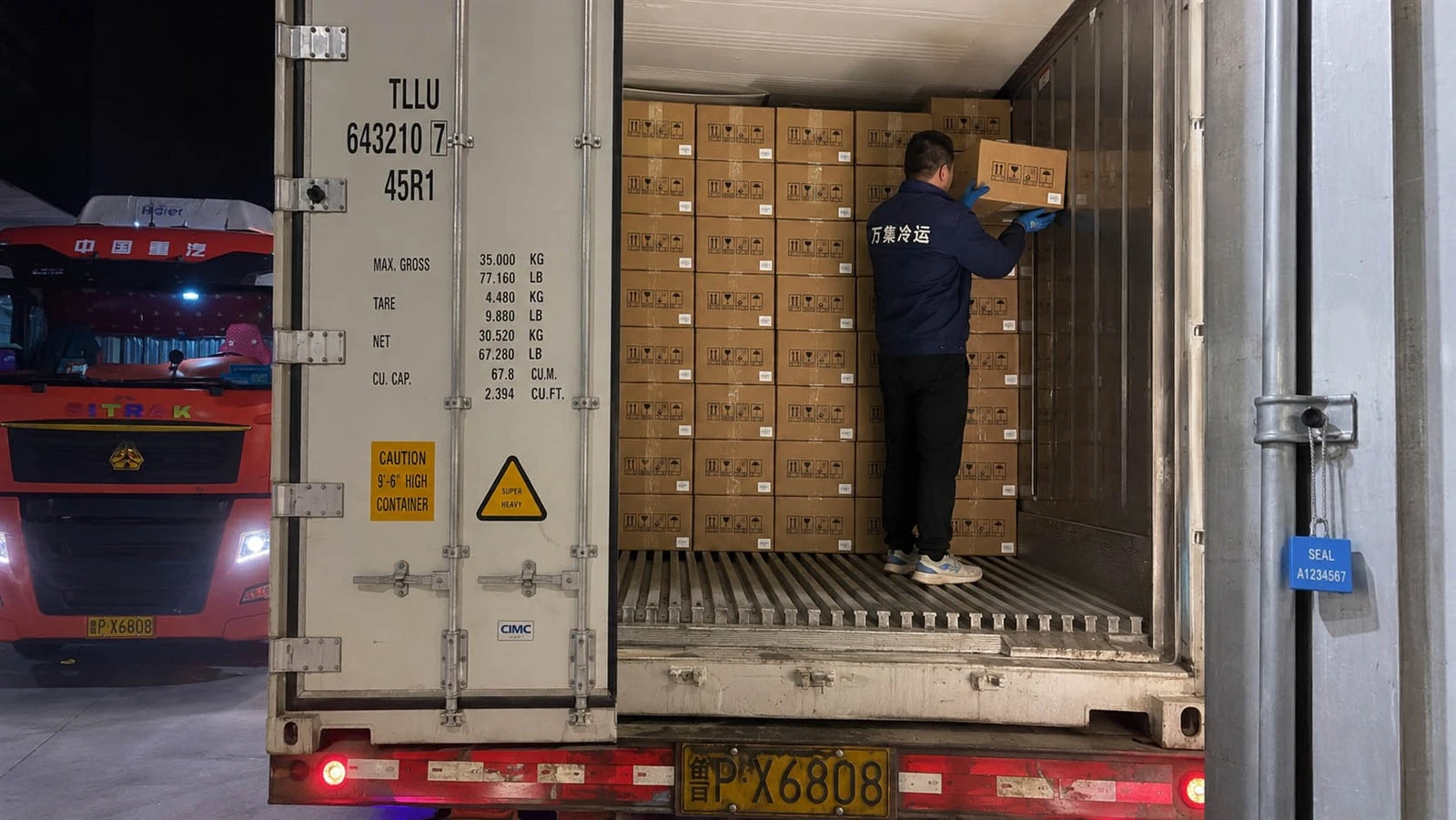
General frozen-food carton loading into a refrigerated container; the image is used only for export-handling evidence.
Frequently Asked Questions
1. Are frozen potato balls made from whole potatoes or mashed potatoes?
Both exist in the market. Our main plain SKU is whole-cut or whole-piece peeled potato. Formed mashed potato noisettes are quoted separately with their own formula, additives, allergens, oil level and cooking test.
2. Which frozen potato ball sizes can you supply?
Weight programs include 6–10 g, 13–18 g and 40–50 g per piece. Diameter programs include 20–30 mm and 30–40 mm. Formed noisettes normally start near 7–8 g and Ø25 mm.
3. Do you accept both diameter and piece weight?
Yes, but one method is selected as the primary lot-acceptance rule. We do not promise an exact diameter and exact weight simultaneously unless the agreed sampling data show that both ranges are compatible.
4. Are the whole-cut potato balls peeled?
Yes. The standard whole-cut product is peeled and trimmed. Starting peel/eye limits are ≤1.0% for Grade A and ≤0.5% for Premium, with separate controls for green tissue and black spots.
5. Can you supply blanched, steamed and pre-fried potato balls?
Yes, these are separate process routes. Blanched and steamed programs focus on centre texture and shape retention; pre-fried programs also define oil, fat, color and finishing performance.
6. What is the difference between Grade A and Premium?
Grade A starts at ≥90% size conformity, ≥85% near-round pieces and ≤5% total visual defects. Premium starts at ≥95% size conformity, ≥92% near-round pieces and ≤3% total defects with tighter individual limits.
7. How do you manage darkening and fry color?
We use suitable potato varieties, storage controls, trimming, heat treatment and an application color test. A selected pre-fry program can specify reducing sugars ≤0.30% together with the agreed analytical method.
8. What microbiological results can appear on the COA?
The starting panel covers total plate count, Enterobacteriaceae, coliforms, E. coli, yeast, mould, S. aureus, Salmonella and Listeria monocytogenes. The COA lists the production-lot results.
9. Can you provide residue and heavy-metal reports?
Yes. EU-oriented starting limits for peeled potato are Pb ≤0.10 mg/kg and Cd ≤0.10 mg/kg. Pesticide residues follow the applicable destination-market MRLs and agreed testing schedule.
10. What bulk and retail packing formats are available?
Bulk and foodservice formats include 1 × 10 kg, 4 × 2.5 kg, 10 × 1 kg and 6 × 2.5 lb. Retail formats include 400 g, 500 g, 750 g and 1 kg with destination-ready private-label details.
11. What is the MOQ for frozen potato balls?
The starting MOQ is 11 MT for one standard bulk SKU and from 15 MT for a new printed private-label program. Mixed loads can start from 3–5 MT per compatible SKU.
12. How much loads in a refrigerated container?
For non-palletized 1 × 10 kg cartons, use 11–12 MT/20RF and 23–25 MT/40RH as the working guide. Retail cases, pallets and route restrictions change the final payload.
13. What is the lead time and storage condition?
Standard packing normally requires 20–25 days. Store and transport the product at −18°C or below; the standard unopened-pack shelf life is 24 months from production.
14. What should I send for a precise quotation?
Send the whole-cut or formed product type, diameter or piece weight, grade, process, ingredient/allergen requirement, application test, packing, quantity, destination port, document list and private-label needs.
Build a Comparable Frozen Potato Ball RFQ
Send us: whole-cut, pre-cooked, pre-fried or formed type; diameter or piece-weight range; Grade A or Premium; dry matter or fry-color target; ingredient and allergen requirements; pack size; volume; destination; COA panel; loading plan and required shipment date. We will return the selected construction, measurable limits, packing plan and document scope in one commercial specification.
Hot Tags: frozen potato balls, China frozen potato balls manufacturers, suppliers, factory, frozen fries, frozen potato, fried potatoes frozen, potato sticks frozen, frozen potato chunk, frozen french fries
Previous
Cubed Potatoes FrozenNext
Frozen Cube Potatoes


