


Frozen Food Traceability System from Raw Material to Shipment
When you receive frozen fruits, frozen vegetables or frozen mushrooms, you may need more than product photos, price and certificates. You may need to know whether each carton can be connected with the correct raw material batch, production batch, packing record, COA, cold storage status and loading evidence.
If you are concerned about clumping, foreign matter, color change, broken pieces, label mistakes, carton mark inconsistency, COA matching or batch variation after arrival, GreenLand-food helps you review the shipment step by step. We trace the carton mark back to the packing batch, the packing batch back to the production record, the production record back to raw material inspection, and the shipment documents back to cold storage and container loading information.
Our traceability system is built for real frozen food procurement. It helps you review quality, handle customer feedback, prepare supplier audits, compare repeat orders and build a long-term supply relationship with clear batch evidence.
If you are still comparing product categories, start from our frozen food solution center. If your team needs an audit route before order confirmation, review our factory audit and inspection support. For product range review, use the catalog overview page or download the PDF catalog directly.
From Carton to Batch
If you provide a carton mark or batch code, we can review the related packing batch, COA, packing list and shipment record according to the order scope.
From Batch to Production
We connect the packing batch with washing, sorting, cutting, IQF freezing, metal detection and packing control records.
From Production to Raw Material
We review raw material source, incoming inspection, maturity, color, defect level, foreign matter risk and product suitability.
From Shipment to Evidence
We connect cold storage status, loading photos, container number, seal number and export documents to complete the shipment evidence chain.
How We Build a Traceability Chain for an Actual IQF Frozen Blueberry Order
For each real order, we do not only prepare the product. We also prepare the traceability chain behind the product. Taking IQF Frozen Blueberry as an example, we connect product specification, batch number, raw material condition, IQF processing, packing information, COA and shipment preparation into one reviewable order record.
If you need to check whether the goods you receive match the confirmed specification, we can help you review the order from document to carton, and from carton back to production and raw material control.


| IQF Frozen Blueberry Example | What We Define | How It Supports Your Review |
|---|---|---|
| Product Name | IQF Frozen Blueberry | Helps confirm the exact product before order, production and receiving. |
| Batch No. | SP24E004 | Connects product specification, COA, packing record and shipment information. |
| Specification Date | 2024/07/05 | Shows the specification version used for this order review. |
| Processing Method | Individually Quick Frozen, IQF | Supports review of separation, clumping risk and frozen product performance. |
| Size | 8–16 mm, or as per order requirement | Helps you check whether the delivered product matches the required application. |
| Storage Temperature | -18°C or below | Connects product quality with cold chain and storage requirement. |
| Traceability Information | Batch number, production record, document matching and quality control points | Helps you trace from carton label to production, COA and shipment evidence. |
How We Use Product Specification to Control Batch Consistency
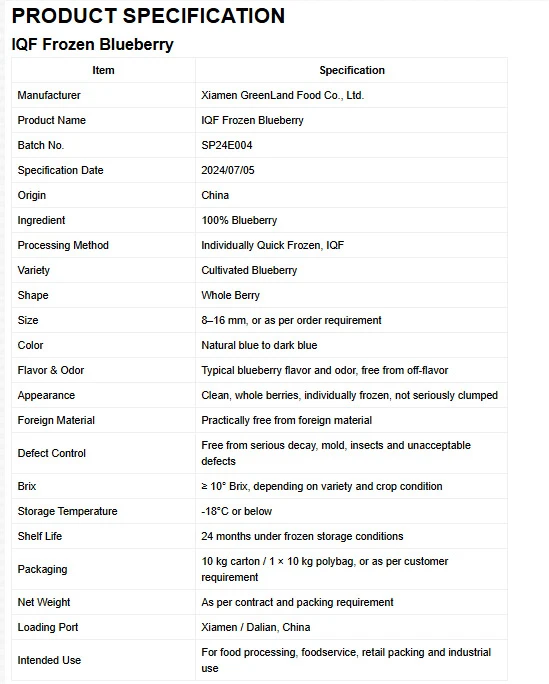
Before production and shipment, we use product specifications to define what the order should be. For IQF Frozen Blueberry, the specification may include manufacturer, batch number, origin, ingredient, processing method, variety, shape, size, color, flavor, appearance, foreign material control, defect control, Brix, storage temperature, shelf life, packaging, loading port and intended use.
This helps you reduce misunderstanding before shipment. When you receive the goods, the same specification can be used together with COA, carton label, packing list and loading record to review whether the shipment matches the agreed standard.


| Specification Section | What We Define | Why It Matters for You |
|---|---|---|
| Product Specification | Product name, variety, shape, size, color, appearance, Brix, packing and intended use. | You can confirm the product standard before production and compare it after receiving goods. |
| Microbiological Specification | Total Plate Count, Coliforms, E. coli, Yeast & Mold, Salmonella and Listeria when required. | You can review safety-related expectations together with COA or test report support. |
| Chemical & Safety Control | Pesticide residues, heavy metals, additives, GMO status, allergen and metal detection. | You can align the order with destination-market and customer requirements. |
| Traceability Information | Batch identification, production record, document matching and quality control points. | You can trace the shipment from carton label to raw material, production, COA and loading evidence. |
How We Connect COA, Test Report and Documents with Frozen Food Batches
A document is only useful when it can be connected with the real shipment. In frozen food procurement, a COA, test report or specification sheet should not be an isolated file. It should match the correct product, batch, packing format, shipment quantity and container record.
If you need to review whether a COA belongs to this batch, whether the packing list matches the cartons loaded, whether the specification sheet matches the product form received, or whether loading photos support the shipment record, we help you check the document chain according to the order requirement.

What We Help You Verify
- Whether the COA matches the correct product and batch
- Whether the specification matches the agreed order requirement
- Whether the packing list matches the loaded cartons
- Whether loading evidence supports shipment review
- Whether documents are suitable for your internal filing or customer review
Document Chain
Specification defines the product standard. COA supports batch-related quality review. Packing list connects cartons and shipment quantity. Loading photos and container information help support shipment evidence before departure.
| Document | What We Connect | How It Helps You |
|---|---|---|
| Specification Sheet | Product standard, size, cut, packing, shelf life and storage condition. | Helps confirm whether the received goods match the agreed product requirement. |
| COA | Batch-related quality result when required by the order. | Supports batch review, customer filing and shipment verification. |
| Test Report | Selected food safety or quality items based on product and order requirement. | Supports compliance review, audit and destination-market requirements. |
| Packing List | Cartons, quantity, packing format and shipment arrangement. | Helps your customs, warehouse and logistics teams review receiving information. |
| Bill of Lading | Container and transport record. | Supports import filing and shipment tracking. |
| Loading Photos | Visual evidence of loading condition. | Helps you review carton condition, loading arrangement and shipment evidence. |
Related resources: Certificates, Certifications Explained, HS Codes for Frozen Fruits, HS Codes for Frozen Vegetables, HS Codes for Frozen Mushrooms.
How GreenLand-food Helps You Review Frozen Food Shipment Problems
Traceability becomes valuable when you need answers after receiving goods, before placing a repeat order, or during a supplier audit. We build our traceability system around the real questions you may face in frozen food procurement.
If You Are Concerned About Clumping
For frozen broccoli, green beans, edamame, mixed vegetables or other IQF products, clumping may relate to surface moisture, IQF freezing condition, cold storage status, container loading or temperature fluctuation during shipment.
We help you trace the carton code to the packing batch, IQF freezing batch, cold storage arrangement and loading record, so the review can be based on evidence rather than assumptions.
If You Are Concerned About Frozen Fruit Color or Brix Variation
For frozen strawberries, mango, blueberries, pineapple or fruit puree, you may care about maturity, color, Brix tendency, broken rate and fruit integrity. If a new batch performs differently from a previous shipment, the review should go back to raw material season, incoming batch and production records.
We help you compare the batch logic step by step, especially for beverage, bakery, dairy, jam, foodservice and private label applications where repeat-order consistency matters.
If You Are Concerned About Sand or Foreign Matter in Frozen Mushrooms
Frozen mushrooms have different risk points from fruits and vegetables. You may need to review sand, substrate residue, cap damage, slice thickness, moisture condition or foreign matter.
We trace these risks from species and incoming batch to cleaning, sorting, cutting, freezing and packing records. This is especially important for frozen shiitake, oyster mushroom, porcini, nameko, button mushroom and mixed mushrooms.
If You Need to Verify Label, Carton Mark or COA
You may need carton marks, production dates, best-before dates, COA, packing lists and shipment documents to match the goods you received. If a label, carton mark or document needs to be checked, traceability helps connect the physical carton with the correct production and shipment records.
This supports customs filing, warehouse receiving, customer documentation, private label management and supplier audit preparation.
How We Trace Frozen Food from Shipment Back to Raw Material
We do not build records only for internal filing. Each record has to answer a practical question for you: which batch, which carton, which process, which document, which cold storage status and which container loading record. For the wider production-control framework behind these records, review our quality control and food safety system.
| Trace-back Point | What We Review | How It Helps You |
|---|---|---|
| Carton Mark / Batch Code | Product name, batch number, production date, best-before date, packing and shipping mark. | You can start the review from the actual carton received, not only from the order number. |
| Packing Batch | Inner bag, carton, label, net weight, carton mark and private label requirements. | You can review whether the packing matches your confirmed order requirement. |
| COA / Test Report | Batch-related quality or food safety verification when required. | You can check whether the document belongs to the correct batch and shipment. |
| Production Batch | Production date, product form, process route, cutting size and line-related record. | You can review whether the delivered product matches the confirmed specification. |
| Processing Record | Washing, sorting, cutting, blanching if required, IQF freezing, metal detection and packing control. | You can review whether the issue may relate to cleaning, cutting, freezing, foreign matter control or packing. |
| Raw Material Batch | Raw material source, incoming condition, maturity, color, size, defects, impurity and product suitability. | You can understand whether quality variation may come from raw material season or incoming batch condition. |
| Cold Storage Record | Frozen status, storage arrangement, carton condition and shipment preparation. | You can review whether the goods were stored and prepared under controlled frozen conditions. |
| Container Loading Record | Container number, seal number, loading photos, loading date and shipment documents. | You can review loading condition, carton arrangement and shipment evidence before departure. |
How We Trace Frozen Fruits, Frozen Vegetables and Frozen Mushrooms Back to Raw Material
If you need to review color, maturity, size, broken rate, impurity, sand, texture or product consistency, we start from the raw material stage. This is where many frozen food quality differences first appear.
We do not use the same traceability checklist for all products. Frozen fruits, frozen vegetables and frozen mushrooms have different quality risks, so we review each category according to its real application and processing characteristics.


How We Trace Production Batch Records in Frozen Food Processing
If you need to review whether the delivered product matches the confirmed specification, we check the production batch route. This includes washing, sorting, cutting, blanching when required, IQF freezing, metal detection and packing records.
This is important for repeat orders and product complaints. A frozen mango dice order, frozen broccoli floret order, frozen mixed vegetable order and frozen mushroom slice order all need different processing records, but each order needs a clear trace-back route.

Washing and Cleaning Record
If you need to review sand, soil, plant impurities or visible foreign matter, washing and cleaning records become part of the trace-back route. This step is especially important for frozen mushrooms, leafy vegetables, root vegetables and products with surface impurity risk.
- Raw material cleaning control
- Visible impurity reduction
- Preparation for cutting or IQF freezing
- Traceability support for complaint review
Cutting and Trimming Batch Control
If you need to review frozen mango dices, pineapple chunks, broccoli florets, chopped vegetables or mushroom slices, we trace the carton back to the cutting and trimming record. This helps review whether the final product form matches your required application.
- Cut size and product form review
- Removal of unsuitable material
- Specification repeatability for repeat orders
- Application support for foodservice and processing use


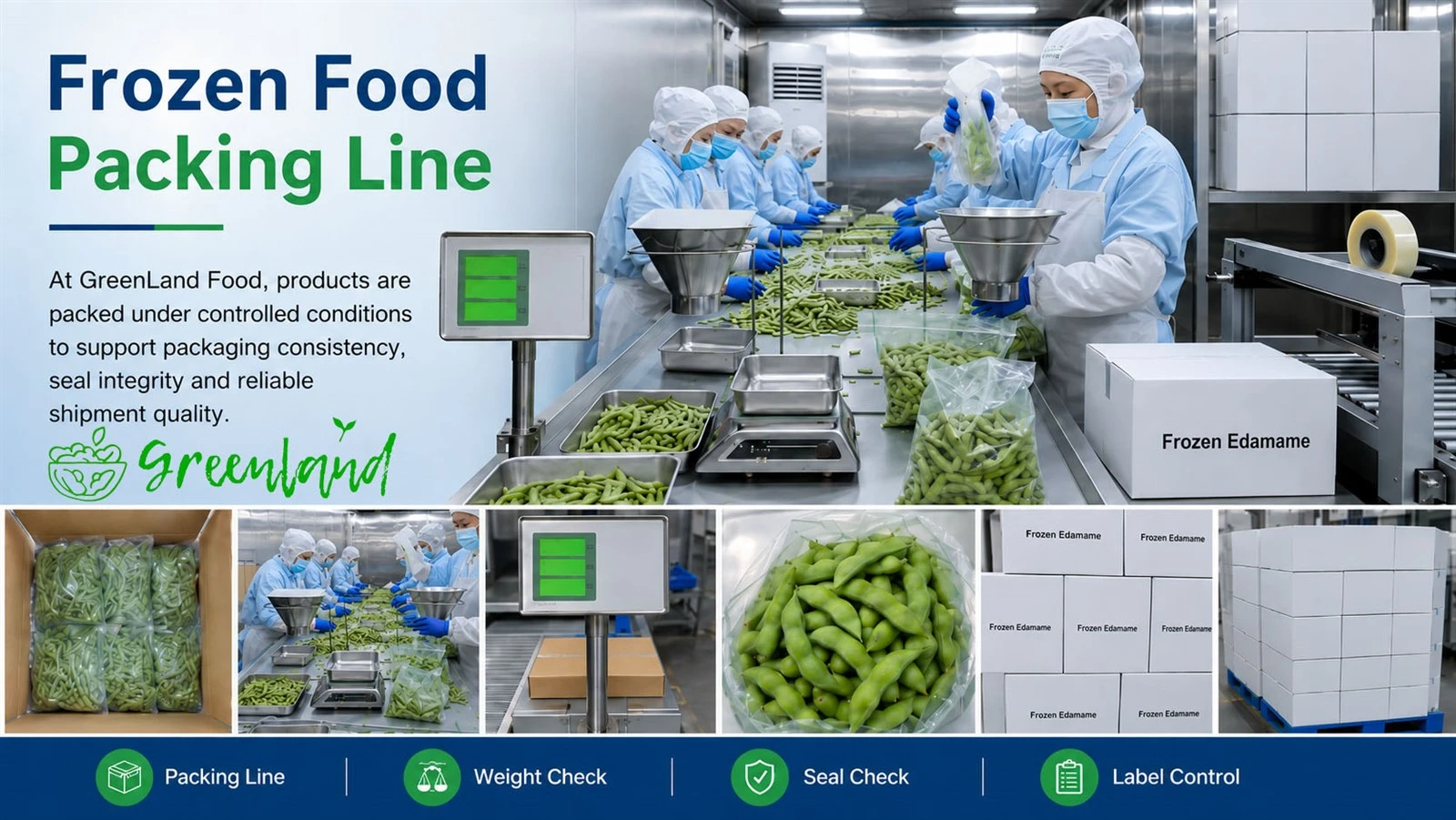
How We Use Carton Code, Label and Packing Records for Frozen Food Traceability
After the goods arrive, your first traceability clue is usually the carton. A carton mark or batch code should help us connect the physical goods with the correct product name, production date, packing batch, COA, packing list and shipment record.
If your warehouse, customer or retail channel reports a problem, we do not start from guessing. We start from the actual carton information and trace it back step by step. This is why GreenLand-food treats packing code and carton mark control as an important part of frozen food traceability.


| Packing Information | What We Review | How It Helps You |
|---|---|---|
| Product Name | Whether the carton identity matches the order item. | Helps reduce wrong product receiving or warehouse mix-up. |
| Batch Number | Whether the carton can connect with production or packing batch. | Supports complaint review, COA matching and repeat-order comparison. |
| Production Date / Best Before | Whether shelf-life information matches shipment and order requirement. | Supports warehouse management, customer filing and shelf-life review. |
| Net Weight / Packing | Whether the carton matches the agreed packing format. | Reduces receiving disputes and supports logistics planning. |
| Private Label / Shipping Mark | Whether label and shipping mark match your channel or customer requirement. | Supports retail, distributor and private label programs. |
How We Trace Cold Storage and Container Loading for Frozen Food Export
Many frozen food quality disputes are not caused by product formula, but by cold chain handling. Clumping, carton deformation, surface frost, soft texture, drip loss or loading mistakes may appear after goods arrive. This is why GreenLand-food keeps cold storage and loading traceability as the final part of the batch record.
Before shipment, we connect cold storage status, pre-shipment inspection, carton condition, loading photos, container number, seal number and shipment documents. This allows you to review not only what was produced, but also how the goods were prepared for export.


How We Adjust Traceability for Frozen Fruits, Frozen Vegetables and Frozen Mushrooms
We do not use one simple checklist for every frozen product. Frozen fruits, frozen vegetables and frozen mushrooms have different quality risks, so we adjust traceability according to product characteristics, processing method, packing format and your final application.
Frozen Fruits Traceability Focus
- Crop season and raw material source
- Maturity, Brix tendency and fruit color
- Whole, sliced, diced, puree or juice form
- Broken rate, stem and leaf control
- Production batch, COA batch and packing code
Frozen Vegetables Traceability Focus
- Vegetable variety and incoming batch
- Cut size, blanching if required and IQF batch
- Metal detection and packing code
- Mixed vegetable formula and ingredient ratio
- Carton mark, production date and shipment batch
Frozen Mushrooms Traceability Focus
- Species identity and origin batch
- Cap condition, stem ratio and slice thickness
- Cleaning batch, sand control and foreign matter review
- IQF / frozen batch and packing code
- COA, inspection record and shipment evidence
Connect Traceability with Quality Control, Certification, Products and Import Review
Traceability should be reviewed together with quality control, certificates, factory audit, product specifications, cold chain logistics and import documents. These GreenLand-food resources help you build a complete frozen food procurement review.
Use Traceability Together with QC, Factory Audit, Product Solutions and Catalog Review
Traceability is strongest when it is connected with quality control, product specification, factory audit, shipment inspection and product category selection. Use these GreenLand-food pages to review the complete sourcing route before placing or repeating an order.
Frozen Food Traceability FAQ
If your frozen food shipment has clumping after arrival, how can we help trace it?
We can review the related carton code, packing batch, IQF freezing condition, cold storage arrangement and loading record. This does not replace arrival inspection, but it gives you a clear route to investigate where the issue may have happened.
If your customer reports foreign matter, what can we review?
We can review the product category, raw material inspection, washing, sorting, cutting, metal detection, packing record and shipment batch according to the order scope. For frozen mushrooms, sand and substrate control are especially important review points.
Can we help you match carton codes with COA, packing list and shipment documents?
Yes. Carton code and packing information can help connect physical goods with batch records, COA, packing list and shipment documents according to the agreed order requirements.
How can traceability help your repeat orders?
Repeat orders depend on stable product standards. We can help compare raw material batch, processing record, packing format and shipment feedback from previous orders, so new orders can be reviewed with clearer reference.
How does traceability support your private label orders?
Private label orders require product, packing, label and batch information to match your channel or customer requirements. We help connect carton mark, production date, best-before date, private label information and shipment documents.
Can traceability support your factory audit or third-party inspection?
Yes. Traceability records help review raw material, production, packing, document and shipment information. Inspection scope should be discussed before shipment according to your order requirements. For the complete inspection route, review our factory audit and inspection support.
What documents can support your frozen food traceability review?
Traceability may be supported by specification sheets, COA, test reports, packing lists, bill of lading, loading photos, certificates and shipment documents according to product type, order requirement and destination market.
Build Your Frozen Food Order with Clear Batch Traceability
Share your target product, packing format, order quantity, destination market and document requirements. GreenLand-food can help you review suitable traceability support for frozen fruits, frozen vegetables and frozen mushrooms.