



Frozen Blueberries Price
Description
Technical Parameters
IQF Whole Berries · Bulk Supply · Landed-Cost Planning
Frozen Blueberries Price by Type, Size, Grade and Delivery Term
We supply IQF frozen blueberries for importers, food manufacturers, bakery and dairy processors, foodservice distributors, retail frozen brands and repackers. A useful frozen blueberry quotation must identify the berry type, diameter, grade, Brix, defect allowance, pack format, container plan, testing file and delivery term. Without these fields, two prices per kilogram may describe materially different products.
Our standard commercial program covers whole cultivated blueberries, 8–12 mm, 12–16 mm and 16 mm+ selections, Grade A and processing-grade options, 10 kg bulk cartons and private-label packs. Wild or lowbush blueberries are quoted separately according to crop availability, origin, size and order plan.

Actual IQF blueberry size inspection: diameter selection changes sorting yield, application fit and quotation level.
What Determines Frozen Blueberry Cost?
The lowest FOB figure is not automatically the lowest usable cost. We build the quotation around the product that enters your production line or sales channel. The relevant comparison is landed cost per usable kilogram after grading loss, breakage, drip loss, repacking, pallet utilization, testing and delivery are considered.
| Cost Driver | What Changes | How We Define It | Commercial Effect |
|---|---|---|---|
| Berry type and origin | Cultivated highbush, lowbush/wild, crop region and season | Botanical or commercial type, origin and crop year on the order | Changes raw-material availability, flavor, color, size and purchase price |
| Diameter selection | 8–12, 12–16 or 16 mm+ berries | Screen range, sample photos and oversize/undersize rule | A narrow or large size band normally requires more sorting and lower usable yield |
| Grade and defect tolerance | Broken, crushed, red-purple, green, stems, clusters and foreign material | Numeric limit, sample method and grade reference | Tighter appearance control raises sorting cost but can reduce buyer-side waste |
| Brix and crop maturity | Sweetness, flavor intensity and processing consistency | Minimum or target range with batch Actual Result | A selected Brix band may require crop segregation |
| Free-flowing condition | Clumping, surface ice and dosing performance | IQF whole berries, not seriously clumped, frozen inspection | Improves portioning and reduces line stoppage or manual separation |
| Packing | Bulk liner, retail film, print, zipper, carton, pallet and label | Exact net weight, materials, bags per carton and pallet pattern | Changes material cost, labor, MOQ, payload and handling |
| Testing and documents | Microbiology, pesticide screen, heavy metals, organic transaction file and destination documents | Panel, method, frequency, laboratory and shipment document list | Avoids hidden testing charges and incomplete import files |
| Trade and delivery term | FOB, CFR or CIF, origin port, ocean freight and insurance | Named port, Incoterm, shipment window and quotation validity | Makes offers commercially comparable |
A Practical Landed-Cost Formula
Landed cost per usable kilogram = product value + inner/outer packing + pallet cost + testing/document charges + origin handling + ocean freight + insurance + duty + destination handling + inland delivery + expected processing loss, divided by usable received kilograms.
Send the same inputs to every supplier. We quote the named product, net weight and trade term instead of presenting an unsupported universal price. A dated quotation can state a validity period, normally 7–14 days when freight or crop availability is moving, so your purchasing team knows which figures can change.
Include broken berries, soft fruit, surface ice, clumping and thaw drip where they affect your process.
Separate bulk liner cost from printed retail film, zipper, cartons, labels and pallets.
Do not compare one FOB offer with another CIF offer without isolating freight and insurance.
State which batch tests and import documents are included in the commercial offer.
Frozen Blueberry Specification Selection Guide
Frozen blueberries should be selected according to the final application rather than by one general product description. Berry type, diameter, visual grade, whole-fruit integrity, Brix, defect tolerance, packing format and testing scope all influence whether the product performs correctly in retail packs, bakery, dairy, foodservice or industrial processing.
| Specification Program | Typical Size / Grade | Recommended Applications | Key Acceptance Points |
|---|---|---|---|
| Small cultivated blueberries | 8–12 mm; Grade A or defined processing grade | Muffins, bakery fillings, yogurt, ice cream, fruit preparations and portion-controlled recipes | Uniform size distribution, broken-fruit limit, color release, Brix and dosing performance |
| Standard whole cultivated blueberries | 12–16 mm; Grade A / Fancy reference | Retail frozen packs, foodservice, bakery decoration, smoothie packs and repacking | Whole-berry integrity, natural color, free-flowing condition, stem residue and accurate net weight |
| Large selected cultivated blueberries | 16 mm+; selected visual grade | Premium retail packs, visible toppings, dessert presentation and high-appearance applications | Oversize consistency, bloom, skin condition, thaw appearance and low crushed-fruit percentage |
| Wild / lowbush blueberries | Naturally smaller berries; origin-specific program | Bakery, yogurt, cereal, fruit preparations and products requiring concentrated blueberry color and flavor | Confirmed species or commercial type, origin, crop year, color profile, Brix and supply continuity |
| Processing-grade blueberries | Defined commercial grade with agreed broken or soft-fruit limits | Jam, puree, sauce, filling, beverage base and industrial fruit preparation | Brix, flavor, color, microbiology, foreign material and usable-yield criteria must remain measurable |
| Retail / private-label program | 300 g, 500 g, 800 g, 1 kg or 2.5 kg packs | Supermarkets, frozen brands, foodservice distributors and branded consumer packs | Film structure, zipper, artwork, coding, carton count, label compliance and pallet configuration |
Selection rule: there is no single specification that is optimal for every buyer. The correct program is the one that matches your application, visual standard, processing method, packing system, testing plan and destination-market requirements.

Original frozen-fruit assortment image retained for mixed-container discussion; it is not presented as a blueberry production image.
Choose the Correct Blueberry Program
Cultivated whole blueberries: the standard program for 12–16 mm and 16 mm+ visual selections, retail packs, bakery inclusions and foodservice. Cultivar and crop influence bloom, skin strength, Brix and thaw performance.
Small cultivated blueberries: commonly 8–12 mm for muffins, bakery fillings, yogurt, ice cream and fruit preparations where smaller distribution per serving is useful.
Wild or lowbush blueberries: smaller berries with a distinct color and flavor profile. We quote them separately because origin, crop availability and product identity must not be substituted with cultivated fruit.
Processing grade: a commercial option where whole visual appearance is less critical than Brix, color, flavor, microbiology and usable yield. The allowable broken or soft-fruit level must still be stated numerically.
Commercial Frozen Blueberry Specification
This table is a quotation basis. The signed product specification controls acceptance, while the COA reports results for the identified production batch. Product limits are not represented as measured batch results.
| Product / market terms | IQF frozen blueberries, frozen whole blueberries, cultivated frozen blueberries, bulk frozen blueberries |
|---|---|
| Ingredient | 100% blueberries; no added sugar or syrup for the standard unsweetened program |
| Type | Cultivated blueberry; wild/lowbush blueberry by separate availability and order specification |
| Origin | China for the standard program; origin stated on contract and shipment documents |
| Style | Whole, individually quick frozen, free-flowing, not seriously clumped |
| Diameter | 8–12 mm, 12–16 mm, 16 mm+, or an order-specific screened range |
| Grade | Grade A / Fancy reference or defined commercial processing grade; grade and numeric defect limits stated together |
| Color | Natural blue to dark blue-purple, typical of the specified type and maturity |
| Brix | 10°Bx minimum or 10–14°Bx target where agreed; crop-batch Actual Result shown on the COA when ordered |
| Flavor / odor | Typical blueberry flavor and odor, free from fermented or other objectionable flavor and odor |
| Processing | Selected, washed, sorted, size graded, IQF frozen, final inspected, metal detected and packed |
| Bulk packing | 1 × 10 kg food-grade PE liner in export carton; 20 kg, 20 lb and 30 lb cases by order |
| Retail / foodservice | 300 g, 500 g, 800 g, 1 kg and 2.5 kg bags; plain label or printed private-label project |
| MOQ | Normally 1 × 20'FCL or an executable mixed-container plan; printed film has a separate MOQ |
| Loading reference | Approximately 23–25 metric tons in a 40' reefer without pallets; final payload follows carton, pallet, airflow and legal weight |
| Shelf life / storage | 24 months from production at −18°C or below; avoid thawing and refreezing |
| Lead time | Normally 15–21 days after product, packing, artwork, testing and shipment plan are agreed |
| Trade / loading port | FOB, CFR or CIF; Xiamen, Dalian or Qingdao according to stock location and booking plan |
Weight, Diameter and Usable Yield
A price per carton is only comparable after net weight is checked. We define the liner and carton tare, verify net weight during packing and state the legal average or minimum system required for the destination market.
Diameter is checked across a representative frozen sample. A 12–16 mm order should include the method for undersize and oversize berries; otherwise, a nominal range may hide a broad distribution. Large 16 mm+ fruit can improve retail appearance, while 8–12 mm fruit can provide more pieces per muffin, yogurt cup or prepared serving.
We also review crushed, broken, mushy and clumped product because a lower invoice price can create higher buyer-side waste. The accepted sample and numeric specification provide a repeat-order reference.

Actual bulk blueberry weight check: net-weight control prevents a low carton price from masking an underweight delivery.
Grade A Defect Reference and Commercial Acceptance
The voluntary U.S. frozen blueberry grade framework scores color, absence of defects and character. We can use the Grade A language as a purchasing reference or prepare a separate commercial standard. The contract must state which system applies.
| Grade A Point | Numeric Reference | What We Inspect | Cost / Application Relevance |
|---|---|---|---|
| Overall score | At least 90 points | Color 20, absence of defects 40, character 40 | Prevents the word Grade A from becoming an undefined label |
| Color | 18–20 points; red-purple berries ≤5% by count | Bright, practically uniform dark blue-purple color and green berries | Important for retail, yogurt, bakery display and fruit preparation color |
| Leaves / large stems | Maximum 2 per 16 oz; total leafy area ≤1/2 square inch | Whole leaves, large stems and leafy fragments | Reduces manual removal and foreign-material complaints |
| Combined defective berries | Maximum 10 per 16 oz, with no more than 5 undeveloped, other edible berries or damaged berries | Green, undeveloped, wrong berries and damaged fruit | Links appearance grade to usable fruit count |
| Cultivated clusters | Maximum 4 per 16 oz | Three or more joined cap stems, with or without berries | Controls stem residue in whole cultivated packs |
| Crushed, mushy or broken | ≤6% by weight for Grade A character | Whole condition, firmness, skin damage and soft fruit | Directly affects yield, bleeding, appearance and dosing |

Cultivated blueberry close-up: bloom, color, stem scar, skin condition and whole-berry integrity can be judged visually.
Brix, Bloom, Texture and Thaw Performance
Brix is a crop-batch measurement, not a marketing adjective. We can quote 10°Bx minimum or a 10–14°Bx target for a selected cultivated program, then place the measured result on the batch COA. Variety, maturity and crop conditions influence the result.
Natural bloom is the pale waxy surface visible on many blueberries. Heavy rubbing, water exposure and handling can change its appearance. We therefore describe the delivered visual standard with an approved frozen sample rather than promising an identical surface on every berry.
For yogurt, bakery, fruit preparation or thawed use, send the processing temperature and hold time. We can align the specification with whole-berry integrity, broken rate, clumping, surface ice and thaw drip. IQF status alone does not define all of these performance points.
How We Prepare IQF Blueberries
- Raw-material intake: we identify type, origin, crop lot and maturity, then remove decayed, moldy, leaking or seriously damaged fruit.
- Cleaning and washing: we remove field material and control water handling to protect fruit condition.
- Sorting and grading: we remove green, undeveloped, soft and damaged berries, stems, leaves, clusters and foreign material; diameter screens create the agreed size band.
- IQF freezing: berries pass quickly through the maximum crystallization range and reach a frozen thermal center suitable for cold-chain handling.
- Final frozen inspection: we check color, whole condition, clumping, surface ice, defects and foreign material after freezing.
- Packing and release: we check net weight, liner and seal, carton, lot coding and metal detection, then connect the batch with frozen storage and shipment records.

Actual frozen blueberry sorting: visible defects and foreign plant material are removed before final packing.
Microbiology, Heavy Metals and Pesticide Residues
The following commercial panel is suitable as a detailed quotation starting point. Destination law, final use and buyer policy may require a different method, sampling plan or limit. Frozen blueberries intended for ready-to-eat use require a specifically agreed food-safety program; freezing is not treated as a pathogen-kill step.
| Analysis | Commercial Limit / Reference | COA Entry |
|---|---|---|
| Total plate count | ≤100,000 CFU/g | Actual Result, unit, method and batch |
| Coliforms | ≤100 CFU/g | Actual Result |
| Yeast and mold | ≤1,000 CFU/g | Actual Result |
| Escherichia coli | ≤10 CFU/g | Actual Result / detection level |
| Salmonella | Absent in 25 g | Detected / Not Detected by agreed method |
| Listeria monocytogenes | Absent in 25 g for the agreed program | Detected / Not Detected by agreed method |
| Lead, EU reference | ≤0.10 mg/kg wet weight | Actual Result on the agreed batch or surveillance report |
| Cadmium, EU reference | ≤0.030 mg/kg wet weight | Actual Result on the agreed batch or surveillance report |
| Pesticide residues | Each active substance within destination MRL | Compound, LOQ, method and Actual Result on the agreed report |
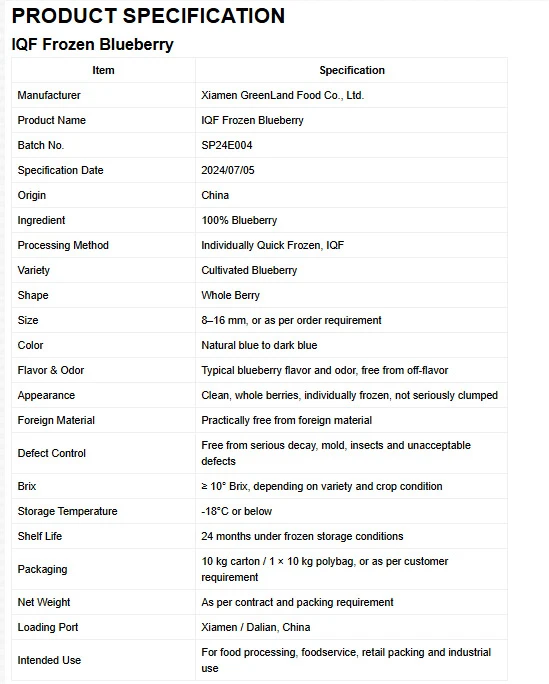
Actual blueberry specification example. It shows defined product fields and is not represented as the COA for every order.
COA: Separate Limits from Batch Results
A specification states the agreed limits. A COA identifies the production batch and records measured or observed Actual Results. For example, Brix 10°Bx minimum is an acceptance limit; the COA may report an Actual Result of the tested batch. We do not copy the limit into the Actual Result column.
A detailed blueberry COA can include product name, lot, production date, type, origin, size, grade, Brix, color, odor, whole-berry condition, broken percentage, foreign-material status, microbiology, heavy-metal or pesticide report reference, packing and release status.
Testing frequency is stated in the order: every batch, composite crop surveillance, periodic monitoring or shipment-specific testing. This prevents the quoted price from hiding an incomplete laboratory plan.
10 kg Bulk Packing and Private Label Cost
The standard bulk format is one food-grade PE liner containing 10 kg net blueberries inside an export carton. We define liner thickness and closure, carton board, sealing tape or strapping, lot mark, production date, best-before date and frozen storage statement.
Retail and foodservice projects can use 300 g, 500 g, 800 g, 1 kg or 2.5 kg bags. A printed zipper bag costs more and normally requires a higher film MOQ than a plain frozen-grade bag with an approved label. We quote film cylinders or plates, print colors, zipper, carton count, artwork work and wastage separately where applicable.
Pallets improve handling but reduce container payload. Send pallet dimensions, maximum stack height, corner-board, stretch-wrap, carton orientation and destination warehouse rules. We then calculate bags per carton, cartons per pallet and total net load instead of using a generic container figure.

Actual frozen blueberry packing evidence: 10 kg weight, lot label, carton condition and product appearance are checked together.
MOQ, Mixed Containers and Loading Efficiency
A normal frozen-fruit MOQ is one 20' full container or a workable mixed-container plan. Mixing blueberries with strawberries, raspberries, mango or other frozen products can lower inventory exposure, but every SKU must share a workable loading port, production window, carton footprint, temperature requirement and document plan.
A 40' reefer without pallets commonly carries approximately 23–25 metric tons of frozen cartons. Palletized loads carry less net product. The actual figure follows container payload, carton dimensions, pallet pattern, airflow space, route and legal axle or gross-weight limits.
Cost comparison should use net delivered weight, not only the number of cartons. We provide a loading list that identifies SKU, pack, cartons, pallets where applicable and net/gross weight.
Cold Chain and Delivered Condition
We store and ship frozen blueberries at −18°C or below. The reefer set point, pre-cooling status, carton condition, loading time, pallet plan and airflow are part of the shipment plan. Repeated thawing and refreezing can increase clumping, surface ice, juice leakage and soft fruit.
At receiving, record seal condition, air or product temperature according to your procedure, carton damage, liner condition, free-flowing state and visible thawing. Place disputed cartons on hold under frozen conditions and retain lot labels and photographs.
A lower freight offer can become more expensive if the route creates delay, detention or cold-chain risk. We state the named destination port, planned route, free-time assumptions where available and document cut-off in the shipment discussion.

General frozen export loading evidence: carton handling, temperature checks and reefer loading support cold-chain delivery.
Match Cost to the Application
Retail Whole Berries
Use Grade A appearance, selected diameter, strong free-flowing condition, accurate net weight and private-label film. Large 12–16 or 16 mm+ berries may justify higher sorting cost.
Bakery and Muffins
Select 8–12 or 12–16 mm by piece distribution, bleeding tolerance and dosing system. Broken rate and thaw behavior may matter more than retail bloom.
Yogurt and Ice Cream
Define size, Brix, color release, whole-berry integrity and fruit-preparation process. A smaller berry can improve piece count and distribution.
Jam, Puree and Filling
A processing grade can reduce raw-material cost when appearance is secondary, but Brix, flavor, color, defect level and microbiology remain measurable.
Foodservice
Use 1 kg or 2.5 kg bags where portioning and open-pack handling matter. Free-flowing condition can reduce manual separation and waste.
Industrial Repacking
Use 10 kg or larger bulk formats with controlled liner, carton, lot coding and pallet plan. The buyer's final retail specification should be reflected in the incoming grade.
Documents, Certification Scope and Traceability
We connect the finished blueberry lot with raw-material intake, origin, crop lot, processing date, size and grade checks, packing shift, liner and carton code, frozen storage and container. This gives your QA team a defined path for investigating a size, defect, temperature or label complaint.
The standard commercial file can include invoice, packing list, bill of lading, certificate of origin and destination-required health or phytosanitary documents. The QA file can include the signed product specification, batch COA, applicable facility certificates and agreed microbiological, pesticide-residue or heavy-metal reports.
BRCGS, HACCP, ISO 22000, Halal, Kosher, FDA Food Facility Registration, organic or other documentation is stated only for the relevant facility, product scope and valid period. Certified-organic orders require a certified crop, processing scope and transaction documentation.
Frozen Blueberries Price FAQ
1. How much do frozen blueberries cost per kilogram?
July 2026 China export listings for standard cultivated IQF blueberries are approximately US$1.50–2.50/kg, with a comparable whole-fruit listing at US$1.90–2.20/kg. The exact dated FOB, CFR or CIF offer depends on type, size, grade, Brix, pack, volume and tests.
2. Why are wild blueberries priced separately?
Wild or lowbush blueberries have different origin, crop availability, size and flavor characteristics. We do not substitute cultivated blueberries under a wild-blueberry description.
3. Which size is most cost-effective?
It depends on the application. Smaller 8–12 mm berries can improve piece distribution, while selected 12–16 or 16 mm+ berries may be required for retail appearance.
4. What does Grade A mean for frozen blueberries?
A U.S. Grade A reference requires at least 90 points and includes numeric controls for color, defects and character. We place the applicable grade system and defect limits in the contract.
5. Can processing grade reduce ingredient cost?
Yes, where perfect whole appearance is not needed. Define acceptable broken/soft fruit, Brix, color, flavor, foreign material and microbiology so the lower purchase price still delivers usable yield.
6. Is Brix included in the COA?
It can be. The specification states the minimum or target, while the COA states the measured Actual Result for the identified crop batch.
7. What is the standard bulk packing?
Our main bulk proposal is one 10 kg food-grade PE liner in an export carton. We can also quote 20 kg, 20 lb, 30 lb and smaller foodservice bags.
8. Can you supply private-label frozen blueberries?
Yes. We review bag size, frozen-film structure, zipper, artwork, barcode, coding, label language, carton marks, case count and pallet plan.
9. What microbiological results can appear on the COA?
The agreed panel can include total plate count, coliforms, yeast and mold, E. coli, Salmonella and Listeria monocytogenes with result, unit, method and lot.
10. Are pesticide and heavy-metal tests available?
Yes, under an agreed crop, batch, periodic or shipment testing plan. Reports list the compounds or metals, methods, LOQs and Actual Results against destination requirements.
11. What are the MOQ and lead time?
MOQ is normally one 20' frozen container or an executable mixed-container plan. Lead time is normally 15–21 days after the product, packing, testing and shipment plan are agreed.
12. How many frozen blueberries fit in a 40' reefer?
A non-pallet reference is approximately 23–25 metric tons. The final payload depends on carton dimensions, pallets, airflow and container/legal weight.
13. What are the shelf life and storage conditions?
The standard shelf life is 24 months from production at −18°C or below. Continuous frozen handling protects free-flowing condition and carton integrity.
14. What information is needed for an exact quotation?
Send type, origin, diameter, grade, Brix, defect limits, application, packing, quantity, pallet need, destination, Incoterm, tests, documents and target delivery date.
Request a Comparable Frozen Blueberry Price
Send cultivated or wild/lowbush type, origin requirement, 8–12 / 12–16 / 16 mm+ size, Grade A or processing grade, Brix target, broken and defect limits, intended application, 10 kg or retail packing, private-label status, annual and first-order quantity, pallet plan, destination port, FOB/CFR/CIF term, testing panel, document list and delivery window.
We will return one measurable product specification, packing plan, batch-document plan and dated commercial quotation so your team can calculate landed cost per usable kilogram.
Hot Tags: frozen blueberries price, China frozen blueberries price manufacturers, suppliers, factory, frozen cultivated blueberries, iqf frozen blueberries, frozen unsweetened blueberries, frozen blueberry
Technical specification · reference schedule
IQF Frozen Blueberries
We review the selected form, grade, process and packing against the technical schedule below. Published and TDS values are specification references for order review. External benchmarks apply only within their stated scope. Acceptance is governed by the signed SKU specification; the identified lot COA reports actual measured results.
01 / Physical & Sensory
| Parameter | Specification / reference | Verification & order basis |
|---|---|---|
| Origin | China for the standard program; origin stated on contract and shipment documentsPublished reference | Reconcile source declaration, intake lot and shipment documents. |
| Style | Whole, individually quick frozen, free-flowing, not seriously clumpedPublished reference | Confirm method, representative sample and acceptance basis in the signed specification. |
| Diameter | 8–12 mm, 12–16 mm, 16 mm+, or an order-specific screened rangePublished reference | Measure a defined frozen sample with caliper or size gauge; report distribution and tolerance. |
| Grade | Grade A / Fancy reference or defined commercial processing grade; grade and numeric defect limits stated togetherPublished reference | Confirm method, representative sample and acceptance basis in the signed specification. |
| Color | Natural blue to dark blue-purple, typical of the specified type and maturityPublished reference | Compare with the approved sensory reference using the stated frozen/thawed/prepared condition. |
| Flavor / odor | Typical blueberry flavor and odor, free from fermented or other objectionable flavor and odorPublished reference | Compare with the approved sensory reference using the stated frozen/thawed/prepared condition. |
| Size-grade inspection | Use the selected diameter, length, piece mass or count-per-weight grade; state the proportion permitted outside the range. | Measure the named anatomical dimension; count and weigh the same representative sample. |
02 / Physicochemical & Residue Controls
| Parameter | Specification / reference | Verification & order basis |
|---|---|---|
| Brix | 10°Bx minimum or 10–14°Bx target where agreed; crop-batch Actual Result shown on the COA when orderedPublished reference | Measure representative prepared sample with a temperature-compensated refractometer. |
| Lead, EU reference | ≤0.10 mg/kg wet weightPublished reference | Use a validated analytical method for this matrix; report sample basis, unit, preparation and lot result. Published commercial target; verify current destination limits, edible-part basis and any processing factor before approval. |
| Cadmium, EU reference | ≤0.030 mg/kg wet weightPublished reference | Use a validated analytical method for this matrix; report sample basis, unit, preparation and lot result. Published commercial target; verify current destination limits, edible-part basis and any processing factor before approval. |
| Pesticide residues | Each active substance within destination MRLPublished reference | Use a validated analytical method for this matrix; report sample basis, unit, preparation and lot result. |
| Thaw yield / drip loss | For a drip-sensitive grade, define thawing conditions, draining apparatus and duration before setting a numerical target. | Record initial sample mass and drained liquid mass; drip loss (%) = 100 × drained liquid mass / initial sample mass. |
| Pesticide residue schedule | Named active ingredients and commodity-specific limits are selected for the destination market. EU source | Link farm spray history, laboratory LOQ and batch result to the destination MRL. EU database is one market reference; apply the actual destination rule. |
| Lead, cadmium and other contaminants | Apply the limit for the exact commodity and processed form in the destination market. EU source | State analyte, preparation basis, method, LOQ and lot result. Do not transfer a fresh-commodity limit to a processed form without the required assessment. |
03 / Microbiological Criteria
| Parameter | Specification / reference | Verification & order basis |
|---|---|---|
| Total plate count | ≤100,000 CFU/gPublished reference | Report the named organism, analytical method, sample mass, sampling plan and lot result; use CFU/g for enumeration and a stated mass for detection. |
| Coliforms | ≤100 CFU/gPublished reference | Report the named organism, analytical method, sample mass, sampling plan and lot result; use CFU/g for enumeration and a stated mass for detection. |
| Yeast and mold | ≤1,000 CFU/gPublished reference | Report the named organism, analytical method, sample mass, sampling plan and lot result; use CFU/g for enumeration and a stated mass for detection. |
| Escherichia coli | ≤10 CFU/gPublished reference | Report the named organism, analytical method, sample mass, sampling plan and lot result; use CFU/g for enumeration and a stated mass for detection. |
| Salmonella | Absent in 25 gPublished reference | Report the named organism, analytical method, sample mass, sampling plan and lot result; use CFU/g for enumeration and a stated mass for detection. |
| Listeria monocytogenes | Absent in 25 g for the agreed programPublished reference | Report the named organism, analytical method, sample mass, sampling plan and lot result; use CFU/g for enumeration and a stated mass for detection. |
| Acceptance schedule | Select the test panel and limits by intended use (ready-to-eat or further processing), product form and destination. EU source | State organism, analytical method, sample mass and n/c plan; report actual lot results. A universal APC, coliform, Salmonella or Listeria limit is not assigned to every frozen product. |
04 / Freezing & Cold Chain
| Parameter | Specification / reference | Verification & order basis |
|---|---|---|
| Frozen storage and transport | ≤−18 °CTDS reference | Product core check and logger record. Selected form and grade must match this TDS reference. Applies to: Frozen Blueberry frozen formats. |
| Type | Cultivated blueberry; wild/lowbush blueberry by separate availability and order specificationPublished reference | Confirm method, representative sample and acceptance basis in the signed specification. |
| Shelf life / storage | 24 months from production at −18°C or below; avoid thawing and refreezingPublished reference | Verify unopened-pack validation, declared storage condition and production/best-before coding. |
| Separation & loose-ice assessment | Keep inherent moisture, loose ice and permanently frozen clusters as separate inspection categories. | Weigh separated loose ice and welded clusters against initial sample mass; distinguish natural paired pieces or blocks. |
| Product thermal centre | −18°C or colder after freezing and thermal stabilization; maintain the agreed frozen distribution condition.External reference Codex | Probe the thickest representative pack and retain storage/transport temperature records. Codex quick-frozen reference; selected product form and route must be frozen. |
| Frozen condition at dispatch | Hard frozen, correctly sealed and coded, without thaw/refreeze evidence or excessive loose ice. Codex | Check pack integrity, free-flow or block condition as declared, carton condition and loading temperature. |
05 / Pack Size & Shelf Life
| Parameter | Specification / reference | Verification & order basis |
|---|---|---|
| Bulk packing | 1 × 10 kg food-grade PE liner in export carton; 20 kg, 20 lb and 30 lb cases by orderPublished reference | Check approved pack drawing, calibrated scale and production records. |
| Declared net contents | Verify each selected pack format against the artwork and applicable quantity-control rule. Codex | Calibrated checkweigher or scale; defined sample and tare. |
| Shelf-life basis | The labelled period applies only to its validated pack and continuous stated storage condition. Codex | Review stability study or approved shelf-life file and production-date code. |
06 / Process Controls
| Parameter | Specification / reference | Verification & order basis |
|---|---|---|
| Processing | Selected, washed, sorted, size graded, IQF frozen, final inspected, metal detected and packedPublished reference | Check the approved product flow, line settings and identified production record; validate numerical critical limits within the site HACCP plan. |
| Raw-material preparation checks | Confirm botanical species and cultivated/wild sourcing; distinguish bilberry from cultivated or lowbush blueberry. | Verify the selected product flow and the relevant trimming, sorting and pretreatment record. |
| Declared route | Selected, washed, sorted, size graded, IQF frozen, final inspected, metal detected and packed | Verify approved process flow, line record and finished-product identity. Page-described route; numerical set-points require the approved line SOP. |
| CCP designation | Use the site-approved HACCP plan to identify true CCPs and their validated critical limits. Codex | Check hazard analysis, monitoring, deviation and corrective-action records. A quality-control step is not automatically a CCP. |
07 / Ingredients, Additives & Allergens
| Parameter | Specification / reference | Verification & order basis |
|---|---|---|
| Ingredient | 100% blueberries; no added sugar or syrup for the standard unsweetened programPublished reference | Verify approved formula, supplier declarations and line-specific allergen assessment. |
| Added glaze / coating declaration | Declare any intentionally added water glaze, syrup, oil or coating and the measurement basis; loose ice is assessed separately. | Verify formula/addition records; agree a deglazing or coating test and net-content basis where applicable. |
| Additive use | Declare any colour-protection agent, acidulant or other additive by ingredient and maximum permitted use for the target market. NHC standard | Check approved formula, actual addition record and market-specific additive category. GB 2760-2024 applies to China; export rules are checked separately. |
| Allergen and cross-contact assessment | Declare inherent allergens and assess shared-line cross-contact from the actual facility schedule. FDA | Review line matrix, cleaning validation and buyer label approval. Do not claim a shared-line allergen or allergen-free status without facility evidence. |
08 / Defects & Foreign Matter
| Parameter | Specification / reference | Verification & order basis |
|---|---|---|
| Free-flowing blueberry clumps: Codex reference tolerance | ≤10 % m/mExternal reference Codex | Examine the entire container contents or as large a quantity as practicable in the frozen state; weigh berries stuck together that cannot easily be separated. Codex reference only when species is confirmed as Vaccinium corymbosum L., V. angustifolium Ait. or V. ashei READE and fruit is offered for direct consumption. Bilberries (V. myrtillus), puree and industrial further-processing products are excluded. Free-flowing presentation only. |
| Blueberry visual defect points: Codex reference ceiling | Minor ≤15; major ≤8; combined total ≤15 points per 300 g drained berriesExternal reference Codex | Segregate and classify visual defects in 300 g drained berries; assign points using Table 1, not percentage or defect counts. Codex reference only when species is confirmed as Vaccinium corymbosum L., V. angustifolium Ait. or V. ashei READE and fruit is offered for direct consumption. Bilberries (V. myrtillus), puree and industrial further-processing products are excluded. |
| Blueberries disintegrated, badly crushed or smashed: Codex reference tolerance | ≤10 % m/m of drained berriesExternal reference Codex | Separate and weigh this defect category in the 300 g drained-berry sample used for Table 1. Codex reference only when species is confirmed as Vaccinium corymbosum L., V. angustifolium Ait. or V. ashei READE and fruit is offered for direct consumption. Bilberries (V. myrtillus), puree and industrial further-processing products are excluded. |
| Intrinsic defect classification | Stems/leaves, green/red berries, clusters, mummified fruit and crushed/leaking berries. | Record each defect class separately by count or mass; state sample size, denominator and combined-limit rules. |
| Hazardous foreign matter | No foreign matter detected in the defined inspection sample; reject and investigate any finding.External reference Codex | Define visual-inspection sample size and detector challenge in the signed quality schedule. "None detected" is a sampling statement, not an absolute guarantee of zero particles. |
09 / Packaging Materials & Label
| Parameter | Specification / reference | Verification & order basis |
|---|---|---|
| Food-contact pack | Specify inner-contact material and obtain the applicable food-contact compliance declaration. NHC standard | Review film structure, supplier DoC, migration evidence and actual intended conditions. GB 4806 series is China-specific; EU export also checks Regulations 1935/2004 and 10/2011. |
| Carton and seal integrity | Define carton stacking strength, bag seal and puncture resistance for the confirmed net weight and pallet plan. EU source | Inspect pack drawing, compression/seal test and shipment configuration. |
| Label verification | Match product name, ingredient/allergen statement, net weight, lot/date, shelf life and storage instruction to the destination artwork. Codex | Approve artwork against the signed specification and destination rules. |
10 / Detection & Traceability
| Parameter | Specification / reference | Verification & order basis |
|---|---|---|
| Foreign-body detector | Validate Fe, non-Fe and stainless-steel challenge pieces for the actual product, aperture, pack and line; record the proven sensitivity. Codex | Challenge at defined start, changeover, interval and end points; retain rejection records. Do not copy generic detector sizes into a plant capability claim. |
| Lot traceability | Link input source lot, processing run, packaging code, test records, frozen storage and shipment to one finished lot. Codex | Trace one sample lot forward and backward in a recorded mock recall. Recall speed is stated only when the site has a validated target and record. |
Previous
Blue Berries FrozenNext
Iqf Wild Blueberries


