We supply whole IQF wild blueberries for importers, frozen-fruit distributors, yogurt and dairy processors, bakery manufacturers, jam and puree plants, beverage producers, foodservice programs and private-label frozen fruit brands. Our main China wild-blueberry specification identifies Vaccinium uliginosum L.; separately quoted bilberry lots identify Vaccinium myrtillus L. on the specification and lot documents.
Commercial grades cover 6-10 mm and 8-12 mm whole berries, with 12-16 degrees Brix used as the normal quotation range. U.S. Grade A provides a precise defect baseline: no more than 6% crushed, mushy or broken berries by weight, plus defined leaf, stem, damaged-berry and wild-cluster tolerances per 16 oz sample.
IQF Frozen Wild Blueberries with Declared Species and Origin
GreenLand supplies whole IQF frozen wild blueberries for importers, ingredient distributors, dairy and bakery manufacturers, jam and puree processors, beverage producers, foodservice buyers and private-label brands. Our main China supply identifies Vaccinium uliginosum L.; bilberry orders identify Vaccinium myrtillus L. and are quoted separately. The species stated in the quotation follows through to the specification and lot documents.
Whole-berry options include 6-10 mm and 8-12 mm, with 12-16°Bx as the quoted commercial range subject to lot confirmation. Orders can use an agreed U.S. Grade A reference, including a maximum 6% crushed, mushy or broken fruit by weight and specified leaf, stem, damaged-berry and wild-cluster limits. Confirm the complete grading and sampling basis before approval.
We prepare wild blueberries from identified collection lots through receiving, cleaning, destemming, washing, sorting, individual quick freezing, inspection and packing. Finished fruit is held at -18°C or below. The standard ingredient is 100% wild blueberries, without added sugar, color, flavor, preservative or ice glaze.
The name wild blueberry does not identify one interchangeable product. Vaccinium uliginosum, Vaccinium myrtillus and cultivated Vaccinium corymbosum are kept distinct in the order file. Confirm the species, berry size, flesh and juice color, acidity and labeling requirements together. The signed specification names the country and collection region so cultivated highbush fruit is not substituted for a wild lot.
IQF provides separate frozen berries for weighing, blending and packing; it is not a pathogen-kill step. Manufacturing orders use the agreed microbiological specification. Thaw-and-use or ready-to-eat applications require a separately approved pathogen and virus risk-control program for the product, facility, destination and intended use.
Whole-berry appearance for reviewing blue-black color, skins, crowns and natural bloom. Confirm the selected lot against the approved sample.
Wild Blueberry and Bilberry: Confirm the Species
Product Identity
Scientific Name
Product Characteristics
Processing Applications
Bilberry
Vaccinium myrtillus L.
Small berries with dark flesh and strongly colored purple juice
Yogurt, beverages, puree, jam and ingredients with agreed anthocyanin requirements
Bog or Northern Wild Blueberry
Vaccinium uliginosum L.
Wild berries with species-specific skin, flesh, flavor and acidity
Bakery, jam, puree, beverages and industrial fruit preparations
For this supply program, wild origin means collection from naturally occurring or naturally reproducing Vaccinium stands rather than a commercial highbush plantation. The origin file identifies species, country, province or region, collection-base code, harvest and receiving dates, raw-material lot, supplier approval and the wild-origin declaration. Where required, the traceability file can add collection maps, zone codes, collector-group records, daily quantities, receiving weights and transport records linked to production.
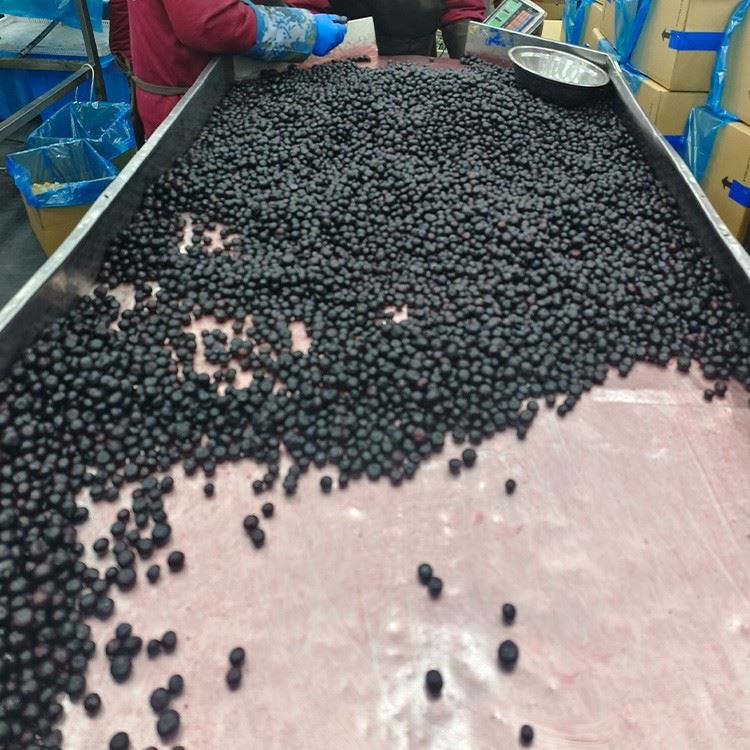
Blueberry cleaning and sorting line shown for processing review. The photograph does not establish the harvest origin or species of a shipment.
Collection Season and Frozen-Stock Availability
The stated collection window for our China wild-blueberry program is July-September, with August as the main crop period. Frozen stock supports shipments after the harvest season, subject to availability. Each quotation identifies the crop year, species, size, available quantity and remaining shelf life.
Annual supply planning covers raw-material reservations, calibration, packing and testing during the crop season. Collection and receiving records are linked to finished batches, allowing buyers to compare Brix, acidity, color and size by crop year and lot rather than relying on one annual average.
IQF Frozen Wild Blueberry Specification
Product
Whole IQF Frozen Wild Blueberries
Main China Species
Vaccinium uliginosum L. for the main China program; Vaccinium myrtillus bilberries identified and quoted separately
Agreed U.S. Grade A reference, customer-defined Grade A, Grade B or processing grade; the grading system is stated in the contract
Origin
China; the collection region and crop year are identified in the lot documents
Size
6-10 mm, 8-12 mm or a natural uncalibrated lot approved by sample
Brix and Acidity
Quoted reference: 12-16°Bx; pH 2.8-3.6; titratable acidity 0.70-1.80% as citric acid. Final limits, methods and sample basis are agreed for the order.
Composition
No added sugar, color, flavor, preservative or ice glaze
Storage and Shelf Life
24 months at -18°C or below under the specified frozen-storage conditions; remaining shelf life confirmed for stock lots
Packing
1 x 10 kg, 2 x 5 kg, 4 x 2.5 kg, 10 x 1 kg, 20 x 500 g or an approved private-label configuration
MOQ and Lead Time
10 MT standard MOQ; normally 15-21 days after specification and packing approval, subject to the confirmed production and shipment plan
Loading
Planning reference: 10-12 MT per 20 ft reefer or 23-25 MT per 40 ft high-cube reefer, subject to cartons, pallets and permitted payload
6-10 mm and 8-12 mm Size Grades
Calibrated orders are specified as 6-10 mm or 8-12 mm whole berries. Natural uncalibrated lots follow the actual crop distribution, with sample-based minimum and maximum sizes recorded in the quotation. Diameter is assessed across the berry equator using the agreed calibrated screen or gauge.
The proposed calibrated specification requires at least 90% of berries by count within the stated range, with undersize and oversize each limited to 5%. A tighter 95% conformity requirement is reviewed after sample approval. The inspection report or COA records the actual in-range, undersize and oversize percentages when these checks form part of the order.
Size release is based on diameter rather than an assumed number of berries per kilogram. Count varies with species, shape, seed development, maturity and moisture. Review smaller berries for distribution through yogurt, bakery and fruit preparations, or 8-12 mm fruit where more visible whole-berry pieces are preferred.
Diameter measurement for discussing the stated size band and sample comparison. Use the agreed inspection basis for lot acceptance.
Brix, Acidity and Anthocyanin Test Requirements
Brix
Quoted reference: 12-16°Bx. The contract states the approved minimum or range.
pH
Quoted reference: 2.8-3.6. Report the measured value for the identified sample or lot.
Titratable Acidity
Quoted reference: 0.70-1.80% as citric acid. Confirm the sample and reporting basis.
Anthocyanins
Report-only or buyer-set minimum, in mg cyanidin-3-glucoside equivalents per 100 g wet weight.
The proposed analytical methods are refractometry on a homogenized sample for Brix, a calibrated meter for pH and titration for acidity. Total monomeric anthocyanins are measured using the pH differential method when ordered. Confirm sample preparation, method, units and wet-weight basis with the laboratory. Reports identify the tested lot and measured result; literature averages are not used as batch results.
U.S. Grade A References and Additional Release Criteria
The selected Grade A references below support specification discussions; they are not the complete grading standard or a claim of USDA certification. Count and leaf-area limits use 16 oz (453.6 g), with the stated averaging rule for wild clusters. Weight percentages are assessed on the agreed sample. Mould, decay and objectionable foreign material are additional rejection criteria in this product program. Confirm all definitions and the applicable lot-sampling rules in the contract.
Quality Point
Grade Reference / Release Limit
Inspection Basis
Color
Red-purple berries: maximum 5% by count
Assess the bright, dark blue-purple color expected for properly matured fruit of the specified variety.
Whole leaves and large stems
Maximum 2 in total per 16 oz; total leafy material no more than 1/2 square inch
Count whole leaves and large stems together; include leafy fragments in the total leaf-area assessment.
Green, undeveloped, other edible berries or damaged berries
Combined maximum 10 berries per 16 oz
Within that total, undeveloped berries, other edible berries and damaged berries together must not exceed 5.
Wild-type clusters
Average maximum 12 per 16 oz basis; maximum 16 in any individual sample or container
A cluster consists of three or more joined cap stems, with or without attached berries.
Crushed, mushy or broken berries
Maximum 6% by weight
At least 94% by weight must fall outside these three defect categories. Other grade requirements are assessed separately.
Mould, decay and objectionable foreign material: additional program criteria
Absent in the inspected sample
The product program rejects glass, metal, stones, hard plastic, wood, visible insects and decayed fruit; this is not presented as a separate USDA numerical tolerance.
The U.S. Grade B character reference permits up to 10% crushed, mushy or broken berries, alongside its other grading requirements. Processing grade is quoted separately for puree, juice, jam and extraction. Different size and breakage tolerances do not relax the agreed food-safety, mould, decay or foreign-material criteria.
Manual sorting of small frozen berries for visible leaves, stems, clusters, damaged fruit and other defects.
Inspect Stems, Clusters and Damaged Fruit Separately
Inspection records distinguish undercolored, green, undeveloped, crushed, mushy, broken, dehydrated and insect-damaged berries. The product program rejects mouldy, decayed or fermented fruit and visible insects, glass, metal, stones, hard plastic, wood, paper, soil and sand.
Where the Grade A reference applies, the 16 oz basis permits no more than two whole leaves or large stems in total, with combined leafy material no greater than one-half square inch. Wild-cluster inspection records both the average limit of 12 and the individual maximum of 16. Cap stems are recorded separately when the buyer specifies a count limit.
Results are recorded as counts or percentages on the defined sample basis so pre-shipment and receiving checks can be compared. A lot outside the signed tolerance is held for investigation, re-sorting where appropriate or another documented disposition before release.
IQF Separation, Surface Ice and Thaw Performance
The proposed whole-berry limits are 2% clumps by weight and 2% excessive loose surface ice. Major ice blocks, accumulated carton ice and evidence of thaw-refreeze are not accepted under this program. Added glaze is 0%. Natural waxy bloom is assessed separately from surface ice.
The proposed application test uses a 500 g sample held at 4 ± 2°C for 16 hours, followed by two minutes of drainage. Record drip loss, retained whole shape, collapsed berries, juice color, aroma and visible stems. The buyer and supplying facility agree the method and acceptance limits after sample review; species, maturity and processing conditions affect the outcome.
Microbiological Limits and Order-Specific Virus Testing
The following figures are commercial specification references, not results from an available shipment. Confirm the sampling plan, method and limits for the destination, intended use and selected facility. The COA reports the result for the identified test sample or lot; virus testing is included only when agreed in the order.
Parameter
Commercial Specification Limit
Result to Report
Aerobic Plate Count
Max 100,000 CFU/g
Measured result, unit, method and lot
Coliforms
Max 100 CFU/g
Measured result and method
E. coli
Less than 10 CFU/g
Measured result or reporting limit, with method
Yeast and Mould
Max 1,000 CFU/g combined
Combined result, or separate results with the agreed combined assessment
Salmonella
Not detected in 25 g
Detected / not detected, with sample mass and method
Listeria monocytogenes
Not detected in 25 g
Detected / not detected, with sample mass and method
HAV / Norovirus GI / GII
Not detected under the agreed customer or thaw-and-use testing program
Lot-linked RT-PCR report stating sample mass, method and reporting limit
Residue, Heavy-Metal and Certification Requirements
Wild origin does not replace residue assessment. The agreed pesticide panel follows the destination-market MRL requirements. EU orders are reviewed under Regulation (EC) No 396/2005, including the general 0.01 mg/kg default where applicable and any relevant exceptions. The report identifies analytes, methods, limits of quantification and measured results.
The quoted EU heavy-metal references are lead at a maximum 0.10 mg/kg and cadmium at a maximum 0.030 mg/kg on a wet-weight basis. Confirm the applicable food category, edible-part basis and current requirements under Regulation (EU) 2023/915 before shipment. These figures are acceptance limits, not test results; the laboratory report identifies the production lot or monitoring sample actually tested.
An organic request is reviewed separately from the wild-origin declaration. Any organic claim requires valid coverage for the collection area, operator, processing site and product. The agreed file includes certificate and collection-area details, segregation and mass-balance records, and the transaction document required for the destination program. Availability must be confirmed before quotation and labeling.
Wild Blueberry Processing and Detection Controls
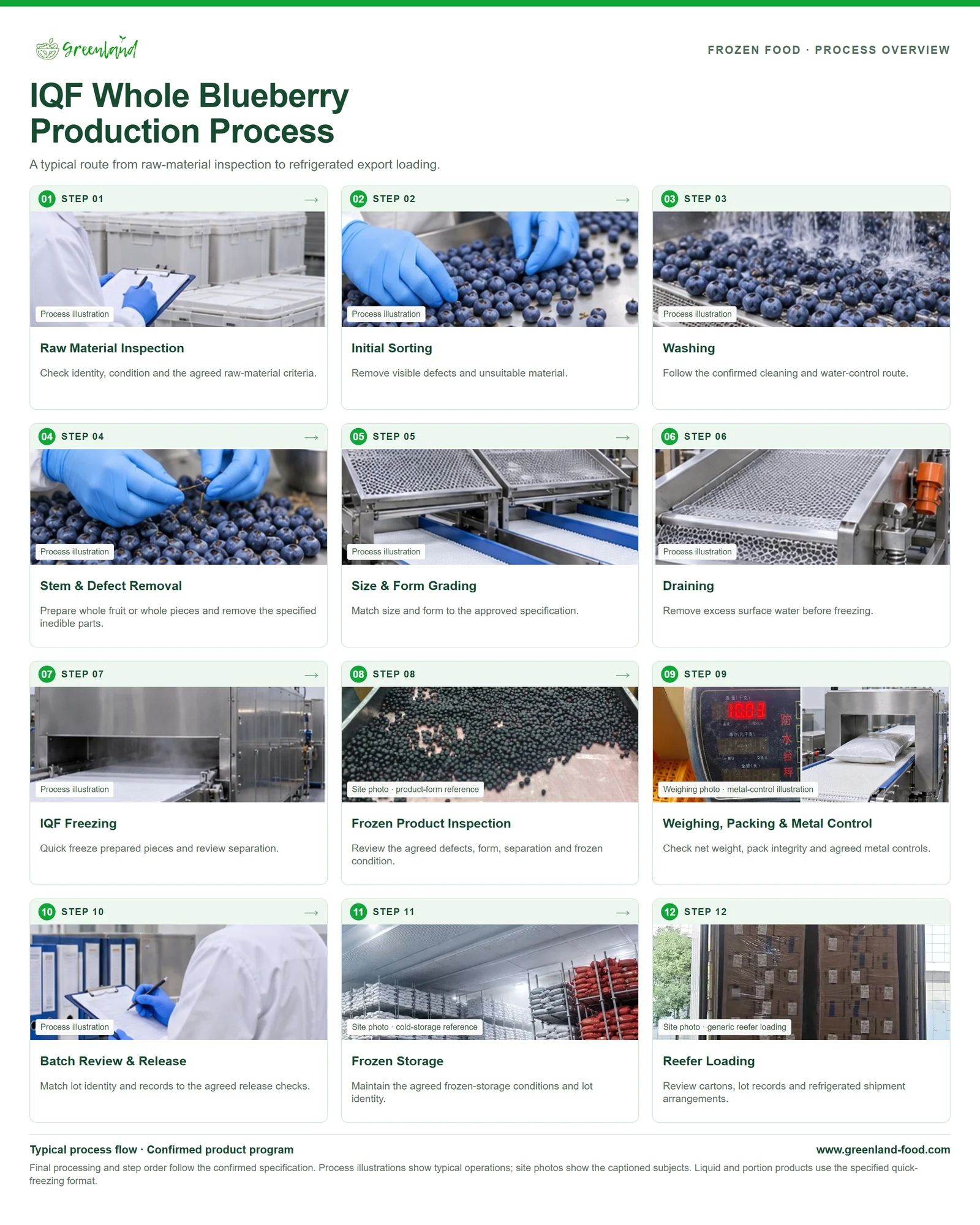
We prepare IQF Frozen Wild Blueberries to the agreed product form, pretreatment, grade and packing specification. The diagram shows a typical production process; we confirm preparation and step order for your order.
Typical process flow. Final processing and step order follow the confirmed specification. Site photos show the captioned subjects and may illustrate a representative form; process illustrations show typical operations. Storage and loading photos are generic frozen-food references.
Production and handling stages
Raw Material InspectionWe check identity, condition and the agreed raw-material criteria.
Initial SortingWe remove visible defects and unsuitable material.
WashingWe follow the confirmed cleaning and water-control route.
Stem & Defect RemovalWe prepare whole fruit or whole pieces and remove the specified inedible parts.
Size & Form GradingWe match size and form to the approved specification.
DrainingWe remove excess surface water before freezing.
IQF FreezingWe quick freeze prepared pieces and review separation.
Frozen Product InspectionWe review the agreed defects, form, separation and frozen condition.
Weighing, Packing & Metal ControlWe check net weight, pack integrity and agreed metal controls.
Batch Review & ReleaseWe match lot identity and records to the agreed release checks.
Frozen StorageWe maintain the agreed frozen-storage conditions and lot identity.
Reefer LoadingWe review cartons, lot records and refrigerated shipment arrangements.
Blueberry conveyor shown for handling and sorting review. Product identity and lot coverage are established by the shipment records.
Wild Blueberry Processing and Detection Controls
The production sequence covers collection-lot receiving and weighing, cleaning, destemming, potable-water washing, sorting, manual inspection, surface-water removal, IQF freezing, calibration, frozen inspection, metal detection, packing, cold storage, batch release and reefer loading.
Optical and manual checks address undercolored, green, mouldy, decayed and damaged fruit, along with leaves, large stems, clusters and visible foreign material. Frozen calibration separates the 6-10 mm and 8-12 mm options. The specified product-core temperature after freezing is -18°C or below.
Metal-detection performance is defined for the actual line, aperture, product and pack format. Challenge checks are recorded at the specified intervals, with detector identification, sensitivity, time, result and corrective action. Metal detection addresses metallic contamination; sorting and other applicable inspections address non-metallic material.
Match the Specification to the Finished Product
Yogurt and dairy fruit preparation: review 6-10 mm or 8-12 mm whole berries with an agreed Brix minimum, a maximum 6% crushed, mushy or broken fruit where the Grade A reference is selected, controlled clusters and the applicable microbiological program.
Bakery and frozen dough: consider 6-10 mm Grade A fruit where small pieces and even distribution are preferred. Include berry integrity, loose juice, clumps and foreign material in receiving checks rather than assessing Brix alone.
Jam, spread and puree: review uncalibrated Grade B or processing fruit with the quoted 12-16°Bx range and agreed pH and acidity reporting. Size conformity can differ while mould, decay, pathogen and foreign-material criteria remain defined.
Beverage and color-intensive preparation: identify the species first, then specify Brix, pH, acidity, juice color, usable yield and any required anthocyanin analysis.
Ice cream, smoothie and retail packs: compare 8-12 mm for more visible whole fruit with 6-10 mm for smaller-piece distribution. Confirm intended use separately, together with frozen separation, seals, labels, net weight and cold-chain requirements.
Extract and functional ingredient processing: review food-grade whole or processing fruit with batch anthocyanin reporting when ordered. These are IQF food ingredients, not pharmaceutical-grade products or products with claimed medical effects.
Frozen-fruit cartons stacked and wrapped on a pallet for packing and shipment discussion; the photograph does not verify wild origin.
Bulk Cartons, Foodservice Packs and Private Label
Bulk options include 1 x 10 kg, 1 x 20 kg, 2 x 5 kg, 4 x 2.5 kg and 20 lb, 30 lb or 40 lb cartons. Foodservice configurations include 10 x 1 kg, 5 x 2 kg and 4 x 2.5 kg. Retail configurations include 20 x 500 g, 10 x 1 kg, 12 x 1 lb, 24 x 8 oz and 10 x 10 oz, subject to the approved packing plan.
The proposed bulk liner is food-grade PE, 0.06-0.08 mm thick; retail programs use film specified for frozen food. Five-ply export cartons are specified without metal staples. Private-label approval covers artwork, barcode, lot code, production and best-before dates, storage instructions, origin, importer details and shipping marks.
General frozen-fruit reefer loading photograph. The visible cartons are not identified as a particular wild-blueberry order.
MOQ, Lead Time and Refrigerated Container Loading
The standard MOQ is 10 MT per specification. Mixed-container and private-label quantities depend on stock, film, artwork and carton requirements. Planning loads are approximately 10-12 MT for a 20-foot reefer and 23-25 MT for a 40-foot high-cube reefer, subject to carton dimensions, pallets and permitted payload.
The reference production lead time is 15-21 days after specification, packing and commercial terms are confirmed. Printed retail packs require artwork approval and film preparation; their schedule is confirmed separately in the quotation.
Product storage, loading and transport are specified at -18°C or below. Shipment records cover cold-store location, product temperature, container inspection, reefer setting, loading photos, carton quantity, container and seal numbers, and batch allocation. Repeated thawing and refreezing are not accepted under the agreed frozen-handling program.
Sampling, Batch COA and Shipment Release
The COA identifies the species, wild status, collection country and region, raw-material and finished lots, production date, grade, size, packing and purchase order. Its reporting format separates Parameter, Specification, Actual Result and Test Method so acceptance limits are not mistaken for measured batch results.
The agreed report can cover identity, sensory condition, size, defects, Brix, pH, acidity, anthocyanins, microbiology, contaminants, glaze, net weight, seals, labels and core temperature. Species, wild-origin, residue, heavy-metal, virus and anthocyanin evidence is linked to the relevant lot or stated monitoring sample rather than implied to cover every shipment.
Agree the carton selection, sample mass and methods before inspection. The proposed physical review samples five cartons at 500 g each; size assessment uses at least 200 berries per unit or the complete defined sample. Extended foreign-material checks use the contract sample mass. Where a 16 oz grading reference is selected, keep its assessment basis explicit rather than treating a 500 g review as the same sample.
Blueberry inspection example showing cartons, labeling, weighing and product checks. It is not evidence that every wild-blueberry lot has the same results.
Traceability from Collection Area to Container
The traceability record connects collection region and zone, collector, harvest date, daily collection lot, receiving date and weight, raw-material lot and species declaration. Production, line, shift, calibration, packing, finished lot, COA, cold-store location, carton label, container and seal complete the shipment link.
The example code WB260805-R03-L2-A illustrates Wild Blueberry, August 5, 2026, Collection Region 03, Line 2 and Shift A; it is not a statement of available stock. The actual coding and carton marks are approved for the order and identify the product, scientific name, wild-origin statement, size, grade, ingredient, origin, dates, lot, -18°C storage, manufacturer, exporter, buyer item code and carton number.
Certificate Scope and Export Document Support
Requested documentation can include applicable BRCGS, HACCP, ISO 22000, Kosher, Halal, organic or social-audit records. FDA Food Facility Registration is identified separately from third-party certification. Confirm the actual holder, production site, product scope and validity for the selected supply arrangement before purchase.
The agreed shipment file can include specification, COA, ingredient and allergen declarations, wild-origin declaration, residue and heavy-metal reports, microbiology and virus reports, invoice, packing list, certificate of origin, applicable health documents, bill of lading draft and container-loading records. The quotation states which documents and tests are included.
Sample Trials for Your Application
Yogurt fruit preparation: use a representative sample to record thaw drip and whole-fruit retention before mixing into the buyer's reference base. Review juice bleed, berry distribution, seed perception, color intensity and visible stems under the agreed trial conditions.
Bakery batter: trial 6-10 mm or 8-12 mm Grade A berries at a recorded fruit-to-batter ratio. Assess distribution, crushing, color migration and visible fruit after baking. Where specified, incoming berries follow the 6% maximum crushed, mushy or broken reference.
Jam and puree: record usable yield, Brix, pH, acidity, juice color, seed load and puree consistency. Grade B or processing fruit may offer a different cost basis without changing the agreed mould, decay, foreign-material or microbiological requirements.
Ice cream: assess berry distribution, hardness, skin texture and color release after the agreed manufacturing and freezing process. Compare 6-10 mm berries for smaller-piece distribution with 8-12 mm berries for more visible inclusions.
Applications & Quality Requirements
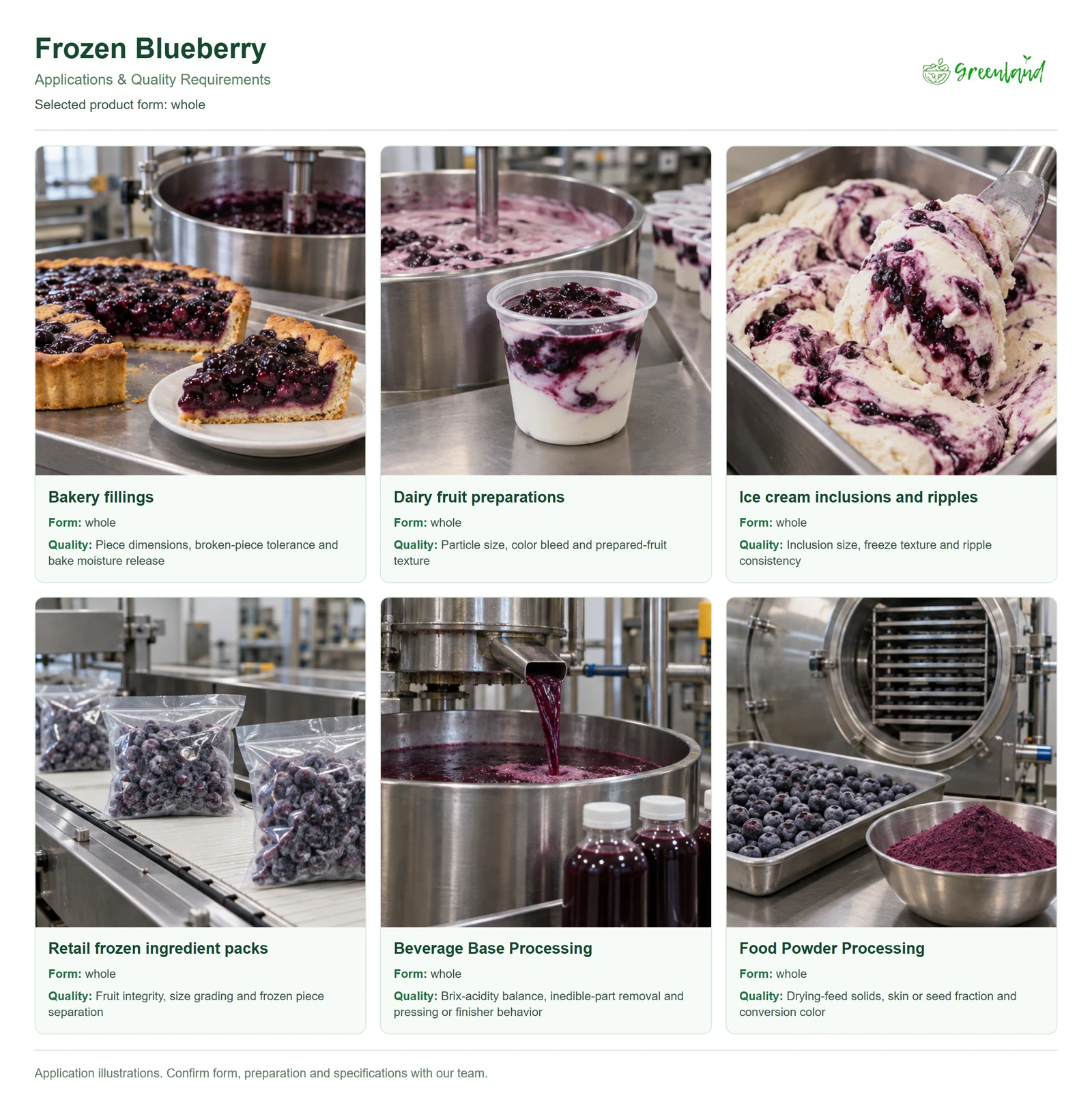
We match IQF Frozen Wild Blueberries to your processing or packing line. Product form to confirm: Whole wild-source blueberries; botanical species by order. Tell us the intended use and target texture so we can review the relevant size, grade, preparation and packing requirements before quotation.
Application illustrations. Product form, preparation and suitability follow the confirmed specification. Open the overview to inspect the image.
Bakery fillings
For: Bakery ingredient purchasing teams
Form: whole
We review whole for your bakery fillings programme. Confirm piece dimensions, broken-piece tolerance and bake moisture release. Cook or formulate the filling and validate bake performance; freezing is not a kill step.
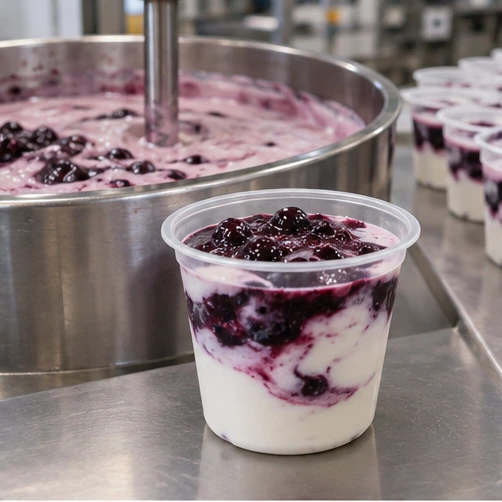
Dairy fruit preparations
For: Fruit preparation and dairy purchasing teams
Form: whole
We review whole for your dairy fruit preparations programme. Confirm particle size, color bleed and prepared-fruit texture. Prepare and validate the fruit component before dairy addition; check acidity, enzyme activity and microbiological suitability.
Ice cream inclusions and ripples
For: Ice cream ingredient procurement teams
Form: whole
We review whole for your ice cream inclusions and ripples programme. Confirm inclusion size, freeze texture and ripple consistency. Validate fruit preparation, freezing texture and safe addition stage; raw frozen fruit is not ready-to-eat by default.
Retail frozen ingredient packs
For: Retail packers and private label purchasing teams
Form: whole
We review whole for your retail frozen ingredient packs programme. Confirm fruit integrity, size grading and frozen piece separation. Confirm consumer intended use and preparation instructions; no automatic thaw-and-eat positioning. Label the confirmed consumer preparation method and expected handling; do not imply unvalidated thaw-and-eat suitability.
Beverage Base Processing
For: Juice processors and beverage ingredient manufacturers
Form: whole
We review whole for your beverage base processing programme. Confirm Brix-acidity balance, inedible-part removal and pressing or finisher behavior. Buyer must extract/filter as appropriate and validate beverage heat treatment or equivalent safety process.
Food Powder Processing
For: Qualified fruit drying and milling processors
Form: whole
We review whole for your food powder processing programme. Confirm drying-feed solids, skin or seed fraction and conversion color. Processor acceptance of GreenLand frozen input is unknown. Buyer qualifies intake and drying/milling or juice-drying route; whole fruit supply is not finished powder supply.
Match the Application with the Purchasing Specification
Application
Selected form
Quality points to confirm
Bakery fillings
whole
piece dimensions, broken-piece tolerance and bake moisture release
Dairy fruit preparations
whole
particle size, color bleed and prepared-fruit texture
Ice cream inclusions and ripples
whole
inclusion size, freeze texture and ripple consistency
Retail frozen ingredient packs
whole
fruit integrity, size grading and frozen piece separation
Beverage Base Processing
whole
Brix-acidity balance, inedible-part removal and pressing or finisher behavior
Food Powder Processing
whole
drying-feed solids, skin or seed fraction and conversion color
Send us the product, required form, final application, key quality requirements, packing, quantity and destination market. We will review the supply programme and confirm the order specification with your team.
Agree the report header before production. It can identify supplier, manufacturer, product code, common and scientific names, wild-origin declaration, collection country and region, collection-lot code, harvest and receiving dates, production and expiry dates, finished lot, packing, purchase order, sampling date, test date and report date.
Identity and sensory fields cover species, wild status, origin, calibrated or uncalibrated form, color, flavor, odor, bloom and frozen separation. Physical fields can record diameter and conformity, intact and defective fruit, clusters, cap stems, leaves, other berries, clumps, surface ice and freezer burn, using the categories in the signed specification.
Analytical fields record measured Brix, pH, acidity and sulphur dioxide when included in the test scope. Anthocyanin reports identify method, unit and wet-weight basis. Microbiological results use counts or detected/not-detected reporting; enhanced plans can include STEC, HAV and Norovirus GI/GII. Untested parameters are not entered as measured results, and a negative result does not establish the safety of every unit in the lot.
Inspection Definitions and Non-Conforming Lots
Agree defect definitions before comparing results. The working descriptions distinguish undercolored fruit, a definite green cast, undeveloped or mummified berries, collapsed crushed fruit, mushy fruit that has lost its shape, and broken fruit with split skin or missing flesh. Where the U.S. standard is adopted, its definitions govern the grading assessment.
Inspect each defined sample before calculating averages. Wild-cluster records retain both the mean count and the highest individual result. Lots outside signed limits are isolated, investigated and, where appropriate, re-sorted and re-sampled. Release requires an acceptable documented disposition and compliant results; sorting alone does not resolve every type of failure.
The proposed packaging-inspection categories treat wrong species or wild-origin statements, undeclared allergens, open liners, missing lot codes, foreign material and incorrect storage instructions as critical. Wrong size or grade, underweight packs, poor seals, unreadable dates and product-affecting carton damage are major defects. Cosmetic printing variation is assessed separately. Final classifications and actions follow the approved inspection plan.
Further-Processing and Ready-to-Eat Requirements
Manufacturing orders identify the intended cooking, pasteurization, baking or other processing step. A proposed direct-consumption program requires separate approval and can include stricter indicator limits, STEC controls, HAV and norovirus testing, collector hygiene, potable-water controls, sanitation records, environmental monitoring and collection-to-container traceability. Testing is one part of the risk-control program, not a substitute for it.
Retail smoothie and thaw-and-use packs need approved storage, preparation and handling instructions. Manufacturing packs identify the expected further process. Ordinary further-processing fruit is not labeled ready to eat without product- and facility-specific approval, and whole IQF berries are not marketed as pharmaceutical-grade material.
What Is Included in a Wild Blueberry Quotation?
The quotation identifies species, collection country and region, crop, size, grade, Brix, pH and acidity requirements, whole-fruit and breakage criteria, clusters and stems, and the agreed microbiological, virus and residue panels. It also states packing, carton quantity, net container load, port, lead time and shipment window. Optional certification documentation, anthocyanin testing, retail artwork, pallets, data loggers and additional reports are listed with their agreed scope and charges.
Frozen Wild Blueberry Buying Questions
1. Which wild blueberry species do you supply?
Bilberry lots identify Vaccinium myrtillus and are quoted separately from the main China program, which identifies Vaccinium uliginosum. The scientific name follows through to the approved specification and lot documents.
2. Are bilberries interchangeable with other wild blueberries?
Not without specification approval. Bilberry identifies V. myrtillus in this program; wild blueberry is a broader commercial term. Confirm the scientific name, origin and required fruit characteristics before comparing offers.
3. Which berry sizes are available?
The quoted options are 6-10 mm, 8-12 mm and natural uncalibrated lots. The proposed calibrated standard is at least 90% by count within range, with final availability and tolerances confirmed by sample and contract.
4. What Brix can be quoted?
The stated commercial reference is 12-16°Bx, subject to species and crop-lot confirmation. The specification records the agreed minimum or range; the COA records the actual result when testing is included.
5. What pH and acidity references are used?
The quotation references are pH 2.8-3.6 and titratable acidity 0.70-1.80% as citric acid. Confirm the limits, sample preparation and reporting basis for the selected order.
6. Does a Grade A reference mean USDA certification?
No. The U.S. Grade A framework requires at least 90 points and compliance with the applicable color, defect, character and lot rules. Its character reference limits crushed, mushy or broken berries to 6% by weight. Using selected criteria in a contract does not itself establish USDA inspection or certification.
7. How are wild clusters, leaves and stems assessed?
On the 16 oz Grade A basis, wild clusters average no more than 12, with no individual sample or container above 16. Whole leaves and large stems together are limited to two, and total leafy material must not exceed one-half square inch.
8. Is ice glaze added to the product?
No. The standard specification has 0% added glaze. Natural bloom and loose surface ice are assessed separately under the agreed frozen-condition criteria.
9. Can anthocyanin testing be included?
Yes, by agreement. Total monomeric anthocyanins are reported as mg cyanidin-3-glucoside equivalents per 100 g wet weight, with the method and tested lot identified. The contract can require reporting only or a buyer-approved minimum.
10. Which pesticide-residue requirements apply?
The testing plan follows the destination-market requirements and states analytes, methods, LOQs and results. EU orders are assessed against the applicable specific MRL or the general 0.01 mg/kg default where applicable, including relevant exceptions.
11. Can HAV and norovirus testing be arranged?
The proposed enhanced panel covers HAV and Norovirus GI/GII by RT-PCR, with not detected in 25 g as the requested criterion. Confirm sample mass, method, reporting limit and laboratory capability before ordering. A negative test is not, by itself, approval for ready-to-eat use.
12. What are the storage conditions and shelf life?
The stated shelf life is 24 months at -18°C or below under continuous frozen storage. Confirm production dates and remaining shelf life for stock lots.
13. What is the minimum order quantity?
The standard reference is 10 MT per specification. Private-label and mixed-container quantities depend on stock, film, artwork and the approved carton and loading plan.
14. How much fits in a refrigerated container?
Planning references are 10-12 MT in a 20-foot reefer and 23-25 MT in a 40-foot high-cube reefer. The confirmed load depends on cartons, pallets and permitted payload.
15. Which documents can accompany the order?
The agreed file can include specification, COA, species and wild-origin declarations, residue, heavy-metal, microbiological, virus and anthocyanin reports, plus loading records. Each document must identify its actual product, lot or monitoring scope.
Request an IQF Frozen Wild Blueberry Specification
Start with the required species, origin, size, packing, quantity and destination. Add grade, Brix, pH, acidity, anthocyanins, breakage, cluster and leaf limits, microbiological or virus testing, residue scope and delivery date where defined. Example for discussion: Vaccinium uliginosum, 6-10 mm, agreed U.S. Grade A reference, 12-16°Bx, standard microbiology, 4 x 2.5 kg cartons and 23 MT. Availability and final terms are confirmed in the quotation.
We review the selected form, grade, process and packing against the technical schedule below. Published and TDS values are specification references for order review. External benchmarks apply only within their stated scope. Acceptance is governed by the signed SKU specification; the identified lot COA reports actual measured results.
Form: Whole wild-source blueberries; botanical species by orderProduct category: Frozen Blueberry
01 / Physical & Sensory
Parameter
Specification / reference
Verification & order basis
Main China Species
Vaccinium uliginosum L. for the main China program; Vaccinium myrtillus bilberries identified and quoted separatelyPublished reference
Confirm method, representative sample and acceptance basis in the signed specification.
Commercial Grades
Agreed U.S. Grade A reference, customer-defined Grade A, Grade B or processing grade; the grading system is stated in the contractPublished reference
Confirm method, representative sample and acceptance basis in the signed specification.
Origin
China; the collection region and crop year are identified in the lot documentsPublished reference
Reconcile source declaration, intake lot and shipment documents.
Size
6-10 mm, 8-12 mm or a natural uncalibrated lot approved by samplePublished reference
Measure a defined frozen sample with caliper or size gauge; report distribution and tolerance.
Color - Grade Reference / Release Limit
Red-purple berries: maximum 5% by countPublished reference
Assess the bright, dark blue-purple color expected for properly matured fruit of the specified variety. Programme: Grade Reference / Release Limit.
Size-grade inspection
Use the selected diameter, length, piece mass or count-per-weight grade; state the proportion permitted outside the range.
Measure the named anatomical dimension; count and weigh the same representative sample.
Declared product form
Whole wild-source blueberries; botanical species by order
Match approved sample, pack label and order form. Published page identity; approve selected grade before order.
Sensory acceptance
Characteristic colour, flavour and texture for the declared product; no abnormal odour or visibly deteriorated material.External referenceCodex
Compare an identified frozen sample with the approved grade and defect schedule. External technical reference; confirm SKU and market applicability.
02 / Physicochemical & Residue Controls
Parameter
Specification / reference
Verification & order basis
Brix and Acidity
Quoted reference: 12-16°Bx; pH 2.8-3.6; titratable acidity 0.70-1.80% as citric acid. Final limits, methods and sample basis are agreed for the order.Published reference
Measure representative prepared sample with a temperature-compensated refractometer.
Thaw yield / drip loss
For a drip-sensitive grade, define thawing conditions, draining apparatus and duration before setting a numerical target.
Record initial sample mass and drained liquid mass; drip loss (%) = 100 × drained liquid mass / initial sample mass.
Pesticide residue schedule
Named active ingredients and commodity-specific limits are selected for the destination market. EU source
Link farm spray history, laboratory LOQ and batch result to the destination MRL. EU database is one market reference; apply the actual destination rule.
Lead, cadmium and other contaminants
Apply the limit for the exact commodity and processed form in the destination market. EU source
State analyte, preparation basis, method, LOQ and lot result. Do not transfer a fresh-commodity limit to a processed form without the required assessment.
Report the named organism, analytical method, sample mass, sampling plan and lot result; use CFU/g for enumeration and a stated mass for detection. Programme: Commercial Specification Limit.
Coliforms - Commercial Specification Limit
Max 100 CFU/gPublished reference
Report the named organism, analytical method, sample mass, sampling plan and lot result; use CFU/g for enumeration and a stated mass for detection. Programme: Commercial Specification Limit.
E. coli - Commercial Specification Limit
Less than 10 CFU/gPublished reference
Report the named organism, analytical method, sample mass, sampling plan and lot result; use CFU/g for enumeration and a stated mass for detection. Programme: Commercial Specification Limit.
Yeast and Mould - Commercial Specification Limit
Max 1,000 CFU/g combinedPublished reference
Report the named organism, analytical method, sample mass, sampling plan and lot result; use CFU/g for enumeration and a stated mass for detection. Programme: Commercial Specification Limit.
Salmonella - Commercial Specification Limit
Not detected in 25 gPublished reference
Report the named organism, analytical method, sample mass, sampling plan and lot result; use CFU/g for enumeration and a stated mass for detection. Programme: Commercial Specification Limit.
Report the named organism, analytical method, sample mass, sampling plan and lot result; use CFU/g for enumeration and a stated mass for detection. Programme: Commercial Specification Limit.
HAV / Norovirus GI / GII - Commercial Specification Limit
Not detected under the agreed customer or thaw-and-use testing programPublished reference
Report the named organism, analytical method, sample mass, sampling plan and lot result; use CFU/g for enumeration and a stated mass for detection. Programme: Commercial Specification Limit.
Acceptance schedule
Select the test panel and limits by intended use (ready-to-eat or further processing), product form and destination. EU source
State organism, analytical method, sample mass and n/c plan; report actual lot results. A universal APC, coliform, Salmonella or Listeria limit is not assigned to every frozen product.
04 / Freezing & Cold Chain
Parameter
Specification / reference
Verification & order basis
Frozen storage and transport
≤−18 °CTDS reference
Product core check and logger record. Selected form and grade must match this TDS reference. Applies to: Frozen Blueberry frozen formats.
Storage and Shelf Life
24 months at -18°C or below under the specified frozen-storage conditions; remaining shelf life confirmed for stock lotsPublished reference
Verify unopened-pack validation, declared storage condition and production/best-before coding.
Separation & loose-ice assessment
Keep inherent moisture, loose ice and permanently frozen clusters as separate inspection categories.
Weigh separated loose ice and welded clusters against initial sample mass; distinguish natural paired pieces or blocks.
Product thermal centre
−18°C or colder after freezing and thermal stabilization; maintain the agreed frozen distribution condition.External referenceCodex
Probe the thickest representative pack and retain storage/transport temperature records. Codex quick-frozen reference; selected product form and route must be frozen.
Frozen condition at dispatch
Hard frozen, correctly sealed and coded, without thaw/refreeze evidence or excessive loose ice. Codex
Check pack integrity, free-flow or block condition as declared, carton condition and loading temperature.
05 / Pack Size & Shelf Life
Parameter
Specification / reference
Verification & order basis
Packing
1 × 10 kg, 2 × 5 kg, 4 × 2.5 kg, 10 × 1 kg, 20 × 500 g or an approved private-label configurationPublished reference
Check approved pack drawing, calibrated scale and production records.
Declared net contents
Verify each selected pack format against the artwork and applicable quantity-control rule. Codex
Calibrated checkweigher or scale; defined sample and tare.
Shelf-life basis
The labelled period applies only to its validated pack and continuous stated storage condition. Codex
Review stability study or approved shelf-life file and production-date code.
06 / Process Controls
Parameter
Specification / reference
Verification & order basis
Raw-material preparation checks
Confirm botanical species and cultivated/wild sourcing; distinguish bilberry from cultivated or lowbush blueberry.
Verify the selected product flow and the relevant trimming, sorting and pretreatment record.
CCP designation
Use the site-approved HACCP plan to identify true CCPs and their validated critical limits. Codex
Check hazard analysis, monitoring, deviation and corrective-action records. A quality-control step is not automatically a CCP.
Verify approved formula, supplier declarations and line-specific allergen assessment.
Composition
No added sugar, color, flavor, preservative or ice glazePublished reference
Verify approved formula, supplier declarations and line-specific allergen assessment.
Added glaze / coating declaration
Declare any intentionally added water glaze, syrup, oil or coating and the measurement basis; loose ice is assessed separately.
Verify formula/addition records; agree a deglazing or coating test and net-content basis where applicable.
Additive use
Declare any colour-protection agent, acidulant or other additive by ingredient and maximum permitted use for the target market. NHC standard
Check approved formula, actual addition record and market-specific additive category. GB 2760-2024 applies to China; export rules are checked separately.
Allergen and cross-contact assessment
Declare inherent allergens and assess shared-line cross-contact from the actual facility schedule. FDA
Review line matrix, cleaning validation and buyer label approval. Do not claim a shared-line allergen or allergen-free status without facility evidence.
08 / Defects & Foreign Matter
Parameter
Specification / reference
Verification & order basis
Green, undeveloped, other edible berries or damaged berries - Grade Reference / Release Limit
Combined maximum 10 berries per 16 ozPublished reference
Within that total, undeveloped berries, other edible berries and damaged berries together must not exceed 5. Programme: Grade Reference / Release Limit.
At least 94% by weight must fall outside these three defect categories. Other grade requirements are assessed separately. Programme: Grade Reference / Release Limit.
Mould, decay and objectionable foreign material: additional program criteria - Grade Reference / Release Limit
Absent in the inspected samplePublished reference
The product program rejects glass, metal, stones, hard plastic, wood, visible insects and decayed fruit; this is not presented as a separate USDA numerical tolerance. Programme: Grade Reference / Release Limit.
Examine the entire container contents or as large a quantity as practicable in the frozen state; weigh berries stuck together that cannot easily be separated. Codex reference only when species is confirmed as Vaccinium corymbosum L., V. angustifolium Ait. or V. ashei READE and fruit is offered for direct consumption. Bilberries (V. myrtillus), puree and industrial further-processing products are excluded. Free-flowing presentation only.
Minor ≤15; major ≤8; combined total ≤15 points per 300 g drained berriesExternal referenceCodex
Segregate and classify visual defects in 300 g drained berries; assign points using Table 1, not percentage or defect counts. Codex reference only when species is confirmed as Vaccinium corymbosum L., V. angustifolium Ait. or V. ashei READE and fruit is offered for direct consumption. Bilberries (V. myrtillus), puree and industrial further-processing products are excluded.
Blueberries disintegrated, badly crushed or smashed: Codex reference tolerance
≤10 % m/m of drained berriesExternal referenceCodex
Separate and weigh this defect category in the 300 g drained-berry sample used for Table 1. Codex reference only when species is confirmed as Vaccinium corymbosum L., V. angustifolium Ait. or V. ashei READE and fruit is offered for direct consumption. Bilberries (V. myrtillus), puree and industrial further-processing products are excluded.
Minor ≤20; major ≤10; combined total ≤20 points per 300 g drained bilberriesExternal referenceCodex
Segregate and classify visual defects in 300 g drained bilberries; assign points using CXS 76 Table 1. Alternative Codex reference only if this wild-berry programme is botanically confirmed as Vaccinium myrtillus L. (bilberry), offered for direct consumption. Do not apply these values to cultivated/highbush or lowbush blueberries; industrial further-processing products are excluded.
Intrinsic defect classification
Stems/leaves, green/red berries, clusters, mummified fruit and crushed/leaking berries.
Record each defect class separately by count or mass; state sample size, denominator and combined-limit rules.
Hazardous foreign matter
No foreign matter detected in the defined inspection sample; reject and investigate any finding.External referenceCodex
Define visual-inspection sample size and detector challenge in the signed quality schedule. "None detected" is a sampling statement, not an absolute guarantee of zero particles.
09 / Packaging Materials & Label
Parameter
Specification / reference
Verification & order basis
Food-contact pack
Specify inner-contact material and obtain the applicable food-contact compliance declaration. NHC standard
Review film structure, supplier DoC, migration evidence and actual intended conditions. GB 4806 series is China-specific; EU export also checks Regulations 1935/2004 and 10/2011.
Carton and seal integrity
Define carton stacking strength, bag seal and puncture resistance for the confirmed net weight and pallet plan. EU source
Inspect pack drawing, compression/seal test and shipment configuration.
Label verification
Match product name, ingredient/allergen statement, net weight, lot/date, shelf life and storage instruction to the destination artwork. Codex
Approve artwork against the signed specification and destination rules.
10 / Detection & Traceability
Parameter
Specification / reference
Verification & order basis
Foreign-body detector
Validate Fe, non-Fe and stainless-steel challenge pieces for the actual product, aperture, pack and line; record the proven sensitivity. Codex
Challenge at defined start, changeover, interval and end points; retain rejection records. Do not copy generic detector sizes into a plant capability claim.
Lot traceability
Link input source lot, processing run, packaging code, test records, frozen storage and shipment to one finished lot. Codex
Trace one sample lot forward and backward in a recorded mock recall. Recall speed is stated only when the site has a validated target and record.
Order approval: Confirm the selected form and grade, ingredient formula, intended use, destination market, packing, sampling plan and test panel. The signed specification controls acceptance; the identified lot COA reports actual results.