



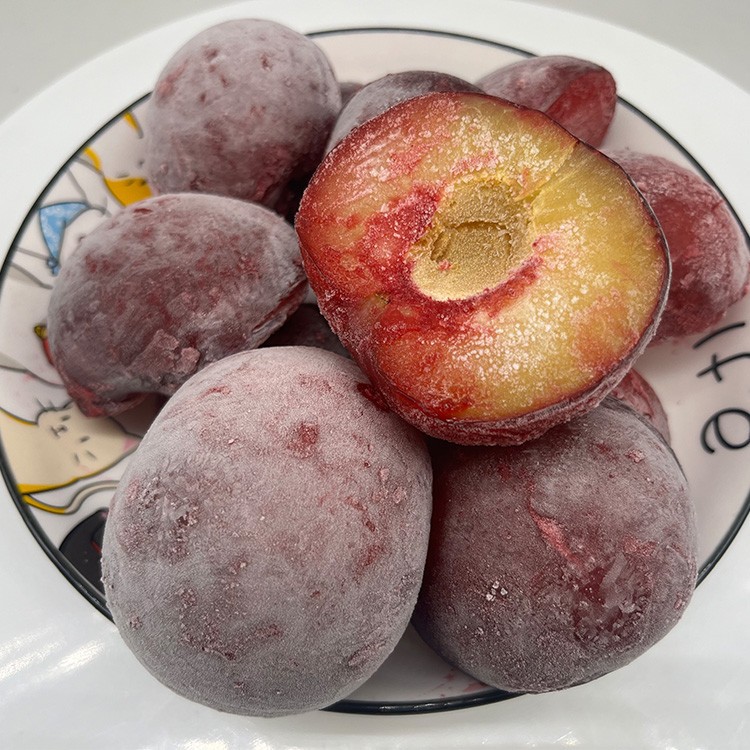


Freezing Plum
Description
Technical Parameters
IQF Frozen Plum Halves and Pitted Plums for Bulk Supply
We supply IQF frozen plums in pitted halves, whole fruit, quarters, slices, dice and broken pieces for industrial processing, foodservice and private-label programs. We confirm cultivar, cut, pit-control standard, maturity, Brix, packing and microbiological requirements against each order before production.
Frozen Plum Supply Built Around the Final Use
Plum specifications change with the finished product. Bakery fillings need controlled piece integrity; puree and sauce production can accept more flexible appearance; retail packs require tighter color, size and defect control. We prepare the order around the intended application instead of presenting one generic plum grade for every program.
We commonly prepare skin-on IQF pitted plum halves. We also produce whole plums, quarters, slices, 10 x 10 mm dice and processing pieces. Each quotation states the exact form, size, cultivar, packing and quality limits we will deliver.

Pitted plum halves give processors a recognizable fruit shape with fewer preparation steps.
Order Parameters at a Glance
Whole, pitted halves, quarters, slices, dice and pieces
11-13, 13-15 or 15-18 degrees Brix programs
2.7-3.5 with the lot result shown on the COA
-18 degrees C or below; shelf life up to 24 months
12 metric tons per standard order
Buyer Risks and GreenLand-food Controls
| Order Risk | Why It Matters | Our Control |
|---|---|---|
| Mixed maturity or unstable color | Flavor, Brix and finished-product appearance vary. | We define cultivar, maturity and color expectations with the approved sample. |
| Whole stones or pit fragments | Pit material can damage equipment and create a foreign-material risk. | We specify pitting checks, whole-stone absence and a measurable fragment tolerance. |
| Excess broken pieces | Usable yield and visible fruit identity decline. | We agree the form, size band and defect method before production. |
| Thawing or temperature abuse | Drip loss, softness and clumping increase. | We maintain frozen storage, inspect loading condition and provide handling guidance. |
Procurement Specification Reference
We offer the following supply specifications. The quotation and signed specification show the exact values included in our offer, giving purchasing, quality and production teams one measurable acceptance standard.
| Product Name | IQF Frozen Plum / IQF Frozen Plum Halves |
|---|---|
| Botanical Reference | Prunus spp.; species and cultivar confirmed in order documents |
| Origin | China; production region and factory confirmed by lot |
| Cultivar | Heibulang and Angeleno dark plum varieties; the offered cultivar is named on the specification |
| Forms | Whole pitted or unpitted, pitted halves, quarters, slices, dice and pieces |
| Skin | Skin-on standard; peeled supply only after capability confirmation |
| Brix | Typical 11-18 degrees Brix; target and test temperature agreed by order |
| pH | Typical 2.7-3.5; lot result available when included in the testing plan |
| Broken or Damaged Pieces | Maximum 10% for standard pitted halves, measured by the agreed inspection method |
| Pit Control | Whole stones absent in pitted product; visible pit fragments controlled to a maximum of 1 piece per 10 kg when confirmed in the order specification |
| Free-Flowing Condition | Predominantly individually frozen; clumps over 3 pieces maximum 5% and free ice maximum 1% |
| Packing | 10 kg, 20 kg, 4 x 2.5 kg, 20 lb, 40 lb; retail 20 x 500 g or 10 x 1 kg; tote packing by confirmation |
| MOQ and Loading | MOQ 12 MT; approximately 12 MT per 20-foot reefer or 22-24 MT per 40-foot reefer |
| Lead Time | Normally 15-21 days after specification, packing and order confirmation |
| Storage and Shelf Life | Keep at -18 degrees C or below; 24 months from production under uninterrupted frozen storage |
| Loading Port | Qingdao or Xiamen; the quotation names the loading port and sailing plan |

Choose the Plum Form by Processing Need
| Form | Best Fit | Confirm Before Order |
|---|---|---|
| Pitted halves | Bakery, topping and visible-fruit fillings | Size, broken-piece and pit-fragment limits |
| Whole fruit | Selected foodservice or further processing | Pitted or unpitted status and diameter |
| Quarters or slices | Desserts, bakery and portioned preparations | Thickness, length and shape tolerance |
| Dice | Yogurt, dairy, bakery filling and blending | Cut size, fines and thawed texture |
| Pieces | Puree, jam, sauce and cost-focused processing | Minimum usable size and foreign-material limits |
Raw Material, Variety and Crop Control
We source processing plums from approved growing and collection areas in China. Heibulang, Angeleno and other suitable dark plum varieties may differ in skin color, flesh tone, sweetness, acidity and firmness, so the cultivar is not treated as interchangeable without approval.
The main processing window is generally June through September, with timing affected by region, variety and weather. We link incoming fruit, production date and finished lots so crop variation can be discussed against the actual shipment.

Raw-material and batch records connect crop intake with finished frozen lots.

Physical and Sensory Quality
We check that frozen plums retain the expected natural varietal color, clean plum flavor and freedom from fermentation, decay, objectionable odors and visible foreign matter. Size and shape tolerances are measured on the frozen product using the method stated in the order.
Frozen and thawed plums are naturally softer than fresh fruit. A specification should therefore separate frozen appearance, thawed texture and finished-application performance instead of promising fresh-fruit firmness after thawing.
Pitting and Foreign-Material Control
Pitted product requires two separate controls: whole stones and pit fragments. We state whole stones as absent and control visible fragments to the numeric tolerance confirmed in the order. A maximum of 1 visible fragment per 10 kg can be applied after the selected production line and cultivar have been confirmed.
We confirm the pitting process, inspection frequency, metal-detection standard and corrective action with the selected plant. Orders with tighter limits require a feasibility review and may affect sorting cost, yield and lead time.

Inspection criteria are tied to the approved order specification and sampling plan.
Typical IQF Processing Flow

Microbiological Reference and Intended Use
Our order specification can control total plate count to no more than 500,000 CFU/g, coliforms to no more than 1,000 CFU/g, E. coli to no more than 100 CFU/g, yeast and mould to no more than 100 CFU/g, and Salmonella as negative in 25 g. Listeria monocytogenes negative in 25 g is included when required by the market or intended use.
IQF freezing is not a sterilization step. Direct-consumption or ready-to-eat status must be expressly validated through raw-material control, process design, hygiene zoning, testing and the destination-market standard. Otherwise, we position the plums as an ingredient for further processing.
Residue, Contaminant and Document Control
We align pesticide-residue and contaminant testing with the destination market, customer specification and approved laboratory scope. The analyte list and maximum residue limits are confirmed for each order.
Available documents can include specification, COA, packing list, commercial invoice, certificate of origin, phytosanitary certificate when applicable, health certificate, microbiological report, residue report and inspection report. The exact set is confirmed before shipment.

Certificate validity, issuing body and applicable production scope should be checked for the selected order.

Application Matching
Bakery and dessert: pitted halves, quarters or dice with defined piece integrity and thawed-drip expectations.
Jam, puree and sauce: halves, dice or pieces selected around yield, Brix, color and pit control.
Beverage and dairy: dice or smaller pieces with a defined microbiological plan and processing declaration.
Foodservice and private label: portion size, bag strength, retail artwork, coding and destination-market labeling confirmed before production.
Thawing and Handling Guidance
Maintain -18 degrees C or below and limit temperature fluctuation during storage and transfer.
Use a covered food-safe container and allow for natural juice release.
Evaluate the thawed product in the intended recipe, not against fresh-fruit firmness.
Do not refreeze thawed product unless a validated industrial process specifically permits it.
Packing and Private-Label Programs
Our common bulk references are 10 kg and 20 kg cartons, 4 x 2.5 kg bags, and 20 lb or 40 lb cases. Retail references include 20 x 500 g and 10 x 1 kg. Large tote packing up to about 600 kg is considered only after factory and product-form confirmation.
We state the inner-film specification, carton strength, net weight, coding, pallet pattern, label language and artwork responsibility in the packing approval. We can combine pitted halves and dice in one container when both products use the same loading port, shipment week and carton footprint. We list the quantity of each SKU in the loading plan.


Frozen Storage and Batch Release
We hold finished lots in frozen storage and connect pallet identification with production and inspection records. Release is based on the agreed product specification, required test results, packing confirmation and shipment instructions.
Cold-Chain Planning
We coordinate the loading window, reefer set point, carton condition and shipment documents before dispatch. A floor-loaded 20-foot reefer carries about 12 MT, while a floor-loaded 40-foot reefer carries 22-24 MT. For palletized cargo, we calculate the carton count from the approved carton dimensions and pallet pattern and show the resulting net weight in the loading plan.


Loading and Shipment Evidence
Loading photos, seal records and pre-shipment observations can be included when required. We use them to document carton condition, loading sequence and container readiness rather than as a substitute for the signed quality specification.
GreenLand-food Frozen Fruit Supply Support
We coordinate product selection, specification alignment, packing, document preparation, inspection and export shipment through a practical buyer-facing workflow. For a broader sourcing program, review our frozen fruit solutions, quality control system, traceability process and factory audit and inspection support.

Concrete Specification Programs We Can Supply
Procurement teams often need more than a broad product name. The examples below show how we turn "frozen plum" into a production-ready order. Each program has a defined fruit form, quality target, packing format and intended use. This allows the receiving warehouse and quality team to inspect the same characteristics that the purchasing team approved.
Bakery Halves Program
We supply skin-on, pitted dark plum halves with natural red-to-purple skin, clean flesh, whole stones absent, visible pit fragments controlled to a maximum of 1 piece per 10 kg, broken or damaged pieces controlled to a maximum of 10%, clumps over 3 pieces controlled to a maximum of 5%, and free ice controlled to a maximum of 1%. Packing options include 10 kg cartons or four 2.5 kg bags in one carton. This program gives pie, tart and pastry producers recognizable fruit pieces after filling preparation.
Jam and Puree Program
We supply pitted halves, irregular pieces or 10 x 10 mm dice with Brix bands of 11-13, 13-15 or 15-18 degrees Brix. The program emphasizes usable fruit yield, natural plum color, clean flavor and pit control. A wider piece-size range is available because the fruit is crushed or cooked during manufacturing. Bulk packing includes 10 kg, 20 kg, 20 lb and 40 lb cases. We can include Brix and pH results on the COA.
Dairy and Dessert Dice Program
We supply pitted plum dice in a 10 x 10 mm target cut for yogurt preparations, ice cream inclusions, dessert sauces and portioned cups. The specification records the cut-size tolerance, fines limit, skin-on status, Brix band, pH range, microbiological limits and packing format. We offer four 2.5 kg bags in a carton for production-line portion control and ten 1 kg bags for foodservice distribution.
Foodservice and Retail Program
We pack pitted halves, quarters or dice in 500 g, 1 kg and 2.5 kg bags. Retail configurations include 20 x 500 g and 10 x 1 kg per carton. We can print or apply private-label artwork, product name, country of origin, lot code, production date, best-before date, storage statement, net weight and preparation instructions. Master cartons can carry shipping marks, barcode labels and importer information.
What We Check During Production
Our quality-control work is built around visible and measurable acceptance points. We do not describe quality only with words such as "premium" or "high grade." The inspection record identifies what was checked, the sampling quantity, the result and the action taken when the product moves outside the approved limit.
| Inspection Stage | What We Check | Example Record |
|---|---|---|
| Raw-fruit receiving | Cultivar identity, maturity, decay, fermentation, foreign matter, fruit temperature and incoming lot code | Supplier lot, receiving time, accepted quantity and rejected quantity |
| After washing and sorting | Leaves, stems, damaged fruit, underripe fruit, overripe fruit and surface cleanliness | Sorting-line check with defect observations and corrective sorting action |
| After pitting and cutting | Whole stones, visible pit fragments, cut form, cut size, damaged flesh and excessive small pieces | Sample weight, fragment count, broken-piece percentage and operator action |
| After IQF freezing | Individual freezing, clumps, free ice, color, odor, frozen temperature and package weight | Finished-lot sensory result, temperature result and net-weight result |
| Before lot release | Specification compliance, microbiological results, packing, coding, metal detection and document completeness | Release signature linked to production lot and pallet identification |
Documents and Evidence We Can Provide
International orders need a document package that matches the physical shipment. We can provide a signed product specification showing product form, ingredient statement, origin, packing, storage, shelf life, physical tolerances and microbiological limits. The COA can show the production lot, production date, Brix, pH and the microbiological results included in the release plan. The packing list shows carton count, net weight, gross weight and shipping marks, while the commercial invoice records the agreed trade information.
For import clearance, we can prepare a certificate of origin, health certificate and phytosanitary certificate when the product and destination require them. Residue and contaminant reports can cover the analytes listed in the purchase specification. We can also provide carton photographs, label photographs, pallet photographs, container-loading photographs, seal information and an inspection report. For private-label orders, the approval file can include the final artwork, barcode, bag dimensions, carton dimensions, coding position and print sample.
A practical document set for one 40-foot reefer shipment may include the signed specification, commercial invoice, packing list, COA, certificate of origin, health certificate, bill-of-lading draft, loading photographs and seal record. When residue testing or an additional microbiological panel is included, the laboratory report is linked to the same finished-product lot. This keeps the shipment identity consistent from production through customs clearance and warehouse receipt.
Example Bulk Order Configurations
| Order Example | Product and Quality | Packing and Shipment |
|---|---|---|
| Industrial bakery | IQF skin-on pitted halves, 13-15 degrees Brix, pH 2.7-3.5, broken pieces maximum 10%, whole stones absent, pit fragments maximum 1 per 10 kg | 10 kg carton, 2,200-2,400 cartons, about 22-24 MT in one 40-foot reefer |
| Jam manufacturer | Pitted plum pieces, 11-15 degrees Brix, whole stones absent, natural red-purple color, clean flavor and standard microbiological panel | 20 kg carton, approximately 1,100-1,200 cartons in one 40-foot reefer |
| Dairy ingredient distributor | 10 x 10 mm pitted dice, 13-15 degrees Brix, cut-size tolerance and fines limit stated on the specification | Four 2.5 kg bags per carton, 10 kg net carton, cold-chain shipment at -18 degrees C |
| Private-label retail | Pitted halves or quarters, retail appearance grade, lot coding and consumer preparation statement | 20 x 500 g or 10 x 1 kg per carton with printed or labeled retail bags |
Information Included in Our Quotation
Our quotation names the offered product instead of using only "frozen plum." For example: "IQF Frozen Dark Plum, skin-on, pitted halves, Heibulang variety, Brix 13-15 degrees, pH 2.7-3.5, broken pieces maximum 10%, whole stones absent, visible pit fragments maximum 1 per 10 kg, packed 1 x 10 kg blue food-grade PE bag in one export carton." This description gives the purchasing team a clear basis for price comparison.
The quotation also states the MOQ, carton net weight, estimated carton count, container loading quantity, unit price basis, loading port, payment terms, production lead time, shipment window and quotation validity. Separate lines identify private-label bag costs, printing-cylinder costs, pallet costs, special laboratory tests and inspection services when these items are included. This prevents packaging or testing charges from appearing late in the order.
After commercial approval, we issue the product specification and packing artwork for signature. Production uses those approved documents. Before shipment, we check the finished lot against the physical limits, microbiological plan, packaging details and coding requirements stated in the order. The same product name and lot identity then appear on the COA, packing list, cartons and shipment records.
Frequently Asked Procurement Questions
1. Which frozen plum forms do you supply?
We supply pitted halves, whole pitted fruit, whole unpitted fruit, quarters, slices, 10 x 10 mm dice and processing pieces. The quotation lists only the forms available for the requested shipment window.
2. Are the plums pitted?
We mainly supply pitted halves. Whole fruit must be marked clearly as pitted or unpitted in the order.
3. Is a frozen plum the same as a prune?
No. We describe frozen fresh plum fruit. A prune generally refers to a dried plum or a cultivar commonly used for drying.
4. What Brix range can you supply?
Our broad reference is 11-18 degrees Brix. Cultivar, maturity, crop and test temperature affect the result, so the order must state the target.
5. What is the typical pH?
We normally control pH within 2.7-3.5. We confirm the applicable method and lot result when pH is a release parameter.
6. Can you control cut size and uniformity?
Yes. We define diameter, thickness or dice size with tolerances and an agreed frozen-product inspection method.
7. What is the broken-piece limit for pitted halves?
We control broken or damaged pieces to a maximum of 10% for standard pitted halves. A different limit requires sample and production confirmation.
8. How do you control stones and pit fragments?
We specify whole stones as absent in pitted product and inspect visible pit fragments during pitting, sorting and final product checks. We can supply a specification with a maximum of 1 visible fragment per 10 kg.
9. Will the plum remain firm after thawing?
No frozen plum should be expected to match fresh-fruit firmness. We recommend testing thawed texture and drip loss in the intended formulation.
10. Can the product be eaten directly after thawing?
Only when a ready-to-eat program has been expressly validated and documented. Standard IQF fruit should not automatically be treated as sterile.
11. What are the storage temperature and shelf life?
Keep the product at -18 degrees C or below. We supply it with a shelf life of up to 24 months under uninterrupted frozen storage.
12. Which packing formats are available?
Common formats include 10 kg, 20 kg, 4 x 2.5 kg, 20 lb and 40 lb bulk packs, plus 20 x 500 g and 10 x 1 kg retail configurations.
13. What is the MOQ and container loading quantity?
Our MOQ is 12 MT. A floor-loaded 20-foot reefer carries about 12 MT. A floor-loaded 40-foot reefer carries 22-24 MT. Palletized orders carry fewer cartons, and we show the calculated carton count in the quotation.
14. Which documents can accompany the shipment?
We confirm the required specification, COA, origin, health, phytosanitary, residue, microbiological, invoice, packing-list and inspection documents before shipment.
15. Can you support a pre-shipment inspection?
Yes. We coordinate pre-shipment checks against the signed specification and agreed sampling plan.
Send Us Your Frozen Plum Buying Requirement
For an accurate quotation, please provide the required form, cultivar or color, pitted status, size, Brix, broken-piece and pit-fragment limits, microbiological standard, packing, annual volume, destination market and expected shipment date.
Hot Tags: freezing plum, China freezing plum manufacturers, suppliers, factory, freezing plum, freeze plum, iqf plums, frozen plum
Technical specification · reference schedule
Frozen Plum
We review the selected form, grade, process and packing against the technical schedule below. Published and TDS values are specification references for order review. External benchmarks apply only within their stated scope. Acceptance is governed by the signed SKU specification; the identified lot COA reports actual measured results.
01 / Physical & Sensory
| Parameter | Specification / reference | Verification & order basis |
|---|---|---|
| Botanical Reference | Prunus spp.; species and cultivar confirmed in order documentsPublished reference | Check raw-material identity and variety/source declaration against the ordered programme. |
| Origin | China; production region and factory confirmed by lotPublished reference | Reconcile source declaration, intake lot and shipment documents. |
| Cultivar | Heibulang and Angeleno dark plum varieties; the offered cultivar is named on the specificationPublished reference | Check raw-material identity and variety/source declaration against the ordered programme. |
| Related form options | Whole pitted or unpitted, pitted halves, quarters, slices, dice and piecesPublished reference | The selected form shown above governs this schedule. Other published forms require their own cut, process and acceptance specification. |
| Skin | Skin-on standard; peeled supply only after capability confirmationPublished reference | Confirm method, representative sample and acceptance basis in the signed specification. |
| Characteristic appearance & texture | Cultivar-specific skin/flesh colour and characteristic plum flavour. | Compare the defined sample with an identified reference grade; use the declared preparation for texture assessment. |
| Size-grade inspection | Use the selected diameter, length, piece mass or count-per-weight grade; state the proportion permitted outside the range. | Measure the named anatomical dimension; count and weigh the same representative sample. |
02 / Physicochemical & Residue Controls
| Parameter | Specification / reference | Verification & order basis |
|---|---|---|
| Brix | Typical 11-18 degrees Brix; target and test temperature agreed by orderPublished reference | Measure representative prepared sample with a temperature-compensated refractometer. |
| pH | Typical 2.7-3.5; lot result available when included in the testing planPublished reference | Use calibrated pH meter or titration on the stated sample preparation. |
| Thaw yield / drip loss | For a drip-sensitive grade, define thawing conditions, draining apparatus and duration before setting a numerical target. | Record initial sample mass and drained liquid mass; drip loss (%) = 100 × drained liquid mass / initial sample mass. |
| Pesticide residue schedule | Named active ingredients and commodity-specific limits are selected for the destination market. EU source | Link farm spray history, laboratory LOQ and batch result to the destination MRL. EU database is one market reference; apply the actual destination rule. |
| Lead, cadmium and other contaminants | Apply the limit for the exact commodity and processed form in the destination market. EU source | State analyte, preparation basis, method, LOQ and lot result. Do not transfer a fresh-commodity limit to a processed form without the required assessment. |
03 / Microbiological Criteria
| Parameter | Specification / reference | Verification & order basis |
|---|---|---|
| Hygiene-indicator panel | Select aerobic count and relevant Enterobacteriaceae, coliform or E. coli indicators for the declared process and intended use. Codex | Report each quantitative result in CFU/g, method/reporting limit, sample plan and lot identity. |
| Pathogen acceptance programme | Define Salmonella and Listeria criteria when applicable to the destination, ready-to-eat status and buyer programme. Codex | State analytical portion, sample-unit plan, method and detected/not-detected reporting; identify the treatment and release basis. |
| Yeast & mould enumeration | Select separate yeast and mould criteria for the ordered grade and process; assess storage stability with the applicable product data. Codex | Report yeast and mould separately in CFU/g using validated matrix-specific methods. |
| Acceptance schedule | Select the test panel and limits by intended use (ready-to-eat or further processing), product form and destination. EU source | State organism, analytical method, sample mass and n/c plan; report actual lot results. A universal APC, coliform, Salmonella or Listeria limit is not assigned to every frozen product. |
04 / Freezing & Cold Chain
| Parameter | Specification / reference | Verification & order basis |
|---|---|---|
| Frozen storage and transport | ≤−18 °CTDS reference | Product core check and logger record. Selected form and grade must match this TDS reference. Applies to: Frozen Plum frozen formats. |
| Storage and Shelf Life | Keep at -18 degrees C or below; 24 months from production under uninterrupted frozen storagePublished reference | Verify unopened-pack validation, declared storage condition and production/best-before coding. |
| Separation & loose-ice assessment | Keep inherent moisture, loose ice and permanently frozen clusters as separate inspection categories. | Weigh separated loose ice and welded clusters against initial sample mass; distinguish natural paired pieces or blocks. |
| Product thermal centre | −18°C or colder after freezing and thermal stabilization; maintain the agreed frozen distribution condition.External reference Codex | Probe the thickest representative pack and retain storage/transport temperature records. Codex quick-frozen reference; selected product form and route must be frozen. |
| Frozen condition at dispatch | Hard frozen, correctly sealed and coded, without thaw/refreeze evidence or excessive loose ice. Codex | Check pack integrity, free-flow or block condition as declared, carton condition and loading temperature. |
05 / Pack Size & Shelf Life
| Parameter | Specification / reference | Verification & order basis |
|---|---|---|
| Packing | 10 kg, 20 kg, 4 × 2.5 kg, 20 lb, 40 lb; retail 20 × 500 g or 10 × 1 kg; tote packing by confirmationPublished reference | Check approved pack drawing, calibrated scale and production records. |
| Declared net contents | Verify each selected pack format against the artwork and applicable quantity-control rule. Codex | Calibrated checkweigher or scale; defined sample and tare. |
| Shelf-life basis | The labelled period applies only to its validated pack and continuous stated storage condition. Codex | Review stability study or approved shelf-life file and production-date code. |
06 / Process Controls
| Parameter | Specification / reference | Verification & order basis |
|---|---|---|
| Raw-material preparation checks | Confirm cultivar, pitted state and skin-on/peeled presentation. | Verify the selected product flow and the relevant trimming, sorting and pretreatment record. |
| CCP designation | Use the site-approved HACCP plan to identify true CCPs and their validated critical limits. Codex | Check hazard analysis, monitoring, deviation and corrective-action records. A quality-control step is not automatically a CCP. |
07 / Ingredients, Additives & Allergens
| Parameter | Specification / reference | Verification & order basis |
|---|---|---|
| Added glaze / coating declaration | Declare any intentionally added water glaze, syrup, oil or coating and the measurement basis; loose ice is assessed separately. | Verify formula/addition records; agree a deglazing or coating test and net-content basis where applicable. |
| Ingredient statement | 10 × 10 mm pitted dice, 13-15 degrees Brix, cut-size tolerance and fines limit stated on the specificationTechnical control | Compare approved formula, product label and supplier bill of materials. Published product statement; verify final commercial formula. |
| Additive use | Declare any colour-protection agent, acidulant or other additive by ingredient and maximum permitted use for the target market. NHC standard | Check approved formula, actual addition record and market-specific additive category. GB 2760-2024 applies to China; export rules are checked separately. |
| Allergen and cross-contact assessment | Declare inherent allergens and assess shared-line cross-contact from the actual facility schedule. FDA | Review line matrix, cleaning validation and buyer label approval. Do not claim a shared-line allergen or allergen-free status without facility evidence. |
08 / Defects & Foreign Matter
| Parameter | Specification / reference | Verification & order basis |
|---|---|---|
| Broken or Damaged Pieces | Maximum 10% for standard pitted halves, measured by the agreed inspection methodPublished reference | Inspect a defined representative sample; record count or mass basis and disposition. |
| Pit Control | Whole stones absent in pitted product; visible pit fragments controlled to a maximum of 1 piece per 10 kg when confirmed in the order specificationPublished reference | Classify on the defined sample by count or mass; record individual categories, denominator and any combined limit. |
| Intrinsic defect classification | Pit/fragment, damaged skin, brown flesh, immature hard fruit and collapsed pieces. | Record each defect class separately by count or mass; state sample size, denominator and combined-limit rules. |
| Hazardous foreign matter | No foreign matter detected in the defined inspection sample; reject and investigate any finding.External reference Codex | Define visual-inspection sample size and detector challenge in the signed quality schedule. "None detected" is a sampling statement, not an absolute guarantee of zero particles. |
09 / Packaging Materials & Label
| Parameter | Specification / reference | Verification & order basis |
|---|---|---|
| Food-contact pack | Specify inner-contact material and obtain the applicable food-contact compliance declaration. NHC standard | Review film structure, supplier DoC, migration evidence and actual intended conditions. GB 4806 series is China-specific; EU export also checks Regulations 1935/2004 and 10/2011. |
| Carton and seal integrity | Define carton stacking strength, bag seal and puncture resistance for the confirmed net weight and pallet plan. EU source | Inspect pack drawing, compression/seal test and shipment configuration. |
| Label verification | Match product name, ingredient/allergen statement, net weight, lot/date, shelf life and storage instruction to the destination artwork. Codex | Approve artwork against the signed specification and destination rules. |
10 / Detection & Traceability
| Parameter | Specification / reference | Verification & order basis |
|---|---|---|
| Foreign-body detector | Validate Fe, non-Fe and stainless-steel challenge pieces for the actual product, aperture, pack and line; record the proven sensitivity. Codex | Challenge at defined start, changeover, interval and end points; retain rejection records. Do not copy generic detector sizes into a plant capability claim. |
| Lot traceability | Link input source lot, processing run, packaging code, test records, frozen storage and shipment to one finished lot. Codex | Trace one sample lot forward and backward in a recorded mock recall. Recall speed is stated only when the site has a validated target and record. |
Previous
No InformationNext
IQF Plums


