



Frozen Broccoli Florets
Description
Technical Parameters
Frozen Broccoli Florets Built Around a Written Buyer Specification
We supply blanched IQF broccoli florets for importers, food manufacturers, foodservice distributors, wholesalers and retail private-label programs. Our offer is organized around measurable floret diameter, stem profile, defect tolerance, microbiological limits, packing format and cold-chain requirements, so purchasing and quality teams can compare the same specification before an order is placed.
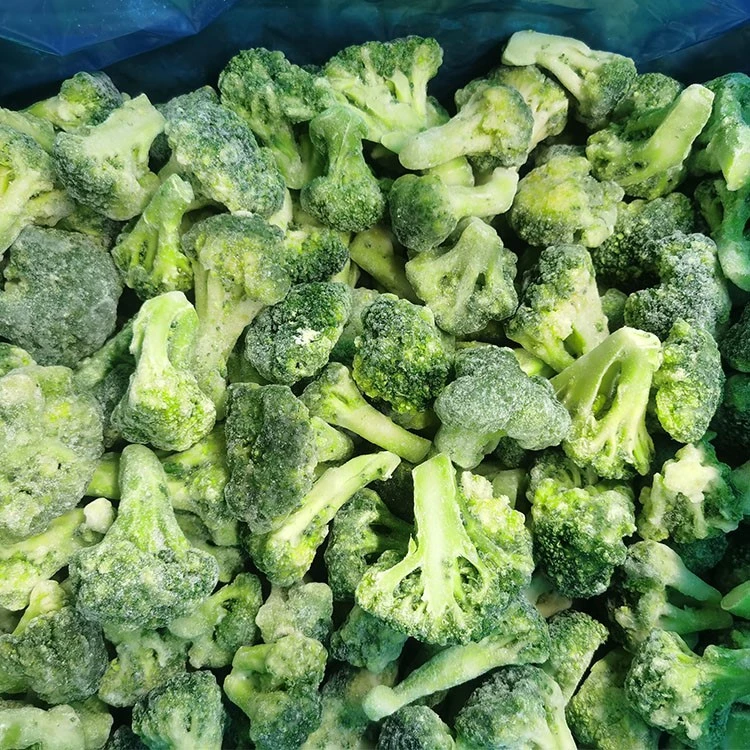
Actual frozen broccoli florets showing the product form, head development, stem proportion and free-flowing frozen condition.
What We Supply
We prepare Brassica oleracea var. italica from sound, appropriately mature heads. After trimming and cutting, the florets are washed, blanched, cooled, individually quick frozen, size graded and packed. The standard ingredient declaration is simply broccoli. Salt, seasoning, sauce and preservatives are not part of the standard product.
Our usual commercial offer is a bright to medium green floret with a compact, reasonably well-developed head and a tender stem after cooking. The product should have the odor and flavor typical of blanched broccoli, with no sour, fermented, scorched or other off-notes. It is supplied frozen and is intended for further cooking by the buyer or final user.
Different programs need different balances between visual presentation, portion control and cost. We therefore quote against a named size and written tolerance, not against the word "florets" alone. Retail packs and premium foodservice programs normally favor uniform heads and short stems. Ready-meal, soup and industrial programs may accept a broader calibration when piece count and yield are more important than a highly uniform plate appearance.
Search Intent Translated Into Procurement Decisions
Buyers searching for frozen broccoli florets, IQF broccoli florets, bulk frozen broccoli or private-label broccoli are usually comparing supply programs rather than looking for a consumer explanation. The useful questions are operational: Will the pieces fit the tray or bag? How much stem and loose bud material is acceptable? Does blanching control enzyme activity? Which lot tests appear on the COA? Can the same supplier pack 1 kg foodservice bags and retail pouches? How is the frozen condition protected through loading?
Stable calibration, carton strength, loading quantity, origin documents and repeat-lot consistency.
Yield, stem profile, fines, blanching endpoint, micro limits and controlled release records.
Piece size, rapid portioning, free-flowing condition and bag formats that fit kitchen throughput.
Net weight, film, artwork, coding, case count, pallet pattern and market-specific label text.
Commercial Product Specification
We use the following table as a detailed quotation baseline. A purchase specification may be tightened or adapted for the destination market, processing use and packing format. Where a buyer requests U.S. Grade A, EU retail requirements or another named standard, that requirement is written into the sales contract together with the applicable sampling and acceptance method.
| Attribute | Standard Offer | How It Is Controlled |
|---|---|---|
| Product | IQF frozen broccoli florets, blanched | Product description and ingredient declaration |
| Botanical name | Brassica oleracea var. italica | Raw-material identity and lot records |
| Ingredient | 100% broccoli | Recipe and label review |
| Calibrations | 20–40, 30–50, 40–60 or 50–70 mm; 2–4, 3–5 and 4–6 cm are equivalent naming forms | Smallest head dimension measured after freezing |
| Size conformity | At least 90% by weight within the contracted calibration | Representative sample, separation and weight calculation |
| Head development | At least 90% well-developed, compact or practically compact heads | Visual grading of thawed sample |
| Color | Characteristic bright to medium green; no material yellowing or browning | Frozen and cooked sensory review |
| Flavor and odor | Typical of young blanched broccoli; no off-odor or off-flavor | Cook test |
| Texture | Tender after cooking, without materially woody or stringy stem tissue | Cook test and cutting assessment |
| Blanching | Peroxidase negative at the agreed test endpoint | Enzyme test recorded for the production lot |
| Frozen condition | Individually frozen and reasonably free flowing | Pack and sample inspection at frozen temperature |
| Clumps | Maximum 5% w/w for the standard offer | Clumps separated and weighed |
| Free ice | Maximum 1% w/w; no deliberate glazing unless specified | Loose surface ice separated and weighed |
| Foreign material | Absent | Sorting, process control and finished-product inspection |
| Shelf life | 24 months from production | Uninterrupted storage and transport at −18°C or below |
| Harvest windows | Main planning windows: June–July and October–November | Crop and production scheduling |
| Declared origin | China; Fujian-origin supply is available by program | Commercial documents and traceability records |
Choose Diameter and Stem Profile Together
A diameter alone does not fully describe a broccoli floret. Two lots can both be called 30–50 mm while having visibly different stem length, head-to-stem balance and broken-piece content. We therefore record the contracted diameter together with the intended presentation.
- 20–40 mm: compact portions for small retail bags, bowls, blended vegetables and ready meals where consistent piece count matters.
- 30–50 mm: the flexible middle range for retail, foodservice, prepared meals and general wholesale distribution.
- 40–60 mm: larger visual pieces for side dishes, steam bags and premium foodservice presentations.
- 50–70 mm: large florets for applications where a substantial head and visible plate presence are preferred.
For short-stem programs, we target a balanced natural stem that supports the head without dominating the piece. If a buyer has a numerical maximum stem length, a maximum percentage of long-stem pieces or a minimum head-material ratio, we place that value in the specification and inspection sheet. This prevents a general floret description from being interpreted differently by the packing plant and receiving warehouse.
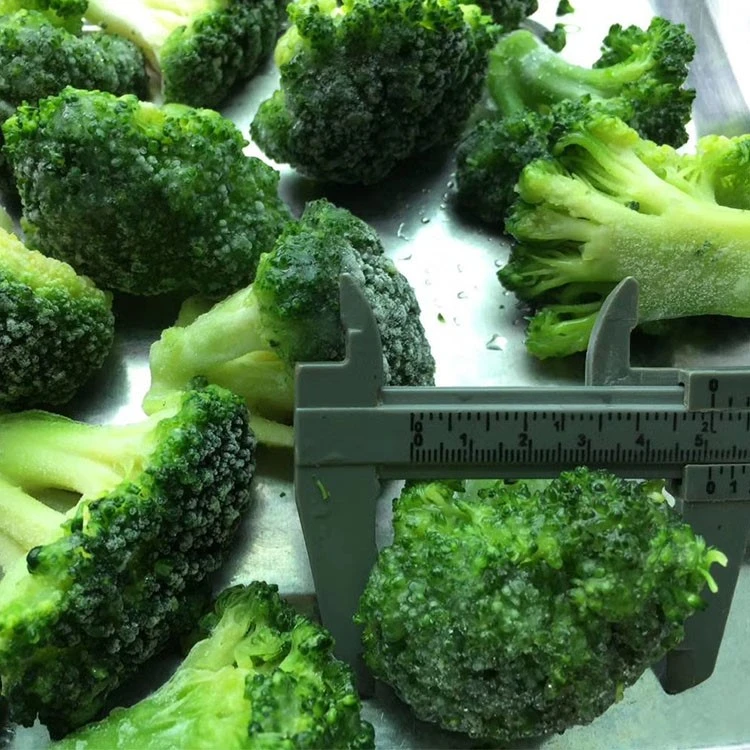
A caliper is used on the smallest head dimension to assess the contracted floret calibration.
Grade Language With Defined Defects
"Grade A" is useful only when its style, sampling plan and defect definitions are understood. The USDA standard for frozen broccoli distinguishes flavor and odor, brightness, grit and silt, development and classified defects. We can supply against a named standard when it is written into the order. For routine international trade, the following defect schedule gives purchasing teams a clearer starting point for a commercial Grade A program.
Yellow, brown, blackened or otherwise discolored areas are assessed by severity and visual impact. Material discoloration is not accepted in the standard offer; any numerical tolerance is recorded separately for the program.
Leaves detached from the floret or retained around the stem are separated from normal head material. A retail program can use a tighter leaf limit than an industrial program.
Detached buds, very small head fragments and broken stem pieces are weighed apart from saleable florets. The undersize fraction is controlled within the contracted 90% size conformity.
Pieces are reviewed for the agreed appearance, stem length and head balance. A floret with a sound head may still fail a short-stem program when the stem is visually dominant.
Disease, insect injury, decay, mechanical damage and dark lesions are classified by how seriously they affect appearance or edible quality.
Open, overmature heads and woody, tough or stringy stems are evaluated after cooking because frozen appearance alone does not reveal the complete eating texture.

Frozen florets in a food-grade liner, allowing buyers to assess head shape, stem profile, color and frost condition.
Processing Flow and Control Points
- Raw material receiving: heads are checked for maturity, compactness, decay, insect damage, foreign material and general condition.
- Trimming and cutting: leaves and excessive stalk are removed; heads are divided into the ordered floret range.
- Washing and sorting: product is washed and visually sorted to remove field material and unacceptable pieces.
- Blanching: time and temperature are controlled to reach the required enzyme endpoint without unnecessary softening.
- Cooling and dewatering: product temperature and surface water are reduced before freezing to support separation and minimize free ice.
- IQF freezing: individual pieces are rapidly frozen, followed by size grading and removal of visible defects.
- Detection and packing: packs pass the applicable foreign-body control, coding, seal, net-weight and case checks.
- Frozen storage and release: the finished lot remains at −18°C or below and is released against the agreed inspection and document package.
Blanching, Freezing and Cooking Performance
Broccoli requires a controlled blanching step before freezing. Under-blanching can leave excessive enzyme activity, while an overly severe treatment may weaken color, texture and stem integrity. Our specification therefore identifies a negative peroxidase result at the agreed endpoint and combines it with a cooked sensory check. The enzyme result describes process control; it does not replace microbiological testing.
IQF performance is judged by more than core temperature. The finished product should separate for portioning, show no evidence of thaw-and-refreeze abuse, and remain within the clump and free-ice limits. Large ice accumulation, crushed heads, dehydrated surfaces or heavily fused blocks may indicate handling problems even when a case is still frozen.
For a buyer trial, we recommend evaluating the same cook method across competing lots. Record cooked color, head integrity, stem tenderness, water release and the amount of fragments left after handling. A short steam or boil test can show whether the chosen calibration fits a tray, bowl, sauce or foodservice side-dish line. We can prepare the trial shipment in the intended production pack so bag handling and portioning are also assessed.
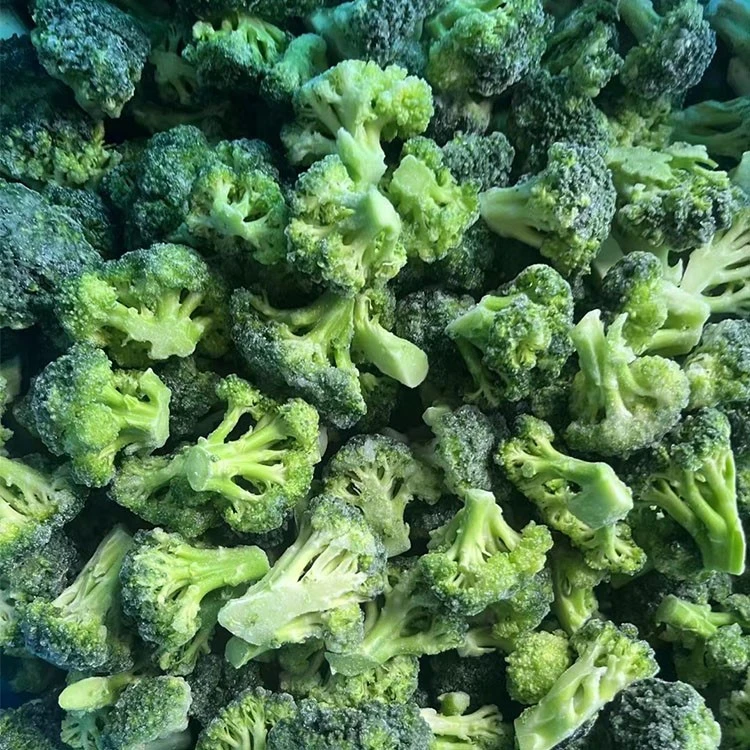
Separated IQF pieces show the frozen condition used for portioning and pack inspection.
Microbiological, Chemical and Physical Control
The table below is our standard discussion baseline for a conventional blanched IQF broccoli program. Destination law, buyer policy, intended use and sampling method may require different limits. We place the final limit, unit, method and sampling basis in the signed product specification. Results reported in a shipment COA come from the corresponding production batch; the limits below are not presented as pre-filled test results.
| Parameter | Standard Contract Limit | COA Reporting |
|---|---|---|
| Aerobic plate count | ≤100,000 CFU/g | Numerical batch result |
| Coliforms | ≤200 CFU/g | Numerical batch result |
| Escherichia coli | <10 CFU/g | Result and method detection limit |
| Yeasts | ≤1,000 CFU/g | Numerical batch result when included |
| Moulds | ≤1,000 CFU/g | Numerical batch result when included |
| Salmonella | Absent in 25 g | Detected / not detected for the batch sample |
| Listeria monocytogenes | Absent in 25 g | Detected / not detected for the batch sample |
| Lead (Pb) | ≤0.10 mg/kg wet weight for the EU brassica-vegetable reference | Numerical result when included in the lot test plan |
| Cadmium (Cd) | ≤0.04 mg/kg wet weight for brassica other than leafy brassica | Numerical result when included in the lot test plan |
| Pesticide residues | Comply with the named destination-market MRL matrix | Analyte-by-analyte result from the applicable screen |
| Foreign material | Absent | Inspection status and corrective disposition if found |
| Metal detection | Detector sensitivity is stated for the selected packing line | Start, interval and end challenge records |

A frozen lot sample used to review piece condition, color, breakage, stem profile and visible defects.
What the Batch COA Shows
We issue the COA against the released production lot and identify the product, lot or batch number, production date, best-before date, packing, applicable specification and report date. The Actual Result column contains values measured on that batch sample. It is separate from the Specification Limit column.
A typical COA includes selected sensory attributes, calibration or physical checks, aerobic plate count, coliforms, E. coli, Salmonella and Listeria monocytogenes. Yeasts, moulds, pesticide residues, Pb, Cd or other buyer-specific parameters are added according to the signed test plan. If a parameter is not tested on every lot, the document does not imply that a contract limit is an actual result.
Method references, laboratory identity, sample date and report number can be included where required. For third-party laboratory testing, lead time and sampling arrangements are built into the order schedule. We retain the link among raw-material source, processing date, packing code, test record, cold-store location and shipment documents so the receiving team can reconcile the cases with the released batch.
Packing Programs From Retail Pouches to Industrial Bulk
We match pack construction to the distribution route, bag handling and required shelf presentation. The original program formats remain available, including 20 × 500 g, 20 × 300 g, 6 × 2.5 lb, 1 × 10 kg, 1 × 20 lb, 1 × 30 lb, 12 × 2 lb and approximately 550 kg octobin supply. Common 1 kg, 2.5 kg and 5 kg foodservice bags can also be developed. Final case dimensions and pallet pattern depend on film, bag count and destination logistics.
| Channel | Typical Formats | Pack Decisions |
|---|---|---|
| Retail | 300 g, 500 g, 1 kg | Plain or printed pouch, artwork, barcode, nutrition panel, coding and case count |
| Foodservice | 1 kg, 2 lb, 2.5 lb, 2.5 kg, 5 kg | Bag strength, repeated opening, portioning and freezer storage |
| Industrial | 10 kg, 20 lb, 30 lb | Food-grade liner, export carton, net weight and line-feeding convenience |
| Large bulk | Approx. 550 kg octobin | Liner configuration, handling equipment, pallet footprint and receiving capability |
Private-label development starts with net weight, legal market, language set, film structure, print colors, seal type, code format, carton marks and barcode data. We check artwork against the supplied product and packing data, while the brand owner retains responsibility for final label approval in its market. Date coding can show production date, best-before date and lot code in the agreed sequence. Case labels and shipping marks are linked to the same batch identity used on the COA and packing list.
Food Manufacturing and Foodservice Fit
Frozen broccoli florets are ordered for ready meals, steamable vegetable packs, side dishes, soup and sauce lines, meal kits, institutional catering and frozen vegetable blends. We keep the page focused on supply fit rather than household recipes. The most important decision is how a floret behaves in the buyer's process.
For tray meals, the piece must fit the compartment, retain a visible head after mixing and finish cooking within the product's heating profile. Soup and sauce lines may favor smaller pieces and a broader stem balance. Foodservice distributors often select 30–50 or 40–60 mm because these ranges are easy to portion and still present as recognizable florets. Steam-bag programs may prefer tighter size distribution so the contents heat more evenly.
Tell us the cook system, target piece count, sauce or blend, bag weight and acceptable broken-piece level. We will align the trial specification with those details. Where broccoli is packed with carrots, cauliflower, beans or other IQF vegetables, we also review the relative calibration and bulk density so one component does not dominate the bag after transport.
Trial Evaluation Sheet
- Frozen piece separation and free ice
- Size distribution and average piece count
- Head-to-stem visual balance
- Loose buds, crumbs and broken pieces
- Cooked color and head integrity
- Stem tenderness and absence of woody fiber
- Water release in the final process
- Pack handling, seal and net-weight performance

General company and facility certificate display. Certificate scope, site name and validity are supplied for the plant assigned to an order; this is not a broccoli batch COA.
Documents for Approval and Shipment
Plant and product approval are separate from shipment release. Before the first commercial order, we provide the available site certificates, product specification, process flow, allergen statement, GMO statement, packing information and label data required by the program. The exact certificate set depends on the production facility selected for the specification and destination.
For shipment, the standard commercial document set can include commercial invoice, packing list, bill of lading, certificate of origin and health or phytosanitary documentation where applicable. A batch COA, temperature records, loading photographs, pallet list, fumigation document or other market-specific paperwork can be added when written into the order.
We do not use a general certificate image as proof of a specific lot result. The buyer receives the named document with its issuing body, scope, site, certificate number and validity information. Product traceability follows the code shown on the bag or case so the COA and shipment papers relate to the physical goods received.
Order Planning, MOQ and Container Loading
A 20-foot reefer commonly plans around 10–12 metric tons and a 40-foot high-cube reefer around 20–24 metric tons for carton-packed frozen vegetables. Actual payload depends on carton dimensions, pallet use, container limit, shipping-line rules and legal road weight at origin and destination. We calculate the loading plan from the final pack rather than promising a fixed carton count before dimensions are set.
Mixed loading can combine compatible frozen vegetables when each SKU reaches a workable production quantity and the carton, pallet and document plan remains clear. A mixed program should identify SKU sequence, lot separation, case marks and document requirements. New printed film and unusual private-label case sizes may require a higher minimum because packaging material has its own production quantity.

General frozen-food cold storage used to illustrate temperature-controlled holding before export; it is not presented as a broccoli-only warehouse.
Cold-Chain Handling Before Dispatch
Finished cases are held at −18°C or below. Before loading, we review the released lot, case condition, code and quantity against the packing list. The reefer is checked for cleanliness, odor, structural condition and suitability for frozen food. The set point is placed on the shipping instruction, and loading is organized to limit unnecessary exposure.
Product temperature, air temperature and display readings are not interchangeable. The shipment record identifies what was measured, where and when. If the order requires a temperature logger, its location and activation are documented. Palletized and floor-loaded shipments use different airflow and capacity plans, so that choice is agreed before final carton calculations.
At receiving, cases should remain hard frozen, seals intact and codes legible. A temperature concern is recorded promptly with logger data, case photographs and the affected lot references. This evidence helps separate a local handling issue from a broader lot question.
Export Loading With Lot Separation
We connect the loading record to the commercial invoice, packing list, lot codes and COA. Carton marks remain visible enough for receiving checks, and different lots or SKUs are separated in the loading plan. Where pallets are used, pallet count, stretch wrapping and labels are recorded. Where cases are floor loaded, the loading sequence is designed around unloading practicality and the final carton count.
The loading image shown here is a general frozen-food export operation. It demonstrates reefer loading, carton handling and temperature checks; it does not claim that every visible carton contains broccoli. Product-specific proof comes from the case code, packing list, loading record and batch documents tied to the order.
For a quotation, provide destination port, Incoterm, required pack, pallet preference and whether mixed SKUs are acceptable. We can then calculate an executable case count, net weight, gross weight and estimated cubic utilization for the proposed shipment.

General frozen-food container loading with carton handling and temperature checks, shown only as cold-chain evidence.
Why Buyers Use GreenLand-food for a Broccoli Program
We define size, stem profile, defects, blanching, micro limits and packing so quotations refer to comparable goods.
We link the product code, lot, inspection record, COA, cold-store release and shipment documents instead of relying on general claims.
We plan retail, foodservice, industrial and octobin formats with coding, artwork, carton marks and container utilization.
We keep the agreed acceptance language visible for future production so a reorder is measured against the same commercial target.
Frozen Broccoli Florets FAQ
1. Which floret sizes do you supply?
We regularly quote 20–40, 30–50, 40–60 and 50–70 mm. The original 2–4, 3–5 and 4–6 cm names refer to the corresponding millimeter ranges. We state the measurement direction and require at least 90% by weight within the contracted range for the standard offer.
2. Are the broccoli florets blanched?
Yes. Our standard IQF broccoli florets are blanched, cooled and then individually quick frozen. The specification uses a negative peroxidase result at the agreed endpoint together with a cook test for color, flavor and texture.
3. Does Grade A define the amount of stem and crumbs?
Not by itself. A grade statement must be linked to a named standard and sampling plan. We also write diameter, stem appearance, size conformity, leaf material, loose buds, undersize pieces, discoloration and other defect tolerances into the commercial specification.
4. Can you supply short-stem broccoli florets?
Yes. State the preferred head-to-stem appearance, maximum stem length or maximum percentage of long-stem pieces. We will use that written definition for the sample and production inspection instead of relying on the phrase "short stem" alone.
5. What is the ingredient declaration?
The standard product is 100% broccoli. It contains no added salt, sauce or seasoning. Any market-specific allergen, GMO or processing-aid statement is supplied as a separate controlled document for the selected plant and product.
6. What microbiological limits can be used?
Our standard discussion baseline is APC ≤100,000 CFU/g, coliforms ≤200 CFU/g, E. coli <10 CFU/g, Salmonella absent/25 g and Listeria monocytogenes absent/25 g. The signed specification controls the final limits, methods and sampling basis.
7. What appears as the COA Actual Result?
The Actual Result is the measured result for the corresponding production batch sample. It is not copied from the specification limit. The COA identifies the lot, dates, pack, methods or references and the parameters included in that order's test plan.
8. Do you test pesticide residues and heavy metals?
We arrange the required residue screen and metal tests according to the destination and buyer matrix. For an EU reference, the table uses Pb ≤0.10 mg/kg and Cd ≤0.04 mg/kg for non-leafy brassica. The shipment plan states which tests apply to each lot.
9. Which retail and foodservice packs are available?
Options include 300 g, 500 g, 1 kg, 2 lb, 2.5 lb, 2.5 kg and 5 kg bags, plus printed or plain film. We develop the case count, artwork, coding, film and carton around the destination market and handling route.
10. Can you pack frozen broccoli in industrial bulk?
Yes. Common bulk formats include 1 × 10 kg, 1 × 20 lb and 1 × 30 lb lined cartons. An approximately 550 kg octobin can be discussed for suitable industrial receiving systems, subject to liner, handling and product-flow requirements.
11. What is the MOQ?
A practical planning MOQ is 10 MT for one regular specification and standard export pack. Selected mixed-container programs may begin around 3–5 MT per SKU when production, packing and documentation are compatible. Printed packaging can raise the minimum.
12. How much fits in a reefer container?
For planning, a 20-foot reefer often carries about 10–12 MT and a 40-foot high-cube reefer about 20–24 MT of carton-packed frozen vegetables. The executable quantity comes from final carton dimensions, pallets, payload and route restrictions.
13. What shelf life and storage temperature apply?
The standard shelf life is 24 months from production when the product remains at −18°C or below. Cases should stay hard frozen, dry, intact and protected from temperature cycling throughout storage and transport.
14. What details are needed for an accurate quotation?
Send the floret size, stem preference, grade or defect schedule, pack, annual volume, destination, required tests, certification scope, Incoterm and desired delivery window. We will return the matching specification, pack plan, MOQ, lead time and container proposal.
Build Your Frozen Broccoli Floret Specification
Send us your required product form, floret diameter, stem profile, grade or defect schedule, blanching requirement, packing, order quantity, application, destination port, Incoterm, private-label needs, certification scope, document and test list, target delivery window and mixed-container plan. We will provide a buyer-ready specification, quotation, packing plan, sample arrangement and shipment document list for the intended program.
Request a Quote View Full Product CatalogHot Tags: frozen broccoli florets, China frozen broccoli florets manufacturers, suppliers, factory, frozen broccoli food storage conditions, frozen broccoli food standards, frozen broccoli slices, frozen broccoli transportation, frozen broccoli nutritional value, frozen broccoli bars
Previous
Frozen Chopped Broccoli


