


Frozen Spinach Brick
Description
Technical Parameters
BQF Spinach Blocks · 500 g & 1 kg · Bulk, Foodservice and Private Label
Frozen Spinach Brick Supply Built Around an Exact Purchase Specification
We supply frozen spinach brick as compact BQF blocks made from 100% Spinacia oleracea. We set the internal leaf form, block weight, leaf-to-stem ratio, dry-matter target, microbiological program, packing and destination-market limits before production.
Our standard offer is 500 g or 1 kg per block, packed to a 10 kg master carton. Chopped, cut-leaf and whole-leaf blocks serve industrial fillings, sauces, ready meals, foodservice kitchens and private-label frozen vegetable programs. The product is blanched and supplied for further commercial cooking or processing; it is not presented as ready-to-eat.

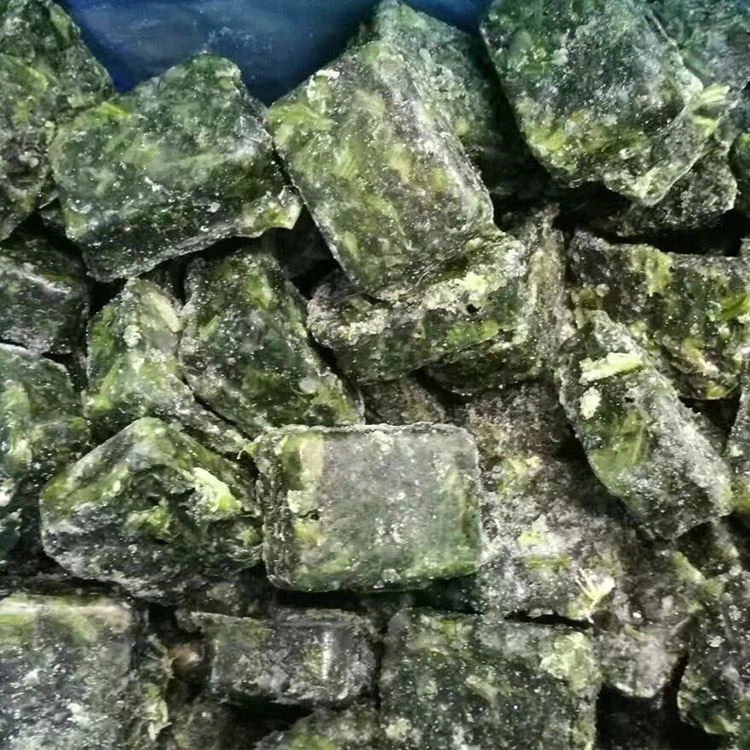
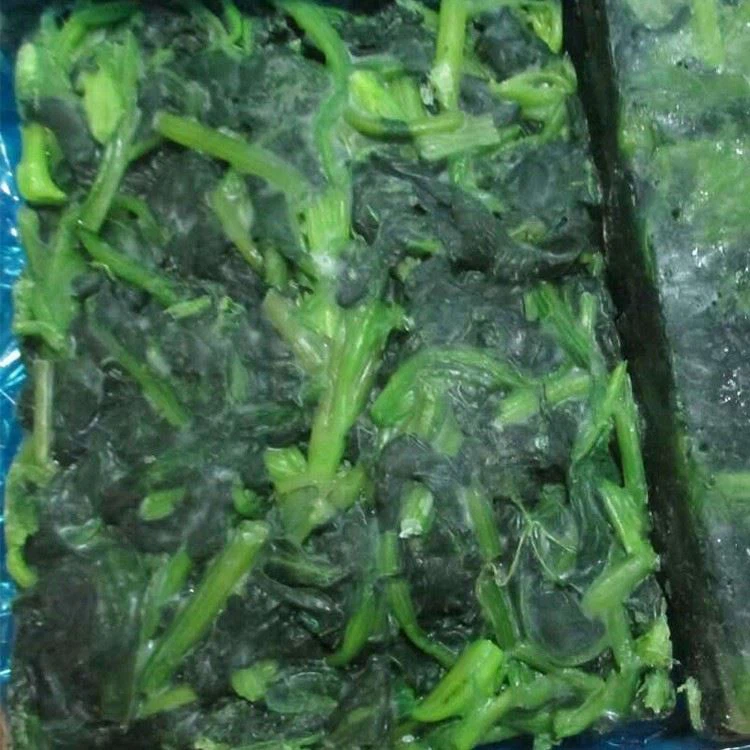
Actual compact spinach block appearance shows why leaf form, stem ratio, color and ice condition must be written into the order standard.
BQF Spinach Brick Is a Compact Block, Not a Loose IQF Product
BQF identifies a block-quick-frozen presentation: prepared spinach is filled or pressed into a defined block and frozen as one compact unit. IQF identifies individually frozen leaf pieces or portions that remain separate. We state the format on the quotation, specification, label and COA so your production team knows whether it will receive a solid block, loose pieces or countable portions.
| Supply form | Physical behavior | Available specification | Typical commercial fit |
|---|---|---|---|
| BQF brick | One compact rectangular block | 500 g or 1 kg; chopped, cut-leaf or whole-leaf interior | Industrial kettles, fillings, puree, sauces and large-batch recipes |
| IQF loose | Free-flowing pieces for partial dosing | 6–10 mm chop; 20–40 mm or 30–50 mm cut leaf | Automated dosing, vegetable blends and rapid dispersion |
| IQF portions | Separate balls or compact mini portions | 15–25 g, 20–30 g, 25–35 g or 30–40 g | Foodservice counting, meal assembly and portion control |

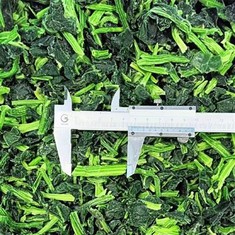
Cut-size measurement provides product-specific evidence for the spinach material used inside each block.

Smaller compact portions illustrate an alternative format; they are quoted separately from 500 g and 1 kg BQF bricks.
Purchase Risks and the Controls Written Into Our Order Standard
A general description such as "1 kg frozen spinach" cannot control how the product runs in a filling line or kettle. We connect each recurring risk to an inspection point and a recordable acceptance result.
| Buyer concern | Order risk | Our control point | Recorded result |
|---|---|---|---|
| Block will not dose consistently | Wrong weight or block form | 500 g or 1 kg nominal weight, packing-count and weight checks | Declared weight and carton configuration on specification |
| Too much stem or coarse texture | Grade does not match filling or sauce | 70:30 standard or 80:20 premium leaf-to-stem target | Ratio and cut form shown in signed specification |
| Recipe becomes watery | Low dry matter or weak draining | Dry matter target ≥6.5%; Codex floor ≥5.5% | Dry-matter result on contracted COA panel |
| Dark, yellow or fibrous material | Raw-material or blanching variation | Color, blemish, stem, root, crown and seed-head inspection | Visual defect record by sample plan |
| Unclear food-safety status | Missing pathogen, nitrate or contaminant data | Defined microbiology and market-specific chemical panel | Batch COA and requested laboratory reports |
| Soft cartons or temperature rise | Block deformation and frost | Seal, carton, product-temperature and reefer-loading checks | Packing inspection and shipment loading record |
Frozen Spinach Brick Forms and Grades
Block weight and internal spinach form are separate selections. A 1 kg block can contain a fine chop, longer cut leaf or substantially whole leaf, and each option behaves differently after thawing, heating and mixing.
Fine chopped block
6–10 mm chopped spinach for sauces, dumpling filling, pasta filling and products requiring rapid dispersion.
Cut-leaf block
20–40 mm or 30–50 mm pieces for ready meals, visible-leaf fillings and foodservice preparation.
Whole-leaf block
Substantially whole leaves with roots removed for applications where a larger leaf appearance remains important.
Puree-grade block
Comminuted spinach with particles below 3 mm for puree, sauce bases and further industrial formulation.
Commercial Specification for Frozen Spinach Brick
The values below form our quotation baseline. They make product comparisons practical and prevent block format, inner cut, packing and test requirements from being mixed into one vague description.
| Product name | Frozen Spinach Brick / BQF Frozen Spinach Block |
| Botanical identity | Spinacia oleracea L. |
| Ingredient | 100% spinach; no added salt, color, preservative or processing additive in the standard item |
| Processing | Sorted, washed, blanched, cooled, drained, chopped/cut as specified, block formed, quick frozen and packed |
| Standard block weight | 500 g or 1 kg per brick |
| Custom compact block range | 350 g, 750 g or 2 kg; project-specific mould, trial and pack plan |
| Internal spinach form | 6–10 mm chopped; 20–40 mm or 30–50 mm cut leaf; whole leaf; puree-grade below 3 mm |
| Leaf-to-stem options | 70:30 standard; 80:20 premium |
| Color and appearance | Characteristic green to dark green, compact block, free from thaw/refreeze deformation and objectionable discoloration |
| Flavor and odor | Characteristic of spinach after commercial cooking; no sour, musty or foreign odor |
| Standard packing | 20 × 500 g / 10 kg carton; 10 × 1 kg / 10 kg carton; food-grade PE liner or individual inner bag |
| Foodservice and industrial packing | 4 × 2.5 kg, 1 × 10 kg, 20 lb or 20 kg master pack when the selected block form and line plan allow it |
| MOQ | 10 MT per standard specification; 15 MT per new private-label artwork; mixed loading from 3 MT per compatible SKU |
| Lead time | 15–20 days after order, specification and packing approval; custom printed film normally 25–35 days |
| Crop and supply | Main processing windows March–April and October–November; frozen inventory supply planned throughout the year |
| Shelf life and storage | 24 months from production at −18°C or below; no thawing and refreezing |
| Loading reference | 20RF: 10.0–11.5 MT; 40RF/40RH: 23.0–24.0 MT, non-palletized 10 kg cartons |
| Origin and loading port | China; Xiamen port baseline |
| Trade terms | FOB, CFR or CIF in USD |
| Commercial use | Food manufacturing, foodservice, distribution, repacking and private label; cook before consumption |
Application Matching by Cut, Block Weight and Dry Matter

Portioned spinach is shown as a clearly different alternative when countable dosing is more important than compact BQF bricks.
Commercial Processing and Product-Specific Control Points
We treat frozen spinach as a leafy-green risk profile. Soil, grit, roots, seed heads, coarse stems, damaged leaves, wash-water control, blanching, drainage and frozen handling all affect the finished block.

Product-specific manual sorting shows inspection of chopped spinach for plant defects and foreign material before final frozen handling.
COA Framework: Identity, Physical Condition and Visual Defects
We use the signed specification as the acceptance standard and issue the COA against the contracted panel. The table combines a tighter commercial dry-matter target with Codex CXS 77-1981 spinach criteria and clear sampling language.
| COA item | Acceptance value | Purpose / assessment |
|---|---|---|
| Identity | 100% Spinacia oleracea L. | Ingredient and botanical identity |
| Color | Characteristic green to dark green | Uniform overall appearance without objectionable dark or yellow material |
| Flavor / odor | Characteristic; no foreign, sour or musty note | Organoleptic assessment after commercial cooking |
| Salt-free dry matter | ≥6.5% commercial target; Codex minimum ≥5.5% | Controls water release and recipe yield |
| Mineral impurities | ≤0.10% m/m | Sand, grit and silt on whole-product basis |
| Visual defect sample | 100 g for chopped; 300 g for leaf/cut-leaf | Codex standard sample sizes |
| Chopped visual defect points | Total ≤20; major ≤10 per 100 g | Discoloration, extraneous vegetable matter, buds, crown and root material |
| Hazardous foreign material | Not detected in the sample | Glass, metal, hard plastic, stone, wood or toxic plant material |
| Leaf-to-stem ratio | 70:30 or 80:20 as contracted | Grade and texture control |
| Product temperature | ≤−18°C at release | Frozen-condition check linked to production or dispatch record |

The product image shows two measurable release checks: spinach cut size and frozen product temperature.
COA Framework: Microbiology, Nitrate, Heavy Metals and Residues
These are defined specification limits, not invented batch results. The shipment COA reports the actual result for the agreed batch and method. Our standard microbiological panel is deliberately more informative than the minimal product descriptions found in most supplier listings.
| Microbiological test | Standard export limit | Reporting format |
|---|---|---|
| Aerobic plate count | ≤100,000 CFU/g | Enumeration |
| Coliforms | ≤100 CFU/g | Enumeration |
| E. coli | <10 CFU/g | Enumeration |
| Yeasts | ≤1,000 CFU/g | Enumeration |
| Moulds | ≤1,000 CFU/g | Enumeration |
| Salmonella spp. | Absent in 25 g | Detected / not detected |
| Listeria monocytogenes | Absent in 25 g | Detected / not detected |
| Chemical / contaminant item | Defined value | Program |
|---|---|---|
| Nitrate as NO3 | ≤2,000 mg/kg | EU maximum for preserved, deep-frozen or frozen spinach |
| Nitrite as NO2 | ≤20 mg/kg | Commercial contract target when included in the panel |
| Lead (Pb) | ≤0.30 mg/kg | EU leaf-vegetable maximum on wet weight |
| Cadmium (Cd) | ≤0.20 mg/kg | EU maximum for spinach and similar leaves on wet weight |
| Perchlorate | ≤0.50 mg/kg | EU maximum for leaf vegetables and herbs |
| Pesticide residues - EU | Each active substance ≤ its spinach MRL; 0.01 mg/kg default where no specific MRL is set | Regulation (EC) No 396/2005, including processing-factor treatment where applicable |
| Pesticide residues - other markets | Each active substance ≤ destination-market tolerance | Multi-residue screen selected for the United States, Canada, United Kingdom, Japan or contracted market |
A destination panel can also add arsenic, mercury, chlorate, irradiation status, GMO statement, allergen statement and nutrition analysis. These are listed as separate report lines rather than hidden inside a general "complies" statement.

The image documents general frozen-food detection capability; the contracted spinach block and pack size govern the validated sensitivity.
Foreign-Material Control and Metal Detection
Spinach requires field-origin and factory-origin controls. We use raw-material sorting, washing, final visual inspection and detection as separate barriers. Hard hazardous material is not accepted in the shipment sample.
For 500 g finished packs, our reference detection target is Fe 1.5 mm, non-ferrous 2.0 mm and stainless steel 2.5 mm test spheres. A thicker 1 kg frozen block creates a different product effect; the line setting is therefore recorded against the actual aperture, product temperature, orientation and block thickness.
Challenge checks are recorded at start-up, at least hourly, after an interruption or setting change, and at the end of the run. A failed challenge places product produced since the last satisfactory check on hold for investigation and re-screening.
Packing, OEM and Private-Label Programs
We define the food-contact liner, block count, master-carton strength, label language, lot coding and pallet or floor-loading plan as separate approval points. This protects net weight, carton condition and traceability during frozen distribution.
| Channel | Pack configuration | Order data required |
|---|---|---|
| Standard export | 20 × 500 g or 10 × 1 kg / 10 kg carton | Block form, leaf grade, inner bag, carton mark and destination |
| Foodservice | 4 × 2.5 kg, 1 × 10 kg, 20 lb or 20 kg case | Kitchen batch size, liner type, case handling and pallet requirement |
| Industrial | 500 g, 1 kg or 2 kg blocks inside a bulk master pack | Kettle input, thaw method, recipe yield, dry matter and test panel |
| Private label | Printed inner bag or retail box inside export carton | Artwork, barcode, language, legal name, nutrition, date format, recycling marks and carton marks |
Documents, Traceability and Importer QA File
We connect the finished lot code with raw-material receipt, production date, processing line, pack format, frozen-storage record and shipment. The resulting document set supports import clearance, supplier approval and repeat-order comparison.
Review our batch traceability system · Review certificates and compliance support
Frozen Storage, Reefer Loading and Container Quantity
We store and ship frozen spinach brick at −18°C or below. The block must remain frozen through warehousing, loading, ocean transport and destination handling; repeated thawing and refreezing causes deformation, excess surface ice and texture loss.
For non-palletized 10 kg cartons, the working reference is 10.0–11.5 MT in a 20RF and 23.0–24.0 MT in a 40RF/40RH. Pallets, carton dimensions, road limits and carrier payload reduce the final net product weight.
Mixed frozen-vegetable loading starts from 3 MT per compatible SKU. We align carton dimensions, production timing, label status, document needs and reefer set point before the loading plan is issued.

Floor-loaded frozen cartons illustrate container-space planning; the final quantity follows the approved carton and route limits.
Why Importers and Food Manufacturers Work With GreenLand-food
Explore frozen vegetable supply solutions · Review our quality control system
Frozen Spinach Brick FAQ
It is washed, blanched and drained spinach formed and frozen as one compact rectangular block. We supply 500 g and 1 kg BQF bricks as our standard sizes.
2. Is frozen spinach brick IQF or BQF?The compact brick format is BQF. IQF describes loose leaf pieces or individual portions that remain separate; we identify the exact freezing format on the quotation and specification.
3. Which block weights can you supply?Our standard block weights are 500 g and 1 kg. Custom 350 g, 750 g and 2 kg compact blocks can be developed with the mould, trial, carton and MOQ plan stated in the quotation.
4. What spinach cuts are available inside the block?We offer 6–10 mm chopped spinach, 20–40 mm or 30–50 mm cut leaf, whole leaf and puree-grade spinach below 3 mm. The internal cut is specified separately from the block weight.
5. What leaf-to-stem ratio is available?The standard target is 70% leaf and 30% stem. We also offer an 80:20 premium grade for a finer texture and stronger leaf presentation.
6. What dry-matter limit do you use?Our commercial target is at least 6.5% salt-free dry matter. Codex CXS 77-1981 sets a minimum of 5.5%; the stronger target gives a clearer baseline for water release and recipe yield.
7. What microbiological limits appear on the COA?Our standard panel uses APC ≤100,000 CFU/g, coliforms ≤100 CFU/g, E. coli <10 CFU/g, yeast and mould each ≤1,000 CFU/g, with Salmonella and Listeria monocytogenes absent in 25 g.
8. What nitrate limit applies to frozen spinach for the EU?The maximum is 2,000 mg nitrate as NO3 per kg for preserved, deep-frozen or frozen spinach. We also offer a nitrite contract target of ≤20 mg/kg when that test is included.
9. Which heavy-metal values do you use for an EU program?The defined limits are lead ≤0.30 mg/kg and cadmium ≤0.20 mg/kg on wet weight. Perchlorate is set at ≤0.50 mg/kg for the EU leaf-vegetable program.
10. How are pesticide residues controlled?For the EU, each active substance must meet its spinach MRL; the default is 0.01 mg/kg where no specific MRL is set. Other destinations use the current tolerance list for that market and the agreed multi-residue screen.
11. What is the standard packing?The standard carton is 20 × 500 g or 10 × 1 kg, totaling 10 kg net. Foodservice options include 4 × 2.5 kg, 1 × 10 kg, 20 lb and 20 kg master packs.
12. What are the MOQ and lead time?The standard MOQ is 10 MT per specification and 15 MT for a new private-label artwork. Standard packing lead time is 15–20 days; custom printed film is normally 25–35 days.
13. Can you load frozen spinach brick with other vegetables?Yes. A compatible mixed-container plan can start from 3 MT per SKU when carton dimensions, production timing, labels, documents and frozen conditions align.
14. Which documents are available with the shipment?We provide the signed product specification, batch COA, packing list, commercial invoice and lot traceability. Microbiology, pesticide, nitrate, heavy-metal, inspection and market documents are included according to the contracted file list.
15. How should frozen spinach blocks be stored and shipped?Keep the product at −18°C or below for its 24-month shelf life and ship it in a frozen reefer. Do not thaw and refreeze; temperature abuse can deform blocks and increase surface frost and drip loss.
Send a Complete Frozen Spinach Brick RFQ
For a usable quotation, send the block weight, internal cut, leaf-to-stem ratio, dry-matter target, microbiological and chemical panel, packing, quantity, application, destination port and shipment month.
Hot Tags: frozen spinach brick, China frozen spinach brick manufacturers, suppliers, factory, frozen vegetables spinach, iqf chopped spinach, frozen spinach cube, frozen spinach
Previous
Spinach Balls Frozen