



Small Frozen Blueberries
Description
Technical Parameters
IQF Whole Fruit · Small Calibre · Bulk · Private Label
Small Frozen Blueberries Specified by Berry Type, Diameter and Processing Performance
We supply small IQF frozen blueberries for bakery factories, jam and fruit-preparation processors, dairy manufacturers, beverage programs, foodservice distributors, repackers and retail frozen brands. Our main small cultivated program is 8–12 mm whole blueberries, individually frozen and supplied as a free-flowing, unsweetened fruit ingredient.
We do not use "small blueberry" as a substitute for product identity. Cultivated highbush blueberries in an 8–12 mm calibration and wild or lowbush blueberries in a 4–9 mm calibration have different botanical types, flavor profiles, Brix ranges, color behavior, availability and costs. We write the type, origin, diameter range, grade, Brix, defect limits and packing into one commercial specification.

Actual frozen blueberry lot shown with diameter measurement and frozen-condition inspection tools.
What Defines a Commercial Small Blueberry Lot
Diameter alone does not determine application performance. Two 8–12 mm lots can differ in maturity, Brix, acidity, whole-berry condition, red or green berry count, cap stems, loose ice and juice release. We place these characteristics beside packing and document requirements so purchasing, quality assurance and production teams work from the same acceptance basis.
| Sourcing decision | Order risk | Our written control | Commercial result |
|---|---|---|---|
| Cultivated or wild? | The name "small" hides species, size, flavor and price differences. | We state cultivated/highbush or wild/lowbush and do not mix the two types. | The quotation matches the fruit identity evaluated by your team. |
| Nominal size or measured distribution? | Wide oversize and undersize tails change piece count and dosing. | We use sieve or caliper measurement and an in-range percentage. | Repeatable berry count, fill distribution and visual density. |
| Brix without pH? | Sweetness alone does not predict tartness or recipe balance. | Brix and pH appear as separate specification and batch result fields. | Better control of jam, dairy, beverage and bakery formulations. |
| Whole fruit or processing grade? | Broken, crushed and soft berries affect yield and color release. | We set whole-berry and defect limits for Grade A and Premium Grade. | The grade is measurable rather than a descriptive label. |
| Specification or COA result? | A copied limit can be mistaken for a laboratory result. | Specification Limit and Batch Actual Result remain separate columns. | A batch-linked QA record for receiving and repeat orders. |
Product Identity and Size Programs
Small Cultivated 8–12 mm
Our primary program for visible bakery inclusions, fruit preparations, dairy applications, retail mixes and foodservice. The commercial specification targets at least 90% in range for Grade A or 95% for Premium Grade.
Extra-Small Cultivated 6–8 mm
A crop- and lot-dependent program for fine dosing or compact inclusions. We quote it separately because availability, sorting yield and price differ from standard 8–12 mm fruit.
Wild / Lowbush 4–9 mm
A separate Vaccinium angustifolium-style supply route with naturally smaller berries, deeper color and a different Brix/pH reference. It is not relabelled cultivated fruit and is offered according to origin and crop availability.
Processing Grade / Uncalibrated
A cost-focused option for jam, puree, concentrate preparation or blending where whole appearance is secondary. Defect tolerance, Brix and foreign-material requirements remain written and measurable.

Whole frozen berries show the natural blue bloom, frost and crop-related color variation evaluated during grade inspection.
One size method per contract
We identify the primary sizing method as sieve screening or individual diameter measurement. The acceptance record states sample weight, in-range percentage, oversize percentage and undersize percentage. A simple "8–12 mm" description without distribution tolerance is not sufficient for repeat-order control.
We also state whether the lot is calibrated before freezing, after freezing or checked at final packing. Frozen berries may carry surface frost, so the method and product condition are kept consistent between approval and shipment inspection.
Commercial Product Specification
The values below form our quotation basis for small cultivated blueberries. Wild fruit and processing grade use separate schedules so type-specific Brix, pH and defect characteristics are not combined.
| Field | Small Cultivated Supply Program |
|---|---|
| Product Name | IQF Small Cultivated Blueberries / Small Frozen Blueberries |
| Ingredient | 100% blueberries; no added sugar, syrup, color or preservative in the standard unsweetened product |
| Type | Cultivated/highbush blueberry; wild/lowbush fruit quoted separately |
| Origin | China or the origin written in the contracted lot specification |
| Main Diameter | 8–12 mm; 6–8 mm project lots according to crop and sorting availability |
| Size Conformity | Grade A ≥90% in range; Premium Grade ≥95% in range |
| Brix | 7–12° reference for cultivated fruit; batch Actual Result reported when included in the COA |
| pH | 2.5–3.8 reference; narrower project range available in the agreed specification |
| Color | Natural blue to blue-black with normal bloom and controlled red-purple or unripe fruit |
| Flavor & Odor | Typical blueberry flavor and odor; free from fermented, mouldy or other off-odor |
| Processing | Selected, cleaned, washed as applicable to the process plan, drained, sorted, size graded, IQF frozen, inspected, metal detected and packed |
| Grade | Grade A or Premium Grade under the defect schedule below |
| Packing | 1×10 kg, 4×2.5 kg, 10×1 kg, 20×500 g, 30 lb case, 550 kg tote, or approved private-label format |
| MOQ | 10 MT for standard bulk packing; 15 MT for new private-label packing; mixed container from 3–5 MT per compatible SKU |
| Loading Capacity | Approximately 10–12 MT per 20'RF or 22–24 MT per 40'RH, adjusted for carton, tote and pallet plan |
| Shelf Life / Storage | 24 months from production when continuously stored at −18°C or below |
| Lead Time | 15–21 days for standard packing; private label follows approved artwork and material schedule |
| Loading Port | Xiamen, Dalian, Qingdao or the contracted China port |
| Trade Terms | FOB, CFR/CNF or CIF |
| HS Code Reference | 0811909090, subject to destination customs classification |
Grade A and Premium Grade Defect Schedule
We evaluate frozen product on a defined sample and record the sample basis in the inspection instruction. "Absent" means no defect observed in the inspected sample; it is not a claim about every berry beyond the agreed sampling plan.
| Parameter | Grade A Limit | Premium Grade Limit | Inspection Basis |
|---|---|---|---|
| Specified diameter | ≥90% in range | ≥95% in range | Sieve or caliper check |
| Whole berries | ≥90% | ≥95% | Weight basis after separation |
| Broken, crushed or mushy berries | ≤10% | ≤5% | Weight basis |
| Red-purple berries | ≤5% | ≤3% | Count or weight basis stated in specification |
| Green / undeveloped / dissimilar edible berries | ≤15 pieces per 500 g | ≤5 pieces per 500 g | Direct count |
| Clusters | ≤5 per 500 g | ≤2 per 500 g | Direct count |
| Cap stems ≥2 mm | ≤8 per 500 g | ≤4 per 500 g | Direct count |
| Loose ice | ≤2% | ≤1% | Weight after separation |
| Mould, decay, insects or hazardous foreign material | Absent | Absent | Visual inspection of sample |
Processing Flow and Product-Specific Controls
Type, origin, maturity, color and incoming defects
Leaves, stems, field material and unsuitable fruit removed
Controlled washing and draining under the process program
Color, maturity, defect and diameter separation
Individual freezing and free-flowing condition control
Inspection, metal detection, weight, seal and label checks
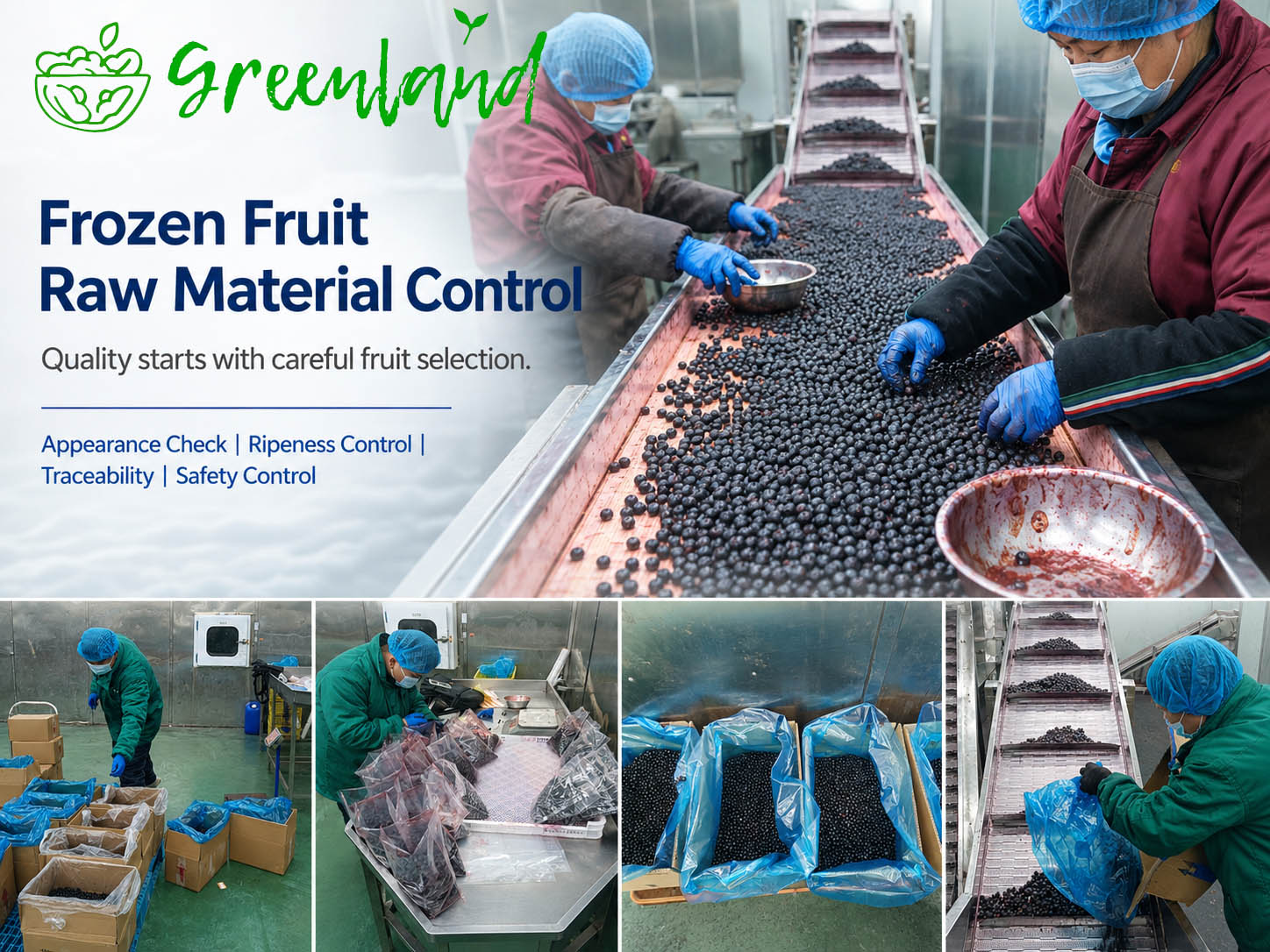
The visual shows dark berries being manually inspected for appearance, maturity and unsuitable material before final packing.

The blueberry line supports color and defect separation; final diameter conformity is recorded against the contracted method.
Application Matching by Processing Need
Bakery Inclusions
For muffins, cakes and filled products, we prioritize diameter distribution, whole-berry ratio, low loose ice and controlled damaged fruit. An application test can record berry count per dough weight, bake bleed, visible berry retention and final color distribution.
Jam, Puree and Fruit Preparation
For cooked processing, Brix, pH, color strength, foreign material and processing yield matter more than bloom. We can quote Grade A, processing grade or wild fruit as separate options without concealing type differences.
Yogurt and Dairy
For visible inclusions or fruit-preparation manufacture, we align berry size with dosing equipment and cup format. The trial record can include thaw drip, color migration, texture after mixing, pH interaction and hold-time appearance.
Smoothie and Beverage
For blending, the key controls are fruit identity, Brix, pH, color, foreign material, microbiological specification and pack handling. A wider size distribution can reduce cost when intact appearance is not part of the finished product.
Retail and Private Label
Retail programs require stable whole-fruit appearance, low frost, controlled clumping, seal integrity and accurate label information. We review net weight, bag dimensions, film, label language, barcode, artwork and case marks as individual fields.
Repacking and Frozen Mixes
Repackers need free-flowing berries, consistent diameter, strong bulk liners and manageable loose ice. For mixed berries or mixed-container orders, we coordinate compatible storage, carton dimensions and SKU quantities.
Thawing, Drip Loss, Color Release and Application Testing
Frozen appearance does not predict every downstream result. We therefore connect the purchase specification with a defined application test when drip, color migration, berry breakage or dosing accuracy matters. The approved sample, production lot and repeat lot are evaluated under the same sample weight, time, temperature and handling method.
Controlled Thaw Test
A 500 g sample is thawed in a covered container at 4°C for 12 hours. We record the starting frozen weight, separated liquid weight, drained fruit weight, visible damaged fruit and final appearance. Drip loss is calculated as separated liquid divided by the original sample weight. The contract can use a project target such as ≤8% for visible-fruit applications or a different limit established by the approved trial.
Bake Performance
For muffins or cakes, we record frozen berry addition rate, mixing time, batter temperature, oven profile and finished product weight. The evaluation covers berry distribution, visible whole pieces, purple bleed halo, localized wet pockets and berry loss at cutting. The same formulation and berry dose are used when comparing 8–12 mm Grade A with Premium Grade or a larger calibration.
Dairy and Fruit Preparation
For yogurt or fruit preparation, the test states whether fruit is added frozen, thawed or cooked. We record dosing through the intended opening, whole-fruit retention, serum color, flavor balance, pH after mixing and appearance after the agreed holding period. A small berry can improve distribution per cup, but a tighter diameter range is needed when a declared piece count or visible inclusion pattern is part of the product standard.
Jam and Puree Yield
For cooked processing, we compare incoming Brix, pH, thawed yield, screened waste and final soluble solids after a fixed cooking profile. Whole-berry appearance can be traded against processing-grade cost, but mould, decay, hazardous foreign material and microbiological requirements remain unchanged. The result lets the quotation compare usable fruit input rather than price per gross kilogram alone.
An application limit is written only after a test method is defined. Terms such as "good bake stability," "low bleed" or "firm texture" are replaced by the agreed conditions, photos, weights, measured result and acceptance decision. This gives R&D and procurement a repeatable reference when crop conditions change.
Microbiological, Chemical and Foreign-Material Controls
The limits below are our commercial starting specification for an IQF fruit ingredient. Destination-market law, final use and customer risk assessment can require a different test panel. The batch COA reports the tests included for that production lot.
| Test | Commercial Specification Limit | Reporting |
|---|---|---|
| Total Plate Count | ≤100,000 cfu/g | Numeric batch result |
| Coliforms | ≤100 cfu/g | Numeric batch result |
| E. coli | ≤10 cfu/g | Numeric or below reporting limit |
| Yeast | ≤1,000 cfu/g | Numeric batch result |
| Mould | ≤1,000 cfu/g | Numeric batch result |
| Salmonella | Absent in 25 g | Detected / not detected |
| Listeria monocytogenes | Absent in 25 g | Detected / not detected |
| Lead for EU program | ≤0.10 mg/kg, wet weight | Laboratory Actual Result |
| Cadmium for EU program | ≤0.030 mg/kg, wet weight | Laboratory Actual Result |
| Pesticide residues | Destination-market MRL by active substance; EU default 0.01 mg/kg where no specific MRL is set | Multi-residue report with analyte results and LOQ |
| Metal detection | Fe 2.0 mm / Non-Fe 2.5 mm / SUS 3.0 mm starting sensitivity | Line challenge record; final sensitivity stated by equipment and pack format |

The photograph shows packed frozen blueberry cartons passing through metal detection before frozen storage.
Food-safety wording tied to a test plan
We report pesticide findings against the named active-substance limits and do not replace laboratory data with an absolute marketing claim. An infant or young-child food project requires its own raw-material standard, destination-market contaminant limits, pesticide panel, microbiological plan, processing controls and customer approval route.
Allergen status, organic status and non-GMO documentation are stated only for the applicable lot and supply program. The standard product is a single fruit ingredient, but shared-site allergen review remains part of the document package.
COA Structure: Limit and Batch Actual Result
A COA is linked to the production batch shown on the carton or bag label. The example structure below shows how we separate the contracted limit from the corresponding production batch's measured Actual Result. It does not pre-fill a result before the lot is tested.
| COA Item | Specification Limit | Batch Actual Result | Method / Basis |
|---|---|---|---|
| Product identity | Small cultivated IQF blueberry | Recorded for production batch | Specification and label review |
| Diameter conformity | 8–12 mm; ≥90% or ≥95% in range | Measured percentage for batch | Sieve / caliper sampling |
| Brix | 7–12° or contracted range | Measured °Brix for batch | Refractometer on prepared sample |
| pH | 2.5–3.8 or contracted range | Measured pH for batch | Calibrated pH meter |
| Whole berries | ≥90% / ≥95% | Inspected percentage | Weight separation |
| Microbiological items | Individual limits in test schedule | Numeric results / detected status | Laboratory methods stated on report |
| Net weight | Declared net weight and legal tolerance | Production weight-check result | Calibrated scale record |

A historical frozen blueberry laboratory report is shown as a document-format example; it is not the COA for every order.
QA and export file
We provide the product specification, batch COA, packing list and commercial invoice. The order file can also include microbiological, pesticide residue, heavy metal, Brix, pH, allergen and traceability records according to the contracted test plan.
Certificate of origin, health certificate, phytosanitary certificate and other clearance documents are prepared according to destination requirements and shipment arrangement. Facility certificates are matched to the selected production site; they are not described as product certificates.
Packing, Private Label and Frozen Shipment
Industrial Bulk
1×10 kg liner/carton, 30 lb case or 550 kg tote for processors and repackers. We align liner thickness, closure, carton strength, pallet pattern and warehouse handling.
Foodservice
4×2.5 kg or 10×1 kg for central kitchens, bakeries and distributors. Inner packs reduce repeated bulk handling and allow controlled issue by production batch.
Retail / OEM
20×500 g, 10×1 kg and approved custom bags. We review film structure, zipper, artwork, nutrition data source, ingredient statement, barcode, language, date code and case marks.
We store and ship the product at −18°C or below. Cartons are checked for label identity, batch number, net weight, seal condition and damage before loading. Reefer set point, pre-cooling status, loading pattern and temperature records are retained with the shipment file. Repeated thawing and refreezing are excluded from the handling plan because they increase clumping, loose ice, texture damage and package staining.

A blueberry order record links bulk product appearance, 10 kg weight, carton label and packing inspection.

General frozen-food reefer loading evidence supports carton, temperature and shipment-handling controls; it is not presented as a blueberry-only container.
Batch Traceability and Repeat-Order Control
We connect the finished carton code with product identity, origin, raw-material lot, production date, process record, packing line, COA and shipment. A specification version number prevents an old grade or packing instruction from being reused after a change.
Type, origin, crop lot, incoming inspection and maturity
Date, line, cleaning, grading, IQF and final inspection records
Specification version, COA, test reports and release status
Carton label, pallet, container, temperature and export documents
For repeat orders, we compare the new lot against the same identity, size method, grade limits, Brix/pH range, pack construction and application test. Crop variation is reported as a new batch result rather than hidden behind a generic product name.
Small Frozen Blueberries FAQ
1. What size are small frozen blueberries?
Our main small cultivated specification is 8–12 mm. We also list 6–8 mm cultivated project lots and 4–9 mm wild/lowbush fruit separately because they are not the same product identity.
2. Are small cultivated blueberries the same as wild blueberries?
No. Cultivated/highbush and wild/lowbush blueberries have different botanical types, size distributions, flavor, color behavior and sourcing. We identify the type on the specification and label.
3. How is the 8–12 mm range controlled?
We use a stated sieve or caliper method and record the in-range percentage. Grade A targets at least 90% in range, while Premium Grade targets at least 95%.
4. What are the Brix and pH ranges?
Cultivated fruit uses a 7–12° Brix and pH 2.5–3.8 reference. Wild 4–9 mm fruit uses a separate 10–17° Brix and pH 2.9–3.6 reference; the batch COA records tested values when included.
5. Are the blueberries unsweetened?
Yes. Our standard product contains 100% blueberries without added sugar, syrup, color or preservative. Any formulated or sweetened product would require a separate ingredient statement.
6. What defects are controlled?
We inspect whole berries, broken/crushed/mushy fruit, red-purple or unripe berries, clusters, cap stems, loose ice, mould, decay, insects and foreign material under written limits.
7. Which grade is suitable for bakery?
Grade A 8–12 mm fits many bakery inclusions. Premium Grade is used when tighter size distribution, at least 95% whole fruit and lower damaged-fruit tolerance are required for visible pieces.
8. Can processing grade be used for jam or puree?
Yes. Processing grade can reduce ingredient cost where final whole appearance is not required. We still write Brix, pH, foreign-material, microbiological and defect limits into that SKU.
9. What packing formats are available?
Options include 1×10 kg, 4×2.5 kg, 10×1 kg, 20×500 g, 30 lb cases and 550 kg totes. Private-label dimensions and film are reviewed with artwork and the loading plan.
10. What is the MOQ?
Our working MOQ is 10 MT for standard bulk packing and 15 MT for a new private-label program. Compatible mixed-container planning starts from 3–5 MT per SKU.
11. What is the shelf life and storage temperature?
Shelf life is 24 months from production under continuous storage at −18°C or below. Frozen transport uses a reefer plan that avoids thawing and refreezing.
12. Which documents accompany an order?
We provide the specification, batch COA, packing list and commercial invoice. Microbiological, pesticide residue, heavy metal, Brix, pH, traceability and clearance documents follow the contracted order file.
13. Does the COA show actual test results?
Yes. Specification Limit and Batch Actual Result are separate. The Actual Result is the measured or observed value for the corresponding production batch, with the method or reporting basis stated.
14. What information is needed for a quotation?
Send the cultivated or wild type, diameter, grade, Brix/pH target, packing, quantity, destination port, application, document list, private-label requirement and target shipment date.
Build a Complete Small Frozen Blueberry RFQ
Send us the blueberry type, 8–12 mm or alternative size, Grade A or Premium Grade, Brix/pH range, whole-berry and defect limits, packing, order quantity, destination port and final application.
Include your microbiological limits, pesticide panel, heavy-metal requirements, COA format, private-label artwork, pallet plan, mixed-container request and target shipment date. We will return one quotation basis that connects product identity, specification, packing, documents and cold-chain delivery.
Hot Tags: small frozen blueberries, China small frozen blueberries manufacturers, suppliers, factory, iqf frozen blueberries, frozen cultivated blueberries, frozen blueberry, frozen unsweetened blueberries
Previous
Iqf Wild Blueberries


