



Frozen Whole Carrots
Description
Technical Parameters
GreenLand-food · IQF Vegetable Supply
IQF Frozen Whole Carrots for Foodservice, Processing and Private Label
We supply natural whole baby carrots, cut-and-shaped baby whole carrots and regular whole carrots for importers, frozen-food distributors, foodservice programs, ready-meal factories, vegetable blenders and retail brands.
We define the carrot form, diameter, length, grade, blanching condition, defect limits, microbiological panel, packing and shipment file in one commercial specification. This prevents whole carrots, baby carrots and shaped carrot pieces from being quoted as though they were the same product.
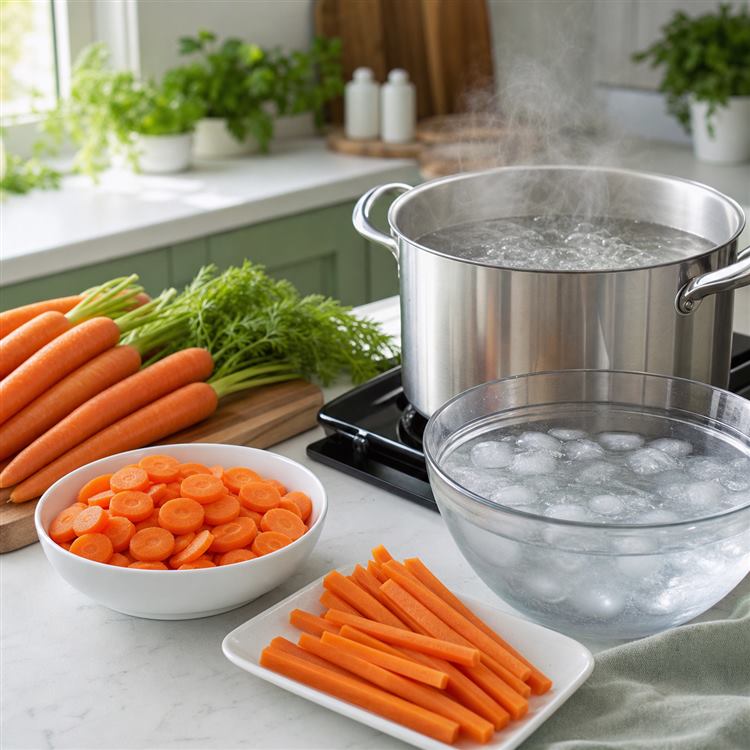
Whole fresh carrot raw material shown with prepared cuts and a blanching setup; this is a process reference, not a frozen-finished-product photograph.
Define "Whole" Before Comparing Price
The trade name frozen whole carrots can describe several products with different raw-material cost, processing yield and cooking behavior. Natural whole baby carrots retain their naturally developed shape. Cut-and-shaped baby whole carrots are prepared from larger roots, cut shorter and shaped to resemble a small whole carrot. Regular whole carrots retain the approximate form of a full carrot and can be much larger. We identify the supplied form in the quotation, specification, label and COA file.
Diameter and length influence heating time, portion count, glazing performance, plate presentation and usable yield. A 6–14 mm natural baby carrot behaves differently from a 14–18 mm carrot or a 45–65 mm shaped unit. The purchase specification therefore states the size range, measurement method, percentage within range and tolerance for short pieces, splits and broken units.
Send these six fields for a precise quotation: natural whole or shaped whole style; diameter; length; grade or defect table; pack size; and destination market.
Whole Carrot Forms and Size Programs
Natural Whole Baby 6–14 mm
Natural length with a declared diameter of 6–14 mm. The diameter is the shortest diameter at the greatest circumference. This extra-fine program suits visible foodservice portions and retail bags.
Natural Whole Baby 14–18 mm
Natural length with a 14–18 mm diameter. The larger unit provides a fuller bite and lower piece count per kilogram for foodservice sides, meal components and retail packs.
Cut-and-Shaped Whole Style
A practical specification is 10–16 mm diameter and 45–65 mm length. The roots are cut and shaped to give a more controlled whole-carrot appearance and portion size.
Cut Baby Whole Style
Diameter can be 6–14 mm or 14–18 mm with a controlled 30–50 mm length. This format gives tighter length uniformity than a natural-length baby carrot.
Regular Whole Carrots
The USDA Grade A size reference permits a maximum whole-carrot diameter of 1.5 inches / 38.1 mm; Grade B permits up to 2.25 inches / 57.2 mm. Commercial length is written separately.
For the declared baby-carrot grade, at least 80% by count should fall inside the stated size. Oversize, undersize and short-piece allowances are recorded separately so a delivery is not accepted only on an average measurement.
Buyer Risk and Control Matrix
| Risk | GreenLand-food Control | Record |
|---|---|---|
| Wrong whole-carrot type | Name natural whole, shaped whole or regular whole in every commercial file. | Specification and label |
| Uneven heating | Measure diameter and length; report the percentage within the declared range. | Size inspection |
| Green collars and black tops | Trim crowns and inspect green, black and discolored areas by count. | Defect sheet |
| Splits and breakage | Control raw-material maturity, shaping, blanching, cooling, IQF handling and final sorting. | Finished-product sample |
| Soft or fibrous texture | Select mature but tender roots and evaluate cooked texture under the agreed test. | Sensory result |
| Clumping or heavy frost | Drain before IQF, inspect free flow, seal packs and maintain the frozen chain. | Packing and temperature record |

Carrot-form inspection reference showing dices, slices and crinkle cuts; the whole-carrot order uses its own approved sample and defect table.
Detailed Commercial Specification
The table below provides a complete purchasing reference. The sales contract identifies which size and defect program applies; optional analytical values are reported as batch results rather than generic product claims.
| Item | Supply Reference |
|---|---|
| Product name | IQF Frozen Whole Carrots / IQF Whole Baby Carrots |
| Botanical name | Daucus carota L. |
| Ingredient | 100% carrot; no additives in the standard program |
| Styles | Natural whole baby, cut-and-shaped baby whole, cut baby whole style, regular whole |
| Diameter and length | 6–14 mm natural length; 14–18 mm natural length; 10–16 × 45–65 mm shaped; 6–14 or 14–18 × 30–50 mm cut whole style |
| Size distribution | At least 80% by count within the declared baby-carrot size |
| Color | Bright orange-yellow to orange, typical of mature carrots; controlled green, white, brown or black discoloration |
| Flavor and odor | Characteristic carrot flavor and odor; free from fermented, musty or other objectionable notes |
| Texture after cooking | Tender, not generally tough, hard, fibrous or mushy |
| Analytical reference | Brix 8–9° at 20°C; pH 6.0–6.8; acidity 0.10–0.30% as citric acid when included in the contract test panel |
| Processing | Washed, peeled or trimmed, size graded or shaped, blanched, cooled, drained, IQF frozen, sorted, metal detected and packed |
| Blanching check | Peroxidase negative when included as the agreed process verification |
| Product status | NRTE / intended to be cooked before consumption |
| Free-flow condition | Individually frozen units, not seriously clumped; no excessive loose ice |
| Storage and shelf life | 24 months at −18°C or below under an uninterrupted frozen chain |
| Origin | Fujian, China, or the origin stated for the contracted crop program |
Grade A Reference and Exact Defect Limits
The USDA frozen-carrot standard scores color at 20 points, uniformity of size and shape at 20, absence of defects at 30 and texture at 30. U.S. Grade A requires at least 90 total points; U.S. Grade B requires at least 80. We use this framework only when it is named in the order. It does not mean that every shipment receives official USDA inspection.
For whole, halved and quartered carrots under the USDA Grade A framework, total defects may not exceed 15% by count. Blemished and seriously blemished units together may not exceed 7.5% by count, including no more than 2% seriously blemished. Grade B permits total defects up to 25%, blemished and seriously blemished up to 12.5%, including no more than 4% seriously blemished.
Not detected in the inspected sample
Maximum 1 piece per kg
Maximum 3% by count
Maximum 2 pieces per 500 g
Maximum 8 pieces per 500 g
A long split is assessed under the written defect method, for example a crack longer than half the carrot and wider than 2 mm. Peeling residue, crown condition, mechanical damage, cracks, brown or black discoloration, sunburn, green or white units, insect damage and pathological damage are inspected separately.

General IQF tunnel and refrigeration equipment; the image shows freezing capability and is not presented as a dedicated carrot line.
Processing Flow and Control Points
- Raw material receiving: we inspect soundness, maturity, diameter, shape, green shoulders, cracks, rot, insect damage and foreign material.
- Washing, peeling and trimming: soil and field material are removed; crowns, ends, skin and damaged areas are treated according to the selected style.
- Size grading or shaping: natural whole units are graded by diameter; shaped units are cut and formed to their declared length and diameter.
- Blanching: time and temperature follow unit size. Peroxidase-negative status can be used as a process check without describing blanching as sterilization.
- Cooling and drainage: prompt cooling stops excess heat exposure; drainage reduces surface water before freezing.
- IQF freezing: units are frozen individually and maintained at −18°C or below after stabilization.
- Sorting, metal detection and packing: finished units are inspected for size, color, damage, free flow, foreign material, net weight, seal integrity and batch coding.
Microbiological and Chemical Specification
Frozen whole carrots are normally supplied as NRTE vegetables intended for cooking. Freezing preserves the frozen condition but does not sterilize the product. Our standard export microbiological panel is shown below; destination-market or customer programs can use a tighter written panel and sampling plan.
| Test | Reference Limit | Batch File |
|---|---|---|
| Total Plate Count | ≤500,000 cfu/g | COA Actual Result |
| Coliforms | ≤1,000 cfu/g | COA Actual Result |
| Escherichia coli | ≤100 cfu/g | COA Actual Result |
| Yeast & Mould | ≤100 cfu/g | COA Actual Result |
| Salmonella | Negative / 25 g | COA Actual Result |
| Listeria monocytogenes | Negative / 25 g | COA Actual Result |
Pesticide residues follow the applicable destination-market MRL list and the contracted laboratory panel. Lead, cadmium, mercury or other heavy metals are tested under the applicable product-category requirements. The specification carries the legal or customer limit; the laboratory report carries the measured batch value. We do not present a legal maximum as though it were an Actual Result.
COA, Traceability and QA File
The product specification states the contract limit. The COA reports the Actual Result measured for the identified production batch or submitted batch sample. A result from one batch is not reused as the result for a later shipment.
The quality file can include:
- product identity, style, diameter, length and size-distribution result;
- color, flavor, odor, cooked texture, free flow and defect inspection;
- Brix, pH and acidity Actual Results when included in the test panel;
- peroxidase result for the agreed blanching check;
- microbiological, pesticide-residue and heavy-metal reports;
- lot number, production date, packing date and carton coding;
- packing list, commercial invoice, origin document and shipping file;
- cold-store, pre-shipment and container-loading records.

General certificate and audit-document display. Certificate scope and validity are reviewed for the relevant factory and order; the image is not a batch COA.

General frozen-food weighing and bag-packing equipment; no dedicated whole-carrot packing claim is made from this image.
Bulk, Foodservice and Private-Label Packing
Bulk lined carton
Foodservice bags
Distributor or retail packs
Private-label retail packs
We set the inner liner or retail bag, net weight, carton strength, seal format, label language, barcode, date code, storage statement, cooking statement, country-of-origin wording and shipping marks before packing. Retail artwork must describe the actual carrot form: natural whole baby, shaped whole or regular whole.
Pallet use changes carton count and container net weight. We prepare a loading plan from the approved bag, carton and pallet configuration rather than quoting one universal container quantity.
Application Matching
Foodservice and HORECA
Natural 14–18 mm or shaped 10–16 × 45–65 mm units give visible portions. Foodservice programs should test center tenderness, glazing performance, holding time and piece count per serving.
Ready Meals
A controlled diameter and length improve heating uniformity. The product-development test should include the first cook, assembly, freezing, reheating and final texture.
Retail Frozen Packs
Retail programs place greater weight on recognizable form, bright color, low splits, free flow, pack-weight consistency, label accuracy and a clear cook-before-eating statement.
Vegetable Blends
Whole baby carrots work in visible vegetable mixes when the companion ingredients have compatible heating behavior. Formula percentage, size balance and component documents remain traceable by batch.
Related Carrot Cuts Are Separate Products
Flower cuts, crinkle slices, smooth slices, dices, strips, julienne and chunks can all be supplied under the wider frozen-carrot category, but they are not frozen whole carrots. Each format has its own dimension, defect, breakage, cooking and packing specification.
If a purchasing program includes whole carrots and another carrot cut, list them as separate SKUs. This prevents a photograph or broad category description from replacing the product-form field in the contract.

Frozen flower-cut carrot slices. This related format is shown to clarify that it is a separate SKU, not a whole-carrot product image.

General frozen-food cold store used as cold-chain evidence; the visible stock is not identified as a whole-carrot batch.
MOQ, Loading and Cold Chain
| MOQ | 1 × 20'FCL or a mixed frozen-food container |
| 20' reefer | Approximately 10–12 metric tons |
| 40' reefer | Approximately 18–25 metric tons |
| Lead time | Approximately 15–21 days |
| Loading ports | Xiamen, Dalian or Qingdao |
| Trade terms | FOB, CFR/CNF or CIF; T/T or L/C |
The reefer is arranged for −18°C or below. Carton condition, batch marks, quantity and frozen-product condition are reviewed before loading. Net payload depends on carton dimensions, pallet use, container limits and the mixed-container composition.
Export Loading and Document Matching
We match the lot number on the cartons with the product specification, COA, packing list, commercial invoice and frozen-loading record. Private-label orders also connect the approved artwork and production code to the packed batch.
A mixed container retains separate SKU identity. Whole carrots, carrot cuts and other vegetables are listed by product name, pack, lot and carton quantity. Certificate copies, residue reports and COAs are attached to the relevant product program rather than treated as one document for all items.
For import preparation, we provide the documents specified in the contract, including certificate of origin, health or phytosanitary support where applicable, packing list, invoice and shipping information. Organic wording is used only for a certified organic order covered by valid scope documentation.

General refrigerated-container loading. The cartons are not represented as a specific whole-carrot shipment.
RFQ Checklist for Frozen Whole Carrots
Send the style, diameter, length, grade, size-distribution rule, defect limits, analytical panel, microbiology, pack, quantity, application, destination market, destination port, private-label requirement, pallet plan and required documents. Attach your house specification when one is used.
Send Whole Carrot InquirySample Approval and Repeat-Order Standard
A sample is useful only when it is tied to a written specification and a test method. We identify the proposed carrot style, crop origin, size, pack and production status on the sample file. Your technical team can then evaluate appearance, piece count, center tenderness, cooking yield, hold performance and fit with the intended processing system. The approved result becomes a comparison reference for the commercial lot.
Record natural whole baby, shaped whole, cut baby whole style or regular whole. Do not approve a sample under the general name "frozen carrots."
Measure diameter, length, percentage within range, short pieces, splits, green or black tops, peeling, color and free-flow condition.
Use the actual foodservice, ready-meal or retail preparation system and record time, center tenderness, breakage, water release and finished appearance.
Connect the approved specification and sample reference to production, COA, packing, label, cold storage and shipment documents.
For repeat orders, the signed specification remains the acceptance basis. Natural crop variation can influence Brix, pH, color tone and unit shape, but the shipment still has to remain inside the agreed ranges. If the application, pack, market or cooking status changes, we revise the affected specification fields before the next production lot instead of treating the old approval as universal.
Certificate Scope and Destination-Market Compliance
We arrange certificate and compliance files according to the relevant factory, product program and importing market. Available support can include BRC, HACCP, ISO, HALAL, KOSHER, FDA Food Facility Registration documentation, ECOCERT records for certified organic orders, FSMA-related files, ISO 9001, ISO 22000 and Non-GMO documentation. Each certificate is assessed by its name, holder, site, scope and validity period; a general certificate image does not replace the current document.
Organic, Non-GMO, HALAL and KOSHER wording is applied only where the order is covered by the necessary program and documents. FDA registration is not described as FDA product certification. A plant audit certificate also does not state the Actual Result for a carrot batch. The batch specification, COA and laboratory reports perform that role.
Import files vary by country. The document schedule can include product specification, COA, pesticide-residue report, heavy-metal report, microbiological report, certificate of origin, health or phytosanitary certificate support where applicable, invoice, packing list, bill-of-lading information and container-loading record. The same product name, lot number, net weight and origin should remain consistent across the carton label and shipment file.
Color, Texture and Cooking-Performance Review
A bright orange appearance alone is not enough to approve a commercial whole-carrot lot. We review color together with maturity, peeling, blanching, diameter, center texture and final application. Green shoulders, white units, brown or black areas and uneven orange color can indicate raw-material or trimming problems. Excessive blanching or poor cooling can weaken texture; insufficient preparation can leave uneven enzyme activity or a hard center.
The cooked-texture test should state the sample weight, starting condition, equipment, water or steam condition, time and evaluation point. Whole units heat more slowly than dices or slices. A 6–14 mm natural baby carrot and a regular whole carrot therefore cannot share one cooking time. For ready meals, evaluate the carrot after its complete production cycle, including assembly, freezing, distribution simulation and final reheating.
Where portion cost matters, record average piece count per kilogram and usable whole-unit yield. A lower invoice price can be offset by excess short pieces, splits or irregular units. The combination of size distribution, defect count, cooking result and usable yield gives a more reliable commercial comparison than color photographs alone.
Frequently Asked Questions
1. What are frozen whole carrots?
They are cleaned, peeled or trimmed, blanched carrots frozen in a form that retains or resembles a whole carrot. Natural whole, shaped whole and regular whole styles must be named separately.
2. Are whole baby carrots always naturally small carrots?
No. Natural whole baby carrots are naturally developed small roots. Cut-and-shaped baby whole carrots are prepared from larger roots and shaped into controlled units.
3. Which diameters are available?
Common natural whole baby grades are 6–14 mm and 14–18 mm. A shaped program can use 10–16 mm diameter with 45–65 mm length.
4. How is carrot diameter measured?
Diameter is the shortest diameter at the greatest circumference, measured at right angles to the longitudinal axis. The order also states the percentage required inside the range.
5. Are the carrots blanched?
Yes, the standard program is blanched before IQF freezing. Peroxidase-negative status can be included as the batch process check.
6. Are frozen whole carrots ready to eat?
The standard product is NRTE and intended to be cooked before consumption. The specification and retail label state this use status.
7. What does USDA Grade A mean for frozen whole carrots?
It requires at least 90 points across color, size and shape, absence of defects and texture. For whole carrots, the Grade A maximum diameter is 1.5 inches / 38.1 mm.
8. Which defects are controlled?
We inspect peeling residue, poor trimming, green collars, black tops, splits, breaks, cracks, discoloration, insect or pathological damage, fibrous units, foreign matter and EVM.
9. Can Brix and pH appear on the COA?
Yes. A commercial analytical reference is Brix 8–9° at 20°C, pH 6.0–6.8 and acidity 0.10–0.30% as citric acid. The COA reports the batch Actual Result.
10. What microbiological limits are used?
The standard reference is TPC ≤500,000 cfu/g, Coliforms ≤1,000 cfu/g, E. coli ≤100 cfu/g, Yeast & Mould ≤100 cfu/g, and Salmonella and Listeria Negative / 25 g.
11. Which packing formats are available?
Common formats are 1×10 kg, 4×2.5 kg, 10×1 kg and 20×500 g. Retail and private-label formats include approved bags, barcodes, language panels and carton marks.
12. What is the MOQ?
The normal MOQ is one 20-foot frozen container. Mixed-container planning can combine compatible frozen products while retaining separate specifications and batch files.
13. What are the shelf life and storage temperature?
Shelf life is 24 months at −18°C or below under continuous frozen storage and transport. Repeated thawing and refreezing are avoided in the commercial cold chain.
14. Which documents accompany an export order?
The contracted set can include specification, batch COA, microbiological and chemical reports, packing list, invoice, origin document, certificate copies, traceability and loading records.
15. What information is needed for a quotation?
Send the whole-carrot style, diameter, length, grade, defect limits, packing, quantity, application, destination market, port and document requirements.
Plan Your Frozen Vegetable Purchase
Download the complete GreenLand-food catalog, review our frozen-vegetable supply system and send the whole-carrot specification required for your market.
Hot Tags: frozen whole carrots, China frozen whole carrots manufacturers, suppliers, factory, frozen carrot chunk, frozen carrot, frozen carrot dices, frozen fresh carrots
Technical specification · reference schedule
Frozen Whole Carrots
We review the selected form, grade, process and packing against the technical schedule below. Published and TDS values are specification references for order review. External benchmarks apply only within their stated scope. Acceptance is governed by the signed SKU specification; the identified lot COA reports actual measured results.
01 / Physical & Sensory
| Parameter | Specification / reference | Verification & order basis |
|---|---|---|
| Characteristic appearance & texture | Characteristic orange flesh; clean carrot flavour and the selected cut profile. | Compare the defined sample with an identified reference grade; use the declared preparation for texture assessment. |
| Size-grade inspection | Use the selected diameter, length, piece mass or count-per-weight grade; state the proportion permitted outside the range. | Measure the named anatomical dimension; count and weigh the same representative sample. |
| Declared product form | Whole product as declared | Match approved sample, pack label and order form. Published page identity; approve selected grade before order. |
02 / Physicochemical & Residue Controls
| Parameter | Specification / reference | Verification & order basis |
|---|---|---|
| Codex reference: mineral impurities | ≤0.1 % m/mExternal reference Codex | Whole-product basis; use the relevant CXS 234-1999 analysis method. Quick-frozen carrot roots (Daucus carota), peeled and cleaned; the annex permits blanched or unblanched carrots. Confirm SKU identity; assess the carrot ingredient separately if a coating or glaze is added. The cited Codex standard excludes products indicated for further industrial processing. |
| Pesticide residue schedule | Named active ingredients and commodity-specific limits are selected for the destination market. EU source | Link farm spray history, laboratory LOQ and batch result to the destination MRL. EU database is one market reference; apply the actual destination rule. |
| Lead, cadmium and other contaminants | Apply the limit for the exact commodity and processed form in the destination market. EU source | State analyte, preparation basis, method, LOQ and lot result. Do not transfer a fresh-commodity limit to a processed form without the required assessment. |
03 / Microbiological Criteria
| Parameter | Specification / reference | Verification & order basis |
|---|---|---|
| Total Plate Count - Reference Limit | ≤500,000 cfu/gPublished reference | Report the named organism, analytical method, sample mass, sampling plan and lot result; use CFU/g for enumeration and a stated mass for detection. Programme: Reference Limit. |
| Total Plate Count - Batch File | COA Actual ResultPublished reference | Report the named organism, analytical method, sample mass, sampling plan and lot result; use CFU/g for enumeration and a stated mass for detection. Programme: Batch File. |
| Coliforms - Reference Limit | ≤1,000 cfu/gPublished reference | Report the named organism, analytical method, sample mass, sampling plan and lot result; use CFU/g for enumeration and a stated mass for detection. Programme: Reference Limit. |
| Coliforms - Batch File | COA Actual ResultPublished reference | Report the named organism, analytical method, sample mass, sampling plan and lot result; use CFU/g for enumeration and a stated mass for detection. Programme: Batch File. |
| Escherichia coli - Reference Limit | ≤100 cfu/gPublished reference | Report the named organism, analytical method, sample mass, sampling plan and lot result; use CFU/g for enumeration and a stated mass for detection. Programme: Reference Limit. |
| Escherichia coli - Batch File | COA Actual ResultPublished reference | Report the named organism, analytical method, sample mass, sampling plan and lot result; use CFU/g for enumeration and a stated mass for detection. Programme: Batch File. |
| Yeast & Mould - Reference Limit | ≤100 cfu/gPublished reference | Report the named organism, analytical method, sample mass, sampling plan and lot result; use CFU/g for enumeration and a stated mass for detection. Programme: Reference Limit. |
| Yeast & Mould - Batch File | COA Actual ResultPublished reference | Report the named organism, analytical method, sample mass, sampling plan and lot result; use CFU/g for enumeration and a stated mass for detection. Programme: Batch File. |
| Salmonella - Reference Limit | Negative / 25 gPublished reference | Report the named organism, analytical method, sample mass, sampling plan and lot result; use CFU/g for enumeration and a stated mass for detection. Programme: Reference Limit. |
| Salmonella - Batch File | COA Actual ResultPublished reference | Report the named organism, analytical method, sample mass, sampling plan and lot result; use CFU/g for enumeration and a stated mass for detection. Programme: Batch File. |
| Listeria monocytogenes - Reference Limit | Negative / 25 gPublished reference | Report the named organism, analytical method, sample mass, sampling plan and lot result; use CFU/g for enumeration and a stated mass for detection. Programme: Reference Limit. |
| Listeria monocytogenes - Batch File | COA Actual ResultPublished reference | Report the named organism, analytical method, sample mass, sampling plan and lot result; use CFU/g for enumeration and a stated mass for detection. Programme: Batch File. |
| Acceptance schedule | Select the test panel and limits by intended use (ready-to-eat or further processing), product form and destination. EU source | State organism, analytical method, sample mass and n/c plan; report actual lot results. A universal APC, coliform, Salmonella or Listeria limit is not assigned to every frozen product. |
04 / Freezing & Cold Chain
| Parameter | Specification / reference | Verification & order basis |
|---|---|---|
| Separation & loose-ice assessment | Keep inherent moisture, loose ice and permanently frozen clusters as separate inspection categories. | Weigh separated loose ice and welded clusters against initial sample mass; distinguish natural paired pieces or blocks. |
| Product thermal centre | −18°C or colder after freezing and thermal stabilization; maintain the agreed frozen distribution condition.External reference Codex | Probe the thickest representative pack and retain storage/transport temperature records. Codex quick-frozen reference; selected product form and route must be frozen. |
| Frozen condition at dispatch | Hard frozen, correctly sealed and coded, without thaw/refreeze evidence or excessive loose ice. Codex | Check pack integrity, free-flow or block condition as declared, carton condition and loading temperature. |
05 / Pack Size & Shelf Life
| Parameter | Specification / reference | Verification & order basis |
|---|---|---|
| Declared net contents | Verify each selected pack format against the artwork and applicable quantity-control rule. Codex | Calibrated checkweigher or scale; defined sample and tare. |
| Shelf-life basis | The labelled period applies only to its validated pack and continuous stated storage condition. Codex | Review stability study or approved shelf-life file and production-date code. |
06 / Process Controls
| Parameter | Specification / reference | Verification & order basis |
|---|---|---|
| Raw-material preparation checks | Check peeling and top/tail trimming before cutting; distinguish plain IQF from a formulated glaze. | Verify the selected product flow and the relevant trimming, sorting and pretreatment record. |
| Blanching / enzyme inactivation | Time and temperature are product- and cut-specific; confirm residual-enzyme endpoint when relevant. Codex | Record validated line set-points and product sample test; assess colour and texture after treatment. Only classify as a CCP when the site's HACCP plan identifies it as one. |
| Cooling and dewatering | Control prompt cooling and surface-water removal before IQF to avoid clumping and loose ice. Codex | Review line time/temperature record, draining check and frozen separation. |
| CCP designation | Use the site-approved HACCP plan to identify true CCPs and their validated critical limits. Codex | Check hazard analysis, monitoring, deviation and corrective-action records. A quality-control step is not automatically a CCP. |
07 / Ingredients, Additives & Allergens
| Parameter | Specification / reference | Verification & order basis |
|---|---|---|
| Added glaze / coating declaration | Declare any intentionally added water glaze, syrup, oil or coating and the measurement basis; loose ice is assessed separately. | Verify formula/addition records; agree a deglazing or coating test and net-content basis where applicable. |
| Ingredient statement | List every ingredient and its declared role for the selected SKU; verify any added sugar, oil, coating, seasoning or glazing medium. | Approved formula and supplier declarations. |
| Additive use | Declare any colour-protection agent, acidulant or other additive by ingredient and maximum permitted use for the target market. NHC standard | Check approved formula, actual addition record and market-specific additive category. GB 2760-2024 applies to China; export rules are checked separately. |
| Allergen and cross-contact assessment | Declare inherent allergens and assess shared-line cross-contact from the actual facility schedule. FDA | Review line matrix, cleaning validation and buyer label approval. Do not claim a shared-line allergen or allergen-free status without facility evidence. |
08 / Defects & Foreign Matter
| Parameter | Specification / reference | Verification & order basis |
|---|---|---|
| Codex reference: major blemishes and unpeeled areas, combined | ≤4 % by numberExternal reference Codex | 25-unit minimum visual sample; apply §2.2.3 definitions. Quick-frozen whole carrot style. The cited Codex standard excludes products indicated for further industrial processing. |
| Intrinsic defect classification | Green shoulder, peel, root hairs, black spots, woody fibres and damaged cuts. | Record each defect class separately by count or mass; state sample size, denominator and combined-limit rules. |
| Hazardous foreign matter | No foreign matter detected in the defined inspection sample; reject and investigate any finding.External reference Codex | Define visual-inspection sample size and detector challenge in the signed quality schedule. "None detected" is a sampling statement, not an absolute guarantee of zero particles. |
09 / Packaging Materials & Label
| Parameter | Specification / reference | Verification & order basis |
|---|---|---|
| Food-contact pack | Specify inner-contact material and obtain the applicable food-contact compliance declaration. NHC standard | Review film structure, supplier DoC, migration evidence and actual intended conditions. GB 4806 series is China-specific; EU export also checks Regulations 1935/2004 and 10/2011. |
| Carton and seal integrity | Define carton stacking strength, bag seal and puncture resistance for the confirmed net weight and pallet plan. EU source | Inspect pack drawing, compression/seal test and shipment configuration. |
| Label verification | Match product name, ingredient/allergen statement, net weight, lot/date, shelf life and storage instruction to the destination artwork. Codex | Approve artwork against the signed specification and destination rules. |
10 / Detection & Traceability
| Parameter | Specification / reference | Verification & order basis |
|---|---|---|
| Foreign-body detector | Validate Fe, non-Fe and stainless-steel challenge pieces for the actual product, aperture, pack and line; record the proven sensitivity. Codex | Challenge at defined start, changeover, interval and end points; retain rejection records. Do not copy generic detector sizes into a plant capability claim. |
| Lot traceability | Link input source lot, processing run, packaging code, test records, frozen storage and shipment to one finished lot. Codex | Trace one sample lot forward and backward in a recorded mock recall. Recall speed is stated only when the site has a validated target and record. |
Previous
Frozen Cubed CarrotsNext
Frozen Fresh Carrots


