



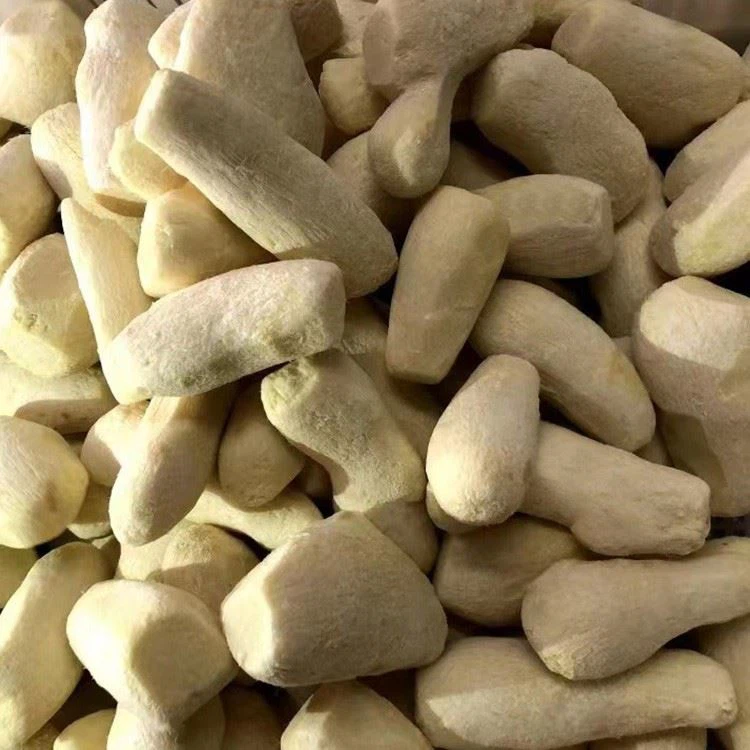
Frozen Chopped Ginger
Description
Technical Parameters
Frozen Chopped Ginger for Industrial, Foodservice and Private-Label Supply
We supply frozen chopped ginger for sauce and seasoning manufacturers, ready-meal factories, dumpling and filling processors, meat and seafood plants, beverage-base producers, foodservice distributors, central kitchens and retail frozen programs. Our standard product is made from sound mature ginger rhizomes, washed, peeled, trimmed, cut, individually quick frozen, sorted, metal detected and packed under frozen conditions.
The order can be built around fine chopped 1-3 mm, minced 3 mm, standard dice 4 x 4 mm or 5 x 5 mm, and coarse dice 8 x 8 mm or 10 x 10 mm. We define the cut, tolerance, size conformity, remaining peel, woody fibre, dark pieces, clumps, loose ice, microbiological limits, pack and batch documents before production. This makes the finished lot measurable instead of relying on descriptions such as "small pieces" or "strong flavor."
Request Chopped Ginger SpecificationRequest Sample and Batch COADownload Frozen Food Catalog
For a priced offer, send the exact particle size, peeling grade, application, microbiological limits, pack, order quantity, destination country and delivery port.
What We Mean by Frozen Chopped Ginger
Frozen chopped ginger is a cut product with visible particles rather than a smooth puree. Fine chopped ginger normally uses a declared sieve or particle range; diced ginger uses nominal length and width. We distinguish chopped, minced, diced and moulded puree portions because they behave differently in dosing, cooking, drainage and finished-product appearance.
Fine chopped 1-3 mm disperses rapidly into sauce, curry, marinade and filling. A 3 mm mince gives visible texture without large pieces. A 4 x 4 mm or 5 x 5 mm dice is the standard starting point for ready meals and foodservice. An 8 x 8 mm or 10 x 10 mm dice remains more visible after cooking and suits soups, braised products and prepared meal components.
Standard cut ginger is a raw, unblanched, ready-to-cook ingredient. Freezing preserves the frozen ingredient and supports portioning, but it is not a sterilization step. Buyers needing a ready-to-eat ingredient require a separately validated thermal or equivalent process and a dedicated microbiological specification.

Peeled ginger pieces are checked for peel residue, fibre, discoloration and sound condition before cutting.
Frozen Chopped Ginger Technical Specification
| Product identity | Frozen chopped ginger / IQF diced ginger; Zingiber officinale Roscoe; edible plant part: rhizome |
|---|---|
| Ingredient and origin | 100% mature ginger; China |
| Standard process | Selected, washed, peeled, trimmed, cut, IQF frozen, frozen sorted, metal detected and packed |
| Standard cut options | Fine chopped 1-3 mm; minced 3 mm; diced 4 x 4 mm, 5 x 5 mm, 8 x 8 mm or 10 x 10 mm; custom 4-10 mm mixed range |
| Peel and heat treatment | Peeled and raw/unblanched as standard; lightly blanched and unpeeled routes use separate named specifications |
| Added ingredients | Added sugar 0%; preservatives 0%; artificial color and flavor 0%; added sulphites none; added water 0%; added glaze 0% |
| Color and aroma | Natural creamy white to pale yellow; clean characteristic ginger aroma and pungent taste; no fermented, mouldy, chemical, rancid or other abnormal odor |
| Frozen condition | Free flowing or readily separable; no large ice masses; Grade A free-flowing pieces at least 98%, Premium A+ at least 99% |
| Temperature and shelf life | Core temperature -18°C or below after freezing; stored and transported at -18°C or below; 24 months from production |
| Intended use | Ingredient for cooking or further processing; not represented as ready to eat |

Visible cut pieces and moulded ginger portions use different size, freezing and packing specifications.
Cut-Size Options and Measurement Rules
Fine chopped 1-3 mm is assessed by sieve or image measurement because irregular particles are not true cubes. Standard release requires at least 85% within 1-3 mm for Grade A and at least 90% for Premium A+. Paste-like material below 1 mm is limited to 5% and 3% respectively; particles above 5 mm are limited to 3% and 1%.
For nominal dice, Grade A size conformity is at least 90% and Premium A+ is at least 95% by weight. Tolerance is ±1.0 mm for 4 x 4 mm, ±1.5 mm for 5 x 5 mm and 8 x 8 mm, and ±2.0 mm for 10 x 10 mm. Fines below 50% of the nominal dimension and oversized pieces above 150% are each limited to 3% for Grade A and 1% for Premium.
A mixed 4-10 mm chopped specification is available for applications where visible ginger character matters more than cube uniformity. It is not substituted for a 4 x 4 mm or 5 x 5 mm dice. The signed specification states whether conformity is measured by weight, sieve result or image measurement and identifies the composite sample size.
Grade A and Premium A+ Quality Comparison
| Control point | Grade A | Premium A+ | Release basis |
|---|---|---|---|
| Nominal dice conformity | At least 90% | At least 95% | By weight from composite sample |
| Visible peel residue | No more than 2% | No more than 1% | Inspected surface / weight basis stated |
| Woody or excessively fibrous pieces | No more than 3% | No more than 1% | Visual and cutting assessment |
| Materially darkened pieces | No more than 2% | No more than 1% | By weight after thaw inspection |
| Soft, hollow or corky material | No more than 2% | No more than 1% | By weight |
| Clumps / loose surface ice | No more than 2% / 1% | No more than 1% / 0.5% | Frozen-state inspection |
| Severe freezer burn | No more than 1% | No more than 0.5% | By weight |
| Mould, rot, insects, stone, glass and metal | Absent | Absent | Composite inspection and process controls |
Raw Material, Peeling and Fibre Control
We select mature ginger with firm tissue, developed aroma and no rot, mould, active sprouting, insect damage or abnormal odor. Each incoming lot records origin, supplier or farm code, crop year, receipt date, quantity and intended production batch. Soil and damaged tissue are removed before the material reaches the clean cutting area.
Peeled grade is standard for chopped ginger. Grade A permits visible peel on no more than 2% of the inspected surface or declared sample-weight basis; Premium A+ permits no more than 1%. Hard attachment tissue is limited to 1% in Grade A and 0.5% in Premium. Mould, rot, fermented tissue, foreign plant material, insects and larvae are absent.
Ginger naturally contains fibre, so the specification must separate normal ginger texture from woody defects. Grade A limits excessively woody, dry or stringy pieces to 3%; Premium A+ limits them to 1%. A selected low-fibre route for sauces, beverages and fine fillings targets no more than 0.5% woody material, subject to crop availability and sample approval.

Fine chopped particles and larger frozen blocks are visually different formats and are specified separately.
Sensory, Color and Physical Release Standards
The frozen product is naturally creamy white to pale yellow, with normal variation between crop lots. It has a clean characteristic ginger aroma, clear pungency and no fermented, sour, mouldy, rancid, chemical or burnt note. Grade A permits materially darkened particles up to 2% by weight; Premium A+ limits them to 1%. Abnormal black or blue-green discoloration is absent in a 1 kg Premium inspection sample.
After controlled thawing, particles remain identifiable and are not slimy or extensively mashed. Some cell softening and juice release are natural after freezing. We therefore do not promise fresh-ginger crispness or zero drip. For process comparison, the sample is thawed under a stated time and temperature, drained for a stated period and weighed by the same method. If the buyer needs a numerical drained-weight or thaw-loss limit, it is written into the order specification and reported with the test conditions.
Standard chopped ginger has no intentional ice glaze. Loose ice is limited to 1% for Grade A and 0.5% for Premium A+. Clumps that do not separate with light hand pressure are limited to 2% and 1% respectively. Free-flowing pieces are at least 98% for Grade A and 99% for Premium A+. These values help dosing systems and foodservice operators manage frozen portions consistently.

Peeled ginger pieces on a perforated processing surface show the raw form before chopped-size grading.
How We Process Frozen Chopped Ginger
Approved source → receiving and lot identification → initial sorting → washing → peeling → trimming → final washing → cutting → size inspection → surface-water removal → IQF freezing → frozen sorting → metal detection → weighing and packing → cold storage → batch release → reefer loading.
Initial sorting removes mould, rot, sprouts, severe shrinkage, soft tissue, heavy mechanical damage and foreign material. Potable processing water is used for washing. Peeling and trimming remove skin, hard collars, damaged areas and fibrous ends. Product-contact equipment is included in the sanitation schedule, with pre-operational inspection before the batch starts.
Cut size is checked at production start, after blade adjustment, after a product change and at least every 30-60 minutes during continuous operation. Typical IQF tunnel air temperature is -30°C to -40°C. Belt speed and residence time are adjusted for particle size and line load; finished product reaches a core temperature of -18°C or below. The frozen product is sorted again before metal detection and packing.
Foreign-Material and Metal-Detection Controls
Glass, metal, hard or soft plastic, wood, stone, paper, hair, visible soil and plant material other than ginger are absent from released product. Cutting blades, screens and food-contact surfaces are inspected before production and after maintenance. Frozen sorting removes off-color pieces, peel fragments, connected pieces and visible foreign material.
Our metal-detector challenge targets are Fe 1.5 mm, non-Fe 2.0 mm and stainless steel 2.5 mm, subject to the confirmed aperture, product effect and pack format. Challenge checks occur at production start, at least every two hours, after a stoppage or changeover and at production end. If a challenge fails, product produced since the last successful check is isolated and re-screened after correction.
Metal detection is one control and does not claim to remove stone, wood or plastic. Those hazards are managed through approved sourcing, washing, visual sorting, equipment integrity, housekeeping and final frozen inspection.

This is general frozen-food processing equipment used as evidence of washing, cutting, inspection and packing capability; it is not presented as a ginger-only line.
Microbiological Specifications
| Parameter | Standard contract limit | Enhanced project option | Typical method |
|---|---|---|---|
| Aerobic Plate Count | ≤500,000 CFU/g | ≤50,000 CFU/g | ISO 4833-1 |
| Enterobacteriaceae | ≤1,000 CFU/g | ≤100 CFU/g | ISO 21528-2 |
| Coliforms | ≤500 CFU/g | <10 CFU/g | ISO 4832 |
| Escherichia coli | <10 CFU/g | <10 CFU/g | ISO 16649-2 |
| Yeast / mould | ≤1,000 / ≤1,000 CFU/g | ≤100 / ≤100 CFU/g | ISO 21527 series |
| Coagulase-positive Staphylococci | <100 CFU/g | <100 CFU/g | ISO 6888-1 |
| Salmonella | Not detected in 25 g | Not detected in 25 g | ISO 6579-1 |
| Listeria monocytogenes | Not detected in 25 g | Not detected in 25 g | ISO 11290-1 |
Microbiological values are contract release limits, not a claim that every batch result equals the limit. The batch COA shows the actual result produced by the applicable test. Standard raw IQF ginger remains a ready-to-cook ingredient. A buyer requiring an enhanced or ready-to-eat route needs a separately agreed process, environmental monitoring plan and finished-product criteria.

General laboratory equipment supports microbiological and physicochemical review; each report identifies the method, unit, batch and actual result.
Physicochemical and Pungency Options
Chopped ginger is normally released by identity, sensory character, cut size, defects, microbiology and frozen condition. For formulation projects we can add moisture, dry matter, pH, extracted-juice Brix and gingerol analysis. Typical natural ginger moisture is 78-85% and dry matter is 15-22%; extracted-juice Brix commonly falls around 3-6°Bx. These are useful characterization ranges, not universal release limits unless written into the order.
A pungency-controlled project can add 6-gingerol by HPLC-UV or HPLC-DAD. The report states analyte, method, unit and whether the result is on frozen wet-weight or dry-weight basis. A practical controlled-pungency starting specification is 6-gingerol ≥0.50 mg/g on frozen wet-weight basis; a selected stronger program can target ≥0.80 mg/g. The COA reports the batch's actual measured value.
We do not use the phrase "strong ginger" as a numerical substitute for analysis. Cultivar, origin, maturity, peeling, storage and processing affect the sensory profile. Sample approval and a defined analytical basis give purchasing and R&D teams a repeatable reference.
Pesticide Residues, Heavy Metals and Chemical Declarations
Residue testing is selected for the destination market and customer program. Available scopes can cover 200+, 300+ or 500+ pesticide active substances by LC-MS/MS and GC-MS/MS. The laboratory report lists each active substance, actual result, unit, reporting limit, applicable destination-market maximum residue level and compliance decision. The statement is limited to the compounds, reporting limits and sample batch covered by the laboratory report.
Heavy-metal programs can include lead, cadmium, arsenic and mercury by ICP-MS or a validated equivalent method. A common commercial target is lead ≤0.50 mg/kg, cadmium ≤0.10 mg/kg, total arsenic ≤0.50 mg/kg and mercury ≤0.02 mg/kg, provided the destination regulation and buyer specification are not stricter. Sulphur dioxide is targeted below 10 mg/kg for product with no intentionally added sulphites.
The order file can also include ingredient, allergen, non-GMO, non-irradiation, additive, sulphite and gluten statements as applicable. Legal compliance is assessed against the destination and product classification current for the shipment. The batch report gives actual results; statutory maxima are not presented as measured values.
Batch COA: Contract Limit and Actual Result
| COA field | Example specification | What the batch COA records |
|---|---|---|
| Identity | 100% peeled frozen chopped ginger, 5 x 5 mm | Product name, item code, batch, production and expiry dates |
| Cut conformity | At least 95% within 5 x 5 mm ±1.5 mm | Actual percentage, sampling basis and result |
| Peel / woody pieces | ≤1% / ≤1% | Actual inspected percentages |
| Color / aroma / foreign matter | Conforming / conforming / absent | Pass result and inspection date |
| APC / coliforms / E. coli | ≤500,000 / ≤500 / <10 CFU/g | Actual laboratory result for each parameter |
| Yeast / mould | ≤1,000 / ≤1,000 CFU/g | Actual laboratory result |
| Salmonella / Listeria | Not detected in 25 g | Detected/not detected result and method |
| Optional chemistry | Specified residue, metal or 6-gingerol target | Actual result, unit, LOQ, method and laboratory |
| Release | All contracted criteria conform | Authorized release status and date |
A COA belongs to one production batch and does not reuse a generic result from another lot. Product name, cut size, pack code, batch number and report identity are matched before release. When an outside laboratory report is used, the sample code and test report number are linked to the shipment file.
Certificates and Shipment Documents
Available order documents can include the signed specification, batch COA, microbiological report, pesticide-residue report, heavy-metal report, 6-gingerol report for controlled-pungency programs, ingredient declaration, allergen statement, non-GMO statement, non-irradiation statement, sulphite statement, shelf-life statement, packing list, commercial invoice, certificate of origin, health certificate, bill of lading, container loading photographs and seal record.
Facility certificates such as BRCGS, HACCP, ISO 22000, Halal and Kosher are supplied when their current site and product scope applies. Organic ginger is offered only through a valid certified chain covering the source, processor, product, certificate period and transaction documents. FDA facility registration is presented as a registration record, not a product-quality certificate.
Before order placement, we can provide the relevant certificate list and sample document format. Before shipment, the issued documents are checked against the buyer name, product description, quantity, batch, production dates, container and destination requirements.

This general company certificate display is not a ginger batch COA; shipment documents are matched to the applicable site, scope and lot.
Choose the Right Chopped Ginger Format
| Application | Recommended form | Starting specification | Critical buyer checks |
|---|---|---|---|
| Sauces and marinades | Fine chopped 1-3 mm or minced 3 mm | Low-fibre Premium A+; optional 6-gingerol ≥0.50 mg/g | Dispersion, fibre, pungency and microbiology |
| Dumpling and prepared fillings | 1-3 mm chopped or 3 mm mince | Paste-like material ≤3%; woody pieces ≤1% | Mouthfeel, even distribution and thaw loss |
| Ready meals and stir-fry kits | 4 x 4 mm or 5 x 5 mm dice | At least 95% conformity; clumps ≤1% | Visible size, dosing, color and piece separation |
| Soup, broth and braised products | 5 x 5, 8 x 8 or 10 x 10 mm | Grade A or Premium by visibility target | Aroma release, piece integrity and fibre |
| Meat and seafood processing | Fine chopped 1-3 mm or 4 x 4 mm | Enhanced microbiology available | Distribution, pungency, fibre and cook step |
| Beverage and extraction base | 1-3 mm chopped or selected low-fibre mince | 6-gingerol ≥0.50 or ≥0.80 mg/g option | Extraction yield, pungency, fibre and sediment |
| Foodservice portions | 3 mm mince or 5 x 5 mm dice | 1 kg inner bags; free flowing ≥98% | Scoopability, pack seal and portion consistency |
| Retail private label | Fine chopped, mince or 5 x 5 mm | 500 g or 1 kg printed bag | Label, net weight, lot code and cooking statement |
Bulk, Foodservice and Retail Packing
| Program | Pack options | Packing control |
|---|---|---|
| Industrial bulk | 1 x 10 kg, 2 x 5 kg, 4 x 2.5 kg or 1 x 20 kg/carton | Food-grade PE liner or sealed inner bags in export carton |
| Foodservice | 10 x 1 kg, 5 x 2 kg or 4 x 2.5 kg/carton | Heat-sealed bags, frozen lot code and outer-carton traceability |
| Retail / private label | 20 x 500 g or 10 x 1 kg/carton | Printed or labelled bag with legal text supplied by buyer and reviewed for production |
| Buyer-specific | Metric or imperial case configurations | Seal trial, carton strength, pallet pattern and label proof before mass production |
Inner packaging is suitable for frozen food contact and sealed to protect the product from dehydration and contamination. The outer carton states product name, cut size, net weight, production date, expiry date, batch, storage condition, origin and handling marks. Private-label projects require final artwork, barcode, language, nutrition format and destination-market statements before printing.
MOQ, Loading, Lead Time and Trade Terms
| MOQ | One 20-foot FCL for a dedicated program; mixed-container loading can combine compatible GreenLand frozen products subject to pack, port and production plan |
|---|---|
| 40-foot reefer loading | Approximately 24 MT loose-loaded small packs or approximately 22 MT with pallets; final quantity depends on carton dimensions and pallet plan |
| Lead time | Normally 15-21 days after specification, artwork, deposit or L/C and production slot are complete; printed retail packing may require longer |
| Loading ports | Xiamen, Qingdao or Dalian according to production base and route |
| Trade terms | FOB, CFR/CNF or CIF |
| Payment | T/T or irrevocable L/C at sight, subject to the agreed contract |
| Supply | Year-round frozen supply based on crop intake, contracted stock and order forecast |

This general frozen-food loading scene supports export and cold-chain capability; the cartons are not identified as a specific ginger shipment.
Cold Storage and Reefer Loading
Finished cartons are held at -18°C or below. Before loading, we review carton quantity, marks, lot allocation, packaging condition, container cleanliness, odor, structural condition and pre-cooling status. The reefer set point is normally -18°C and is recorded with the container and seal numbers.
Loading follows the approved loose-load or pallet pattern without blocking required air circulation. Palletized orders use the agreed pallet material, dimensions, stretch wrapping and corner protection. Temperature evidence can include warehouse records, loading checks, container display photographs and a data logger when contracted.
The shipment file links the batch, packing list, invoice, container, seal, bill of lading and applicable release documents. Frozen product should remain at -18°C or below through transport and receiving. Thawed product should not be refrozen for commercial distribution.
Sampling, Traceability and Complaint Investigation
A production batch is linked to incoming ginger lot, processing date, line, shift, cut setting, packing material, metal-detector checks, cold-store location and shipment. Finished-product sampling covers the beginning, middle and end of the lot. Composite samples are used for size, defects and laboratory testing according to the signed inspection plan.
Retention samples are stored under frozen conditions for the agreed period. If a buyer reports an issue, the investigation starts with product name, cut, batch, carton and bag codes, quantity affected, receiving temperature, storage history, photographs and retained sample. We review source records, production controls, test results, pack records, warehouse movement and loading evidence before issuing findings and corrective action.
See our batch traceability system and review our frozen-food quality controls.
Frozen Chopped Ginger FAQ
1. What cut sizes of frozen chopped ginger do you supply?
We supply fine chopped 1-3 mm, minced 3 mm, diced 4 x 4 mm, 5 x 5 mm, 8 x 8 mm and 10 x 10 mm, plus a custom 4-10 mm mixed chopped range. The quotation states the nominal size, tolerance, conformity percentage and measurement basis.
2. Is frozen chopped ginger peeled?
Yes. Peeled ginger is our standard route. Grade A allows no more than 2% visible peel residue and Premium A+ no more than 1%. A selected fully peeled target can be quoted with a tighter inspection limit.
3. Is the product IQF or block frozen?
Chopped and diced ginger is normally IQF so the pieces remain free flowing or readily separable. Moulded puree tablets and some paste portions are block frozen or BQF and use a separate product specification.
4. Does the product contain additives or ice glaze?
Our standard product contains 100% ginger with no added sugar, preservatives, artificial color, artificial flavor, water or ice glaze. Added sulphites are not used; the target for naturally incidental sulphur dioxide is below 10 mg/kg.
5. What is the difference between Grade A and Premium A+?
Premium A+ tightens dice conformity from at least 90% to 95%, visible peel from no more than 2% to 1%, woody pieces from no more than 3% to 1%, dark pieces from no more than 2% to 1%, and clumps from no more than 2% to 1%.
6. Can you control ginger pungency?
Yes. A controlled-pungency program can specify 6-gingerol at ≥0.50 mg/g or a selected stronger target of ≥0.80 mg/g on frozen wet-weight basis. The batch COA or laboratory report gives the actual result, method and unit.
7. What microbiological limits are available?
Our standard starting limits are APC ≤500,000 CFU/g, coliforms ≤500 CFU/g, E. coli <10 CFU/g, yeast and mould each ≤1,000 CFU/g, and Salmonella and Listeria monocytogenes not detected in 25 g. Enhanced limits are available for defined projects.
8. Is frozen chopped ginger ready to eat?
No. Standard raw IQF chopped ginger is a ready-to-cook or further-processing ingredient. Buyers requiring ready-to-eat status need a separately validated process, environmental monitoring plan and finished-product microbiological specification.
9. What information appears on the batch COA?
The COA identifies the product, cut size, batch, production and expiry dates, sensory and physical results, microbiological results and release status. Optional residue, heavy-metal and gingerol results include the actual value, unit, method and laboratory reference.
10. Can you provide pesticide-residue and heavy-metal testing?
Yes. We can arrange destination-market residue panels and lead, cadmium, arsenic and mercury testing. The laboratory report shows each actual result, reporting limit, method and applicable compliance decision.
11. What packing formats are available?
Options include 1 x 10 kg, 2 x 5 kg, 4 x 2.5 kg, 10 x 1 kg, 20 x 500 g and buyer-specific private-label packs. We review bag material, seal, carton strength, label proof and pallet pattern before production.
12. What is the MOQ for wholesale frozen chopped ginger?
The normal starting quantity is one 20-foot FCL for a dedicated program. A mixed container can combine compatible GreenLand frozen products when pack sizes, production bases, loading port and schedule allow.
13. How much fits in a 40-foot reefer?
A typical 40-foot reefer carries about 24 MT for loose-loaded small packs or about 22 MT with pallets. The exact quantity is calculated from the confirmed carton dimensions, pack configuration and pallet plan.
14. What are the storage condition and shelf life?
Store and transport at -18°C or below. Shelf life is 24 months from production under an uninterrupted frozen cold chain. Commercially thawed product should not be refrozen.
15. What should I send for an accurate quotation?
Send the required particle size and tolerance, Grade A or Premium A+, peeling and fibre target, intended use, microbiological limits, residue or gingerol testing, pack, quantity, destination country, port, Incoterm and requested delivery window.
Build Your Frozen Chopped Ginger Program
We help you match particle size, grade, microbiological profile, packing, documents and cold-chain plan to your finished product. Download our catalog, review our quality and traceability systems, then send the exact requirements for your market.
Send the product form, cut size, grade, raw or blanched route, packing, quantity, application, destination port, private-label requirement, document list, required lead time and mixed-container plan.
Send InquiryHot Tags: frozen chopped ginger, China frozen chopped ginger manufacturers, suppliers, factory, frozen fresh ginger, frozen ginger, iqf ginger, frozen ginger root
Technical specification · reference schedule
Frozen Chopped Ginger
We review the selected form, grade, process and packing against the technical schedule below. Published and TDS values are specification references for order review. External benchmarks apply only within their stated scope. Acceptance is governed by the signed SKU specification; the identified lot COA reports actual measured results.
01 / Physical & Sensory
| Parameter | Specification / reference | Verification & order basis |
|---|---|---|
| Standard cut options | Fine chopped 1-3 mm; minced 3 mm; diced 4 × 4 mm, 5 × 5 mm, 8 × 8 mm or 10 × 10 mm; custom 4-10 mm mixed rangePublished reference | Measure a defined frozen sample with caliper or size gauge; report distribution and tolerance. |
| Color and aroma | Natural creamy white to pale yellow; clean characteristic ginger aroma and pungent taste; no fermented, mouldy, chemical, rancid or other abnormal odorPublished reference | Compare with the approved sensory reference using the stated frozen/thawed/prepared condition. |
| Nominal dice conformity - Grade A | At least 90%Published reference | By weight from composite sample. Programme: Grade A. |
| Nominal dice conformity - Premium A+ | At least 95%Published reference | By weight from composite sample. Programme: Premium A+. |
| Particle-size distribution | Define the desired cut range and separate undersize fines from oversize pieces. | Sieve or gauge a defined frozen sample; state each size fraction and denominator. |
| Sensory acceptance | Characteristic colour, flavour and texture for the declared product; no abnormal odour or visibly deteriorated material.External reference Codex | Compare an identified frozen sample with the approved grade and defect schedule. External technical reference; confirm SKU and market applicability. |
02 / Physicochemical & Residue Controls
| Parameter | Specification / reference | Verification & order basis |
|---|---|---|
| Visible peel residue - Grade A | No more than 2%Published reference | Inspected surface / weight basis stated. Programme: Grade A. |
| Visible peel residue - Premium A+ | No more than 1%Published reference | Inspected surface / weight basis stated. Programme: Premium A+. |
| Pesticide residue schedule | Named active ingredients and commodity-specific limits are selected for the destination market. EU source | Link farm spray history, laboratory LOQ and batch result to the destination MRL. EU database is one market reference; apply the actual destination rule. |
| Lead, cadmium and other contaminants | Apply the limit for the exact commodity and processed form in the destination market. EU source | State analyte, preparation basis, method, LOQ and lot result. Do not transfer a fresh-commodity limit to a processed form without the required assessment. |
03 / Microbiological Criteria
| Parameter | Specification / reference | Verification & order basis |
|---|---|---|
| Aerobic Plate Count - Standard contract limit | ≤500,000 CFU/gPublished reference | ISO 4833-1. Programme: Standard contract limit. |
| Aerobic Plate Count - Enhanced project option | ≤50,000 CFU/gPublished reference | ISO 4833-1. Programme: Enhanced project option. |
| Enterobacteriaceae - Standard contract limit | ≤1,000 CFU/gPublished reference | ISO 21528-2. Programme: Standard contract limit. |
| Enterobacteriaceae - Enhanced project option | ≤100 CFU/gPublished reference | ISO 21528-2. Programme: Enhanced project option. |
| Coliforms - Standard contract limit | ≤500 CFU/gPublished reference | ISO 4832. Programme: Standard contract limit. |
| Coliforms - Enhanced project option | <10 CFU/gPublished reference | ISO 4832. Programme: Enhanced project option. |
| Escherichia coli - Standard contract limit | <10 CFU/gPublished reference | ISO 16649-2. Programme: Standard contract limit. |
| Escherichia coli - Enhanced project option | <10 CFU/gPublished reference | ISO 16649-2. Programme: Enhanced project option. |
| Yeast / mould - Standard contract limit | ≤1,000 / ≤1,000 CFU/gPublished reference | ISO 21527 series. Programme: Standard contract limit. |
| Yeast / mould - Enhanced project option | ≤100 / ≤100 CFU/gPublished reference | ISO 21527 series. Programme: Enhanced project option. |
| Coagulase-positive Staphylococci - Standard contract limit | <100 CFU/gPublished reference | ISO 6888-1. Programme: Standard contract limit. |
| Coagulase-positive Staphylococci - Enhanced project option | <100 CFU/gPublished reference | ISO 6888-1. Programme: Enhanced project option. |
| Salmonella - Standard contract limit | Not detected in 25 gPublished reference | ISO 6579-1. Programme: Standard contract limit. |
| Salmonella - Enhanced project option | Not detected in 25 gPublished reference | ISO 6579-1. Programme: Enhanced project option. |
| Listeria monocytogenes - Standard contract limit | Not detected in 25 gPublished reference | ISO 11290-1. Programme: Standard contract limit. |
| Listeria monocytogenes - Enhanced project option | Not detected in 25 gPublished reference | ISO 11290-1. Programme: Enhanced project option. |
| Acceptance schedule | Select the test panel and limits by intended use (ready-to-eat or further processing), product form and destination. EU source | State organism, analytical method, sample mass and n/c plan; report actual lot results. A universal APC, coliform, Salmonella or Listeria limit is not assigned to every frozen product. |
04 / Freezing & Cold Chain
| Parameter | Specification / reference | Verification & order basis |
|---|---|---|
| Frozen condition | Free flowing or readily separable; no large ice masses; Grade A free-flowing pieces at least 98%, Premium A+ at least 99%Published reference | Confirm method, representative sample and acceptance basis in the signed specification. |
| Temperature and shelf life | Core temperature -18°C or below after freezing; stored and transported at -18°C or below; 24 months from productionPublished reference | Verify unopened-pack validation, declared storage condition and production/best-before coding. |
| Separation & loose-ice assessment | Keep inherent moisture, loose ice and permanently frozen clusters as separate inspection categories. | Weigh separated loose ice and welded clusters against initial sample mass; distinguish natural paired pieces or blocks. |
| Product thermal centre | −18°C or colder after freezing and thermal stabilization; maintain the agreed frozen distribution condition.External reference Codex | Probe the thickest representative pack and retain storage/transport temperature records. Codex quick-frozen reference; selected product form and route must be frozen. |
| Frozen condition at dispatch | Hard frozen, correctly sealed and coded, without thaw/refreeze evidence or excessive loose ice. Codex | Check pack integrity, free-flow or block condition as declared, carton condition and loading temperature. |
05 / Pack Size & Shelf Life
| Parameter | Specification / reference | Verification & order basis |
|---|---|---|
| Declared net contents | Verify each selected pack format against the artwork and applicable quantity-control rule. Codex | Calibrated checkweigher or scale; defined sample and tare. |
| Shelf-life basis | The labelled period applies only to its validated pack and continuous stated storage condition. Codex | Review stability study or approved shelf-life file and production-date code. |
06 / Process Controls
| Parameter | Specification / reference | Verification & order basis |
|---|---|---|
| Standard process | Selected, washed, peeled, trimmed, cut, IQF frozen, frozen sorted, metal detected and packedPublished reference | Check the approved product flow, line settings and identified production record; validate numerical critical limits within the site HACCP plan. |
| Peel and heat treatment | Peeled and raw/unblanched as standard; lightly blanched and unpeeled routes use separate named specificationsPublished reference | Check the approved product flow, line settings and identified production record; validate numerical critical limits within the site HACCP plan. |
| Raw-material preparation checks | Declare rhizome dice versus grated/minced material or moulded puree cubes; check peeling and fibre. | Verify the selected product flow and the relevant trimming, sorting and pretreatment record. |
| CCP designation | Use the site-approved HACCP plan to identify true CCPs and their validated critical limits. Codex | Check hazard analysis, monitoring, deviation and corrective-action records. A quality-control step is not automatically a CCP. |
07 / Ingredients, Additives & Allergens
| Parameter | Specification / reference | Verification & order basis |
|---|---|---|
| Ingredient and origin | 100% mature ginger; ChinaPublished reference | Verify approved formula, supplier declarations and line-specific allergen assessment. |
| Added ingredients | Added sugar 0%; preservatives 0%; artificial color and flavor 0%; added sulphites none; added water 0%; added glaze 0%Published reference | Verify approved formula, supplier declarations and line-specific allergen assessment. |
| Added glaze / coating declaration | Declare any intentionally added water glaze, syrup, oil or coating and the measurement basis; loose ice is assessed separately. | Verify formula/addition records; agree a deglazing or coating test and net-content basis where applicable. |
| Ingredient statement | List every ingredient and its declared role for the selected SKU; verify any added sugar, oil, coating, seasoning or glazing medium. | Approved formula and supplier declarations. |
| Additive use | Declare any colour-protection agent, acidulant or other additive by ingredient and maximum permitted use for the target market. NHC standard | Check approved formula, actual addition record and market-specific additive category. GB 2760-2024 applies to China; export rules are checked separately. |
| Allergen and cross-contact assessment | Declare inherent allergens and assess shared-line cross-contact from the actual facility schedule. FDA | Review line matrix, cleaning validation and buyer label approval. Do not claim a shared-line allergen or allergen-free status without facility evidence. |
08 / Defects & Foreign Matter
| Parameter | Specification / reference | Verification & order basis |
|---|---|---|
| Clumps / loose surface ice - Grade A | No more than 2% / 1%Published reference | Frozen-state inspection. Programme: Grade A. |
| Clumps / loose surface ice - Premium A+ | No more than 1% / 0.5%Published reference | Frozen-state inspection. Programme: Premium A+. |
| Mould, rot, insects, stone, glass and metal - Grade A | AbsentPublished reference | Composite inspection and process controls. Programme: Grade A. |
| Mould, rot, insects, stone, glass and metal - Premium A+ | AbsentPublished reference | Composite inspection and process controls. Programme: Premium A+. |
| Intrinsic defect classification | Peel, woody fibre, dark vascular tissue, coarse particles and damaged rhizome pieces. | Record each defect class separately by count or mass; state sample size, denominator and combined-limit rules. |
| Hazardous foreign matter | No foreign matter detected in the defined inspection sample; reject and investigate any finding.External reference Codex | Define visual-inspection sample size and detector challenge in the signed quality schedule. "None detected" is a sampling statement, not an absolute guarantee of zero particles. |
09 / Packaging Materials & Label
| Parameter | Specification / reference | Verification & order basis |
|---|---|---|
| Food-contact pack | Specify inner-contact material and obtain the applicable food-contact compliance declaration. NHC standard | Review film structure, supplier DoC, migration evidence and actual intended conditions. GB 4806 series is China-specific; EU export also checks Regulations 1935/2004 and 10/2011. |
| Carton and seal integrity | Define carton stacking strength, bag seal and puncture resistance for the confirmed net weight and pallet plan. EU source | Inspect pack drawing, compression/seal test and shipment configuration. |
| Label verification | Match product name, ingredient/allergen statement, net weight, lot/date, shelf life and storage instruction to the destination artwork. Codex | Approve artwork against the signed specification and destination rules. |
10 / Detection & Traceability
| Parameter | Specification / reference | Verification & order basis |
|---|---|---|
| Foreign-body detector | Validate Fe, non-Fe and stainless-steel challenge pieces for the actual product, aperture, pack and line; record the proven sensitivity. Codex | Challenge at defined start, changeover, interval and end points; retain rejection records. Do not copy generic detector sizes into a plant capability claim. |
| Lot traceability | Link input source lot, processing run, packaging code, test records, frozen storage and shipment to one finished lot. Codex | Trace one sample lot forward and backward in a recorded mock recall. Recall speed is stated only when the site has a validated target and record. |
Previous
Frozen Garlic And GingerNext
Frozen Minced Ginger


