


How to Cook Frozen Breaded Okra in the Oven
Sep 23, 2026
Leave a message


Key takeaways
- Match the method to the exact starting format and final use.
- Control moisture, portion or load, and temperature rather than trusting a single generic time.
- Keep quality guidance separate from food-safety requirements and product-specific directions.
- For buying, confirm the written specification and test a representative sample.
Start With the Package: Breaded Okra Products Differ

Start With the Package: Breaded Okra Products Differ.
Breading composition, piece size, pre-frying, oil level, vegetable cut and factory cook status all change how a frozen product heats. USDA guidance emphasizes following manufacturer instructions because frozen food can look browned or ready even when its required preparation is incomplete.
In practice, this is where many otherwise careful batches go wrong. One verified oven-ready okra label uses different conventional and convection settings and a stated internal endpoint. That schedule belongs to that product, not every bag. The useful control is to decide the endpoint before starting, then keep the preparation, package and later use consistent.
For a buyer or production manager, the same issue becomes a specification question. If a package lists only frying, do not assume an oven result has been validated. Contact the manufacturer or treat any oven trial as a local quality test under the applicable safety plan. Record what was tested, including starting condition, portion or load, equipment and the observed result, so the next batch can be compared on the same basis.
Record the exact SKU during foodservice testing. Changing suppliers can change coating behavior even when the purchasing description stays frozen breaded okra. That boundary matters because a convenient household method is not automatically a validated commercial process. GreenLand's verified pages show plain IQF okra, not a current breaded okra SKU. The CTA must remain plain frozen okra.
Authoritative background for this section includes USDA FSIS Freezing and Food Safety USDA Preparing Frozen Food. These sources support the preservation or handling principles; the application recommendation still needs to be confirmed against the actual product and operating procedure.
A useful working check for "Start With the Package: Breaded Okra Products Differ" is to write down the starting material, the intended finished use, the variable being controlled and the point at which the result will be accepted. USDA guidance emphasizes following manufacturer instructions because frozen food can look browned or ready even when its required preparation is incomplete. Then repeat the method with the normal production or household portion rather than judging only a tiny demonstration. Watch what happens during packing, freezing, heating or thawing as applicable, because a problem that appears at the end may have started much earlier. If a package lists only frying, do not assume an oven result has been validated. Contact the manufacturer or treat any oven trial as a local quality test under the applicable safety plan. If the result changes, investigate the material, load, temperature history, equipment and holding sequence before changing several settings at once. This simple record also makes supplier conversations more useful: both sides can discuss a defined form and observed performance instead of relying on broad adjectives. Finally, keep the limitation visible. Record the exact SKU during foodservice testing. Changing suppliers can change coating behavior even when the purchasing description stays frozen breaded okra.
Oven Setup for Crisp Frozen Breaded Okra

Oven Setup for Crisp Frozen Breaded Okra.
| Route or format | Useful when | Main control |
|---|---|---|
| Package oven directions | The exact tested product | Follow stated oven, time and endpoint |
| Package convection directions | Fan-assisted production | Do not use conventional settings automatically |
| No oven directions | Only a controlled local trial where allowed | Do not present a fallback as manufacturer validation |
Preheat fully before loading. A cold-start tray melts ice and coating fat before the surface can set, increasing the chance of a pale or soft result. The decision should follow the intended use rather than a habit carried over from another format. Use a light metal sheet pan or the surface named by the package. Parchment can reduce sticking, while a rack may improve airflow but can shed crumbs and alter browning.
A practical trial should change one variable at a time. Arrange one layer with visible space. Crowding traps steam from the okra and cools the pan. If several variables move together, a wetter, softer or less even result cannot be diagnosed reliably.
Do not thaw unless the manufacturer directs it. Thawing makes the coating wet and can cause pieces to stick together or lose breading. For repeat production, write the relevant cut, starting state, load, package and endpoint into the method. Staff should not have to infer them from a photograph.
Place the rack where the oven manual and product directions support even heat. Dark pans and very low racks can brown the base before the center is ready. We treat that as a quality-control choice, not a marketing promise. GreenLand's verified pages show plain IQF okra, not a current breaded okra SKU. The CTA must remain plain frozen okra.
The core preservation and handling references are USDA FSIS Freezing and Food Safety USDA Preparing Frozen Food. They are used for factual limits and process logic, while exact product directions retain priority.
A useful working check for "Oven Setup for Crisp Frozen Breaded Okra" is to write down the starting material, the intended finished use, the variable being controlled and the point at which the result will be accepted. Use a light metal sheet pan or the surface named by the package. Parchment can reduce sticking, while a rack may improve airflow but can shed crumbs and alter browning. Then repeat the method with the normal production or household portion rather than judging only a tiny demonstration. Watch what happens during packing, freezing, heating or thawing as applicable, because a problem that appears at the end may have started much earlier. Do not thaw unless the manufacturer directs it. Thawing makes the coating wet and can cause pieces to stick together or lose breading. If the result changes, investigate the material, load, temperature history, equipment and holding sequence before changing several settings at once. This simple record also makes supplier conversations more useful: both sides can discuss a defined form and observed performance instead of relying on broad adjectives. Finally, keep the limitation visible. Place the rack where the oven manual and product directions support even heat. Dark pans and very low racks can brown the base before the center is ready.
How to Bake Frozen Breaded Okra Step by Step
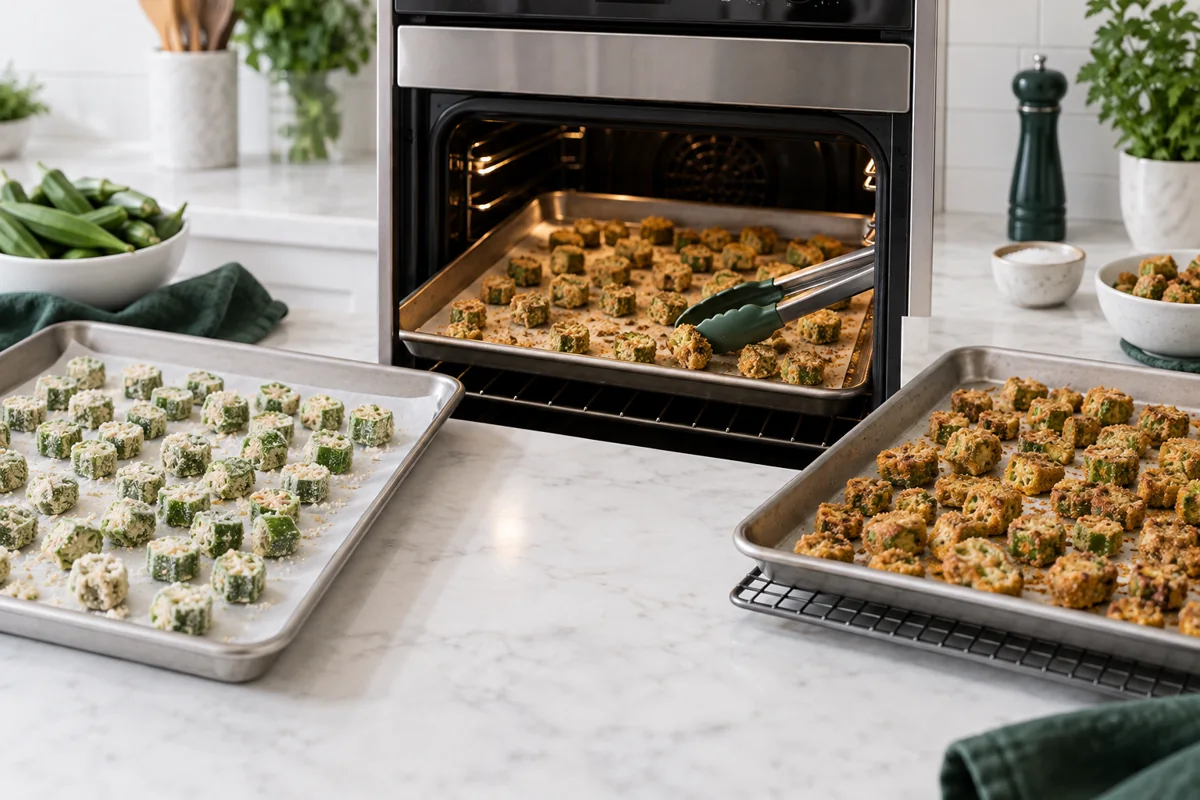
How to Bake Frozen Breaded Okra Step by Step.
- Read the package and identify oven type, temperature, time, turning instruction and required internal endpoint. Preheat accordingly.
- Open the package only when the pan and oven are ready. Separate loose pieces gently and discard packaging according to site practice.
- Spread the frozen okra in one layer without adding unnecessary liquid. Apply a light oil mist only if the product or approved trial calls for it.
- Bake for the first interval, then turn or shake as directed. Return the tray promptly so oven recovery remains consistent.
Read the package and identify oven type, temperature, time, turning instruction and required internal endpoint. Preheat accordingly. Open the package only when the pan and oven are ready. Separate loose pieces gently and discard packaging according to site practice.
The most useful check is not whether the method can work once, but whether it works with the exact material, portion and equipment that will be used. Spread the frozen okra in one layer without adding unnecessary liquid. Apply a light oil mist only if the product or approved trial calls for it. Keep the first comparison small enough to observe clearly.
In procurement, translate the observation into something confirmable. Bake for the first interval, then turn or shake as directed. Return the tray promptly so oven recovery remains consistent. A written requirement makes supplier review and incoming inspection more objective.
At the end, check the thickest representative pieces for coating crispness and required doneness. Rest briefly on an open rack or tray rather than sealing in steam. Avoid converting a quality range into a safety guarantee or a photograph into proof of an unseen process. GreenLand's verified pages show plain IQF okra, not a current breaded okra SKU. The CTA must remain plain frozen okra.
Reference points: USDA FSIS Freezing and Food Safety USDA Preparing Frozen Food. Use the applicable label, local food-safety plan and product specification whenever they are more specific.
A useful working check for "How to Bake Frozen Breaded Okra Step by Step" is to write down the starting material, the intended finished use, the variable being controlled and the point at which the result will be accepted. Open the package only when the pan and oven are ready. Separate loose pieces gently and discard packaging according to site practice. Then repeat the method with the normal production or household portion rather than judging only a tiny demonstration. Watch what happens during packing, freezing, heating or thawing as applicable, because a problem that appears at the end may have started much earlier. Bake for the first interval, then turn or shake as directed. Return the tray promptly so oven recovery remains consistent. If the result changes, investigate the material, load, temperature history, equipment and holding sequence before changing several settings at once. This simple record also makes supplier conversations more useful: both sides can discuss a defined form and observed performance instead of relying on broad adjectives. Finally, keep the limitation visible. At the end, check the thickest representative pieces for coating crispness and required doneness. Rest briefly on an open rack or tray rather than sealing in steam.
Temperature and Time: Use a Tested Range, Then Verify
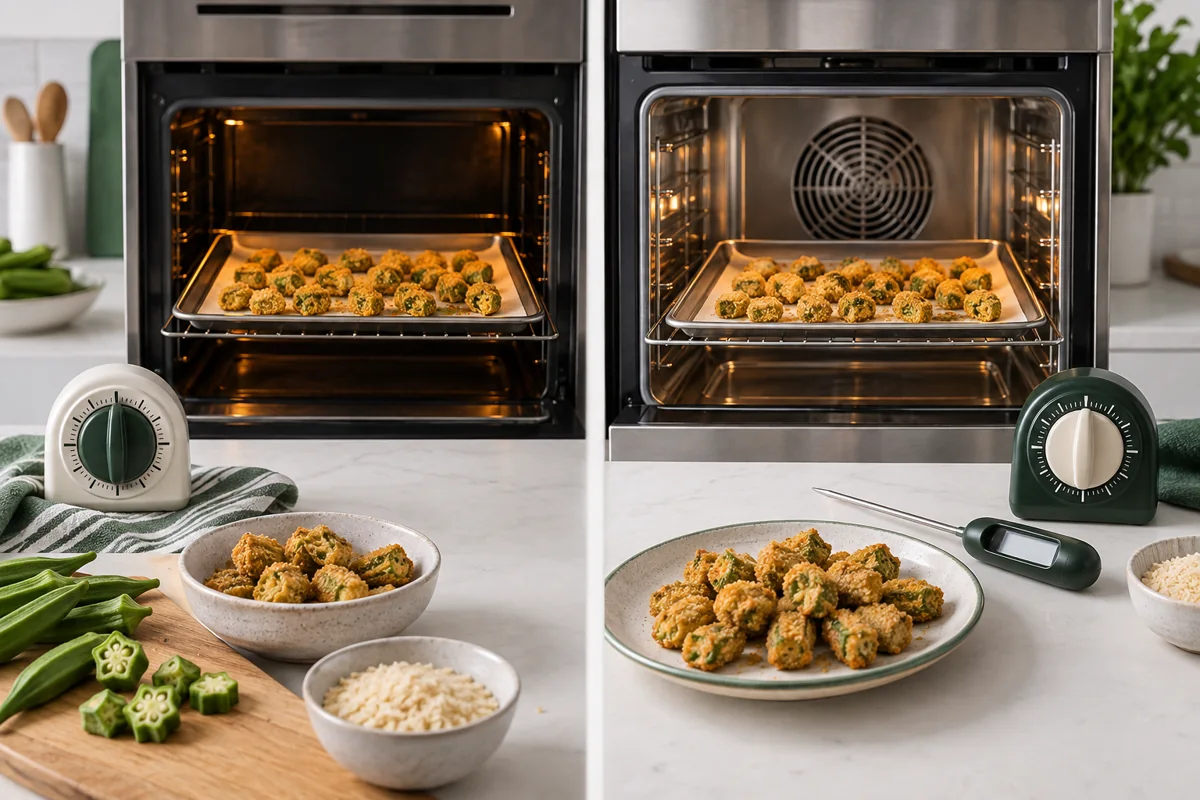
Temperature and Time: Use a Tested Range, Then Verify.
Consumer pages commonly suggest hot ovens and mid-teen to low-twenty-minute ranges, but those figures mix different products and cannot replace a label. That is the physical reason behind the recommendation. Convection moves hot air more efficiently and often uses a lower setting or shorter interval. Do not convert automatically without a supplier or kitchen trial.
Work in a clean, controlled sequence and avoid adding an unnecessary thawing or holding step. A manufacturer example specifies 350°F convection or 400°F conventional for 11–13 minutes and 165°F. It is valuable evidence of variation, not a universal recipe. A shorter process is not automatically better, but every extra transition introduces another variable.
If no oven direction exists and local rules allow a trial, start with a hot fully preheated oven, inspect frequently, and document the final safe, crisp result for that exact SKU. In a commercial review, compare the same quantity under the same conditions and record yield, appearance, texture and handling loss.
Calibrate the oven and avoid trusting the dial alone. A loaded foodservice oven can recover differently from an empty test. The result should be described honestly: useful for the named application, not perfect under every condition. GreenLand's verified pages show plain IQF okra, not a current breaded okra SKU. The CTA must remain plain frozen okra.
Process principles were checked against USDA FSIS Freezing and Food Safety USDA Preparing Frozen Food. Those references do not verify a supplier-specific specification; current product documents do.
A useful working check for "Temperature and Time: Use a Tested Range, Then Verify" is to write down the starting material, the intended finished use, the variable being controlled and the point at which the result will be accepted. Convection moves hot air more efficiently and often uses a lower setting or shorter interval. Do not convert automatically without a supplier or kitchen trial. Then repeat the method with the normal production or household portion rather than judging only a tiny demonstration. Watch what happens during packing, freezing, heating or thawing as applicable, because a problem that appears at the end may have started much earlier. If no oven direction exists and local rules allow a trial, start with a hot fully preheated oven, inspect frequently, and document the final safe, crisp result for that exact SKU. If the result changes, investigate the material, load, temperature history, equipment and holding sequence before changing several settings at once. This simple record also makes supplier conversations more useful: both sides can discuss a defined form and observed performance instead of relying on broad adjectives. Finally, keep the limitation visible. Calibrate the oven and avoid trusting the dial alone. A loaded foodservice oven can recover differently from an empty test.
Why Breaded Okra Turns Soggy or Bakes Unevenly

Why Breaded Okra Turns Soggy or Bakes Unevenly.
Crowding is the most common visual cause: moisture leaving many pieces has nowhere to escape and condenses on neighboring coating. A partially thawed bag can create wet patches and lost crumb. Temperature abuse also requires a food-safety decision, not just a longer bake.
In practice, this is where many otherwise careful batches go wrong. Too much oil weighs down some coatings, while no oil may leave a product designed for frying dry and pale. Follow the product design. The useful control is to decide the endpoint before starting, then keep the preparation, package and later use consistent.
For a buyer or production manager, the same issue becomes a specification question. Mixed piece sizes finish at different times. Small rounds can darken while large clusters remain cool inside. Record what was tested, including starting condition, portion or load, equipment and the observed result, so the next batch can be compared on the same basis.
Closed holding pans, deep bowls and tight foil soften a crisp coating after baking. Serve promptly or test a ventilated holding method. That boundary matters because a convenient household method is not automatically a validated commercial process. GreenLand's verified pages show plain IQF okra, not a current breaded okra SKU. The CTA must remain plain frozen okra.
Authoritative background for this section includes USDA FSIS Freezing and Food Safety USDA Preparing Frozen Food. These sources support the preservation or handling principles; the application recommendation still needs to be confirmed against the actual product and operating procedure.
A useful working check for "Why Breaded Okra Turns Soggy or Bakes Unevenly" is to write down the starting material, the intended finished use, the variable being controlled and the point at which the result will be accepted. A partially thawed bag can create wet patches and lost crumb. Temperature abuse also requires a food-safety decision, not just a longer bake. Then repeat the method with the normal production or household portion rather than judging only a tiny demonstration. Watch what happens during packing, freezing, heating or thawing as applicable, because a problem that appears at the end may have started much earlier. Mixed piece sizes finish at different times. Small rounds can darken while large clusters remain cool inside. If the result changes, investigate the material, load, temperature history, equipment and holding sequence before changing several settings at once. This simple record also makes supplier conversations more useful: both sides can discuss a defined form and observed performance instead of relying on broad adjectives. Finally, keep the limitation visible. Closed holding pans, deep bowls and tight foil soften a crisp coating after baking. Serve promptly or test a ventilated holding method.
Convection, Rack and Batch Adjustments

Convection, Rack and Batch Adjustments.
Convection improves airflow only when air can reach the food. A crowded pan or blocked oven remains crowded even with a fan. The decision should follow the intended use rather than a habit carried over from another format. Leave space between pans and avoid placing a tray directly above another if it blocks heat movement. Rotate only when the oven's pattern requires it.
A practical trial should change one variable at a time. Increase capacity by using more correctly spaced pans, not by piling pieces deeper. Revalidate time when the oven is fully loaded. If several variables move together, a wetter, softer or less even result cannot be diagnosed reliably.
Record recovery time, pan material, rack position and product weight. Those variables explain why a small test and a lunch rush can differ. For repeat production, write the relevant cut, starting state, load, package and endpoint into the method. Staff should not have to infer them from a photograph.
For centralized production, evaluate transport and holding as part of the cook test. A crisp piece at the oven door may soften before service. We treat that as a quality-control choice, not a marketing promise. GreenLand's verified pages show plain IQF okra, not a current breaded okra SKU. The CTA must remain plain frozen okra.
The core preservation and handling references are USDA FSIS Freezing and Food Safety USDA Preparing Frozen Food. They are used for factual limits and process logic, while exact product directions retain priority.
A useful working check for "Convection, Rack and Batch Adjustments" is to write down the starting material, the intended finished use, the variable being controlled and the point at which the result will be accepted. Leave space between pans and avoid placing a tray directly above another if it blocks heat movement. Rotate only when the oven's pattern requires it. Then repeat the method with the normal production or household portion rather than judging only a tiny demonstration. Watch what happens during packing, freezing, heating or thawing as applicable, because a problem that appears at the end may have started much earlier. Record recovery time, pan material, rack position and product weight. Those variables explain why a small test and a lunch rush can differ. If the result changes, investigate the material, load, temperature history, equipment and holding sequence before changing several settings at once. This simple record also makes supplier conversations more useful: both sides can discuss a defined form and observed performance instead of relying on broad adjectives. Finally, keep the limitation visible. For centralized production, evaluate transport and holding as part of the cook test. A crisp piece at the oven door may soften before service.
Holding and Reheating Without Losing the Coating

Holding and Reheating Without Losing the Coating using the specific product form shown.
Move finished okra away from pooled oil and condensation. A shallow ventilated hold generally protects texture better than a covered deep pan. Keep hot food under the time and temperature controls required by the operation. Crispness does not override food-safety holding rules.
The most useful check is not whether the method can work once, but whether it works with the exact material, portion and equipment that will be used. If reheating is permitted, use a dry-heat method and a single layer. Microwave reheating tends to soften breading because moisture is trapped around the piece. Keep the first comparison small enough to observe clearly.
In procurement, translate the observation into something confirmable. Do not mix a fresh tray into an older soft batch. Separate lots so staff can control holding time and investigate problems. A written requirement makes supplier review and incoming inspection more objective.
Quality declines with every heat cycle. Plan smaller batches when demand is uneven instead of relying on repeated reheating. Avoid converting a quality range into a safety guarantee or a photograph into proof of an unseen process. GreenLand's verified pages show plain IQF okra, not a current breaded okra SKU. The CTA must remain plain frozen okra.
Reference points: USDA FSIS Freezing and Food Safety USDA Preparing Frozen Food. Use the applicable label, local food-safety plan and product specification whenever they are more specific.
A useful working check for "Holding and Reheating Without Losing the Coating" is to write down the starting material, the intended finished use, the variable being controlled and the point at which the result will be accepted. Keep hot food under the time and temperature controls required by the operation. Crispness does not override food-safety holding rules. Then repeat the method with the normal production or household portion rather than judging only a tiny demonstration. Watch what happens during packing, freezing, heating or thawing as applicable, because a problem that appears at the end may have started much earlier. Do not mix a fresh tray into an older soft batch. Separate lots so staff can control holding time and investigate problems. If the result changes, investigate the material, load, temperature history, equipment and holding sequence before changing several settings at once. This simple record also makes supplier conversations more useful: both sides can discuss a defined form and observed performance instead of relying on broad adjectives. Finally, keep the limitation visible. Quality declines with every heat cycle. Plan smaller batches when demand is uneven instead of relying on repeated reheating.
What Frozen Okra Buyers Should Specify

What Frozen Okra Buyers Should Specify using the specific product form shown.
Separate the purchase of plain IQF okra from a breaded prepared item. Whole pods, cut rounds and coated pieces are not interchangeable. That is the physical reason behind the recommendation. For plain frozen okra, confirm cut, size, maturity, defects, loose-flow condition, pack, origin, testing and documents.
Work in a clean, controlled sequence and avoid adding an unnecessary thawing or holding step. For a breaded item, add coating formula, allergen declaration, pre-fry status, pickup percentage, cooking directions, yield and sensory target. A shorter process is not automatically better, but every extra transition introduces another variable.
GreenLand-food's verified pages used here concern plain frozen okra. We do not claim a current breaded okra SKU in this article or CTA. In a commercial review, compare the same quantity under the same conditions and record yield, appearance, texture and handling loss.
Ask us about available plain frozen okra formats and specifications. If a project requires breading, describe the need explicitly so feasibility can be reviewed rather than assumed. The result should be described honestly: useful for the named application, not perfect under every condition. GreenLand's verified pages show plain IQF okra, not a current breaded okra SKU. The CTA must remain plain frozen okra.
Process principles were checked against USDA FSIS Freezing and Food Safety USDA Preparing Frozen Food. Those references do not verify a supplier-specific specification; current product documents do.
A useful working check for "What Frozen Okra Buyers Should Specify" is to write down the starting material, the intended finished use, the variable being controlled and the point at which the result will be accepted. For plain frozen okra, confirm cut, size, maturity, defects, loose-flow condition, pack, origin, testing and documents. Then repeat the method with the normal production or household portion rather than judging only a tiny demonstration. Watch what happens during packing, freezing, heating or thawing as applicable, because a problem that appears at the end may have started much earlier. GreenLand-food's verified pages used here concern plain frozen okra. We do not claim a current breaded okra SKU in this article or CTA. If the result changes, investigate the material, load, temperature history, equipment and holding sequence before changing several settings at once. This simple record also makes supplier conversations more useful: both sides can discuss a defined form and observed performance instead of relying on broad adjectives. Finally, keep the limitation visible. Ask us about available plain frozen okra formats and specifications. If a project requires breading, describe the need explicitly so feasibility can be reviewed rather than assumed.
Source frozen okra with GreenLand-food
We supply and coordinate frozen okra for wholesale and factory-direct programs. As a manufacturer-facing supplier, GreenLand-food will review the requested form, packing, documents and application before confirming an offer. GreenLand's verified pages show plain IQF okra, not a current breaded okra SKU. The CTA must remain plain frozen okra.