


Can You Steam Mushrooms? Texture, Timing and Best Types
Sep 23, 2026
Leave a message


Key takeaways
- Match the method to the exact starting format and final use.
- Control moisture, portion or load, and temperature rather than trusting a single generic time.
- Keep quality guidance separate from food-safety requirements and product-specific directions.
- For buying, confirm the written specification and test a representative sample.
Yes, You Can Steam Mushrooms-Define the Result You Want

Yes, You Can Steam Mushrooms-Define the Result You Want.
Steaming transfers heat through condensing vapor without submerging the mushroom. The result is usually tender and moist, with less surface browning than sautéing or roasting. That gentle profile suits dumpling fillings, composed vegetable plates, low-fat preparations and pre-cooking steps where browned flavor is not the target.
In practice, this is where many otherwise careful batches go wrong. A covered pan with a small amount of liquid is often called pan-steaming, but it is not identical to a basket held above boiling water. Name the method clearly when recording a process. The useful control is to decide the endpoint before starting, then keep the preparation, package and later use consistent.
For a buyer or production manager, the same issue becomes a specification question. Mushrooms are naturally high in water, so steaming can expose weak texture if the raw material is old, damaged or crowded. Record what was tested, including starting condition, portion or load, equipment and the observed result, so the next batch can be compared on the same basis.
For a commercial menu, define yield, tenderness, color and holding performance. Good is too vague for repeatable production. That boundary matters because a convenient household method is not automatically a validated commercial process. Real photos show oyster mushroom examples; they must not be presented as every mushroom type.
Authoritative background for this section includes UC ANR Freezing Mushrooms Harvard Nutrition Source. These sources support the preservation or handling principles; the application recommendation still needs to be confirmed against the actual product and operating procedure.
A useful working check for "Yes, You Can Steam Mushrooms-Define the Result You Want" is to write down the starting material, the intended finished use, the variable being controlled and the point at which the result will be accepted. That gentle profile suits dumpling fillings, composed vegetable plates, low-fat preparations and pre-cooking steps where browned flavor is not the target. Then repeat the method with the normal production or household portion rather than judging only a tiny demonstration. Watch what happens during packing, freezing, heating or thawing as applicable, because a problem that appears at the end may have started much earlier. Mushrooms are naturally high in water, so steaming can expose weak texture if the raw material is old, damaged or crowded. If the result changes, investigate the material, load, temperature history, equipment and holding sequence before changing several settings at once. This simple record also makes supplier conversations more useful: both sides can discuss a defined form and observed performance instead of relying on broad adjectives. Finally, keep the limitation visible. For a commercial menu, define yield, tenderness, color and holding performance. Good is too vague for repeatable production.
Choose Mushroom Type, Cut and Starting State

Choose Mushroom Type, Cut and Starting State.
| Route or format | Useful when | Main control |
|---|---|---|
| Fresh whole or halved | A plump moist side dish | Needs longer than thin slices |
| Fresh sliced | Fast even steaming | Can over-soften quickly |
| Frozen pieces | Direct-from-frozen service | Allow for steam recovery and released water |
Button and cremini mushrooms tolerate whole, halved or sliced service, while oyster, shiitake and other types have different stem, cap and fiber structures. The decision should follow the intended use rather than a habit carried over from another format. Uniform size matters more than matching an internet time. Thick whole mushrooms and thin slices should not share the same basket if an even endpoint is required.
A practical trial should change one variable at a time. Fresh mushrooms should be sound and cleaned without prolonged soaking. Frozen mushrooms should be evaluated for cut, loose flow, frost and expected thaw release. If several variables move together, a wetter, softer or less even result cannot be diagnosed reliably.
Do not identify a wild mushroom by an article photograph. Use a verified edible commercial species and approved sourcing. For repeat production, write the relevant cut, starting state, load, package and endpoint into the method. Staff should not have to infer them from a photograph.
Buyers should specify species, cut dimensions, cap/stem ratio where relevant, blanching status and defect limits. Those variables change steaming behavior. We treat that as a quality-control choice, not a marketing promise. Real photos show oyster mushroom examples; they must not be presented as every mushroom type.
The core preservation and handling references are UC ANR Freezing Mushrooms Harvard Nutrition Source. They are used for factual limits and process logic, while exact product directions retain priority.
A useful working check for "Choose Mushroom Type, Cut and Starting State" is to write down the starting material, the intended finished use, the variable being controlled and the point at which the result will be accepted. Uniform size matters more than matching an internet time. Thick whole mushrooms and thin slices should not share the same basket if an even endpoint is required. Then repeat the method with the normal production or household portion rather than judging only a tiny demonstration. Watch what happens during packing, freezing, heating or thawing as applicable, because a problem that appears at the end may have started much earlier. Do not identify a wild mushroom by an article photograph. Use a verified edible commercial species and approved sourcing. If the result changes, investigate the material, load, temperature history, equipment and holding sequence before changing several settings at once. This simple record also makes supplier conversations more useful: both sides can discuss a defined form and observed performance instead of relying on broad adjectives. Finally, keep the limitation visible. Buyers should specify species, cut dimensions, cap/stem ratio where relevant, blanching status and defect limits. Those variables change steaming behavior.
How to Steam Fresh Mushrooms on the Stovetop

How to Steam Fresh Mushrooms on the Stovetop.
- Bring a controlled amount of water to a steady simmer below the basket. The water should not touch the mushrooms as it boils.
- Arrange a single loose layer or a shallow even load, cover and let steam circulate. Start with a short check rather than an automatic long cook.
- Turn or redistribute only if the equipment has a known hot spot. Repeatedly lifting the lid releases heat and makes the logged time unreliable.
- Season after steaming when precise moisture control matters. Salt, sauces and acids can change apparent water release and flavor balance.
Bring a controlled amount of water to a steady simmer below the basket. The water should not touch the mushrooms as it boils. Arrange a single loose layer or a shallow even load, cover and let steam circulate. Start with a short check rather than an automatic long cook.
The most useful check is not whether the method can work once, but whether it works with the exact material, portion and equipment that will be used. Turn or redistribute only if the equipment has a known hot spot. Repeatedly lifting the lid releases heat and makes the logged time unreliable. Keep the first comparison small enough to observe clearly.
In procurement, translate the observation into something confirmable. Season after steaming when precise moisture control matters. Salt, sauces and acids can change apparent water release and flavor balance. A written requirement makes supplier review and incoming inspection more objective.
Record basket depth, mushroom cut, load weight and endpoint in a foodservice trial. Those details make a method transferable between cooks. Avoid converting a quality range into a safety guarantee or a photograph into proof of an unseen process. Real photos show oyster mushroom examples; they must not be presented as every mushroom type.
Reference points: UC ANR Freezing Mushrooms Harvard Nutrition Source. Use the applicable label, local food-safety plan and product specification whenever they are more specific.
A useful working check for "How to Steam Fresh Mushrooms on the Stovetop" is to write down the starting material, the intended finished use, the variable being controlled and the point at which the result will be accepted. Arrange a single loose layer or a shallow even load, cover and let steam circulate. Start with a short check rather than an automatic long cook. Then repeat the method with the normal production or household portion rather than judging only a tiny demonstration. Watch what happens during packing, freezing, heating or thawing as applicable, because a problem that appears at the end may have started much earlier. Season after steaming when precise moisture control matters. Salt, sauces and acids can change apparent water release and flavor balance. If the result changes, investigate the material, load, temperature history, equipment and holding sequence before changing several settings at once. This simple record also makes supplier conversations more useful: both sides can discuss a defined form and observed performance instead of relying on broad adjectives. Finally, keep the limitation visible. Record basket depth, mushroom cut, load weight and endpoint in a foodservice trial. Those details make a method transferable between cooks.
How to Steam Frozen Mushrooms

How to Steam Frozen Mushrooms.
Many frozen mushrooms can be steamed directly from frozen, avoiding a thawing puddle and extra handling. Separate loose pieces before loading when possible. That is the physical reason behind the recommendation. Use an even shallow layer and restore full steam after the frozen load enters. A heavy load cools the chamber and makes a fixed clock time misleading.
Work in a clean, controlled sequence and avoid adding an unnecessary thawing or holding step. Frozen pieces may release liquid on the plate after cooking. Drain briefly or finish in the intended sauce rather than holding them in condensate. A shorter process is not automatically better, but every extra transition introduces another variable.
Follow product instructions where provided. A pre-blanched frozen mushroom and a raw frozen mushroom do not start from the same state. In a commercial review, compare the same quantity under the same conditions and record yield, appearance, texture and handling loss.
For batch service, compare the first and last basket, because repeated loading changes equipment recovery and condensate. The result should be described honestly: useful for the named application, not perfect under every condition. Real photos show oyster mushroom examples; they must not be presented as every mushroom type.
Process principles were checked against UC ANR Freezing Mushrooms Harvard Nutrition Source. Those references do not verify a supplier-specific specification; current product documents do.
A useful working check for "How to Steam Frozen Mushrooms" is to write down the starting material, the intended finished use, the variable being controlled and the point at which the result will be accepted. Use an even shallow layer and restore full steam after the frozen load enters. A heavy load cools the chamber and makes a fixed clock time misleading. Then repeat the method with the normal production or household portion rather than judging only a tiny demonstration. Watch what happens during packing, freezing, heating or thawing as applicable, because a problem that appears at the end may have started much earlier. Follow product instructions where provided. A pre-blanched frozen mushroom and a raw frozen mushroom do not start from the same state. If the result changes, investigate the material, load, temperature history, equipment and holding sequence before changing several settings at once. This simple record also makes supplier conversations more useful: both sides can discuss a defined form and observed performance instead of relying on broad adjectives. Finally, keep the limitation visible. For batch service, compare the first and last basket, because repeated loading changes equipment recovery and condensate.
Timing and Doneness by Size and Form

Timing and Doneness by Size and Form.
Published consumer ranges often cluster around several minutes for slices and longer for whole mushrooms, but species, cut, load and equipment can move the endpoint. Look for heat through the center, tender resistance, a cooked aroma and a surface that remains intact. Over-steamed mushrooms can become collapsed and watery.
In practice, this is where many otherwise careful batches go wrong. Use a representative piece from the thickest group when checking. Thin slices can appear ready while large caps remain firm. The useful control is to decide the endpoint before starting, then keep the preparation, package and later use consistent.
For a buyer or production manager, the same issue becomes a specification question. Timing for quality is not a universal microbial lethality schedule. If the mushroom is part of a regulated ready meal, follow the validated process for that product. Record what was tested, including starting condition, portion or load, equipment and the observed result, so the next batch can be compared on the same basis.
Build a small internal table from actual trials rather than copying a generic chart. Include cut size, frozen/fresh state, load, equipment and sensory endpoint. That boundary matters because a convenient household method is not automatically a validated commercial process. Real photos show oyster mushroom examples; they must not be presented as every mushroom type.
Authoritative background for this section includes UC ANR Freezing Mushrooms Harvard Nutrition Source. These sources support the preservation or handling principles; the application recommendation still needs to be confirmed against the actual product and operating procedure.
A useful working check for "Timing and Doneness by Size and Form" is to write down the starting material, the intended finished use, the variable being controlled and the point at which the result will be accepted. Look for heat through the center, tender resistance, a cooked aroma and a surface that remains intact. Over-steamed mushrooms can become collapsed and watery. Then repeat the method with the normal production or household portion rather than judging only a tiny demonstration. Watch what happens during packing, freezing, heating or thawing as applicable, because a problem that appears at the end may have started much earlier. Timing for quality is not a universal microbial lethality schedule. If the mushroom is part of a regulated ready meal, follow the validated process for that product. If the result changes, investigate the material, load, temperature history, equipment and holding sequence before changing several settings at once. This simple record also makes supplier conversations more useful: both sides can discuss a defined form and observed performance instead of relying on broad adjectives. Finally, keep the limitation visible. Build a small internal table from actual trials rather than copying a generic chart. Include cut size, frozen/fresh state, load, equipment and sensory endpoint.
Prevent Watery, Flat or Uneven Results

Prevent Watery, Flat or Uneven Results.
Do not overload the basket. Crowding traps condensate, blocks circulation and produces mixed doneness. The decision should follow the intended use rather than a habit carried over from another format. Keep boiling water below the food and control the boil so droplets do not splash into the basket. Refill only with care if a long batch requires it.
A practical trial should change one variable at a time. Drain cooked mushrooms promptly and season with enough acidity, salt, aromatics or fat for the intended dish. Steaming itself does not create browned flavor. If several variables move together, a wetter, softer or less even result cannot be diagnosed reliably.
Avoid long hot holding in a closed wet pan. If service requires holding, test the shortest practical window and observe continuing softening. For repeat production, write the relevant cut, starting state, load, package and endpoint into the method. Staff should not have to infer them from a photograph.
When a batch is watery, check raw material, frost, load, equipment recovery and holding before blaming one factor. We treat that as a quality-control choice, not a marketing promise. Real photos show oyster mushroom examples; they must not be presented as every mushroom type.
The core preservation and handling references are UC ANR Freezing Mushrooms Harvard Nutrition Source. They are used for factual limits and process logic, while exact product directions retain priority.
A useful working check for "Prevent Watery, Flat or Uneven Results" is to write down the starting material, the intended finished use, the variable being controlled and the point at which the result will be accepted. Keep boiling water below the food and control the boil so droplets do not splash into the basket. Refill only with care if a long batch requires it. Then repeat the method with the normal production or household portion rather than judging only a tiny demonstration. Watch what happens during packing, freezing, heating or thawing as applicable, because a problem that appears at the end may have started much earlier. Avoid long hot holding in a closed wet pan. If service requires holding, test the shortest practical window and observe continuing softening. If the result changes, investigate the material, load, temperature history, equipment and holding sequence before changing several settings at once. This simple record also makes supplier conversations more useful: both sides can discuss a defined form and observed performance instead of relying on broad adjectives. Finally, keep the limitation visible. When a batch is watery, check raw material, frost, load, equipment recovery and holding before blaming one factor.
Steaming to Serve vs Steam-Blanching Before Freezing

Steaming to Serve vs Steam-Blanching Before Freezing using the specific product form shown.
Steaming to serve aims at a pleasant finished texture. Steam-blanching before freezing is a pretreatment intended to slow quality-degrading enzyme activity. UC ANR guidance gives different steam-blanch times for whole, quartered and sliced mushrooms. Those times belong to a preservation workflow that also includes cooling, draining and freezing.
The most useful check is not whether the method can work once, but whether it works with the exact material, portion and equipment that will be used. Do not use a blanching table as a restaurant doneness chart, and do not use a tender serving endpoint as proof that a freezing pretreatment was completed. Keep the first comparison small enough to observe clearly.
In procurement, translate the observation into something confirmable. If preparing mushrooms for home freezing, follow the full tested method, including any anti-darkening treatment specified by the authority. A written requirement makes supplier review and incoming inspection more objective.
Commercial IQF processing uses controlled equipment and specifications. A kitchen steamer is not evidence that the same process or shelf life has been achieved. Avoid converting a quality range into a safety guarantee or a photograph into proof of an unseen process. Real photos show oyster mushroom examples; they must not be presented as every mushroom type.
Reference points: UC ANR Freezing Mushrooms Harvard Nutrition Source. Use the applicable label, local food-safety plan and product specification whenever they are more specific.
A useful working check for "Steaming to Serve vs Steam-Blanching Before Freezing" is to write down the starting material, the intended finished use, the variable being controlled and the point at which the result will be accepted. UC ANR guidance gives different steam-blanch times for whole, quartered and sliced mushrooms. Those times belong to a preservation workflow that also includes cooling, draining and freezing. Then repeat the method with the normal production or household portion rather than judging only a tiny demonstration. Watch what happens during packing, freezing, heating or thawing as applicable, because a problem that appears at the end may have started much earlier. If preparing mushrooms for home freezing, follow the full tested method, including any anti-darkening treatment specified by the authority. If the result changes, investigate the material, load, temperature history, equipment and holding sequence before changing several settings at once. This simple record also makes supplier conversations more useful: both sides can discuss a defined form and observed performance instead of relying on broad adjectives. Finally, keep the limitation visible. Commercial IQF processing uses controlled equipment and specifications. A kitchen steamer is not evidence that the same process or shelf life has been achieved.
Commercial Frozen Mushroom Checks for Foodservice
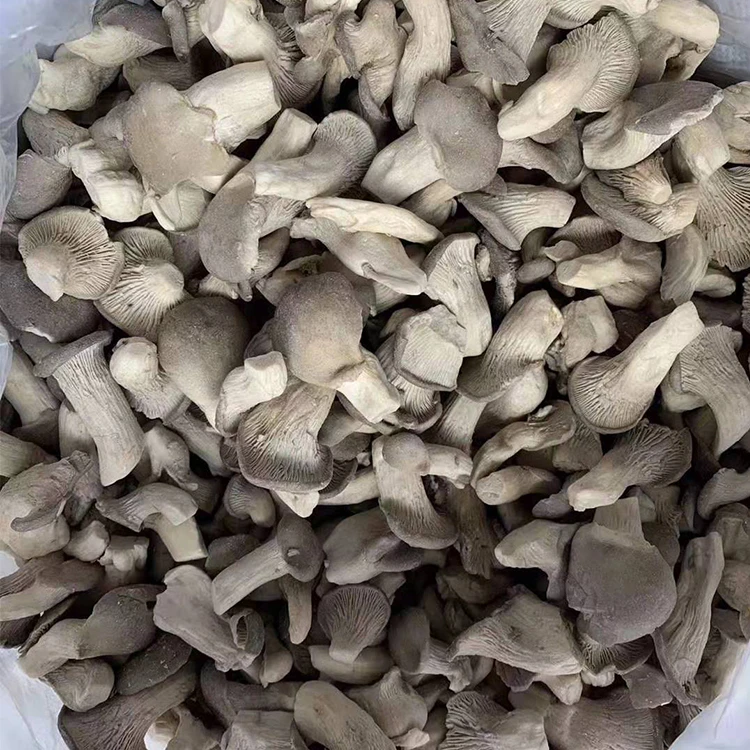
Commercial Frozen Mushroom Checks for Foodservice using the specific product form shown.
Confirm species, cut, blanching status, individual quick freezing, loose-flow condition, defect tolerance, pack size and required documents. That is the physical reason behind the recommendation. Test the mushrooms in the actual steamer and service system. Measure yield, drip, color, bite, seasoning uptake and holding quality.
Work in a clean, controlled sequence and avoid adding an unnecessary thawing or holding step. Our real product photographs in this article show oyster mushroom examples. They should not be read as proof that every mushroom type looks or performs the same. A shorter process is not automatically better, but every extra transition introduces another variable.
We can review frozen mushroom requirements, available forms and packing. Final availability and specification are confirmed against the inquiry. In a commercial review, compare the same quantity under the same conditions and record yield, appearance, texture and handling loss.
Keep the approved sample, written specification and receiving checks aligned. A purchasing name alone rarely captures the cut and performance a kitchen expects. The result should be described honestly: useful for the named application, not perfect under every condition. Real photos show oyster mushroom examples; they must not be presented as every mushroom type.
Process principles were checked against UC ANR Freezing Mushrooms Harvard Nutrition Source. Those references do not verify a supplier-specific specification; current product documents do.
A useful working check for "Commercial Frozen Mushroom Checks for Foodservice" is to write down the starting material, the intended finished use, the variable being controlled and the point at which the result will be accepted. Test the mushrooms in the actual steamer and service system. Measure yield, drip, color, bite, seasoning uptake and holding quality. Then repeat the method with the normal production or household portion rather than judging only a tiny demonstration. Watch what happens during packing, freezing, heating or thawing as applicable, because a problem that appears at the end may have started much earlier. We can review frozen mushroom requirements, available forms and packing. Final availability and specification are confirmed against the inquiry. If the result changes, investigate the material, load, temperature history, equipment and holding sequence before changing several settings at once. This simple record also makes supplier conversations more useful: both sides can discuss a defined form and observed performance instead of relying on broad adjectives. Finally, keep the limitation visible. Keep the approved sample, written specification and receiving checks aligned. A purchasing name alone rarely captures the cut and performance a kitchen expects.
Source frozen mushrooms with GreenLand-food
We supply and coordinate frozen mushrooms for wholesale and factory-direct programs. As a manufacturer-facing supplier, GreenLand-food will review the requested form, packing, documents and application before confirming an offer. Real photos show oyster mushroom examples; they must not be presented as every mushroom type.