



Truly Frozen Strawberries
Description
Technical Parameters
Ten Fields That Define an IQF Strawberry Order
A usable purchase specification must identify the product, quality level, packing, test plan and delivery basis. We use the following ten fields to prepare an offer that can be repeated in the purchase contract and checked again at lot release.
Whole, halves, slices, dices, whole-and-broken, crumbles or puree-grade pieces.
Whole diameter, slice thickness, dice dimensions and permitted off-size percentage.
Premium A+, Grade A or processing grade, with numeric defect limits.
AM13, Honey, Sweet Charlie, Red Face, 99# or another available crop direction.
Natural-solids range, pH or acidity target when the formula needs it.
10 kg bulk liner, foodservice bags, retail packs, printed film, pallet or floor loading.
Trial quantity, 20-foot reefer, 40-foot reefer, annual contract or mixed load.
COA, microbiology, pesticide panel, heavy metals, virus testing or private limits.
FOB, CFR/CNF or CIF, loading port, destination port and shipment month.
OEM artwork, barcode, certificate scope, origin and destination-market files.
Specification, Lot Result and Shipment Record
| Control document | What it contains | How we use it |
|---|---|---|
| Signed product specification | Form, size, grade, Brix, chemistry, defects, microbiology, residues, packing and shelf life | This is the contractual acceptance reference. Its maximum and minimum values are limits, not statements about a particular production lot. |
| Production-lot COA | Lot code, production date and Actual Result for the agreed test lines | We enter the measured value, count or presence/absence result for the corresponding lot and keep it separate from the contractual limit. |
| Packing and shipment record | Carton mark, quantity, net weight, seal, container, loading date and temperature record | These fields connect released cartons to the lot and provide the commercial trace from production through frozen export loading. |
Procurement Risk-Control Worksheet
We recommend placing every offer into one comparison sheet before selecting an IQF strawberry program. The worksheet should preserve technical, packing and delivery differences instead of treating every line as the same frozen fruit. Six checks expose the most common sources of unusable yield, rejection and repeat-order drift.
Compare the same usable form
Record the percentage of intact whole berries, broken fruit, fines and clumps. If one 22 MT container contains 5% more unusable pieces than another, that equals 1.10 MT of product that may not serve the intended presentation. Processing programs may accept those pieces, while retail whole-fruit programs may not.
Normalize pack and net weight
Compare net kilograms per carton, inner-bag count, carton dimensions, pallet status and quantity per reefer. A 10 kg bulk liner uses less packaging than ten 1 kg bags. Retail film, printing, coding and added seals should appear as defined cost elements rather than hidden specification differences.
Use one Incoterm and port
FOB Qingdao, CFR Rotterdam and CIF Jebel Ali are not comparable unit prices. Record the named port, included freight, insurance basis, free-time assumptions and quote validity. Ocean freight can change independently of strawberry crop cost, so the product and logistics portions should remain visible.
Price the required testing route
List the microbiological panel, residue analytes, heavy metals, virus tests, laboratory status, sampling frequency and certificate scope. An offer without the mandatory destination-market file is not equivalent to an offer that includes the test and release route.
Calculate exposure, not only product value
As a simple illustration, 22 MT at USD 1,500/MT equals USD 33,000 of FOB product value before freight, insurance, duties and destination handling. This arithmetic is not a current offer. Add the financial effect of rejection, rework, underweight packs, excessive drip, delayed documents or missed production before choosing the lowest quoted rate.
Lock the repeat-order reference
Store the signed specification, approved sample identification, artwork revision, COA format, carton mark and acceptance method together. Repeat pricing can then be discussed against the same product standard, making crop and freight movements visible without silently changing grade or packing.
IQF Strawberry Forms, Sizes and Application Fit
We separate each form because yield, sorting labor, appearance and application value change the price. Selecting the lowest-cost form that still performs in the finished product is more useful than paying for intact whole fruit that will immediately be crushed or pureed.
Whole IQF
15–25 mm, 25–35 mm, 35 mm+ or uncalibrated. Whole berries command more when color, intact shape, hulling and uniform calibration are tight. Use for retail packs, foodservice, visible toppings and premium frozen fruit blends.
Halves
Cut lengthwise from suitable whole fruit. Halves provide visible fruit with lower unit size and more predictable portioning for desserts, yogurt cups, bakery toppings and foodservice.
Slices
7–9 mm, 8–10 mm, 10 mm or 12 mm thickness. Slice integrity and fines matter for bakery decoration, fruit preparations and visible layers.
Dices
10×10×10, 12×12×12 or 15×15×15 mm. Dices improve dosing into yogurt, ice cream, bakery fillings, beverages and industrial fruit systems; the order defines cut tolerance and fines.
Whole and broken
A controlled mix for smoothies, jam, sauce and puree where intact appearance is secondary. Define the whole/broken ratio, minimum particle size and allowable fines.
Crumbles / puree grade
Cost-focused material for further comminution. It remains sound fruit and free from decay and foreign material; it is not a disposal grade. Brix, seed level and particle range can be specified.

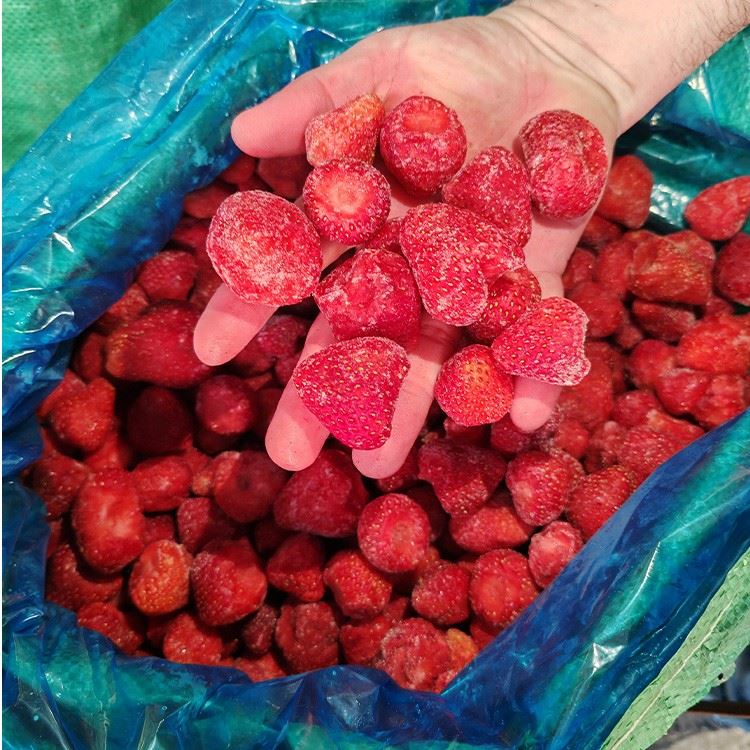
Whole hulled IQF strawberries showing fruit integrity, frozen separation and normal crop variation.

Frozen strawberry halves showing cut direction, internal color and fruit integrity.
Commercial Grade Matrix
Grade names are meaningful only when the defects are quantified. The following matrix is our quotation baseline for unsweetened IQF product. The signed specification can use tighter limits for a specific retail or processing program.
| Criterion | Premium A+ | Grade A | Processing grade |
|---|---|---|---|
| Best application | Retail, visible topping, foodservice presentation | Distribution, bakery, dairy, beverage, foodservice | Jam, sauce, puree, smoothie base, filling |
| Intact whole berries | ≥95% by weight | ≥90% by weight | Not applicable; form ratio stated separately |
| Disintegrated / broken | ≤5% w/w | ≤10% w/w | Buyer-defined whole/broken or particle range |
| Blemished fruit | ≤2% w/w | ≤5% w/w | ≤5% w/w; no decay or mould |
| Misshapen fruit | ≤2% w/w | ≤2% w/w | Not a critical appearance criterion |
| Underripe fruit | ≤2% w/w | ≤2% w/w | Buyer-defined when color or Brix is critical |
| Overripe / mushy fruit | ≤2% w/w | ≤2% w/w | No decay, mould or fermentation |
| Partially uncolored | ≤3% w/w | ≤5% w/w | ≤10% w/w if color is suitable for processing |
| Clumps over 3 pieces | ≤1% w/w | ≤5% w/w | ≤5% w/w unless block form is ordered |
| Calyx / stalk pieces | ≤2 pieces/kg | ≤4 pieces/kg | ≤4 pieces/kg |
| Mineral impurities | ≤0.10% w/w; glass, metal, hard plastic and other hazardous foreign material absent | ||
| Mould, decay, fermentation, off-odor | Absent in the agreed sample and inspection method | ||

A caliper check shows how whole-berry diameter can be assessed against the contracted range.
Size acceptance
For calibrated whole fruit, our baseline is at least 90% by count within the stated diameter band. Up to 10% may fall outside the band unless the signed specification is tighter. For dices and slices, conformity is assessed by weight and the order states the nominal cut, acceptable dimension range and fines limit.
The sample approval should use the same grade, crop direction and pack as the proposed bulk supply. A photograph alone cannot define drip loss, softness, Brix or hidden cut damage.
Detailed IQF Frozen Strawberry Specification
| Field | Commercial specification |
|---|---|
| Product | IQF Frozen Strawberry / Bulk Frozen Strawberry / Frozen Strawberry Ingredients |
| Botanical name | Fragaria × ananassa; commercial cultivar stated by lot when required |
| Ingredient | 100% strawberry; no added sugar, color or preservative in the standard unsweetened product |
| Origin / crop | China; main crop April–May, with origin and crop year stated in commercial files |
| Varieties | AM13, Honey, Sweet Charlie, Red Face, 99# or crop-available equivalent |
| Forms and sizes | Whole 15–25 mm, 25–35 mm, 15–35 mm, 35 mm+ or uncalibrated; halves; slices 10 or 12 mm; dices 10×10×10, 12×12×12 or 15×15×15 mm; controlled brokens |
| Processing | Selected, hulled, washed, drained, cut when ordered, individually quick frozen, sorted, detected, packed and frozen stored |
| Brix | 7–11° Bx for standard unsweetened fruit; 7.5° Bx minimum option; lot Actual Result reported when included in the COA |
| pH | 3.0–4.0 when specified for formula control |
| Titratable acidity | 0.6–1.2% as citric acid for formula-specific orders |
| Sensory | Natural red to deep red; characteristic strawberry aroma and sweet-tart flavor; free from fermentation, decay and off-odor |
| Frozen condition | Free flowing for IQF form, no excessive surface ice, product temperature ≤ −18°C |
| Bulk packing | 1×10 kg PE liner/carton; 20 lb, 40 lb, 12 kg or 20 kg formats by program |
| Foodservice / retail | 4×2.5 kg, 10×1 kg, 20×500 g, 400 g/500 g/1 kg printed bag or approved OEM format |
| MOQ | 10 MT standard; mixed load reviewed from 3 MT per compatible SKU |
| Loading | Approximately 10–12 MT/20RF or 23–25 MT/40RH, subject to carton, pallet and legal payload |
| Lead time | Normally 15–21 days after deposit and release of specification and packing files |
| Trade terms | FOB, CFR/CNF or CIF; Qingdao or another agreed Chinese loading port |
| Storage / shelf life | Keep continuously frozen at ≤ −18°C; 24 months from production |
| Documents | Specification, lot COA, microbiology, pesticide residue, heavy metal, packing list, invoice, certificate of origin, health/phytosanitary document where applicable, bill of lading and traceability records |
Processing Flow and Strawberry-Specific Risk Control
We inspect variety, maturity, red color, firmness, decay, mould and field contamination.
We remove calyx, stalk and unacceptable hard core to the agreed tolerance.
Controlled washing removes soil and loose field material while protecting soft fruit.
Halves, slices and dices are prepared to the order dimensions and fines limit.
Surface-water reduction limits free ice and supports IQF separation.
Rapid freezing reduces adhesion and prepares free-flowing berries or pieces.
We grade color, size, clumps, broken fruit, calyx, frost and foreign material.
We check net weight, seals, coding, detection, COA status and frozen storage.

Strawberries shown in a stainless steel washing stage before freezing and final grading.
Microbiological and Chemical Specification
Freezing does not sterilize fruit. The order must identify whether the strawberries are not-ready-to-eat ingredients for a validated process or are intended for an application with a different food-safety plan. Our commercial baseline below is written as measurable purchasing criteria; destination law and the buyer's private standard take priority where stricter.
| Microbiological test | Grade A baseline |
|---|---|
| Aerobic plate count | < 100,000 CFU/g |
| Coliforms | < 100 CFU/g |
| E. coli | < 10 CFU/g |
| Yeasts | < 1,000 CFU/g |
| Moulds | < 1,000 CFU/g |
| Salmonella | Absent in 25 g |
| Listeria monocytogenes | Absent in 25 g |
Chemical and residue limits
Lead: ≤0.20 mg/kg wet weight for the EU-oriented strawberry baseline
Cadmium: ≤0.030 mg/kg wet weight for the EU-oriented strawberry baseline
Pesticide residues: each active substance must comply with the destination-market MRL. For EU orders, the default 0.01 mg/kg applies where no specific MRL is set.
A residue report lists the tested analytes and the result for each one. We do not replace analyte-level reporting with a blanket marketing claim. Norovirus and hepatitis A testing can be added when the buyer's risk plan or market program requires it.

Manual strawberry inspection for color, hulling condition, damaged fruit and visible foreign material.
Detection does not replace sorting
Optical sorting can help identify color or shape differences, while metal detection or X-ray addresses defined physical hazards. Manual inspection, washing, hulling and process hygiene remain necessary because one machine does not control every strawberry defect.
The quotation identifies the requested detection standard and test-piece sizes when the buyer has a private requirement. The release record links that control to the production lot.
Lot COA: Limits vs. Actual Results
We provide a COA for the corresponding production lot when it is included in the order. The specification column shows the contractual limit. The Actual Result column contains that lot's measured value, count, presence/absence finding or inspection result. A specification maximum is not presented as if it were the actual laboratory result.
| COA line | Specification | Actual Result for the production lot |
|---|---|---|
| Brix | 7–11° Bx; 7.5° minimum when contracted | Measured numeric value at the stated method/temperature |
| pH | 3.0–4.0 when contracted | Measured numeric value for that lot |
| Broken fruit | Grade-specific maximum | Inspected percentage by weight |
| APC / yeasts / moulds | Contract limits | Lot-specific CFU/g result or below reporting limit |
| Salmonella / Listeria | Absent in 25 g | Detected / not detected under the stated method |
| Pb / Cd | ≤0.20 / ≤0.030 mg/kg wet weight for the EU-oriented baseline | Measured value or reporting-limit statement |
| Disposition | All agreed lines compliant | Pass/release conclusion, date and authorized signatory |
Certificate scope matters to price and route
BRCGS, HACCP, ISO, Kosher, Halal, organic project documents or FDA-related compliance files are supplied only within the selected facility and product scope. Organic price is quoted against a certified product route and available crop, not by adding an organic word to a conventional lot.
State mandatory certificates and customer audit requirements in the first RFQ. Changing the required factory route after price agreement can alter availability, testing cost and lead time.
Packing, Net Weight and OEM Price Effects
| Channel | Common pack | Price-sensitive details |
|---|---|---|
| Industrial bulk | 1×10 kg liner/carton | Liner thickness, carton grade, floor/pallet loading and net-weight tolerance |
| Foodservice | 4×2.5 kg or 10×1 kg | More inner bags, seals, labels and packing labor than a bulk liner |
| Retail | 20×500 g, 10×1 kg, 400 g or buyer format | Printed film MOQ, artwork cylinders, zipper, bag structure, barcode and case count |
| OEM program | Buyer-approved format | Language, regulatory copy, nutrition panel, carton marks, inspection level and packing-material balance |

A bulk strawberry carton shown during a net-weight check near the 10 kg packing target.
OEM artwork and packaging are released as controlled files. We review declared net quantity, bag dimensions, sealing area, date/lot coding, label language, ingredient declaration, storage instruction, country of origin, barcode and carton marks. The final quote separates product cost from one-time or packaging-specific charges when applicable.
Cold Chain, Loading and Landed-Cost Control
Final payload depends on carton dimensions, pallet use, retail configuration, legal weight and carrier limits. We calculate cases and net product after the pack is chosen. A temperature logger, loading photographs, seal number and reefer set-point record can be included in the shipment file when required by order agreement.

General frozen-fruit container loading; the image is not represented as a strawberry-only shipment.
Application Economics: Pay for the Attribute You Use
Retail frozen fruit
Whole calibration, bright color, low breakage, low clumping and clean hulling justify the cost. Printed film, retail net weight and visual bag presentation also enter the quote.
Yogurt and dairy
Dices or fruit-preparation pieces reduce cutting loss. Brix, pH, particle size, drip and microbiological limits matter more than whole-berry appearance.
Beverage and smoothie
Whole-and-broken or processing grade can provide better ingredient economics when the fruit is blended. Define Brix, color and usable yield.
Bakery and dessert
Halves, slices or dices should be selected by visible piece requirement, bake stability, drip, fines and pack size instead of by the lowest whole-fruit price.
Jam, sauce and puree
Processing-grade pieces can reduce raw-material cost. Soundness, Brix, acidity, color, foreign material and puree yield remain contractual controls.
Foodservice
1 kg or 2.5 kg working bags balance labor, portioning and open-pack handling. Whole, half or sliced form is priced against presentation needs.
Frequently Asked Questions
1. What information is needed to quote IQF strawberries?
State form, size, grade, Brix, defect limits, pack, quantity, destination, Incoterm, shipment period, test panel and certificate scope. We return a dated specification-linked quotation with a validity period.
2. How is whole IQF strawberry grade defined?
We define whole-fruit grade through diameter, intact-fruit percentage, hulling, red color, Brix, blemishes, underripe and overripe fruit, clumps, calyx pieces and foreign-material limits. Numeric criteria matter more than the grade name alone.
3. Which whole strawberry sizes are available?
Common bands are 15–25 mm, 25–35 mm and 35 mm+. Uncalibrated whole fruit is also available for applications that do not need a narrow visual size.
4. Can you quote diced and sliced frozen strawberries?
Yes. Dices include 10×10×10, 12×12×12 and 15×15×15 mm. Slice options include 10 and 12 mm thickness, with cut tolerance and fines written into the offer.
5. What Brix, pH and acidity ranges apply?
Our standard unsweetened range is 7–11° Brix, with a 7.5° minimum option. Formula programs can use pH 3.0–4.0 and titratable acidity 0.6–1.2% as citric acid. The COA shows the corresponding production-lot Actual Result when these lines are contracted.
6. Is Grade A the same for every supplier?
No. We attach Grade A to measurable limits for intact fruit, broken fruit, blemishes, uncolored fruit, clumps, calyx/stalk and foreign material. Use those figures when comparing offers.
7. Can processing-grade strawberry lower ingredient cost?
Yes, when the finished process crushes, blends or purees the fruit. Processing grade still excludes decay, mould, fermentation and hazardous foreign material and uses an agreed particle or whole/broken range.
8. Do you provide a lot-specific COA?
Yes. The COA identifies the production lot and separates each contractual limit from the actual physical, Brix, pH, microbiological or chemical result measured for that lot.
9. What residue and heavy-metal limits are used?
Each pesticide analyte follows the destination-market MRL; for EU orders the default is 0.01 mg/kg where no specific MRL is set. Our EU-oriented strawberry baseline is Pb ≤0.20 mg/kg and Cd ≤0.030 mg/kg wet weight. A stricter private standard can be added to the contract.
10. What bulk and retail packs can you quote?
Common formats are 1×10 kg, 4×2.5 kg, 10×1 kg and 20×500 g. We also quote 20 lb, 40 lb and approved private-label bag configurations.
11. What is the MOQ and lead time?
The standard MOQ is 10 MT. Normal lead time is 15–21 days after deposit and release of product and packing files; printed retail material or special testing can require more time.
12. Can strawberries be mixed with other frozen fruit in one container?
Yes, compatible frozen products can be planned from approximately 3–5 MT per SKU. Carton dimensions, stock, facility route, temperature and document requirements must fit the same loading plan.
13. Do you offer private-label frozen strawberries?
Yes. We price product, printed film, inner-pack count, artwork, barcode, carton marks, label language, inspection level and packing-material MOQ as one controlled OEM program.
14. What storage and shelf life apply?
Keep IQF strawberries continuously frozen at or below −18°C. Shelf life is 24 months from production under the agreed frozen chain; thawing and refreezing can increase clumping, drip and texture damage.
Request an IQF Strawberry Specification and Quote
Send: whole/half/slice/dice/broken form; size; Premium A+, Grade A or processing grade; Brix/pH target; defect limits; pack; quantity; destination port; FOB/CFR/CIF basis; shipment month; required certificates and reports; private-label details; pallet or mixed-load plan.
We will return a specification-linked quotation with unit basis, packing, MOQ, indicative loading, lead time, payment term, price validity and document scope.
Hot Tags: truly frozen strawberries, China truly frozen strawberries manufacturers, suppliers, factory, frozen tayberries, frozen fruit nut free snacks, frozen starfruits, frozen fruit butters, frozen custard apples, frozen kiwi slices
Technical specification · reference schedule
IQF Frozen Strawberries
We review the selected form, grade, process and packing against the technical schedule below. Published and TDS values are specification references for order review. External benchmarks apply only within their stated scope. Acceptance is governed by the signed SKU specification; the identified lot COA reports actual measured results.
01 / Physical & Sensory
| Parameter | Specification / reference | Verification & order basis |
|---|---|---|
| Misshapen fruit - Premium A+ | ≤2% w/wPublished reference | Confirm method, representative sample and acceptance basis in the signed specification. Programme: Premium A+. |
| Misshapen fruit - Grade A | ≤2% w/wPublished reference | Confirm method, representative sample and acceptance basis in the signed specification. Programme: Grade A. |
| Misshapen fruit - Processing grade | Not a critical appearance criterionPublished reference | Confirm method, representative sample and acceptance basis in the signed specification. Programme: Processing grade. |
| Partially uncolored - Premium A+ | ≤3% w/wPublished reference | Compare with the approved sensory reference using the stated frozen/thawed/prepared condition. Programme: Premium A+. |
| Partially uncolored - Grade A | ≤5% w/wPublished reference | Compare with the approved sensory reference using the stated frozen/thawed/prepared condition. Programme: Grade A. |
| Partially uncolored - Processing grade | ≤10% w/w if color is suitable for processingPublished reference | Compare with the approved sensory reference using the stated frozen/thawed/prepared condition. Programme: Processing grade. |
| Botanical name | Fragaria × ananassa; commercial cultivar stated by lot when requiredPublished reference | Check raw-material identity and variety/source declaration against the ordered programme. |
| Origin / crop | China; main crop April–May, with origin and crop year stated in commercial filesPublished reference | Confirm method, representative sample and acceptance basis in the signed specification. |
| Forms and sizes | Whole 15–25 mm, 25–35 mm, 15–35 mm, 35 mm+ or uncalibrated; halves; slices 10 or 12 mm; dices 10 × 10 × 10, 12 × 12 × 12 or 15 × 15 × 15 mm; controlled brokensPublished reference | Measure a defined frozen sample with caliper or size gauge; report distribution and tolerance. |
| Style-specific measurement | For solid cuts, report each required dimension and the in-size fraction; for minced material, report particle distribution; for moulded puree or portions, report unit mass and refining grade separately. | Apply the measurement method to the selected physical style; do not use a portion weight as a solid-cut dimension. |
| Sensory acceptance | Characteristic colour, flavour and texture for the declared product; no abnormal odour or visibly deteriorated material.External reference Codex | Compare an identified frozen sample with the approved grade and defect schedule. External technical reference; confirm SKU and market applicability. |
02 / Physicochemical & Residue Controls
| Parameter | Specification / reference | Verification & order basis |
|---|---|---|
| Mineral impurities | ≤0.10% w/w; glass, metal, hard plastic and other hazardous foreign material absentPublished reference | Use a validated analytical method for this matrix; report sample basis, unit, preparation and lot result. |
| Brix | 7–11° Bx for standard unsweetened fruit; 7.5° Bx minimum option; lot Actual Result reported when included in the COAPublished reference | Measure representative prepared sample with a temperature-compensated refractometer. |
| pH | 3.0–4.0 when specified for formula controlPublished reference | Use calibrated pH meter or titration on the stated sample preparation. |
| Titratable acidity | 0.6–1.2% as citric acid for formula-specific ordersPublished reference | Use calibrated pH meter or titration on the stated sample preparation. |
| Thaw yield / drip loss | For a drip-sensitive grade, define thawing conditions, draining apparatus and duration before setting a numerical target. | Record initial sample mass and drained liquid mass; drip loss (%) = 100 × drained liquid mass / initial sample mass. |
| Pesticide residue schedule | Named active ingredients and commodity-specific limits are selected for the destination market. EU source | Link farm spray history, laboratory LOQ and batch result to the destination MRL. EU database is one market reference; apply the actual destination rule. |
| Lead, cadmium and other contaminants | Apply the limit for the exact commodity and processed form in the destination market. EU source | State analyte, preparation basis, method, LOQ and lot result. Do not transfer a fresh-commodity limit to a processed form without the required assessment. |
03 / Microbiological Criteria
| Parameter | Specification / reference | Verification & order basis |
|---|---|---|
| Aerobic plate count | < 100,000 CFU/gPublished reference | Report the named organism, analytical method, sample mass, sampling plan and lot result; use CFU/g for enumeration and a stated mass for detection. |
| Coliforms | < 100 CFU/gPublished reference | Report the named organism, analytical method, sample mass, sampling plan and lot result; use CFU/g for enumeration and a stated mass for detection. |
| E. coli | < 10 CFU/gPublished reference | Report the named organism, analytical method, sample mass, sampling plan and lot result; use CFU/g for enumeration and a stated mass for detection. |
| Yeasts | < 1,000 CFU/gPublished reference | Report the named organism, analytical method, sample mass, sampling plan and lot result; use CFU/g for enumeration and a stated mass for detection. |
| Moulds | < 1,000 CFU/gPublished reference | Report the named organism, analytical method, sample mass, sampling plan and lot result; use CFU/g for enumeration and a stated mass for detection. |
| Salmonella | Absent in 25 gPublished reference | Report the named organism, analytical method, sample mass, sampling plan and lot result; use CFU/g for enumeration and a stated mass for detection. |
| Listeria monocytogenes | Absent in 25 gPublished reference | Report the named organism, analytical method, sample mass, sampling plan and lot result; use CFU/g for enumeration and a stated mass for detection. |
| Enteric-virus risk programme | For a direct-consumption berry programme, assess hepatitis A and norovirus controls and any buyer-required verification. FDA | Use an appropriate validated method and sampling plan; support testing with farm, worker and water hygiene controls. FDA prevention guidance is a risk-control reference; it does not assign a universal numerical batch limit. |
| Acceptance schedule | Select the test panel and limits by intended use (ready-to-eat or further processing), product form and destination. EU source | State organism, analytical method, sample mass and n/c plan; report actual lot results. A universal APC, coliform, Salmonella or Listeria limit is not assigned to every frozen product. |
04 / Freezing & Cold Chain
| Parameter | Specification / reference | Verification & order basis |
|---|---|---|
| Frozen storage and transport | ≤−18 °CTDS reference | Product core check and logger record. Selected form and grade must match this TDS reference. Applies to: Frozen Strawberry frozen formats. |
| Frozen condition | Free flowing for IQF form, no excessive surface ice, product temperature ≤ −18°CPublished reference | Confirm method, representative sample and acceptance basis in the signed specification. |
| Storage / shelf life | Keep continuously frozen at ≤ −18°C; 24 months from productionPublished reference | Verify unopened-pack validation, declared storage condition and production/best-before coding. |
| Separation & loose-ice assessment | Keep inherent moisture, loose ice and permanently frozen clusters as separate inspection categories. | Weigh separated loose ice and welded clusters against initial sample mass; distinguish natural paired pieces or blocks. |
| Product thermal centre | −18°C or colder after freezing and thermal stabilization; maintain the agreed frozen distribution condition.External reference Codex | Probe the thickest representative pack and retain storage/transport temperature records. Codex quick-frozen reference; selected product form and route must be frozen. |
| Frozen condition at dispatch | Hard frozen, correctly sealed and coded, without thaw/refreeze evidence or excessive loose ice. Codex | Check pack integrity, free-flow or block condition as declared, carton condition and loading temperature. |
05 / Pack Size & Shelf Life
| Parameter | Specification / reference | Verification & order basis |
|---|---|---|
| Bulk packing | 1 × 10 kg PE liner/carton; 20 lb, 40 lb, 12 kg or 20 kg formats by programPublished reference | Check approved pack drawing, calibrated scale and production records. |
| Declared net contents | Verify each selected pack format against the artwork and applicable quantity-control rule. Codex | Calibrated checkweigher or scale; defined sample and tare. |
| Shelf-life basis | The labelled period applies only to its validated pack and continuous stated storage condition. Codex | Review stability study or approved shelf-life file and production-date code. |
06 / Process Controls
| Parameter | Specification / reference | Verification & order basis |
|---|---|---|
| Processing | Selected, hulled, washed, drained, cut when ordered, individually quick frozen, sorted, detected, packed and frozen storedPublished reference | Check the approved product flow, line settings and identified production record; validate numerical critical limits within the site HACCP plan. |
| Raw-material preparation checks | Separate unsweetened IQF, syrup-packed fruit, puree and freeze-dried styles; hull before the declared processing route. | Verify the selected product flow and the relevant trimming, sorting and pretreatment record. |
| Declared route | Selected, hulled, washed, drained, cut when ordered, individually quick frozen, sorted, detected, packed and frozen stored | Verify approved process flow, line record and finished-product identity. Page-described route; numerical set-points require the approved line SOP. |
| CCP designation | Use the site-approved HACCP plan to identify true CCPs and their validated critical limits. Codex | Check hazard analysis, monitoring, deviation and corrective-action records. A quality-control step is not automatically a CCP. |
07 / Ingredients, Additives & Allergens
| Parameter | Specification / reference | Verification & order basis |
|---|---|---|
| Ingredient | 100% strawberry; no added sugar, color or preservative in the standard unsweetened productPublished reference | Verify approved formula, supplier declarations and line-specific allergen assessment. |
| Added glaze / coating declaration | Declare any intentionally added water glaze, syrup, oil or coating and the measurement basis; loose ice is assessed separately. | Verify formula/addition records; agree a deglazing or coating test and net-content basis where applicable. |
| Additive use | Declare any colour-protection agent, acidulant or other additive by ingredient and maximum permitted use for the target market. NHC standard | Check approved formula, actual addition record and market-specific additive category. GB 2760-2024 applies to China; export rules are checked separately. |
| Allergen and cross-contact assessment | Declare inherent allergens and assess shared-line cross-contact from the actual facility schedule. FDA | Review line matrix, cleaning validation and buyer label approval. Do not claim a shared-line allergen or allergen-free status without facility evidence. |
08 / Defects & Foreign Matter
| Parameter | Specification / reference | Verification & order basis |
|---|---|---|
| Disintegrated / broken - Premium A+ | ≤5% w/wPublished reference | Inspect a defined representative sample; record count or mass basis and disposition. Programme: Premium A+. |
| Disintegrated / broken - Grade A | ≤10% w/wPublished reference | Inspect a defined representative sample; record count or mass basis and disposition. Programme: Grade A. |
| Disintegrated / broken - Processing grade | Buyer-defined whole/broken or particle rangePublished reference | Inspect a defined representative sample; record count or mass basis and disposition. Programme: Processing grade. |
| Blemished fruit - Premium A+ | ≤2% w/wPublished reference | Classify on the defined sample by count or mass; record individual categories, denominator and any combined limit. Programme: Premium A+. |
| Blemished fruit - Grade A | ≤5% w/wPublished reference | Classify on the defined sample by count or mass; record individual categories, denominator and any combined limit. Programme: Grade A. |
| Blemished fruit - Processing grade | ≤5% w/w; no decay or mouldPublished reference | Classify on the defined sample by count or mass; record individual categories, denominator and any combined limit. Programme: Processing grade. |
| Overripe / mushy fruit - Premium A+ | ≤2% w/wPublished reference | Classify on the defined sample by count or mass; record individual categories, denominator and any combined limit. Programme: Premium A+. |
| Overripe / mushy fruit - Grade A | ≤2% w/wPublished reference | Classify on the defined sample by count or mass; record individual categories, denominator and any combined limit. Programme: Grade A. |
| Overripe / mushy fruit - Processing grade | No decay, mould or fermentationPublished reference | Classify on the defined sample by count or mass; record individual categories, denominator and any combined limit. Programme: Processing grade. |
| Clumps over 3 pieces - Premium A+ | ≤1% w/wPublished reference | Classify on the defined sample by count or mass; record individual categories, denominator and any combined limit. Programme: Premium A+. |
| Clumps over 3 pieces - Grade A | ≤5% w/wPublished reference | Classify on the defined sample by count or mass; record individual categories, denominator and any combined limit. Programme: Grade A. |
| Clumps over 3 pieces - Processing grade | ≤5% w/w unless block form is orderedPublished reference | Classify on the defined sample by count or mass; record individual categories, denominator and any combined limit. Programme: Processing grade. |
| Mould, decay, fermentation, off-odor | Absent in the agreed sample and inspection methodPublished reference | Compare with the approved sensory reference using the stated frozen/thawed/prepared condition. |
| Stalks or stalk parts: Codex reference tolerance | ≤3 stalks or parts each >3 mm in one dimension count per 500 g drained fruitExternal reference Codex | Thaw until practically free of ice crystals; drain on a 3 mesh/cm (8 mesh/inch) screen for two minutes; assess 500 g drained fruit. Recover specified plant material from drained syrup; wash off post-freezing dry sugar before draining whole berries. Codex reference for quick-frozen Fragaria grandiflora L. or Fragaria vesca L. offered for direct consumption. Puree, freeze-dried fruit and products intended for further industrial processing are excluded. |
| Blemished fruit: Codex reference tolerance | ≤5 % m/m of drained fruitExternal reference Codex | Thaw until practically free of ice crystals; drain on a 3 mesh/cm (8 mesh/inch) screen for two minutes; assess 500 g drained fruit. Recover specified plant material from drained syrup; wash off post-freezing dry sugar before draining whole berries. Codex reference for quick-frozen Fragaria grandiflora L. or Fragaria vesca L. offered for direct consumption. Puree, freeze-dried fruit and products intended for further industrial processing are excluded. |
| Dissimilar varieties: Codex reference tolerance | ≤6 % m/m of drained fruitExternal reference Codex | Thaw until practically free of ice crystals; drain on a 3 mesh/cm (8 mesh/inch) screen for two minutes; assess 500 g drained fruit. Recover specified plant material from drained syrup; wash off post-freezing dry sugar before draining whole berries. Codex reference for quick-frozen Fragaria grandiflora L. or Fragaria vesca L. offered for direct consumption. Puree, freeze-dried fruit and products intended for further industrial processing are excluded. |
| Intrinsic defect classification | Calyx/stem, white immature tissue, mould, damaged fruit and excessive broken pieces. | Record each defect class separately by count or mass; state sample size, denominator and combined-limit rules. |
| Hazardous foreign matter | No foreign matter detected in the defined inspection sample; reject and investigate any finding.External reference Codex | Define visual-inspection sample size and detector challenge in the signed quality schedule. "None detected" is a sampling statement, not an absolute guarantee of zero particles. |
09 / Packaging Materials & Label
| Parameter | Specification / reference | Verification & order basis |
|---|---|---|
| Food-contact pack | Specify inner-contact material and obtain the applicable food-contact compliance declaration. NHC standard | Review film structure, supplier DoC, migration evidence and actual intended conditions. GB 4806 series is China-specific; EU export also checks Regulations 1935/2004 and 10/2011. |
| Carton and seal integrity | Define carton stacking strength, bag seal and puncture resistance for the confirmed net weight and pallet plan. EU source | Inspect pack drawing, compression/seal test and shipment configuration. |
| Label verification | Match product name, ingredient/allergen statement, net weight, lot/date, shelf life and storage instruction to the destination artwork. Codex | Approve artwork against the signed specification and destination rules. |
10 / Detection & Traceability
| Parameter | Specification / reference | Verification & order basis |
|---|---|---|
| Foreign-body detector | Validate Fe, non-Fe and stainless-steel challenge pieces for the actual product, aperture, pack and line; record the proven sensitivity. Codex | Challenge at defined start, changeover, interval and end points; retain rejection records. Do not copy generic detector sizes into a plant capability claim. |
| Lot traceability | Link input source lot, processing run, packaging code, test records, frozen storage and shipment to one finished lot. Codex | Trace one sample lot forward and backward in a recorded mock recall. Recall speed is stated only when the site has a validated target and record. |
Previous
Frozen Strawberry Chunks


