





Frozen Julienne Carrots
Description
Technical Parameters

What Buyers Mean by Frozen Julienne Carrots
Julienne, shoestring, shredded carrot and carrot strips are often used as overlapping search terms, but they should not be treated as identical specifications. Codex describes shoestring or julienne carrots as longitudinal strips whose cross-section does not exceed 9.5 mm at its longest side. For an industrial order, that broad definition is only a starting point. A workable contract also states the nominal width and thickness, accepted dimensional tolerance, target length band, percentage within range, short-piece threshold, fines threshold and sampling method.
We use 4×4×30–50 mm as the principal julienne reference because it balances piece integrity, rapid heat transfer and visual consistency in prepared foods. A 3×3 mm cut offers a finer profile for vegetable blends, fillings and products with short heating cycles. A 5×5 mm cut gives more bite and better resistance to mechanical handling. Coarser 6×6, 8×8 or 10×10 mm strips are available as carrot strips or batons, but we identify them separately so a buyer does not receive a heavy strip when the line requires true julienne.
| Cut option | Nominal specification | Cross-section tolerance | Length control | Commercial fit |
|---|---|---|---|---|
| Fine Julienne | 3×3×30–50 mm | 3–4 mm | 30–50 mm target; short pieces controlled separately | Fine blends, fillings, rapid-heating lines |
| Standard Julienne | 4×4×30–50 mm | 3–5 mm | 30–50 mm target | Ready meals, stir-fry blends, foodservice |
| Robust Julienne | 5×5×30–60 mm | 4–6 mm | 30–60 mm target | Foodservice, meal kits, longer heat process |
| Carrot Strip / Baton | 6×6, 8×8 or 10×10×30–50 mm | Written by selected cut | 30–50 mm typical | Chunkier vegetable sides and catering |

A ruler beside frozen carrot strips provides a visible dimensional reference.

Fine julienne shown during cross-section and length checking.
Commercial Grade and Defect Tolerances
A grade name alone does not protect a production line. We therefore translate Premium A+, Grade A and Grade B into measurable receiving criteria. The figures below are our commercial order references for washed, peeled, blanched IQF carrot julienne. They can be placed into a signed product specification together with the agreed sampling plan. Premium A+ is intended for visible retail and higher-uniformity presentations; Grade A is the regular foodservice and processing standard; Grade B is for cost-sensitive further processing where a wider length and appearance tolerance is acceptable.
| Control item | Premium A+ | Grade A | Grade B | Measurement basis |
|---|---|---|---|---|
| Within agreed cross-section and length range | ≥95% | ≥90% | ≥85% | By weight from representative frozen sample |
| Short pieces below 20 mm | ≤3% | ≤5% | ≤8% | By weight |
| Fines below 10 mm | ≤1% | ≤2% | ≤4% | By weight after separation |
| Frozen clumps | ≤2% | ≤3% | ≤5% | By weight; separable clumps recorded |
| Loose ice | ≤1% | ≤2% | ≤3% | By weight |
| Major blemishes and unpeeled areas | ≤1% | ≤2% | ≤4% | By weight |
| Green shoulder / green pieces | ≤0.5% | ≤1% | ≤2% | By weight |
| Woody or fibrous pieces | ≤0.5% | ≤1% | ≤2% | By weight |
| Extraneous vegetable material | ≤1 piece/1,000 g | ≤2 pieces/1,000 g | ≤2 pieces/1,000 g | Piece count |
| Foreign material | Absent | Absent | Absent | Visual inspection |
The agreed product specification governs the order. Destination-market law, buyer protocols and any stricter signed requirements take precedence over these commercial reference grades.
Product Specification for Procurement
| Product name | IQF Frozen Julienne Carrots / Frozen Carrot Strips / Frozen Shredded Carrots |
|---|---|
| Ingredient | 100% carrot; standard supply without added salt, sugar, color or preservative |
| Botanical identity | Daucus carota L. |
| Origin | China; production lot, crop source and packing facility recorded in the traceability file |
| Processing | Selected, washed, peeled, trimmed, longitudinally cut, size checked, blanched, cooled, drained, IQF frozen, inspected, metal detected and packed |
| Standard cut | 4×4×30–50 mm |
| Other cuts | 3×3×30–50 mm; 5×5×30–60 mm; 6×6, 8×8 or 10×10×30–50 mm carrot strips; order-specific cuts |
| Color | Natural orange to bright orange, reasonably uniform for the agreed grade |
| Flavor and odor | Typical of properly processed carrot; no foreign odor or objectionable flavor after preparation |
| Frozen condition | Free-flowing IQF pieces within agreed clump and loose-ice limits |
| Packing | 1×10 kg, 4×2.5 kg, 10×1 kg, 20×500 g, 20 lb, 30 lb, 40 lb, foodservice, retail or private-label packing |
| Shelf life | 24 months from production when continuously stored at −18°C or below |
| Intended use | Ingredient for further heat processing unless the buyer-approved product specification and local label state otherwise |
| Label controls | Product name, cut, grade, net weight, lot code, production date, best-before date, origin, storage instruction and required market declarations |
Processing Flow and Control Points
Thin carrot strips expose more surface area than dices or thick batons. That makes peeling quality, blade condition, blanching balance, water removal and gentle conveying especially important. We manage the process as a connected control system rather than a series of isolated operations.
Sound orange carrots are checked for maturity, color, green shoulder, rot, woodiness and field material.
Soil is removed and the peel surface is controlled to reduce peel fragments and dark defects.
Ends, green shoulder and damaged tissue are removed before calibrated longitudinal cutting.
Cross-section, target length, short pieces and fines are assessed against the selected grade.
Time and temperature are set for the cut and downstream heat process, followed by prompt cooling.
Surface water is reduced before rapid freezing to support free-flowing pieces and lower loose ice.
Color, cut, defects, clumps and foreign material are checked; product passes metal detection.
Lot-coded packs are check-weighed, sealed, cased and held at −18°C or below for shipment.

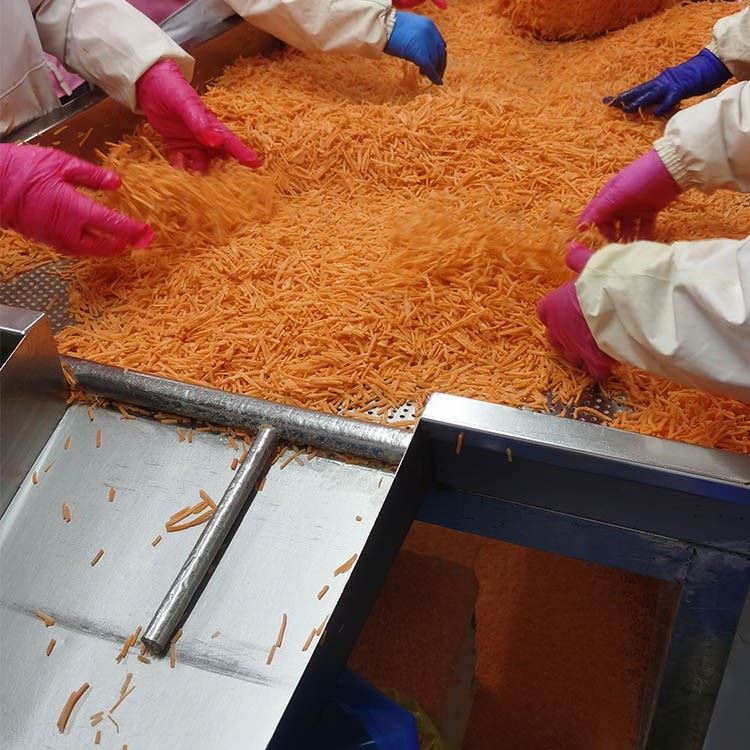
Workers sort orange carrot julienne on a stainless-steel table; the image supports the inspection stage.

A general food-processing room showing protective clothing, stainless equipment and packing activity; it is not presented as a carrot-only line.
Batch COA: Limits and Actual Results
The product specification states the acceptance limit. The Certificate of Analysis records the Actual Result measured or assessed for the corresponding production batch. These two columns are kept separate so a contractual maximum is never presented as though it were a test result. The COA also carries the product name, cut, lot number, production date, best-before date, sampling date, report date and release status.
| COA item | Regular specification limit | Actual Result field | Basis / unit |
|---|---|---|---|
| Appearance | Natural orange, free-flowing, typical julienne form | Batch assessment recorded | Sensory / visual |
| Size conformity | Grade A: ≥90% within agreed range | Measured batch percentage | % by weight |
| Short pieces below 20 mm | Grade A: ≤5% | Measured batch percentage | % by weight |
| Fines below 10 mm | Grade A: ≤2% | Measured batch percentage | % by weight |
| Clumps / loose ice | ≤3% / ≤2% | Separate batch values | % by weight |
| Aerobic Plate Count | <100,000 CFU/g | Batch laboratory result | CFU/g |
| Coliforms | <100 CFU/g | Batch laboratory result | CFU/g |
| E. coli | <10 CFU/g | Batch laboratory result | CFU/g |
| Yeast and mould | <1,000 CFU/g | Batch laboratory result | CFU/g |
| Salmonella | Absent in 25 g | Detected / Not detected | 25 g |
| Listeria monocytogenes | Absent in 25 g | Detected / Not detected | 25 g |
| Lead (Pb) | ≤0.10 mg/kg for EU-oriented specification | Batch or crop-lot laboratory result | mg/kg, wet weight |
| Cadmium (Cd) | ≤0.10 mg/kg for EU-oriented specification | Batch or crop-lot laboratory result | mg/kg, wet weight |
| Pesticide residues | Comply with the destination-market MRL schedule written into the order | Analyte-by-analyte laboratory result | mg/kg |
Microbiological and contaminant limits are regular commercial references, not universal legal limits. A stricter buyer protocol or destination-market requirement is written into the order specification and COA plan.
Quality Records, Traceability and Export Documents
We connect the finished carton code to the production lot and supporting records. The traceability file can include raw-material intake information, processing date, packing date, line or shift, inspection results, metal-detection records, cold-store movement and shipment reference. This structure helps a buyer reconcile the delivered lot with the COA instead of receiving a generic test sheet that cannot be tied to the goods.
The regular export document set includes commercial invoice, packing list, bill of lading data, certificate of origin when required, phytosanitary or health documents where applicable, product specification, batch COA and carton-mark details. Microbiological, pesticide-residue and heavy-metal laboratory reports are arranged by the agreed lot and testing plan. Halal, Kosher, HACCP, BRCGS, ISO or other system documents are supplied only when the relevant facility and shipment scope support them.
Signed cut, grade, packing, label, destination and test plan.
Batch inspection, COA fields, coding and pack integrity review.
Invoice, packing list, shipping marks and market documents.
Container, seal and shipment data linked to the commercial lot.

General certificate display used to illustrate the documentation module; it is not a batch-specific carrot COA.
Packing, MOQ, Lead Time and Container Planning
Packing must protect thin frozen strips from dehydration, breakage and temperature fluctuation while fitting the buyer's handling system. For industrial use, the common configuration is one food-grade PE liner in a 10 kg export carton. Foodservice programs often use 4×2.5 kg or 10×1 kg inner bags, while retail and private-label programs use 500 g, 750 g, 1 kg or 2.5 kg printed bags packed into master cartons. Carton strength, liner thickness, bag seal, barcode, language, net-weight statement, production coding and pallet pattern are set in the packing specification.
| Supply item | Reference | Planning detail |
|---|---|---|
| Bulk carton | 1×10 kg; 20 lb; 30 lb; 40 lb | Food-grade PE liner and export carton |
| Foodservice pack | 4×2.5 kg; 10×1 kg | Plain or printed inner bags |
| Retail / private label | 20×500 g; 10×1 kg; other retail counts | Artwork, language, barcode and case mark included in pre-production file |
| Regular MOQ | 10–12 MT or one 20RF loading plan | One cut and one standard bulk packing |
| Mixed container | 3–5 MT per SKU reference | Subject to compatible packing, stock, loading pattern and destination |
| 20RF loading | About 10–12 MT | Depends on carton dimensions, pallets and weight restrictions |
| 40RH loading | About 22–24 MT | Final payload follows carrier, route, pallet and axle limits |
| Production lead time | 15–21 days | Regular specification after order and packing details are fixed |
| Loading port | China main frozen-food export port | Selected by production location, route and freight plan |
A payload of 28.5 MT is not used as a standard promise. Reefer loading is constrained by the container's legal payload, road weight rules, carton cube, palletization and shipping route. We provide the carton count, net weight, gross weight and loading pattern for the actual shipment plan.
Cold-Chain Storage and Export Loading
Frozen julienne carrots should remain at −18°C or below during storage and transport. The thin cut can show dehydration, excess frost, clumping and mechanical breakage when cartons are exposed to temperature cycling or poor handling. We therefore treat cold-store release, carton condition, loading sequence and container temperature as part of product quality, not merely logistics.
Cartons are held in frozen storage, moved through the loading operation promptly and arranged to preserve airflow. The shipment file records the container and seal reference. Palletized and floor-loaded solutions are planned separately because they have different carton counts, airflow patterns and handling costs. Buyers should also maintain frozen distribution after arrival and avoid repeated thaw-and-refreeze cycles.

General frozen-food cold storage used to show the −18°C warehousing stage; it is not described as a carrot-only warehouse.

General export loading image showing cartons, refrigerated-container handling and temperature-control checks.
Application Matching by Cut and Process
The right julienne specification depends on how the buyer will dose, mix, heat and present the product. We match the cut to the process rather than presenting every size as interchangeable. The following application map is intended for industrial purchasing and product development.
Inquiry Information That Produces an Accurate Offer
A workable inquiry includes the exact cut, grade, packing, expected quantity, destination port, application and document scope. For example: "IQF carrot julienne, 4×4×30–50 mm, Grade A, 1×10 kg carton, 22 MT, Hamburg, for frozen ready meals, EU contaminant and residue plan, batch COA required." This gives our team enough information to calculate product fit, carton count, loading and testing without converting a vague request into an unreliable price.
For a private-label offer, add bag size, bags per carton, annual forecast, label language, barcode format and artwork status. For a mixed container, list every SKU and target tonnage. For a sample, state the cut and the tests you intend to run so the sample represents the future order.
Send Julienne Carrot InquiryFrozen Julienne Carrots FAQ
1. What is the standard size for IQF frozen julienne carrots?
Our principal commercial reference is 4×4×30–50 mm. We also supply 3×3×30–50 mm fine julienne and 5×5×30–60 mm robust julienne. The order specification states the nominal cross-section, allowed tolerance, target length range, percentage within range, short pieces and fines. This is more precise than using "shredded carrot" without measurable dimensions.
2. What is the difference between carrot julienne, shredded carrots and carrot strips?
Julienne describes longitudinal matchstick-style pieces. Shredded carrot may refer to a finer, less regular cut, while carrot strips can include thicker 6×6, 8×8 or 10×10 mm batons. Codex places shoestring or julienne within a maximum 9.5 mm cross-section, but the purchase contract needs a narrower nominal dimension. We label thick strips separately to prevent a cut mismatch.
3. Are the carrots blanched before IQF freezing?
Yes, our regular julienne specification is blanched before cooling, draining and IQF freezing. Blanching conditions are matched to the cut and intended further process. Because thin julienne heats faster than thick batons, the treatment must protect texture while achieving the planned enzyme control. The finished product is supplied as an ingredient for further heat processing unless the approved label states otherwise.
4. How are short pieces, fines and broken julienne controlled?
For Grade A, our regular references are no more than 5% short pieces below 20 mm and no more than 2% fines below 10 mm, measured by weight. Premium A+ uses limits of 3% and 1%. These limits are separate from the overall size-conformity percentage, allowing the buyer to see whether a lot contains too many visually disruptive or dosing-sensitive small pieces.
5. What defects are included in the product specification?
We address peel residue, major blemishes, black or discolored areas, green shoulder, woody or fibrous pieces, damaged tissue, extraneous vegetable material, foreign material, clumps, loose ice, short pieces and fines. Each measurable defect can be assigned a percentage or piece-count limit. Foreign material is required to be absent.
6. What microbiological limits are available for frozen carrot julienne?
Our regular commercial reference uses aerobic plate count below 100,000 CFU/g, coliforms below 100 CFU/g, E. coli below 10 CFU/g, yeast and mould below 1,000 CFU/g, Salmonella absent in 25 g and Listeria monocytogenes absent in 25 g. A buyer protocol with stricter values is written into the testing plan and order specification.
7. What does the batch COA show?
The COA identifies the product, cut, grade, lot number, production date, best-before date and report date. It then places the specification limit beside the Actual Result for the corresponding production batch. Physical results may include size conformity, short pieces, fines, clumps and loose ice. Laboratory fields can include microbiology, lead, cadmium and the pesticide-residue panel arranged for the destination market.
8. What lead and cadmium limits are used for EU-oriented orders?
The regular EU-oriented specification uses lead at no more than 0.10 mg/kg and cadmium at no more than 0.10 mg/kg on a wet-weight basis for carrots. The applicable legislation and any buyer-specific lower limit are included in the test plan. The COA or supporting laboratory report then states the measured result for the relevant batch or crop lot.
9. What bulk and foodservice packing formats are available?
Bulk supply includes 1×10 kg cartons and 20 lb, 30 lb or 40 lb cases with a food-grade liner. Foodservice options include 4×2.5 kg and 10×1 kg. Retail and private-label formats include 500 g, 750 g, 1 kg and 2.5 kg bags in an agreed master-carton count. Pack film, seal, carton strength, coding and pallet pattern are written into the packing specification.
10. What is the MOQ for bulk frozen julienne carrots?
The regular MOQ is about 10–12 MT or one 20RF loading plan for one cut and standard bulk packing. A mixed-container reference is 3–5 MT per SKU when the products have compatible packing, production availability and loading requirements. Retail printed bags may require a higher run because film printing and carton production have separate minimums.
11. How much product fits in a refrigerated container?
A 20RF normally carries about 10–12 MT and a 40RH about 22–24 MT under common frozen-food packing plans. The final quantity depends on carton dimensions, gross weight, palletization, airflow, container payload, route and road limits. We do not use 28.5 MT as a universal 40-foot promise; the shipment plan states the actual carton count and weights.
12. What is the production lead time?
The regular reference is 15–21 days after the order specification, packing details and commercial terms are fixed. Printed retail film, special laboratory panels, peak crop periods and mixed-container coordination can extend the schedule. The offer identifies the production window separately from ocean transit time.
13. How should frozen julienne carrots be stored and transported?
Store and transport the cartons at −18°C or below and avoid temperature cycling. Keep cases dry, intact and protected from crushing. During export loading, carton condition, container readiness, loading time and temperature are controlled. The buyer's warehouse and distribution system should maintain the same frozen condition after arrival.
14. Can you supply private-label frozen carrot julienne?
Yes. We support private-label bag and carton programs with agreed net weight, bag count, label language, barcode, nutrition panel supplied for the destination label, product name, origin, lot coding, storage statement and carton marks. A private-label project is costed with the artwork, film structure, print quantity, packing run and document scope included.
15. What information should I send for a quotation?
Send the nominal cut, accepted tolerance, grade, packing, quantity, destination port, application, target delivery date, required certificates, COA items, microbiological limits, contaminant or residue requirements and whether the load is single-product or mixed. For a precise comparison between suppliers, use the same dimensional, defect and testing specification in every request.
Plan Your Frozen Julienne Carrot Order
Send us your cut, grade, packing, quantity, destination, application and COA requirements. We will structure the offer around measurable product criteria, export documents and a realistic frozen-container plan.
Hot Tags: frozen julienne carrots, China frozen julienne carrots manufacturers, suppliers, factory, frozen carrot chunk, frozen carrot, frozen fresh carrots, frozen carrot dices
Previous
Frozen Shredded CarrotsNext
Frozen Cubed Carrots


