



Frozen White Potatoes
Description
Technical Parameters
IQF Frozen White Potato Cuts for Bulk, Foodservice and Private Label
We supply white-flesh Solanum tuberosum as peeled, blanched and individually quick-frozen dice, cubes, chunks, slices and non-fried strips. We prepare these plain IQF ingredients for importers, frozen-vegetable distributors, soup and ready-meal factories, central kitchens, foodservice wholesalers, repackers and private-label programs.
Our core SKU is 10 × 10 × 10 mm potato dice with no added oil, salt or seasoning. Additional cube sizes are 5, 8, 12, 15 and 20 mm. We also prepare 20–30, 20–40 and 30–50 mm chunks, 5–15 mm slices, 8 × 8 and 10 × 10 mm non-fried strips. Pre-fried French fries, hash browns and coated potato products are quoted under separate specifications.
Send the required form, size, dry matter, reducing-sugar target, texture, defect limits, packing, destination and annual volume. We will build the sample, quotation, production standard and batch COA around the same measurable requirements.

Actual potato-dice appearance for reviewing colour, cut regularity, surface frost and free-flowing condition.
Frozen White Potatoes: Define the Process Before Comparing Price
The same product name is used online for uncooked potato cuts, blanched IQF dice, precooked cubes, pre-fried fries, shredded hash browns and retail prepared sides. These products have different ingredients, customs descriptions, oil levels, cooking behaviour and cost. We place the exact process beside the product name on the offer and specification.
| Product Line | Factory Process | Standard Ingredient Direction | Main Commercial Use |
|---|---|---|---|
| Plain IQF white potato dice | Peeled, trimmed, diced, rinsed, blanched, cooled, dewatered and IQF frozen | 100% potato; no oil, salt or seasoning | Soups, ready meals, vegetable mixes, curries and industrial ingredients |
| Precooked potato cubes | Longer heat treatment before freezing | Potato; process and salt/additive status declared | Short reheating, foodservice sides and prepared meals |
| Non-fried strips and wedges | Cut, blanched and IQF frozen without frying | Potato; no oil in the plain specification | Roasting, prepared meals and further industrial processing |
| Pre-fried French fries | Cut, colour treatment, blanching, drying, frying, cooling and quick freezing | Potato plus declared edible oil; coating and dextrose only when specified | Foodservice frying, oven preparation and retail |

Frozen sorting removes dark pieces, peel, irregular cuts, fines and clumps before packing.
Buyer Risks and Our Control Points
Raw potatoes can meet the product name and still fail after cooking. High reducing sugar creates excessive browning, low solids can produce a watery texture, excessive blanching causes disintegration, weak dewatering creates ice and clumps, and an unclear formula creates label problems.
We connect each risk to a measurable control: cultivar and crop lot, dry matter, reducing sugars, peel status, nominal cut, size conformity, blanch condition, defect weights, cook test, ingredient declaration, microbiological panel, pack weight and frozen temperature.
The approved result becomes a signed specification, reference sample, batch record or COA value. This gives your purchasing and QA teams the same acceptance language at sample approval, production release and receiving inspection.
Available Forms, Sizes and Dimensional Tolerances
| Form | Commercial Sizes | Starting Tolerance | Application Direction |
|---|---|---|---|
| Fine dice | 5 × 5 × 5 mm | ±1 mm; ≥90% by count conforming | Fillings, small vegetable mixes and compact inclusions |
| Standard dice | 8, 10 and 12 mm cubes | ±2 mm; Grade A ≥90%, Premium ≥95% | Soups, ready meals, curries, salads after cooking and foodservice |
| Large dice | 15 and 20 mm cubes | ±2 mm; ≥90% by count conforming | Stews, tray meals and visible potato portions |
| Chunks | 20–30, 20–40 or 30–50 mm | ≥90% by weight inside declared band | Hearty soups, catering and roast-style processing |
| Slices | 5–7, 8–10 or 10–15 mm thick | ±1.5 mm up to 10 mm; ±2 mm above 10 mm | Layered meals, roasting and foodservice |
| Non-fried strips | 8 × 8 or 10 × 10 mm; 30–70 mm long | Cross-section ±1 mm; declared length distribution | Further processing and roasting; not represented as pre-fried fries |
| Wedges | 8 or 10 cuts per whole potato | Cut-count and minimum-length specification | Roasting, catering and prepared sides |
A Separate Specification for Frozen French Fries
Strip shape alone does not make a product a French fry. Codex describes quick-frozen French fried potatoes as potato strips treated for colour and fried in edible oil before freezing. It groups cross-sections as shoestring 5–8 mm, medium 8–12 mm, thick 12–16 mm and extra-large above 16 mm.
For a pre-fried quotation, we state cross-section, length distribution, surface style, coating, oil type, oil content, moisture, fry colour, defects and final cooking method. Our starting Codex-aligned limits are moisture ≤76% for shoestring, medium and thick cuts; sorting defects ≤12% by weight; small pieces plus scrap ≤6%; burnt pieces ≤0.5%; and free fatty acids in extracted oil ≤1.5% as oleic acid.
These fried-product values are never copied into the plain IQF dice specification. Your RFQ should state "blanched non-fried" or "pre-fried" explicitly.

Caliper measurement supports a separate 7, 8, 9, 10 or 12 mm strip specification.
Raw Potato Profile by Final Application
We declare the cultivar or processing profile by crop lot. Atlantic, Shepody, Russet-type or another approved white-flesh cultivar may be selected according to availability and use; a variety name alone does not guarantee fixed solids or colour.
| Control | General Cooking Profile | Roast/Fry-Oriented Profile | Batch Evidence |
|---|---|---|---|
| Dry matter | 18–22% | 20–24% | Oven or gravimetric actual result |
| Reducing sugars | ≤0.50% fresh-weight basis | ≤0.30% fresh-weight basis | Actual glucose + fructose or agreed method |
| Specific gravity | 1.070–1.100 when contracted | 1.080–1.120 | Hydrometer or weight-in-air/water result |
| Raw defects | No rot, blackheart, freezing injury, loose sprouts, insects or foreign matter | Same safety limits plus fry-colour screening | Intake inspection and rejection record |
| Cooked result | Tender centre with ≥90% pieces retaining identity | Even golden direction without excessive darkening | Defined application-test record and approved sample |

Colour comparison supports a repeatable high-temperature application test for the separate strip program.
Application Tests with Fixed Conditions
10 mm soup dice: add frozen product to water at 95–100°C, simmer 8 minutes with gentle agitation, drain for 2 minutes and inspect. Starting acceptance is ≥90% pieces retaining cube identity, broken/disintegrated material ≤5% by weight and no hard raw centre.
15 mm ready-meal dice: run the complete factory heat, chill/freeze and reheat cycle. Record centre tenderness, shape retention, sauce thickening and visible breakup. Starting post-reheat retention is ≥85% by count.
Roast or fry test: use the buyer's oil, load, temperature and time. If no method is supplied, start at 175°C for 3 minutes for pre-fried strips or 200°C oven for 18 minutes for blanched cubes, then compare colour, centre texture, breakage and sticking with the approved reference.
Grade A and Premium Physical Release Limits
Grade A and Premium below are GreenLand-food commercial grades, not automatic USDA grade claims. A 1 kg frozen sample is the standard visual starting sample, collected as a composite from multiple cartons.
| Parameter | Grade A | Premium | Inspection Rule |
|---|---|---|---|
| Size conformity | ≥90% by count | ≥95% by count | Caliper/template against nominal tolerance |
| Undersize pieces and fines | ≤5.0% | ≤3.0% | Weight below half the nominal unit volume |
| Irregular/misshapen pieces | ≤10.0% by count | ≤5.0% by count | Loss of the declared cut identity |
| Mechanical damage/breakage | ≤3.0% | ≤2.0% | Weight |
| Peel and visible eyes | ≤1.0% | ≤0.5% | Weight |
| Black/brown discoloration | ≤1.0% | ≤0.5% | A diced unit with dark affected area above 9 mm² is major |
| Green tissue or sprouts | 0 in 1 kg | 0 in 1 kg | Count/visual inspection |
| Loose surface ice | ≤2.0% | ≤1.0% | Separated weight |
| Clumps | ≤5.0% | ≤3.0% | Pieces not separated by gentle hand pressure |
| Total visual defects | ≤5.0% | ≤3.0% | Overall cap; defect categories do not stack above it |
| Rot, mould, insects, glass, stone or metal | 0 | 0 | Inspected sample |
Processing Flow and Blanching Windows
We inspect sound, mature potatoes for rot, blackheart, freezing injury, green tissue, sprouts, bruising and foreign matter. Accepted lots move through washing, peeling, trimming, cutting, rinsing, blanching, cooling, dewatering, IQF freezing, frozen sorting, metal detection, packing and storage.
Production starting windows are 85–95°C for 2–4 minutes for 5–8 mm dice, 90–98°C for 3–6 minutes for 10–12 mm dice, and 90–98°C for 5–9 minutes for 15–20 mm dice or chunks. The finished release depends on enzyme control, colour, centre condition and the contracted cook test-not time alone.
After cooling and dewatering, the product enters IQF freezing. The process is complete when the thermal centre reaches −18°C after stabilisation. Freezing preserves the product but is not a sterilisation step.

General IQF tunnel evidence for rapid freezing, temperature control and loose-piece separation.

General equipment reference for washing, freezing, inspection, weighing and sealing controls.
Foreign Material, Metal Detection and Pack Control
We control physical hazards through raw-material cleaning, trimming, equipment condition checks, line inspection, frozen sorting and final detection. The starting metal-detector validation for a 10 kg potato pack is Fe 1.5 mm, non-Fe 2.0 mm and stainless steel 2.5 mm. The production record states the actual test pieces, aperture, product temperature and challenge frequency.
Finished bags are checked for seal contamination, leakage, code legibility and declared net weight. The average lot weight must meet or exceed the label declaration; no individual 10 kg pack may be below 9.95 kg under the starting internal pack-control rule.
If the selected bag size or detector aperture cannot reliably achieve the starting sensitivity, the validated values are written into the signed specification before production rather than hidden behind a general "metal detected" statement.
Microbiological and Chemical Release Specification
| Test | Starting Limit | COA Reporting |
|---|---|---|
| Aerobic plate count | ≤100,000 CFU/g | Actual count |
| Enterobacteriaceae | ≤1,000 CFU/g | Actual count |
| Coliforms | ≤100 CFU/g | Actual count |
| E. coli | <10 CFU/g | Actual result or below LOQ |
| Yeast / mould | ≤1,000 / ≤1,000 CFU/g | Separate actual results |
| Bacillus cereus | ≤1,000 CFU/g | Actual count when contracted |
| Salmonella | Not detected in 25 g | Detected/not detected |
| Listeria monocytogenes | Not detected in 25 g | Detected/not detected |
| Lead / cadmium | ≤0.10 / ≤0.10 mg/kg | Actual value, LOQ and method |
| Sulphur dioxide | <10 mg/kg for the standard sulphite-free-labelled program | Actual result when tested |
| Pesticide residues | Each analyte ≤ destination-market MRL | 200+, 300+ or 500+ panel with actual result, LOQ and MRL |
For an EU program, the general pesticide MRL is 0.01 mg/kg where no specific value exists. Plain IQF white potatoes are intended for further cooking unless a separate validated use program and label are agreed.
Clean-Label and Formulated Options
| SKU | Ingredient / Process Direction | Declaration Rule |
|---|---|---|
| Plain clean-label IQF | 100% potato; water is used in processing; oil, salt, dextrose and SAPP 0% | Ingredient: potato |
| Colour-control option | SAPP starting maximum 100 mg/kg expressed as P₂O₅ where permitted | Declared by additive name/number for the destination market |
| Dextrose-treated fries | Dextrose used only for contracted fry-colour control | Separate pre-fried formula and nutrition calculation |
| Coated or seasoned potato | Oil, starches, flours, salt and seasoning according to approved formula | Full ingredient, allergen and nutrition review |
Batch COA, Traceability and Document File
The signed specification states the limit; the COA shows the actual batch result. The COA includes product name, form, nominal size, ingredient statement, cultivar/crop profile, origin, production lot, production date, best-before date, colour, odour, size conformity, measured defects, dry matter and reducing sugar when contracted, microbiological results, chemical-report references and release conclusion.
The lot code connects raw-potato intake, field or supplier reference, production shift, blanching and freezing record, finished-pack checks, retained sample, cold-storage location and shipment. Available documents include specification, COA, commercial invoice, packing list, certificate of origin, bill-of-lading support, health/phytosanitary document where required, microbiological report, residue report, heavy-metal report, allergen/GMO/irradiation statements and current in-scope facility certificates.
We retain a reference sample from the approved production lot and record specification changes. A change in cultivar profile, cut, blanch condition, ingredient, factory, packing material, analytical scope or shelf life requires written review before repeat production.
Packaging, MOQ, Lead Time and Container Plan
Bulk: 1 × 10 kg PE liner/carton. Foodservice: 4 × 2.5 kg or 10 × 1 kg. Retail: 300, 400, 500, 750, 900 or 1,000 g. Private-label approval covers film structure, artwork, barcode, language, ingredient statement, cooking instruction, date-code area and carton marks.
The starting MOQ is 10 MT for one standard bulk SKU and 15 MT for a custom cut or private-label program. Mixed-container planning starts at 3–5 MT per compatible SKU. Standard lead time is 15–20 days after specification, packing and deposit approval; new printed film normally requires 30–40 days.
A 20 ft reefer carries approximately 10–12 MT. A 40 ft high-cube reefer carries approximately 24 MT floor-loaded or 22 MT palletised. Xiamen is the starting port for the Fujian program; Qingdao applies to contracted northern production. The final port and payload appear on the quotation.

General frozen-food packing and pre-shipment evidence for carton, label, quantity and cold-chain checks.
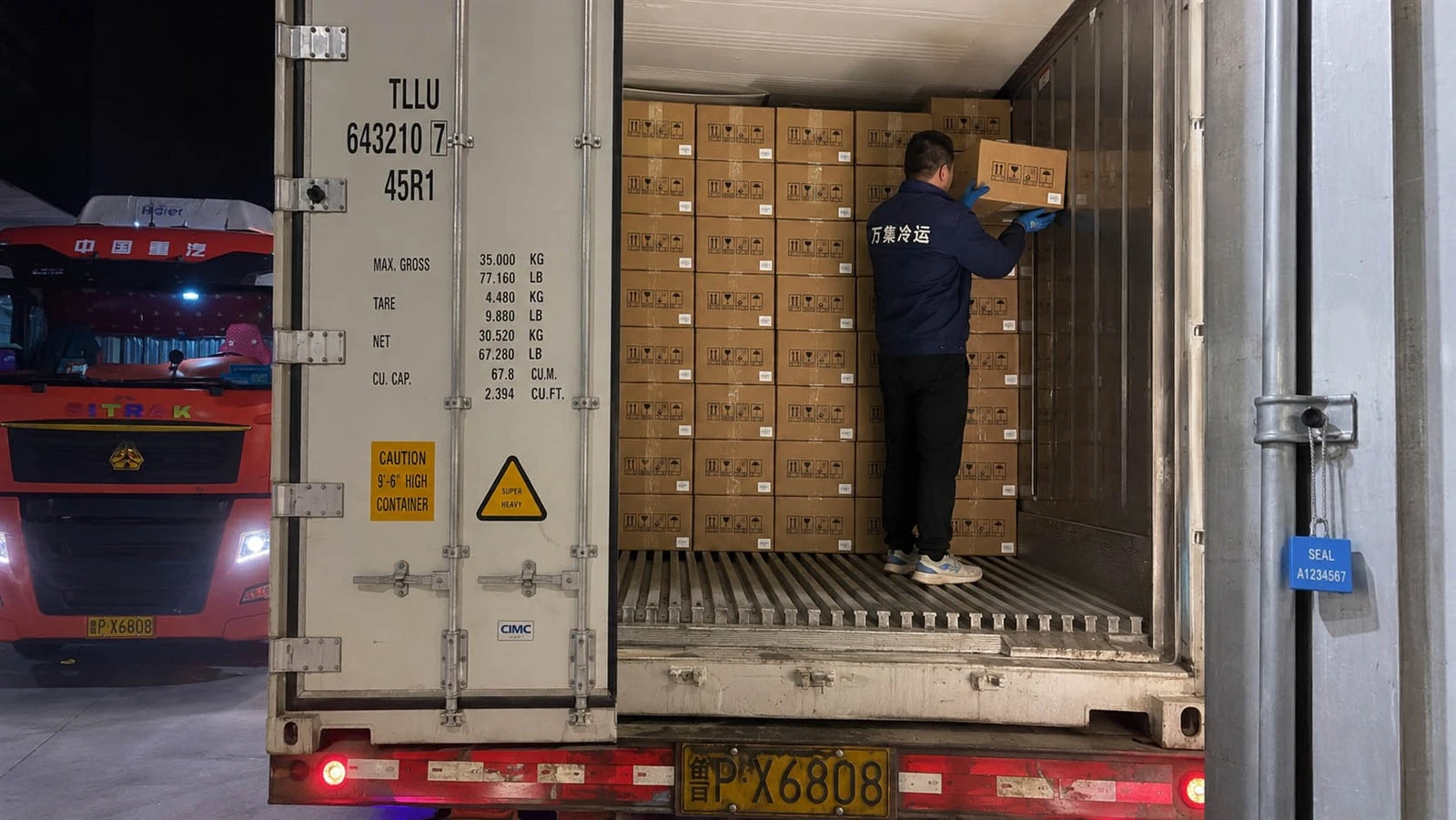
Reefer loading evidence; product identity remains tied to carton codes and shipment documents.
Cold Chain, Receiving Inspection and Claim Evidence
Finished product is stored and shipped at −18°C or below. Loading checks cover product temperature, carton condition, container cleanliness, pre-cooling, set point, loading sequence, container number, seal and recorder placement when contracted.
At receipt, record seal condition, reefer display, product temperature, carton condition and lot codes before unloading is complete. Select cartons across door, middle and front positions. Keep samples frozen until the agreed visual inspection begins.
A claim file includes lot/carton codes, container and seal, sampling positions, calibrated temperatures, unopened-pack photographs, one complete 1 kg defect separation, unit counts, cook-test method and retained sample. This distinguishes production variation from thaw/refreeze damage or an application mismatch.
Frequently Asked Questions
1. What does Frozen White Potatoes mean?
It refers to frozen cuts from white- or cream-flesh Solanum tuberosum. Our main product is peeled, blanched, non-fried IQF dice; the exact form and process appear beside the name.
2. Are the standard potato dice pre-fried?
No. The standard SKU is blanched and IQF frozen with 0% added oil. French fries and fried cubes use separate ingredient and performance specifications.
3. Which cube sizes are available?
We prepare 5, 8, 10, 12, 15 and 20 mm cubes. The main size is 10 × 10 × 10 mm with ±2 mm tolerance and at least 90% conformity by count.
4. Can you supply chunks, slices, strips and wedges?
Yes. Starting options are 20–50 mm chunks, 5–15 mm slices, 8 or 10 mm non-fried strips and 8- or 10-cut wedges.
5. What dry matter should we specify?
Use 18–22% for general cooking and 20–24% for roast/fry-oriented applications. The COA states the actual lot result when included.
6. What reducing-sugar limit is available?
The starting limit is ≤0.50% on a fresh-weight basis for general cooking and ≤0.30% for high-temperature applications.
7. Do plain IQF potatoes contain SAPP or dextrose?
No. The plain SKU contains potato only. SAPP, dextrose, oil, coating or seasoning creates a separately declared formula.
8. How are peel, eyes and dark spots controlled?
Grade A limits peel/eyes to 1.0%, black/brown discoloration to 1.0%, mechanical damage to 3.0% and total visual defects to 5.0% by weight.
9. Are IQF white potato cuts ready to eat?
No. Standard IQF potato cuts require further cooking. Blanching and freezing are not represented as a validated ready-to-eat process.
10. Can you provide a batch COA?
Yes. It shows the represented lot, acceptance limit, actual result, method/reference, units and release conclusion for the contracted items.
11. What microbiological limits are used?
The starting panel is APC ≤100,000 CFU/g, coliforms ≤100, E. coli <10, yeast/mould ≤1,000 each, and no Salmonella or Listeria monocytogenes in 25 g.
12. What packaging and MOQ are available?
Bulk packing is 1 × 10 kg; foodservice and retail packs are available. MOQ starts at 10 MT for bulk and 15 MT for custom/private-label production.
13. How much fits in a reefer?
A 20 ft reefer carries about 10–12 MT. A 40 ft high-cube reefer carries about 24 MT floor-loaded or 22 MT palletised.
14. What is the shelf life and storage temperature?
Shelf life is 24 months from production at −18°C or below in unopened original packing under an uninterrupted frozen chain.
15. What should we include in an RFQ?
Send form, cut size, tolerance, plain or fried process, dry matter, reducing sugar, grade, cooking application, pack, quantity, destination, document list and shipment month.
Request a Comparable Frozen White Potato Quotation
Copy this structure into your inquiry: form + nominal size/tolerance + peeled/skin-on + blanched/precooked/pre-fried + dry matter + reducing sugar + grade + cook test + micro/chemical panel + packing + quantity + destination + Incoterm + shipment month.
Example: peeled IQF white potato dice, 10 × 10 × 10 mm ±2 mm, blanched and non-fried, 18–22% dry matter, reducing sugars ≤0.50%, Grade A, 1 × 10 kg carton, batch COA plus 300+ pesticide panel, 22 MT palletised, CIF Rotterdam, October shipment.
Hot Tags: frozen white potatoes, China frozen white potatoes manufacturers, suppliers, factory, frozen french fries, frozen potato, frozen fries, fried potatoes frozen, potato sticks frozen, frozen potato chunk
Previous
No Information


