



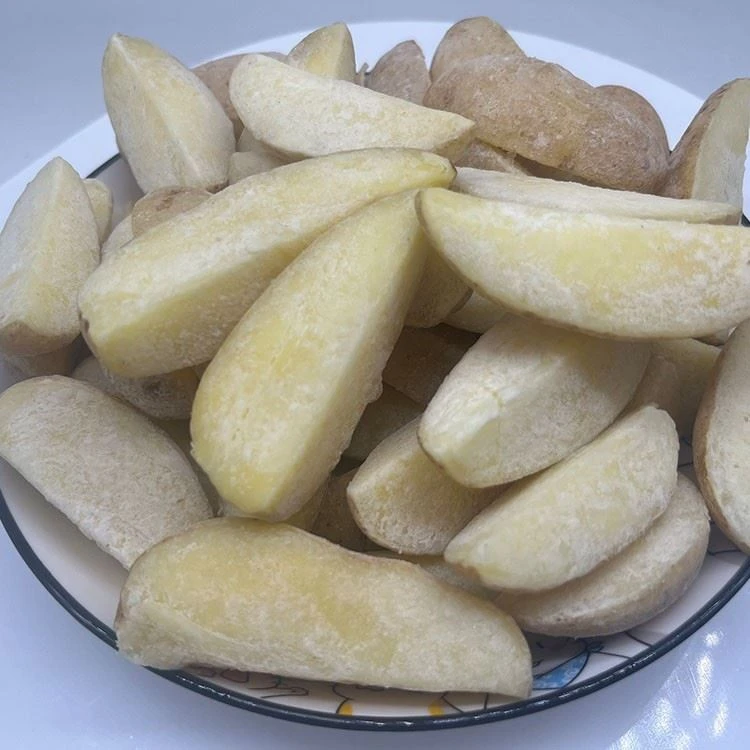


Frozen Square Potatoes
Description
Technical Parameters
IQF Frozen Diced Potatoes for Industrial, Foodservice and Private-Label Supply
We supply peeled, blanched, non-fried IQF frozen potato dice made from Solanum tuberosum L. for ready meals, soups, vegetable blends, salads, casseroles, catering packs and retail programs. This is a clean potato ingredient: 100% potato, no added oil, no added salt, no added sugar, no glaze and no preservatives in our standard specification.
The standard commercial form is a free-flowing frozen dice with a natural white, cream or pale-yellow color. We control cube dimensions, broken pieces, fines, peel residue, green tissue, black spots, clumping, loose ice and cooked integrity as measurable lot-release points. Buyers can select 6, 8, 10, 12 or 15 mm dice; 20 mm is sold as a large potato cube, while irregular pieces above 20 mm are specified as potato chunks.

Actual IQF potato dice appearance: individually frozen pieces with visible cube edges and natural potato color.
Standard Product Identity
| Commercial Name | Peeled, Blanched, Non-Fried IQF Frozen Potato Dice |
|---|---|
| Botanical Identity | Solanum tuberosum L., edible tuber |
| Ingredient | 100% potato |
| Processing | Washed, peeled, trimmed, diced, blanched, cooled, drained, IQF frozen, sorted and metal detected |
| Frozen Condition | Core temperature ≤ -18°C; free-flowing pieces ≥98% Grade A or ≥99% Premium |
| Shelf Life | 24 months at -18°C or below |
| Crop Windows | June-July and October-November |
| Origin Programs | Fujian, Shandong and Inner Mongolia, China |
What This Product Is, and What It Is Not
Our standard IQF potato dice are blanched but not fully cooked, not fried and not coated. They are prepared for a later cooking step in a food factory, foodservice kitchen or retail consumer pack. Skin-on cubes, large chunks, pre-fried cubes, wedges, fries and formed potato products each use an independent ingredient, processing and quality specification.
Skin-On Potato Cubes
10, 12, 15 and 20 mm cube programs retain the skin. Loose peel longer than 10 mm is limited to 3 pieces/kg for Grade A and 1 piece/kg for Premium.
Large Cubes and Chunks
20 mm pieces are large cubes. Irregular 15-25, 20-30, 20-40 and 30-50 mm pieces are chunks, with their own conformity and broken-piece limits.
Pre-Fried Potato Cubes
Pre-fried cubes include oil and require a separate oil type, fat target, fry color and acrylamide-control specification. They are not quoted as plain IQF potato dice.
Wedges, Fries and Hash Browns
Wedges, eighths, strips, fries, balls and formed hash browns are quoted under their own geometry, ingredient, oil-content, cooking and packing specifications.
Cube Sizes and Dimensional Tolerances
We measure three edges with a calibrated caliper. A complete cube retains at least 75% of the expected cube shape. An incomplete cube has lost more than 25% of the outline but still retains more than 50% of the expected volume. A broken piece retains less than 50%. Fines measure below 50% of the nominal edge; undersize is below 50% and oversize is above 150% of the nominal edge.
The table below gives finished frozen-product release limits. Grade A suits mainstream foodservice and processing. Premium gives tighter dimensional conformity and lower fines for visible ready-meal, salad and retail applications.

GreenLand-food frozen food production base, product range and export-service capability.
| Nominal Size | Grade A Tolerance | Premium Tolerance | Conforming Cubes | Grade A Fines / Oversize | Premium Fines / Oversize |
|---|---|---|---|---|---|
| 6×6×6 mm | ±1.5 mm | ±1.5 mm | ≥90% / ≥95% | ≤5% below 3 mm / ≤5% above 9 mm | ≤3% / ≤3% |
| 8×8×8 mm | ±2.0 mm | ±2.0 mm | ≥90% / ≥95% | ≤5% below 4 mm / ≤5% above 12 mm | ≤3% / ≤3% |
| 10×10×10 mm | ±2.0 mm | ±1.5 mm | ≥90% / ≥95% | ≤5% below 5 mm / ≤5% above 15 mm | ≤3% / ≤3% |
| 12×12×12 mm | ±2.5 mm | ±2.0 mm | ≥90% / ≥95% | ≤5% below 6 mm / ≤5% above 18 mm | ≤3% / ≤3% |
| 15×15×15 mm | ±3.0 mm | ±2.0 mm | ≥90% / ≥95% | ≤5% below 7.5 mm / ≤5% above 22.5 mm | ≤3% / ≤3% |
| 20×20×20 mm large cube | ±3.0 mm | ±2.5 mm | ≥90% / ≥95% | ≤5% below 10 mm / ≤5% above 30 mm | ≤3% / ≤3% |

Actual potato-dice processing line used to inspect piece separation, visible defects and frozen condition.
Grade A and Premium Release Limits
Premium grade uses tighter numerical limits than Grade A. Grade A requires at least 90% dimensionally conforming pieces and at least 90% complete cubes. Premium requires at least 95% for both measures, with lower limits for broken pieces, peel residue, discoloration, clumping and cooking breakdown.
Gross blemish affecting more than 25% of a piece, rot, mould, foreign material, black heart, sprout tissue and green peel are absent in both grades. The order specification states the selected grade so the sample, production lot, COA and retained sample use one release standard.
| Quality Point | Grade A | Premium |
|---|---|---|
| Complete cubes / dimensional conformity | ≥90% / ≥90% | ≥95% / ≥95% |
| Broken or incomplete pieces / fines / connected pieces | ≤5% / ≤5% / ≤3% | ≤3% / ≤3% / ≤1% |
| Peel residue / color defects / greening | ≤2% / ≤3% / ≤0.5% | ≤1% / ≤1% / absent in 1 kg |
| Major blemish above 6 mm / minor blemish 2-6 mm | ≤1% / ≤3% | ≤0.5% / ≤1.5% |
| Black or grey spots / bruised or crushed pieces | ≤1% / ≤3% | ≤0.5% / ≤1.5% |
| Translucent or water-soaked pieces | ≤2% | ≤1% |
| Clumps / loose ice / severe freezer burn | ≤2% / ≤2% / ≤1% | ≤1% / ≤1% / ≤0.5% |
| Glaze / rot / mould / foreign material | 0% / absent / absent / absent | 0% / absent / absent / absent |
Raw Potato Selection, Variety and Crop Control
We use mature, firm and sound potatoes suitable for freezing. Commercial variety options include Atlantic, Shepody, Russet, Favorita and Holland 15. Variety selection controls dry matter, specific gravity, reducing sugar, color after heat treatment and cooked texture. The production lot records the variety or defined variety group.
Raw receiving size options are 45-65, 50-70, 60-80 and 70+ mm, with a minimum diameter of 45 mm for the standard dice program. Receiving temperature is 8-15°C. Premium raw material has no sprouting, rot, mould, off-odor, severe bruising, extensive greening, freezing injury, hollow heart, black heart or pest damage. Grade A permits only short sprouts up to 3 mm; severe greening remains absent.
Dry Matter and Specific Gravity by Application
For ready meals, we target 18-22% dry matter and a specific gravity of 1.070-1.090. Firm salad and boiling programs use 16-20% dry matter. Roast and fry applications use 20-24% dry matter with specific gravity at or above 1.080. The practical starch reference is 12-18%.
Reducing sugar controls browning during roasting and frying. For glucose plus fructose on a fresh-weight basis, our standard roast/fry target is ≤0.50%, Premium is ≤0.30%, and a selected very-low-sugar program is ≤0.20%. Raw sugar, process color, frying temperature and cooking time form the acrylamide-control program for high-temperature applications.

Cutting and trimming stations control piece dimensions, surface defects and uniformity before blanching and freezing.
Clean-Label Ingredient and Chemical Controls
Our standard formula is 100% potato. Added oil, salt, sugar, preservatives, artificial color, artificial flavor and glaze are all 0. The standard program has no added sulphites, phosphates or dextrose; sulphur dioxide is below 10 mg/kg. The product is Non-GMO, not irradiated and has no intentionally added allergens.
A separate anti-browning program can use sodium acid pyrophosphate, citric acid or ascorbic acid. The selected additive appears in the ingredient list, order specification, COA and retail label. A sulphite-treated program records the sulphite source, measured result and required allergen declaration.
Total glycoalkaloids, measured as alpha-solanine plus alpha-chaconine, have a GreenLand-food release target of ≤100 mg/kg for Grade A and ≤75 mg/kg for Premium. We use LC-MS/MS or LC-UV/DAD analysis. Green or sprouted raw potatoes are removed before processing.

The IQF tunnel operates at -30 to -40°C to freeze separated potato pieces to a core temperature of -18°C or below.
Blanching, Cooling and IQF Freezing Parameters
The process flow is: raw receiving, washing, peeling, trimming, dicing, size screening, blanching, cooling, draining, IQF freezing, optical and manual sorting, metal detection, weighing, packing and frozen storage.
Blanching operates at 85-98°C for 2-10 minutes. A 10 mm dice typically runs at 90-98°C for about 3-8 minutes. The standard program requires a negative peroxidase result. The alternate guaiacol program permits a trace-positive endpoint at 60-90 seconds and is identified separately in the product specification and COA.
After blanching, potable-water cooling brings the product to ≤15°C before freezing. The IQF tunnel operates at -30 to -40°C and the frozen product exits with a core temperature at or below -18°C. Grade A requires ≥98% free-flowing pieces; Premium requires ≥99%. Glaze remains 0%.
Cooking Performance: Exact Methods and Acceptance Limits
We test cooking from frozen, not after overnight thawing. For a boiling test, place 200 g of frozen potato dice into 2 L of boiling water and begin timing when the water returns to a steady boil. Use 5-7 minutes for 10 mm dice, 6-8 minutes for 12 mm, 8-10 minutes for 15 mm and 10-12 minutes for 20 mm large cubes. The finished pieces should be fully hot, free from a hard raw center and suitable for the selected texture profile.
| Cook Test | Grade A | Premium | Sensory Requirement |
|---|---|---|---|
| Pieces retaining integrity | ≥90% | ≥95% | Recognizable cube shape after stirring and draining |
| Breakdown / mushy pieces / hard centers | ≤5% / ≤5% / ≤5% | ≤2% / ≤2% / ≤2% | Typical potato flavor; fermentation, bitterness, rancidity and foreign odor absent |
| Roast or fry dark/burnt pieces | ≤5% | ≤2% | Even light-golden development for the selected low-sugar program |
We can set the cooked texture as firm/waxy, medium, mealy or roast-oriented. The product is not ready to eat. Cook it from frozen until the center reaches 70°C for 2 minutes or 75°C for 30 seconds. Boiling, steaming, baking, roasting, pan-frying and deep-frying are all possible; the chosen size and dry-matter program must match the method.
Application Matching for B2B Buyers
| Application | Recommended Cut | Technical Target | Buyer Benefit |
|---|---|---|---|
| Soup and chowder | 8, 10 or 12 mm | 16-21% dry matter; firm or medium texture | Fast heat transfer and even spoon presentation |
| Ready meals | 10, 12 or 15 mm | 18-22% dry matter; cooked integrity ≥90% or ≥95% | Stable portioning and visible cubes after reheating |
| Stews and casseroles | 15 or 20 mm; 20-40 mm chunks | 18-22% dry matter; low breakdown | Longer cook tolerance and recognizable pieces |
| Potato salad | 10, 12 or 15 mm | 16-20% dry matter; firm/waxy profile | Reduced edge breakdown during dressing and mixing |
| Frozen vegetable blends | 6, 8 or 10 mm | Tight dimensional conformity and low fines | Better visual balance with carrot, pea, corn and bean cuts |
| Roasting | 15 or 20 mm; skin-on option | 20-24% dry matter; reducing sugar ≤0.30% | More even browning and less dark scorching |
| Pan or deep frying | 10-15 mm | Dry matter ≥20%; reducing sugar ≤0.30% | Controlled color with a crisp surface after final frying |
Foreign Material and Metal Detection
Stones, glass, hard plastic, wood, insects, animal material, paper, string and other foreign material are absent. Visual sorting covers raw receiving, post-cutting inspection and final frozen inspection. Metal detection follows final packing or the specified pack-line position.
Standard detector sensitivity is ferrous 1.5 mm, non-ferrous 2.0 mm and stainless steel 2.5 mm. Challenge checks are completed at start-up, every 2 hours, after a product or pack change, after a line stop and at the end of the run. Failed checks trigger line isolation, re-screening and documented disposition.
Inspection acceptance uses AQL General Inspection Level II: critical defects 0, major defects AQL 1.5 and minor defects AQL 4.0. Any critical food-safety defect places the inspected lot on hold.

Metal-detection checks use ferrous 1.5 mm, non-ferrous 2.0 mm and stainless-steel 2.5 mm test pieces.
Microbiological Release Specification
These limits apply to the frozen product at release. The product still requires cooking. The COA presents each acceptance limit beside the measured result for the released production lot.
| Test | Grade A | Premium |
|---|---|---|
| Aerobic plate count | ≤100,000 cfu/g | ≤50,000 cfu/g |
| Enterobacteriaceae / coliforms | ≤1,000 / ≤100 cfu/g | ≤100 / <10 cfu/g |
| E. coli | <10 cfu/g | <10 cfu/g |
| Yeast / mould | ≤1,000 / ≤1,000 cfu/g | ≤500 / ≤500 cfu/g |
| Staphylococcus aureus | <100 cfu/g | <100 cfu/g |
| Bacillus cereus | ≤1,000 cfu/g | ≤100 cfu/g |
| Clostridium perfringens, when included | <100 cfu/g | <100 cfu/g |
| Salmonella / Listeria monocytogenes | Not detected in 25 g | Not detected in 25 g |
Residues, Heavy Metals and Destination-Market Compliance
Pesticide-residue testing is matched to the destination program: EU Regulation (EC) No 396/2005, US EPA tolerances, Japan Positive List or Canada PMRA limits. The analytical panel covers potato crop-protection compounds relevant to the selected origin and export market, with results reported in mg/kg.
For EU programs, lead is ≤0.10 mg/kg and cadmium is ≤0.10 mg/kg for peeled potatoes. Our Premium internal target is ≤0.05 mg/kg for each. Additional release targets are arsenic ≤0.20 mg/kg, mercury ≤0.02 mg/kg and sulphur dioxide <10 mg/kg for the standard no-added-sulphite product.

Carton inspection checks product name, lot code, production date, best-before date, net weight, storage statement and origin.
Industrial, Foodservice and Retail Packing
Industrial: 10, 15 or 20 kg net cartons; 2×5 kg and 4×2.5 kg inner packs; 20, 30 or 40 lb formats. An octobin program can be built for an industrial line after pack testing.
Foodservice: 10×1 kg, 5×2 kg, 4×2.5 kg, 6×5 lb and 12×2.5 lb.
Retail and private label: 20×300 g, 20×400 g, 20×500 g, 10×900 g and 10×1 kg.
Bulk cartons use a food-grade PE liner with a 0.06-0.08 mm reference thickness and a five-ply corrugated outer carton. Staples are not used. Labels show product name, cut, net weight, ingredient, lot, production date, best-before date, storage statement, origin and required importer information.
MOQ, Lead Time, Container Loading and Samples
MOQ
12 MT for one production specification; 5 MT for a stock trial lot; 3-5 MT per SKU in a mixed container; 10-12 MT for private label; 12-20 MT for organic.
Container Load
A 20 ft refrigerated container loads about 12 MT. A 40 ft refrigerated container loads 22-24 MT, subject to carton dimensions and legal payload.
Lead Time
15-21 days for standard production; 7-10 days for available stock; 20-30 days for printed retail packing after artwork approval.
Sample
1-2 kg sample, prepared within 3-5 working days. The sample label states size, grade, processing method and production lot.
Frozen Storage and Cold-Chain Records
Finished cartons are stored at -18 to -22°C. The reefer set point is -18°C. We record finished-product core temperature, cold-store room temperature, pre-loading inspection, reefer pre-cooling, container condition, loading start and finish time, set point, seal number and temperature recorder information.
The product remains frozen throughout loading. Cartons showing water damage, collapse, open seals or unreadable lot codes are held. Pallet and floor loading plans maintain airflow around the cargo. A shipment file connects the released lot to the packing list, invoice, bill of lading, health or phytosanitary document when required, certificate of origin and temperature record.

Frozen cartons held in a controlled loading area before reefer transfer.
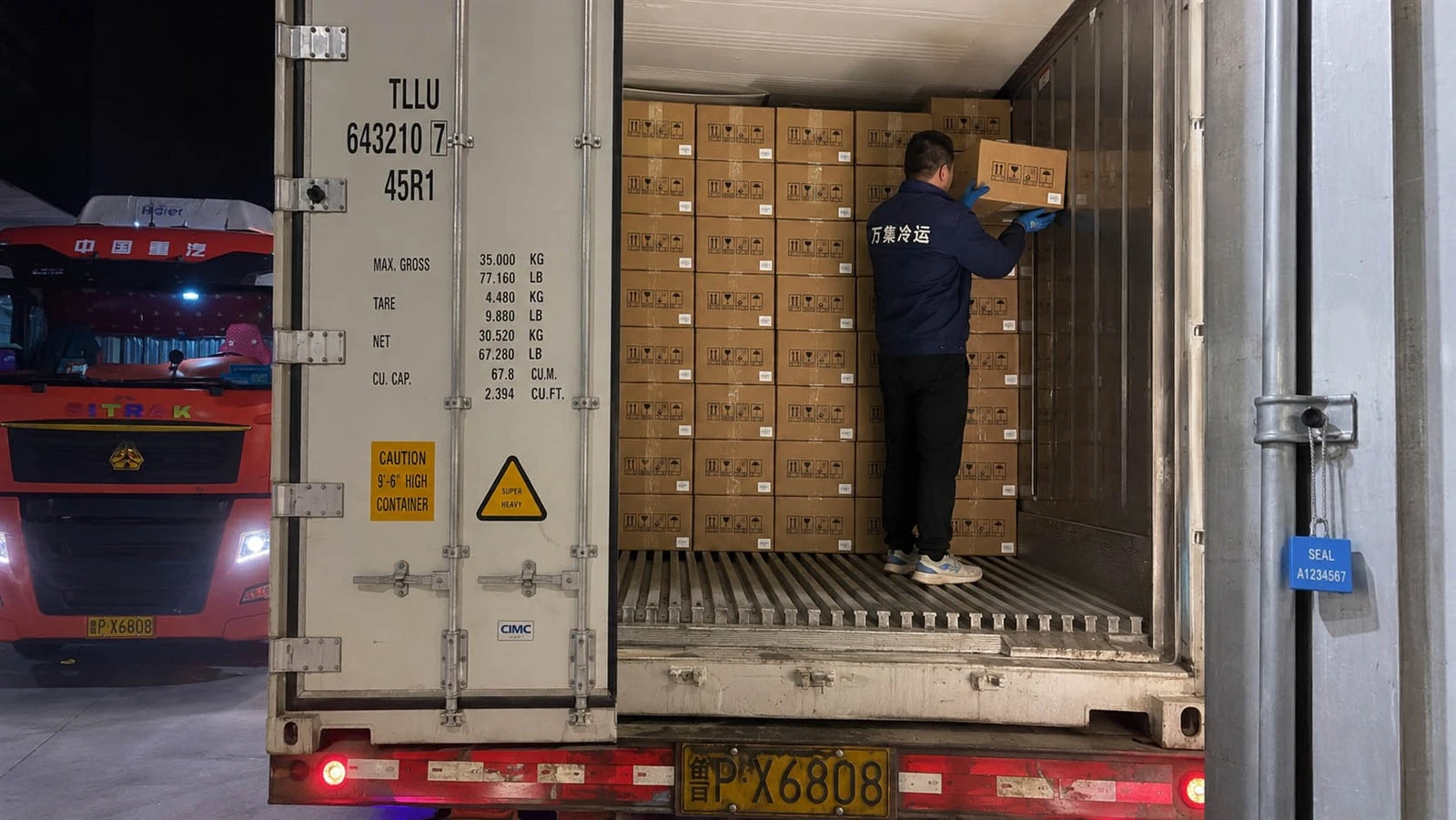
Reefer loading includes carton condition, cargo temperature, loading time, container set point and seal-number records.
Lot Code and Traceability
A code such as PT261015-G08-L2-A identifies the potato program, production date, grade/size reference, line and shift. The batch record connects raw-potato receiving, supplier lot, variety, production date, blanching record, IQF record, metal-detector checks, packing materials, finished-product inspection, laboratory results, cold-store location and shipment.
Retained samples are held from the released lot. The lot code retrieves the matching specification, raw-material record, production file, inspection record and COA. It also supports repeat-order comparison across crop and production dates.
COA Content and Lot Sampling Plan
The COA identifies the product name, botanical name, lot, production date, grade, cut size, ingredient, processing method, packing and storage. Results cover dimensions, conformity, complete and broken pieces, fines, peel, green pieces, black spots, color, odor, texture, clumps, loose ice, core temperature, dry matter, reducing sugar when selected, cooking integrity, microbiology and contracted contaminants. Quantitative tests show the measured value and unit; pathogen and foreign-material tests show detected or not detected.
A production lot contains one variety or declared variety group, one cut, one grade, one processing date, one line, one shift and one pack format. We select at least five cartons from separated pallet positions. A 500 g portion from each carton forms a 2.5 kg composite. Dimension checks use 200 cubes per carton. Defect scoring uses 1 kg; contracted foreign-material inspection uses 10 kg.
Dry-matter samples are taken at the beginning, middle and end of the run. Cooking uses one representative composite batch. Microbiology uses five separate units. Temperature is measured in five cartons. Two retained samples are held. Product remains on hold until sensory, physical, metal-detection, microbiological and selected chemical results meet the release specification.
Certificates and Export Document Set
Supply programs can include BRCGS, HACCP, ISO 22000, ISO 9001, Kosher, Halal, organic certification and FDA facility registration. The quotation lists the certificates included in the selected plant and crop program.
The commercial document set can include invoice, packing list, bill of lading, certificate of origin, health certificate, phytosanitary certificate, COA, microbiological report, pesticide-residue report, heavy-metal report, allergen statement, Non-GMO statement and product specification. We list the required documents in the order file before production so the shipment and buyer file use the same product identity.

Food-safety, quality-system, market-access and product-program certificates for export purchasing files.
Frequently Asked Questions
1. Are these IQF potato dice pre-fried?
No. The standard product is peeled, blanched and IQF frozen with 0 added oil. Pre-fried potato cubes are a separate SKU with an oil declaration, fat target, frying color and acrylamide-control specification.
2. Which cube sizes can we buy?
We supply 6, 8, 10, 12 and 15 mm dice. A 20 mm product is sold as a large cube. Irregular 15-25, 20-30, 20-40 and 30-50 mm forms are sold as chunks.
3. What is the difference between Grade A and Premium?
Grade A requires at least 90% dimensional conformity and complete cubes. Premium requires at least 95%, limits fines and broken pieces to 3%, peel residue to 1%, color defects to 1% and clumps to 1%.
4. Can you supply skin-on potato cubes?
Yes. Skin-on cubes are available in 10, 12, 15 and 20 mm. Grade A limits loose peel longer than 10 mm to 3 pieces/kg; Premium limits it to 1 piece/kg.
5. Do the standard potato dice contain sulphites or phosphates?
No. Our standard clean-label formula contains 100% potato with no added sulphites, phosphate, dextrose, oil, salt, sugar or preservatives. Sulphur dioxide is below 10 mg/kg.
6. Which potato dice are best for soup, salad and ready meals?
Use 8-12 mm for soup, 10-15 mm with 16-20% dry matter for salad, and 10-15 mm with 18-22% dry matter for ready meals. Premium grade gives the strongest visible cube consistency.
7. Can IQF potato dice be roasted or fried?
Yes. Select 15 or 20 mm dice with 20-24% dry matter and reducing sugar at or below 0.30%. For frying, use 10-15 mm and dry matter at or above 20% for controlled color and crispness.
8. How should the product be cooked?
Cook from frozen by boiling, steaming, baking, roasting, pan-frying or deep-frying. For boiling, 10 mm takes 5-7 minutes, 12 mm 6-8 minutes, 15 mm 8-10 minutes and 20 mm 10-12 minutes. Reach 70°C for 2 minutes or 75°C for 30 seconds at the center.
9. What microbiological limits are used?
Grade A uses APC ≤100,000 cfu/g, coliforms ≤100 cfu/g, E. coli <10 cfu/g and absence of Salmonella and Listeria monocytogenes in 25 g. Premium tightens APC to ≤50,000 and coliforms to <10 cfu/g.
10. What is the MOQ?
The standard MOQ is 12 MT. A stock trial can start at 5 MT. Mixed containers use 3-5 MT per SKU. Private-label programs start at 10-12 MT and organic programs at 12-20 MT.
11. How much fits in a refrigerated container?
A 20 ft reefer loads about 12 MT. A 40 ft reefer loads 22-24 MT. Final loading uses the selected carton dimensions and the container's legal payload.
12. What packing formats can you provide?
We provide 10, 15 and 20 kg industrial cartons; 2×5 kg and 4×2.5 kg foodservice packs; 300 g, 400 g, 500 g, 900 g and 1 kg retail packs; plus selected lb formats and private-label bags.
13. What appears on the COA?
The COA reports the lot identity, cut, grade, actual dimension and defect results, frozen condition, core temperature, dry matter, selected cooking result, microbiology and contracted residue or heavy-metal results.
14. What is the shelf life and storage temperature?
Shelf life is 24 months at -18°C or below. Finished storage is -18 to -22°C and the reefer set point is -18°C. Do not thaw and refreeze.
15. What should we send for a precise quotation?
Send the cube size, Grade A or Premium, peeled or skin-on form, final application, dry-matter or reducing-sugar target, pack format, quantity, destination port, required certificates and required laboratory documents.
Build Your IQF Frozen Diced Potato Order
For a complete offer, send us an example such as: "10×10×10 mm peeled Premium IQF potato dice, 18-22% dry matter, 4×2.5 kg carton, 22 MT for Germany, EU residue panel, COA and BRCGS plant." We will return the matched specification, packing, sample plan, lead time and quotation.
Hot Tags: frozen square potatoes, China frozen square potatoes manufacturers, suppliers, factory, frozen french fries, potato sticks frozen, frozen potato chunk, fried potatoes frozen, frozen fries, frozen potato
Technical specification · reference schedule
Frozen Square Potatoes
We review the selected form, grade, process and packing against the technical schedule below. Published and TDS values are specification references for order review. External benchmarks apply only within their stated scope. Acceptance is governed by the signed SKU specification; the identified lot COA reports actual measured results.
01 / Physical & Sensory
| Parameter | Specification / reference | Verification & order basis |
|---|---|---|
| Botanical Identity | Solanum tuberosum L., edible tuberPublished reference | Check raw-material identity and variety/source declaration against the ordered programme. |
| Origin Programs | Fujian, Shandong and Inner Mongolia, ChinaPublished reference | Confirm method, representative sample and acceptance basis in the signed specification. |
| Complete cubes / dimensional conformity - Grade A | ≥90% / ≥90%Published reference | Confirm method, representative sample and acceptance basis in the signed specification. Programme: Grade A. |
| Complete cubes / dimensional conformity - Premium | ≥95% / ≥95%Published reference | Confirm method, representative sample and acceptance basis in the signed specification. Programme: Premium. |
| Dimensional inspection basis | Confirm all required axes of the nominal cut and the in-size fraction; specify how irregular edges and fines are classified. | Measure length, width and thickness on the frozen sample; report count- or mass-based in-size percentage. |
| Sensory acceptance | Characteristic colour, flavour and texture for the declared product; no abnormal odour or visibly deteriorated material.External reference Codex | Compare an identified frozen sample with the approved grade and defect schedule. External technical reference; confirm SKU and market applicability. |
02 / Physicochemical & Residue Controls
| Parameter | Specification / reference | Verification & order basis |
|---|---|---|
| Peel residue / color defects / greening - Grade A | ≤2% / ≤3% / ≤0.5%Published reference | Compare with the approved sensory reference using the stated frozen/thawed/prepared condition. Programme: Grade A. |
| Peel residue / color defects / greening - Premium | ≤1% / ≤1% / absent in 1 kgPublished reference | Compare with the approved sensory reference using the stated frozen/thawed/prepared condition. Programme: Premium. |
| Pesticide residue schedule | Named active ingredients and commodity-specific limits are selected for the destination market. EU source | Link farm spray history, laboratory LOQ and batch result to the destination MRL. EU database is one market reference; apply the actual destination rule. |
| Lead, cadmium and other contaminants | Apply the limit for the exact commodity and processed form in the destination market. EU source | State analyte, preparation basis, method, LOQ and lot result. Do not transfer a fresh-commodity limit to a processed form without the required assessment. |
03 / Microbiological Criteria
| Parameter | Specification / reference | Verification & order basis |
|---|---|---|
| Aerobic plate count - Grade A | ≤100,000 cfu/gPublished reference | Report the named organism, analytical method, sample mass, sampling plan and lot result; use CFU/g for enumeration and a stated mass for detection. Programme: Grade A. |
| Aerobic plate count - Premium | ≤50,000 cfu/gPublished reference | Report the named organism, analytical method, sample mass, sampling plan and lot result; use CFU/g for enumeration and a stated mass for detection. Programme: Premium. |
| Enterobacteriaceae / coliforms - Grade A | ≤1,000 / ≤100 cfu/gPublished reference | Report the named organism, analytical method, sample mass, sampling plan and lot result; use CFU/g for enumeration and a stated mass for detection. Programme: Grade A. |
| Enterobacteriaceae / coliforms - Premium | ≤100 / <10 cfu/gPublished reference | Report the named organism, analytical method, sample mass, sampling plan and lot result; use CFU/g for enumeration and a stated mass for detection. Programme: Premium. |
| E. coli - Grade A | <10 cfu/gPublished reference | Report the named organism, analytical method, sample mass, sampling plan and lot result; use CFU/g for enumeration and a stated mass for detection. Programme: Grade A. |
| E. coli - Premium | <10 cfu/gPublished reference | Report the named organism, analytical method, sample mass, sampling plan and lot result; use CFU/g for enumeration and a stated mass for detection. Programme: Premium. |
| Yeast / mould - Grade A | ≤1,000 / ≤1,000 cfu/gPublished reference | Report the named organism, analytical method, sample mass, sampling plan and lot result; use CFU/g for enumeration and a stated mass for detection. Programme: Grade A. |
| Yeast / mould - Premium | ≤500 / ≤500 cfu/gPublished reference | Report the named organism, analytical method, sample mass, sampling plan and lot result; use CFU/g for enumeration and a stated mass for detection. Programme: Premium. |
| Staphylococcus aureus - Grade A | <100 cfu/gPublished reference | Report the named organism, analytical method, sample mass, sampling plan and lot result; use CFU/g for enumeration and a stated mass for detection. Programme: Grade A. |
| Staphylococcus aureus - Premium | <100 cfu/gPublished reference | Report the named organism, analytical method, sample mass, sampling plan and lot result; use CFU/g for enumeration and a stated mass for detection. Programme: Premium. |
| Bacillus cereus - Grade A | ≤1,000 cfu/gPublished reference | Report the named organism, analytical method, sample mass, sampling plan and lot result; use CFU/g for enumeration and a stated mass for detection. Programme: Grade A. |
| Bacillus cereus - Premium | ≤100 cfu/gPublished reference | Report the named organism, analytical method, sample mass, sampling plan and lot result; use CFU/g for enumeration and a stated mass for detection. Programme: Premium. |
| Salmonella / Listeria monocytogenes - Grade A | Not detected in 25 gPublished reference | Report the named organism, analytical method, sample mass, sampling plan and lot result; use CFU/g for enumeration and a stated mass for detection. Programme: Grade A. |
| Salmonella / Listeria monocytogenes - Premium | Not detected in 25 gPublished reference | Report the named organism, analytical method, sample mass, sampling plan and lot result; use CFU/g for enumeration and a stated mass for detection. Programme: Premium. |
| Acceptance schedule | Select the test panel and limits by intended use (ready-to-eat or further processing), product form and destination. EU source | State organism, analytical method, sample mass and n/c plan; report actual lot results. A universal APC, coliform, Salmonella or Listeria limit is not assigned to every frozen product. |
04 / Freezing & Cold Chain
| Parameter | Specification / reference | Verification & order basis |
|---|---|---|
| Frozen Condition | Core temperature ≤ -18°C; free-flowing pieces ≥98% Grade A or ≥99% PremiumPublished reference | Confirm method, representative sample and acceptance basis in the signed specification. |
| Separation & loose-ice assessment | Keep inherent moisture, loose ice and permanently frozen clusters as separate inspection categories. | Weigh separated loose ice and welded clusters against initial sample mass; distinguish natural paired pieces or blocks. |
| Product thermal centre | −18°C or colder after freezing and thermal stabilization; maintain the agreed frozen distribution condition.External reference Codex | Probe the thickest representative pack and retain storage/transport temperature records. Codex quick-frozen reference; selected product form and route must be frozen. |
| Frozen condition at dispatch | Hard frozen, correctly sealed and coded, without thaw/refreeze evidence or excessive loose ice. Codex | Check pack integrity, free-flow or block condition as declared, carton condition and loading temperature. |
05 / Pack Size & Shelf Life
| Parameter | Specification / reference | Verification & order basis |
|---|---|---|
| Shelf Life | 24 months at -18°C or belowPublished reference | Verify unopened-pack validation, declared storage condition and production/best-before coding. |
| Declared net contents | Verify each selected pack format against the artwork and applicable quantity-control rule. Codex | Calibrated checkweigher or scale; defined sample and tare. |
| Shelf-life basis | The labelled period applies only to its validated pack and continuous stated storage condition. Codex | Review stability study or approved shelf-life file and production-date code. |
06 / Process Controls
| Parameter | Specification / reference | Verification & order basis |
|---|---|---|
| Processing | Washed, peeled, trimmed, diced, blanched, cooled, drained, IQF frozen, sorted and metal detectedPublished reference | Check the approved product flow, line settings and identified production record; validate numerical critical limits within the site HACCP plan. |
| Raw-material preparation checks | Distinguish raw/cooked whole-cut potato from prefried or formed potato; formula and route govern release. | Verify the selected product flow and the relevant trimming, sorting and pretreatment record. |
| Blanching / enzyme inactivation | Time and temperature are product- and cut-specific; confirm residual-enzyme endpoint when relevant. Codex | Record validated line set-points and product sample test; assess colour and texture after treatment. Only classify as a CCP when the site's HACCP plan identifies it as one. |
| Cooling and dewatering | Control prompt cooling and surface-water removal before IQF to avoid clumping and loose ice. Codex | Review line time/temperature record, draining check and frozen separation. |
| CCP designation | Use the site-approved HACCP plan to identify true CCPs and their validated critical limits. Codex | Check hazard analysis, monitoring, deviation and corrective-action records. A quality-control step is not automatically a CCP. |
07 / Ingredients, Additives & Allergens
| Parameter | Specification / reference | Verification & order basis |
|---|---|---|
| Ingredient | 100% potatoPublished reference | Verify approved formula, supplier declarations and line-specific allergen assessment. |
| Added glaze / coating declaration | Declare any intentionally added water glaze, syrup, oil or coating and the measurement basis; loose ice is assessed separately. | Verify formula/addition records; agree a deglazing or coating test and net-content basis where applicable. |
| Additive use | Declare any colour-protection agent, acidulant or other additive by ingredient and maximum permitted use for the target market. NHC standard | Check approved formula, actual addition record and market-specific additive category. GB 2760-2024 applies to China; export rules are checked separately. |
| Allergen and cross-contact assessment | Declare inherent allergens and assess shared-line cross-contact from the actual facility schedule. FDA | Review line matrix, cleaning validation and buyer label approval. Do not claim a shared-line allergen or allergen-free status without facility evidence. |
08 / Defects & Foreign Matter
| Parameter | Specification / reference | Verification & order basis |
|---|---|---|
| Broken or incomplete pieces / fines / connected pieces - Grade A | ≤5% / ≤5% / ≤3%Published reference | Inspect a defined representative sample; record count or mass basis and disposition. Programme: Grade A. |
| Broken or incomplete pieces / fines / connected pieces - Premium | ≤3% / ≤3% / ≤1%Published reference | Inspect a defined representative sample; record count or mass basis and disposition. Programme: Premium. |
| Major blemish above 6 mm / minor blemish 2-6 mm - Grade A | ≤1% / ≤3%Published reference | Classify on the defined sample by count or mass; record individual categories, denominator and any combined limit. Programme: Grade A. |
| Major blemish above 6 mm / minor blemish 2-6 mm - Premium | ≤0.5% / ≤1.5%Published reference | Classify on the defined sample by count or mass; record individual categories, denominator and any combined limit. Programme: Premium. |
| Black or grey spots / bruised or crushed pieces - Grade A | ≤1% / ≤3%Published reference | Classify on the defined sample by count or mass; record individual categories, denominator and any combined limit. Programme: Grade A. |
| Black or grey spots / bruised or crushed pieces - Premium | ≤0.5% / ≤1.5%Published reference | Classify on the defined sample by count or mass; record individual categories, denominator and any combined limit. Programme: Premium. |
| Clumps / loose ice / severe freezer burn - Grade A | ≤2% / ≤2% / ≤1%Published reference | Classify on the defined sample by count or mass; record individual categories, denominator and any combined limit. Programme: Grade A. |
| Clumps / loose ice / severe freezer burn - Premium | ≤1% / ≤1% / ≤0.5%Published reference | Classify on the defined sample by count or mass; record individual categories, denominator and any combined limit. Programme: Premium. |
| Glaze / rot / mould / foreign material - Grade A | 0% / absent / absent / absentPublished reference | Inspect a defined representative sample; record count or mass basis and disposition. Programme: Grade A. |
| Glaze / rot / mould / foreign material - Premium | 0% / absent / absent / absentPublished reference | Inspect a defined representative sample; record count or mass basis and disposition. Programme: Premium. |
| Intrinsic defect classification | Green tissue, sprouts, eyes, bruises, dark ends, slivers and irregular pieces. | Record each defect class separately by count or mass; state sample size, denominator and combined-limit rules. |
| Hazardous foreign matter | No foreign matter detected in the defined inspection sample; reject and investigate any finding.External reference Codex | Define visual-inspection sample size and detector challenge in the signed quality schedule. "None detected" is a sampling statement, not an absolute guarantee of zero particles. |
09 / Packaging Materials & Label
| Parameter | Specification / reference | Verification & order basis |
|---|---|---|
| Food-contact pack | Specify inner-contact material and obtain the applicable food-contact compliance declaration. NHC standard | Review film structure, supplier DoC, migration evidence and actual intended conditions. GB 4806 series is China-specific; EU export also checks Regulations 1935/2004 and 10/2011. |
| Carton and seal integrity | Define carton stacking strength, bag seal and puncture resistance for the confirmed net weight and pallet plan. EU source | Inspect pack drawing, compression/seal test and shipment configuration. |
| Label verification | Match product name, ingredient/allergen statement, net weight, lot/date, shelf life and storage instruction to the destination artwork. Codex | Approve artwork against the signed specification and destination rules. |
10 / Detection & Traceability
| Parameter | Specification / reference | Verification & order basis |
|---|---|---|
| Foreign-body detector | Validate Fe, non-Fe and stainless-steel challenge pieces for the actual product, aperture, pack and line; record the proven sensitivity. Codex | Challenge at defined start, changeover, interval and end points; retain rejection records. Do not copy generic detector sizes into a plant capability claim. |
| Lot traceability | Link input source lot, processing run, packaging code, test records, frozen storage and shipment to one finished lot. Codex | Trace one sample lot forward and backward in a recorded mock recall. Recall speed is stated only when the site has a validated target and record. |
Previous
Frozen White Potatoes


