




Bag Of Frozen Fries
Description
Technical Parameters
Bag of Frozen Fries for Foodservice, Retail and Private Label Supply
We supply pre-fried frozen French fries in foodservice and retail bags for importers, frozen-food distributors, QSR and restaurant groups, wholesale cash-and-carry channels, supermarket programs and private-label brands. Our standard offer is peeled potato cut into uniform strips, blanched, pre-fried in vegetable oil, individually frozen, inspected and packed for storage at -18°C or below.
A bag size alone does not define the order. Cut width, length distribution, potato solids, pre-fry oil uptake, coating, fried color, texture, defect tolerance and finishing method determine kitchen yield and customer acceptance. We put these parameters into the signed specification and record the production batch on the COA.
Four Decisions That Prevent an Incorrect Fries Order
| Buyer Concern | Order Risk | Our Control | Receiving Standard |
|---|---|---|---|
| The bag says fries but omits product type | Plain frozen potato strips, pre-fried fries and coated fries perform differently | We state pre-fried status, oil type, coating and full ingredient declaration | The label, specification and COA identify the same recipe |
| Inconsistent plate coverage and portion yield | Too many short pieces, slivers or narrow strips | We measure cross section and count length fractions on a defined sample | Cut tolerance, long-fries percentage and short-piece limit are recorded |
| Dark color or uneven finish | High reducing sugars or excessive heat increase browning and acrylamide risk | We use fry tests, blanching control, pre-fry time/temperature control and a color reference | Fried color USDA 0-2 under the agreed finishing protocol |
| Weak bags, ice and clumped product | Moisture ingress, seal damage or temperature fluctuation reduces free flow | We inspect free ice, clumps, seal integrity, weight, carton marks and frozen loading condition | Free ice ≤1.0%, clumps ≤2.0% and intact sealed bags |
| The COA only repeats limits | QA cannot see what was measured for the shipped lot | We separate Specification, Actual Result and Test Method | The identified batch has measured or observed results and QA status |
Standard Product Identity and Ingredient Options
Our main product is pre-fried frozen potato strips, commonly traded as frozen French fries, frozen chips, frozen potato fries or a bag of frozen fries. It is not the same as raw frozen potato sticks. Pre-frying develops the surface, adds vegetable oil and reduces the final preparation time.
The basic recipe is potato and vegetable oil. Depending on the agreed product, disodium diphosphate or sodium acid pyrophosphate (E450) may be used for color control, and a controlled amount of dextrose may be used to standardize finished color. Coated fries can include modified starches, rice flour, dextrin, salt or raising agents. Every ingredient and allergen status must match the signed formula and destination label.
Dextrose-free, additive-controlled, skin-on, coated, uncoated and seasoned projects are separate recipes. We do not describe one recipe as representing all bags.

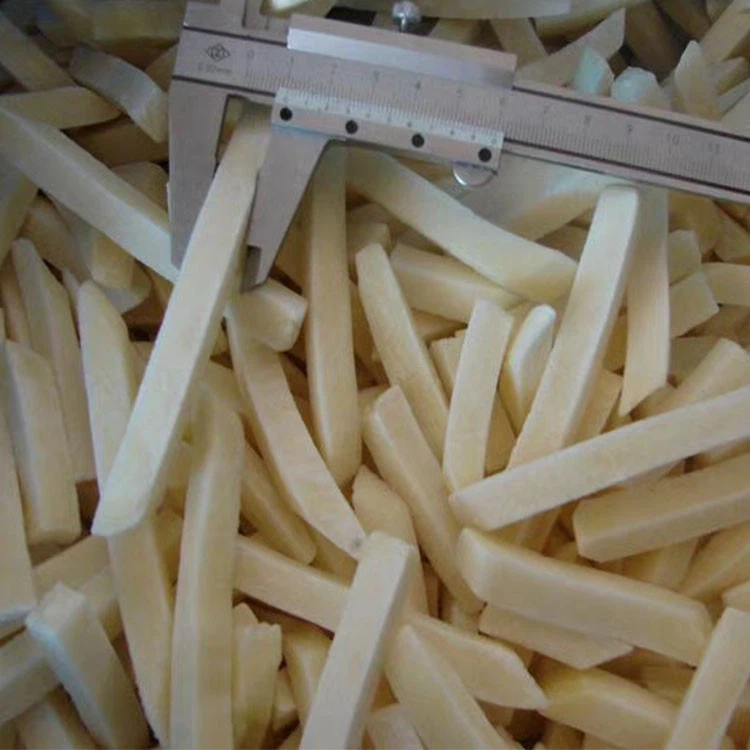
The image shows straight-cut potato fries under manual sorting. It supports removal of short pieces, damaged strips and visible defects; it is not presented as a laboratory result.
Cut Profiles, Length Grades and Product Forms
We quote the nominal cross section in millimeters and keep the measurement method consistent. A 9x9 mm fry is not interchangeable with shoestring 6x6 mm or steakhouse 12x12 mm: the surface-to-center ratio changes cooking time, crispness retention, oil pickup and serving yield.
Shoestring
6x6 or 7x7 mm straight cut for rapid finishing and high piece count. Length and breakage limits matter because narrow fries are more vulnerable during packing.
Regular Straight Cut
9x9 or 10x10 mm is the core foodservice and retail range. We match long-fries percentage, raw color and fried color to the channel.
Thick / Steakhouse
11x11 or 12x12 mm provides more potato center. It needs a separate finishing protocol and may use a different length mix.
Crinkle and Coated
Crinkle cut changes surface area; clear or seasoned coatings change crispness retention and ingredient declaration. We specify these as individual SKUs.
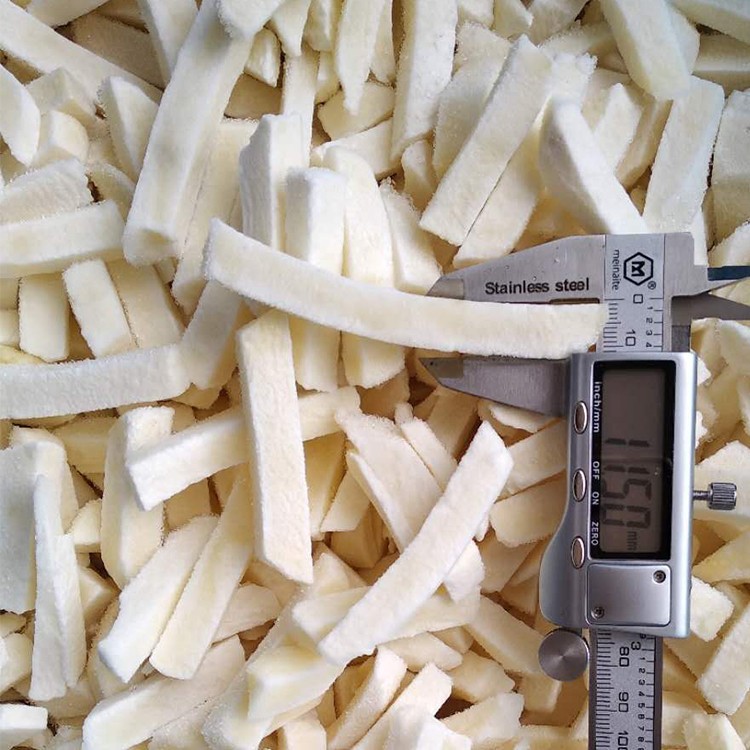
A digital caliper shows finished-strip width control. The commercial specification states the nominal cut and agreed tolerance rather than relying on visual estimation.

This image shows an approximately 9 mm straight-cut sample. Lot inspection uses multiple pieces and reports conformity to the signed cut tolerance.
Application Matching by Sales Channel
QSR and Restaurant Groups
We match cut, long-fries percentage, hold-time target, fryer protocol and case format. The approval test should record batch, fryer load, oil temperature, time, color and texture after the required holding period.
Foodservice Distribution
A 4x2.5 kg carton balances kitchen handling and warehouse efficiency. We review carton strength, bag puncture resistance, lot coding and frozen case condition.
Retail and Private Label
Typical bags are 400 g, 500 g, 750 g, 900 g, 1 kg or 2 kg. We review language, ingredient list, nutrition panel data, cooking directions, barcode, lot code and carton marks.
Industrial and Meal Assembly
For meal kits and prepared-food lines, we match strip size, pre-fry level, final heat process, sauce contact and pack format. The final formula must be tested in the customer's actual process.
Commercial Specification for Pre-Fried Frozen French Fries
The table below is our standard quotation framework. The purchase specification selects one cut, recipe, grade, packing and test plan. Where the destination market has a tighter legal limit, that requirement takes priority.
| Product Name | Pre-fried frozen French fries | Market Terms | Frozen fries, frozen chips, frozen potato fries |
|---|---|---|---|
| Basic Ingredients | Potato, vegetable oil | Optional Recipe Items | E450 color-control agent, controlled dextrose, coating or seasoning as declared |
| Product State | Blanched, pre-fried, individually frozen; not ready to eat | Skin | Peeled standard; skin-on by separate order |
| Cut Options | 6x6, 7x7, 9x9, 10x10, 11x11, 12x12 mm | Cut Tolerance | Nominal width ±1 mm; minimum 90% by count within tolerance |
| Length Distribution | ≥75 mm: minimum 20%; ≥50 mm: minimum 60% | Short Pieces | Below 25 mm: maximum 10% by count |
| Raw Frozen Color | Uniform cream to pale yellow | Fried Color | USDA color 0-2 under agreed finishing conditions |
| Total Solids | Minimum 28% | Moisture | 66-72% |
| Pre-fry Oil Content | 3-6% by recipe | Processing-oil FFA | Maximum 1.5% |
| Free Ice | Maximum 1.0% w/w | Clumps | Maximum 2.0% w/w; product substantially free flowing |
| Broken / Irregular | Maximum 5.0% w/w | Major Blemishes | Maximum 2 affected units per kg |
| Foreign Material | Absent | Texture After Finish | Crisp exterior, cooked potato interior; no hard or hollow dominant condition |
| Foodservice Packing | 4x2.5 kg/carton, 5x2 kg/carton or 1x10 kg/carton | Retail Packing | 400 g, 500 g, 750 g, 900 g, 1 kg or 2 kg bags |
| Standard MOQ | 12 MT; compatible mixed container 3-5 MT per SKU | Lead Time | 20-30 days after order, artwork and packing confirmation |
| Loading Guidance | 20 ft: approximately 12-13 MT; 40 ft: approximately 24-26 MT | Loading Port | Qingdao or Xiamen by production and consolidation plan |
| Shelf Life | 24 months from production | Storage | -18°C or below; do not thaw and refreeze |
| Trade Terms | FOB, CFR or CIF | Documents | Specification, batch COA and agreed test/shipment reports |
Loading quantities are planning values, not guaranteed container payloads. Final weight depends on bag dimensions, carton dimensions, pallet use and carrier weight limits.
Color Control Is a Measured Product Attribute
Raw potato sugar changes with variety, crop, maturity and storage. High reducing sugar can produce dark, uneven fries during final cooking. We use an incoming fry test or an agreed analytical method, remove unsuitable and damaged tubers, control blanching, and compare the final-cooked sample with the agreed color reference.
The color result is meaningful only when the test conditions are fixed. The approval record therefore includes cut, sample mass, appliance, oil type, oil temperature, cooking time and drain/hold time. A supplier and buyer using different conditions can obtain different color and texture from the same batch.
For regular unseasoned fries, our standard target is USDA 0-2 after the agreed finish. Coated or seasoned products require a separate visual standard because the surface ingredients change color.

The image shows raw frozen fries beside color references. The signed order uses the agreed color system and finishing protocol; the printed cards are not a batch COA.
Production Flow and Product-Specific Control Points
We check variety, maturity, solids, reducing-sugar response, green areas, sprouts, rot, bruising and internal defects. Lots that cannot meet the finished color target are segregated.
We remove soil, stones and loose peel, then trim green, black, damaged and decayed tissue. Skin-on orders use a separate peel tolerance.
We set the cutting head for the named cross section and remove undersized slivers. Caliper results and length distribution form part of line inspection.
Blanching reduces surface sugars and prepares texture. Time and temperature follow raw-material condition; excess surface water is removed before pre-frying.
Color-control agents, dextrose or coating are dosed only for the signed recipe. Ingredient lot and usage records connect the formula to the production batch.
We control fryer temperature, residence time and oil condition. The target is stable surface development without excessive color or oil pickup.
The pre-fried strips are cooled and frozen to a free-flowing condition. We limit clumps, frost and free ice before packing.
We inspect cut, length, color, broken pieces, defects and foreign material, then complete metal detection, weight control and seal inspection.

The bulk sample shows straight-cut frozen fries before final preparation. It supports visual review of length mix, surface frost, breakage and free-flowing condition.
Defect Limits for Repeatable Receiving
A grade name without tolerances cannot settle a receiving dispute. Our standard Grade A framework controls the quantity of nonconforming material within the sample. Broken or irregular strips are limited to 5.0% by weight, pieces below 25 mm to 10% by count, clumps to 2.0% and loose ice to 1.0%.
Major black, green, bruised or deeply blemished areas are limited to two affected units per kilogram. Decay, mold, insects, glass, metal, hard plastic and other foreign material are not acceptable. Minor peel remnants are assessed under the peeled or skin-on specification rather than judged without a definition.
Inspection records state sample size and basis of calculation. Percent by weight is not silently exchanged with percent by count, and length distribution is evaluated separately from general broken-piece weight.
Crinkle, Coated and Skin-On Fries Need Separate Approval
Crinkle cut exposes more surface and cannot be evaluated with the same visual geometry as a straight cut. Coated fries may hold crispness longer, but the coating changes ingredients, allergens, oil interaction, surface color and label data. Skin-on fries require an agreed peel coverage and defect distinction.
For each special format, we prepare a separate specification and kitchen validation. The record defines cut, coating pick-up where applicable, bag fill, cook method, color endpoint, crispness at service and any seasoning declaration.
We do not substitute a crinkle or coated item into a straight-cut purchase order because the net weight is the same. The product code and carton marks keep each recipe identifiable in frozen storage.

The image shows frozen crinkle-cut potato strips. It proves the alternative cut form only; coating and recipe must be read from the signed specification.
Finished-Cook Validation and Acrylamide Control
Frozen fries are supplied for final cooking and are not ready to eat. Finished color and texture depend on cut, appliance, load, time and temperature. A practical approval protocol for regular straight-cut fries is deep frying from frozen at 170-175°C for approximately 3-4 minutes. Oven and air-fryer products require their own validated label directions. The final directions printed on the bag must match the approved SKU rather than a generic instruction copied across all cuts.
Acrylamide forms during high-temperature cooking from naturally present potato precursors. The EU benchmark for ready-to-eat French fries is 500 µg/kg. This is a process-performance benchmark for the food after final preparation, not an automatic release limit for the uncooked frozen bag. Where an acrylamide report is required, the contract states the preparation method, sampling plan, laboratory method, destination rule and whether the result applies to the frozen product or the ready-to-eat test portion.
Our control chain covers low-sugar suitable potato lots, raw-material fry tests, removal of immature or damaged tubers, blanching, sliver removal, controlled pre-fry conditions, finished-color checks and accurate final-cooking directions. This is more reliable than an unsupported claim that a frozen fry is simply acrylamide-free.

The prepared sample shows a light golden endpoint. A batch color result is recorded only under the agreed cooking conditions; this photograph is a visual example, not the batch test result.
Kitchen Approval Record
- Product code, lot and cut size
- Frozen sample weight and appliance load
- Oil type and starting temperature
- Cook time and actual recovery temperature
- Drain time, seasoning and service hold time
- Color reference, exterior crispness and internal texture
- Yield after cooking and broken-piece observation
Microbiological and Chemical Commercial Limits
Frozen storage slows microbial growth but does not replace hygienic processing or the required final cooking step. The following standard commercial targets can be included in the purchase specification. Destination law and the customer's tighter approved limit take priority.
| Microbiological Criteria | |
|---|---|
| Aerobic Plate Count | ≤100,000 CFU/g |
| Yeast and Mold | ≤1,000 CFU/g each |
| Enterobacteriaceae | ≤1,000 CFU/g |
| Coliforms | ≤100 CFU/g |
| E. coli | <10 CFU/g |
| Staphylococcus aureus | ≤100 CFU/g |
| Salmonella | Absent in 25 g |
| Listeria monocytogenes | Absent in 25 g |
| Chemical Safety Targets | |
|---|---|
| Lead (Pb) | ≤0.10 mg/kg |
| Cadmium (Cd) | ≤0.10 mg/kg |
| Total Arsenic (As) | ≤0.20 mg/kg |
| Mercury (Hg) | ≤0.02 mg/kg |
| Pesticide Residues | Comply with destination-market MRLs |
| Acrylamide | Test protocol by order; EU ready-to-eat benchmark 500 µg/kg |
| Processing Oil FFA | ≤1.5% |
| Allergen Status | Declared from actual formula and producing site |
Batch COA: Limits and Actual Results Are Different Columns
The COA header identifies product code, product name, cut, recipe, grade, bag and carton packing, production date, best-before date, lot number, purchase order and sample date. Each result row uses Parameter, Specification, Actual Result and Test Method. Actual Result is the value measured or status observed for the identified production batch.
| Parameter | Specification | Actual Result | Method / Basis |
|---|---|---|---|
| Cut size | 9x9 mm, ±1 mm; ≥90% within tolerance | Measured batch percentage | Caliper / count |
| Long fries ≥50 mm | ≥60% | Measured batch percentage | Defined sample / count |
| Fried color | USDA 0-2 | Observed batch grade | Agreed cooking protocol |
| Moisture | 66-72% | Measured batch value | Validated laboratory method |
| Aerobic Plate Count | ≤100,000 CFU/g | Measured batch value | ISO / destination method |
| Salmonella | Absent in 25 g | Detected / not detected | ISO / destination method |
The wording "measured batch value" above describes what the final COA must contain; it is not a fabricated result. The released document replaces these descriptions with the actual numerical or observed results for the shipped lot.
Traceability and Shipment Document Package
We connect the finished-lot code to potato receiving, ingredient and oil lots, processing date, in-process checks, packing material, metal-detection record, frozen storage and loading information. This connection allows receiving QA to compare the bag code, carton code, COA and packing list.
The shipment file can include the signed specification, batch COA, microbiological report, pesticide-residue report, heavy-metal report, acrylamide report under the agreed finishing protocol, ingredient statement, allergen statement, nutrition data support, packing list, commercial invoice, certificate of origin, health certificate and bill-of-lading data according to the order and destination. Facility certificates are supplied only for the actual producing site, current validity period and applicable scope; they are not described as product-specific certificates unless the certificate says so.
Potato lot, intake date, origin record and incoming inspection.
Recipe, line date, cut, blanching, pre-fry, freezing and QA checks.
Bag film, print version, weight, seal, case and lot coding.
Frozen storage, loading date, container and document references.
Foodservice, Retail and OEM Bag Plans
Foodservice cartons normally use 4x2.5 kg, 5x2 kg or a 10 kg liner bag. Retail projects commonly use 400 g to 2 kg printed bags. We review net weight, film structure, seal width, bag dimensions, tear or zipper features where required, carton dimensions, compression strength and pallet plan.
Private-label artwork review covers legal product name, ingredient order, allergen declaration, nutrition panel, net content, storage condition, cooking directions, country of origin, importer details, date format, lot-code area, barcode, recycling marks and required language. The approved artwork version is linked to the purchase order before printing.
A transparent unprinted sample bag can show the product but does not prove the final retail film, seal or print. Commercial approval uses the nominated packaging material and a packing specification.

The image shows clear bags of frozen straight-cut fries arranged in a carton. It demonstrates a packing format, not final private-label artwork or an identified shipment lot.
Frozen Storage, Container Planning and Receiving
We store and ship frozen fries at -18°C or below in a reefer container. Before loading, we review case condition, frozen product condition, quantity, marks, pallet requirement and document references. Repeated thawing and refreezing can increase frost, ice, clumping and texture damage even when the bag remains sealed.
Planning capacity is approximately 12-13 MT in a 20 ft reefer and 24-26 MT in a 40 ft reefer. Pallets, retail display cartons, heavy film and local road limits reduce usable payload. We calculate the final plan from the approved case dimensions and carrier restrictions.
At receiving, record container seal, air temperature, product temperature sampling plan, carton condition, bag seals, lot codes and quantity before the stock is released. Keep the delivery frozen while QA sampling is arranged. Temperature concerns should be assessed with the shipment record and product condition rather than from one air reading alone.
Why Source Frozen Fries Through GreenLand-food
Recipe Clarity
We distinguish pre-fried, coated, seasoned, skin-on and plain potato forms, then connect the declared recipe to the SKU.
Measurable Grade
Cut tolerance, length fractions, color, defects, free ice and clumps give receiving teams judgeable limits.
Application Test
We put appliance, load, time, temperature, color and hold time into the approval record for repeatable comparison.
Measured Batch COA
Actual Result shows the identified production batch's measured value or observed status beside the limit and method.
OEM Detail
We review film, artwork, barcode, label language, date code, carton marks and pallet plan before packing.
Export Coordination
We align product, packing, QA reports, container plan and destination documents under one order reference.
Frozen Fries FAQ for Commercial Buyers
1. What is inside a standard bag of frozen fries?
Our standard pre-fried fries contain potato and vegetable oil. E450, controlled dextrose, coating or seasoning is included only when declared in the agreed recipe and label.
2. Are the fries raw, fully cooked or ready to eat?
They are blanched and pre-fried before freezing but are not ready to eat. They require final cooking according to the approved directions for the SKU.
3. Which frozen French fry sizes are available?
Straight cuts include 6x6, 7x7, 9x9, 10x10, 11x11 and 12x12 mm. Crinkle, steakhouse, skin-on and coated formats are quoted as separate SKUs.
4. How is fry length specified?
Our standard framework uses at least 20% at 75 mm or longer, at least 60% at 50 mm or longer, and no more than 10% below 25 mm by count. A project can use a different signed distribution.
5. What is the standard defect allowance?
Broken and irregular strips are limited to 5.0% by weight, clumps to 2.0%, loose ice to 1.0%, and major blemishes to two affected units per kilogram. Foreign material is absent.
6. How do you evaluate fried color?
Regular unseasoned fries target USDA color 0-2 under the agreed cooking protocol. The test records sample mass, appliance, oil temperature, time, drain time and holding period.
7. Can you supply coated or extra-crispy fries?
Yes, as a separate project. We define the coating recipe, declared ingredients, allergen status, coating behavior, finishing directions and hold-time target before approval.
8. What foodservice and retail bags are available?
Foodservice formats include 4x2.5 kg, 5x2 kg and 1x10 kg cartons. Retail projects commonly use 400 g, 500 g, 750 g, 900 g, 1 kg or 2 kg bags.
9. Do you provide private-label frozen fries?
Yes. We review bag film, artwork, ingredient statement, nutrition data, cooking directions, barcode, date code, label language, carton marks and pallet plan.
10. What is the shelf life and storage temperature?
Shelf life is 24 months from production when continuously stored at -18°C or below. Thawed product should not be refrozen.
11. What does the 500 microgram acrylamide value mean?
The EU 500 µg/kg value is a benchmark for ready-to-eat French fries. An order requiring testing must state the final preparation protocol, laboratory method and destination requirement.
12. Which batch documents can accompany the shipment?
We provide the signed specification, batch COA, invoice and packing list. Microbiological, residue, heavy-metal, acrylamide, origin and health documents follow the order and destination.
13. What are the MOQ and lead time?
Standard MOQ is 12 MT. Compatible mixed-container projects can start at 3-5 MT per SKU, and normal lead time is 20-30 days after order, packing and artwork confirmation.
14. Can frozen fries be combined with other frozen products?
Yes, when product availability, packing, food-safety compatibility, loading port and minimum quantity align. Send the SKU list, quantity per item, bag format and destination port for a loading plan.
Send a Complete Frozen Fries RFQ
Send the straight, crinkle, coated or skin-on form; cut size; target length distribution; fried-color and hold-time requirement; ingredient restrictions; foodservice or retail bag; carton plan; order quantity; destination port; private-label artwork needs; required reports; preferred trade term; and target shipment date. We will return the matching specification, packing plan, MOQ, lead time and document scope.
Hot Tags: bag of frozen fries, China bag of frozen fries manufacturers, suppliers, factory, fried potatoes frozen, frozen potato chunk, frozen fries, frozen french fries, potato sticks frozen, frozen potato
Technical specification · reference schedule
Pre-Fried Frozen French Fries
We review the selected form, grade, process and packing against the technical schedule below. Published and TDS values are specification references for order review. External benchmarks apply only within their stated scope. Acceptance is governed by the signed SKU specification; the identified lot COA reports actual measured results.
01 / Physical & Sensory
| Parameter | Specification / reference | Verification & order basis |
|---|---|---|
| Skin | Peeled standard; skin-on by separate orderPublished reference | Confirm method, representative sample and acceptance basis in the signed specification. |
| Cut Options | 6 × 6, 7 × 7, 9 × 9, 10 × 10, 11 × 11, 12 × 12 mmPublished reference | Measure a defined frozen sample with caliper or size gauge; report distribution and tolerance. |
| Cut Tolerance | Nominal width ±1 mm; minimum 90% by count within tolerancePublished reference | Measure a defined frozen sample with caliper or size gauge; report distribution and tolerance. |
| Length Distribution | ≥75 mm: minimum 20%; ≥50 mm: minimum 60%Published reference | Measure a defined frozen sample with caliper or size gauge; report distribution and tolerance. |
| Raw Frozen Color | Uniform cream to pale yellowPublished reference | Compare with the approved sensory reference using the stated frozen/thawed/prepared condition. |
| Fried Color | USDA color 0-2 under agreed finishing conditionsPublished reference | Compare with the approved sensory reference using the stated frozen/thawed/prepared condition. |
| Texture After Finish | Crisp exterior, cooked potato interior; no hard or hollow dominant conditionPublished reference | Compare with the approved sensory reference using the stated frozen/thawed/prepared condition. |
| Cross-section & length distribution | Report cross-section, length fractions and short/sliver material separately for the selected strip grade. | Gauge both cross-section axes and sort a representative frozen sample by the agreed length bands. |
| Declared product form | Blanched, prefried frozen French-fry strips | Match approved sample, pack label and order form. Published page identity; approve selected grade before order. |
| Sensory acceptance | Characteristic colour, flavour and texture for the declared product; no abnormal odour or visibly deteriorated material.External reference Codex | Compare an identified frozen sample with the approved grade and defect schedule. External technical reference; confirm SKU and market applicability. |
02 / Physicochemical & Residue Controls
| Parameter | Specification / reference | Verification & order basis |
|---|---|---|
| Total Solids | Minimum 28%Published reference | Use a validated analytical method for this matrix; report sample basis, unit, preparation and lot result. |
| Moisture | 66-72%Published reference | Report validated laboratory method, sample basis and lot result. |
| Pre-fry Oil Content | 3-6% by recipePublished reference | Use a validated analytical method for this matrix; report sample basis, unit, preparation and lot result. |
| Processing-oil FFA | Maximum 1.5%Published reference | Use a validated analytical method for this matrix; report sample basis, unit, preparation and lot result. |
| Lead (Pb) | ≤0.10 mg/kgPublished reference | Use a validated analytical method for this matrix; report sample basis, unit, preparation and lot result. Published commercial target; verify current destination limits, edible-part basis and any processing factor before approval. |
| Cadmium (Cd) | ≤0.10 mg/kgPublished reference | Use a validated analytical method for this matrix; report sample basis, unit, preparation and lot result. Published commercial target; verify current destination limits, edible-part basis and any processing factor before approval. |
| Total Arsenic (As) | ≤0.20 mg/kgPublished reference | Use a validated analytical method for this matrix; report sample basis, unit, preparation and lot result. Published commercial target; verify current destination limits, edible-part basis and any processing factor before approval. |
| Mercury (Hg) | ≤0.02 mg/kgPublished reference | Use a validated analytical method for this matrix; report sample basis, unit, preparation and lot result. Published commercial target; verify current destination limits, edible-part basis and any processing factor before approval. |
| Pesticide Residues | Comply with destination-market MRLsPublished reference | Use a validated analytical method for this matrix; report sample basis, unit, preparation and lot result. |
| Acrylamide | Test protocol by order; EU ready-to-eat benchmark 500 µg/kgPublished reference | Use a validated analytical method for this matrix; report sample basis, unit, preparation and lot result. |
| Processing Oil FFA | ≤1.5%Published reference | Use a validated analytical method for this matrix; report sample basis, unit, preparation and lot result. |
| Acrylamide programme scope | Apply destination mitigation and monitoring requirements to the relevant potato product and finishing state. EU source | Use a stated preparation protocol and validated laboratory method; a ready-to-eat benchmark is not a frozen-batch limit. |
| Pesticide residue schedule | Named active ingredients and commodity-specific limits are selected for the destination market. EU source | Link farm spray history, laboratory LOQ and batch result to the destination MRL. EU database is one market reference; apply the actual destination rule. |
| Lead, cadmium and other contaminants | Apply the limit for the exact commodity and processed form in the destination market. EU source | State analyte, preparation basis, method, LOQ and lot result. Do not transfer a fresh-commodity limit to a processed form without the required assessment. |
03 / Microbiological Criteria
| Parameter | Specification / reference | Verification & order basis |
|---|---|---|
| Aerobic Plate Count | ≤100,000 CFU/gPublished reference | Report the named organism, analytical method, sample mass, sampling plan and lot result; use CFU/g for enumeration and a stated mass for detection. |
| Yeast and Mold | ≤1,000 CFU/g eachPublished reference | Report the named organism, analytical method, sample mass, sampling plan and lot result; use CFU/g for enumeration and a stated mass for detection. |
| Enterobacteriaceae | ≤1,000 CFU/gPublished reference | Report the named organism, analytical method, sample mass, sampling plan and lot result; use CFU/g for enumeration and a stated mass for detection. |
| Coliforms | ≤100 CFU/gPublished reference | Report the named organism, analytical method, sample mass, sampling plan and lot result; use CFU/g for enumeration and a stated mass for detection. |
| E. coli | <10 CFU/gPublished reference | Report the named organism, analytical method, sample mass, sampling plan and lot result; use CFU/g for enumeration and a stated mass for detection. |
| Staphylococcus aureus | ≤100 CFU/gPublished reference | Report the named organism, analytical method, sample mass, sampling plan and lot result; use CFU/g for enumeration and a stated mass for detection. |
| Salmonella | Absent in 25 gPublished reference | Report the named organism, analytical method, sample mass, sampling plan and lot result; use CFU/g for enumeration and a stated mass for detection. |
| Listeria monocytogenes | Absent in 25 gPublished reference | Report the named organism, analytical method, sample mass, sampling plan and lot result; use CFU/g for enumeration and a stated mass for detection. |
| Acceptance schedule | Select the test panel and limits by intended use (ready-to-eat or further processing), product form and destination. EU source | State organism, analytical method, sample mass and n/c plan; report actual lot results. A universal APC, coliform, Salmonella or Listeria limit is not assigned to every frozen product. |
04 / Freezing & Cold Chain
| Parameter | Specification / reference | Verification & order basis |
|---|---|---|
| Storage | -18°C or below; do not thaw and refreezePublished reference | Confirm method, representative sample and acceptance basis in the signed specification. |
| Separation & loose-ice assessment | Keep inherent moisture, loose ice and permanently frozen clusters as separate inspection categories. | Weigh separated loose ice and welded clusters against initial sample mass; distinguish natural paired pieces or blocks. |
| Product thermal centre | −18°C or colder after freezing and thermal stabilization; maintain the agreed frozen distribution condition.External reference Codex | Probe the thickest representative pack and retain storage/transport temperature records. Codex quick-frozen reference; selected product form and route must be frozen. |
| Frozen condition at dispatch | Hard frozen, correctly sealed and coded, without thaw/refreeze evidence or excessive loose ice. Codex | Check pack integrity, free-flow or block condition as declared, carton condition and loading temperature. |
05 / Pack Size & Shelf Life
| Parameter | Specification / reference | Verification & order basis |
|---|---|---|
| Retail Packing | 400 g, 500 g, 750 g, 900 g, 1 kg or 2 kg bagsPublished reference | Check approved pack drawing, calibrated scale and production records. |
| Shelf Life | 24 months from productionPublished reference | Verify unopened-pack validation, declared storage condition and production/best-before coding. |
| Declared net contents | Verify each selected pack format against the artwork and applicable quantity-control rule. Codex | Calibrated checkweigher or scale; defined sample and tare. |
| Shelf-life basis | The labelled period applies only to its validated pack and continuous stated storage condition. Codex | Review stability study or approved shelf-life file and production-date code. |
06 / Process Controls
| Parameter | Specification / reference | Verification & order basis |
|---|---|---|
| Product State | Blanched, pre-fried, individually frozen; not ready to eatPublished reference | Check the approved product flow, line settings and identified production record; validate numerical critical limits within the site HACCP plan. |
| Raw-material preparation checks | Distinguish raw/cooked whole-cut potato from prefried or formed potato; formula and route govern release. | Verify the selected product flow and the relevant trimming, sorting and pretreatment record. |
| Fry-process consistency | Link potato reducing sugars/solids, blanching, pre-fry profile and processing-oil condition to the declared recipe and finish-colour target. Codex | Record product-specific line settings and oil-condition checks; use one defined final-fry colour protocol. |
| CCP designation | Use the site-approved HACCP plan to identify true CCPs and their validated critical limits. Codex | Check hazard analysis, monitoring, deviation and corrective-action records. A quality-control step is not automatically a CCP. |
07 / Ingredients, Additives & Allergens
| Parameter | Specification / reference | Verification & order basis |
|---|---|---|
| Basic Ingredients | Potato, vegetable oilPublished reference | Verify approved formula, supplier declarations and line-specific allergen assessment. |
| Allergen Status | Declared from actual formula and producing sitePublished reference | Verify approved formula, supplier declarations and line-specific allergen assessment. |
| Added glaze / coating declaration | Declare any intentionally added water glaze, syrup, oil or coating and the measurement basis; loose ice is assessed separately. | Verify formula/addition records; agree a deglazing or coating test and net-content basis where applicable. |
| Ingredient statement | List every ingredient and its declared role for the selected SKU; verify any added sugar, oil, coating, seasoning or glazing medium. | Approved formula and supplier declarations. |
| Additive use | Declare any colour-protection agent, acidulant or other additive by ingredient and maximum permitted use for the target market. NHC standard | Check approved formula, actual addition record and market-specific additive category. GB 2760-2024 applies to China; export rules are checked separately. |
| Allergen and cross-contact assessment | Declare inherent allergens and assess shared-line cross-contact from the actual facility schedule. FDA | Review line matrix, cleaning validation and buyer label approval. Do not claim a shared-line allergen or allergen-free status without facility evidence. |
08 / Defects & Foreign Matter
| Parameter | Specification / reference | Verification & order basis |
|---|---|---|
| Short Pieces | Below 25 mm: maximum 10% by countPublished reference | Classify on the defined sample by count or mass; record individual categories, denominator and any combined limit. |
| Free Ice | Maximum 1.0% w/wPublished reference | Classify on the defined sample by count or mass; record individual categories, denominator and any combined limit. |
| Clumps | Maximum 2.0% w/w; product substantially free flowingPublished reference | Classify on the defined sample by count or mass; record individual categories, denominator and any combined limit. |
| Broken / Irregular | Maximum 5.0% w/wPublished reference | Inspect a defined representative sample; record count or mass basis and disposition. |
| Major Blemishes | Maximum 2 affected units per kgPublished reference | Classify on the defined sample by count or mass; record individual categories, denominator and any combined limit. |
| Foreign Material | AbsentPublished reference | Inspect a defined representative sample; record count or mass basis and disposition. |
| Intrinsic defect classification | Green tissue, sprouts, eyes, bruises, dark ends, slivers and irregular pieces. | Record each defect class separately by count or mass; state sample size, denominator and combined-limit rules. |
| Hazardous foreign matter | No foreign matter detected in the defined inspection sample; reject and investigate any finding.External reference Codex | Define visual-inspection sample size and detector challenge in the signed quality schedule. "None detected" is a sampling statement, not an absolute guarantee of zero particles. |
09 / Packaging Materials & Label
| Parameter | Specification / reference | Verification & order basis |
|---|---|---|
| Food-contact pack | Specify inner-contact material and obtain the applicable food-contact compliance declaration. NHC standard | Review film structure, supplier DoC, migration evidence and actual intended conditions. GB 4806 series is China-specific; EU export also checks Regulations 1935/2004 and 10/2011. |
| Carton and seal integrity | Define carton stacking strength, bag seal and puncture resistance for the confirmed net weight and pallet plan. EU source | Inspect pack drawing, compression/seal test and shipment configuration. |
| Label verification | Match product name, ingredient/allergen statement, net weight, lot/date, shelf life and storage instruction to the destination artwork. Codex | Approve artwork against the signed specification and destination rules. |
10 / Detection & Traceability
| Parameter | Specification / reference | Verification & order basis |
|---|---|---|
| Foreign-body detector | Validate Fe, non-Fe and stainless-steel challenge pieces for the actual product, aperture, pack and line; record the proven sensitivity. Codex | Challenge at defined start, changeover, interval and end points; retain rejection records. Do not copy generic detector sizes into a plant capability claim. |
| Lot traceability | Link input source lot, processing run, packaging code, test records, frozen storage and shipment to one finished lot. Codex | Trace one sample lot forward and backward in a recorded mock recall. Recall speed is stated only when the site has a validated target and record. |
Previous
Freezing Fried PotatoesNext
Potato Fries Frozen


