


Calcium-Treated Frozen Fruit: Does a Firmer Sample Mean a Better Ingredient?
Sep 29, 2026
Leave a message

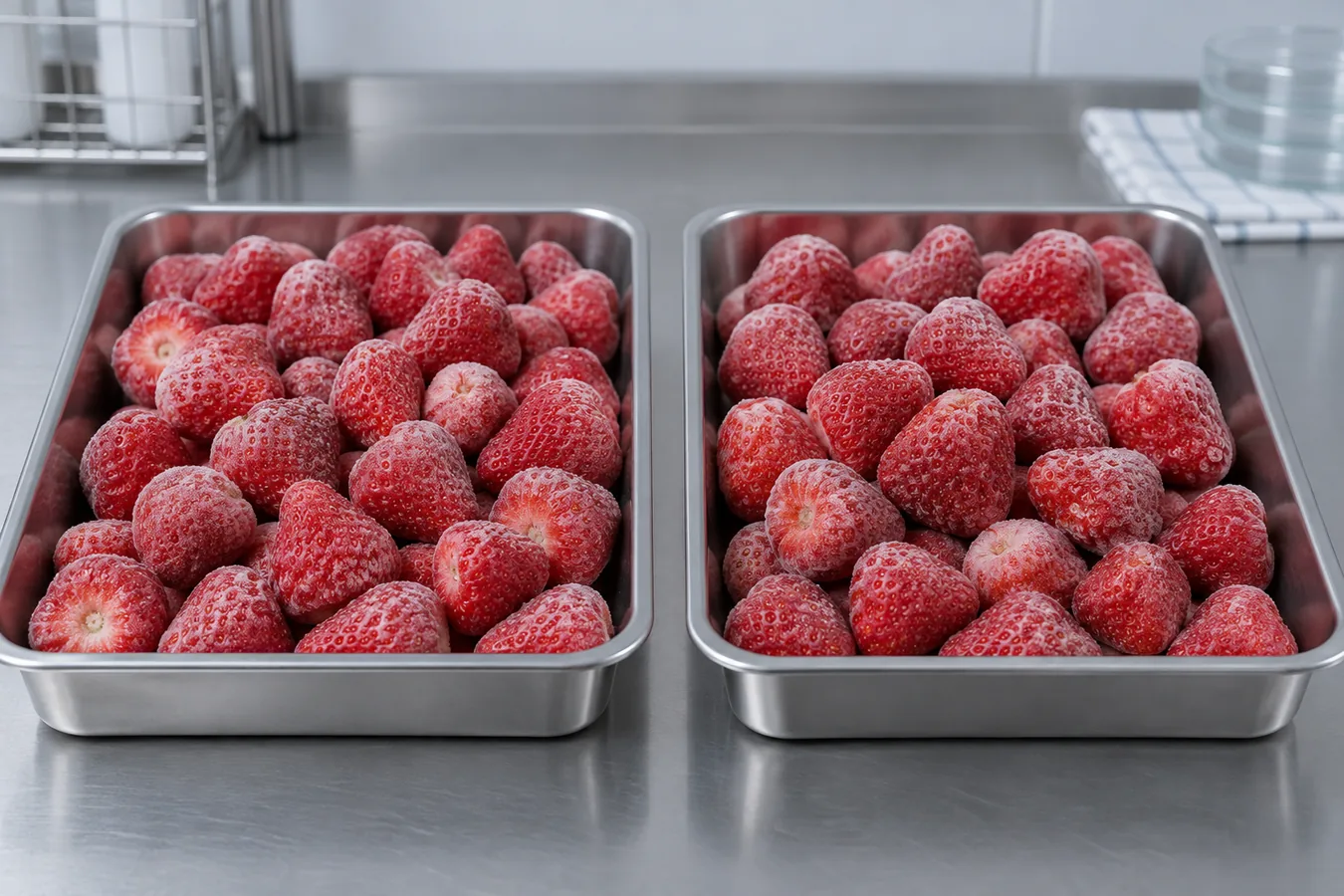
Identify the treatment and the outcome it is meant to improve
"Calcium-treated" is not one ingredient description. Calcium chloride, calcium lactate and other calcium salts have different sensory and formulation implications. Some studies combine calcium with pectin methylesterase, osmotic steps, pressure, modified freezing or other interventions. A result from a combined protocol does not prove that calcium alone caused the change. Ask for the compound, treatment stage, solution and contact conditions, fruit form, any rinsing step and the ingredient declaration for the specific commercial sample. If those details are unavailable, the term "calcium-treated" is too broad for a meaningful qualification trial.
Specify the target benefit before asking for a firmer sample. Whole strawberries in a bakery inclusion may need to survive thawing and mixing with limited breakage. Sliced berries for a topping may need a particular bite and minimal drip. A fruit preparation cooked into a sauce may value color and flavor more than firmness measured at room temperature. A stronger raw texture could be irrelevant after the buyer's thermal process, and an undesirable taste note could outweigh a modest structural gain.
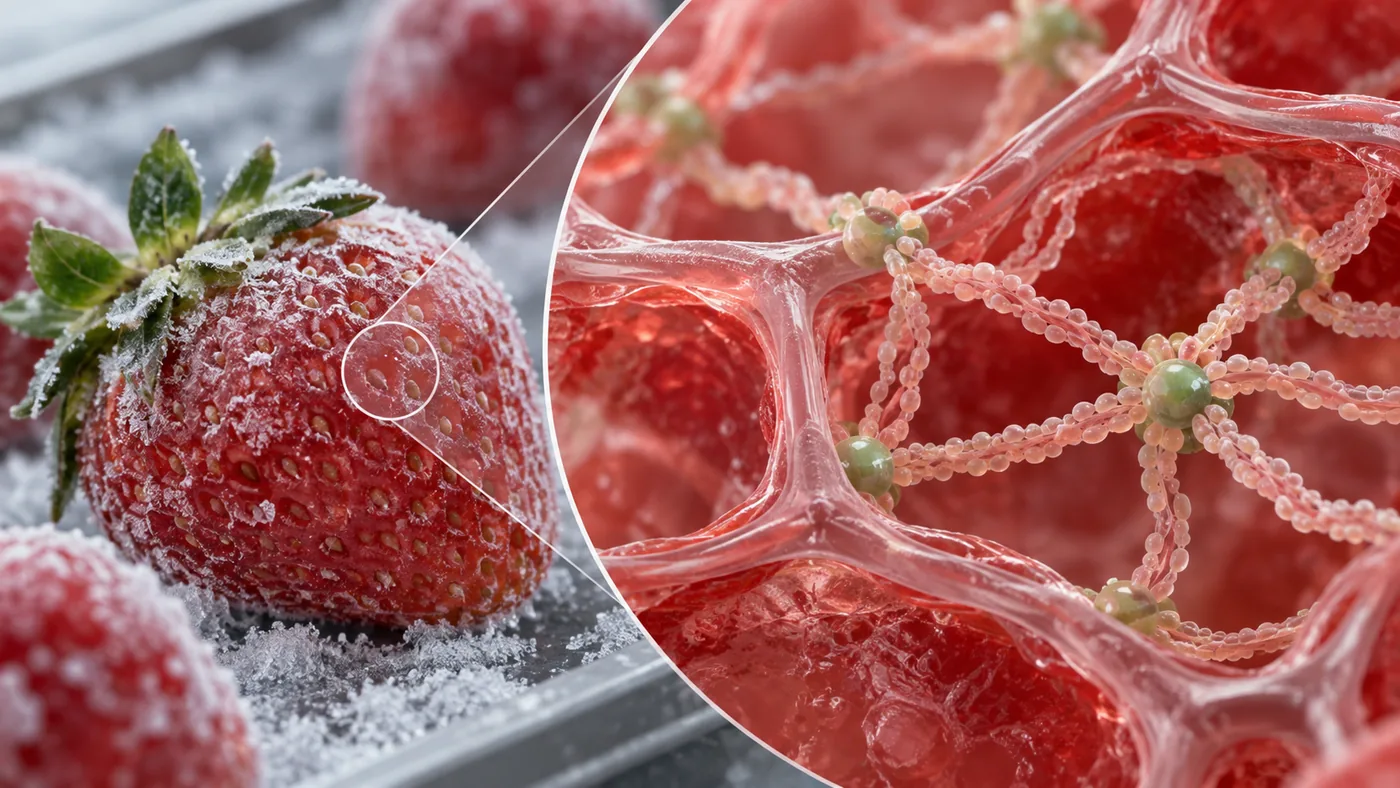
The mechanism often cited is calcium interaction with pectin in plant cell walls and middle lamella. That is a useful conceptual explanation, not a guarantee that every berry will retain structure through freezing and thawing. Calcium uptake depends on the fruit and treatment conditions; freezing damage, maturity and later processing remain important. The illustration beside this section shows a simplified tissue concept. It does not depict a measured GreenLand berry or establish that a specific calcium bridge was formed in a commercial lot.
The commercial question must be separated from the scientific one. A study may test an experimental pretreatment under laboratory conditions that are unsuitable, uneconomic or unavailable at supply scale. Procurement should request a real specification and sample, not assume that a published method is an offered SKU. The supplier's written formulation, pack identity and processing disclosure are the starting point for any claim.
Clarify whether the sales sample is a research prototype or routine-production material. A small pilot batch may be treated by hand with precise contact time, while commercial fruit moves through a faster line with a wider size distribution. If the method changes with scale, uptake and flavor can change as well. Qualification should include a production-representative lot and a plan for how treatment is monitored, not only a beautiful single tray from an experiment. This is especially relevant when the fruit will be distributed across multiple destinations or private-label formulas.
Read study results in their actual conditions
Search results on calcium and frozen fruit can appear contradictory because the experiments are not the same. A strawberry study might treat slices rather than whole fruit, use a specific maturity stage, combine calcium with another agent, and measure texture after a defined thaw. A papaya study may show a promising effect but cannot be used as a direct prediction for a strawberry line. Even within strawberry research, drip loss, color and firmness need not improve together. Read the methods and measured endpoints before reducing a paper to "calcium works."
The published strawberry study on calcium chloride treatment is a useful reminder that treatment effects can be limited or non-significant under particular conditions. A separate frozen strawberry pretreatment study considers specified protocols and quality outcomes. These sources inform a controlled comparison; neither establishes a universal best compound or dose for all frozen fruit applications. Where only an abstract is accessible, treat the finding as a scoped lead and avoid claiming details of methods not read.
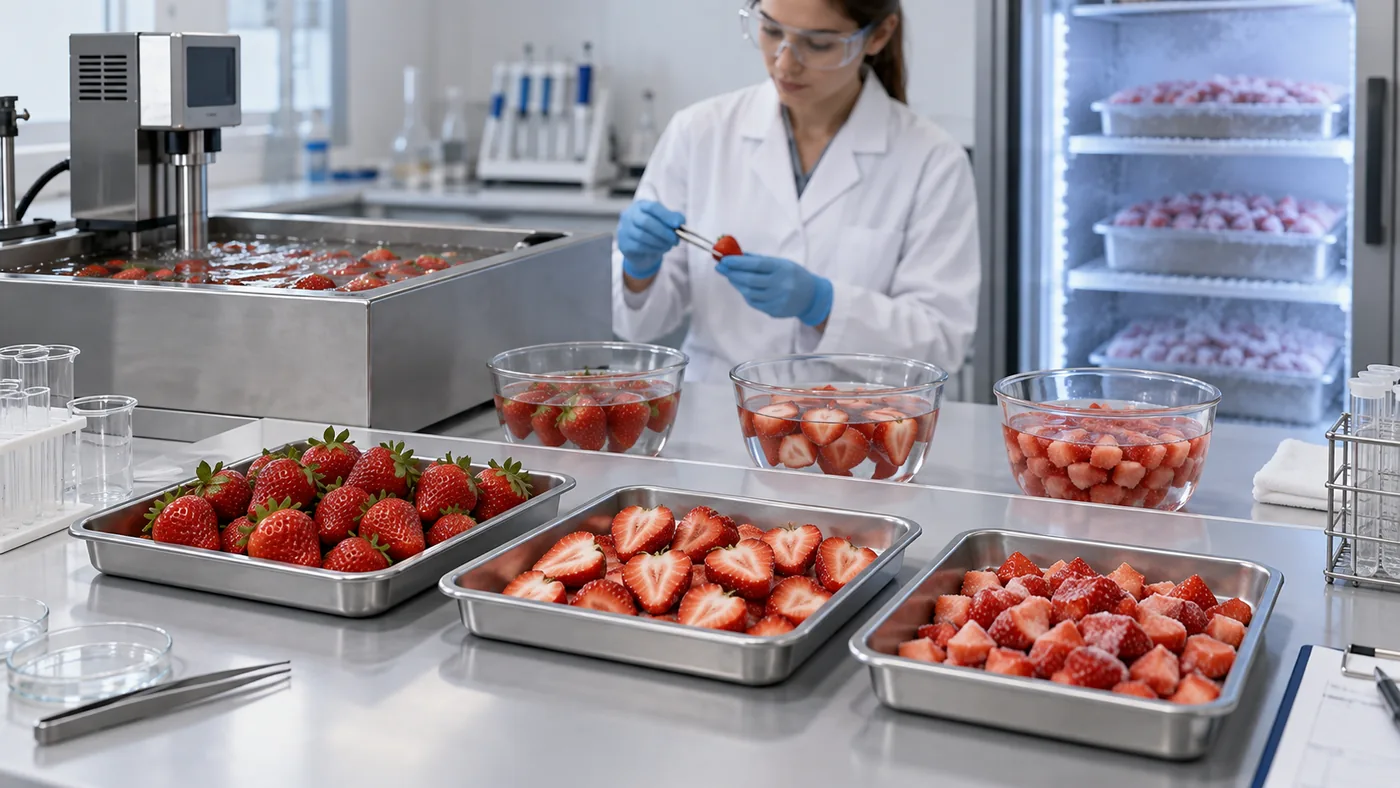
Study design details matter: variety, soluble solids and maturity at harvest, whether berries are whole or cut, treatment time, freezing rate, storage duration, thaw temperature and measurement geometry. A texture probe's value on a large whole berry is not directly comparable with a force measurement on a slice. A short storage experiment may miss changes seen after a commercial cold-chain period. A sensory panel may detect taste that an instrument does not. These factors explain why a buyer needs a local validation trial even when the literature gives a plausible mechanism.
Read the reported baseline, not just the percentage improvement. If untreated fruit already meets the application's firmness requirement, a statistically detectable increase may have no buying value. If both treated and untreated samples fail after the buyer's heating step, the published advantage is insufficient for that use. Conversely, a modest change in drip may be valuable in a bakery inclusion if it prevents wet pastry. Translate each study endpoint into the actual product failure mode before investing in a supplier development request.
Look at the control condition. If treated fruit was picked from a different field or frozen on a different day from the untreated comparison, the resulting difference is confounded. If calcium was paired with another pretreatment, isolate the contribution where the research design permits. If the paper reports only one favorable metric while other outcomes worsened or were not measured, do not promote it to "better frozen fruit." The study photo in this article illustrates multiple forms and process stages; it does not reproduce a named experiment.
Build a matched untreated control
An effective buyer trial begins with the same raw material lot. Split comparable fruit by size, ripeness and form before treatment. Hold the same freezing, packaging, storage and thaw route for both arms as far as the treatment design allows. If the commercial supplier cannot provide a split-lot control, acknowledge that the comparison is less able to isolate calcium's effect. It may still tell the buyer which of two available ingredients performs better, but not why.
Write the sampling plan before thawing. Decide how many packs and berries are examined, how they are selected across the lot, and which outcomes are primary. Keep pack identities and process histories attached to the observations. Randomize the order in which samples are measured or served where practical. For sensory assessment, blind the treatment identity so an expectation of firmness does not steer the judgment. Report the spread, not just the best-looking specimen.

Thaw both arms by the same controlled method and use the same time after thaw. A berry can appear firmer immediately after an incomplete thaw than after equilibration. Measuring at different temperatures or after different drainage periods creates a false advantage. If the intended application is a chilled dessert, measure under that use condition. If it is a cooked fruit filling, run the filling process as a second endpoint instead of assuming the raw thaw result survives cooking.
Keep packaging and cold-chain exposure matched too. A treated sample in a small rigid tray and an untreated sample in a large flexible bag may freeze, store and thaw differently even if the berries began in the same field. Use comparable pack depth and insulation or record the difference explicitly. When results are close, compare more than one pack to avoid over-interpreting a particularly favorable or damaged container. The aim is to test the treatment claim, not the accidental advantage of a different package.
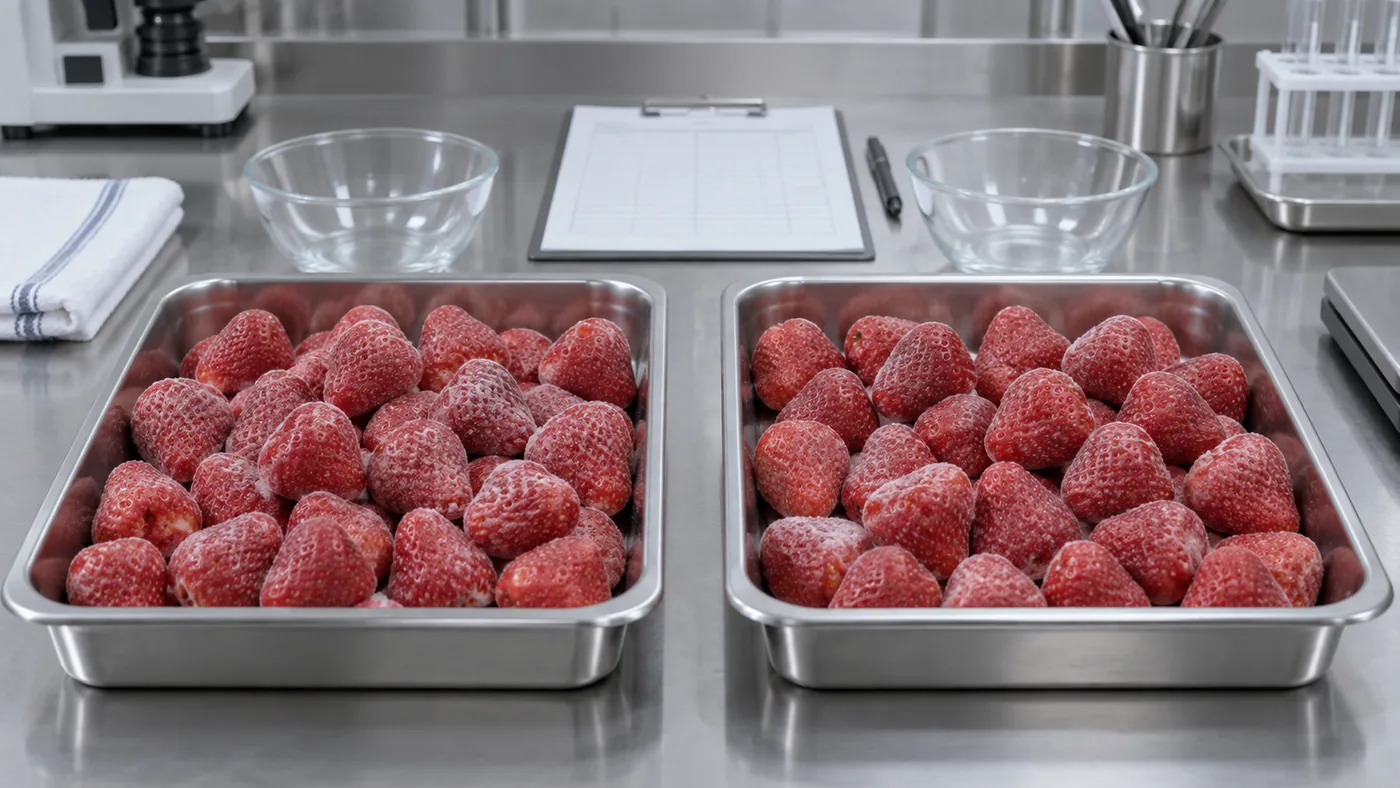
The authentic GreenLand strawberry photograph in this section shows an IQF product form that can serve as a visual reference. It is not evidence of calcium treatment. For a proposed treated-versus-untreated project, the buyer would require separate documented sample identities and a matched route. This boundary protects both parties from inferring treatment from the fruit's appearance.
Measure drip, flavor and process behavior alongside firmness
Firmness is worth measuring, but its direction may not align with the full application. Set a defined texture method appropriate to the fruit form. Record how many berries are measured and where a probe contacts them. Averages alone can hide a large share of fruit that collapses during use. Include visual integrity and breakage after normal handling, because the product may be judged as pieces rather than as isolated probe readings.
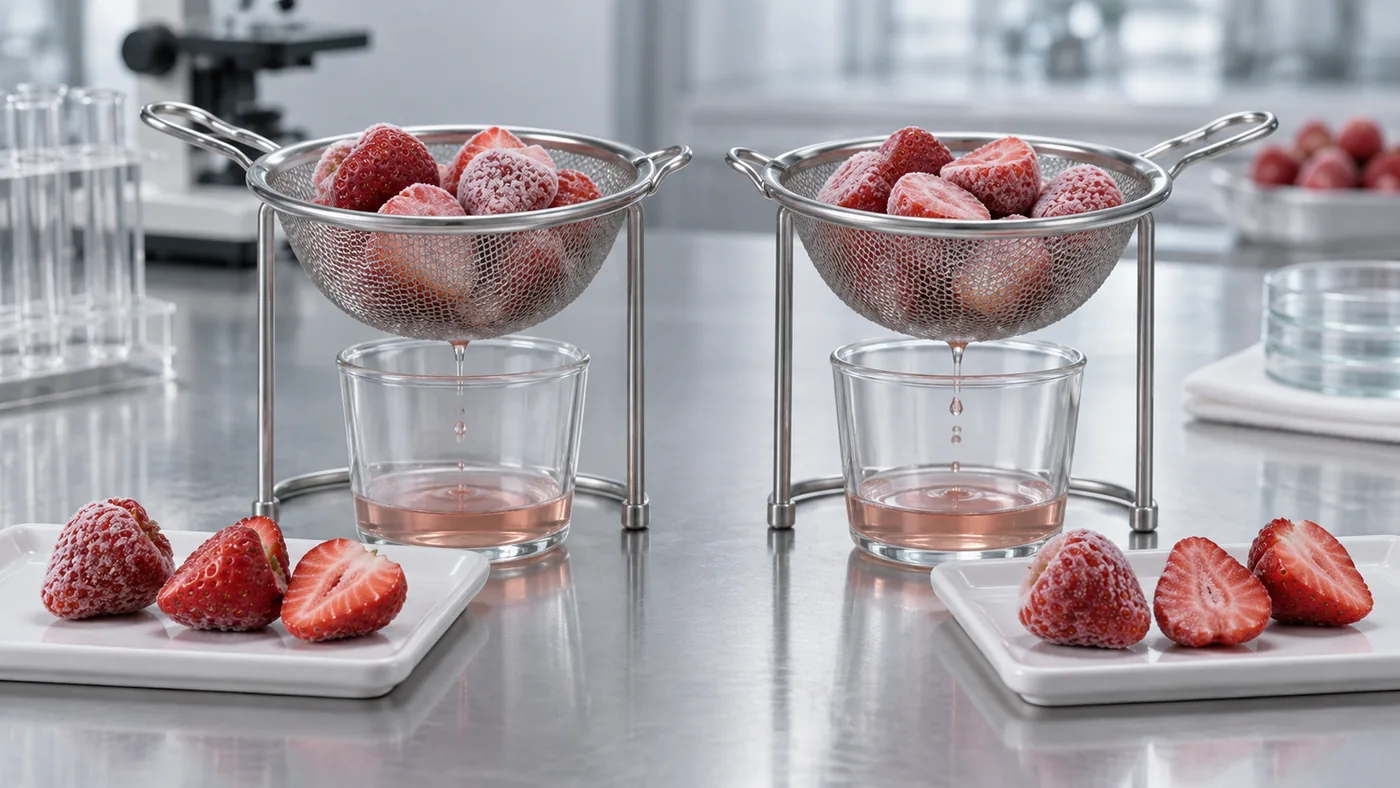
Measure thaw drip under a consistent method: starting mass, vessel, mesh or support, thaw time and temperature, drainage period and recovered liquid mass. If one sample loses less free liquid, ask whether that improves final yield or whether the liquid is normally retained in the buyer's recipe. Drip can affect a bakery filling, a fruit topping or a bulk ingredient balance differently. The image beside this section illustrates two equal drain setups; it does not assert that either treatment performs better.
Assess flavor and appearance. Some calcium compounds or high treatment intensities can create taste or color tradeoffs, depending on the fruit and method. A buyer needs a blind sensory comparison in the actual finished matrix, not only a lab texture plot. Measure color under a defined lighting or instrument method if appearance is a critical claim. Look for color bleed into the surrounding base after processing, not only berry surface color at thaw.
Do not discard the released juice before evaluating flavor or yield unless the real recipe does so. In a sauce, the drip may remain in the batch and contribute color and solids; in a pastry inclusion, it may migrate into dough and become a defect. The same numerical drip percentage can therefore carry different commercial meaning. Record whether the whole ingredient or drained fruit was used in the finished-product test, and weigh what was removed. A firmer berry is not necessarily more economical if it requires additional draining or leaves a weaker fruit flavor.
Finally, process the candidate in the intended application. For a fruit filling, compare depositability, piece retention, released liquid, final solids and taste after the real heating and cooling sequence. For a frozen dessert, consider the actual freeze-thaw and serving conditions. For a smoothie, a firmer whole berry may have little value if the product is fully blended. Decide the weighting of these outcomes before seeing the result. Otherwise a single favorable metric can dominate the narrative after the fact.
Use an outcome table with separate columns for the untreated and treated arms, method, result and decision relevance. Do not force all results into a single "quality score" unless the purchasing team has an explicit, justified weighting. A texture gain accompanied by more drip or off-flavor may be a poor trade. A small texture difference may be commercially irrelevant if both pass the finished-product test. The trial's purpose is to decide fit, not to validate a general theory.
Review formulation and destination-market requirements
Before approving a treated ingredient, obtain the exact treatment and ingredient declaration for the lot offered. Ask whether residues or incorporated ingredients remain, what is declared on the supplier document, and whether the proposed use and destination market permit the treatment and label wording. These questions require product-specific regulatory review by qualified personnel. There is no universal permitted concentration or label statement that can be given for all markets and fruits in a short article.
Keep the commercial and experimental documents distinct. A research paper's calcium concentration is not a purchase-order specification. A development sample may be prepared under different conditions from routine production. The supplier should confirm whether the same procedure is available at scale, how it is controlled, and what batch evidence accompanies it. If it cannot, treat the result as a development finding, not as qualified supply.
Ingredient disclosure also affects downstream formulations. A buyer making an organic, clean-label or allergen-sensitive product may have constraints beyond texture. Calcium salt selection can influence taste and label presentation. Claims of "untreated," "additive-free" or similar status need accurate supporting records, not an inference from the absence of a visible treatment. Ask the destination-market team to review the actual facts and wording.
Check whether the proposed treatment changes the customer's own ingredient statement or process records. An industrial buyer may incorporate the fruit into another labeled food, where the fruit supplier's description becomes part of a larger declaration review. The relevant rules depend on jurisdiction and product category, and can change. Procurement should circulate the actual supplier documentation to qualified regulatory staff before a commercial commitment, especially if the fruit crosses borders or enters several finished products. A verbal assurance of "food grade calcium" is not an adequate substitute.
Our frozen strawberry specification discussion can help frame size, cut and application questions. It does not mean that calcium-treated fruit is part of GreenLand's catalog. We can review a buyer's desired outcome against the currently available frozen fruit specification and, if a special development request is feasible, define what evidence would be required before any commercial claim.
Put the commercial specification ahead of the treatment label
The purchase decision should be expressed as product performance and disclosure requirements. Identify fruit variety or approved range, size or cut, packaging, frozen state, drip and texture methods, the intended application test, sensory acceptance and the exact declaration. Include lot and sample identities so the buyer can repeat the comparison. If the treated sample meets all agreed criteria and has a clear lawful specification, procurement has a basis to discuss price and supply. If it improves only an isolated lab measurement, the case remains open.
For routine receiving, choose a small set of practical indicators proven in the qualification trial. A full research protocol on every shipment may be unnecessary, while a single visual check may miss the key failure mode. The parties can agree a reference sample, a defined thaw test, selected analytical measures and an escalation plan for borderline lots. Preserve the distinction between an application acceptance rule and a scientific claim about mechanism.
Build in a requalification trigger. A new crop season, fruit variety, cut, pack size, treatment supplier or freezing route can alter the performance that was established in the original trial. The supply agreement can require notice of these changes and a targeted repeat check. That keeps a successful pilot result from becoming an unsupported permanent guarantee. The routine specification should say what is supplied and measured; the development report should retain why those limits were chosen.

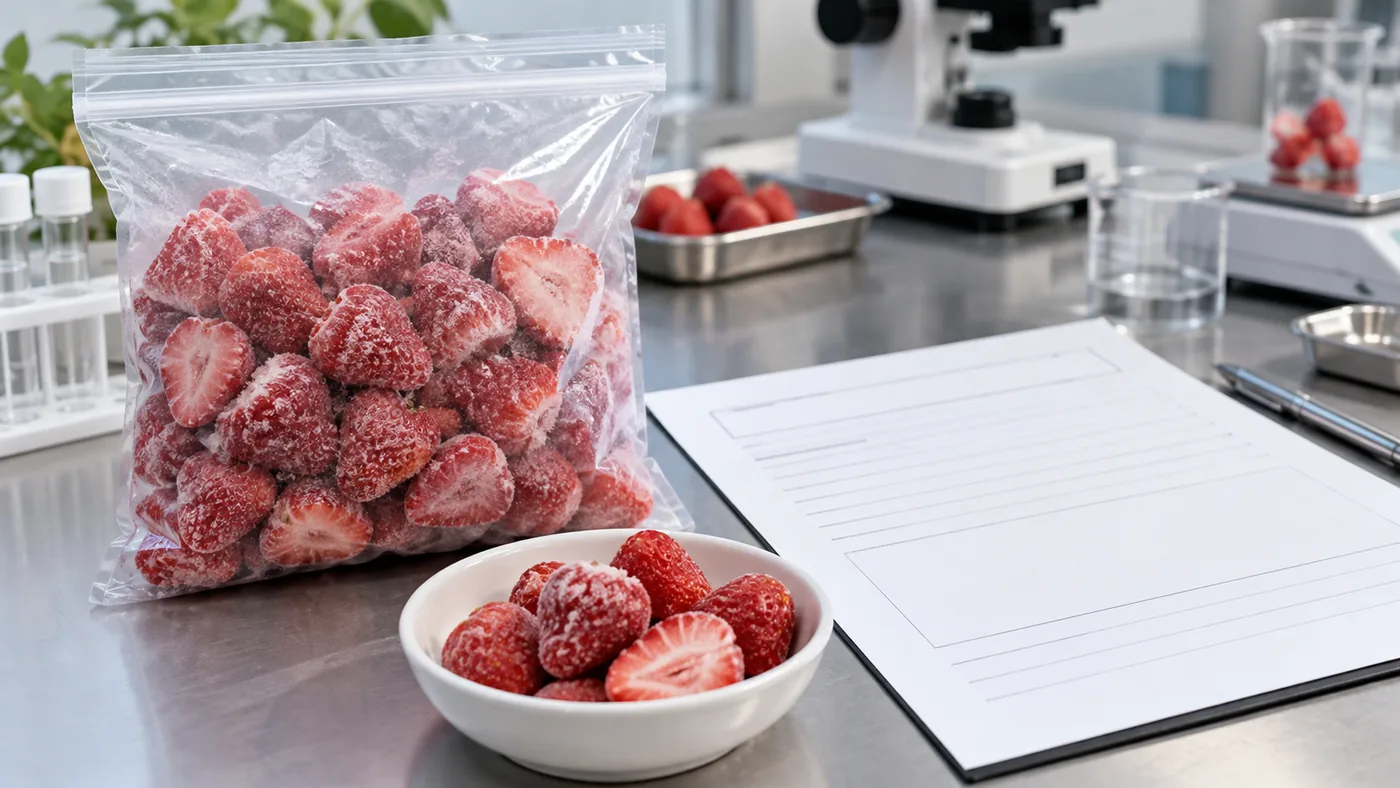
The second authentic strawberry photograph in this article documents real frozen fruit form and a product inspection context. It is not a calcium-treated sample, and no visual feature in it can establish treatment status. Use product photographs to confirm form and packing expectations; use supplier declarations and matched trials to decide treatment and performance.
We can discuss bulk IQF strawberry supply around your finished product and the property that matters most. Send the application, desired fruit form, current thaw or cook procedure, and any treatment claim you have been offered. As a frozen fruit supplier, we can help align an available product sample and a clear evidence request. We would not promise a calcium-treated SKU or a universal texture benefit without a defined commercial specification and valid comparison.
If a treated candidate is more expensive, compare total usable output rather than purchase price per kilogram alone. Measure the amount of intact fruit retained after normal thawing and processing, the liquid that is discarded, any extra handling needed to meet the finished specification and the sensory value delivered. A small increase in firmness may justify a premium for a visible fruit inclusion yet provide no benefit in a blended puree. This calculation should use the buyer's own trial yields; literature values and photographs cannot supply the commercial answer.
Keep a record of an unsuccessful treatment trial as well. It can show that a particular compound or process combination did not meet the current application, without implying calcium pretreatments are universally ineffective. State the tested fruit lot, form, treatment information and endpoints. A future candidate with a different method can then be judged on fresh evidence rather than on a broad, unsupported yes-or-no claim. This is a more durable purchasing decision than a single preference for the firmer-looking sample.
Questions buyers ask
Does a firmer thawed strawberry always make a better ingredient? No. The buyer should also assess drip, flavor, color, piece integrity and behavior in the actual finished product. A higher instrument force can be irrelevant or come with a tradeoff.
Can a published calcium concentration be copied into our order? No. A study's method is specific to its fruit, treatment and research conditions. Confirm the real commercial process, ingredient declaration and destination-market requirements with qualified teams.
How do we know calcium caused an apparent improvement? Use a matched split-lot untreated control with the same freezing, storage and thaw route, then compare several endpoints. If the samples differ in crop lot or route, the cause remains uncertain.
Does GreenLand's strawberry page show treated fruit? No treatment should be inferred from a product image. Ask for the specific offered specification and written disclosure; the genuine photos here illustrate frozen strawberry form only.
Sources: Calcium chloride and frozen strawberry study and frozen strawberry pretreatment research. Study findings are condition-specific and do not constitute a GreenLand product claim.
Source frozen fruit with GreenLand-food
GreenLand-food is a professional frozen fruit supplier and manufacturer in China, providing factory-direct wholesale supply for importers, food manufacturers, foodservice distributors, and private-label programs.
Send the product form, specification, packing, quantity, application, destination, private-label needs, and requested documents.