


Frozen vs Thawed Ingredient Loading: Why the Same Kilograms Change a Kettle Trial
Sep 29, 2026
Leave a message

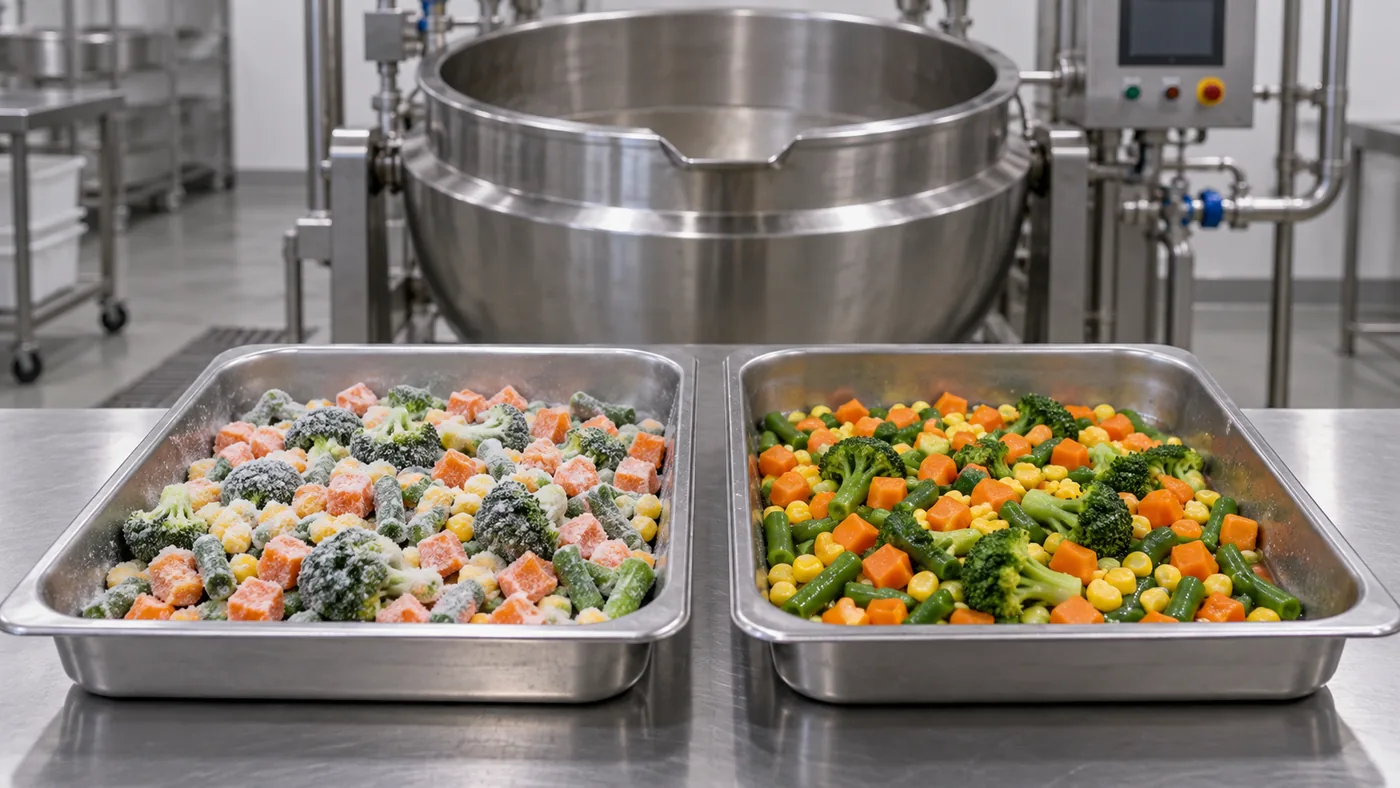
Record the material state as well as the mass
The trial log should start with what actually entered the kettle, not just the purchase order line. Record net ingredient mass, product identity and form, measured temperature at a defined point, whether pieces were hard frozen and free flowing, partly thawed and clumped, or fully thawed, and the time the material spent outside controlled storage. For a puree, include whether the pack contains a hard frozen block, a slush, or a pumpable chilled product. These states can have different heat demand and different loading behavior despite identical nominal kilograms.
A single surface reading is an incomplete description of a mixed or blocked load. The exterior of a bag may soften while its center remains frozen. Loose IQF pieces may be more uniform but vary in surface frost and agglomeration. A tray allowed to temper for a few minutes may appear similar to an untouched tray from a distance. Note where and how temperature was measured, and retain a photograph or short physical-state note. Do not convert that one reading into an exact fraction of ice without a justified method.

Keep formulation and form constant when possible. A comparison between IQF carrot dice and a thawed puree changes both state and geometry; it cannot isolate the state effect. Similarly, comparing a 10 mm vegetable cut with a large frozen block tests more than frozen versus thawed. Use material split from the same approved lot and the same component composition. If the buyer wants to compare two suppliers, run each at the same starting-state specification, or record the difference and interpret it explicitly.
For mixed ingredients, record the distribution of pieces as well as average temperature. A bag with many separated small pieces presents more surface to the surrounding sauce than an equally heavy agglomerate. If a sample contains large frozen clumps after a disrupted cold chain, the kettle can have cold pockets even when the total thermal energy requirement is similar. The distinction affects heat-transfer rate and piece damage. It is a legitimate receiving observation to note free-flowing condition, but it should be measured or described separately from the question of whether the formula contains the right mass of vegetables.
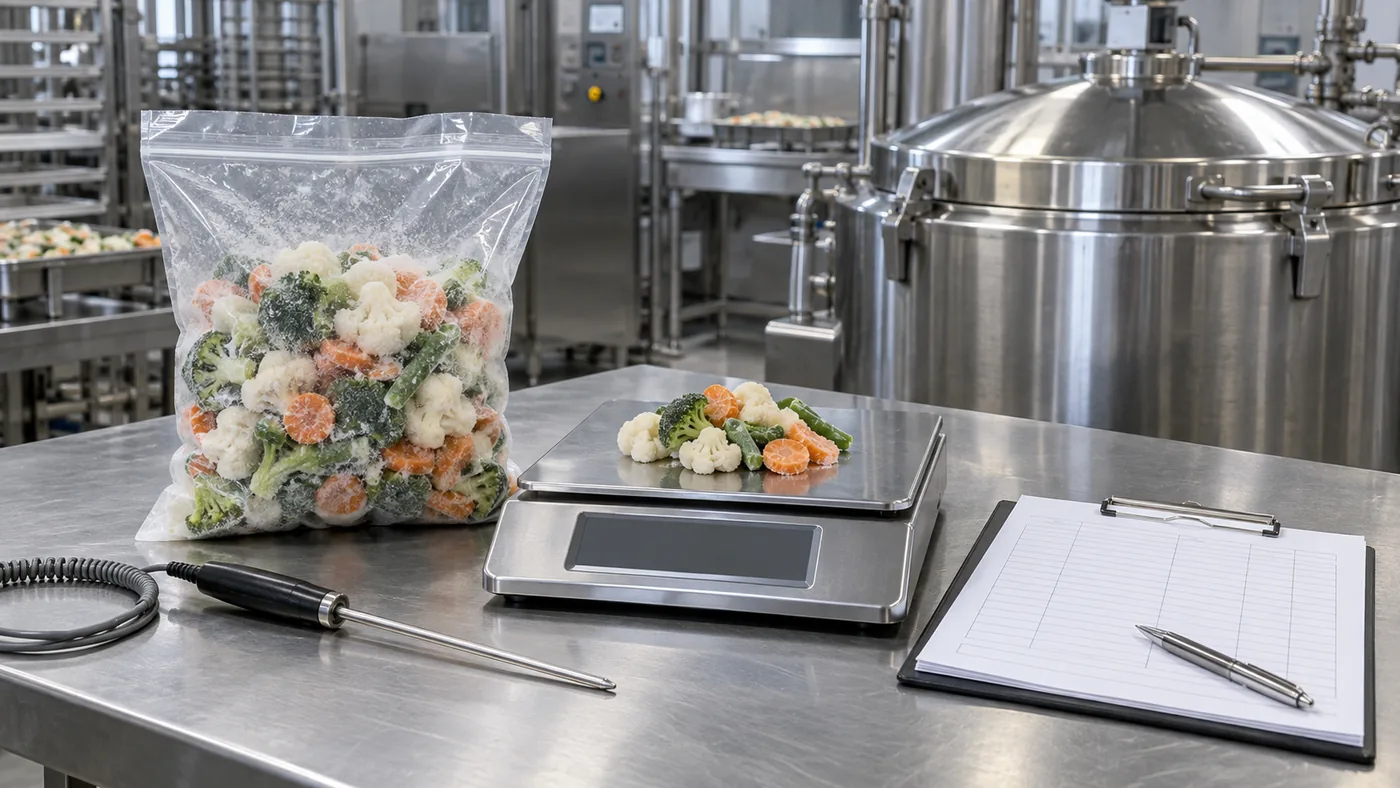
The photograph of actual GreenLand mixed vegetables used with this article identifies product form; it does not document a kettle trial. Our industrial frozen vegetable discussion covers ingredient fit for processing more broadly. For the present trial, the key addition is a state record detailed enough that another technician could reproduce the starting point.
Account for warming and melting before judging the heat-up time
Heating frozen food has stages. Heat first raises the temperature of the frozen material toward its melting range. Energy then changes ice to liquid water while temperature may rise slowly through the phase-change region. Heat subsequently raises the temperature of the thawed material. The University of Guelph food-processing text describes this practical division; the FAO chapter on freezing fruits and vegetables explains how ice formation and food composition complicate a simple water-only picture. The exact heat load depends on water content, ice fraction, temperature, geometry and other components. It is not one universal number for every frozen fruit or vegetable.
Imagine two equal 20 kg portions from a suitable lot. One is loaded as hard-frozen pieces and the other has been thawed under a controlled procedure. The kettle, base recipe and net ingredient mass are held constant. The frozen condition will generally require additional heat for warming and melting. That is a physical expectation, not a prediction of a specific number of minutes. Kettle design, jacket power, agitation, batch size, product viscosity and addition rate govern how visible the difference will be. The comparison is illustrative, not a GreenLand test result.
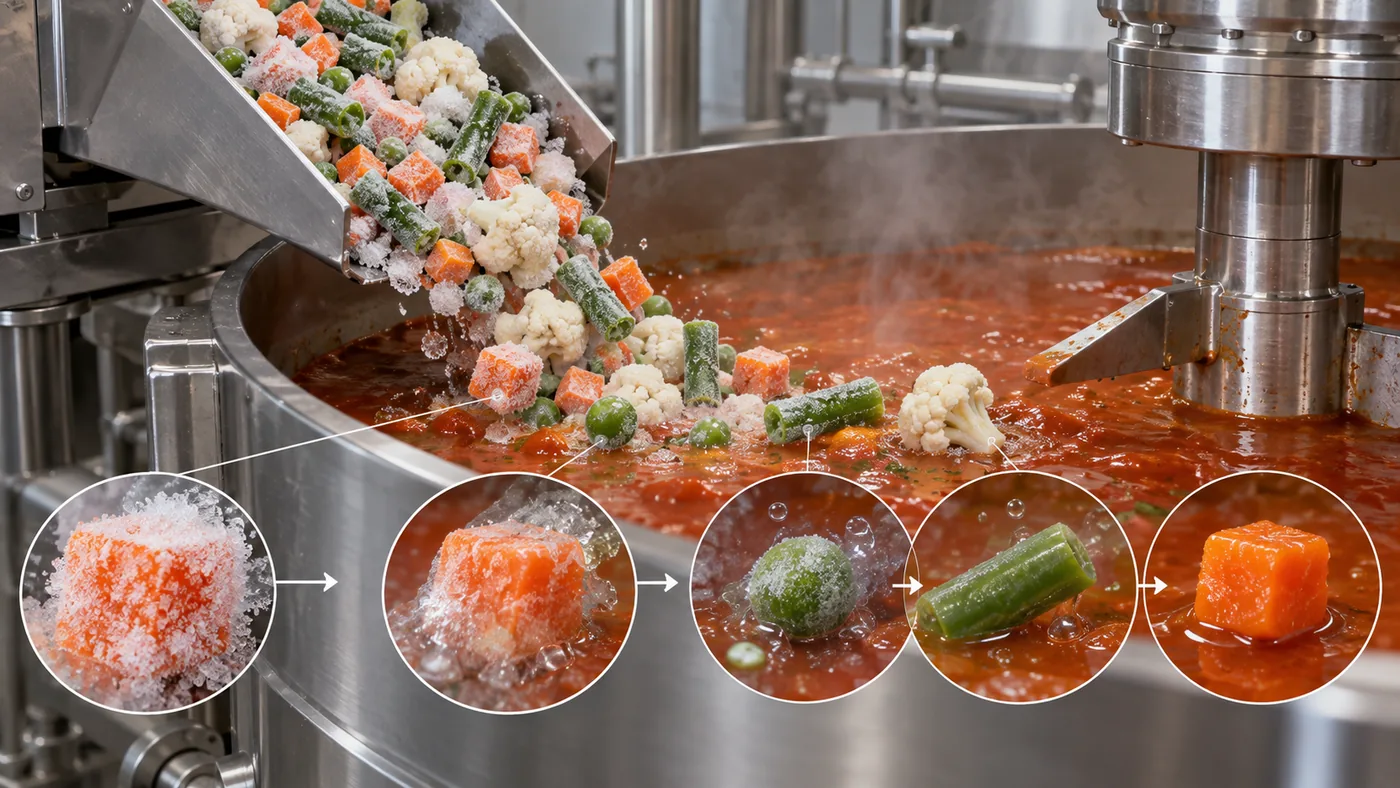
Heat demand is only part of what a cook observes. A hard frozen addition may cool the immediate sauce around it, alter local viscosity and temporarily slow circulation. Clumped material can enter as large masses, creating a different contact area from separated IQF pieces. A thawed ingredient may release liquid early, thin the base and change mixing. If a technician responds by increasing heat or extending hold time without recording the state difference, the finished samples may have different concentration even when the original masses were identical.
The liquid released on thaw is not necessarily waste. In a fruit preparation it may carry soluble solids, pigment and flavor compounds. Removing it before weighing or before the kettle trial changes the effective formulation, while adding it later changes when water and solids enter the system. The log should say whether the whole pack, including separated liquid, was charged. If the buyer's normal process drains the ingredient, repeat that practice consistently and account for the discarded mass. Otherwise a supposed state comparison quietly becomes a solids-balance comparison.
Do not use the phrase "thermal diffusivity" as a substitute for the whole heat balance. Diffusivity describes how quickly a temperature disturbance propagates through a material under specified conditions; the kettle also has to supply the energy required for phase change. Likewise, a frozen ingredient is not automatically "more difficult" in every application. Its state may be part of the intended process design. The purchasing issue is whether all candidates were assessed under conditions that match the line's real operating practice.
Control the loading sequence in a trial
Make the trial reproducible before interpreting a quality difference. Start with the same kettle fill, base formulation, initial kettle temperature, agitation setting and nominal heat input. Weigh the ingredient separately and document whether it was added in one charge or in portions, over what period, at what location in the kettle, and whether it was manually dispersed. Record the time at which the first and last portions entered. "Added 20 kg" does not capture a two-minute staged addition versus a large block dropped in at once.
Define the clock carefully. If one operator starts timing when the bag is opened and another starts when the last piece is submerged, apparent heat-up time differs even with identical materials. Record the start point, several actual product temperatures at safe representative locations, and the event that ends the comparison. Where the product has particulates, a single probe near a wall or in a stagnant zone can misrepresent the batch. Follow the processor's established measurement and safe-working procedures; an editorial article cannot validate a probe placement for every kettle.
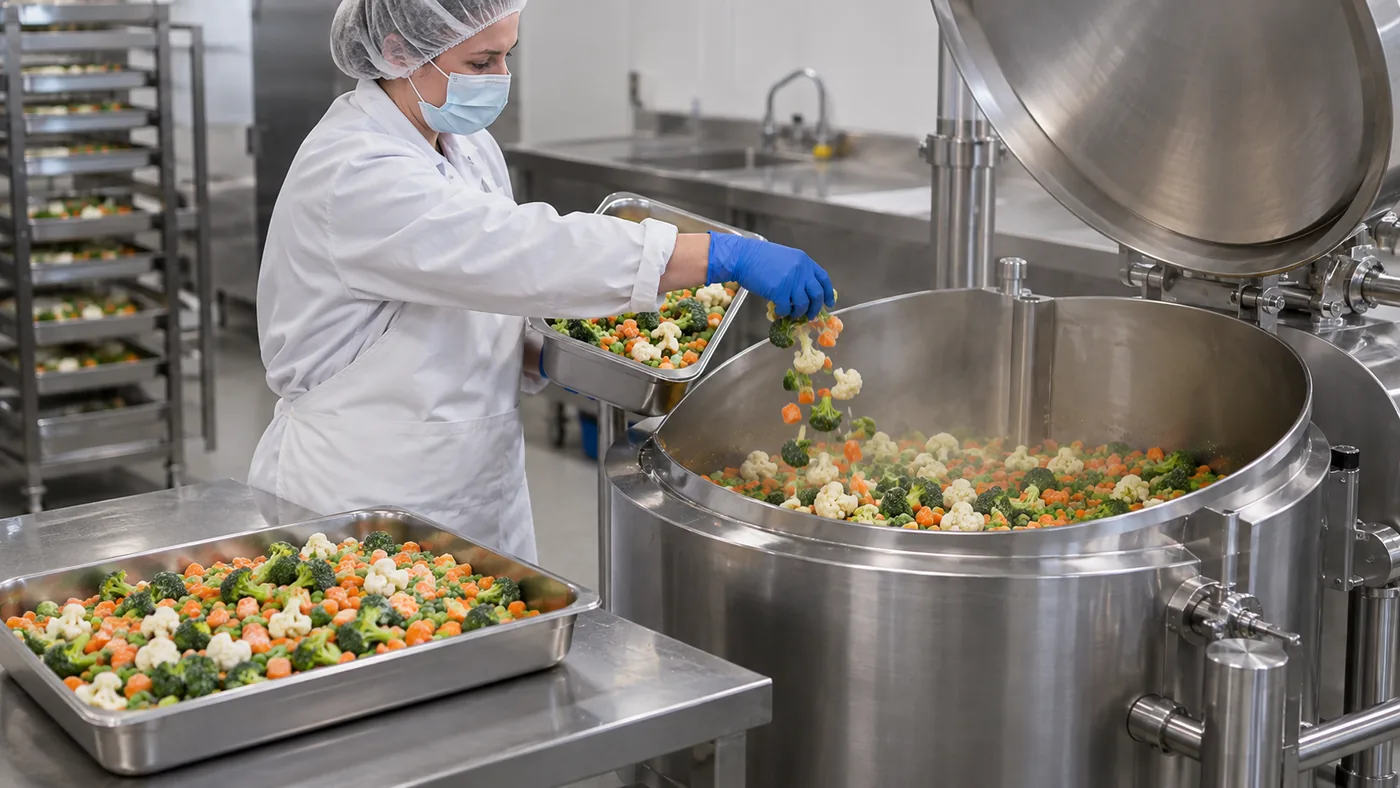
It helps to distinguish the ingredient exposure history from the kettle process history. A tray that has partly thawed during staging may bring free liquid to the kettle and enter at a different temperature from a tray pulled directly from frozen storage. The heat source and agitator may then react differently to that addition. For a true same-lot comparison, control and document staging, packaging removal and drainage. Do not silently discard thaw liquid if it is part of the purchased ingredient and the recipe would normally receive it; that changes both mass and solids.
Plan repeats that match the decision. One frozen and one thawed run can identify a large practical difference, but it cannot reveal normal day-to-day variability of steam supply, operator timing or ingredient condition. If the first difference is small enough to affect a purchase decision, repeat runs in a balanced order or on more than one production day. Keep the baseline setup written down between runs. The object is not a statistically elaborate research program; it is to avoid treating a chance kettle fluctuation as a reliable ingredient effect.
Run the first trial at the line's usual operating approach, then make one change at a time if the development team needs to isolate a factor. If the production line always adds IQF vegetables in several charges, a single large laboratory addition is a poor predictor of production behavior. Conversely, a supplier sample that performs well after complete thawing does not answer a buyer whose line loads it from frozen storage. The GreenLand temperature-control discussion underlines the value of recording handling history; for this use, the record must continue through the actual kettle addition.
Read the kettle trace before evaluating the ingredient
A basic trace makes the comparison more interpretable. Record the mass and temperature of each input, the kettle's initial condition, charge times, product temperature at defined events, agitation changes, any unplanned stop and the time to the agreed endpoint. Add evaporation or final net mass where concentration matters. A chart is convenient, but a complete table with event times is often enough to expose a hidden difference between runs.
Suppose the frozen run takes longer to return to a target product temperature, and the operator holds both runs for the same additional clock time after the endpoint. The frozen batch may have a longer total process exposure but a different temperature path. If the operator instead stops both runs at the same wall-clock time, they may end at different temperatures. Neither outcome can be interpreted as ingredient quality until the chosen endpoint and history are stated. The key question is what the ingredient experienced, not merely what the kettle display showed at one moment.
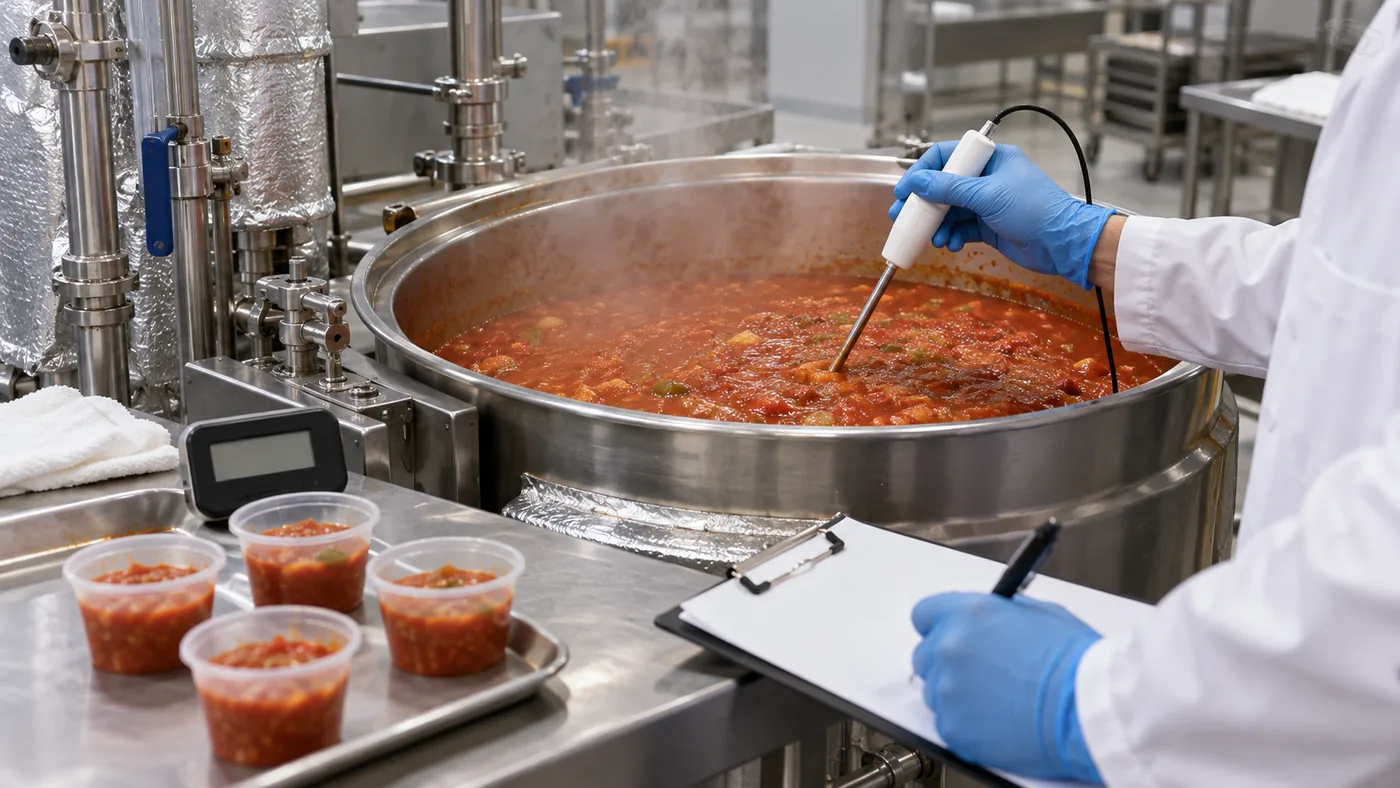
For particulates, compare both the continuous phase and representative pieces. Larger strawberry pieces or vegetable chunks can lag behind the surrounding sauce. A probe immersed in the liquid does not automatically measure the core of the largest inclusion. Any attempt to change a safety-critical target, including a lethality hold or a validated cooling rule, needs competent process authority and the processor's own validation. This article addresses how to compare quality trials; it gives no time-temperature substitute for a validated process.
Look for other causes of a slow trace. A larger batch, reduced steam supply, different agitation, a more viscous base or a poorly positioned probe may dominate the difference. If both candidate ingredients were loaded under different conditions, do not apportion the entire observed delay to ice melting. Record enough process variables to test rival explanations. This is especially important when a purchase decision is being made from a single small trial, where ordinary run-to-run variation can look like a supplier difference.
Make the trace readable to the next person. Mark charge start and end, the lowest observed temperature after loading, the return to the process target and the final product condition. Add the probe location or measurement method beside each reading. If the agitator is paused to avoid splashing during charging, note the pause; it may explain a slow recovery independent of ice. A simple annotated timeline lets the application team see what happened, whereas one isolated "time to target" number hides the sequence.
Compare the finished product after the histories are understood
The buyer ultimately cares about the finished food: intact pieces, color, flavor, suspension, target solids, yield and handling on the line. A slower run may produce softer fruit or vegetables because of added exposure; it may also concentrate sauce differently through evaporation. Those outcomes should be measured directly. Avoid using heat-up time as a proxy for all quality attributes.
First, compare products at a common, relevant endpoint. That might be a specified final net mass or soluble solids for a fruit preparation, a defined sauce concentration and piece condition for a meal component, or another parameter the application team already controls. Then evaluate the retained pieces and continuous phase separately. Note the size distribution entering the kettle and the size after processing, because a nominally identical recipe with different cut or ripeness can change texture independently of state.

Second, choose whether the question is "Which ingredient performs better under our actual process?" or "Does frozen versus thawed state explain the difference?" These are related but different trials. The first should use the real production loading practice for each candidate, including the same acceptable supply format. The second is a controlled same-lot comparison with only state intentionally varied, as far as practical. Mixing the aims makes it hard to tell procurement what the result means.
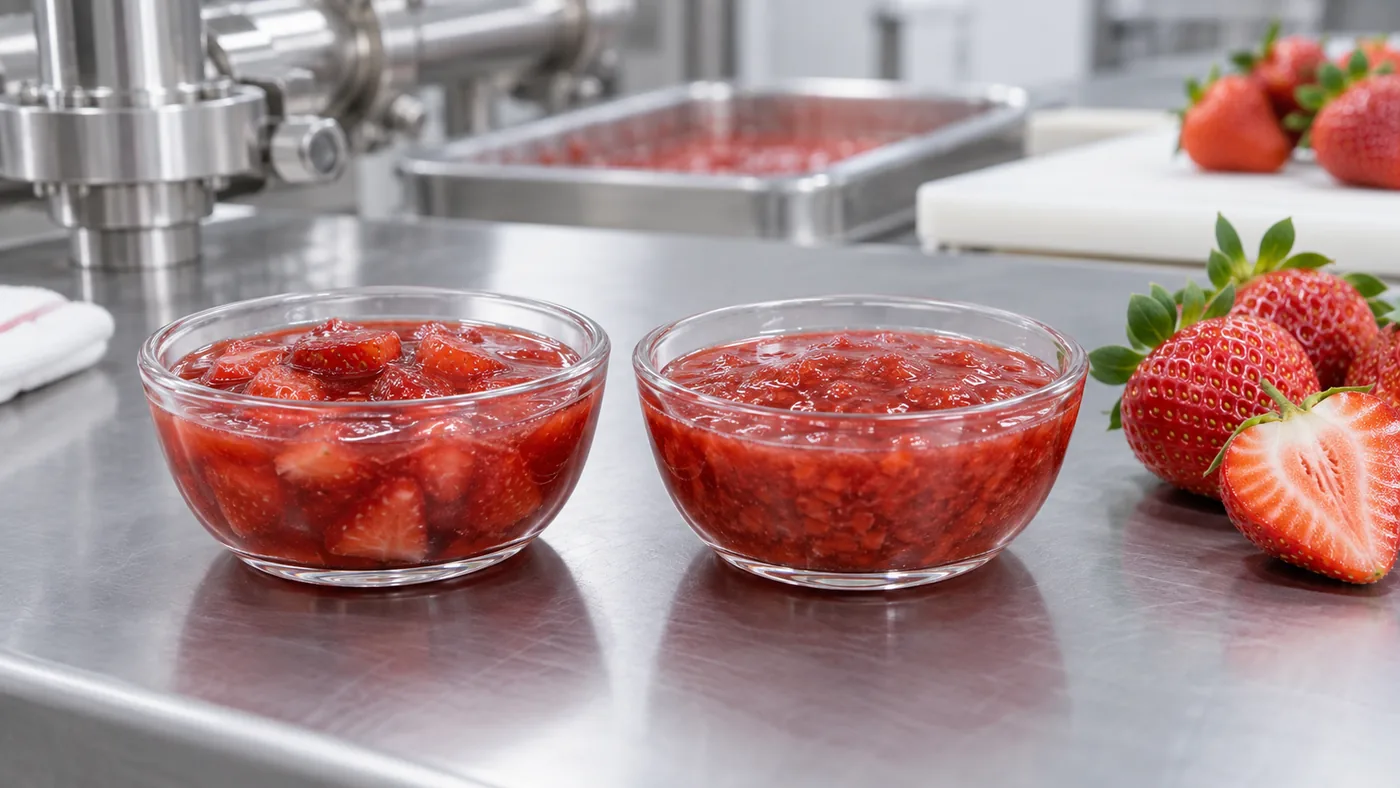
Consider an illustrative fruit preparation with equal strawberry mass in both runs. If one run receives frozen whole berries and another receives thawed berries, their initial structure and available liquid may differ. Their final piece retention may also differ if the kettle histories diverge. A sound assessment reports starting state, heating path, final concentration and piece integrity together. The image beside this section is a conceptual application comparison; it is not a measured GreenLand sample or a claim that one form always yields larger pieces.
Ask the application team to note sensory and commercial consequences too. A few minutes of extra cooking may matter little in a heavily blended sauce but substantially change a delicate fruit inclusion. A lower final yield from longer evaporation can change true ingredient cost. If a frozen product allows simpler storage or more consistent dosing, that is part of the business decision as well. A single laboratory number does not settle it.
For a fair cost comparison, report the finished yield as well as the incoming kilograms. If one run loses more water because it remained hot longer, cost per kilogram of input is not the same as cost per kilogram of usable finished product. Likewise, an ingredient that retains more identifiable pieces may meet a premium specification with less overfill. These commercial measures should be derived from actual trial data, never inferred from the illustrative sample bowls or a general statement about frozen food.
Hand a useful record to the process team
When the trials differ, send the process engineer or application specialist a compact dossier: ingredient lot and composition, incoming form and state, measured input temperatures with location, net masses, addition sequence, kettle settings, event trace, final mass or concentration, and physical and sensory observations. Include photographs of the ingredient form and retained pieces, with clear captions. The dossier lets the team decide whether the difference is expected thermal load, a controllable loading factor, or a genuine product-performance question.
For supplier qualification, specify the state the plant will actually use. If production loads from frozen storage, the supplier discussion should include IQF separation, block formation, pack size and temperature history. If the plant intentionally thaws before loading, it should define that thaw method, drainage rule and maximum handling window according to its own validated food-safety system. The supplier can then provide the right sample form and realistic handling information, while the processor owns process validation.
Keep the decision in two columns during approval: ingredient requirements that a supplier can agree to, and process settings that the plant must own. Product form, cut, pack size, lot traceability and agreed frozen condition belong in the first column. Kettle heat input, agitation, probe placement and validated hold belong in the second. A quality trial links the columns but does not transfer responsibility for the plant's safe process to an ingredient certificate. This separation also makes a repeat order easier: the supplier can reproduce the material specification while the processor reproduces its application method.
We can review a frozen vegetable or fruit ingredient trial with your team using the real pack form and the specific application. Send the intended cut or puree form, current kettle loading sequence, pack size and the trace that raised the question. As a frozen-food supplier, we can help define the ingredient and sample comparison; any change to validated processing or food-safety controls remains with your qualified process team.
For the next trial, agree in advance what result would change the purchasing choice. A meaningful decision might require equal finished yield and acceptable piece integrity under the actual frozen-loading procedure, or it might permit a longer heat-up time if the final texture and production capacity remain acceptable. Writing this criterion before testing prevents the team from selecting whichever single number favored the preferred sample after the run. It also tells the supplier what improvement, if any, is commercially useful.
Questions buyers ask
Does the same kilogram of frozen and thawed ingredient require the same heating time? No. The frozen portion normally needs heat for warming and ice melting in addition to later warming. The observed time depends on equipment, geometry, composition and loading procedure; there is no universal minutes-per-kilogram rule.
Can a thermometer reading tell us how much ice remains? A single temperature reading does not reliably give the exact ice fraction in a mixed food. Record physical form and measurement location as well as temperature, especially for blocks or clumped material.
Should a supplier be rejected because a frozen trial heats more slowly? Not on that observation alone. Compare like starting states, the addition sequence and the kettle trace, then evaluate the finished product against the application specification.
Can this article set a new safe kettle schedule? No. Product safety and any changed thermal process require the processor's qualified validation. The proposed log is for interpreting an ingredient comparison.
Sources: FAO freezing chapter and University of Guelph heat-transfer teaching material. Examples are illustrative and do not report supplier or customer trial data.
Source frozen food with GreenLand-food
GreenLand-food is a professional frozen food supplier and manufacturer in China, providing factory-direct wholesale supply for importers, food manufacturers, foodservice distributors, and private-label programs.
Send the product form, specification, packing, quantity, application, destination, private-label needs, and requested documents.