


Air in Thawed Fruit Puree: Separate Foam, Dissolved Oxygen and Filling Variation
Sep 29, 2026
Leave a message

Name the air-related observation precisely
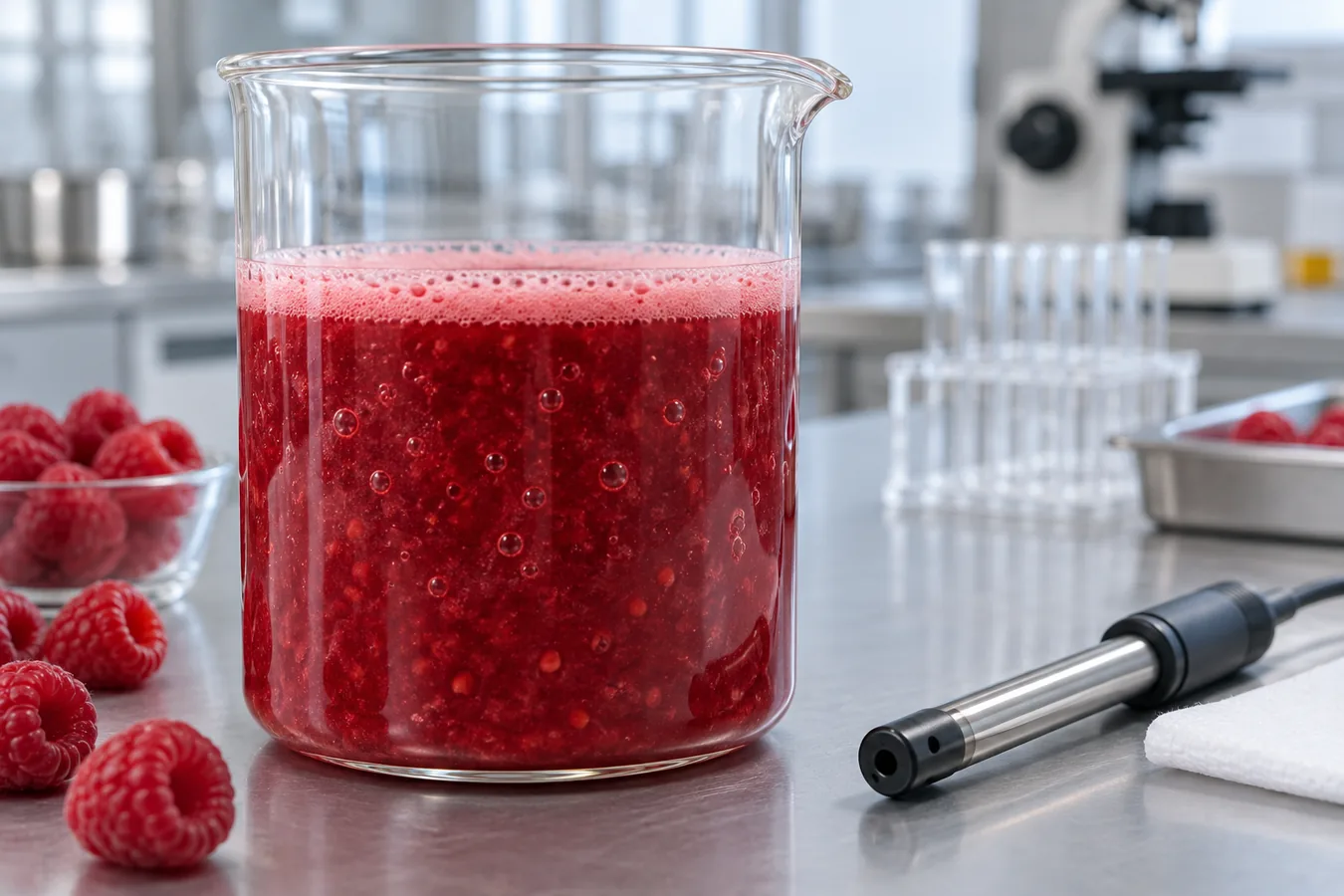
A surface foam layer contains bubbles collected at the top. Entrained air means discrete gas bubbles dispersed through the puree. Dissolved oxygen is oxygen present in the liquid phase and is not directly visible as bubbles. A sample can have one without a conspicuous amount of the others. This is why a statement such as "the puree has high oxygen because it foams" is not supported by the observation alone. The Tetra Pak Orange Book discussion of juice processing separates free air and dissolved oxygen in a liquid food process. Its equipment settings and conclusions for orange juice cannot simply be transferred to a viscous raspberry puree, but the distinction is useful.
Describe what is actually seen: a stable foam cap, bubbles distributed through the vessel, a transient froth after stirring, or gas emerging at a pump inlet. Note when the observation appears. Foam present before the pack is opened may tell a different story from foam appearing after a laboratory technician vigorously mixes a thawed sample. A bubble-free surface after rest does not establish that dissolved oxygen is low. A puree's color, pulp and viscosity can also change how easily bubbles are seen or released.
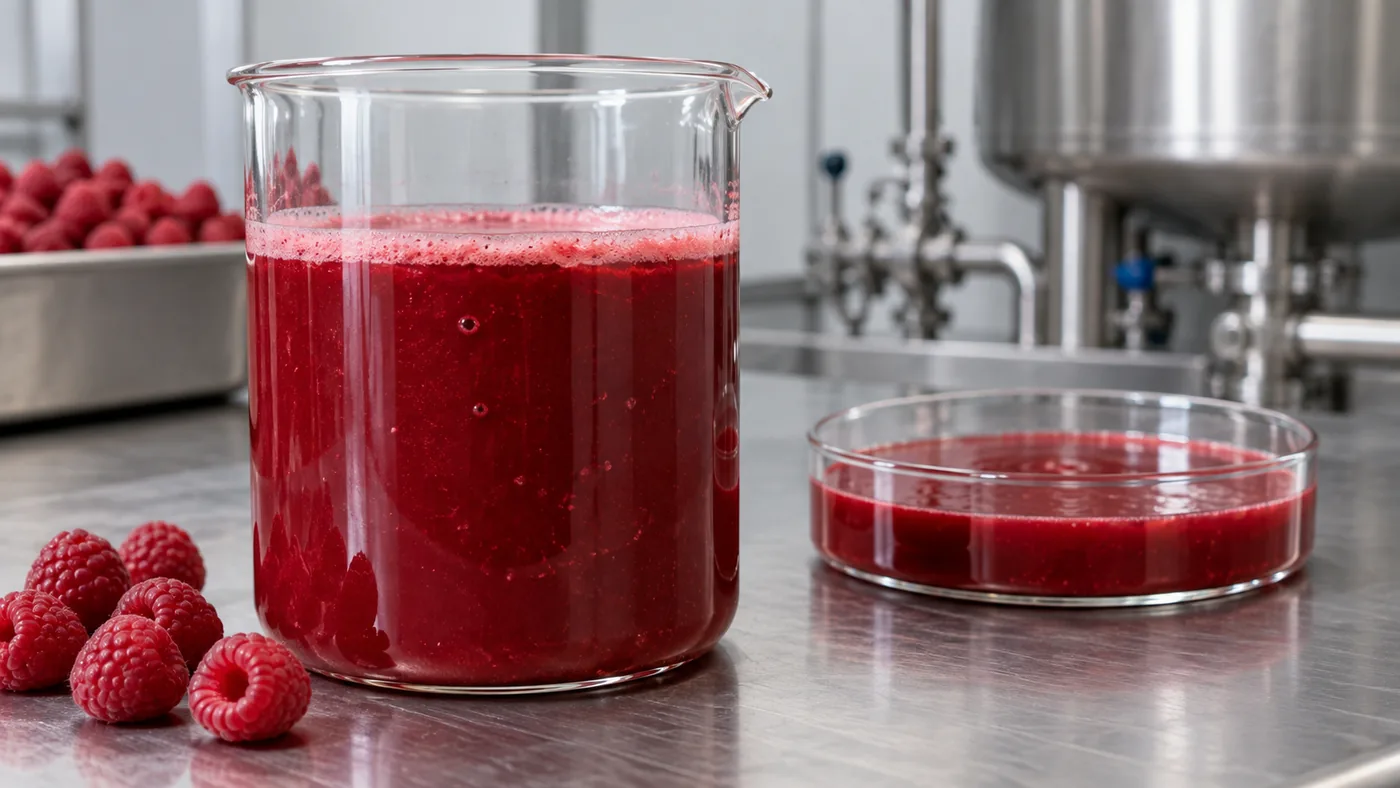
The distinction matters commercially because each symptom can affect a different decision. A foam layer can change the apparent fill line and create product loss during overflow. Entrained bubbles can alter the apparent volume of a dispensed portion and interfere with some rheological measurements. Dissolved oxygen may be relevant to oxidative quality, depending on the product and package. Air can also change the impression of body and texture. None of these should be collapsed into one vague specification line reading "no air."
Use plain descriptors before instrument readings. For example, record "thin foam layer after a high-speed transfer, reduced after ten minutes of rest" rather than "excessive aeration" if no acceptance criterion exists. This keeps a complaint useful to the supplier and the process team. In the image beside this section, the visible layer and submerged bubbles are explanatory; the image cannot depict or quantify dissolved oxygen.
Two photographs taken at different times can make the same sample look like different products. A froth that rises immediately after pouring may collapse before the filler starts, while a fine dispersion of bubbles may persist below the surface. Timestamp the observations and keep the vessel size and fill height comparable. If the surface is opaque, gently expose a side view in a transparent test container rather than stirring again just to look for bubbles. That additional action could change the very state being investigated.
Trace what happened during thawing, transfer and mixing
Make a short handling map from frozen pack to tested sample. Record pack size and condition, thaw method, final product temperature, opening time, transfer height, pump or pouring step, mixing tool and speed, hold time, and whether the vessel was filled from the top or below the surface. Include any strainers, valves or recirculation loops. Each of these can change the amount of visible air and the time it remains trapped in a viscous puree.
Keep an untouched reference when possible. Split a representative pack into two comparable aliquots after the same controlled thaw. Handle one according to the normal routine and leave the other with minimal disturbance. If foam appears only after a high-shear or high-fall transfer, the handling step deserves investigation before the incoming lot is judged. If both aliquots show the same persistent feature before further processing, the team has a stronger reason to examine the supplied product and the packaging history. The comparison is diagnostic; it is not proof of a single cause by itself.

Thaw liquid and pulp distribution need attention. A fruit puree that is only partly thawed may have regions of different solids concentration. Stirring to homogenize it can introduce air, while avoiding all stirring can yield a nonrepresentative top sample. The solution is not "never mix." It is to define a gentle, reproducible preparation that produces a representative aliquot while limiting unnecessary aeration. Document the protocol so two laboratories can compare the same material state.
Use the actual GreenLand product photograph in this section only to show raspberry puree form during transfer. It does not establish that the pictured material has an air defect. For related fruit-puree application considerations, our strawberry puree product page describes supply form. A buyer's accept/reject rule must still be anchored to the exact puree and pack being purchased.
Packaging can affect the interpretation. A flexible frozen bag may contain headspace before or after thawing, and a partially emptied container may draw air into a pump line. Ask whether the symptom begins with the first aliquot from a fresh pack or only after the vessel level falls. Inspect pack integrity and connection points separately from puree composition. If the line uses a recirculation loop, record how many passes the material completed before the troublesome sample was taken. These details help avoid an expensive ingredient rejection when a loose fitting is the real cause.
Compare actual mass with apparent fill volume
An aerated puree may occupy more apparent volume for a given mass. If a filler targets a volume or if an operator judges a container by eye, bubbles can make the level look satisfactory before the product has settled. A weight-controlled fill, a volumetric fill and a visually checked fill can therefore respond differently to the same air history. The Oklahoma State University guide to filling equipment is useful background on such distinctions; it is not a specification for every fruit-puree line.
Design the comparison around the actual packaging operation. Take adjacent containers from a stable production run, record the fill method and line setting, weigh net contents with an appropriate calibrated balance, and note apparent fill level promptly and after an agreed rest. If the product can legally and safely be opened for a test, measure density or a defined volume-to-mass relationship under a controlled method. Keep temperature and container geometry consistent, because both influence the result. Do not infer a precise density change from the illustrative image beside this section.
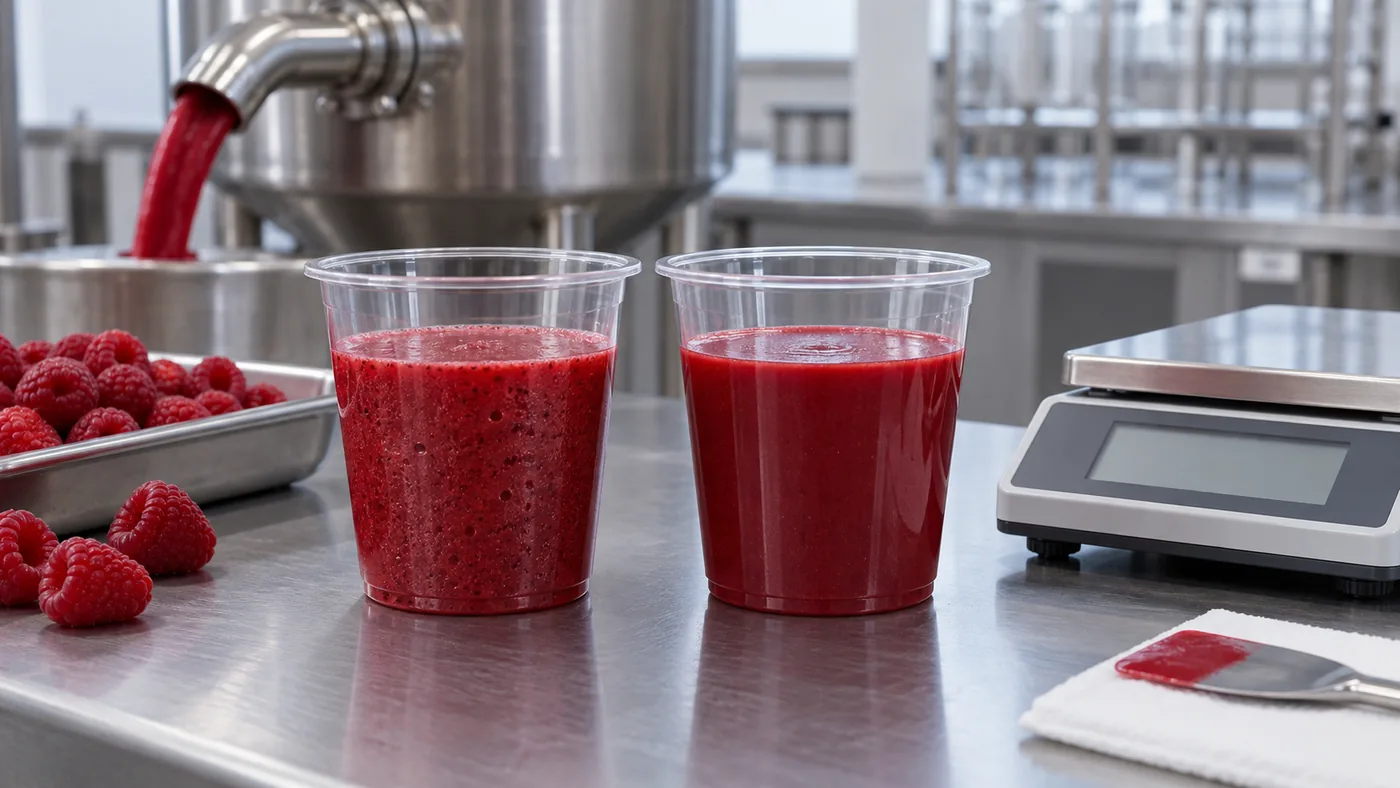
A sample that appears to fill more of a cup while weighing less may contain more air, but several other explanations are possible: different pulp or soluble solids, temperature, cup tare, retained residue, filler timing or measurement error. Check those factors. The useful question is whether the process meets the declared net-content requirement and whether the ingredient behaves consistently enough for the selected fill control. A change in foam appearance alone does not answer either question.
Separate the product's property from the measurement artifact. For viscosity, entrained air can disturb the contact between sample and instrument, and a foamy sample may not represent the bulk puree. The manufacturer's Brookfield viscometer operating manual provides method context, including sample handling concerns. It does not show that GreenLand owns that instrument or that a particular viscosity result can be assigned to the pictured puree.
If the line fills by volume, examine whether a stable measured density is required for the nominal pack weight. A volumetric piston can deliver a repeatable displaced volume while the mass varies with air and product density. A net-weight filler addresses the net mass directly but can still suffer from foam, splashing or unstable flow. Equipment type does not remove the need to sample actual packs across a production interval. The buyer should distinguish legal net content, operational giveaway and cosmetic fill height rather than assuming one control solves all three.
Measure oxygen and flow behavior as separate questions
If the application is sensitive to oxidation, define a dissolved-oxygen measurement with an appropriate method and sampling time. A value taken immediately after a transfer may differ from one taken after resting or after another pump pass. A visual foam score cannot substitute for that reading. Conversely, a dissolved-oxygen result does not tell the filler how much gas is present as visible bubbles at the nozzle. The Orange Book is a reminder to keep those endpoints separate.
The sampling point can reverse the apparent story. An incoming puree aliquot may have an acceptable oxygen reading while the finished pack is higher after several transfers, or the reverse after a validated processing step. Label the point as incoming pack, thaw vessel, pump outlet or filled container. Minimize disturbance when collecting the oxygen sample, because pouring it into an open beaker for convenience can introduce air before the probe is inserted. Follow the instrument maker's procedure for temperature compensation and calibration rather than comparing unqualified values from different devices.
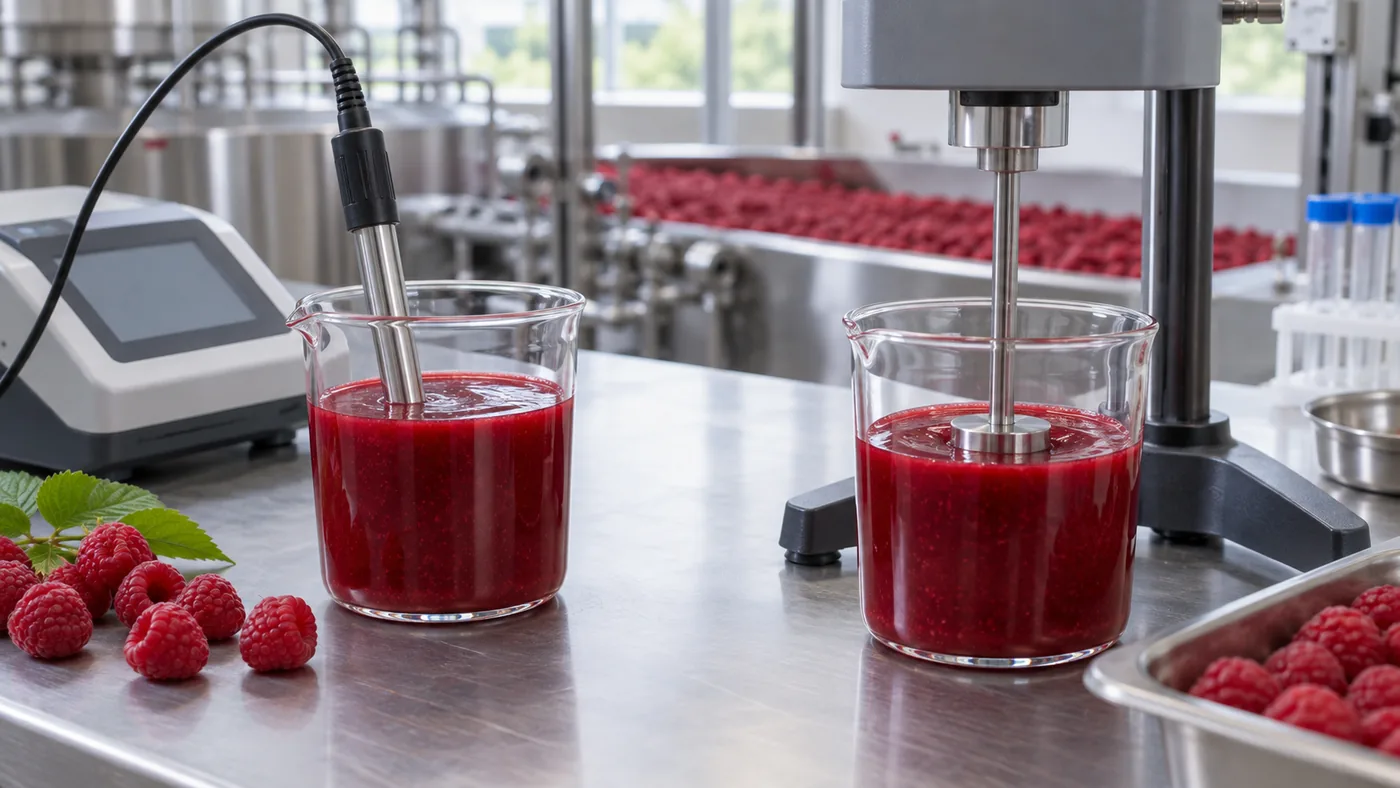
For flow, specify the measurement geometry, sample temperature, preparation, rest time and shear history. Fruit puree is not simply water with a flavor; pulp particles and structure can make measured viscosity depend on how the sample was stirred and how fast the instrument moves. Compare like with like. If a buyer wants to know whether a puree pumps through a line, an application trial at the relevant temperature and solids content may be more informative than a single laboratory reading under an unrelated method.
Avoid causal shortcuts. Suppose a batch has a higher apparent viscosity and more foam than a reference. Air may influence the reading, but a change in solids or particle size can also affect both the measurement and how bubbles persist. Take separate aliquots for density, dissolved oxygen and viscosity where the methods require different handling. Record the sample sequence; measuring viscosity after vigorous mixing and oxygen after a long rest creates a misleading comparison.
The cleanest report has separate rows for visible foam, entrained-bubble observation, dissolved oxygen, density or volume-to-mass relation, viscosity method and actual fill mass. Include handling state and time for each row. That format helps procurement ask the right supplier question. "Air is high" is too vague to negotiate; "net fill mass varies after a specific transfer while settled density and incoming solids remain within the agreed range" points to a narrower process investigation.
Solids deserve their own measurement when the claim concerns consistency. A lower Brix or different insoluble pulp fraction can change flow independently of air. If a puree is separated after thaw, the top and bottom aliquots may differ in solids even before a filler introduces bubbles. Sample and mix according to a documented method, then report the actual temperature, Brix and relevant pulp condition beside rheology. A supplier cannot investigate a "thin puree" complaint reliably if the test cup came only from the watery top of a partially thawed pack.
Test one handling change at a time
If the handling map suggests air was introduced after thawing, run a controlled small comparison with the processor's equipment and food-safety guidance. Keep puree lot, initial state, mass, vessel, temperature and endpoint the same. Change one factor, such as pour height, mixing intensity, transfer route or rest interval. Observe foam, measure the relevant oxygen or density endpoint and record filling behavior. Repeat enough to distinguish a stable pattern from ordinary operator variation.
Do not assume that the intervention with the least visible foam is automatically best. More rest time may change temperature or expose product longer. Gentler mixing may leave pulp uneven. A process that gives a stable fill may alter aroma or color. If the application is a beverage base, texture and flavor may matter more than a small temporary foam layer. If it is a tight volumetric fill, bubble persistence near the nozzle may be the central problem. The acceptance metric follows the application.
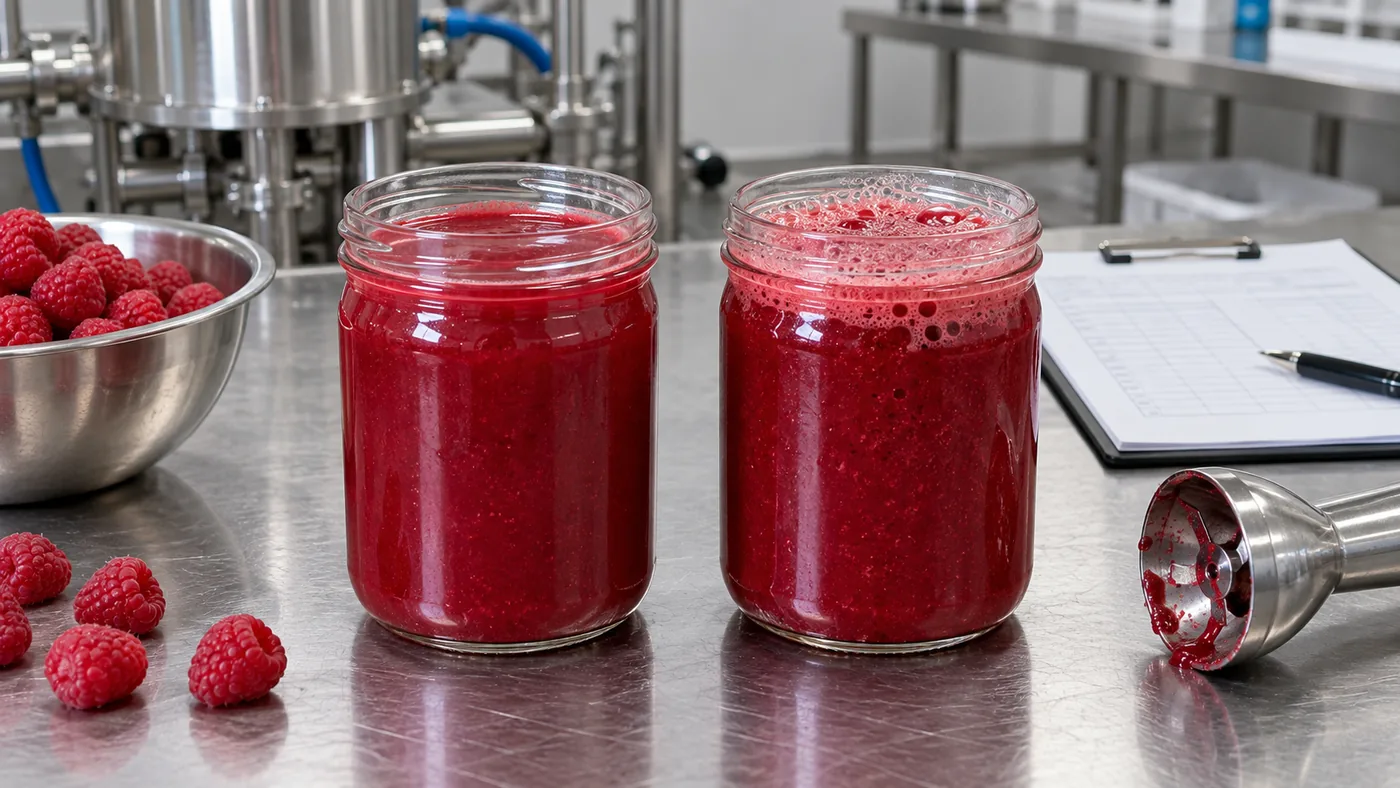
Some operations use deaeration, but there is no single transferable setting for all fruit purees. Viscosity, pulp loading, aroma retention, equipment and packaging differ. This article does not recommend a vacuum level, temperature or residence time, and it does not claim GreenLand offers a particular deaeration process. Any equipment change should be designed and validated by the processor with the relevant manufacturer and quality team.
Choose an intervention that can be adopted on the real line. A laboratory may eliminate foam by pouring slowly into a wide open beaker, but the plant may use a closed high-throughput transfer and cannot reproduce that gentle path. Test the plausible change at representative shear and head pressure. Where a hold period is proposed, evaluate microbiological and quality implications under the processor's own controls. A handling trial is useful only if the resulting procedure can be documented and maintained in production.
The paired jars shown here illustrate a way to keep handling comparisons visible. They do not show a measured benefit or an approved production method. A real trial should use blank-coded samples when a sensory judgment might be biased by knowing which jar was handled more gently. Record the adverse outcomes as carefully as the improvement you hoped to see.
Write an acceptance rule for the property that matters
Finish the investigation by naming the decision parameter. If net fill mass is the business risk, specify the net-content and process controls appropriate to the market and package. If oxidation is the risk, define an oxygen method and the time and place of sampling. If the puree must pass through a pump or depositor, specify flow behavior under a reproducible condition or an application trial. If consumer-visible foam in the final pack is the concern, define when appearance is judged after filling and resting. One catch-all "air content" number cannot replace all of these.
The supplier agreement can then state the puree form, pack and thaw conditions, sample preparation, measured endpoints and how a failed or borderline result is resolved. Keep the incoming frozen reference and the post-handling sample as separate identities. This makes it possible to distinguish supply variation from a problem introduced in the buyer's transfer or fill line. Use photographs as supporting records, paired with mass and method data.

For repeat shipments, decide where routine sampling stops and exception testing begins. It may be sensible to check incoming pack condition and a defined thawed appearance routinely, then run oxygen or detailed rheology tests when a trend or application problem appears. The appropriate frequency depends on risk and the agreed commercial specification. If the product will be blended with other fruit or heat processed later, the acceptance focus may differ from that of a chilled drink that exposes every color and flavor change. A proportional plan keeps the data actionable and avoids testing a parameter merely because an instrument is available.
When a complaint is raised, preserve the chronology. Save the unopened reference pack, a post-thaw aliquot prepared under the agreed method, and a line sample from the point where the issue appeared. Record the time and temperature for each. If only the final foamy cup survives, neither party can tell whether the bubbles arrived with the supply or formed during handling. This simple three-point record often narrows the investigation faster than a broad request for every possible laboratory parameter.
We can review frozen fruit puree supply for your filling or formulation process with your team. Send the fruit type, pack format, thaw and transfer steps, fill method and the actual symptom you need to control. As a frozen fruit supplier, we can align the incoming sample and product specification with that decision; we would not treat a foam photograph as a dissolved-oxygen certificate.
When asking for a corrective action, name the stage at which the property leaves its agreed range. If an incoming pack passes the defined reference test but the line sample fails after pumping, a joint process trial is more informative than asking the supplier to change its entire recipe. If the incoming reference itself fails repeatedly under the same method, the supplier has a concrete lot and measurement to investigate. This stage-based description shortens the loop between procurement, quality and production.
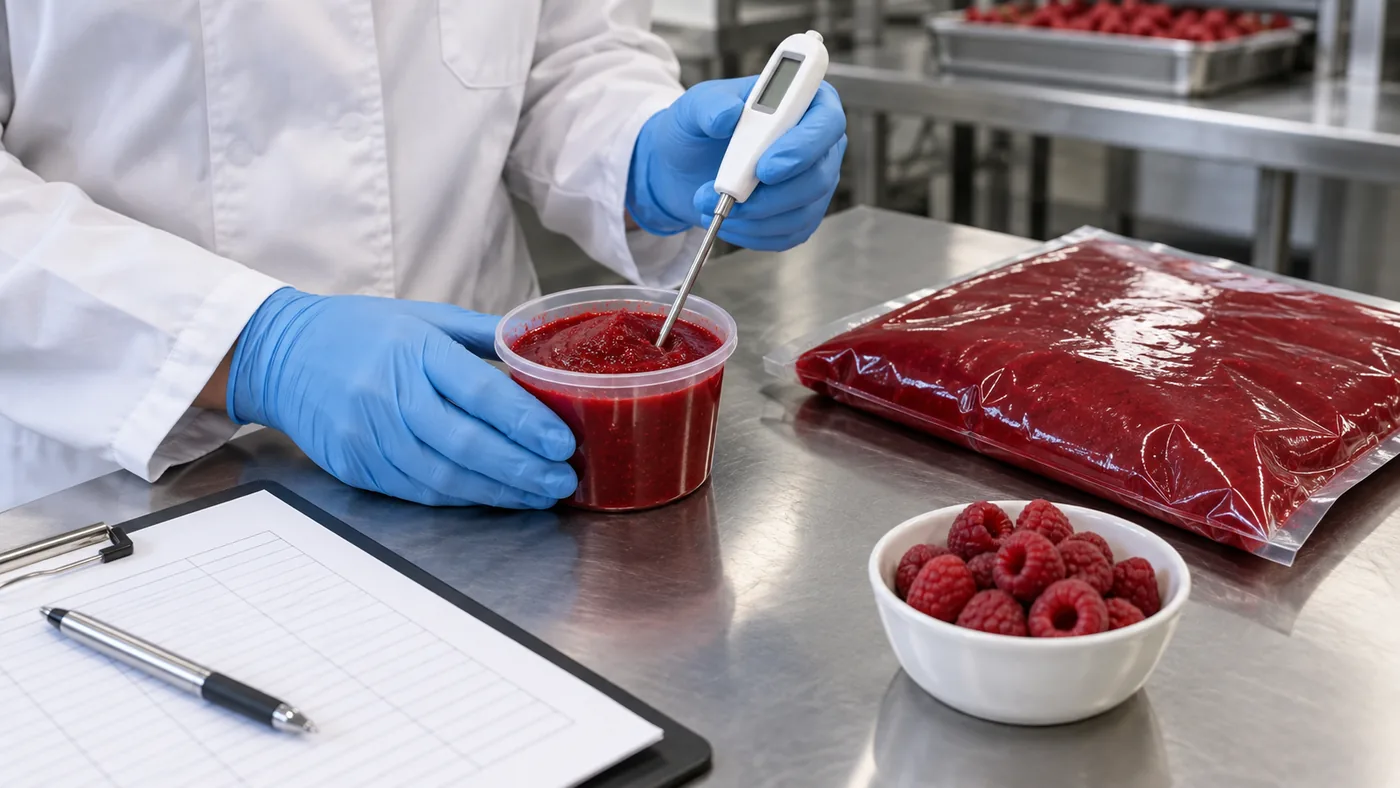
Questions buyers ask
Does visible foam prove high dissolved oxygen? No. Foam shows free gas bubbles at the surface. Dissolved oxygen requires its own measurement under a stated sampling method.
Can a foamy puree appear full but be underweight? It can, because gas contributes apparent volume without equivalent puree mass. Verify the actual net fill mass under the line's control method; do not infer compliance from the image or cup level.
Why do two laboratories report different viscosity for the same puree? Temperature, shear history, thaw uniformity, sample preparation, entrained bubbles and instrument method can all matter. Align the method and compare representative aliquots before attributing the difference to the lot.
Should we ask for a deaeration setting in the purchase order? Start with the property your application needs and evidence that the incoming material meets it. A processor-specific deaeration setting requires equipment and product validation; a generic number would be unreliable.
Sources: Tetra Pak Orange Book, Oklahoma State filling guidance and the Brookfield viscometer manual. Their contexts differ from the illustrative raspberry-puree trial described here.
Source frozen fruit with GreenLand-food
GreenLand-food is a professional frozen fruit supplier and manufacturer in China, providing factory-direct wholesale supply for importers, food manufacturers, foodservice distributors, and private-label programs.
Send the product form, specification, packing, quantity, application, destination, private-label needs, and requested documents.