


Do Wild Blueberries Need to Be Organic? What Buyers Should Check
Sep 20, 2026
Leave a message

For a household purchase, the choice may come down to preference, availability and price. For an importer, food manufacturer or private-label buyer, the consequences are more specific: the fruit must match the product description, the destination market's requirements and any claim on the finished pack. Paying for an organic program makes sense when that verified attribute serves the product. Paying for the word "wild" as if it were equivalent evidence does not.
The most useful purchasing approach is to keep five questions distinct: what berry is being supplied, where and how it was grown, whether its organic status is valid, what the relevant test evidence establishes, and whether the delivered lot performs in your application. One attractive photograph or certificate cannot answer all five.
Wild describes the blueberry crop
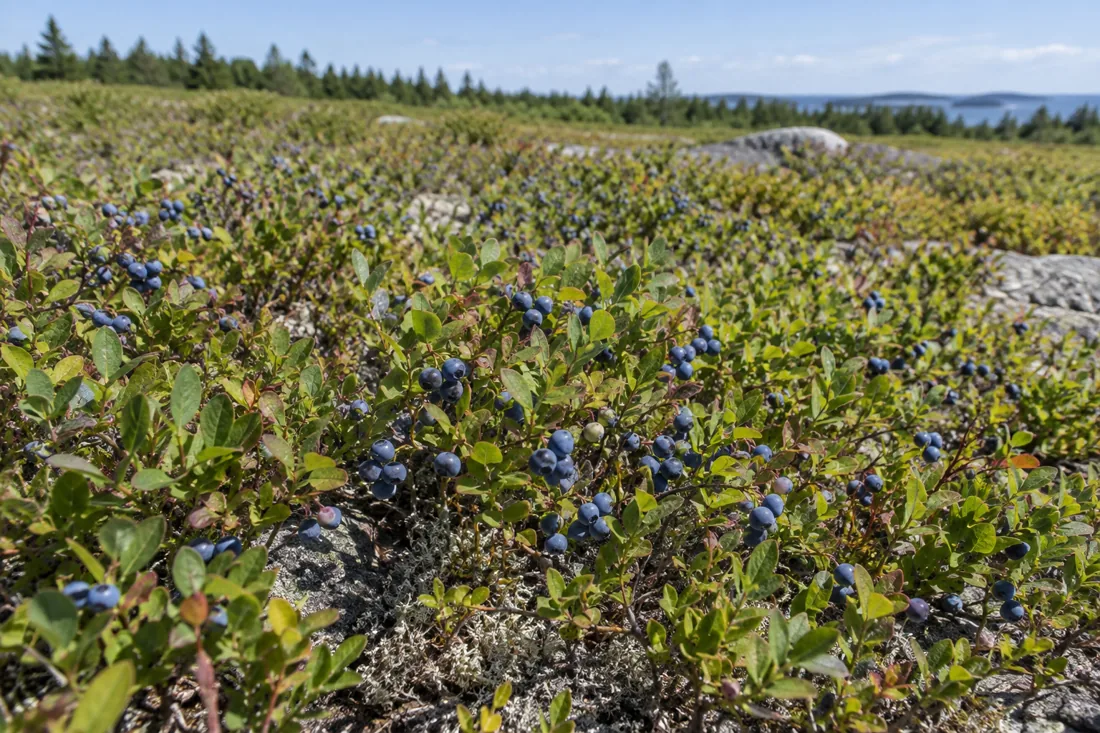
Commercial wild blueberries commonly come from managed lowbush blueberry stands rather than the taller planted bushes associated with many cultivated blueberry programs. The fruit grows close to the ground, often within naturally established patches. That botanical and production context helps explain the term "wild," but it does not mean that people simply walk into an untouched forest and collect every commercial shipment by hand.
Managed stands can receive substantial agricultural attention. Weed management, insect monitoring, pollination, pruning and harvest practices influence the crop. The Canadian lowbush blueberry crop profile describes this production context, while university research examines practical management challenges. A buyer should therefore avoid treating "wild" and "unmanaged" as interchangeable descriptions.
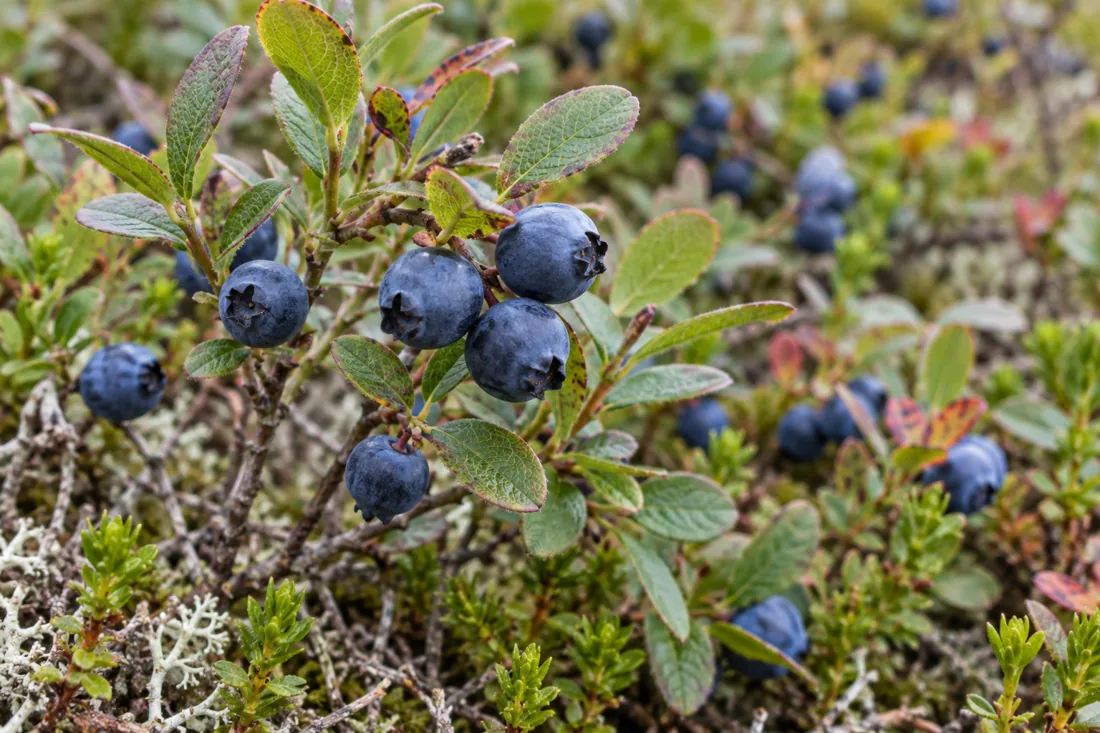
Illustrative close view of low-growing blueberry branches and small berries; verify commercial identity through the specification.
The distinction matters when someone makes a broad claim such as "wild blueberries never need pesticides." Commercial production is more varied than that sentence allows. A grower may use cultural controls, permitted crop-protection inputs or another management program according to the operation and applicable rules. Whether a particular lot is organic requires its own evidence; the low growth habit of the plants is not that evidence.
Product identity also deserves more attention than berry diameter alone. Wild blueberries are often associated with smaller fruit and a strong color contribution, but natural variation and grading mean that size is not a dependable certification test. Small cultivated berries do not become wild because they fit through a particular screen. Similarly, a photograph cannot reliably establish species, origin or the production system of the fruit in a shipment.
Ask the supplier to state the commercial product identity, relevant botanical identity where required, country or region of origin, crop year and form. For frozen fruit, clarify whether the specification is whole IQF berries, a graded fraction, broken fruit or another preparation. These details belong in the product description independently of any organic declaration. They also help prevent a sample discussion from drifting into a different fruit program at the quotation stage.
At GreenLand, our frozen blueberry product information distinguishes the established cultivated blueberry reference from wild blueberry inquiries that need separate origin and availability confirmation. A cultivated product photo in this article illustrates a supply format only. It is not evidence that the pictured berries are wild or certified organic, and it should not be reused on a label to imply either attribute.
The practical first decision is therefore simple: confirm that you want wild blueberries for a specific flavor, color, size distribution or label description. Then decide whether an organic claim is also required. Keeping those decisions separate makes the next document request much clearer.
What organic certification establishes
Organic certification is a defined production and handling system, not a synonym for "natural." Its exact requirements depend on the market and program involved. For the United States, the USDA organic basics describe a regulated system covering production practices and handling. A buyer using the USDA organic claim needs evidence that the product and relevant operations fit that system, not merely a supplier's informal assurance.
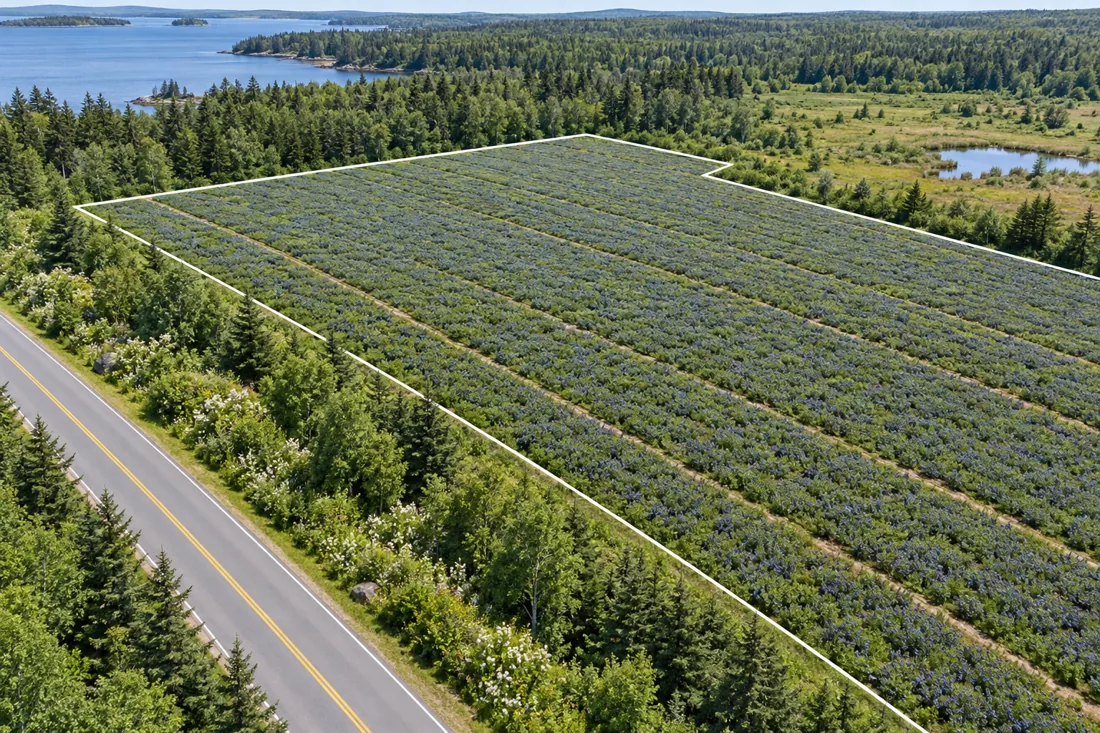
Illustrative harvest-area boundary. This is not a certified farm map or evidence of a particular organic operation.
Wild-crop harvesting also has specific requirements. USDA guidance on wild crop harvesting addresses matters such as the defined harvest area, land history and a harvesting approach that maintains the natural resource. It should not be read as a shortcut that makes every lowbush blueberry field automatically eligible. The appropriate classification and certification scope must be established for the actual operation.
For a buyer, the certificate is a starting document. Check the named operation, certifier, current status and the scope or product listing that covers the blueberries being offered. The name on the certificate may legitimately differ from the trading company's name, but that difference needs an understandable, documented supply-chain relationship. A certificate from an unrelated grower does not establish the status of a trader's entire inventory.
Do not stop at a scanned logo or a cropped certificate image in a brochure. Request a complete, readable document and use the relevant certifier or official database where available to verify status. Confirm that the document is current for the transaction, that any annex is included and that the product is actually covered. An impressive certificate with the wrong scope is not improved by a high-resolution scan.
Organic handling matters after harvest. Freezing, storage, repacking and shipment can introduce different operations into the chain. Ask how organic lots remain identified and separated from non-organic fruit, and which certified or otherwise appropriately covered operators handle the product. This is particularly important when a supplier offers both conventional and organic fruit in similar cartons or from the same warehouse.
The document set also depends on the destination. USDA's international organic trade guidance explains the electronic NOP Import Certificate requirement for organic imports into the United States and the role of trade arrangements. Do not assume that a certificate acceptable in one market automatically supports the same claim in another. Confirm the current transaction requirements with the appropriate certifier and import compliance team before shipping.
None of this means every purchaser needs to become a certification specialist. It means the purchase specification should name the intended organic market and claim, and the supplier should provide evidence that can be checked against them. When the documents do not align, pause the organic claim rather than filling the gap with the word "wild."
Why pesticide claims need separate evidence
"Organic," "no pesticides used," "no detectable residues" and "complies with the destination's maximum residue limits" are different statements. They need different evidence and should not be merged into a single marketing phrase. Organic systems restrict and regulate inputs, but an organic claim is not a universal analytical promise that every conceivable pesticide residue will be absent from every sample.
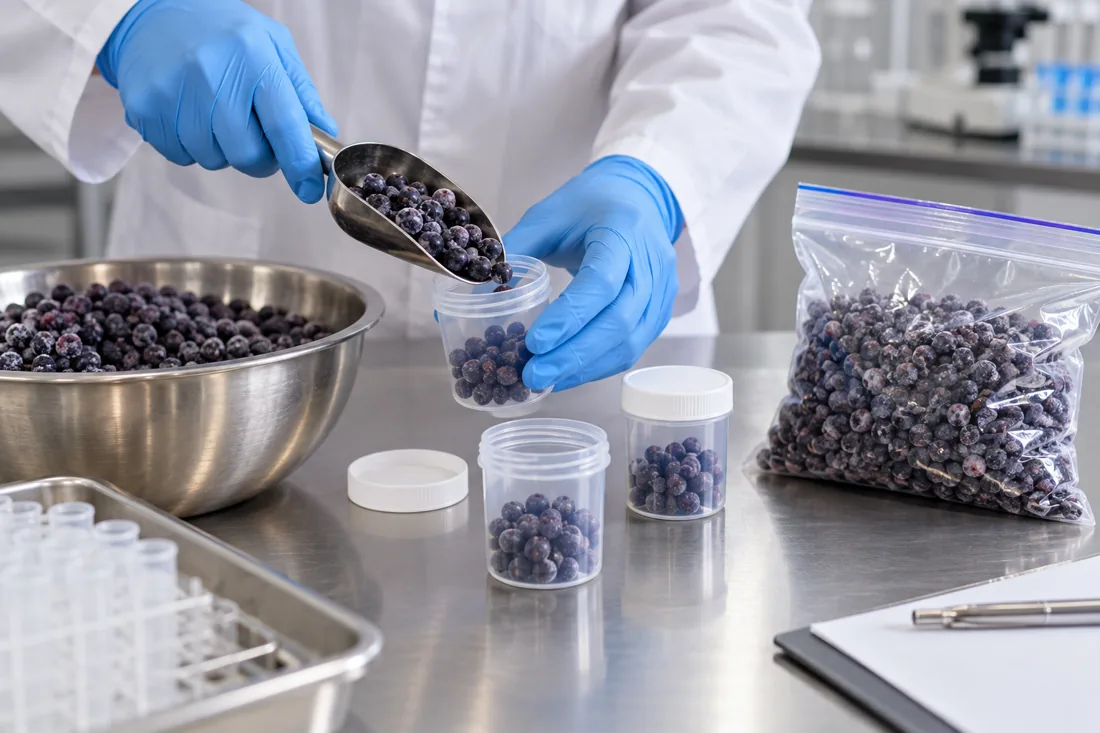
Illustrative sample preparation, not a GreenLand laboratory or a test result. Analytical scope and lot identity still need review.
The University of Maine's wild blueberry insect management guide discusses cultural and chemical management options and cautions about export residue limits. Its existence is a useful corrective to the assumption that commercial wild blueberries are necessarily untreated. It does not tell you which treatment was used on your supplier's lot; that still requires operation-specific records or relevant testing.
A laboratory report answers a narrower question than a production certificate. It describes the sample submitted, the analytes included, the methods used and the results within the method's limits. A result reported as not detected means not detected under those analytical conditions. It does not mean that the laboratory tested every possible substance or established a permanent characteristic of every lot from that origin.
Check the sample identity carefully. The report should relate to the product and lot you are evaluating, or the supplier should explain the sampling program and what broader inference is justified. A report for an earlier crop, another factory or a generic product sample can have background value, but it should not be presented as if it directly tested the container being shipped. Keep that distinction visible in the approval file.
For a destination-market compliance review, the relevant residue limits and analyte scope matter as much as the presence of a laboratory letterhead. Ask your technical team or qualified service provider to determine the appropriate requirements. A report interpreted for one market may not settle compliance in another, and a long list of tested substances may still miss the substances relevant to the production program or customer specification.
Production records can answer a different question: which inputs were used, when, where and under what program. The organic wild blueberry research at Dalhousie illustrates why weed control is a real management problem even in native stands. That context supports asking specific questions about the system, not assuming that the crop has no management needs.
Avoid suggesting that washing or freezing will convert a non-compliant lot into an acceptable one. Neither is a substitute for the required sourcing and compliance evidence. Likewise, a low residue result does not create organic certification retrospectively. For a conventional product, an appropriate residue-compliance program may be the relevant requirement. For an organic-labeled product, organic status remains necessary in addition to whatever testing and food-safety controls your specification requires.
Read the documents through to the delivered lot
A successful document review connects the production claim to the fruit that arrives. That connection is often more demanding than collecting a certificate, test report and packing list in the same folder. The documents need compatible identities, dates, quantities and lot references, with a clear explanation whenever a product is repacked or a lot number changes along the route.
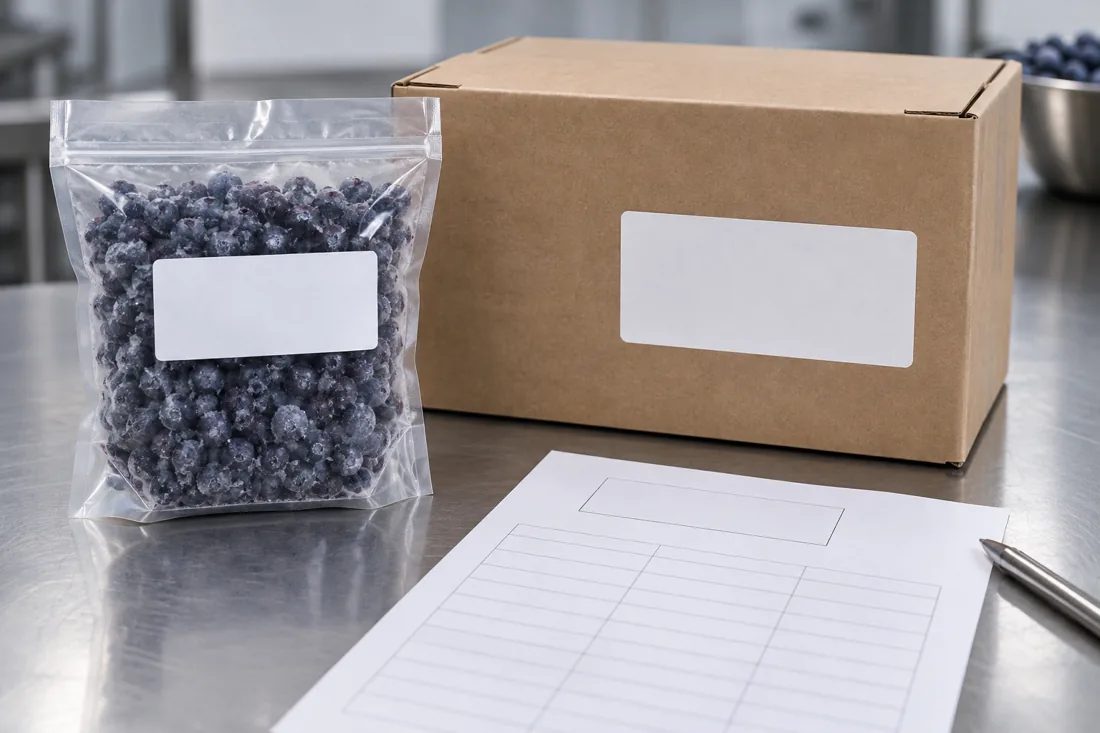
Illustrative sample-to-carton relationship. Blank labels are not certification or transaction documents.
Start with the quoted product description. It should say whether the fruit is wild or cultivated, organic or conventional, and which frozen format and origin are being offered. Compare that description with the sample label and specification. If the sample says cultivated blueberries while the quotation says wild blueberries, resolve the discrepancy before evaluating texture or flavor. A good tasting result cannot repair an uncertain product identity.
For an organic purchase, connect the named certified operation and product scope to the seller and handling chain. Then connect the shipment or transaction documents to the cartons and lot codes. Depending on the destination and transaction, the required evidence may include an import certificate or other official documentation. The exact set should be confirmed for the order rather than copied from a previous shipment with different parties or a different market.
The MOFGA blueberry recordkeeping checklist is a useful illustration of the records behind an organic crop program: field information, inputs, harvest and sales records all contribute to traceability. A buyer does not necessarily need every farm record in an unrestricted folder, but should understand what records exist and how the supplier can substantiate the lot's status when requested through the appropriate process.
- Match the product identity and organic requirement in the inquiry, quotation and specification.
- Verify the relevant certification status and product scope through an appropriate current source.
- Review the handling chain and the transaction documents required for the destination.
- Match sample, laboratory and shipment references to the lot or explain the documented sampling relationship.
- At receipt, compare carton labels, lot codes, quantities and condition with the approved documents before releasing the product for the intended claim.
This sequence also exposes ordinary administrative errors before they become label problems. A misspelled operation name may be easy to clarify; a missing handler or incompatible product description may require a more substantial review. Treat discrepancies in proportion to their significance, but do not silently correct a supplier document yourself and assume the underlying issue has disappeared.
Keep a record of the approval decision and any limitations. For example, a conventional lot may be acceptable for a non-organic bakery product even if it cannot serve the originally proposed organic line. That is a new, explicit use decision, not a reason to retain the organic claim. Clear separation protects both the buyer's finished product and the integrity of the supplier conversation.
Keep food safety and frozen quality in the purchase decision
Organic status does not remove the need for a food-safety assessment. Neither does wild origin. Frozen blueberries remain a food ingredient with a defined intended use, handling instructions and supply-chain controls. Ask whether the product is intended for a cooking process or another specified use, and make sure the supplier's information matches the way your operation plans to serve or process it.

GreenLand cultivated blueberry product photograph. It is a frozen-form reference, not evidence of wild identity or organic certification.
Freezing is a preservation step, not a blanket guarantee that pathogens have been eliminated. Do not assume that a fruit suitable for baking is automatically approved for an uncooked application. If you need a ready-to-eat use, raise that requirement directly and review the appropriate product-specific evidence with your technical team. An organic certificate cannot answer that question for you.
Cold-chain condition also deserves a separate review. Examine packaging integrity, lot identification and the product's condition under your receiving procedure. Excessive clumping, visible thawing or damaged packaging should trigger the appropriate investigation. These observations do not by themselves prove a particular safety outcome, but they can reveal a mismatch between the agreed frozen handling standard and the delivery.
For quality, define the attributes that matter in your recipe. Whole-berry appearance may be critical for a topping; color release and distribution may matter more in a muffin; seed perception and flavor balance may matter in a purée. Test the actual form you intend to buy. A visually attractive whole-fruit sample can conceal a poor fit for an application that demands a specific size distribution or controlled broken-fruit fraction.
Evaluate flavor and performance after the same preparation your production line will use. If the berries enter a batter frozen, test them frozen. If your process includes a controlled thaw, use that procedure and assess the released liquid as part of the recipe. Otherwise, differences in sample handling can be mistaken for differences between organic and conventional production.
The real GreenLand product photograph beside this section shows a cultivated blueberry supply reference. It is included to make the frozen form and sample discussion concrete, not to certify a wild or organic program. We would need to confirm the relevant identity, origin, certification scope and availability before representing a specific lot as organic wild blueberries.
Keep your approval categories separate in the sample report: identity, organic documentation where required, food-safety suitability, residue evidence, frozen condition and application quality. A pass in one category should not automatically fill the others. This structure is useful even for a small buyer because it prevents a strong taste preference or an attractive origin story from displacing an unresolved technical requirement.
Compare organic and conventional purchasing programs
The better purchasing program is the one that supports the finished product's actual requirements. If the finished pack carries an organic claim, conventional fruit is not a like-for-like substitute. If the finished product makes no such claim, you can compare the programs on verified attributes, application performance, availability and total cost without suggesting that one label alone settles every quality or safety question.
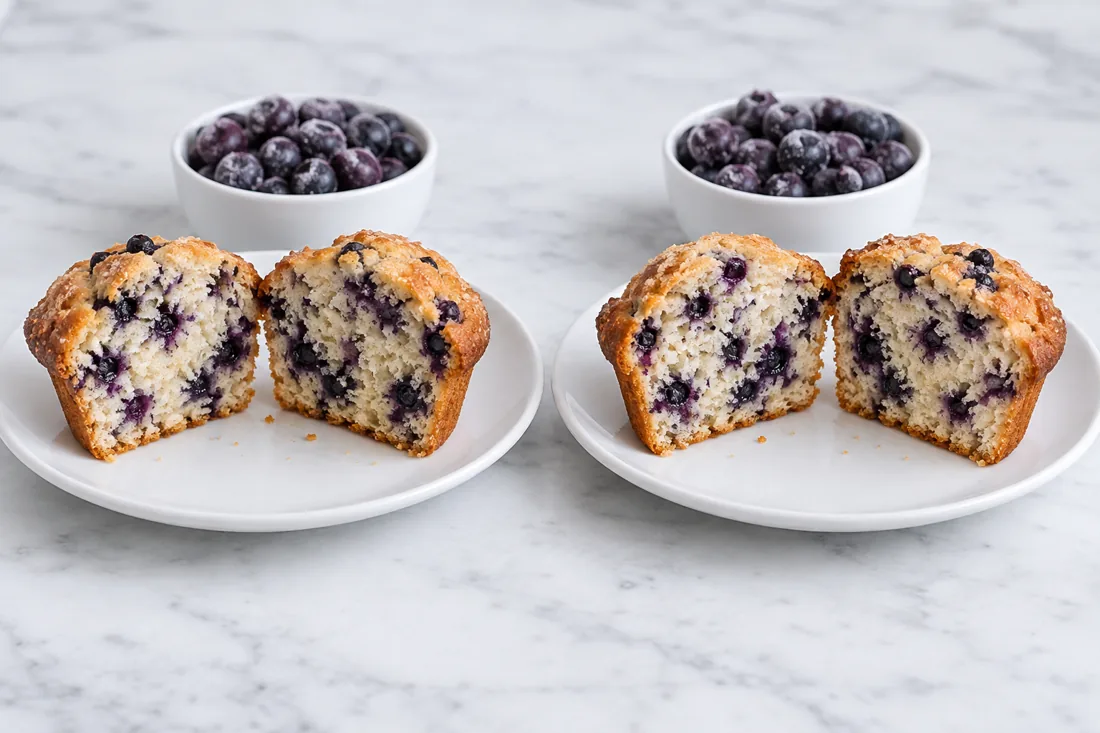
Illustrative bakery trial: compare berry distribution in the finished food separately from the certification review.
| Purchasing question | Organic wild blueberry program | Conventional wild blueberry program |
|---|---|---|
| Can it support an organic claim? | Only with valid, applicable certification and transaction evidence | No; wild identity does not create organic status |
| Is wild identity still necessary? | Yes, verify the crop and origin separately | Yes, verify the crop and origin separately |
| Is residue review still relevant? | Yes, according to market and customer requirements | Yes, according to market and customer requirements |
| Must application performance be tested? | Yes, using the actual form and process | Yes, using the actual form and process |
| Can supply be assumed interchangeable? | No, certification, handling and availability need confirmation | No, cut, grade, crop and lot still need confirmation |
Compare quotations on the same commercial basis. Pack size, net weight, grade, origin, crop, delivery terms and required documentation can all change the offer. A lower unit price may cover a different berry identity or a different broken-fruit allowance. A higher price may include a required certified handling program but does not automatically promise better flavor in your recipe.
Plan substitutions before they become urgent. An organic brand may need a separately approved backup organic program rather than a conventional replacement. A conventional product may have more sourcing flexibility but still need the same sensory and processing performance. Write down which attributes are mandatory and which can vary with approval. That makes a supply interruption easier to manage without an improvised label decision.
Availability should be discussed in concrete terms: expected volume, shipping window, crop planning and the number of approved sources. Do not ask a supplier simply whether organic fruit is "available" and treat an affirmative answer as a reservation for an unspecified future quantity. Request confirmation against the actual order or planning period, including any conditions that could affect fulfillment.
Application trials should be blind to the claim when practical. Give the kitchen or development team comparable coded samples and evaluate the attributes that matter in the finished food. Review the certification and commercial documents separately. This does not diminish the value of organic production; it prevents an expected label preference from being mistaken for demonstrated sensory performance.
Finally, consider the cost of maintaining the claim inside your own operation. Receiving checks, identification, segregation, recordkeeping and label control may matter as much as the price difference between bags. The procurement decision is stronger when the commercial team and the technical team agree on the same intended product rather than optimizing different versions of it.
Prepare an inquiry that can be answered accurately
A useful inquiry begins with the finished application and destination market. Say whether the berries are for muffins, yogurt preparation, a cooked sauce, an uncooked use or another process. State whether an organic claim is mandatory, optional or not required. If it is mandatory, identify the relevant market or certification expectation so the supplier can assess the correct program instead of sending a generic certificate.

A second GreenLand cultivated blueberry product photograph. Confirm any proposed organic wild program independently.
Include the required berry identity and form. For wild blueberries, ask for the origin and crop information to be confirmed, along with whole-fruit or other format, size expectations and any acceptable broken-fruit allowance. If you are open to cultivated blueberries as a separate option, say so explicitly. Do not allow the two products to become interchangeable in the quotation merely because both are called blueberries.
Give the expected order volume, pack size, shipment window and destination. Add any laboratory, microbiological, residue or customer-specific documentation requirements your technical team has established. These details let the supplier identify genuine gaps early. A request for "all certificates" is less useful than a short list tied to the product, market and intended claim.
For samples, agree what they represent. Ask whether the sample comes from the proposed lot, a current representative lot or an earlier reference lot. Record how it is packed and shipped and how you should store it before testing. If the final order will use a different crop or source, define what needs to be reapproved rather than treating one historic sample as a permanent guarantee.
We can review a blueberry inquiry and confirm which product, origin, packing and supporting documents are available for the requested program. We do not use a cultivated blueberry photograph, a general supplier profile or the word "wild" as evidence of organic certification. Any organic wild offer needs its own specific confirmation.
The final purchasing answer is therefore conditional but clear: wild blueberries need to be organic when your intended claim or customer specification requires a verified organic product. Otherwise, choose on the attributes you actually need and verify them individually. That approach leaves room for both conventional and organic programs while avoiding claims that neither the fruit's growing habit nor a single test report can support.
Source frozen blueberry with GreenLand-food
GreenLand-food is a professional frozen blueberry supplier and manufacturer in China, providing factory-direct wholesale supply for importers, food manufacturers, foodservice distributors, and private-label programs.
Send your required form and cut, pack size, expected quantity, application, destination, private-label needs and requested documents. For organic wild blueberry inquiries, we must separately confirm identity, origin, certification scope and current availability; cultivated product photographs do not establish that program.