


How to Cook Frozen Peppers and Onions Without Excess Water
Sep 20, 2026
Leave a message

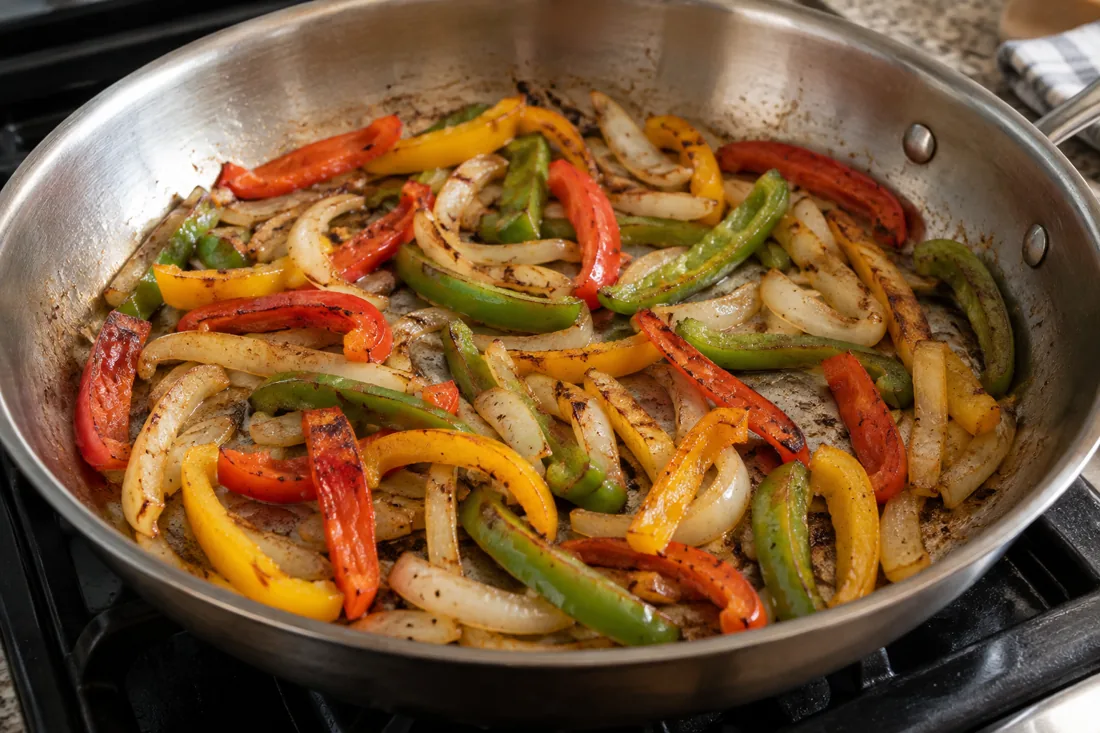
The important difference is between tender vegetables with a little surface moisture and vegetables sitting in a puddle. Frozen peppers will not regain the snap of freshly cut raw peppers, and that is not the target. For fajitas, sandwiches, breakfast fillings and many prepared meals, the useful result is separate, tender pieces with concentrated flavor and enough structure to portion cleanly.
This guide focuses on the cooking stage. If you are preparing your own freezer blend, our separate guide to freezing peppers and onions together covers that preparation. Here, the question is what to do with the frozen bag already in your kitchen, and how to make the same method repeatable in a larger operation.
Why the pan fills with water
Frozen peppers and onions bring water into the pan in several ways. Some is loose ice on the outside; some is moisture released from the vegetable as it heats. That release is expected. A little steam does not mean the product has failed, and it does not mean you need to thaw the entire bag before cooking. The practical problem starts when water arrives faster than the pan can evaporate it.
A deep mound of vegetables makes that imbalance more likely. The bottom pieces contact the pan, while the pieces above them cool the batch and trap moisture. Stirring can expose different surfaces, but stirring cannot create more cooking area. If every sweep of the spatula fills immediately with liquid, the batch is still in its evaporation stage. Adding more oil at that point makes an oily puddle; it does not remove the water.
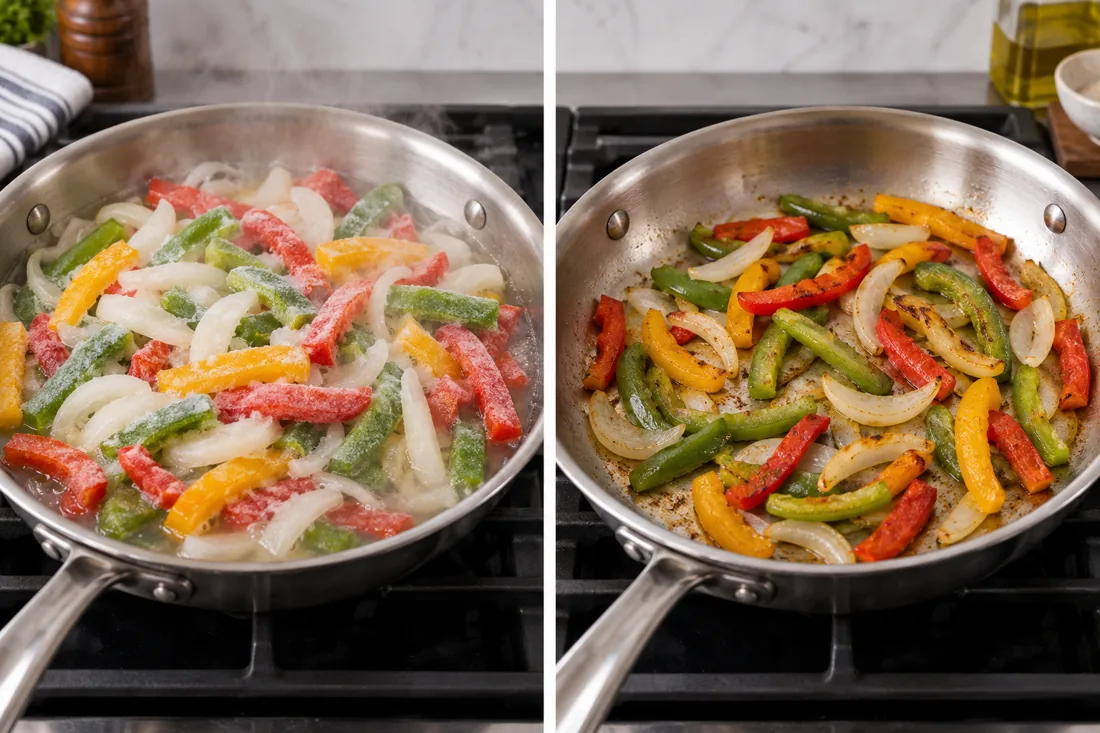
Illustrative comparison: pooled water in a crowded pan versus a shallower batch with exposed cooking surface.
Choose the widest appropriate pan your burner can heat effectively. A large pan on a much smaller burner can still leave cool, wet edges. Conversely, a small skillet on a powerful burner may scorch exposed fragments while the center remains wet. Match the equipment first, then choose a batch that sits loosely across the base. Some overlap is unavoidable with strips, but a tall pile is a useful warning that you need two batches.
A lid changes the job. It can help a product heat through when its directions call for covered cooking, but it retains steam and returns condensation to the food. If you need a dry filling, remove the lid for the evaporation stage after completing any required covered step. Do not treat steam trapped under a lid as evidence that browning is underway. Watch the exposed pan surface instead.
Loose crystals and a solid frozen block also deserve different handling. A free-flowing blend can be portioned directly. A bag frozen into a large mass may reflect compression or temperature fluctuation; investigate its storage history and follow the label rather than leaving it on the counter until convenient. Never strike a hard frozen block with a knife. For a kitchen trial, document clumping separately from the method, because an inconsistent frozen input can make the same written cooking instructions behave differently.
The endpoint is visible: the bubbling puddle recedes, the spatula leaves a temporarily clear track, and the sound changes from wet simmering toward a steadier sizzle. Those signs help you control texture. They do not replace any cooking time, temperature or handling requirement printed on the pack.
A reliable skillet method from frozen
Start with plain frozen vegetables and an uncomplicated test. A heavily seasoned sauce makes it harder to see when the water is gone, and a crowded mixed meal makes it harder to know which ingredient is causing the problem. Once the basic batch behaves well, add it to your usual recipe. Have a clean plate or shallow container ready so the first batch does not sit in the pan while you cook the second.
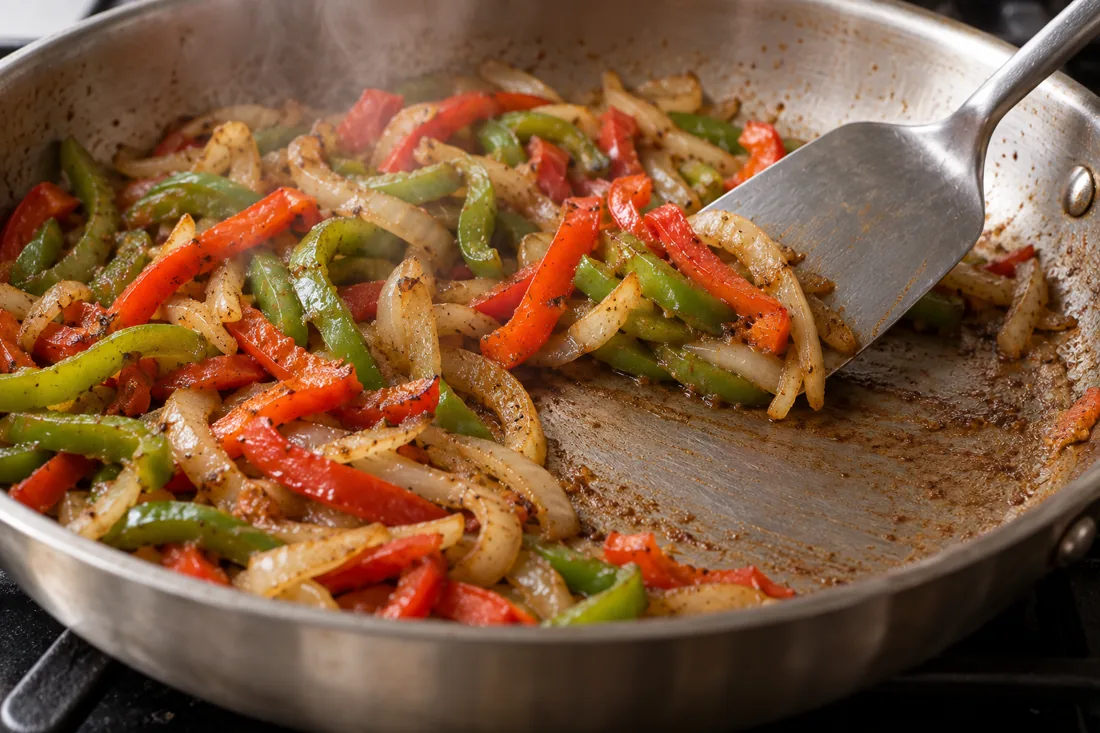
Illustrative cooking endpoint: a spatula reveals a dry track after the free liquid has evaporated.
- Check the package and choose the portion. Read whether the vegetables must be cooked from frozen and whether a specific final temperature is required. Remove only the amount you will cook and return the remaining bag to frozen storage promptly. Do not use this method to override directions for a seasoned, sauced or otherwise prepared product.
- Warm a wide skillet and add a thin coating of suitable cooking oil. Use a controlled medium to medium-high setting within the pan manufacturer's guidance. The pan should be ready to cook, not smoking. Add the frozen vegetables carefully; surface ice meeting hot oil can spit. There should be no deep pool of oil.
- Spread the blend into a shallow layer. Allow the initial steam to escape, then turn the vegetables with a broad spatula. Keep the pan uncovered unless the product instructions specify an initial covered step. Move pieces from a cooler edge toward the center when necessary, rather than repeatedly tossing the entire batch without checking the base.
- Continue until the product is properly cooked and the excess liquid has evaporated. Check a thicker onion or pepper piece, not only the smallest fragment. If liquid remains plentiful while the vegetables are already very soft, finish this batch gently and reduce the next batch size instead of turning the heat to its maximum.
- Let selected surfaces contact the now-drier pan briefly, then add the final seasoning. Remove the vegetables when they are tender and lightly browned to your preference. For a filling, check the liquid left on the plate after a short rest before deciding the method is finished.
As one product-specific reference, Wegmans' frozen pepper and onion blend gives a skillet method with oil, medium heat and a stated cooking endpoint. Its timing belongs to that product and portion. A different cut, pan, burner or frozen starting temperature can need a different time. Record how your batch behaves instead of promising that every bag is ready in the same number of minutes.
Do not keep the vegetables moving continuously once they are nearly dry. Brief, controlled contact helps develop color; constant stirring may keep the result pale. Equally, do not leave thin onion fragments unattended in a dry pan while waiting for large pepper pieces. If those two events regularly overlap, adjust the cut specification or separate the cooking stages. That is a more reliable correction than adding water and starting evaporation again.
Roasting, microwaving and simmering compared
The skillet is useful when you need close control over a relatively small batch. It is not automatically the best choice for every dish. A tray offers more exposed area, a microwave can heat a portion conveniently, and a simmering sauce can deliberately accept the vegetable liquid. Choose the method by the finished food, not by whether the vegetables started frozen.
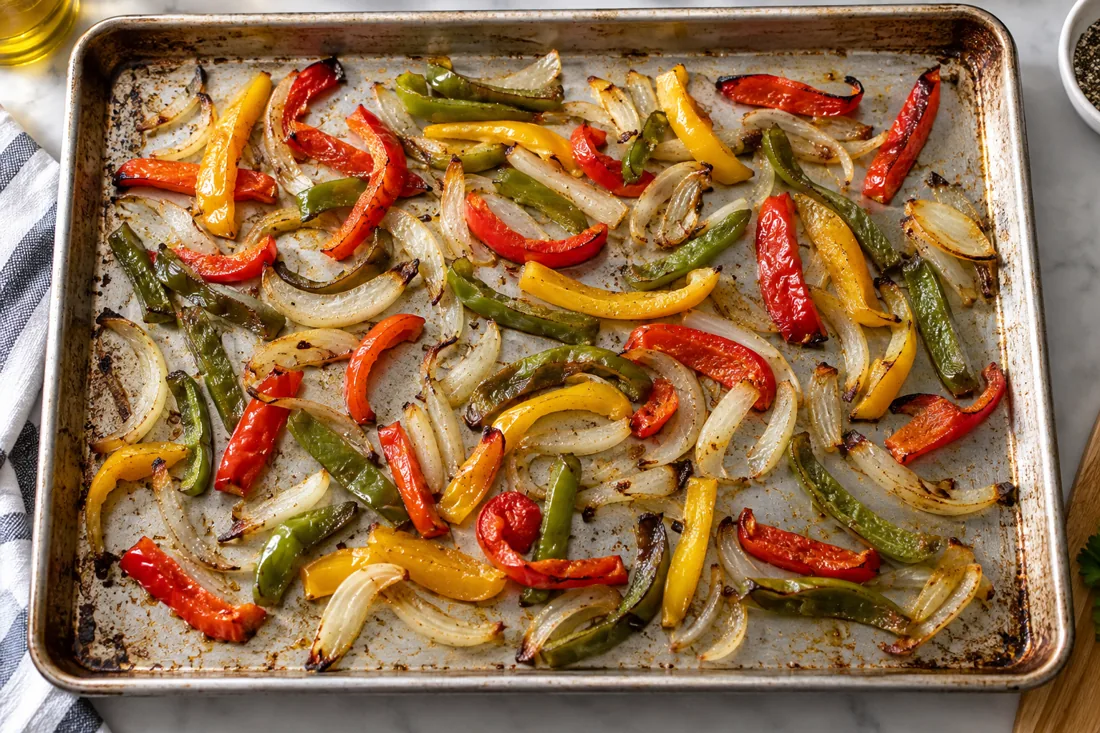
Illustrative roasting view: open tray space lets steam escape around the vegetables.
| Method | Useful finished result | Main moisture control | What to avoid |
|---|---|---|---|
| Wide uncovered skillet | Sandwich, fajita or breakfast filling with some browned edges | Shallow load and an evaporation stage before sauce | A deep pile that stays in a puddle |
| Open sheet tray | Larger batch of softened vegetables with roasted edges | Loose single layer, hot oven and room for steam to escape | Multiple crowded trays treated as one unchanged recipe |
| Microwave, following pack directions | Fast heated vegetables for a moist dish or a later pan finish | Appropriate container and draining when the recipe permits | Expecting direct-contact browning |
| Soup, stew or sauce | Tender vegetables integrated into a liquid base | Account for their released moisture in the recipe | Adding the full recipe liquid before seeing the final consistency |
For roasting, preheat the oven and use a rimmed tray with enough surface area for the portion. Toss the vegetables lightly with oil, spread them out and turn them as needed. A moderate-to-hot roasting setting commonly used for vegetables can work, but follow the bag's directions and your equipment limits. The tray should not be so full that you effectively create a shallow steaming dish. If liquid pools, separate the load across two trays rather than merely extending the time until all the onions are dark.
Tray position matters when scaling. An oven that cooks one tray well may behave differently with several trays blocking circulation. Rotate only as appropriate for the oven, and check different positions during a trial. The browned corner of one tray is not a reliable sample of the center of another. Also distinguish a convection oven from a still-air oven when recording a procedure; identical temperature settings do not guarantee identical drying behavior.
Microwaving is a reasonable option when browning is unnecessary. Use a microwave-safe container and the specified covering or venting method. If the vegetables will go into an egg filling, drain suitable excess liquid before combining, then complete the dish's cooking step. If they will go into soup, that same liquid may be part of the intended result. Draining is an application choice, not a universal requirement for every recipe.
For a simmered dish, add the frozen blend with enough cooking time for the vegetables and the whole dish to meet their instructions. Keep some of the recipe's adjustable liquid in reserve. You can add broth later more easily than you can remove it from a finished sauce without overcooking the vegetables. This is particularly useful when a new lot or a different pepper-to-onion ratio changes the amount of moisture you see.
Add seasonings and other ingredients at the right stage
The easiest way to lose moisture control is to add several wet ingredients at once. Frozen peppers, onions, mushrooms, raw meat and a cup of sauce do not all behave like one vegetable blend. Each contributes its own liquid and cooking requirement. The resulting puddle is often a sequencing problem rather than proof that frozen vegetables cannot be sautéed successfully.
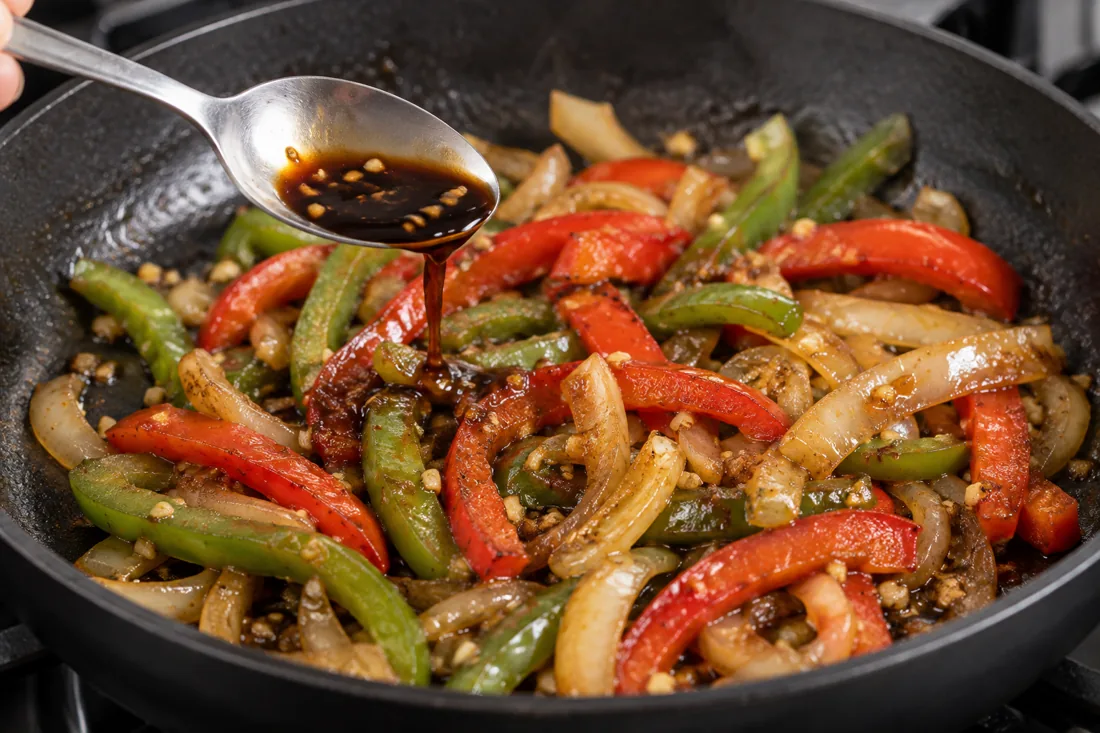
Illustrative finishing stage: a small sauce addition coats vegetables after the pan has dried.
For a meat-and-vegetable dish, follow a safe recipe for the meat, use separate utensils as necessary, and cook ingredients in stages when their requirements differ. Remove properly cooked meat to a clean plate while the vegetables finish, then combine and complete the dish appropriately. Do not place cooked food back on a plate that held raw meat. Vegetables that contacted raw meat juices must receive the cooking treatment required by the combined dish; a quick final toss is not an automatic safety step.
Garlic is usually easier to control near the end of the vegetable stage, once the pan is no longer flooded but before it is excessively dry. Give it enough contact to become aromatic without letting fine pieces turn bitter. Ground spices can also scorch on an exposed hot base. Reduce the heat when adding them if necessary, stir them through the oil and vegetables, and proceed promptly to the next step.
Salt belongs in a considered seasoning sequence. You can season during cooking, but do not assume that adding all the salt early will solve the water problem or that waiting until the end is a strict scientific requirement for every batch. The stronger practical reason to season toward the finish is control: the vegetables shrink, liquid evaporates and sauces may bring additional salt. Taste a properly cooked sample before making the final adjustment.
Add a small amount of sauce after the evaporation stage when you want coated, separate pieces. Stir until it clings, then judge whether another spoonful is needed. A watery sauce can put the pan back into a simmer; that may be appropriate for a rice bowl but less helpful for a sandwich. Thick sauces containing sugar can catch quickly on a dry, hot pan, so reduce the heat and do not chase extra browning after they are added.
Acidic finishes such as a little vinegar or citrus juice can brighten a cooked blend, but they also add liquid. Add them deliberately and taste the whole dish. For a tortilla filling, a spoonful may be enough; for a braised dish, a larger amount may belong in the recipe. Cheese, cream and other finishing ingredients have their own behavior, so establish the vegetable texture before asking them to rescue it.
Finally, consider the assembly surface. A dry-looking skillet mixture can still release moisture in a closed sandwich or a covered holding pan. Rest a small cooked sample briefly on the actual bread, wrap or plate used in service. If the base becomes wet, adjust the vegetable finish, portion size or assembly timing before changing the seasoning formula.
Choose cuts and blends for the finished dish
Cut geometry is part of the cooking method. Long pepper strips and sliced onions can make an attractive visible filling, but they do not portion like small dice. Dice distribute through omelets, sauces and rice more evenly; strips create a more distinct bite. Neither is inherently better. The useful question is whether the pieces cook and assemble consistently in your intended product.

GreenLand product photograph: green pepper cuts provide a reference for discussing cut geometry; the ordered cut needs its own specification.
Within a strip blend, look at thickness as well as length. A long thin pepper strip can soften quickly, while a shorter, thick-walled piece may still feel firm. Onion slices also separate into layers, changing their apparent size during cooking. A specification that only names a nominal length may leave an important source of cooking variation uncontrolled. Ask which dimensions are specified and what tolerances or distribution are available.
The pepper-to-onion ratio affects more than appearance. A blend with more onion may behave differently in sweetness, shrinkage and final portion weight. Different pepper colors also change the visual identity of the finished dish. A mixed-color frozen sample is not enough to establish the ratio throughout a commercial pack, so confirm the agreed composition and the sampling basis rather than judging one attractive handful.
For fajitas, choose pieces that remain recognizable after cooking and fit the tortilla without dragging out as one long strand. For pizza or a baked pastry filling, smaller pieces may distribute more evenly and need a drier preparation before assembly. For soup, visible browning may be unnecessary, and the released liquid may be useful. Write the finished application into the specification conversation; it explains why you care about the cut.
Our frozen pepper range and frozen onion range provide starting points for discussing component formats. A pictured product is a form reference, not proof that every mixed ratio or cut is available for every order. We confirm the requested combination, packing and supply arrangement against the actual inquiry.
Check whether the product is plain or prepared. Oil, seasoning, starch or sauce already present in a commercial blend can change the cooking instructions and the ingredient declaration. A recipe developed around plain IQF vegetables should not silently substitute a pre-seasoned product. The reverse substitution can also make an established recipe under-seasoned or alter its yield.
When comparing samples, use the same frozen input weight, equipment, oil addition and endpoint. Photograph the raw cut distribution and the cooked result, then record the usable weight. If one sample looks drier only because it was cooked much longer, the comparison has not isolated the product difference. Repeat the trial with a documented endpoint before deciding that one supplier's blend is inherently superior.
Scale the method for foodservice
Scaling is not simply multiplying a household portion and leaving the cooking time unchanged. A larger load changes how quickly equipment recovers heat and how freely steam escapes. The best starting point is a batch size that your chosen pan or tray can handle, followed by enough repeated batches to meet service demand. Increasing the depth of one batch is often the least controllable shortcut.
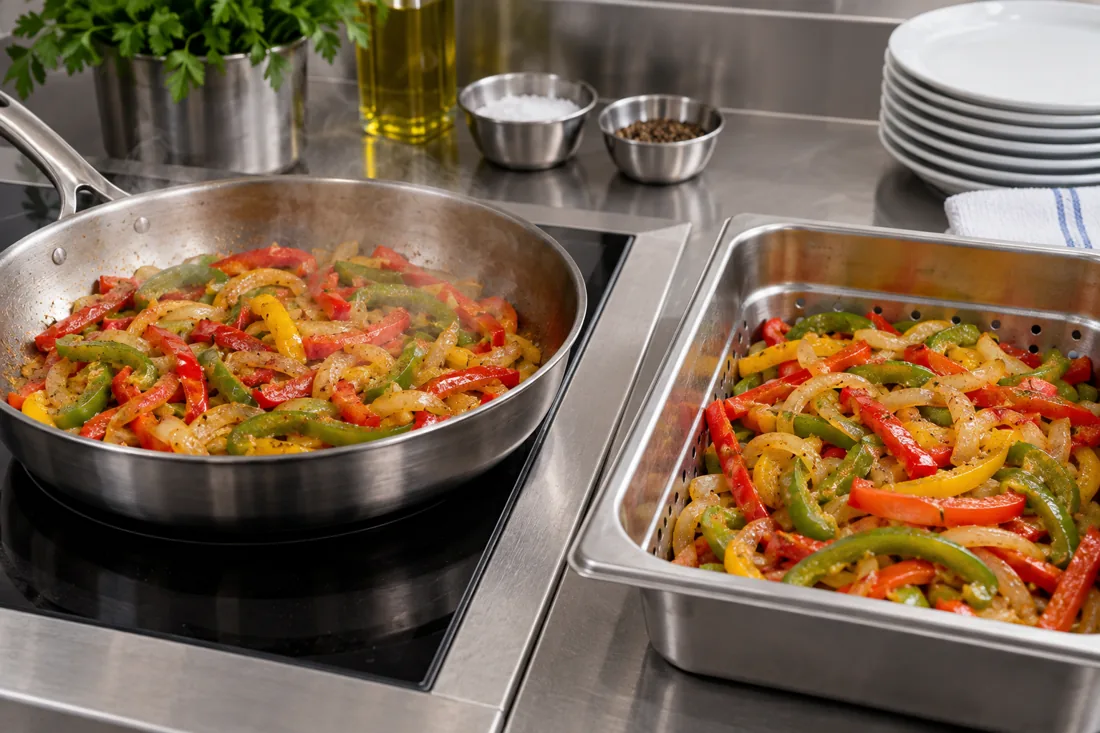
Illustrative foodservice setup: separate shallow batches make loading and portioning easier to compare.
Use frozen input weight and finished usable weight to understand yield. As an illustrative calculation, a 1,000 gram trial producing 720 grams of usable cooked vegetables has a 72 percent cooked yield. Those numbers are an example, not a GreenLand specification or a typical promise. Your actual result depends on the product, cut, equipment and desired dryness. A wetter yield is not automatically a better commercial result if it damages the finished sandwich.
Record the batch load, pan dimensions, heat setting, starting condition, oil addition and cooking endpoint. Also record how long the vegetables wait before portioning. These details make a trial reproducible without pretending that a burner dial number is a universal temperature. If different staff members obtain different results, compare their loading and endpoint first; minor differences in stirring technique are often less important.
Holding creates a second moisture test. Vegetables that leave the pan in good condition can soften further and collect condensation under a cover. Use your operation's approved time and temperature controls, and test the same covered or uncovered arrangement that service will use. Do not leave food at an uncontrolled temperature to keep it dry. Food safety requirements take priority over a preferred surface texture.
For a delivery meal or ready meal, evaluate the full route: cooking, portioning, packing, holding and reheating where applicable. A blend suitable for immediate fajita service may be too soft after a second heat treatment. That does not necessarily call for a different vegetable; you may need a different cut, initial endpoint or sauce addition. Make one controlled change at a time so the next trial answers a useful question.
Free-flowing product helps portioning, but bag handling still matters. Keep unopened stock at the specified frozen temperature, open only what the shift needs and protect remaining product from repeated warming. Use appropriate stock rotation and lot identification. If a trial bag has been repeatedly opened and handled, do not use its condition to represent a freshly received lot without noting that difference.
Finally, price the usable portion rather than the bag alone. Cooking loss, labor, equipment occupancy and waste all influence the result. A lower-priced product that needs an extra batch or produces an unacceptable wet filling may not meet your operational target. Conversely, a premium cut adds little value if the finished product deliberately blends the vegetables into a sauce.
Judge the cooked result and confirm supply
A useful acceptance standard describes what the vegetables must do in the dish. For a dry filling, you might require separate pieces, tender onion, recognizable pepper strips and no obvious puddle after a defined short rest. For a sauce, you might instead require even distribution and a softer bite. Avoid using the single word "good" as the sample result; it does not tell the next cook or the supplier what was approved.

GreenLand product photograph: sliced onion form for discussing a cooked blend, not a promise of a particular blend ratio.
Separate appearance, eating texture and process performance. Color and cut can be photographed, but tenderness needs an appropriate tasting assessment after safe cooking. Portioning and holding need a service trial. These observations can disagree: a visually attractive blend may release too much liquid for a pastry, while a less colorful blend may work perfectly in a dark sauce. Approve against the intended application.
If the pan remains watery, reduce the next load or provide more evaporation area. If small onion pieces burn before larger peppers soften, review cut compatibility and heat distribution. If the vegetables become mushy after holding, shorten the hold within the operation's approved system or reconsider the cut and initial finish. If the result is dry but flat-tasting, correct the seasoning; more cooking is unlikely to solve that problem.
Before requesting a repeat sample, send the conditions that produced the result. A photo of a wet pan is useful when it is accompanied by frozen input weight, pan size, approximate cooking time, whether a lid was used and when sauce entered the pan. Without that context, a supplier can see the outcome but cannot distinguish a product issue from an overloaded cooking method.
For a commercial inquiry, include the pepper colors, onion form, preferred cut dimensions, blend ratio, plain or seasoned status, pack size, destination market and expected quantity. Add the finished application and any sample acceptance criteria already established. If the product must match an existing label or recipe, share the relevant requirements before the quotation stage rather than discovering an ingredient mismatch after the sample arrives.
We can review a frozen vegetable supply request against those details and confirm the available product and packing options. Specific availability, documentation and delivery terms need order-level confirmation. The practical aim is a repeatable result: the kitchen knows how to cook the blend, and the supply specification describes the blend the kitchen has actually approved.
Source frozen vegetables with GreenLand-food
GreenLand-food is a professional frozen vegetables supplier and manufacturer in China, providing factory-direct wholesale supply for importers, food manufacturers, foodservice distributors, and private-label programs.
Send your required form and cut, pack size, expected quantity, application, destination, private-label needs and requested documents. We will review the available product and order-specific requirements.