


Titratable Acidity in Frozen Fruit: How to Compare Supplier COAs
Sep 28, 2026
Leave a message

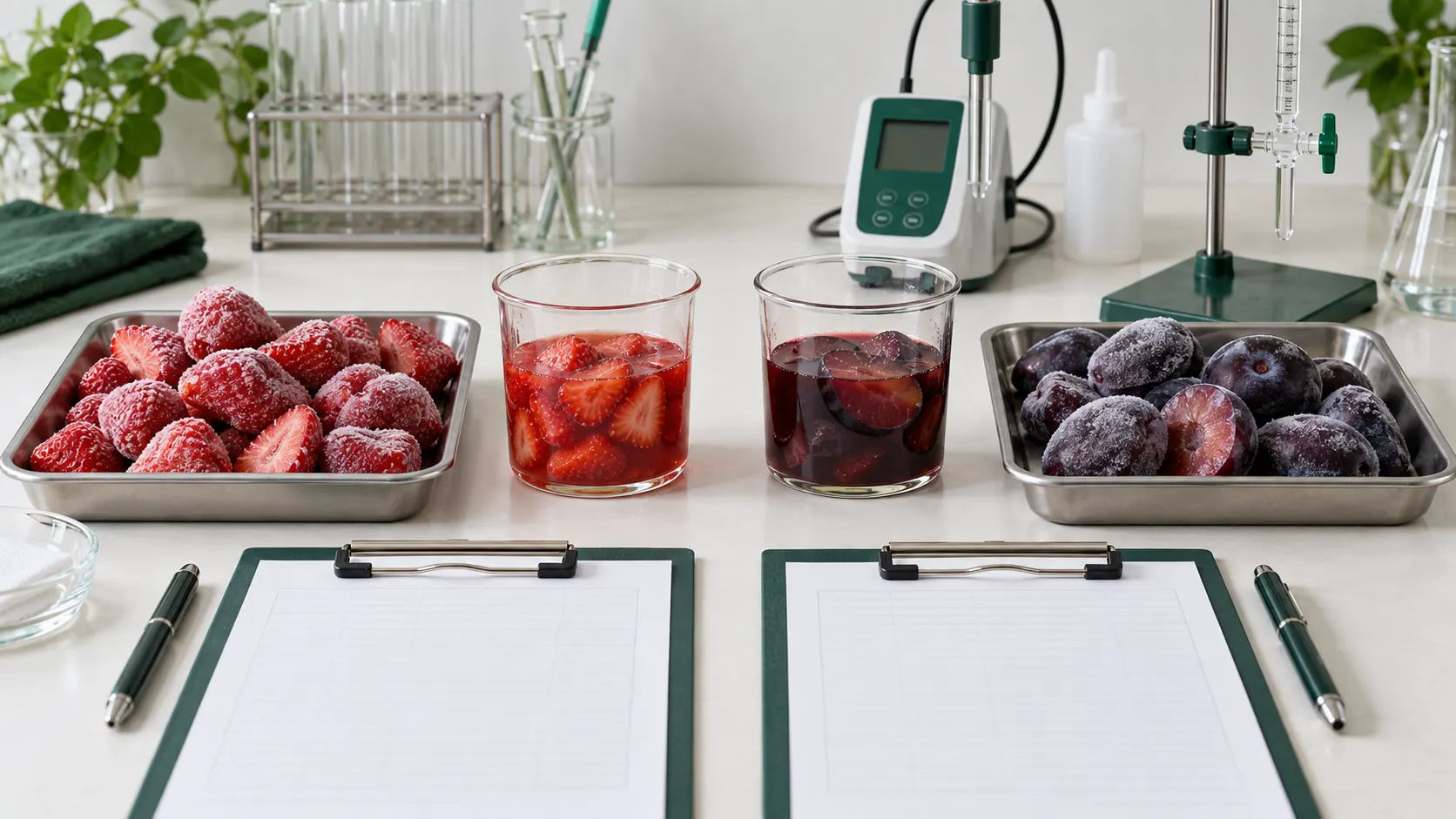
This guide is for fruit QA, purchasing and formulation teams comparing incoming frozen ingredients. It uses intentionally illustrative COAs, not GreenLand specifications or acceptance limits. The useful decision is whether the values are like for like. Once they are, TA can help explain flavor balance and a formulation trial alongside °Brix, fruit form and sensory results. It cannot, on its own, clear a lot for food safety or predict the finished product's shelf life.
Why the same pH can hide different acid loading
Quick answer: pH measures the activity of hydrogen ions in a sample; titratable acidity measures how much alkali the prepared sample consumes up to a defined endpoint, reported as an equivalent of a named acid. The values can move together, but one is not a conversion of the other. A pair of fruit lots with similar pH readings can still have different TA and taste different in an otherwise matched formulation. That possibility is why we ask for both measurements when the application needs a more complete acid profile.
The distinction becomes practical at receiving. Imagine that your team is choosing between two frozen strawberry lots for a fruit preparation. Both suppliers write a pH value close to the other. One COA also has a TA result, while the second supplies only pH. You cannot fill the missing TA cell by estimating from pH. Fruit acids, salts and buffering components affect how much titrant is needed as the sample is taken toward the endpoint. The measurement must be made on a defined sample. The existing GreenLand pH and acidity primer covers the basic distinction; here the procurement problem is how to compare reports that may use different laboratory conventions.
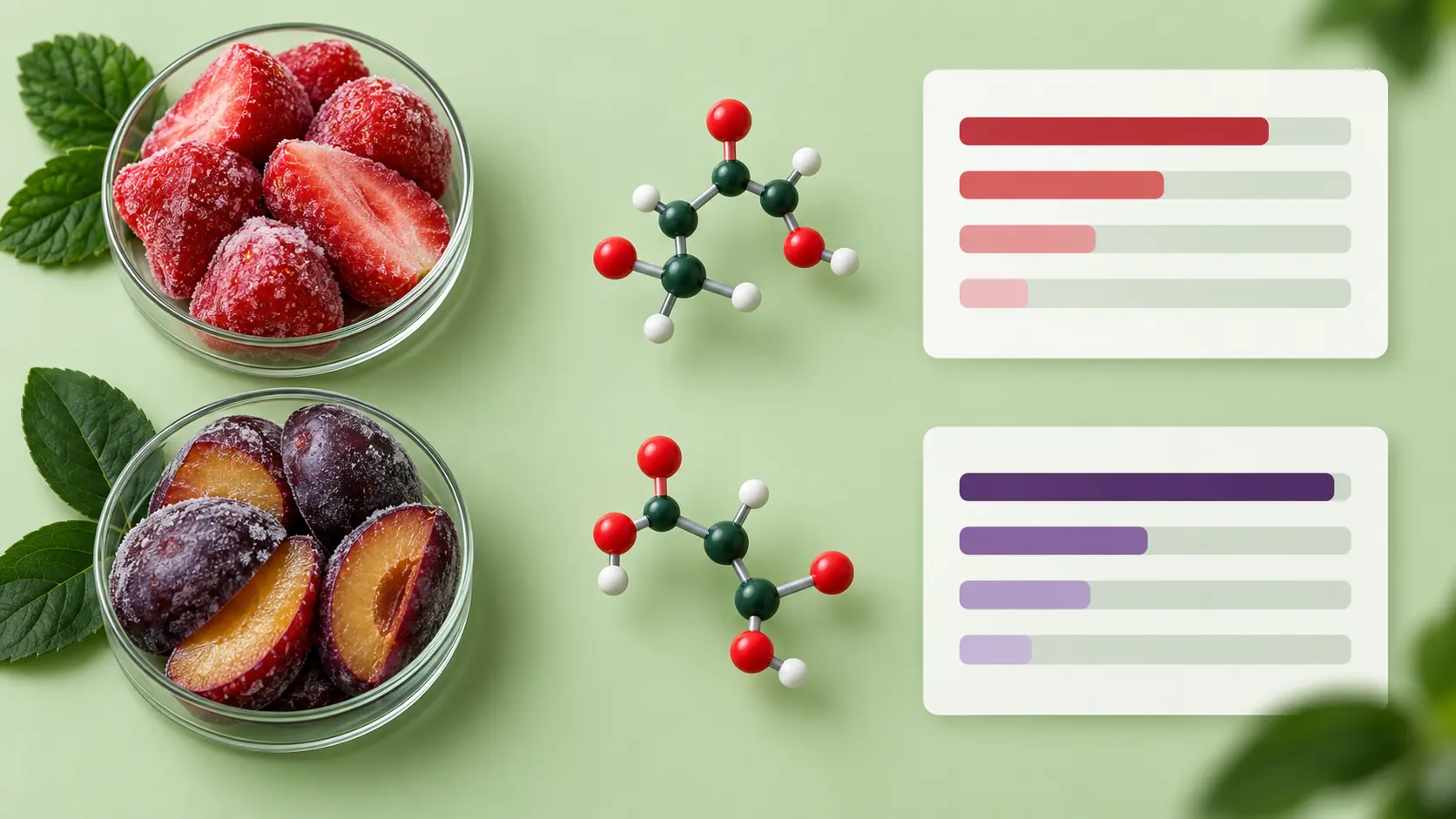
Illustration of different fruit and acid-equivalent reporting conventions; the charts contain no test data.
We would also resist interpreting either number alone as a pass or fail on microbial safety. A formulation's safety assessment depends on the finished product, process, packaging and applicable criteria, not on a frozen-fruit supplier's isolated pH or TA line. If an acid limit forms part of your purchase specification, state exactly what is being tested and how. If a separate finished-food control is required, assess that separately with your technical team.
A fruit COA is a snapshot of a specified lot under a named method. It does not prove that every individual berry or piece has the same acid profile. The sample plan matters: which cartons were drawn, how portions were combined, how the frozen material was handled and whether the released liquid was included. A good comparison therefore starts upstream of the titration bench. We would ask a supplier for the sampling description before arguing about a small numerical gap that might vanish under matched preparation.

GreenLand frozen strawberry product photograph. It identifies a possible input form; it is not a measured TA result.
Key takeaways for an initial COA screen:
- Read pH and TA as different measurements. Neither predicts the other from a single number.
- Check that the TA result belongs to the actual frozen fruit form and lot offered, not a generic fresh-fruit or juice reference.
- Keep the intended application in view: a fruit filling, dairy swirl, beverage base and bakery inclusion expose acidity differently.
- If the buyer has a contractual range, specify the test method and reporting basis along with that range. A bare percentage is a weak acceptance criterion.
The product photograph above shows IQF strawberries from a GreenLand product page. It documents a possible frozen input form, not a measured TA. Fruit size and surface frost visible in a photograph are not analytical evidence. We place a real input image here because the sampling discussion should stay anchored to what the receiving team can actually receive, thaw and homogenize.
Read the unit and reference acid first
The most frequent comparison error is to place two percentage signs next to each other and assume they mean the same thing. A COA may express TA in grams of acid equivalent per 100 grams of sample (g/100 g, a mass basis) or grams per 100 milliliters (g/100 mL, a volume basis). A supplier may write "%" without spelling out whether it means mass per mass or mass per volume. For a juice-like sample, density can bridge those bases when it is measured and the calculation is documented; it is not safe to treat the printed values as numerically identical. The USDA AMS Technical Procedures Manual explicitly separates weight and volume calculations in its fruit-juice procedure and describes conversion when the applicable standard calls for a different basis.
The named reference acid is a second axis. A titration measures neutralization; the laboratory reports the result "as" a particular acid by applying that acid's equivalent factor. Citric, malic and tartaric acid do not share the same equivalent weight. Thus a report expressed as citric-acid equivalents and one expressed as malic-acid equivalents are not automatically comparable, even if both say g/100 g. The USDA manual lists separate factors for common acids, including citric and malic. We do not recommend applying a factor from a blog post or converting two COAs by eye. Confirm the original method, units and acid basis with the testing lab, then have a qualified analyst document any reconciliation.
An acid equivalent is a reporting convention, not a claim that the fruit contains only that molecule. Frozen strawberries and plums contain mixtures of organic acids and other constituents. The equivalent named on a COA may follow a product standard or the laboratory's method choice. The buyer should specify the desired convention for a given fruit and application and require each supplier to use it consistently.
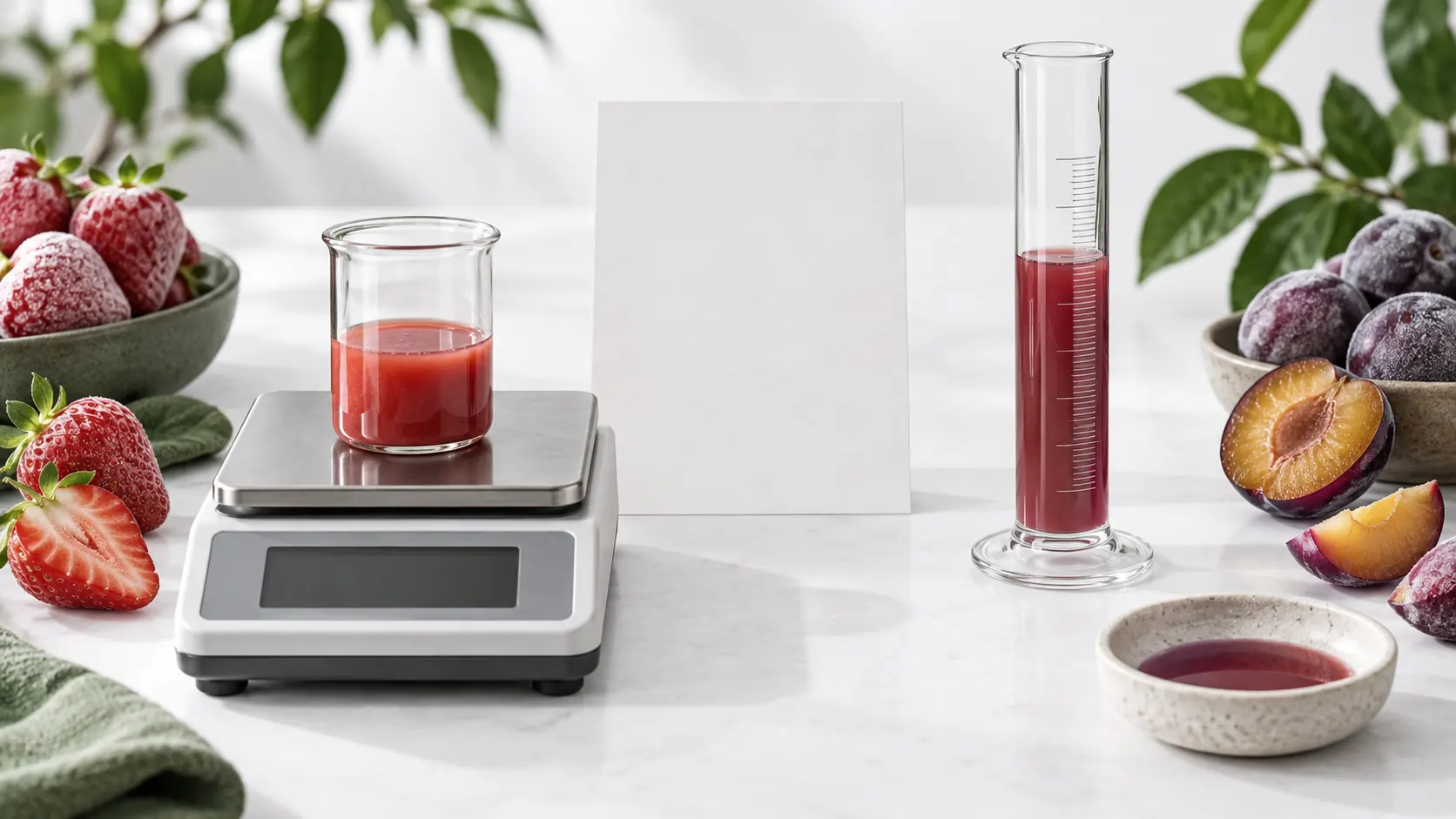
Illustrative laboratory mass and volume setups. State whether the COA uses g/100 g or g/100 mL.
Comparing across different fruit species may be useful for formulation planning, but it needs more interpretation than comparing two lots of the same strawberry product.
Here is a practical reading order for the TA line:
- Find the analyte name: "titratable acidity," "total acidity" and "acidity" can be used differently across laboratories. Ask what was actually measured.
- Find the reference acid: for example, "expressed as citric acid" or "as malic acid." Never leave this implicit in a new purchase specification.
- Find the denominator: grams of acid equivalent per 100 g of the prepared sample or per 100 mL of a defined liquid. If the COA says only "%," obtain a written definition.
- Find the sample basis: whole thawed fruit homogenate, pulp, screened juice, concentrate or another preparation. The unit does not tell you this by itself.
- Find the method and endpoint: a reporting basis has meaning only when the underlying titration is clear enough to reproduce.
For example, a result in g citric acid equivalent/100 mL of juice and one in g citric acid equivalent/100 g of juice could be related by a documented density adjustment in a particular juice case; they are not equal merely because their digits are close. The USDA manual presents a fruit-juice conversion procedure. We do not lift its numerical worked example into a frozen-fruit decision rule because the sample matrix and contract basis still need to be agreed. The required procurement action is to get the lab's validated calculation and sample density where relevant.
When we discuss a tolerance with a buyer, we ask whether the limit will be written against a mass of whole prepared fruit or a measured volume of a liquid fraction. That choice affects lab instructions, COA wording and disputes at receiving. Locking the basis before the first shipment is easier than resolving it after a rejected lot is already in cold storage.
Agree the frozen-fruit sample preparation
A frozen fruit sample is not a ready-made uniform liquid. Pieces can differ in size, degree of damage and amount of free juice after thawing. If one lab decants the thaw liquid and another includes it in a homogenate, their test portions no longer describe the same material. The same problem appears when one report covers screened juice and the other covers pulp. For a direct supplier comparison, write the sample preparation into the brief and ask both labs to report any deviation.
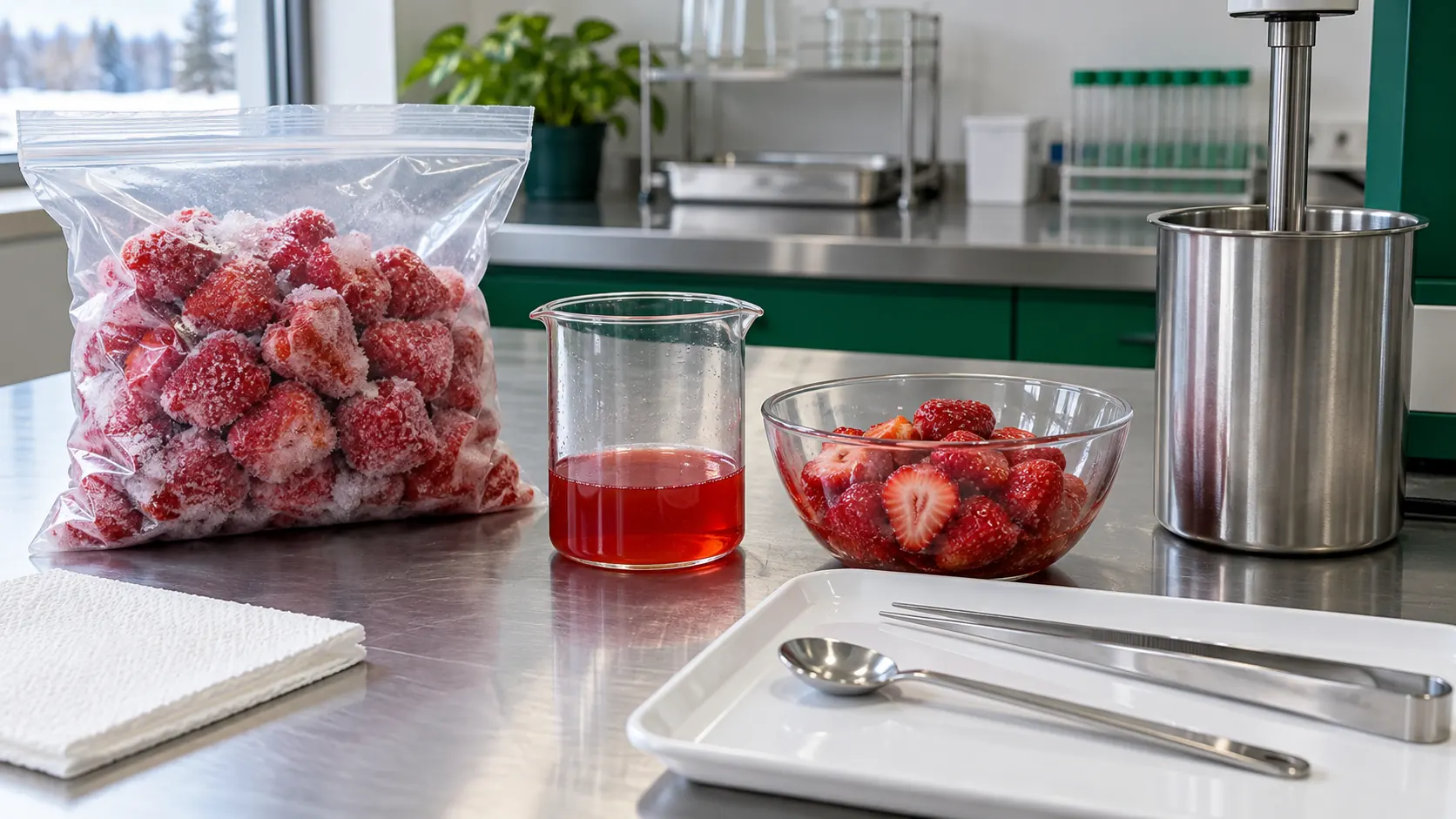
Illustrative sampling: define thaw handling and retain released juice when that is part of the agreed material.
A workable request starts with representative sealed packs from the named lot, an agreed number and mass of increments, and a documented way to combine them. The laboratory should record the condition on receipt and a controlled thaw procedure appropriate to its validated method. Unless the specification explicitly defines a drained product, keep all released juice associated with the fruit being tested. Then define whether the analytical test portion is a fully homogenized whole-fruit mixture or a clarified liquid fraction. There is no universal protocol in this article for every frozen berry, stone fruit and fruit puree; a qualified lab should select and validate the procedure for the exact matrix.
The choice has a commercial consequence. Suppose a beverage developer will make a strained syrup from frozen plum. A screened liquid result may describe that planned process more closely than a whole-fruit homogenate. A bakery team adding diced fruit and its thaw exudate to a filling may prefer the whole prepared material. Neither result is "better" in isolation. The mismatch occurs when purchasing compares a supplier's whole-fruit result to an internal juice result, then attributes the difference to fruit quality rather than sample definition.
The GreenLand frozen-plum product photograph below helps distinguish a piece product from a standardized juice. The cut surface and visible frost are relevant to the sample-definition question; the image does not state an acid value or laboratory result. A receiving plan should identify fruit variety or grade where specified, cut form, pack type, lot identity and whether the product is IQF pieces, blocks or puree. A representative sample of one form cannot be used as a universal certificate for another.

GreenLand frozen-plum product photograph. A cut piece shows the fruit form, not its acid value.
Ask the testing laboratory to record at least these preparation fields with the result: lot and pack identifiers; sample mass or volume; thaw state and retained liquid; blending or homogenization procedure; whether solids were removed; any dilution and its factor; replicate count; and the time from preparation to measurement. When a supplier cannot provide every detail on its standard COA, a linked method sheet or lab report can carry them. This is especially useful for repeat purchases: once the method is agreed, the COA can refer to its version rather than reproduce an entire SOP on every shipment.
The purpose is consistency, not paperwork for its own sake. If two valid labs use different preparation routes, their results may each be useful within their own trend series. They should not be used to rank two suppliers until the scope is reconciled. The safest response to a mismatch is a retained-sample retest under one agreed method, with both suppliers given the same instructions and the buyer's technical team reviewing the outcome.
Check method and endpoint comparability
Even two results on the same homogenate can differ when the endpoint and calculation differ. A titration adds standardized alkali to a defined sample until a specified endpoint is reached. The report should identify the titrant, its concentration or standardization record, endpoint rule and the calculation that converts volume consumed into the stated acid equivalent. These fields are routine for a laboratory, but they often disappear in a purchasing spreadsheet that keeps only the final percentage.
An instrument may use a pH electrode and a programmed endpoint; another method may use an indicator in a specified matrix. Some fruit colors or suspended solids make a visual endpoint difficult to judge. The Hanna Instruments fruit-juice method gives a defined application and acid expression, while the Mettler Toledo application note illustrates acidity testing for juices and pulp. Those documents show why a method ID matters. They are examples for their stated matrices, not permission to substitute a juice or wine method into an unvalidated frozen whole-fruit contract.
Wine resources from UC Davis and the Australian Wine Research Institute explain useful principles about acidity and pH. Wine is not frozen strawberry or plum. We use those pages to check terminology and prevent a pH/TA mix-up, while placing the actual method decision with a qualified lab working on the contracted fruit matrix. If your customer standard names an official method, use that version and its product scope. If it does not, write a mutually accepted lab SOP into the supplier specification.
Method comparability is more than matching a pH endpoint number.
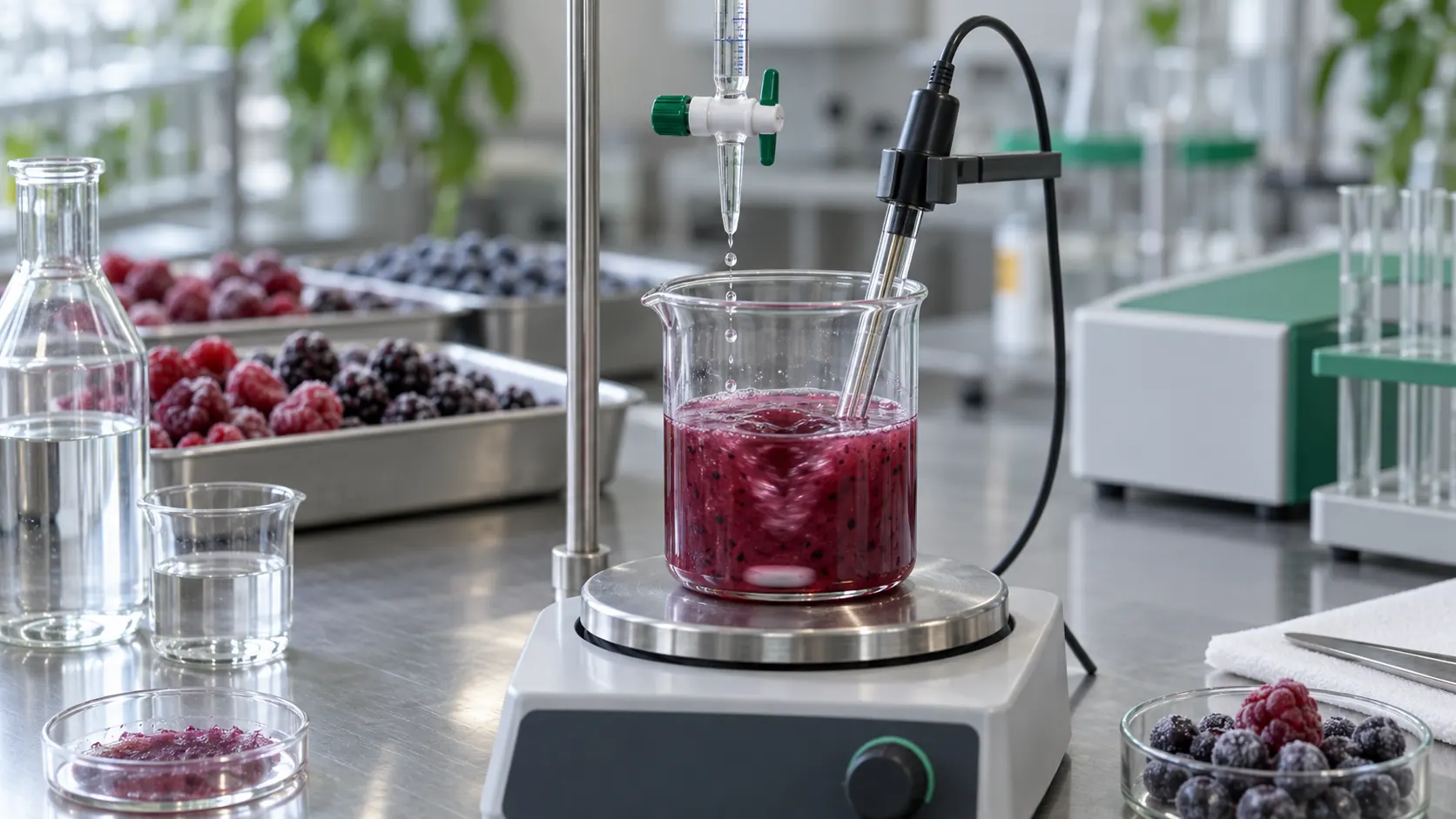
Illustrative titration setup. A qualified laboratory must use a method validated for the contracted matrix.
Check the prepared sample fraction, dilution factor, whether carbon dioxide or other interferences matter in the actual matrix, instrument calibration, titrant standardization and blank correction where the method requires it. Ask whether the result is a single determination or an average of replicates, and whether the lab has a normal repeatability range for that fruit product. A small between-lot difference should not drive a purchase decision if it sits within method variation or uncontrolled sampling differences.
We would also keep a distinction between contract comparability and formulation usefulness. A COA tested under one stable method can support receiving decisions against a documented limit. A development kitchen may run a different internal method to understand how the fruit behaves in a beverage or filling. Those internal trends can be valuable, but label them as such. If the numbers must be combined for supplier comparison, have the lab perform a bridge study or retest retained samples under a single method. A guessed conversion cannot repair an undocumented endpoint.
Build a like-for-like COA comparison
The following two COAs are illustrative only. The values are invented to show a reporting mismatch; they are not GreenLand data, supplier test results, acceptance limits or a formula for converting acid equivalents. The same purchasing team received two candidate frozen-fruit reports and wants to decide which lot has the lower TA. At first glance, Lot A's number is larger. The table shows why that conclusion cannot yet be made.
| Field | Illustrative COA A | Illustrative COA B | Buyer action |
|---|---|---|---|
| Product and lot | Frozen strawberry pieces, Lot A | Frozen strawberry pieces, Lot B | Confirm cut form, pack and lot scope match. |
| TA result | 0.90 g/100 g, as citric acid | 0.78 g/100 mL, as malic acid | Do not rank raw numbers. Units and acid equivalent differ. |
| Prepared sample | Whole thawed fruit homogenate; thaw juice retained | "Juice" only; solids handling unstated | Ask whether B was screened, pressed or diluted and whether thaw juice was retained. |
| Method and endpoint | Lab SOP F-12, potentiometric endpoint disclosed | "Titration"; endpoint absent | Request method version, endpoint and titrant details for B. |
| Replicates and °Brix | Triplicate mean and °Brix on same homogenate | One TA number and °Brix on unspecified liquid | Match sample basis and review repeatability before discussing acid-to-sugar balance. |
| Comparison status | Documented within its own method | Missing key fields | Retest retained samples under a shared method if the records cannot be reconciled. |
The table is not a contest between laboratories. Both may have measured their own prepared samples correctly. It simply shows that "lower TA" is not established by 0.78 versus 0.90. A buyer could request the full lab reports, then ask whether a legitimate conversion is possible using the original data and the appropriate fruit-matrix method. If sample fractions are different, a unit conversion alone will not solve the comparison. A common retest is likely clearer.

Illustrative buyer review of two incomplete COAs; check missing fields before comparing values.
Once the reports align, read TA with °Brix and a controlled sensory trial. The ratio between soluble solids and acid can be useful in some fruit applications, but use values on the same prepared sample and consistent basis. °Brix is a refractometer reading, not a complete sweetness description, and two fruits with the same ratio can differ in aroma, texture and perceived flavor. A QA report helps narrow a decision; the final recipe trial tests the actual ingredient in its target use. We would record the planned dose, processing step and finished matrix before accepting a numerical range as commercially meaningful.
For a repeatable supplier comparison, send a short request that both the procurement and laboratory teams can use:
- Define the product. Name fruit species, variety or grade where relevant, frozen form, cut size and pack, and the exact lot or shipment.
- Define the sample. Specify representative pack selection, thaw and retained-liquid handling, homogenization or screening, and any dilution.
- Define the report. Require TA unit, named acid equivalent, method ID/version, endpoint, titrant basis and replicate summary.
- Define the related data. Request pH and °Brix where useful, measured on an identified equivalent sample rather than an unrelated liquid fraction.
- Define the decision. State the purchase range and what triggers a clarification, retained-sample test or technical review. Do not use TA as a stand-alone safety release.
If your current COAs omit several fields, begin by revising the inquiry specification rather than rejecting a shipment on an ambiguous comparison. GreenLand can discuss frozen-fruit form, packing and supply information with the buyer, while the buyer's qualified laboratory sets the analytical method and acceptance criteria for its product. That division keeps a meaningful lot decision attached to evidence the receiving team can reproduce.
Keep the original reports, not only the values copied into a sourcing worksheet. A later customer question may turn on a small detail such as whether a report said g/100 mL or g/100 g, whether the laboratory tested drained fruit, or whether the COA was for a different processing date. The linked lab report, method revision and sample identity make a comparison auditable. If the fruit is reformulated into a sweetened preparation, distinguish the incoming-fruit TA from a later measurement of the finished blend. Added sugar, water and other ingredients change the reporting basis and the sensory impression, so a finished-product number should not be filed as if it described the original frozen lot.
We use a simple traffic-light review internally: green when the sample, unit, acid equivalent and method match; amber when a field can be clarified from a referenced laboratory record; and red when the materials or test fractions differ and need a shared retest. The colors are a workflow aid, not a quality grade for the fruit. A red comparison can contain two perfectly acceptable lots. The question is whether the evidence supports the buyer's specific ranking or release decision.
Compare frozen-fruit lots on a clear specification
GreenLand-food is a frozen fruit supplier and manufacturer in China, supporting factory-direct wholesale supply against an agreed product specification. Tell us the fruit form, cut, packing, volume, destination, intended use and documents your team requires. We can discuss the product brief and lot information while your qualified laboratory defines the acidity method and acceptance range for your application.