


What Is Stem Ginger? Syrup-Preserved Ginger vs Frozen Ginger Root
Sep 28, 2026
Leave a message

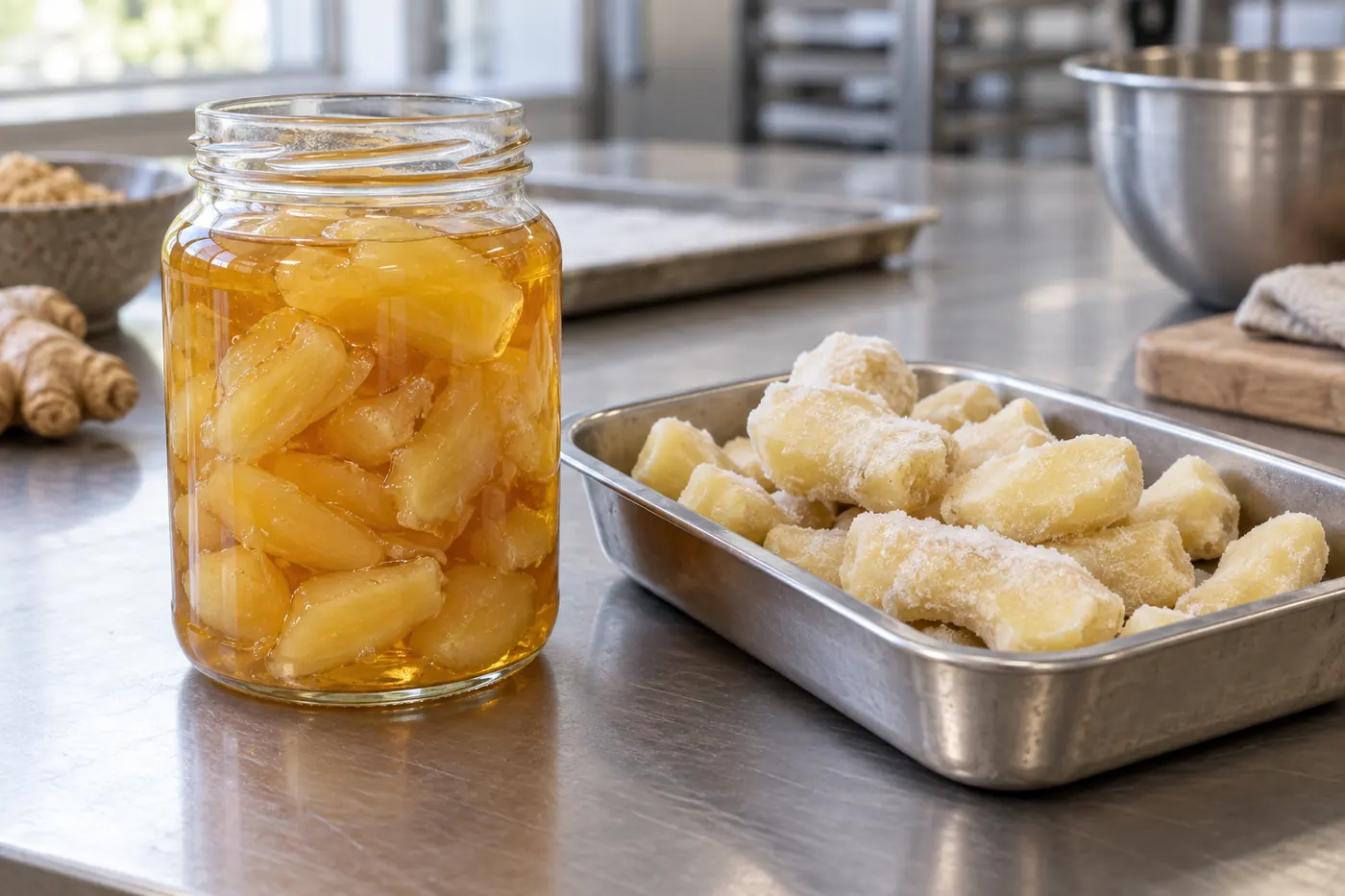
The search phrase "what is stemmed ginger" often points to this same preserved ingredient, but the standard product name in a specification should be stem ginger in syrup. For an industrial formula, check the exact pack label, drained weight, piece size and ingredient list before changing supplier or form. If the intended product is a cake with visible tender pieces, an unsweetened frozen ginger puree will solve a different flavor problem. If the product only needs ginger flavor, a controlled reformulation using frozen ginger may be possible.
Stem ginger is a preserved product name
The essential feature is the preservation medium. Pieces of ginger rhizome are cooked until suitable for the product and packed in a sweet syrup. Good Food's ginger glossary calls ginger preserved in syrup "stem ginger" and lists candied or crystallised ginger as other forms. The Bennett Opie stem ginger product is a concrete example: its published ingredients are ginger, sugar, water and citric acid. That is an ingredient list for one named product, not a formula every stem-ginger manufacturer follows. Check the actual specification for the jar or bulk pack your bakery buys.
Crystallized ginger is commonly presented as sugar-coated pieces without a surrounding liquid syrup. It may give a firmer chew and a different distribution of surface sugar in a batter. Plain fresh or frozen ginger root is an unpreserved culinary ingredient, often peeled, diced, minced or grated for processing. The physical differences are obvious when the products are placed side by side, but a written order needs more than a photograph. Product names can vary by region and supplier; ask for ingredients, sugar content, piece condition and packing medium when a label says "candied," "stem," "preserved" or simply "ginger pieces."
The word "stem" can mislead ingredient buyers because the edible ginger used here is the rhizome, not a celery-like stem. Do not substitute the botanical name of a plant part for the commercial identity. A recipe that calls for two finely chopped bulbs of stem ginger typically refers to the syrup-preserved pieces in a jar. It may also use a spoon of the syrup. A purchasing specification should therefore say "stem ginger in syrup, drained pieces" if only pieces are needed, or state separately how much packing syrup enters the formula. Those are two ingredient streams with different effects on sweetness and moisture.
For a baked good, the preserved pieces can be both flavor and texture. A small translucent ginger dice may remain visible in a dark cake crumb and give a sweet, warm bite. A fine mince can distribute more evenly, but it still carries sugar and process-altered ginger. A grated plain frozen root may disperse ginger flavor without forming the same tender confectionery inclusion. No single form is intrinsically better. The right form follows the cake, biscuit, filling, glaze or drink being developed. A supplier brief should say whether the desired outcome is visible chew, smooth ginger note, syrup flavor, or all three.
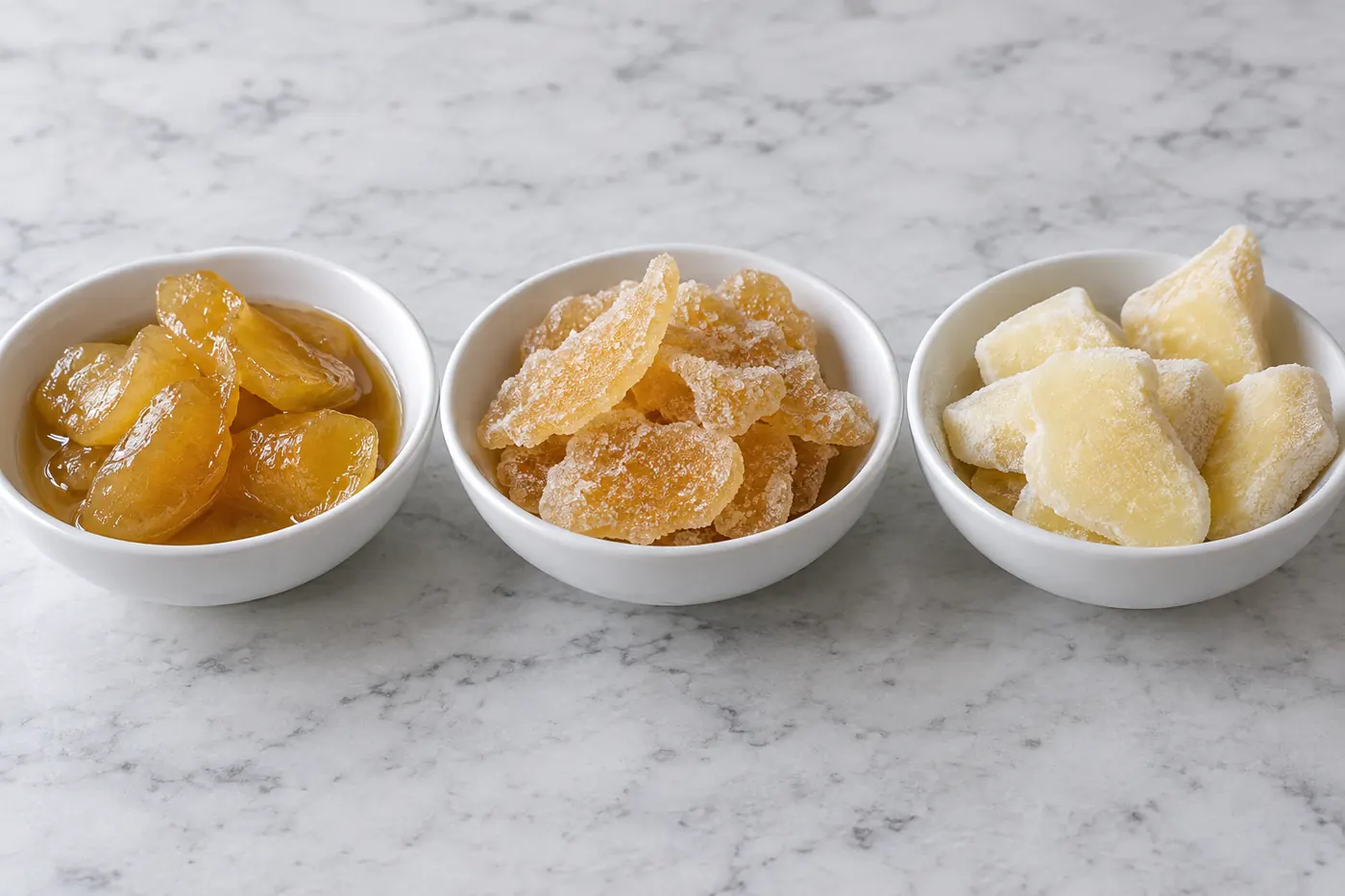
Compare syrup-packed pieces, crystallized pieces and unsweetened frozen pieces.
Do not infer shelf life or food-safety status from a home recipe or from the word "preserved." Commercial stem ginger has a manufacturer-defined pack, ingredients, processing controls and storage directions. The Opies page, for example, gives its own opened-jar instructions; another brand or foodservice bulk pack may differ. This article does not give a shelf-stable preservation recipe and does not validate a homemade syrup pack for a bakery. Follow the actual supplier label and the bakery's food-safety system. For a reformulation, the preserved product's handling requirements and the frozen product's cold-chain requirements also differ.
GreenLand-food's frozen ginger range concerns frozen ginger root, pieces, cubes, grated and related formats under order-specific confirmation. The page does not establish a GreenLand stem ginger in syrup SKU. We use the preserved product as a comparison because bakeries may be deciding whether plain frozen ginger can replace it. The answer is conditional: frozen ginger can be a candidate when the recipe can be reformulated around its unsweetened form, but it does not become syrup-preserved stem ginger merely by being thawed or mixed into a batter.
Read the ginger and the packing syrup separately
A jar has a net weight that includes the ginger pieces and the liquid around them. The drained weight is the amount of ginger retained after the syrup is separated under the supplier's method. Those figures are not interchangeable. Bennett Opie's published manufacturer specification lists 560 g net and 340 g drained for one pack configuration. It shows why a buyer must ask what a recipe's "one jar" actually contributes. The ratio belongs to that specified product, not to all syrup-packed ginger or an automatic formula for frozen-ginger substitution.
Record the ginger pieces and syrup as separate components in the formulation sheet. If a recipe uses only drained pieces, weigh the pieces by the stated method and note whether they were rinsed, patted or simply allowed to drain. Those handling choices change the residual surface syrup. If the recipe adds a measured amount of packing syrup, record that addition explicitly. The syrup is not neutral water: it brings sugar, water, ginger extract and potentially acids or other ingredients from the preserved product. The supplier's ingredient declaration and soluble-solids information, if provided, make the accounting more reliable than a visual guess from how thick the syrup looks.
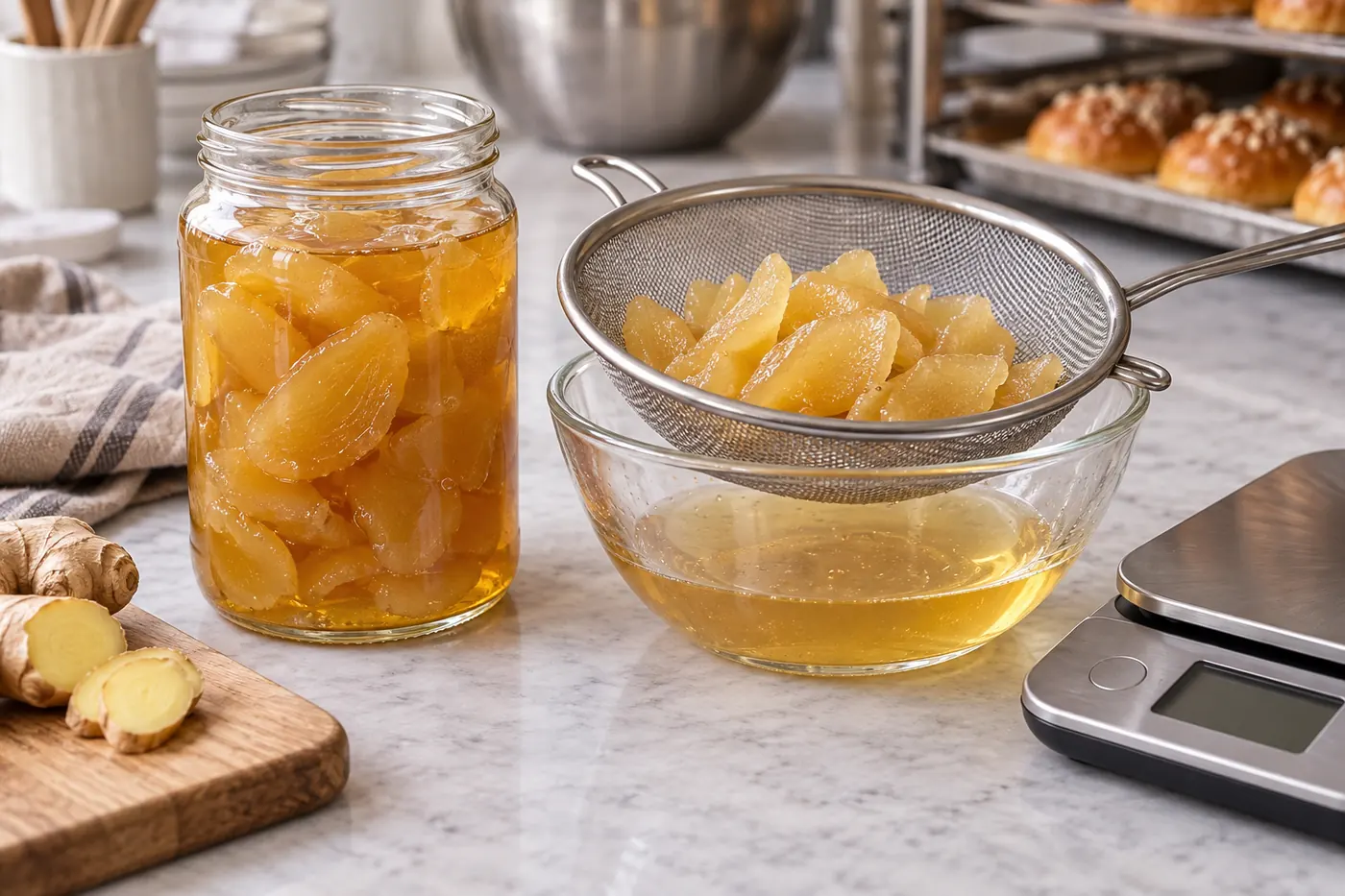
The jar net contents and drained ginger pieces are different accounting bases.
For a cake, sugar affects sweetness, moisture retention, browning, batter behavior and perceived ginger warmth. Syrup can also change how the crumb sets. A frozen ginger cube contributes its own plant solids and water but does not carry the same added sugar. Replacing a mass of drained preserved pieces with the same mass of frozen root while leaving the formula otherwise unchanged may make the cake sharper, less sweet or structurally different. Replacing the whole jar weight with frozen root is an even larger category error because part of that jar weight is syrup. The direction and size of any change depend on the specific products and recipe; they must be measured in a trial.
Texture deserves its own line in the record. Preserve a sample of the stem ginger, cut several pieces and assess whether they are soft enough for the intended bite. Note the distribution of fibrous strands, the chosen dice or slice size, and how the pieces behave after baking. A frozen root may be grated finely, but grating does not make it a tender candied piece. It may disperse rather than remain as a distinct inclusion. If the visual identity of a biscuit or cake includes amber ginger pockets, that may be a non-negotiable requirement. If the recipe only needs a ginger note, the inclusion might be optional and a different form may be viable.
The syrup also matters outside cake batter. A glaze, filling or dessert sauce may depend on its viscosity and sweetness. A beverage base may need the syrup's flavor and sugar profile, but that is a new formulation question. Do not treat "ginger flavor" as a complete functional specification. Ask whether the liquid needs to remain clear, whether ginger solids are permitted, how much sweetness is acceptable, and whether the system will be heated, chilled or frozen. A supplier can confirm the ingredient's composition and format; the customer must test the finished application.
When comparing costs, use the usable ingredient basis. A price per net kilogram of syrup-packed ginger cannot be directly compared with a price per kilogram of frozen ginger without accounting for drained yield, syrup use and losses in the process. If the bakery discards most of the syrup, the effective cost of ginger inclusions differs from a bakery that uses all the syrup in a glaze. Waste, packaging disposal, freezer storage and production labor may matter as much as list price. Calculate cost from the actual process flow, then decide whether the reformulation improves the finished product and operation.
Why frozen ginger is not a spoon-for-spoon replacement

GreenLand product photo shows frozen ginger portions and fine-cut particles, without syrup.
Plain frozen ginger is attractive when a plant wants a consistent ginger ingredient without a preloaded sweetener. It may arrive as peeled root, pieces, cubes, mince or a grated grade. The GreenLand frozen grated ginger page describes order-specific particle grades and packing. Those forms are ingredient options; none is described here as sugar-preserved stem ginger. The physical input changes pungency perception, water contribution, distribution and chew. A formula conversion needs a trial rather than a fixed tablespoon ratio copied from a household recipe.
The GreenLand photograph above shows frozen ginger portions and fine-cut pieces. It proves the appearance of a frozen form on the product page, not its use as a confectionery inclusion. A dense piece may require further cutting, while a fine grade disperses rapidly. Confirm the actual particle size, peel status, composition, unit weight and handling directions for the SKU offered. For a cake that originally contains chopped stem ginger, choose the frozen form according to the effect desired. A fine grate may replace some smooth flavor contribution; a larger plain cube will not automatically reproduce the syrup-softened bite.
Start with a control bake using the current stem-ginger product. Record drained piece mass, syrup mass used, piece size, total batter mass, bake profile and finished yield. Make a first frozen-ginger trial with a deliberately chosen ginger mass, then adjust sugar and liquid as separate controlled variables. Keep the base flour, fat, eggs or other structure ingredients constant in the first comparison. Do not assert that the frozen ginger mass equals the drained preserved mass in pungency or solids; treat the first trial as an exploration. A blinded tasting can identify whether the ginger note is too sharp, too faint or simply different.
| Input form | Added sugar and packing liquid | Main texture effect | What a substitution trial must address |
|---|---|---|---|
| Stem ginger in syrup | Sugar and flavored syrup are part of the product; amount depends on brand and use | Soft, sweet pieces can remain as inclusions | Separate drained pieces from syrup; preserve intended chew and sweetness |
| Crystallized ginger | Sugar is associated with coated pieces; generally no packing syrup | Sugar-coated chew and visible pieces | Check coating sugar, piece hardness and distribution |
| Plain frozen ginger | No syrup-preservation sugar unless the exact SKU states otherwise | Root pieces or fine particles; not a candied texture | Rebalance sugar and water, assess pungency and fiber, choose cut size |
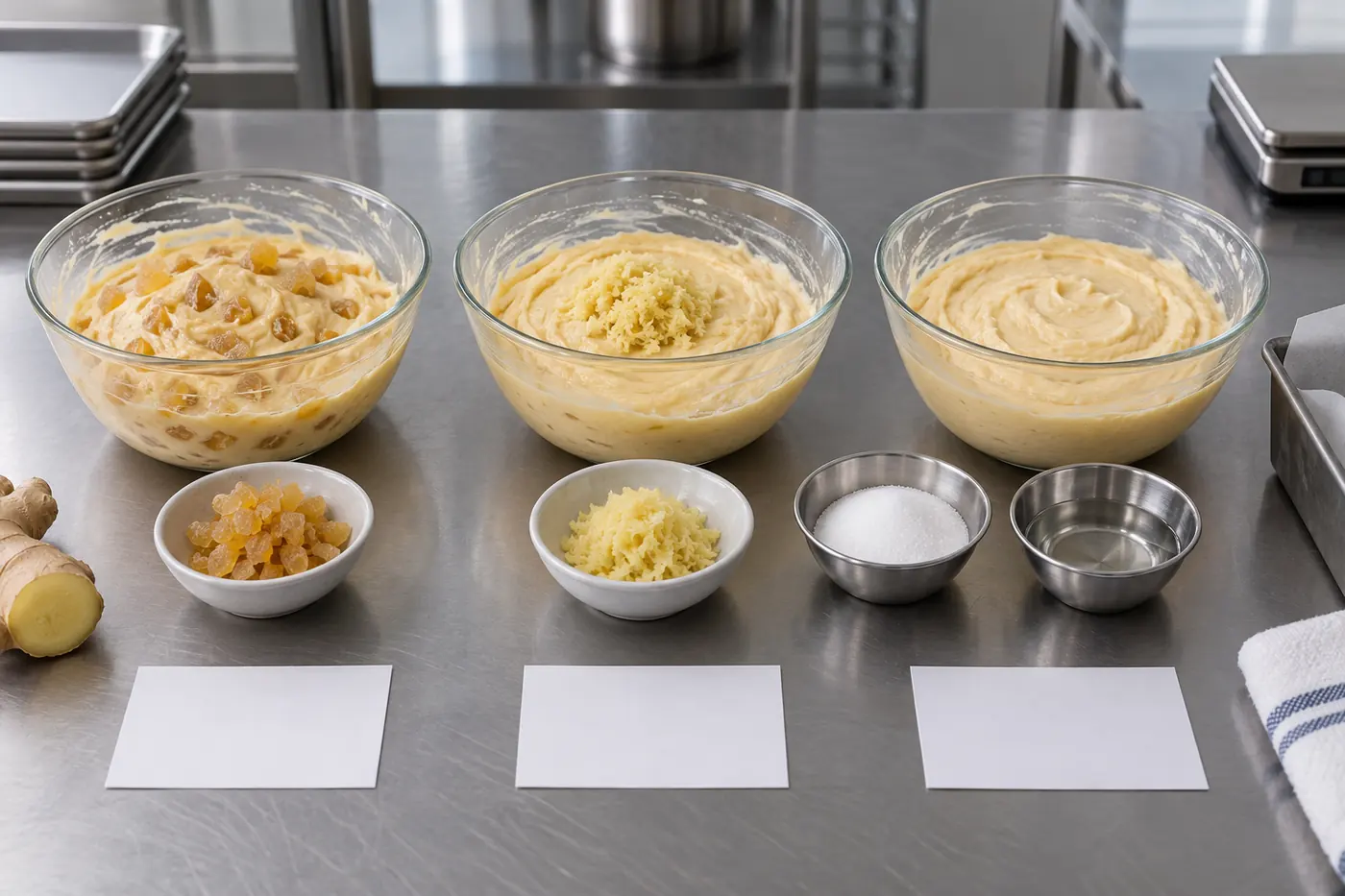
Hold the base batter constant while testing ginger form, sugar and water separately.
Do not ignore water. Frozen ginger may carry surface ice and release water during thawing or heating. A syrup-preserved piece carries liquid and sugar differently. If the process adds ginger straight from frozen, check whether the product disperses and whether cold spots or inconsistent portioning affect the mix. If it is thawed first, define a controlled thaw and drain method under the bakery's food-safety program. Compare finished moisture, slice integrity and shelf-life behavior using the actual packaging and storage conditions. This article does not specify a universal safe hold time for either ingredient.
Pungency is more than a mass fraction. The ginger raw material, maturity, cut, heat history and distribution in the matrix all matter. A preserved ginger piece may taste gently warm because sweetness and cooking change perception; a small quantity of plain grated ginger can taste sharper in a smooth crumb. Conversely, some frozen products may taste milder after a long bake. There is no reliable universal conversion from "two stem-ginger bulbs" to grams of frozen ginger without specifying the preserved product and the desired sensory target. Build a dose ladder and evaluate flavor after cooling as well as fresh from the oven.
The decision to substitute should be explicit. If the cake needs both syrup and tender visible pieces, use a suitable preserved product or redesign the product concept. If the cake needs only ginger aroma with low added sugar, a plain frozen form may be an appropriate starting material. If the product needs a ginger glaze, a frozen ingredient might supply flavor but the sugar system still needs design. This is a commercial formulation choice, not a claim that one form is a superior ingredient in every bake.
Choose the input for the intended bake
Consider a dark ginger cake sold in slices. Small syrup-preserved pieces can provide recognizable amber inclusions and a localized sweet chew. A smooth loaf with no visible pieces may instead rely on finely grated ginger dispersed through the batter. A biscuit can react differently again: larger moist inclusions may alter spread or create sticky spots, while a dry crystallized piece may keep a more discrete chew. Define the target before comparing prices or grams. "Ginger cake" describes a category, not enough detail to select an ingredient form.
The first bakery trial should answer a sensory question. Is the desired ginger note immediate and sharp, slow and warm, or balanced with other spices? Are visible pieces part of the product promise? Should every bite carry a similar amount, or should there be occasional inclusion bites? A preserved piece can create a different sequence of flavor from a fine frozen grate. Photograph the sliced crumb at a fixed distance, count or describe inclusion distribution, and taste at the time the customer will eat the product. Warm cake can hide a harsh note that appears when cool, and syrup can soften it in a way plain ginger does not.
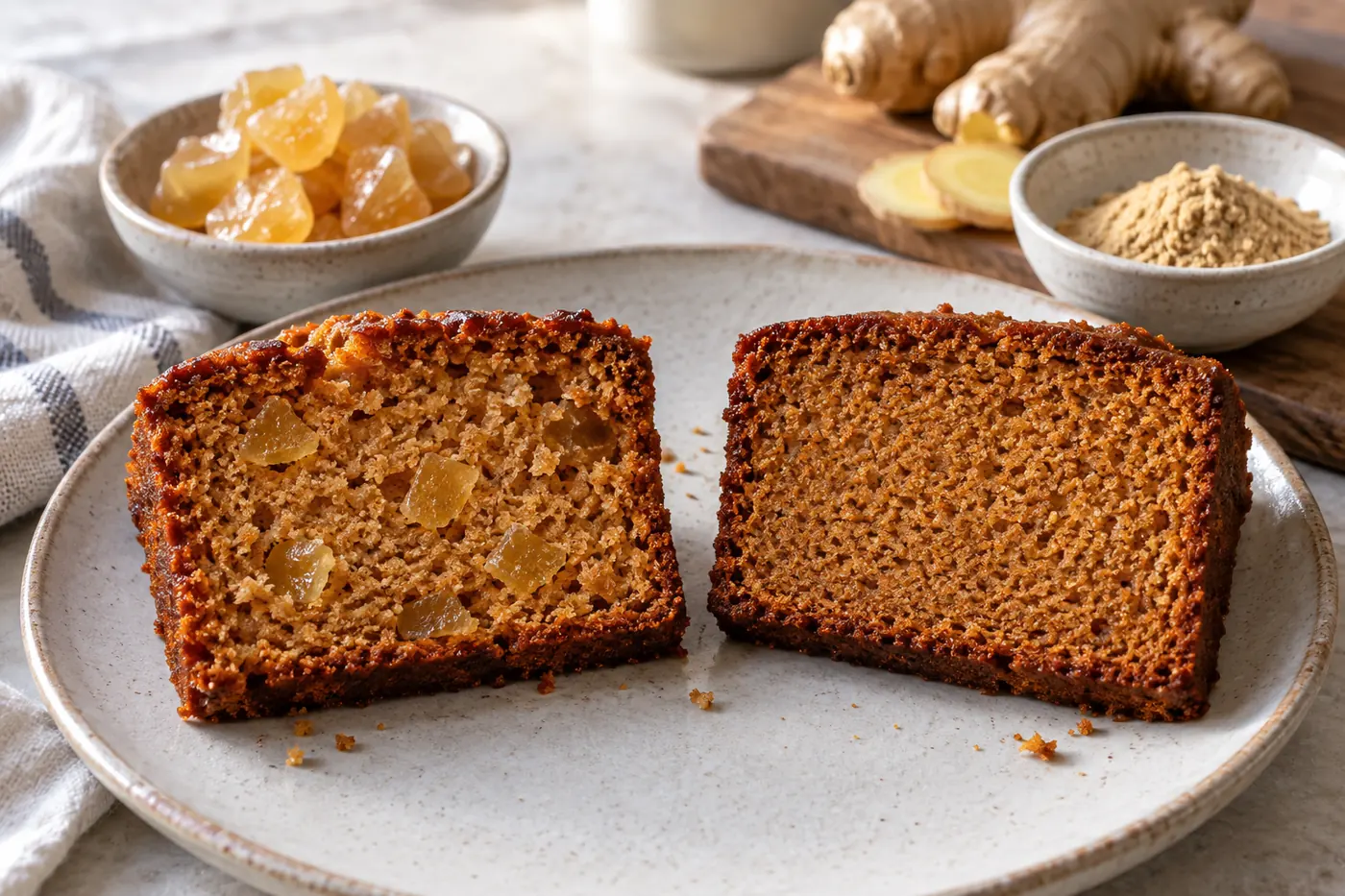
Visible tender inclusions and smooth distributed flavor serve different briefs.
Then assess process performance. Does the ginger sink, clump, smear or separate during mixing? Is a frozen portion easy to dose at production speed? Does a piece block a depositor or cause uneven slicing? If the production line uses an inclusion feeder, the form must fit its size range. A manually chopped jarred product may be acceptable for a small bakery but laborious at scale. A fine frozen form may improve dosing while changing the expected mouthfeel. The target isn't to reproduce the photograph of another ingredient; it is to meet the finished-product specification within a workable line process.
Compare at least a control and a limited set of purposeful alternatives. One alternative might keep stem ginger pieces but reduce syrup addition. Another might use plain frozen grated ginger and separately adjust sugar and water. A third could combine a small amount of preserved inclusion with frozen ginger for a more even base note, if the product brief permits it. Change one major variable at a time. Record formula weights, ingredient temperature, mix time, bake loss, cooled product mass and sensory notes. The pilot should identify a practical next experiment rather than generating an arbitrary tasting table.
For fillings and glazes, ask whether visible pieces are desired or whether smoothness matters more. Stem-ginger syrup may bring sweetness and a glossy liquid phase; plain ginger will not create those properties unaided. For a fruit filling, consider the interaction with the fruit's own acidity and sweetness. For a frozen dessert, check whether the ginger form remains pleasant at serving temperature. These are application tests, not assumptions about ingredient quality. A supplier can give a particle specification and ingredient statement, but the bakery must validate how that input behaves in its own matrix.
Label language follows the chosen formula. "Stem ginger" may imply a syrup-preserved ingredient to buyers familiar with the term. A product made only with plain frozen ginger should be named and declared accurately under the market's rules. Do not use a photograph of glossy syrup-packed pieces to imply they are in a smooth frozen-ginger cake. If a preserved product is used, confirm its full ingredient list, including acids or other added ingredients, before finalizing a retail declaration. Technical substitution and truthful presentation should be resolved together.
Ask for a clearly named ingredient

GreenLand product photo shows peeled frozen ginger pieces as a raw-material form.
A useful ingredient inquiry starts with the finished application and a clear product identity. If the brief calls for preserved stem ginger, state the desired ginger piece size, drained weight basis, syrup use, sweetness, packaging and handling. Ask the preserved-product supplier for its current ingredient list, net and drained weights, relevant specification and storage directions. Do not accept a photo of a jar as the whole specification. The Opies example illustrates that named products can be documented this way, but its numbers and ingredients cannot be imposed on another manufacturer's pack.
If the brief asks GreenLand-food about plain frozen ginger, state that it is unsweetened frozen ginger root or a specified cut, not stem ginger in syrup. The GreenLand product photograph above shows peeled frozen pieces as one raw-material form. The current offer, cut size, peel tolerance, packing, minimum order, documents and availability need confirmation for the exact order. Our frozen ginger range gives the available form vocabulary, and the frozen grated ginger page shows how particle grades can be specified. Those pages do not make a preserved-confection claim.
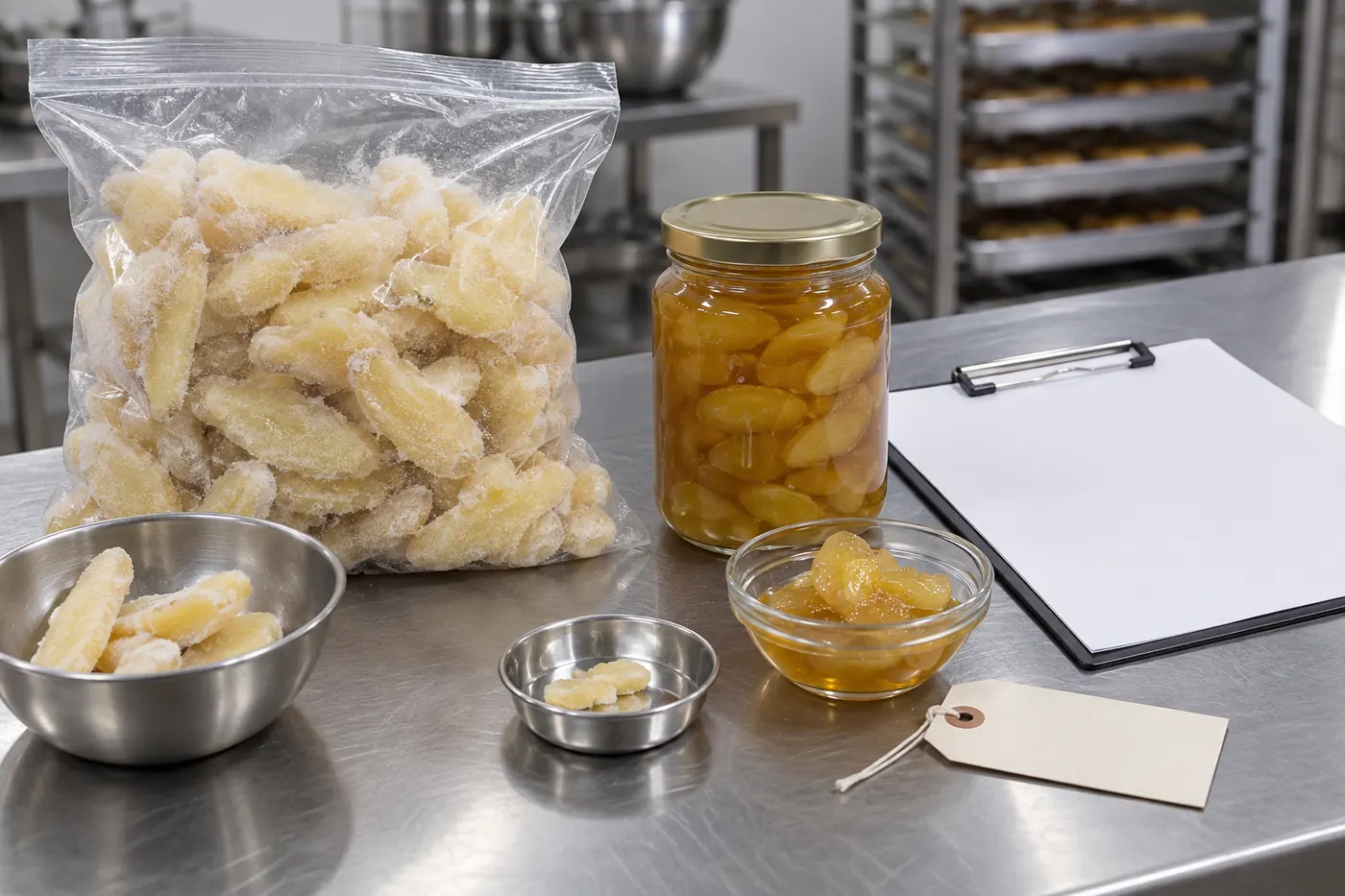
Name preserved and frozen ingredients distinctly in a supplier brief.
Include practical parameters: whether the ginger will be mixed from frozen or thawed, desired particle size, whether visible fibers are acceptable, target flavor intensity, intended bake or filling, batch size, expected annual volume, destination and pack format. If the product will be portioned into a small batter, discuss whether a cube or fine grate is easier to weigh consistently. If the formula needs a sweet ginger inclusion, say so; a supplier can then tell you whether the requested item is outside its frozen product scope. Clear terminology prevents a quote for plain root from being mistaken for a syrup-preserved confection.
Ask for a representative sample and run it against the existing control. Record the lot, product temperature and condition on arrival, then follow the supplier's handling instructions and the bakery's own process controls. Evaluate ginger distribution, pungency, water, chew and finished-product appearance. If an offered frozen form is promising but does not match the preserved reference, identify which variable needs reformulation: sweetness, syrup flavor, piece texture or dose. That record is more useful than a generic comment that the cake "needs more ginger." It also gives procurement a basis for comparing commercial costs after the recipe has a defined target.
The approval document should state what may change without a new trial. Particle grade, raw-material source, unit size and pack can all affect mixing and dose. A preserved ingredient supplier may change syrup composition or drained weight; a frozen supplier may change cut size or processing route. Define the notification and reapproval point for each. Keep a retained reference sample or an agreed sensory standard where practical. For a buyer replacing stem ginger in an established product, the final sign-off should include the technical team, not only a price comparison.
GreenLand-food can discuss frozen ginger root, pieces, cubes and grated forms for wholesale and industrial programs, subject to the actual order specification. We can help buyers confirm an unsweetened ginger form, packing and documentation for a controlled bakery trial. If the formula requires tender syrup-preserved stem ginger, keep that requirement explicit and source the preserved ingredient as such. The precise answer to the search question is therefore also a purchasing answer: stem ginger names a ginger-in-syrup product, while frozen ginger is a different starting material that may work only after the recipe is deliberately redesigned.
Discuss Unsweetened Frozen Ginger with GreenLand-food
GreenLand-food is a professional frozen ginger supplier and manufacturer in China, supporting factory-direct wholesale programs for bakeries, processors and importers. Our frozen ginger forms are distinct from stem ginger preserved in syrup.
Send your required ginger form, cut or particle size, intended bake, packing, quantity, destination and document list. We can discuss a relevant frozen ingredient sample for a controlled formula trial.