



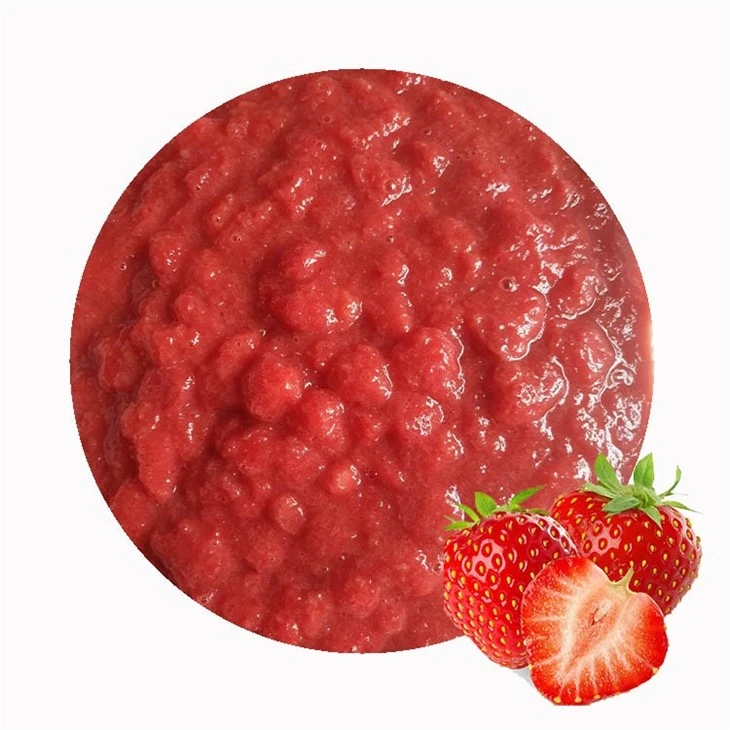
Frozen Strawberry Puree
Description
Technical Parameters
Frozen Strawberry Puree for Industrial Food Production
We supply frozen strawberry puree for beverage plants, dairy processors, yogurt fruit-preparation manufacturers, ice cream factories, bakeries, jam and sauce producers, central kitchens, foodservice distributors and private-label programs. We separate single-strength puree, concentrate, seeded puree, seedless puree, coarse pulp, pasteurized puree and non-pasteurized puree into clearly identified specifications. This prevents a buyer from receiving a product whose texture, heat-treatment status or solids content differs from the approved sample.
Our standard unsweetened single-strength product contains 100% strawberry with no added water, sugar, preservative, artificial color or artificial flavor. Commercial contracts can define natural Brix, pH, titratable acidity, refining screen, visible-seed tolerance, Bostwick flow, microbiological grade, packing and intended use. Each contracted batch can be released with actual results in the COA rather than a repeated copy of the specification limits.
Request Puree SpecificationRequest Sample and Batch COADownload Frozen Food Catalog
For a precise quotation, send the puree type, Brix, pH, acidity, screen aperture, seed level, Bostwick target, heat-treatment status, microbiological limits, packing, quantity, application and destination port.
Strawberry Puree, Pulp and Concentrate Explained
Single-strength strawberry puree is made by crushing and refining strawberries without removing water by concentration. Its natural soluble-solids range is normally 7.5-11°Bx. The standard ingredient declaration is 100% strawberry, with 0% added water and 0% added sugar.
NFC strawberry puree means Not From Concentrate. It is made directly from strawberry material and is not first concentrated and later reconstituted. NFC does not mean "not frozen concentrate."
Refined seedless puree passes through a 0.3-0.7 mm screen. It removes most whole seeds and coarse particles, but it is not described as 100% seed-free. Our contract language is "refined seedless puree with controlled visible-seed tolerance." Seeded puree uses a 1.0-1.5 mm screen and retains natural seeds and fibre. Strawberry pulp uses a 2.0-3.0 mm screen and keeps a coarser fruit texture.
Strawberry puree concentrate is a separate product in which part of the water has been physically removed. We identify it as concentrated strawberry puree and offer 18-20°Bx, 20-22°Bx, 24±1°Bx and 28±0.5°Bx specifications. It is not labelled as ordinary single-strength puree.

Fine homogeneous puree for applications that need controlled flow and a smooth fruit base.
Available Frozen Strawberry Puree Specifications
| Commercial SKU | Defined identity | Key control | Best application fit |
|---|---|---|---|
| 100% Natural Strawberry Puree | Single-strength, natural Brix, seeded, no added sugar | 7.5-11°Bx; pasteurized and non-pasteurized sold separately | Smoothies, yogurt, jam, general processing |
| Fine Seedless Puree | Smooth refined puree with low visible-seed level | 0.3-0.6 mm screen; whole seeds ≤5/100 g | Beverages, drinking yogurt, ice cream, dosing lines |
| Premium Seedless Puree | Extra-fine refined texture | 0.3-0.5 mm screen; whole seeds ≤3/100 g; particles above 1 mm ≤0.5% | Fine beverages, dairy systems, automated fillers |
| Standard Seeded Puree | Natural seeds and fibre retained | 1.0-1.5 mm screen; particles above 2 mm ≤2% | Spoonable yogurt, smoothies, bakery and sauce |
| Pulp-Style Puree | Coarse fruit fibre and natural pulp retained | 2.0-3.0 mm screen; particles above 4 mm ≤3% | Bakery filling, fruit layers, sauces, jam |
| Pasteurized Frozen Puree | Thermally processed, filled and frozen | Validated product-specific process and hold-and-release | Beverage, dairy, ice cream and controlled foodservice programs |
| Non-Pasteurized Frozen Puree | No validated kill step; not ready to eat | Labelled "For further processing only" | Factories applying their own validated heat or equivalent treatment |
| Frozen Puree Concentrate | Concentrated product, separate name and formula | 18-32°Bx; principal option 28±0.5°Bx | Jam, beverage bases and high-solids formulations |

Fine seedless specifications reduce whole seeds and coarse particles while retaining natural strawberry solids.
Natural Brix, pH, Acidity and Consistency
For standard single-strength puree, we use a natural Brix range of 7.5-11°Bx. A low-Brix commercial lot is identified separately at 6-8°Bx. Grade A starts at 8°Bx, a premium selected lot at 9°Bx and a high-Brix selected lot at 10°Bx. We do not hide crop variation inside an undefined 7-12°Bx statement. Brix is measured on a representative homogenized sample at 20±1°C using a calibrated digital refractometer and reported to 0.1°Bx.
The standard pH range is 3.0-3.8; our main controlled contract range is 3.1-3.6, with a premium 3.2-3.5 option. Titratable acidity is 0.50-1.20%, calculated as citric acid. Beverage programs can use 0.60-1.00%, while selected dairy projects can use 0.60-0.90%. The COA records the measured pH and acidity for the lot.
Bostwick flow is measured at 20±1°C after 30 seconds. Fine seedless puree targets 8-16 cm/30 s, standard seeded puree 6-14 cm/30 s, pulp-style puree 3-10 cm/30 s, thick bakery puree 2-6 cm/30 s and beverage-flow puree 12-20 cm/30 s. A larger distance means a more fluid product. These ranges let a buyer choose a product that moves through its pump, hopper, filler or depositor without relying on the vague phrase "viscosity can be customized."
Where Brookfield viscosity is required, the signed method identifies the instrument model, spindle, speed, temperature, reading time and sample preparation. A practical reference method is Brookfield RV, spindle No. 4, 20 rpm, 20±1°C and a 60-second reading. We do not publish one universal cP number because strawberry puree is non-Newtonian and the result changes with the method.
Core Technical Specification
| Product / scientific name | Frozen Strawberry Puree / Fragaria × ananassa |
|---|---|
| Standard ingredient | 100% strawberry; 0% added water; 0% added sugar |
| Origin / main sourcing areas | China; Shandong, Liaoning, Hebei, Jiangsu and contracted origins identified by lot |
| Variety options | Senga Sengana, Sweet Charlie, A13, Hongyan, Dahongpao, Honey, Ningyu, Albion and Monterey processing lots |
| Natural Brix | 7.5-11°Bx standard; Grade A ≥8°Bx; premium ≥9°Bx; selected high-Brix ≥10°Bx |
| pH / acidity | pH 3.0-3.8 standard, 3.1-3.6 controlled; acidity 0.50-1.20% as citric acid |
| Screen / seed tolerance | 0.3-0.5, 0.5-0.7, 1.0-1.5, 1.5-2.0 or 2.0-3.0 mm; visible-seed and large-particle limit stated by SKU |
| Color / sensory | Natural red to deep red; clean ripe strawberry aroma and flavor; no fermented, mouldy, metallic, chemical or burnt note; no visible mould or foreign material |
| Additives and declarations | No preservatives, artificial color, artificial flavor or added sulphites; SO₂ target <10 mg/kg; non-GMO; not irradiated; no intentionally added allergens |
| Storage / shelf life | Store at -18°C to -22°C; reefer set point -18°C; 24 months at -18°C or below |
Request Screen and Bostwick Options
Raw Material, Variety and Receiving Control
We receive each strawberry lot against a defined variety, origin, source code, harvest or raw-material lot, receiving date and temperature. The inspection checks maturity, Brix, color, aroma, mould, decay, fermentation, leaves, stems and foreign material. Chilled fresh fruit should arrive at 10°C or below; frozen raw material should arrive at -18°C or below. Mouldy, fermented, green, decayed or severely damaged fruit is rejected from the puree stream.
Variety is selected for the application, but we do not present the variety name as a guarantee of finished Brix or viscosity. Senga Sengana is valued for deep red color, aroma and balanced acidity; Sweet Charlie for a softer sweet profile; Hongyan for attractive red color; Dahongpao for processing color; and A13 for stable general-purpose processing supply. The actual lot is still measured for Brix, pH, acidity, color, aroma and application performance.
After sorting, potable processing water is used for washing. Where a sanitizer is used, its chemical name, concentration, contact time, water temperature, monitoring frequency, residue control and corrective action are recorded. Washing is a cleaning step, not a kill step. Calyx, stem, leaves, hard white tops and damaged tissue are removed before crushing and refining.

Strawberry lots are checked for maturity, color, defects, source identity and receiving condition before processing.

Coarse pulp-style puree retains more fibre and particles for fillings, layers, sauces and jam.
Processing Route and Screen Integrity
Our frozen route is defined as approved source, receiving, batch identification, sorting, washing, destemming, final inspection, crushing, refining or sieving, contracted standardization, optional deaeration, pasteurized or non-pasteurized route, filling, sealing, freezing, cold storage, COA release, pre-shipment inspection and reefer loading.
The refining aperture is chosen before production. We verify the screen at start-up, after a screen change, at least every two hours and at production end. The record identifies the installed aperture and confirms that no mesh section or component is broken or missing. Physical-hazard control also includes raw-material sorting, washing, destemming, inline filtration, magnets where applicable, pre-fill pipeline metal detection and packaging inspection.
Pipeline metal-detection challenge targets can be set at Fe 1.5 mm, non-Fe 2.0 mm and stainless steel 2.5 mm when the installed equipment achieves these sensitivities. Challenge checks are performed at production start, every two hours, at product or screen change, after equipment adjustment or restart and at production end. A failed check stops filling; product since the last successful check is isolated, the detector is corrected, affected product is re-screened or re-tested and the action is recorded. For foil bags or steel drums, detection is completed before filling.
Pasteurized and Non-Pasteurized Products Are Separate
Pasteurized Frozen Strawberry Puree
This route uses a validated thermal process with a defined pertinent pathogen and reduction target. Product temperature, holding time or equivalent process value, flow conditions, controlled filling and hold-and-release are recorded. US juice-HACCP programs use a minimum 5-log reduction target for the pertinent pathogen. The exact schedule is product- and equipment-specific; it is not replaced by one invented time-and-temperature statement.
Non-Pasteurized Frozen Strawberry Puree
This product has no validated kill step. It is labelled "For further processing only," is not ready to eat and must receive a validated heat or equivalent treatment in the buyer's process. It is not marketed for direct consumption. Its microbiological limits and intended use are stated separately from the pasteurized SKU.
Pasteurized frozen puree is not the same as aseptic puree. Pasteurized frozen puree still depends on storage at -18°C or below and its package is not automatically commercially sterile. Aseptic puree requires an aseptic process, sterilized packaging, aseptic filling, container-integrity controls, incubation testing and commercial-sterility release. Aseptic 200 kg drums, 220 kg drums or 1,000 kg totes are offered only through a separately qualified aseptic program and never share the frozen product specification.
Microbiological Release Grades
| Parameter | Non-pasteurized, further processing | Standard pasteurized | Premium beverage / dairy |
|---|---|---|---|
| Aerobic Plate Count | ≤100,000 CFU/g | ≤5,000 CFU/g | ≤500 CFU/g |
| Enterobacteriaceae | ≤1,000 CFU/g | <10 CFU/g | <10 CFU/g |
| Coliforms / E. coli | ≤100 / <10 CFU/g | <10 / <10 CFU/g | <10 / <10 CFU/g |
| Yeast / mould | ≤1,000 / ≤1,000 CFU/g | ≤500 / ≤500 CFU/g | ≤100 / ≤100 CFU/g |
| Staphylococcus aureus | <100 CFU/g | <100 CFU/g | <100 CFU/g |
| Salmonella / L. monocytogenes | Not detected in 25 g / 25 g | Not detected in 25 g / 25 g | Not detected in 25 g / 25 g |
| Additional application tests | HAV and Norovirus GI/GII for non-pasteurized, direct-consumption and retail programs | Standard pathogen and hygiene panel above | Heat-resistant mould ≤10 CFU/g and Alicyclobacillus not detected in 10 g for high-control beverage and dairy programs |
Laboratory methods include ISO 4833-1 for aerobic count, ISO 21528-2 for Enterobacteriaceae, ISO 16649-2 for E. coli, ISO 21527 for yeast and mould, ISO 6579-1 for Salmonella, ISO 11290-1 for Listeria monocytogenes and ISO 6888-1 for Staphylococcus aureus. HAV and Norovirus GI/GII can be tested by the ISO 15216 series or a validated RT-qPCR method. Virus testing supports, but does not replace, farm-water control, worker hygiene, harvest sanitation, validated processing and traceability.
Request Pasteurization Documents
Pesticide, Heavy-Metal and Chemical Controls
We screen pesticide residues against the destination market and the signed buyer list. Programs can cover 200+, 300+ or 500+ active substances by GC-MS/MS and LC-MS/MS. The report identifies each active substance, actual result, LOQ, applicable MRL, compliance decision, method, laboratory and batch number. EU orders are reviewed against Regulation (EC) No 396/2005 and current amendments; US, Japan and Canada programs use their applicable market limits. We do not use "pesticide free," "zero pesticide" or "chemical free" claims.
Our shipment targets for standard puree include lead ≤0.10 mg/kg, cadmium ≤0.03 mg/kg, total arsenic ≤0.10 mg/kg, mercury ≤0.01 mg/kg and sulphur dioxide <10 mg/kg. Selected EU programs can use a perchlorate target of ≤0.05 mg/kg, while chlorate is assessed against the current market MRL. Concentrated puree is evaluated separately because concentration and processing factors may change the final compliance calculation.
The contracted documentation package identifies whether pesticide, heavy-metal, chlorate, perchlorate, HAV, Norovirus, heat-resistant mould or Alicyclobacillus testing applies to the specific order. This keeps routine orders commercially practical while allowing beverage, dairy, retail and high-control programs to add the tests relevant to their risk assessment.

Certification scope and validity are checked against the actual manufacturing facility and contracted product.
Application-Based Puree Selection
| Application | Recommended form | Numerical starting point | Buyer checks before approval |
|---|---|---|---|
| Beverage / smoothie | Fine seedless or standard seeded | Screen 0.3-0.7 or 1.0-1.5 mm; Brix 7.5-11; pH 3.1-3.6; Bostwick 10-20 cm/30 s | Pumpability, seed perception, foaming, color, aroma and microbiology |
| Drinking yogurt | Fine seedless | Screen 0.3-0.6 mm; Bostwick 10-18 cm/30 s; premium microbiology | Dosing line, fermentation compatibility and visible seeds |
| Spoonable yogurt | Seeded or pulp style | Screen 1.0-3.0 mm; Bostwick 4-12 cm/30 s | Fruit texture, color migration, pH interaction and separation |
| Ice cream / gelato | Fine seedless or seeded | Brix 8-11; pH 3.1-3.6; screen 0.5-1.5 mm | Seed perception, freezing-point effect, color and mixing consistency |
| Bakery filling | Pulp style or thick puree | Screen 2.0-3.0 mm; Bostwick 2-8 cm/30 s; Brix 8-12 or adjusted formula | Deposit control, bake stability, water migration and starch/pectin system |
| Jam / fruit spread | Seeded, pulp or concentrate | 7.5-11°Bx single strength or 20-28°Bx concentrate | pH, acidity, pectin interaction, final solids and color |
| Sauce / topping | Fine seedless or pulp | Bostwick 3-12 cm/30 s | Pourability, coating, syneresis, color and particle distribution |
| Brewing / fermentation | Seedless or standard seeded | Natural Brix and pH stated by lot | Fermentable solids, preservative-free status, heat treatment and microbiology |
Infant-food projects are not automatically labelled "baby food grade." They require a separate review of infant-food pesticide limits, lead, cadmium, perchlorate, microbiology, farm traceability, additives, process validation and packaging. Sweetened puree is also a separate formula. Examples include 90% puree plus 10% sugar, 87.5% fruit plus 12.5% sugar, 80% fruit plus 20% sugar or 96.4% fruit plus 3.6% sugar. Added sugar is declared in the product name, ingredient list, specification, COA, nutrition panel and label.

Factory-area, production, packing, cold-storage and record reviews can support qualified buyer audits.
Batch COA and Process Evidence
The product specification defines the contract. The COA shows the actual result for one production batch. A laboratory report identifies the sample, lot, method, result, unit, LOQ, date, laboratory and accreditation. A process-validation summary demonstrates that the thermal process achieves the intended reduction target. These documents serve different functions and are not substituted for one another.
The COA header identifies supplier, manufacturer, product code, scientific name, variety, seeded or seedless type, screen size, pasteurization status, concentration, origin, source code, production and expiry dates, lot, packing, customer PO, sampling date and report date. Its four working columns are Parameter, Specification, Actual Result and Test Method.
Actual-result fields include Brix, pH, titratable acidity, Bostwick, screen verification, visible-seed count, large-particle content, sensory findings, microbiological results, sulphur dioxide and contracted contaminants. Packaging release includes fill weight, seal integrity, liner or drum condition, label, lot code and product temperature. We do not copy specification limits into the actual-result column.
Sampling, Hold-and-Release and Packaging AQL
A lot consists of the same product type, formula, heat-treatment status, production date, line, shift and packing. We take start, middle and end production samples and prepare a physicochemical composite from at least three production points. Brix, pH, acidity and Bostwick are checked for every production batch. Screen verification occurs at least every two hours and whenever the screen changes.
The microbiological plan uses at least five representative filled units or an accredited-laboratory sampling plan. Packaging is inspected at start, middle and end of filling, and product temperature is checked across at least five containers. At least two sealed retained units are kept per lot; where storage capacity permits, retention continues through shelf life plus six months. Finished goods remain on quality hold until required results are reviewed and released.
Packaging inspection uses General Inspection Level II as the working reference. Critical defects use AQL 0 and include wrong product or formula, missing ingredient declaration, open or leaking liner, missing lot code, foreign material, swollen container and wrong storage statement. Major defects use AQL 1.5 and include underweight units, poor heat seals, damaged pails, integrity-affecting drum deformation, wrong Brix or seed-status label and unreadable production date. Minor cosmetic and print-position defects use AQL 4.0.

Certificate validity, product scope and manufacturing-site coverage are reviewed for each program.

Finished-lot codes link source, processing, inspection, packing, cold-storage and shipment records.
Strawberry Puree Batch Traceability
Our traceability chain links farm or raw-material supplier, variety, harvest or incoming lot, receiving date, raw-material inspection, processing date, refining screen, pasteurization batch, filling line, shift, finished lot, COA, cold-storage position, pail or drum code, container number and seal number.
A lot code such as SP260515-G08-L2-A identifies strawberry puree, the 2026 production year, May 15 production date, source code G08, production line 2 and shift A. This structure supports a complaint investigation without relying on a generic production date alone. From one finished-product code we can locate incoming inspection, screen checks, heat-treatment records, filling records, test reports, warehouse location and the loading list.
Frozen Strawberry Puree Packing Options
| Program | Available packs | Construction and use |
|---|---|---|
| Retail / private label | 500 g, 1 kg, 2 × 500 g; 10 × 1 kg or 20 × 500 g/carton | Food-grade frozen pouch, printed label and buyer item code |
| Foodservice | 1 kg, 2.5 kg, 5 kg, 10 kg bags; 12.7 kg/28 lb or 20 kg pails | LDPE/multilayer liner or food-grade HDPE pail with tamper-evident lid |
| Industrial | 10 kg liner/carton, 20 kg bag-in-box, 170 kg, 181 kg or 200 kg drum | Food-grade liner in export carton, pail or coated food-compatible steel drum |
Each label states product name, seeded or seedless type, puree or pulp form, pasteurized or non-pasteurized status, single-strength or concentrated identity, ingredient, net weight, origin, production date, best-before date, lot number, storage at -18°C or below, manufacturer/exporter details, buyer item code and pail or drum number. The Brix appears on concentrate, adjusted-Brix and buyer-coded retail labels. Sweetened products declare the exact sugar ratio. Heat sealing or a validated tamper-evident closure is used; metal staples are not used in food-contact packaging.

Carton identity, seal condition, pallet stability and storage marks are checked before cold storage.
MOQ, Lead Time and Loading Reference
Our standard frozen puree MOQ is 12 metric tons per specification. Standard drum programs start at 10-12 MT. Trial orders of 2-5 MT are possible when matching standard stock is available. Custom Brix, screen, formula or private-label programs start at 12 MT; certified organic programs start at 12-20 MT against certified inventory.
Standard production lead time is 15-21 days. An urgent 7-10 day shipment is possible when matching puree and packaging are in stock. Printed retail packs require 20-30 days after artwork approval. A 1-2 kg development sample is prepared in 3-5 working days when matching stock is available.
Reference loads include about 12 MT of 10 kg cartons in a 20-foot reefer and 22-24 MT in a 40-foot reefer. A 20 kg bag-in-box program loads about 14-16 MT in a 20-foot reefer or 20-23 MT in a 40-foot reefer. Eighty 170 kg drums provide 13.6 MT; 120-130 drums provide 20.4-22.1 MT. Eighty 200 kg drums provide 16 MT; 100-110 drums provide 20-22 MT. The shipping plan states drum dimensions, palletization, stacking pattern, reefer payload and legal destination weight.
Frozen Storage and Handling
Finished puree is frozen to a core temperature of -18°C or below and stored at -18°C to -22°C. Before loading, product temperature must be -18°C or below and the reefer set point is -18°C. We inspect the container for cleanliness, dryness, abnormal odor, pest evidence, visible damage, unobstructed air channels and correct temperature setting.
Every shipment file can include cold-store temperature, product-temperature checks, set-point photograph, container inspection, loading photographs, container and seal numbers and the batch loading list. Monitored-transit programs also include a temperature data logger. These records keep warehouse release, loaded lots and transport settings connected.
Thaw under refrigeration at 0-4°C and mix until homogeneous before use. Do not thaw at uncontrolled room temperature, repeatedly thaw and refreeze, or use a damaged, swollen or abnormally fermented pack. After complete thawing and opening, use within 48 hours while held at 0-4°C. Large drums require a controlled thawing procedure matched to the buyer's equipment and hygiene plan.

Released lots remain identified by batch while product temperature and cold-storage conditions are controlled.
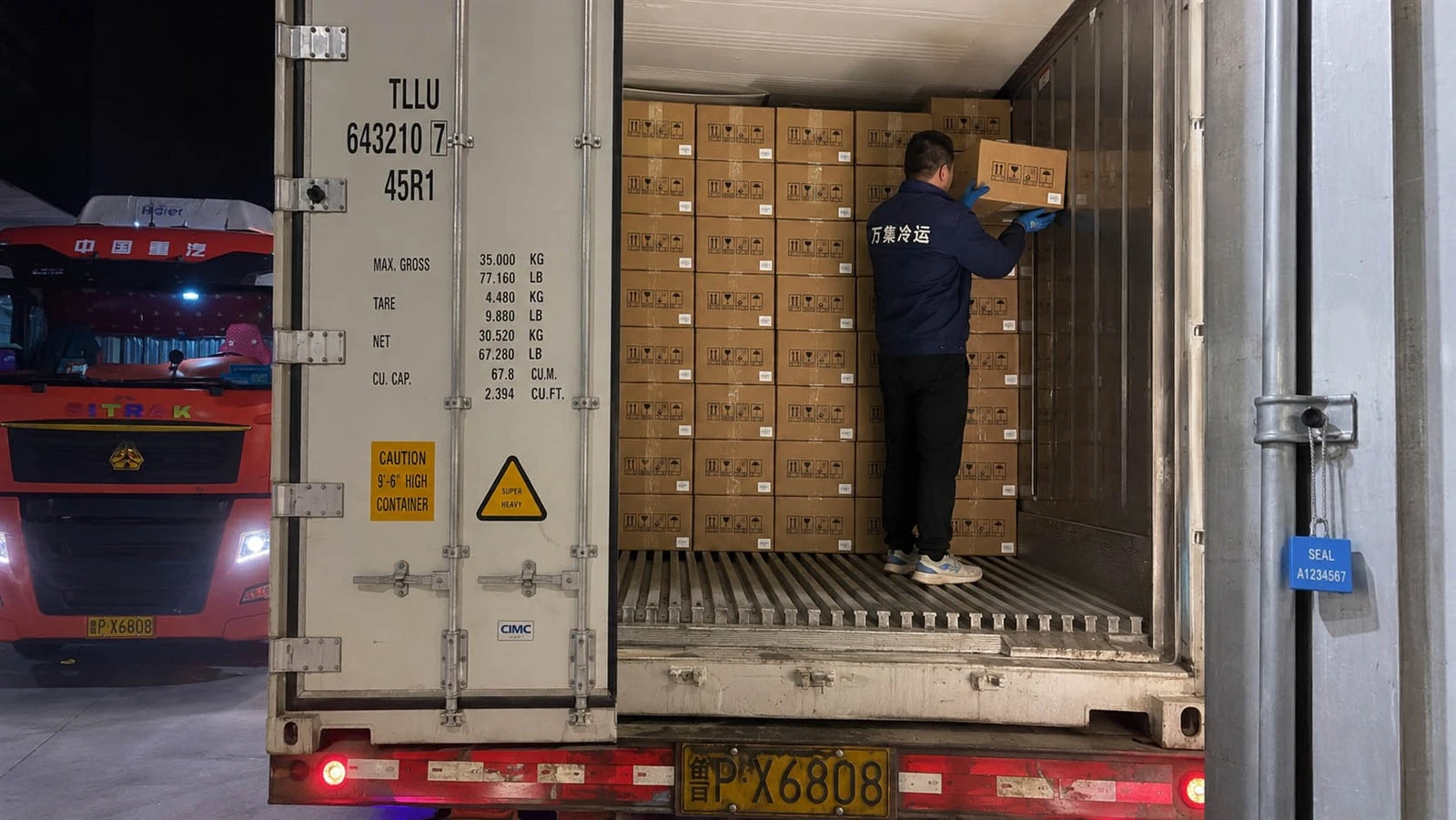
Loading records connect the released lot, carton or drum count, reefer setting, container number and seal number.
Documents Available for Buyer Review
Our product file can include the signed specification, batch COA, ingredient declaration, added-sugar and added-water declarations, seeded/seedless statement, pasteurization statement, shelf-life statement and nutrition information. Food-safety evidence can include microbiology, pesticide, heavy-metal, chlorate/perchlorate and contracted HAV/Norovirus reports, plus a process-validation summary and metal-detection record.
Compliance files can include allergen, non-GMO, non-irradiation and sulphite statements, packaging-compliance and food-contact declarations. Facility documents can include HACCP, BRCGS, ISO 22000, Kosher, Halal and organic certification when the actual site, product and certificate scope apply. Export documents include commercial invoice, packing list, certificate of origin, health certificate where applicable, bill of lading, loading record, container number and seal number.
Why Buyers Use Our Frozen Strawberry Puree Program
Defined Product Identity
We separate single-strength, concentrate, seeded, seedless, pulp, pasteurized, non-pasteurized and aseptic identities.
Formula-Controlled Supply
Brix, pH, acidity, screen, seed tolerance and Bostwick are written before production and measured by lot.
Application-Based Texture
Fine, standard and pulp-style options match beverage, dairy, bakery, ice cream, jam and sauce equipment.
Documented Food Safety
Heat-treatment status, microbiological grade, contaminant panel and intended use are visible in the order documents.
Actual Batch COA
The COA contains measured physicochemical, sensory, microbiological, packaging and temperature results.
Bulk and Private Label
We support 500 g retail pouches through 200 kg drums with lot coding, cold-chain and loading records.
Frozen Strawberry Puree FAQ
1. Is the correct commercial name "Frozen Strawberry Pure" or "Frozen Strawberry Puree"?
The correct product name is Frozen Strawberry Puree. "Pure" is an adjective; "puree" identifies fruit reduced to a smooth or semi-smooth preparation.
2. Is the standard product made from 100% strawberries?
Yes. Our standard unsweetened single-strength puree contains 100% strawberry with 0% added water and 0% added sugar. Sweetened formulations are separate SKUs with the exact sugar ratio declared.
3. What Brix, pH and acidity do you supply?
Standard natural Brix is 7.5-11°Bx, with Grade A at ≥8°Bx, premium selected lots at ≥9°Bx and high-Brix lots at ≥10°Bx. Standard pH is 3.0-3.8, with 3.1-3.6 available as the principal controlled range. Acidity is 0.50-1.20% as citric acid.
4. Which seedless, seeded and pulp screens are available?
Available apertures are 0.3-0.5, 0.5-0.7, 1.0-1.5, 1.5-2.0 and 2.0-3.0 mm. Premium seedless puree targets no more than three whole visible seeds per 100 g; fine seedless targets no more than five per 100 g.
5. What is the difference between puree, pulp and concentrate?
Puree is smooth and homogeneous; pulp uses a coarser screen and retains more fruit fibre and particles. Concentrate has part of the water removed and is sold under a separate 18-32°Bx concentrated-puree specification.
6. What does NFC strawberry puree mean?
NFC means Not From Concentrate. It is made directly from strawberry material without first concentrating and later reconstituting it.
7. Can you control puree consistency?
Yes. We combine screen aperture and Bostwick flow targets. Typical values at 20±1°C are 8-16 cm/30 s for fine seedless, 6-14 cm/30 s for standard seeded and 3-10 cm/30 s for pulp style.
8. Is the puree pasteurized and ready to eat?
Pasteurized and non-pasteurized products are separate. Non-pasteurized puree is not ready to eat and is supplied for further validated processing only. Pasteurized frozen puree follows a documented heat-treatment program but is not automatically aseptic.
9. What are the standard pasteurized microbiological limits?
APC ≤5,000 CFU/g, Enterobacteriaceae and coliforms <10 CFU/g, E. coli <10 CFU/g, yeast and mould ≤500 CFU/g, Salmonella not detected in 25 g and Listeria monocytogenes not detected in 25 g.
10. Can you provide HAV, Norovirus and premium beverage testing?
Yes. Contracted programs can add HAV and Norovirus GI/GII testing. Premium programs can target APC ≤500 CFU/g, yeast and mould ≤100 CFU/g, heat-resistant mould ≤10 CFU/g and Alicyclobacillus not detected in 10 g.
11. What is included in the batch COA?
The COA can include actual Brix, pH, acidity, Bostwick, screen, visible-seed count, large particles, color, flavor, microbiology, sulphur dioxide, contracted contaminants, fill weight, seal condition and product temperature.
12. Which packaging formats are available?
Formats include 500 g, 1 kg, 2.5 kg, 5 kg and 10 kg bags; 10 kg cartons; 20 kg bag-in-box; 12.7 kg and 20 kg pails; and 170 kg, 181 kg and 200 kg drums.
13. What are the MOQ and lead time?
Standard MOQ is 12 MT per specification, with 10-12 MT for drum programs. Matching-stock trials can start at 2-5 MT. Standard lead time is 15-21 days; printed retail packing requires 20-30 days after artwork approval.
14. How should frozen puree be thawed and used?
Thaw at 0-4°C, mix until homogeneous and use within 48 hours after complete thawing and opening while held at 0-4°C. Do not thaw at uncontrolled room temperature or repeatedly refreeze.
15. What details should be included in an inquiry?
State single-strength or concentrate, NFC status, seeded or seedless, puree or pulp, screen, Brix, pH, acidity, Bostwick, heat treatment, microbiology, contaminant panel, sugar ratio, packing, quantity, application, destination market and port.
Build Your Frozen Strawberry Puree Specification
Send us your application and production requirements. We will build the quotation around a named SKU, measurable texture, heat-treatment route, testing panel and exact pack rather than one generic "customized puree" description.
Inquiry checklist: single-strength or concentrate; NFC or from concentrate; seeded, seedless or pulp; screen aperture; natural or adjusted Brix; pH; acidity; Bostwick; Brookfield method if needed; pasteurized or non-pasteurized; microbiological grade; HAV/Norovirus testing; pesticide panel; heavy-metal limits; added sugar or ascorbic acid; packing; quantity; application; destination port; certification and private label.
Request Detailed Puree SpecificationRequest Sample and Batch COAGet Packing and Loading Plan
Hot Tags: Frozen Strawberry Pureee, China Frozen Strawberry Pureee manufacturers, suppliers, factory, frozen tropical fruit medley, frozen fruit kids snacks, frozen fruit dairy free snacks, frozen berry mix, frozen fruit smoothies, frozen fruit margaritas
Previous
Frozen Sweet Strawberries


