


Allergen Cleaning Verification on Frozen-Vegetable Lines: What Should Buyers Ask For?
Sep 29, 2026
Leave a message


Consider an illustrative changeover from edamame, which is a soybean food, to a different frozen vegetable on shared equipment. The question is whether soy protein might remain on a belt seam, hopper joint, utensil or transfer chute and reach the following product. This is a hypothetical buyer scenario. It does not state that GreenLand-food operates such a shared line, nor does it describe a measured GreenLand result. The buyer should first establish whether the proposed supplier site has this route at all. If equipment or production areas are dedicated, the evidence request will be different; if they are shared, the changeover record becomes central.
The evidence has to be read as a chain. Ingredient and scheduling records identify the hazard and the next product. A validation study establishes that a specified clean can work under a chosen challenge. Routine verification shows whether that clean was performed as approved. Testing can support the assessment when the method matches the allergen, material and surface. Finally, the label or claim must be assessed under the rules of the destination market and the actual product route. Buyers should not compress these decisions into a generic supplier declaration.
Define the ingredient and cross-contact routes
Start with the previous product's formulation, including ingredients in coatings, seasonings, sauces and processing aids where relevant. For plain edamame, the soybean identity is visible, but the supplier's allergen inventory still needs to identify the food and the product form handled on the line. In-pod edamame and shelled kernels can leave different material in equipment. A frozen vegetable blend could contain a soy ingredient even when the front of the pack emphasizes another vegetable. Conversely, an ordinary green vegetable may have no intentional soy ingredient but still need a cross-contact assessment if it follows soy on shared equipment. The product name alone does not resolve the route.
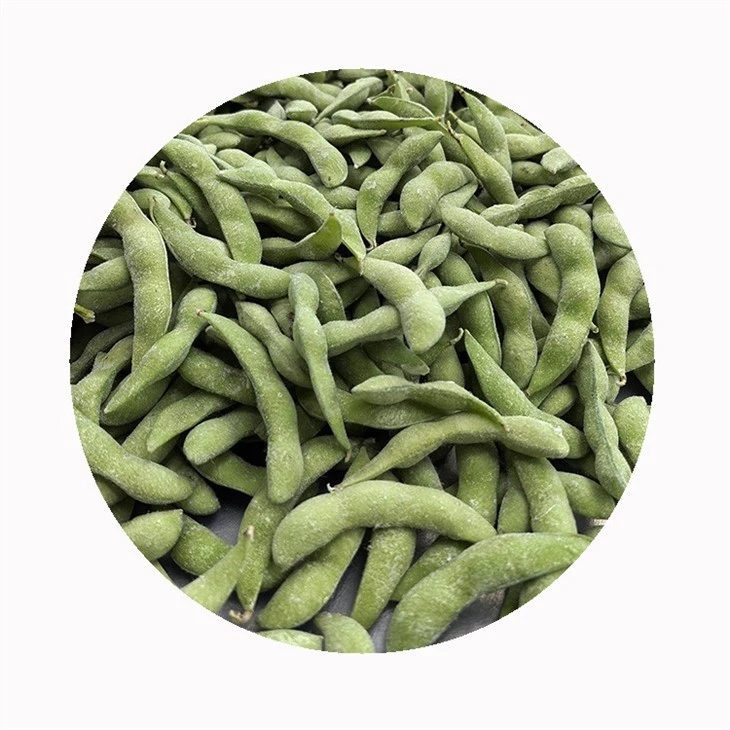
Actual in-pod soy ingredient form; not a shared-line claim.
The buyer's request should name the actual site, line and products in the proposed order. Ask for a process flow from ingredient receipt through weighing, washing or blanching, freezing, transfer, packing and rework handling. Mark where soy-containing material enters, where it may adhere, and where the later product becomes exposed. The same worker tools, collection bins, conveyor belts, grading equipment and packing chutes can create different routes. A site map is more useful than a general statement that "allergens are controlled" because it ties the claim to the surfaces and time window that matter.

An illustrative route must be checked against the actual site and product sequence.
One route can be direct: retained soybean fragments in a belt joint transfer to the next vegetable. Another can involve people and removable tools: a scoop, glove or maintenance part moves between areas. Rework or product hold bins need separate scrutiny because their contents and return path can outlast a routine washdown. The supplier's food safety team should identify the plausible routes in its own facility; a buyer should not assume that the illustrative paths drawn here exist on the proposed line. The record should also show how product scheduling, physical segregation and cleaning reduce the routes that are actually present.
Clarify the product's intended market use before judging the control claim. Bulk frozen vegetables for further processing, retail packs and a ready-to-eat meal component can have different exposure and labeling arrangements. The key allergen question is still the unintended presence of the relevant protein, but the customer may need different documents or approval steps before using the ingredient. Provide the supplier with the intended application and destination. Ask whether the product is supplied under a customer specification, a private-label specification or a general catalog description, and which one governs the declaration.
This ingredient review should precede test selection. A test kit may say "soy," yet its recovery can depend on whether the residue is raw, blanched, heated, fermented or mixed with other food soil. A swab from an easily accessed flat surface may miss the narrow joint that the route analysis identifies. The purchasing team does not need to prescribe the laboratory assay, but it should ask the supplier's qualified reviewer to show that the method and locations were selected for the real hazard. This keeps testing from becoming a decorative addition to a generic cleaning certificate.
Distinguish validation from routine verification
Validation asks whether a defined cleaning procedure is capable of reducing or removing the target allergen residue under the conditions for which it will be used. Routine verification asks whether the approved procedure was carried out and continues to work during ordinary production. Those two forms of evidence answer different questions. A validation study from an earlier date does not prove that last Tuesday's clean was executed correctly. A signed checklist from last Tuesday does not establish that the checklist's procedure was ever effective against soy residue in a difficult joint. The Codex code of practice on food allergen management treats allergen management as part of the food business's control system.

Equipment geometry, product soil and cleaning action define a meaningful challenge.
For the validation file, ask what condition was deliberately challenged. A useful study should resemble the most difficult relevant product and equipment condition, rather than an easy clean on a smooth empty belt. The prior ingredient's soy loading, particle size, stickiness, product temperature, run length and drying time can affect residue removal. Equipment geometry also matters: hinges, gaskets, hollow rollers, belt returns and removable parts may require disassembly or separate cleaning steps. The validation protocol should state the chosen challenge, why it represented a hard case, how cleaning was performed and which sites were sampled before and after it.
The study also needs controls that make the result interpretable. A positive control or suitable pre-clean sample shows that the assay can recover the target in that context; a negative control helps identify contamination in sampling or analysis. Surface swabs may be paired with a following product sample when the technical team judges that useful. The laboratory report should identify the assay, target, reporting basis and method limitations. A blank or "not detected" result is weaker if there is no evidence that the method worked on the residue and matrix being challenged. A practitioner review of allergen cleaning validation discusses challenge conditions and routine verification, although an individual supplier study still requires its own review.
The approved procedure should emerge clearly from validation. It may define pre-rinse, detergent type and concentration, mechanical action, contact time, water temperature, disassembly points, sanitation, inspection and reassembly. These are examples of parameters to check, not a universal recipe. If the supplier changes detergent, equipment, product form or operating sequence, ask how it decided whether revalidation was needed. A validated clean is valid only within its stated scope. A procedure shown to remove one allergen in one product matrix should not be extended to another allergen, a new sticky sauce or a different line without technical justification.
The study report should also state how many independent cleaning runs were evaluated and how the investigators treated an inconsistent result. A single demonstration can miss variation in operator technique, run duration or the condition of removable parts. Buyers can ask for the protocol, summary and approved operating procedure without requesting proprietary details that do not affect the conclusion. The essential point is reproducibility under the stated challenge. If the validation evidence is old, ask whether the line and recipe still match the conditions described in that report.

A validation plan should explain why its selected sites are difficult to clean.
Routine verification is the production-day record. It should link the prior soy-containing run, the cleaned equipment, the next product, the trained operator, the completed steps, visual inspection, any planned swabs or other checks, and the sign-off before restart. If a step was missed or a component could not be reached, the response should be recorded before the next product flows through the line. Trend review can show whether repeated difficult sites remain under control. The buyer may not receive every internal log, but an audit or supplier approval file should make the logic and ownership of these records visible.
Choose tests that match the residue and surface
Test selection follows the hazard question. ATP detects a general biochemical signal from living-cell material and food residues on the sampled surface. A generic protein test can indicate that some proteinaceous soil remains. An allergen-specific method is intended to detect a defined target, such as soy protein, within the method's validated scope. The tests are not substitutes for one another. The University of Georgia Extension swab guidance notes that a target-specific allergen swab is needed when the concern is a particular allergen; a generic protein or ATP result cannot identify it.
For a surface assay, ask whether the method is suitable for stainless steel, plastic belt material, gasket rubber or another surface being swabbed. Recovery can differ across smooth and rough materials. The laboratory or kit instructions may require a defined area, wetting fluid, swab motion and extraction. If the equipment has irregular seams, the team should justify how it samples them. The result must be tied to that specific location and to the moment after cleaning, before the following product could contact it. A result from a convenient table cannot stand in for a belt joint identified as the highest-risk site.
The material being tested also matters. Processing can change protein structure and affect antibody-based assays. A soy-specific kit evaluated on one ingredient may not perform identically on a cooked or highly processed residue, especially when cleaning chemicals or mixed vegetable soil remain. Laboratories may offer ELISA, lateral-flow or other approaches, each with an intended use, detection limit and potential interference. Ask for the supplier's method-suitability rationale for the actual residue and sample matrix. The buyer should avoid prescribing a universal detection number from a different process. A result below a stated method limit means the target was not detected under those conditions; it is not a promise of absolute zero.

General hygiene indicators and a soy-specific assay answer different questions.
Sometimes ATP remains useful as an immediate process check. It can reveal inadequate cleaning before a slower target-specific result is available, giving the team a chance to reclean. That practical role does not make it an allergen release test. If the supplier uses ATP for routine verification after allergen validation, ask how the ATP action level was correlated with successful removal in the validated procedure, what other checks remain in place, and which situations trigger target-specific testing. The answer should be documented by the qualified site team, not inferred from a general-purpose luminometer reading.
Request a report that preserves the sample chain. It should identify the prior allergen-containing product, swab site, sample time, method, result, reporting unit or detection limit where applicable, control results, laboratory and action taken. When a follow-on product sample is used, its lot and position in the production run must be clear. A composite sample can make a record convenient, but it may obscure which location contributed a signal; the supplier should explain why the design fits the question. The goal is not to maximize swab count. It is to choose points and assays that can challenge the actual cross-contact route.
Connect findings to corrective actions and product decisions
When a verification point fails, ask for the affected production window. The record should show when the last acceptable clean occurred, when the failure was collected and reported, what product was made while the result was pending, and whether any product was held. An ATP failure may require recleaning and rechecking a surface under the approved procedure. A target-specific soy detection can prompt a broader technical investigation of the line, equipment, product sequence and exposure. The site should document who made the decisions and what evidence supported them. A repeat negative at the same easy site does not necessarily address a transfer route through an unexamined joint.

Shelled edamame is a different soy product form; the image is not a residue finding.
Product form can influence the investigation. Shelled edamame kernels can reach seams that intact pods may not; small fragments and loose skins can remain under guards or belt returns. This photograph shows a GreenLand shelled edamame product form, not a residue finding. In an actual supplier review, ask which form ran before the clean and which form was packed next. The supplier should be able to connect the cleaning record and any swab result to those products and their lot identifiers. A generic declaration for "frozen vegetables" does not supply that connection.

Result timing and lot identity define which later product needs review.
The corrective file should distinguish line readiness from product disposition. Recleaning and a satisfactory verification check may support restarting equipment under the validated procedure. Product already produced in a potentially affected window requires a separate assessment. That assessment may consider the allergen and next product, sampling limits, traceability, intended market and labeling options; its outcome must follow the site's food safety plan and applicable law. A buyer should not treat a later clean swab as proof that earlier product was unaffected. The relevant technical owner should sign the disposition decision.
If the same site fails repeatedly, a narrow reclean-and-reswab loop may hide a persistent equipment or procedure problem. Ask whether maintenance, disassembly, cleaning chemistry, operator training or production scheduling was revised, and how the revision was verified. A change can require renewed validation if it alters the conditions under which the original study demonstrated effectiveness. Supplier approval is strengthened by a transparent trend and a closed action record, even when the file includes a problem. The important evidence is that the system can detect the route, contain affected product and prevent recurrence.
Procurement should agree on what information it needs before a failure occurs. The specification can request notice of a relevant allergen-control deviation, hold status for affected lots, method and result records, and written approval before release under the agreed process. Where a buyer has a private-label product, its own quality and regulatory teams should define the approval authority. This avoids a rushed interpretation after a shipment has already been allocated to customers. The supplier can protect confidential site details while still providing enough traceability and technical reasoning to support the buyer's decision.
Check destination-market wording separately
The label or supplier declaration is a distinct decision from the cleaning result. An intentional soy ingredient requires one kind of ingredient and allergen declaration; possible unintended cross-contact requires a risk assessment under the destination market's rules and the buyer's product claim. The precise terms used on a retail pack, private-label artwork or B2B specification should be reviewed by qualified regulatory staff for that market. Do not assume that one precautionary phrase, one numerical threshold or one certificate works globally. A valid statement must describe the actual product route and evidence available at the site.

The actual route and destination determine the wording review.
For the United States, the FDA food-allergy overview describes allergen cross-contact and labeling as part of preventive-control expectations. The Codex allergen-management code provides international control principles. Neither document, by itself, approves a particular label for a particular frozen vegetable shipment. The destination, formulation, processing site, target consumer and intended claim all need review. If the customer wants a "free from" statement, its evidence demand is especially consequential and should be settled before artwork is printed or product is committed.
The purchase brief can keep the commercial and technical questions together without making them interchangeable. Specify the frozen vegetable form, cut, blanching or cooking status, packing, order quantity, application, destination, private-label needs and requested documents. Add the ingredient and allergen declaration scope, the site and line proposed, whether equipment is shared or dedicated, the applicable cleaning validation and routine verification summary, and the escalation rule for a relevant finding. A change in site, line, ingredient or recipe should trigger a renewed statement rather than silently reusing an old declaration.
Customers sometimes compare two supplier declarations whose wording looks identical even though the underlying product routes differ. One statement may cover only a dedicated packing operation; another may include a shared preparation line and a validated changeover. The purchasing team should ask for the scope and date on each declaration and keep it linked to the approved specification. A current, narrow statement is more useful than a broad certificate that cannot be traced to the product ordered. The final retail claim should be derived from the reviewed route, test limitations and destination rules, not from a general marketing description.
At GreenLand-food, we supply frozen vegetables as a professional supplier and manufacturer in China, and we help buyers define the evidence needed for their intended product. Our IQF edamame product page identifies product forms, while the frozen vegetable category gives broader sourcing context. Our quality-control system page describes control stages. These links give context; they do not establish that a hypothetical shared-line scenario occurred at our facility. For an actual order, our team should confirm the applicable site, route and documentation against the buyer's specification.
The useful closing question for a buyer is concrete: which allergen-containing ingredient ran where, what exact clean was validated for that equipment and residue, which production-day records show the approved clean occurred, what assay could detect the target at the difficult sites, and who decided the fate of any product made during a deviation? A supplier answer that connects those points is more useful than a collection of unrelated "clean" stamps. It allows the buyer's QA and regulatory reviewers to judge the proposed frozen-vegetable program on its actual evidence.
Source frozen vegetables with GreenLand-food
GreenLand-food is a professional frozen vegetables supplier and manufacturer in China, providing factory-direct wholesale supply for importers, food manufacturers, foodservice distributors and private-label programs.
Send the product form, specification, packing, quantity, application, destination, private-label needs and requested documents.