


Can Roasted Cauliflower Be Frozen and Reheated?
Sep 23, 2026
Leave a message

Can Roasted Cauliflower Be Frozen and Reheated?

Can Roasted Cauliflower Be Frozen and Reheated?.
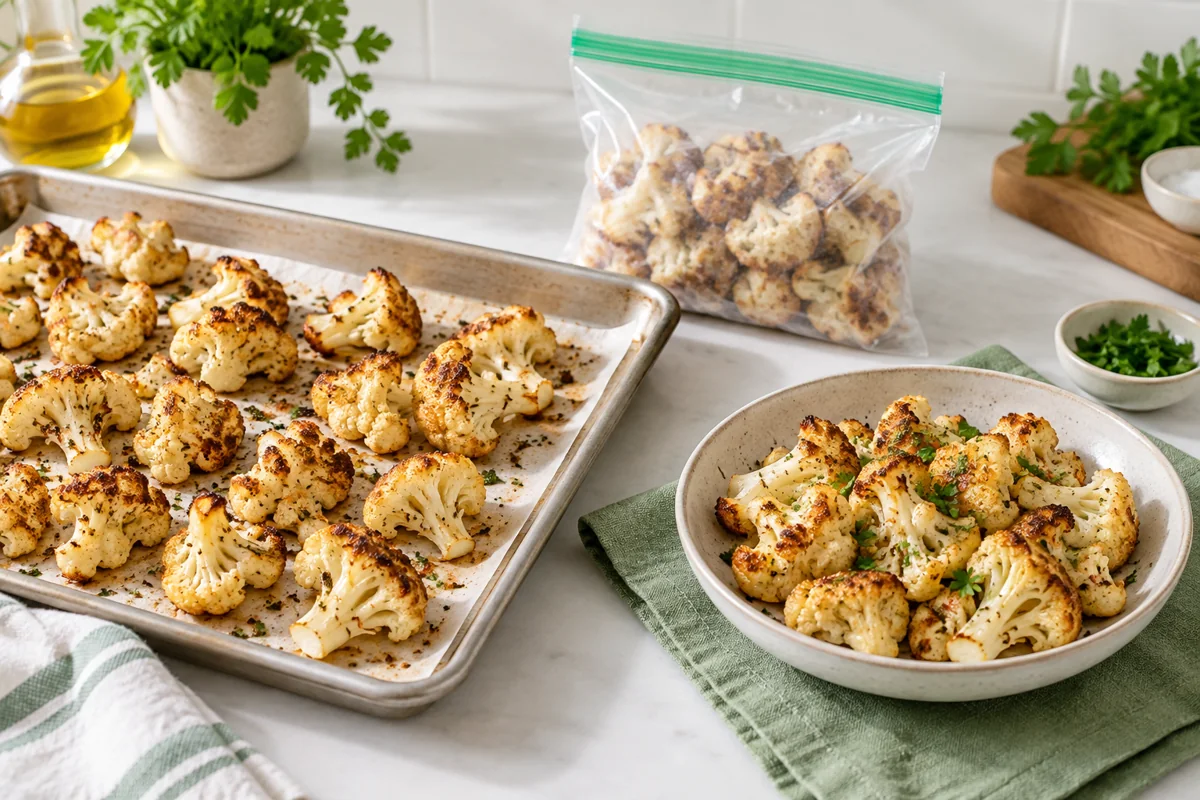
Roasted cauliflower freezes successfully when it is cooled and packed promptly, although the thawed cell structure becomes softer. The browned surface contains less free water than a steamed surface, which helps, but moisture still migrates during freezing and reheating.
In practice, this is where many otherwise careful batches go wrong. Freeze only a sound freshly cooked batch, not leftovers that have already spent an uncertain period warm. The useful control is to decide the endpoint before starting, then keep the preparation, package and later use consistent.
For a buyer or production manager, the same issue becomes a specification question. Choose the later application before packing because crisp side-dish portions and soup ingredients need different handling. Record what was tested, including starting condition, portion or load, equipment and the observed result, so the next batch can be compared on the same basis.
Keep safety decisions tied to time, temperature and the operation's leftover plan rather than to color alone. That boundary matters because a convenient household method is not automatically a validated commercial process. This page covers cauliflower after it has been roasted; it does not repeat instructions for roasting raw frozen cauliflower.
Authoritative background for this section includes USDA FSIS Leftovers and Food Safety USDA FSIS Freezing and Food Safety. These sources support the preservation or handling principles; the application recommendation still needs to be confirmed against the actual product and operating procedure.
A useful working check for "Can Roasted Cauliflower Be Frozen and Reheated?" is to write down the starting material, the intended finished use, the variable being controlled and the point at which the result will be accepted. The browned surface contains less free water than a steamed surface, which helps, but moisture still migrates during freezing and reheating. Then repeat the method with the normal production or household portion rather than judging only a tiny demonstration. Watch what happens during packing, freezing, heating or thawing as applicable, because a problem that appears at the end may have started much earlier. Choose the later application before packing because crisp side-dish portions and soup ingredients need different handling. If the result changes, investigate the material, load, temperature history, equipment and holding sequence before changing several settings at once. This simple record also makes supplier conversations more useful: both sides can discuss a defined form and observed performance instead of relying on broad adjectives. Finally, keep the limitation visible. Keep safety decisions tied to time, temperature and the operation's leftover plan rather than to color alone.
Roast With Freezing in Mind

Roast With Freezing in Mind using the specific product form shown.
| Route or format | Useful when | Main control |
|---|---|---|
| Hot oven or convection | Drier browned edges | Spread one layer and avoid covered holding |
| Air fryer | Small crisp batches | Match load to basket airflow |
| Microwave | Fast soft reheating | Expect more steam and less browning |
Use evenly sized florets and enough pan space for evaporation so the first roast develops dry browned edges. The decision should follow the intended use rather than a habit carried over from another format. Stop before the smallest pieces become brittle because every portion will receive another heat cycle.
A practical trial should change one variable at a time. Heavy wet sauce, excessive oil and crowded pans create a softer starting point that freezing cannot correct. If several variables move together, a wetter, softer or less even result cannot be diagnosed reliably.
Seasonings that burn easily can be added during reheating, while stable dry spices can be applied in the first roast. For repeat production, write the relevant cut, starting state, load, package and endpoint into the method. Staff should not have to infer them from a photograph.
Record finished yield and browning level when producing a batch for later service. We treat that as a quality-control choice, not a marketing promise. This page covers cauliflower after it has been roasted; it does not repeat instructions for roasting raw frozen cauliflower.
The core preservation and handling references are USDA FSIS Leftovers and Food Safety USDA FSIS Freezing and Food Safety. They are used for factual limits and process logic, while exact product directions retain priority.
A useful working check for "Roast With Freezing in Mind" is to write down the starting material, the intended finished use, the variable being controlled and the point at which the result will be accepted. Stop before the smallest pieces become brittle because every portion will receive another heat cycle. Then repeat the method with the normal production or household portion rather than judging only a tiny demonstration. Watch what happens during packing, freezing, heating or thawing as applicable, because a problem that appears at the end may have started much earlier. Seasonings that burn easily can be added during reheating, while stable dry spices can be applied in the first roast. If the result changes, investigate the material, load, temperature history, equipment and holding sequence before changing several settings at once. This simple record also makes supplier conversations more useful: both sides can discuss a defined form and observed performance instead of relying on broad adjectives. Finally, keep the limitation visible. Record finished yield and browning level when producing a batch for later service.
Cool Before Steam Softens the Surface
Cool Before Steam Softens the Surface.
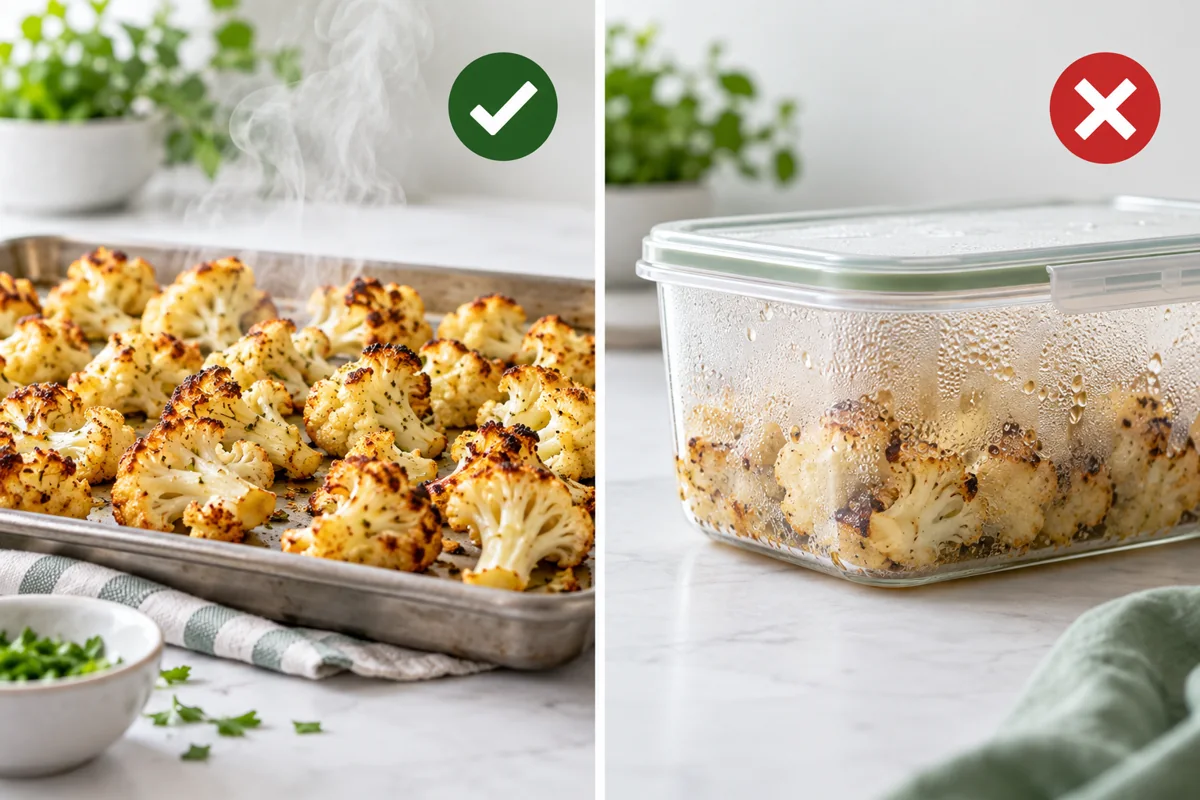
- Move roasted florets away from the hot crowded pan so residual steam does not condense around them.
- Spread them in a shallow clean layer and follow applicable cooling limits; a sealed deep container cools too slowly.
- Do not leave the tray at room temperature for an open-ended attempt to preserve crispness.
- Pack only after visible steam has gone and the food is properly chilled, because trapped condensation becomes extra ice.
Move roasted florets away from the hot crowded pan so residual steam does not condense around them. Spread them in a shallow clean layer and follow applicable cooling limits; a sealed deep container cools too slowly.
The most useful check is not whether the method can work once, but whether it works with the exact material, portion and equipment that will be used. Do not leave the tray at room temperature for an open-ended attempt to preserve crispness. Keep the first comparison small enough to observe clearly.
In procurement, translate the observation into something confirmable. Pack only after visible steam has gone and the food is properly chilled, because trapped condensation becomes extra ice. A written requirement makes supplier review and incoming inspection more objective.
Separate cooling control from the later freezing step in production records so deviations can be traced. Avoid converting a quality range into a safety guarantee or a photograph into proof of an unseen process. This page covers cauliflower after it has been roasted; it does not repeat instructions for roasting raw frozen cauliflower.
Reference points: USDA FSIS Leftovers and Food Safety USDA FSIS Freezing and Food Safety. Use the applicable label, local food-safety plan and product specification whenever they are more specific.
A useful working check for "Cool Before Steam Softens the Surface" is to write down the starting material, the intended finished use, the variable being controlled and the point at which the result will be accepted. Spread them in a shallow clean layer and follow applicable cooling limits; a sealed deep container cools too slowly. Then repeat the method with the normal production or household portion rather than judging only a tiny demonstration. Watch what happens during packing, freezing, heating or thawing as applicable, because a problem that appears at the end may have started much earlier. Pack only after visible steam has gone and the food is properly chilled, because trapped condensation becomes extra ice. If the result changes, investigate the material, load, temperature history, equipment and holding sequence before changing several settings at once. This simple record also makes supplier conversations more useful: both sides can discuss a defined form and observed performance instead of relying on broad adjectives. Finally, keep the limitation visible. Separate cooling control from the later freezing step in production records so deviations can be traced.
Tray Freeze and Pack in Useful Portions
Tray Freeze and Pack in Useful Portions.
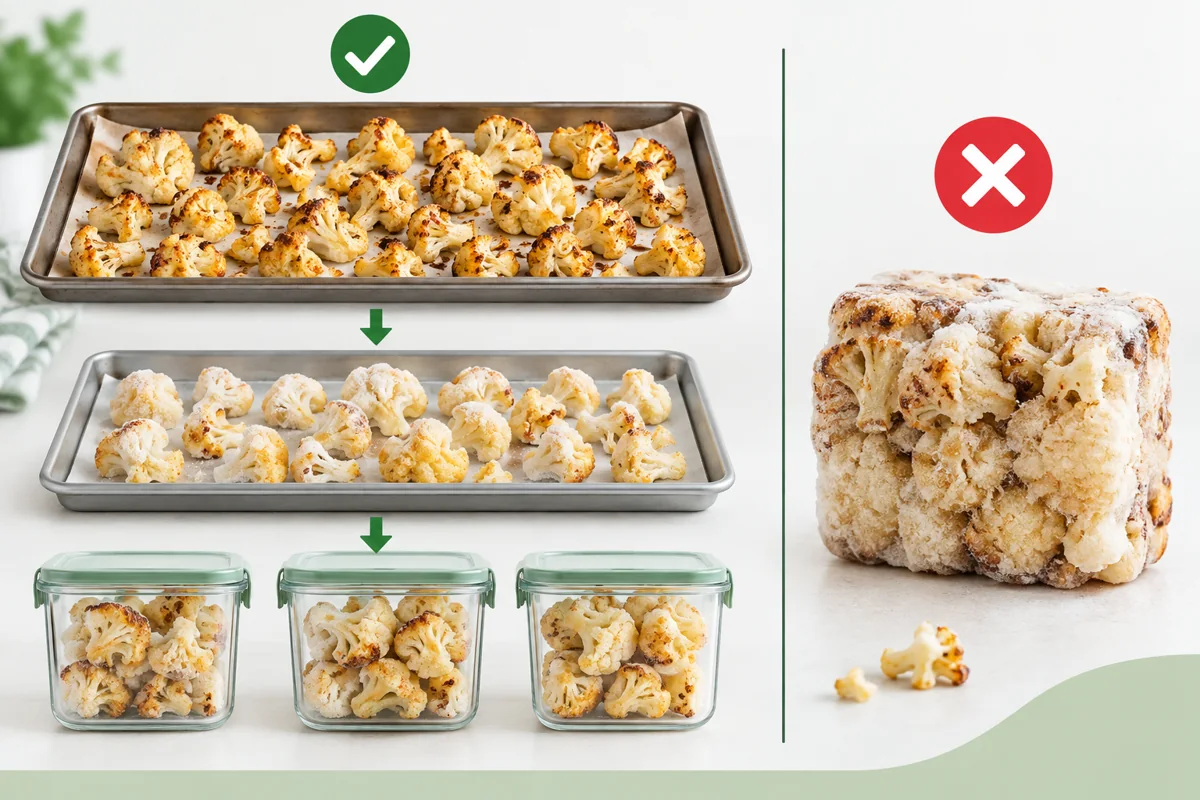
Arrange cooled florets in one layer on a lined tray and freeze until firm enough to transfer without crushing. That is the physical reason behind the recommendation. Move them promptly into moisture-vapor-resistant packaging rather than storing them uncovered on the tray.
Work in a clean, controlled sequence and avoid adding an unnecessary thawing or holding step. Remove excess air, keep the sealing surface clean and label the cook date, freeze date and portion size. A shorter process is not automatically better, but every extra transition introduces another variable.
Flat single-service packs reduce thawing and make it easier to reheat only the quantity needed. In a commercial review, compare the same quantity under the same conditions and record yield, appearance, texture and handling loss.
A compact frozen block is usable for puree but inefficient when intact browned florets are required. The result should be described honestly: useful for the named application, not perfect under every condition. This page covers cauliflower after it has been roasted; it does not repeat instructions for roasting raw frozen cauliflower.
Process principles were checked against USDA FSIS Leftovers and Food Safety USDA FSIS Freezing and Food Safety. Those references do not verify a supplier-specific specification; current product documents do.
A useful working check for "Tray Freeze and Pack in Useful Portions" is to write down the starting material, the intended finished use, the variable being controlled and the point at which the result will be accepted. Move them promptly into moisture-vapor-resistant packaging rather than storing them uncovered on the tray. Then repeat the method with the normal production or household portion rather than judging only a tiny demonstration. Watch what happens during packing, freezing, heating or thawing as applicable, because a problem that appears at the end may have started much earlier. Flat single-service packs reduce thawing and make it easier to reheat only the quantity needed. If the result changes, investigate the material, load, temperature history, equipment and holding sequence before changing several settings at once. This simple record also makes supplier conversations more useful: both sides can discuss a defined form and observed performance instead of relying on broad adjectives. Finally, keep the limitation visible. A compact frozen block is usable for puree but inefficient when intact browned florets are required.
Choose the Reheating Method by Texture Goal

Choose the Reheating Method by Texture Goal.
For browned edges, use an uncovered hot oven, convection oven or air fryer with a single uncrowded layer. A microwave is faster and useful for soft applications, but trapped steam makes the surface less crisp.
In practice, this is where many otherwise careful batches go wrong. Reheat from frozen when the equipment and recipe allow, or thaw under refrigeration when portion separation requires it. The useful control is to decide the endpoint before starting, then keep the preparation, package and later use consistent.
For a buyer or production manager, the same issue becomes a specification question. Turn or shake only as needed so fragile florets do not break into crumbs. Record what was tested, including starting condition, portion or load, equipment and the observed result, so the next batch can be compared on the same basis.
Validate the time and endpoint for the actual portion, equipment and product rather than repeating one universal schedule. That boundary matters because a convenient household method is not automatically a validated commercial process. This page covers cauliflower after it has been roasted; it does not repeat instructions for roasting raw frozen cauliflower.
Authoritative background for this section includes USDA FSIS Leftovers and Food Safety USDA FSIS Freezing and Food Safety. These sources support the preservation or handling principles; the application recommendation still needs to be confirmed against the actual product and operating procedure.
A useful working check for "Choose the Reheating Method by Texture Goal" is to write down the starting material, the intended finished use, the variable being controlled and the point at which the result will be accepted. A microwave is faster and useful for soft applications, but trapped steam makes the surface less crisp. Then repeat the method with the normal production or household portion rather than judging only a tiny demonstration. Watch what happens during packing, freezing, heating or thawing as applicable, because a problem that appears at the end may have started much earlier. Turn or shake only as needed so fragile florets do not break into crumbs. If the result changes, investigate the material, load, temperature history, equipment and holding sequence before changing several settings at once. This simple record also makes supplier conversations more useful: both sides can discuss a defined form and observed performance instead of relying on broad adjectives. Finally, keep the limitation visible. Validate the time and endpoint for the actual portion, equipment and product rather than repeating one universal schedule.
Use Softer Reheated Cauliflower Productively

Use Softer Reheated Cauliflower Productively.
Softer florets work well in soup, curry, grain bowls, pasta sauce, mash, puree and blended vegetable bases. The decision should follow the intended use rather than a habit carried over from another format. For a visible side dish, reserve the least damaged pieces and use dry high heat close to service.
A practical trial should change one variable at a time. Released moisture can be useful in a sauce but should be evaporated before it dilutes a bowl or filling. If several variables move together, a wetter, softer or less even result cannot be diagnosed reliably.
Measure reheated yield and breakage during a trial instead of judging only the frozen package. For repeat production, write the relevant cut, starting state, load, package and endpoint into the method. Staff should not have to infer them from a photograph.
Redirecting a quality-appropriate batch is sound planning; concealing unsafe handling or severe defects is not. We treat that as a quality-control choice, not a marketing promise. This page covers cauliflower after it has been roasted; it does not repeat instructions for roasting raw frozen cauliflower.
The core preservation and handling references are USDA FSIS Leftovers and Food Safety USDA FSIS Freezing and Food Safety. They are used for factual limits and process logic, while exact product directions retain priority.
A useful working check for "Use Softer Reheated Cauliflower Productively" is to write down the starting material, the intended finished use, the variable being controlled and the point at which the result will be accepted. For a visible side dish, reserve the least damaged pieces and use dry high heat close to service. Then repeat the method with the normal production or household portion rather than judging only a tiny demonstration. Watch what happens during packing, freezing, heating or thawing as applicable, because a problem that appears at the end may have started much earlier. Measure reheated yield and breakage during a trial instead of judging only the frozen package. If the result changes, investigate the material, load, temperature history, equipment and holding sequence before changing several settings at once. This simple record also makes supplier conversations more useful: both sides can discuss a defined form and observed performance instead of relying on broad adjectives. Finally, keep the limitation visible. Redirecting a quality-appropriate batch is sound planning; concealing unsafe handling or severe defects is not.
Foodservice Batch and Product-Form Decisions

Foodservice Batch and Product-Form Decisions using the specific product form shown.
Foodservice teams should distinguish roasted leftovers from raw or blanched frozen cauliflower purchased for later cooking. Confirm floret size, stem ratio, blanching status, defects, loose-flow condition, pack and cold-chain requirements for commercial supply.
The most useful check is not whether the method can work once, but whether it works with the exact material, portion and equipment that will be used. Plan batch size around expected service so repeated reheating and long holding do not erase the benefit of freezing. Keep the first comparison small enough to observe clearly.
In procurement, translate the observation into something confirmable. The real product images show frozen cauliflower as a supply input, not a claim that the pictured florets were previously roasted. A written requirement makes supplier review and incoming inspection more objective.
We can review frozen cauliflower formats and application needs against a written specification before confirming an offer. Avoid converting a quality range into a safety guarantee or a photograph into proof of an unseen process. This page covers cauliflower after it has been roasted; it does not repeat instructions for roasting raw frozen cauliflower.
Reference points: USDA FSIS Leftovers and Food Safety USDA FSIS Freezing and Food Safety. Use the applicable label, local food-safety plan and product specification whenever they are more specific.
A useful working check for "Foodservice Batch and Product-Form Decisions" is to write down the starting material, the intended finished use, the variable being controlled and the point at which the result will be accepted. Confirm floret size, stem ratio, blanching status, defects, loose-flow condition, pack and cold-chain requirements for commercial supply. Then repeat the method with the normal production or household portion rather than judging only a tiny demonstration. Watch what happens during packing, freezing, heating or thawing as applicable, because a problem that appears at the end may have started much earlier. The real product images show frozen cauliflower as a supply input, not a claim that the pictured florets were previously roasted. If the result changes, investigate the material, load, temperature history, equipment and holding sequence before changing several settings at once. This simple record also makes supplier conversations more useful: both sides can discuss a defined form and observed performance instead of relying on broad adjectives. Finally, keep the limitation visible. We can review frozen cauliflower formats and application needs against a written specification before confirming an offer.
Source frozen cauliflower with GreenLand-food
We supply and coordinate frozen cauliflower for wholesale and factory-direct programs. As a manufacturer-facing supplier, GreenLand-food will review the requested form, packing, documents and application before confirming an offer. This page covers cauliflower after it has been roasted; it does not repeat instructions for roasting raw frozen cauliflower.