


How to Freeze Asparagus Without Blanching: What Changes?
Sep 23, 2026
Leave a message


Can You Freeze Asparagus Without Blanching?

Can You Freeze Asparagus Without Blanching?.
Raw asparagus will freeze solid, so the literal answer is yes, but freezing alone does not stop every quality reaction. Blanching is recommended in tested preservation guidance because it slows enzyme activity that otherwise affects color, flavor and texture.
In practice, this is where many otherwise careful batches go wrong. Skipping that step may be reasonable for a small short-term batch intended for a forgiving cooked dish. The useful control is to decide the endpoint before starting, then keep the preparation, package and later use consistent.
For a buyer or production manager, the same issue becomes a specification question. It is a poor choice when bright appearance, distinct spear texture or extended storage is the main goal. Record what was tested, including starting condition, portion or load, equipment and the observed result, so the next batch can be compared on the same basis.
Treat no-blanch freezing as a deliberate compromise, not as proof that blanching has no purpose. That boundary matters because a convenient household method is not automatically a validated commercial process. No-blanch home freezing is a convenience shortcut with faster quality change; it is not equivalent to a validated blanched process or commercial IQF asparagus.
Authoritative background for this section includes National Center for Home Food Preservation Colorado State University Extension. These sources support the preservation or handling principles; the application recommendation still needs to be confirmed against the actual product and operating procedure.
A useful working check for "Can You Freeze Asparagus Without Blanching?" is to write down the starting material, the intended finished use, the variable being controlled and the point at which the result will be accepted. Blanching is recommended in tested preservation guidance because it slows enzyme activity that otherwise affects color, flavor and texture. Then repeat the method with the normal production or household portion rather than judging only a tiny demonstration. Watch what happens during packing, freezing, heating or thawing as applicable, because a problem that appears at the end may have started much earlier. It is a poor choice when bright appearance, distinct spear texture or extended storage is the main goal. If the result changes, investigate the material, load, temperature history, equipment and holding sequence before changing several settings at once. This simple record also makes supplier conversations more useful: both sides can discuss a defined form and observed performance instead of relying on broad adjectives. Finally, keep the limitation visible. Treat no-blanch freezing as a deliberate compromise, not as proof that blanching has no purpose.
What Continues to Change in Raw Frozen Asparagus
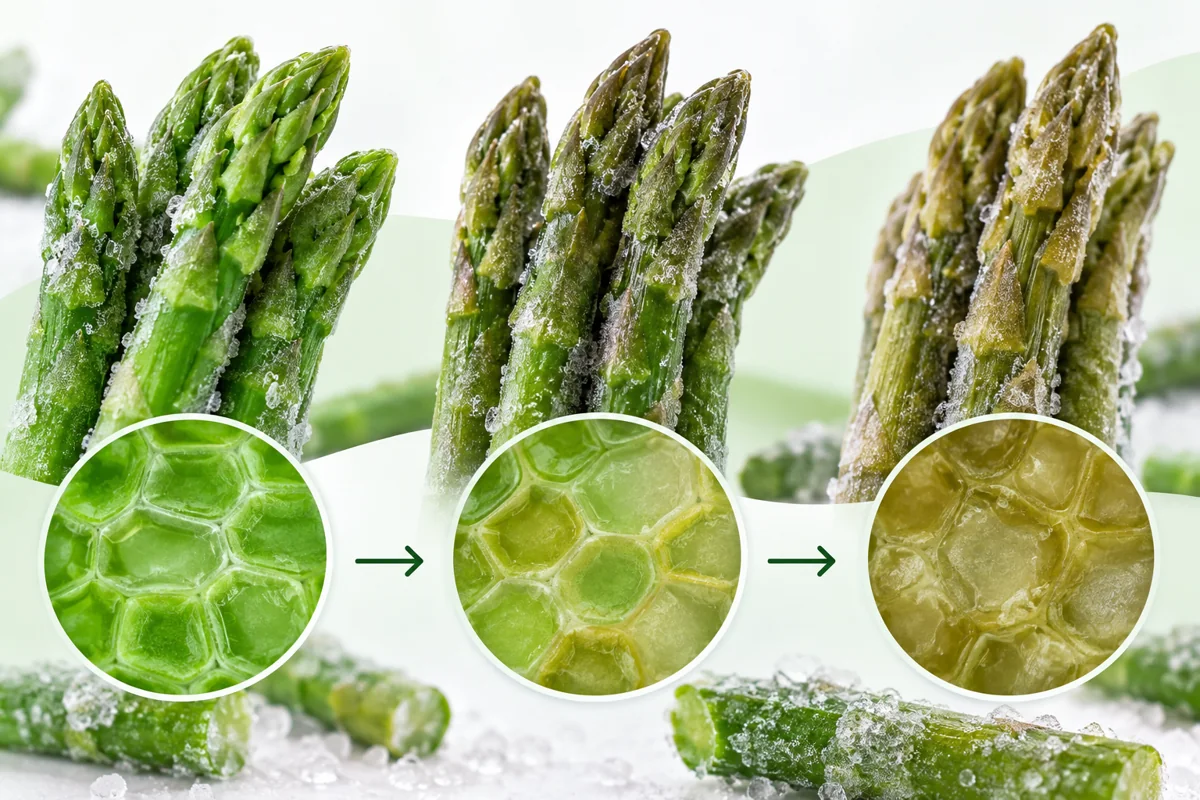
What Continues to Change in Raw Frozen Asparagus.
| Route or format | Useful when | Main control |
|---|---|---|
| Raw no-blanch | Short-term convenience and tolerant dishes | Faster color, flavor and texture change |
| Blanched home batch | Longer quality protection | Use tested size-based times |
| Commercial IQF | Repeatable bulk or foodservice supply | Confirm the actual specification |
Cold greatly slows reactions, but active enzymes can still contribute to dull color, grassy or stale notes and texture loss over time. The decision should follow the intended use rather than a habit carried over from another format. Ice crystals also rupture plant cells, so thawed raw-frozen spears release water and bend more easily than fresh ones.
A practical trial should change one variable at a time. Slow freezing, warm loading and temperature cycling enlarge crystals and make this damage more noticeable. If several variables move together, a wetter, softer or less even result cannot be diagnosed reliably.
Thin tips and thick bases respond differently, which is why mixed diameters can give uneven quality in one bag. For repeat production, write the relevant cut, starting state, load, package and endpoint into the method. Staff should not have to infer them from a photograph.
The changes are mainly quality issues, while safe handling and continuous freezing remain separate requirements. We treat that as a quality-control choice, not a marketing promise. No-blanch home freezing is a convenience shortcut with faster quality change; it is not equivalent to a validated blanched process or commercial IQF asparagus.
The core preservation and handling references are National Center for Home Food Preservation Colorado State University Extension. They are used for factual limits and process logic, while exact product directions retain priority.
A useful working check for "What Continues to Change in Raw Frozen Asparagus" is to write down the starting material, the intended finished use, the variable being controlled and the point at which the result will be accepted. Ice crystals also rupture plant cells, so thawed raw-frozen spears release water and bend more easily than fresh ones. Then repeat the method with the normal production or household portion rather than judging only a tiny demonstration. Watch what happens during packing, freezing, heating or thawing as applicable, because a problem that appears at the end may have started much earlier. Thin tips and thick bases respond differently, which is why mixed diameters can give uneven quality in one bag. If the result changes, investigate the material, load, temperature history, equipment and holding sequence before changing several settings at once. This simple record also makes supplier conversations more useful: both sides can discuss a defined form and observed performance instead of relying on broad adjectives. Finally, keep the limitation visible. The changes are mainly quality issues, while safe handling and continuous freezing remain separate requirements.
Prepare Spears for the Best Possible No-Blanch Result

Prepare Spears for the Best Possible No-Blanch Result using the specific product form shown.
- Start with tender fresh asparagus, closed compact tips and firm stalks; freezing will not improve aged or woody spears.
- Wash under clean running water, trim the fibrous base and sort by diameter or cut to the intended recipe length.
- Dry every surface carefully because clinging wash water becomes frost and encourages pieces to freeze together.
- Keep preparation short and cold, and discard damaged portions rather than hiding them in a frozen bag.
Start with tender fresh asparagus, closed compact tips and firm stalks; freezing will not improve aged or woody spears. Wash under clean running water, trim the fibrous base and sort by diameter or cut to the intended recipe length.
The most useful check is not whether the method can work once, but whether it works with the exact material, portion and equipment that will be used. Dry every surface carefully because clinging wash water becomes frost and encourages pieces to freeze together. Keep the first comparison small enough to observe clearly.
In procurement, translate the observation into something confirmable. Keep preparation short and cold, and discard damaged portions rather than hiding them in a frozen bag. A written requirement makes supplier review and incoming inspection more objective.
Label the pack clearly as raw and unblanched so it is not confused with a tested blanched batch. Avoid converting a quality range into a safety guarantee or a photograph into proof of an unseen process. No-blanch home freezing is a convenience shortcut with faster quality change; it is not equivalent to a validated blanched process or commercial IQF asparagus.
Reference points: National Center for Home Food Preservation Colorado State University Extension. Use the applicable label, local food-safety plan and product specification whenever they are more specific.
A useful working check for "Prepare Spears for the Best Possible No-Blanch Result" is to write down the starting material, the intended finished use, the variable being controlled and the point at which the result will be accepted. Wash under clean running water, trim the fibrous base and sort by diameter or cut to the intended recipe length. Then repeat the method with the normal production or household portion rather than judging only a tiny demonstration. Watch what happens during packing, freezing, heating or thawing as applicable, because a problem that appears at the end may have started much earlier. Keep preparation short and cold, and discard damaged portions rather than hiding them in a frozen bag. If the result changes, investigate the material, load, temperature history, equipment and holding sequence before changing several settings at once. This simple record also makes supplier conversations more useful: both sides can discuss a defined form and observed performance instead of relying on broad adjectives. Finally, keep the limitation visible. Label the pack clearly as raw and unblanched so it is not confused with a tested blanched batch.
Tray Freeze and Pack to Limit Air and Clumping

Tray Freeze and Pack to Limit Air and Clumping.
Arrange dry spears or cuts in one uncrowded layer on a tray that fits the freezer. That is the physical reason behind the recommendation. Freeze until the surfaces are firm, then transfer quickly into a moisture-vapor-resistant bag or rigid container.
Work in a clean, controlled sequence and avoid adding an unnecessary thawing or holding step. Remove excess air without crushing the tips, seal cleanly and return the package to the freezer at once. A shorter process is not automatically better, but every extra transition introduces another variable.
Use shallow portions that match one recipe so the whole pack does not need to warm for separation. In a commercial review, compare the same quantity under the same conditions and record yield, appearance, texture and handling loss.
Tray freezing improves loose handling, but it does not replace blanching or duplicate industrial individual quick freezing. The result should be described honestly: useful for the named application, not perfect under every condition. No-blanch home freezing is a convenience shortcut with faster quality change; it is not equivalent to a validated blanched process or commercial IQF asparagus.
Process principles were checked against National Center for Home Food Preservation Colorado State University Extension. Those references do not verify a supplier-specific specification; current product documents do.
A useful working check for "Tray Freeze and Pack to Limit Air and Clumping" is to write down the starting material, the intended finished use, the variable being controlled and the point at which the result will be accepted. Freeze until the surfaces are firm, then transfer quickly into a moisture-vapor-resistant bag or rigid container. Then repeat the method with the normal production or household portion rather than judging only a tiny demonstration. Watch what happens during packing, freezing, heating or thawing as applicable, because a problem that appears at the end may have started much earlier. Use shallow portions that match one recipe so the whole pack does not need to warm for separation. If the result changes, investigate the material, load, temperature history, equipment and holding sequence before changing several settings at once. This simple record also makes supplier conversations more useful: both sides can discuss a defined form and observed performance instead of relying on broad adjectives. Finally, keep the limitation visible. Tray freezing improves loose handling, but it does not replace blanching or duplicate industrial individual quick freezing.
What to Expect After One, Two and Several Months

What to Expect After One, Two and Several Months.
There is no universal month-by-month promise because freshness, diameter, freezer performance and package barrier all change the result. During the first weeks, a carefully packed batch may remain useful for many cooked applications even though it is softer than fresh.
In practice, this is where many otherwise careful batches go wrong. As storage length increases, color dulling, stronger aroma change, surface dehydration and greater drip become more likely. The useful control is to decide the endpoint before starting, then keep the preparation, package and later use consistent.
For a buyer or production manager, the same issue becomes a specification question. Check a small cooked sample at one month and again later, using the same recipe, to define your own quality limit. Record what was tested, including starting condition, portion or load, equipment and the observed result, so the next batch can be compared on the same basis.
Do not turn a household quality observation into a safety claim or a commercial shelf-life statement. That boundary matters because a convenient household method is not automatically a validated commercial process. No-blanch home freezing is a convenience shortcut with faster quality change; it is not equivalent to a validated blanched process or commercial IQF asparagus.
Authoritative background for this section includes National Center for Home Food Preservation Colorado State University Extension. These sources support the preservation or handling principles; the application recommendation still needs to be confirmed against the actual product and operating procedure.
A useful working check for "What to Expect After One, Two and Several Months" is to write down the starting material, the intended finished use, the variable being controlled and the point at which the result will be accepted. During the first weeks, a carefully packed batch may remain useful for many cooked applications even though it is softer than fresh. Then repeat the method with the normal production or household portion rather than judging only a tiny demonstration. Watch what happens during packing, freezing, heating or thawing as applicable, because a problem that appears at the end may have started much earlier. Check a small cooked sample at one month and again later, using the same recipe, to define your own quality limit. If the result changes, investigate the material, load, temperature history, equipment and holding sequence before changing several settings at once. This simple record also makes supplier conversations more useful: both sides can discuss a defined form and observed performance instead of relying on broad adjectives. Finally, keep the limitation visible. Do not turn a household quality observation into a safety claim or a commercial shelf-life statement.
Use No-Blanch Asparagus Where Texture Is Less Exposed

Use No-Blanch Asparagus Where Texture Is Less Exposed.
Soups, purees, pasta sauces, frittatas, casseroles and fillings tolerate a softer spear better than a plated side dish. The decision should follow the intended use rather than a habit carried over from another format. Cook from frozen when possible so the product does not spend extra time leaking water during a separate thaw.
A practical trial should change one variable at a time. Add it late enough to protect color but long enough to reach the recipe's intended doneness. If several variables move together, a wetter, softer or less even result cannot be diagnosed reliably.
Account for released water in sauces and egg dishes, and reduce the batch before adding sensitive ingredients if needed. For repeat production, write the relevant cut, starting state, load, package and endpoint into the method. Staff should not have to infer them from a photograph.
Reserve fresh or properly blanched frozen asparagus for applications where an intact bright spear is the visual focus. We treat that as a quality-control choice, not a marketing promise. No-blanch home freezing is a convenience shortcut with faster quality change; it is not equivalent to a validated blanched process or commercial IQF asparagus.
The core preservation and handling references are National Center for Home Food Preservation Colorado State University Extension. They are used for factual limits and process logic, while exact product directions retain priority.
A useful working check for "Use No-Blanch Asparagus Where Texture Is Less Exposed" is to write down the starting material, the intended finished use, the variable being controlled and the point at which the result will be accepted. Cook from frozen when possible so the product does not spend extra time leaking water during a separate thaw. Then repeat the method with the normal production or household portion rather than judging only a tiny demonstration. Watch what happens during packing, freezing, heating or thawing as applicable, because a problem that appears at the end may have started much earlier. Account for released water in sauces and egg dishes, and reduce the batch before adding sensitive ingredients if needed. If the result changes, investigate the material, load, temperature history, equipment and holding sequence before changing several settings at once. This simple record also makes supplier conversations more useful: both sides can discuss a defined form and observed performance instead of relying on broad adjectives. Finally, keep the limitation visible. Reserve fresh or properly blanched frozen asparagus for applications where an intact bright spear is the visual focus.
Why Blanched and Commercial IQF Asparagus Behave Differently

Why Blanched and Commercial IQF Asparagus Behave Differently using the specific product form shown.
Blanching applies controlled heat before freezing to slow enzymes, followed by rapid cooling and draining. Commercial IQF adds faster, engineered heat removal and controlled handling designed to keep pieces separate and repeatable.
The most useful check is not whether the method can work once, but whether it works with the exact material, portion and equipment that will be used. IQF is not merely a home tray placed in a very cold cabinet, and it does not describe every pretreatment or specification by itself. Keep the first comparison small enough to observe clearly.
In procurement, translate the observation into something confirmable. Buyers should confirm diameter, cut, blanching status, defects, glazing, pack, origin, testing and cold-chain requirements. A written requirement makes supplier review and incoming inspection more objective.
We supply verified frozen asparagus formats against an agreed specification; the product photos shown are not a promise about a no-blanch home batch. Avoid converting a quality range into a safety guarantee or a photograph into proof of an unseen process. No-blanch home freezing is a convenience shortcut with faster quality change; it is not equivalent to a validated blanched process or commercial IQF asparagus.
Reference points: National Center for Home Food Preservation Colorado State University Extension. Use the applicable label, local food-safety plan and product specification whenever they are more specific.
A useful working check for "Why Blanched and Commercial IQF Asparagus Behave Differently" is to write down the starting material, the intended finished use, the variable being controlled and the point at which the result will be accepted. Commercial IQF adds faster, engineered heat removal and controlled handling designed to keep pieces separate and repeatable. Then repeat the method with the normal production or household portion rather than judging only a tiny demonstration. Watch what happens during packing, freezing, heating or thawing as applicable, because a problem that appears at the end may have started much earlier. Buyers should confirm diameter, cut, blanching status, defects, glazing, pack, origin, testing and cold-chain requirements. If the result changes, investigate the material, load, temperature history, equipment and holding sequence before changing several settings at once. This simple record also makes supplier conversations more useful: both sides can discuss a defined form and observed performance instead of relying on broad adjectives. Finally, keep the limitation visible. We supply verified frozen asparagus formats against an agreed specification; the product photos shown are not a promise about a no-blanch home batch.
Source frozen asparagus with GreenLand-food
We supply and coordinate frozen asparagus for wholesale and factory-direct programs. As a manufacturer-facing supplier, GreenLand-food will review the requested form, packing, documents and application before confirming an offer. No-blanch home freezing is a convenience shortcut with faster quality change; it is not equivalent to a validated blanched process or commercial IQF asparagus.