


What to Do with Frozen Sweet Potato Cubes: Practical Foodservice Uses
Sep 23, 2026
Leave a message

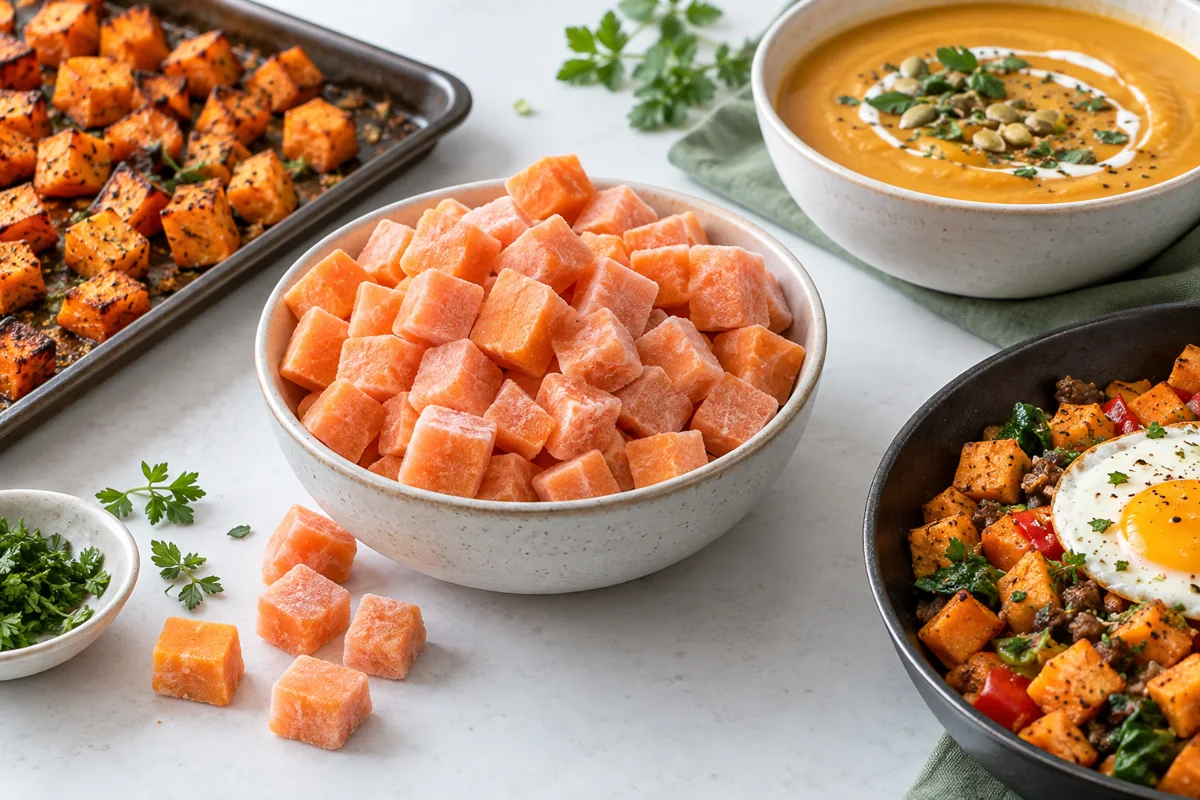
Start With the Cube Size and Pre-Cook Level

Start With the Cube Size and Pre-Cook Level using the specific product form shown.
Measure the cube rather than relying on small, medium or large because edge length changes heating time and portion count. Confirm whether the product is raw, blanched, steamed or otherwise partly cooked before choosing a method.
In practice, this is where many otherwise careful batches go wrong. Surface frost, glazing and free ice affect browning and the amount of water entering a pan or sauce. The useful control is to decide the endpoint before starting, then keep the preparation, package and later use consistent.
For a buyer or production manager, the same issue becomes a specification question. Keep pieces frozen until the equipment is ready unless the specification provides a controlled thawing route. Record what was tested, including starting condition, portion or load, equipment and the observed result, so the next batch can be compared on the same basis.
Run the first test with the normal commercial load because a small handful heats differently from a full pan. That boundary matters because a convenient household method is not automatically a validated commercial process. The article focuses on cube applications and portion control; the second real product photo shows strips only as a cut-format comparison, not as cubes.
Authoritative background for this section includes USDA Frozen Sweet Potato Specification USDA FSIS Freezing and Food Safety. These sources support the preservation or handling principles; the application recommendation still needs to be confirmed against the actual product and operating procedure.
A useful working check for "Start With the Cube Size and Pre-Cook Level" is to write down the starting material, the intended finished use, the variable being controlled and the point at which the result will be accepted. Confirm whether the product is raw, blanched, steamed or otherwise partly cooked before choosing a method. Then repeat the method with the normal production or household portion rather than judging only a tiny demonstration. Watch what happens during packing, freezing, heating or thawing as applicable, because a problem that appears at the end may have started much earlier. Keep pieces frozen until the equipment is ready unless the specification provides a controlled thawing route. If the result changes, investigate the material, load, temperature history, equipment and holding sequence before changing several settings at once. This simple record also makes supplier conversations more useful: both sides can discuss a defined form and observed performance instead of relying on broad adjectives. Finally, keep the limitation visible. Run the first test with the normal commercial load because a small handful heats differently from a full pan.
Roast or Air-Fry for Visible Browned Cubes

Roast or Air-Fry for Visible Browned Cubes.
| Route or format | Useful when | Main control |
|---|---|---|
| Small cubes | Fast cooking and frequent distribution | Can soften or break sooner |
| Larger cubes | Visible pieces and distinct bite | Need more heating time |
| Strips | Fries and cut-format applications | Not a cube substitute |
Use dry high heat, an uncrowded layer and enough spacing for steam to escape around each cube. The decision should follow the intended use rather than a habit carried over from another format. A light controlled oil coating can support browning, but excess oil and melted ice create a soft surface.
A practical trial should change one variable at a time. Turn or shake after the exterior has set so partially cooked cubes do not break apart. If several variables move together, a wetter, softer or less even result cannot be diagnosed reliably.
Air fryers recover heat differently from loaded convection ovens, so record the actual load, temperature and endpoint. For repeat production, write the relevant cut, starting state, load, package and endpoint into the method. Staff should not have to infer them from a photograph.
Serve promptly or use ventilated holding because a covered pan softens browned cubes. We treat that as a quality-control choice, not a marketing promise. The article focuses on cube applications and portion control; the second real product photo shows strips only as a cut-format comparison, not as cubes.
The core preservation and handling references are USDA Frozen Sweet Potato Specification USDA FSIS Freezing and Food Safety. They are used for factual limits and process logic, while exact product directions retain priority.
A useful working check for "Roast or Air-Fry for Visible Browned Cubes" is to write down the starting material, the intended finished use, the variable being controlled and the point at which the result will be accepted. A light controlled oil coating can support browning, but excess oil and melted ice create a soft surface. Then repeat the method with the normal production or household portion rather than judging only a tiny demonstration. Watch what happens during packing, freezing, heating or thawing as applicable, because a problem that appears at the end may have started much earlier. Air fryers recover heat differently from loaded convection ovens, so record the actual load, temperature and endpoint. If the result changes, investigate the material, load, temperature history, equipment and holding sequence before changing several settings at once. This simple record also makes supplier conversations more useful: both sides can discuss a defined form and observed performance instead of relying on broad adjectives. Finally, keep the limitation visible. Serve promptly or use ventilated holding because a covered pan softens browned cubes.
Build Breakfast Hashes and Grain Bowls

Build Breakfast Hashes and Grain Bowls.
- Cook the sweet potato cubes until nearly tender and browned before adding fast-cooking greens, eggs or delicate garnishes.
- Match cube size with onion, pepper and protein pieces so the customer receives a balanced bite rather than one dominant component.
- For grain bowls, control the portion by weight and distribute cubes after the grain base is measured.
- A separate hot hold may protect texture better than mixing cubes into a moist base too early.
Cook the sweet potato cubes until nearly tender and browned before adding fast-cooking greens, eggs or delicate garnishes. Match cube size with onion, pepper and protein pieces so the customer receives a balanced bite rather than one dominant component.
The most useful check is not whether the method can work once, but whether it works with the exact material, portion and equipment that will be used. For grain bowls, control the portion by weight and distribute cubes after the grain base is measured. Keep the first comparison small enough to observe clearly.
In procurement, translate the observation into something confirmable. A separate hot hold may protect texture better than mixing cubes into a moist base too early. A written requirement makes supplier review and incoming inspection more objective.
Test the first and last serving from a batch to confirm that settlement and breakage remain acceptable. Avoid converting a quality range into a safety guarantee or a photograph into proof of an unseen process. The article focuses on cube applications and portion control; the second real product photo shows strips only as a cut-format comparison, not as cubes.
Reference points: USDA Frozen Sweet Potato Specification USDA FSIS Freezing and Food Safety. Use the applicable label, local food-safety plan and product specification whenever they are more specific.
A useful working check for "Build Breakfast Hashes and Grain Bowls" is to write down the starting material, the intended finished use, the variable being controlled and the point at which the result will be accepted. Match cube size with onion, pepper and protein pieces so the customer receives a balanced bite rather than one dominant component. Then repeat the method with the normal production or household portion rather than judging only a tiny demonstration. Watch what happens during packing, freezing, heating or thawing as applicable, because a problem that appears at the end may have started much earlier. A separate hot hold may protect texture better than mixing cubes into a moist base too early. If the result changes, investigate the material, load, temperature history, equipment and holding sequence before changing several settings at once. This simple record also makes supplier conversations more useful: both sides can discuss a defined form and observed performance instead of relying on broad adjectives. Finally, keep the limitation visible. Test the first and last serving from a batch to confirm that settlement and breakage remain acceptable.
Add Cubes Directly to Soups, Curries and Stews

Add Cubes Directly to Soups, Curries and Stews.
Frozen cubes can enter a simmering liquid directly when the recipe allows for their cooling load and released starch. That is the physical reason behind the recommendation. Add them early for a thick soft result or later when distinct pieces need to remain visible.
Work in a clean, controlled sequence and avoid adding an unnecessary thawing or holding step. Strong boiling and repeated stirring break partially cooked cubes and can over-thicken the sauce. A shorter process is not automatically better, but every extra transition introduces another variable.
Account for sweetness and water release before adjusting sugar, acid, salt or final viscosity. In a commercial review, compare the same quantity under the same conditions and record yield, appearance, texture and handling loss.
Use a measured batch ratio so a larger kettle does not produce either sparse fruit or a paste of broken cubes. The result should be described honestly: useful for the named application, not perfect under every condition. The article focuses on cube applications and portion control; the second real product photo shows strips only as a cut-format comparison, not as cubes.
Process principles were checked against USDA Frozen Sweet Potato Specification USDA FSIS Freezing and Food Safety. Those references do not verify a supplier-specific specification; current product documents do.
A useful working check for "Add Cubes Directly to Soups, Curries and Stews" is to write down the starting material, the intended finished use, the variable being controlled and the point at which the result will be accepted. Add them early for a thick soft result or later when distinct pieces need to remain visible. Then repeat the method with the normal production or household portion rather than judging only a tiny demonstration. Watch what happens during packing, freezing, heating or thawing as applicable, because a problem that appears at the end may have started much earlier. Account for sweetness and water release before adjusting sugar, acid, salt or final viscosity. If the result changes, investigate the material, load, temperature history, equipment and holding sequence before changing several settings at once. This simple record also makes supplier conversations more useful: both sides can discuss a defined form and observed performance instead of relying on broad adjectives. Finally, keep the limitation visible. Use a measured batch ratio so a larger kettle does not produce either sparse fruit or a paste of broken cubes.
Steam and Purée for Sauces, Soups and Bakery Bases

Steam and Purée for Sauces, Soups and Bakery Bases.
Steam cubes until evenly tender, drain controlled free water and purée while the product is at the suitable processing temperature. A defined cube size improves steaming uniformity and reduces the mix of hard centers and waterlogged edges.
In practice, this is where many otherwise careful batches go wrong. For soup or sauce, adjust liquid only after the purée is smooth because frozen product contributes its own moisture. The useful control is to decide the endpoint before starting, then keep the preparation, package and later use consistent.
For a buyer or production manager, the same issue becomes a specification question. For bakery use, record purée solids, yield and cooling method so dough or batter consistency remains repeatable. Record what was tested, including starting condition, portion or load, equipment and the observed result, so the next batch can be compared on the same basis.
Do not infer a validated shelf life for the finished purée from the frozen raw material's storage statement. That boundary matters because a convenient household method is not automatically a validated commercial process. The article focuses on cube applications and portion control; the second real product photo shows strips only as a cut-format comparison, not as cubes.
Authoritative background for this section includes USDA Frozen Sweet Potato Specification USDA FSIS Freezing and Food Safety. These sources support the preservation or handling principles; the application recommendation still needs to be confirmed against the actual product and operating procedure.
A useful working check for "Steam and Purée for Sauces, Soups and Bakery Bases" is to write down the starting material, the intended finished use, the variable being controlled and the point at which the result will be accepted. A defined cube size improves steaming uniformity and reduces the mix of hard centers and waterlogged edges. Then repeat the method with the normal production or household portion rather than judging only a tiny demonstration. Watch what happens during packing, freezing, heating or thawing as applicable, because a problem that appears at the end may have started much earlier. For bakery use, record purée solids, yield and cooling method so dough or batter consistency remains repeatable. If the result changes, investigate the material, load, temperature history, equipment and holding sequence before changing several settings at once. This simple record also makes supplier conversations more useful: both sides can discuss a defined form and observed performance instead of relying on broad adjectives. Finally, keep the limitation visible. Do not infer a validated shelf life for the finished purée from the frozen raw material's storage statement.
Use Frozen Cubes for Portion and Labor Control

Use Frozen Cubes for Portion and Labor Control.
Pre-cut frozen cubes remove peeling and cutting labor and can reduce trim variation when the specification is stable. The decision should follow the intended use rather than a habit carried over from another format. Portion by recipe batch, tray load or serving weight and return the main pack to frozen storage promptly.
A practical trial should change one variable at a time. Free-flowing cubes support flexible withdrawal, while a fused block slows service and encourages unwanted partial thawing. If several variables move together, a wetter, softer or less even result cannot be diagnosed reliably.
Compare purchased weight with cooked yield, breakage and labor rather than using case price alone. For repeat production, write the relevant cut, starting state, load, package and endpoint into the method. Staff should not have to infer them from a photograph.
A standard scoop is convenient but should be verified by weight because cube size and packing density change volume. We treat that as a quality-control choice, not a marketing promise. The article focuses on cube applications and portion control; the second real product photo shows strips only as a cut-format comparison, not as cubes.
The core preservation and handling references are USDA Frozen Sweet Potato Specification USDA FSIS Freezing and Food Safety. They are used for factual limits and process logic, while exact product directions retain priority.
A useful working check for "Use Frozen Cubes for Portion and Labor Control" is to write down the starting material, the intended finished use, the variable being controlled and the point at which the result will be accepted. Portion by recipe batch, tray load or serving weight and return the main pack to frozen storage promptly. Then repeat the method with the normal production or household portion rather than judging only a tiny demonstration. Watch what happens during packing, freezing, heating or thawing as applicable, because a problem that appears at the end may have started much earlier. Compare purchased weight with cooked yield, breakage and labor rather than using case price alone. If the result changes, investigate the material, load, temperature history, equipment and holding sequence before changing several settings at once. This simple record also makes supplier conversations more useful: both sides can discuss a defined form and observed performance instead of relying on broad adjectives. Finally, keep the limitation visible. A standard scoop is convenient but should be verified by weight because cube size and packing density change volume.
Specify Frozen Sweet Potato Cubes for Repeatable Results

Cut-format comparison: this verified GreenLand product photograph shows sweet potato strips, not cubes.
State the cube dimensions and tolerance, pre-cook or blanching status, skin allowance, color, defects and loose-flow requirement. Align glazing or surface ice, pack size, case weight, origin, crop or production date and frozen storage condition.
The most useful check is not whether the method can work once, but whether it works with the exact material, portion and equipment that will be used. Request applicable microbiological, residue, traceability, certification and inspection documents for the market. Keep the first comparison small enough to observe clearly.
In procurement, translate the observation into something confirmable. One verified real photograph in this section shows sweet potato strips as a cut-format comparison; those pieces are not cubes. A written requirement makes supplier review and incoming inspection more objective.
We can review frozen sweet potato cube availability and other cuts against the application and written specification. Avoid converting a quality range into a safety guarantee or a photograph into proof of an unseen process. The article focuses on cube applications and portion control; the second real product photo shows strips only as a cut-format comparison, not as cubes.
Reference points: USDA Frozen Sweet Potato Specification USDA FSIS Freezing and Food Safety. Use the applicable label, local food-safety plan and product specification whenever they are more specific.
A useful working check for "Specify Frozen Sweet Potato Cubes for Repeatable Results" is to write down the starting material, the intended finished use, the variable being controlled and the point at which the result will be accepted. Align glazing or surface ice, pack size, case weight, origin, crop or production date and frozen storage condition. Then repeat the method with the normal production or household portion rather than judging only a tiny demonstration. Watch what happens during packing, freezing, heating or thawing as applicable, because a problem that appears at the end may have started much earlier. One verified real photograph in this section shows sweet potato strips as a cut-format comparison; those pieces are not cubes. If the result changes, investigate the material, load, temperature history, equipment and holding sequence before changing several settings at once. This simple record also makes supplier conversations more useful: both sides can discuss a defined form and observed performance instead of relying on broad adjectives. Finally, keep the limitation visible. We can review frozen sweet potato cube availability and other cuts against the application and written specification.
Source frozen sweet potato with GreenLand-food
We supply and coordinate frozen sweet potato for wholesale and factory-direct programs. As a manufacturer-facing supplier, GreenLand-food will review the requested form, packing, documents and application before confirming an offer. The article focuses on cube applications and portion control; the second real product photo shows strips only as a cut-format comparison, not as cubes.