


Frozen vs. Fresh Strawberries: Price Difference and Cost-Benefit
Jan 12, 2026
Leave a message

Frozen Strawberry Cost per Usable Kg: How Buyers Should Compare Fresh and Frozen
I am Jacky from GreenLand-food. Many procurement managers ask me a practical question: "Should we switch part of our fresh strawberry usage to frozen strawberries?"
This is not a simple fresh-versus-frozen debate. It is a cost-control and risk-management decision. Finance may focus on budget pressure. Operations may focus on stable supply and consistent output. QA may worry about texture, Brix, color, food safety and customer complaints. Procurement sits in the middle and must turn all these concerns into a measurable decision.
The most common mistake is comparing only the purchase price per kilogram. For strawberries, that is often misleading. A more useful metric is cost per usable kilogram: how much you really pay for every kilogram of strawberry that becomes usable ingredient in your product, drink, dessert, bakery filling, yogurt cup or retail pack.
Core message: Fresh strawberries may look cheaper in peak season, but the final cost can change after sorting loss, trimming, soft fruit, mold, labor, emergency buying, cold-chain problems and quality fluctuation are included. Buyers should compare usable cost, not only quotation price.
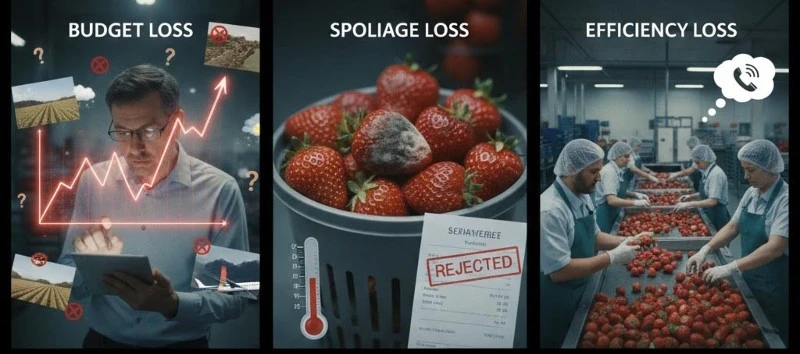
1. What Procurement Managers Are Really Afraid Of
When buyers hesitate between fresh and frozen strawberries, the concern is rarely only price. The deeper concern is whether the chosen supply model will create hidden operational problems later.
| Buyer Concern | Fresh Strawberry Risk | Frozen Strawberry Value |
|---|---|---|
| Budget control | Seasonal price fluctuation, weather impact and urgent buying pressure. | Better annual or quarterly planning through frozen inventory and framework supply. |
| Waste and shrinkage | Soft fruit, mold, bruising, expiration and arrival rejection. | Longer usable window and more predictable usable yield if cold chain is controlled. |
| Operational efficiency | Daily washing, sorting, de-stemming, cutting and rework. | IQF, de-stemmed, sliced, diced or puree formats reduce preparation work. |
| Output consistency | Batch-to-batch variation affects color, Brix, texture and recipe stability. | Specification-based frozen supply can support more repeatable production. |
2. The Better Metric: Cost per Usable Kg
Purchase price tells you how much you pay for incoming weight. It does not tell you how much you pay for usable ingredient. For strawberries, this difference can be significant because fresh fruit may require sorting, trimming, cutting, urgent handling and loss control after arrival.
Formula: Cost per Usable Kg = (Purchase Price + Logistics Cost + Processing Cost + Waste Cost + Quality Management Cost) ÷ Usable Kg
This formula helps procurement speak the same language as Finance. It puts hidden costs back into the calculation instead of treating them as separate operational problems.
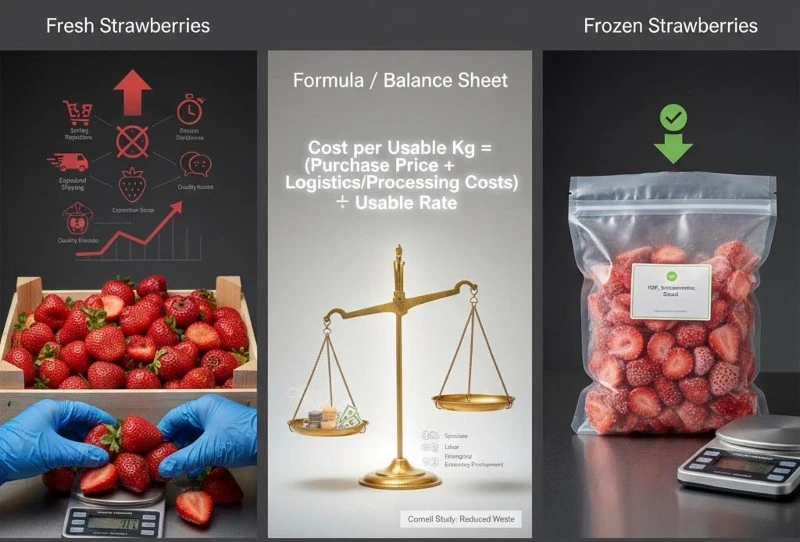
| Cost Element | Fresh Strawberry | Frozen Strawberry |
|---|---|---|
| Purchase price | May look attractive during peak season but fluctuate heavily off season. | Often easier to plan through seasonal processing and annual supply discussion. |
| Waste cost | Soft fruit, mold, damage, expiration and trimming loss. | Lower waste risk in many applications if storage and handling are correct. |
| Labor cost | Washing, de-stemming, cutting, sorting and rework. | De-stemmed, sliced, diced or puree formats can reduce preparation work. |
| Quality fluctuation cost | Recipe adjustment, customer complaints, inconsistent color and flavor direction. | Specification control can improve repeatability across batches. |
| Management cost | Frequent negotiation, emergency sourcing and claim handling. | Framework supply can reduce fire-fighting procurement. |
3. Why Unit Price Can Mislead Procurement
A fresh strawberry quotation may look lower than a frozen strawberry quotation at certain times of the year. But if the buyer compares only incoming price, the calculation ignores how much product is lost before it becomes usable.
Fresh strawberries are highly perishable and temperature-sensitive. If temperature control, transport handling or storage discipline is weak, quality can decline quickly. The cost then appears later as scrap, rework, emergency purchase, customer complaint or recipe compensation.
| Unit-Price Thinking | Usable-Cost Thinking |
|---|---|
| "Fresh is cheaper today." | "How much fresh fruit will become usable ingredient after sorting, trimming and spoilage?" |
| "Frozen looks more expensive per kg." | "Does frozen reduce waste, labor, emergency buying and recipe fluctuation?" |
| "We already have a fresh supplier." | "Can the supplier support our annual volume, off-season quality and operational stability?" |
4. Fresh Strawberry Cost Fluctuation: The Usable Rate Problem
Many procurement teams believe they are fighting price fluctuation. For strawberries, they are often fighting usable rate fluctuation. The same quote can lead to very different real costs if soft fruit, mold, bruising or temperature damage changes from batch to batch.
| Situation | Business Effect | Cost Result |
|---|---|---|
| Same price, different arrival condition | One batch has higher soft fruit or rejection rate. | Usable cost rises even if purchase price is unchanged. |
| Same planned volume, different sales speed | Fresh stock expires or loses appearance before use. | Waste cost and inventory loss increase. |
| Same supplier, different cold-chain week | Temperature deviation affects firmness and shelf life. | Complaint, rework and emergency buying costs rise. |

5. The Value of Frozen Strawberries: Three Certainties
I do not recommend describing frozen strawberries simply as "cheaper." A more professional explanation is that frozen strawberries can help buyers build three types of certainty: cost certainty, usability certainty and efficiency certainty.
1. Cost certainty
Frozen strawberries are commonly processed during harvest season and released through frozen storage and shipment planning. This makes them suitable for quarterly or annual framework discussion, especially for buyers with stable beverage, bakery, dairy, dessert or foodservice demand.
2. Usability certainty
Frozen strawberries can be specified by form: whole IQF, de-stemmed, sliced, diced, crumbles, puree or sweetened strawberries. The buyer can reduce daily sorting and pre-processing loss by selecting the correct form for the final application.
3. Efficiency certainty
Standardized frozen strawberry specifications can reduce preparation time, store-level labor, production-line variation and emergency rework. For chain restaurants, beverage stores and central kitchens, this is often more valuable than a small unit-price difference.

6. Base Volume + Flex Volume: A Practical Sourcing Strategy
For many buyers, the best strategy is not to replace all fresh strawberries with frozen strawberries. A more balanced strategy is to use frozen strawberries as the Base Volume and fresh strawberries as the Flex Volume.
| Volume Type | Best Use | Business Role |
|---|---|---|
| Frozen Base Volume | Year-round smoothies, yogurt bowls, bakery fillings, sauces, puree, dessert bases and chain menu items. | Controls cost, supply stability, preparation efficiency and recipe consistency. |
| Fresh Flex Volume | Peak-season promotions, premium decoration, limited-edition menus and fresh visual display. | Supports marketing, fresh appearance and seasonal selling points. |
Procurement logic: Use frozen strawberries to solve certainty. Use fresh strawberries to solve seasonal visual appeal and marketing value.
7. Anonymized Project Scenario
Here is a typical project scenario, with identifying details removed. The buyer was a beverage chain using strawberries for milkshakes and yogurt bowls throughout the year. Their original model relied heavily on fresh strawberries, including off-season procurement.
Original problem
- Fresh fruit quality fluctuated strongly during off-season sourcing.
- Store-level scrap and sorting work were high.
- Emergency buying became frequent when planned supply failed.
- Product consistency varied across stores and batches.
- Finance could not forecast gross margin clearly during volatile periods.
Adjustment made
- KPI changed: The buyer moved from purchase price per kg to cost per usable kg.
- Base volume changed: The regular menu base shifted to IQF de-stemmed frozen strawberries.
- Fresh use changed: Fresh strawberries were kept for peak-season visual upgrades and limited promotions.
- SOP improved: Receiving, storage, thawing and turnover rules were written into operations.
Observed result
- Scrap and emergency buying became easier to control.
- Store preparation time was reduced.
- Product output became more stable.
- Budget planning became clearer during off-season operations.
Buyer lesson: The main gain was not only a lower unit price. The main gain was lower uncertainty across cost, labor, waste and output consistency.
8. Six Costs Buyers Should Calculate Quarterly or Annually
A serious comparison should be calculated on a quarterly or annual basis, not only by one shipment. This is especially important for chain restaurants, beverage programs, central kitchens, bakery factories and dairy processors.
| Cost Item | What to Calculate | Why It Matters |
|---|---|---|
| 1. Procurement cost | Unit price × purchased volume. | The visible starting cost. |
| 2. Logistics and arrival loss | Temperature risk, carton damage, shrinkage and rejection upon arrival. | Fresh and frozen both need control, but risk patterns differ. |
| 3. Pre-processing and labor | Sorting, washing, de-stemming, cutting, thawing, blending or rework. | Labor cost often hides outside the purchasing spreadsheet. |
| 4. Scrap and inventory loss | Expired stock, mold, soft fruit, unused leftovers and inventory shrinkage. | Directly affects usable cost and gross margin. |
| 5. Quality fluctuation cost | Recipe compensation, production failure, customer complaints and downgrade. | Poor consistency creates invisible operating cost. |
| 6. Management cost | Order frequency, negotiation time, emergency sourcing and dispute handling. | Procurement time and operational attention are also costs. |

9. When Frozen Strawberries Usually Become More Attractive
Frozen strawberries become more attractive when fresh strawberry cost is unstable or when application requirements depend on consistency. Buyers should not switch blindly. They should define trigger points.
| Trigger Point | What It Means | Recommended Action |
|---|---|---|
| Fresh usable rate drops | Soft fruit, trimming loss, mold or rejection becomes high. | Compare frozen cost per usable kg immediately. |
| Off-season price rises sharply | Fresh price no longer reflects stable annual cost. | Use frozen base volume for budget control. |
| Labor shortage appears | Stores or factories struggle with washing, de-stemming and cutting. | Evaluate de-stemmed, sliced, diced or puree formats. |
| Customer complaints increase | Color, flavor, texture or recipe output becomes unstable. | Use approved sample and frozen specification control. |
10. Frozen Quality Still Depends on Cold Chain and SOP
Frozen strawberries are not magic. Their advantages depend on stable cold chain, correct receiving inspection, proper frozen storage and application-specific handling. If a frozen product is repeatedly exposed to temperature fluctuation or poor thawing discipline, quality can also be damaged.
| Control Point | Buyer SOP Requirement | Cost Impact if Ignored |
|---|---|---|
| Receiving temperature | Record carton condition, product temperature and container data where needed. | Dispute risk, thaw-refreeze suspicion and quality complaints. |
| Storage temperature | Store at -18°C or below unless otherwise agreed. | Frost, clumping, texture decline and drip loss. |
| Thawing method | Use controlled thawing according to application and food safety procedure. | Water release, texture loss and unstable recipe output. |
| Turnover discipline | Use FIFO, batch control and clear production planning. | Old stock, documentation confusion and quality variation. |
11. Which Frozen Strawberry Form Fits Your Cost Model?
The cost advantage of frozen strawberries depends heavily on product form. Choosing the wrong form can create rework. Choosing the right form can reduce waste and labor.
| Frozen Strawberry Form | Best Application | Cost Logic |
|---|---|---|
| Whole IQF strawberries | Smoothies, retail packs, puree and general processing. | Flexible use, but may require blending or cutting depending on application. |
| De-stemmed strawberries | Beverage chains, sauces, puree and central kitchens. | Reduces trimming and preparation labor. |
| Sliced strawberries | Bakery topping, desserts, pancakes, yogurt and visual applications. | Reduces manual slicing and improves portion control. |
| Diced strawberries | Yogurt inclusions, muffins, beverage inclusions, fillings and industrial dosing. | Improves dosing accuracy and reduces cutting labor. |
| Strawberry puree | Beverages, sauces, sorbet, dessert bases and industrial formulations. | Reduces blending, filtering and yield uncertainty. |
12. Buyer Checklist: Before Switching Part of Fresh Volume to Frozen
Before changing your sourcing model, use this checklist with Procurement, Finance, Operations and QA.
- Current fresh waste rate: How much is rejected, trimmed, spoiled, expired or discarded?
- Fresh usable rate: How much fresh strawberry becomes usable ingredient after handling?
- Labor cost: How much time is spent washing, de-stemming, cutting and reworking?
- Emergency buying cost: How often do you buy urgently because fresh supply fails?
- Quality fluctuation: How often do Brix, color, texture or recipe output change?
- Base volume: Which part of demand is stable and repeatable year-round?
- Flex volume: Which part of demand is seasonal, visual or marketing-driven?
- Frozen form: Whole, de-stemmed, sliced, diced, puree or sweetened?
- Cold-chain capacity: Can your warehouse and stores maintain frozen condition?
- SOP readiness: Are receiving, storage, thawing and turnover rules written clearly?
13. Frozen Strawberry Cost RFQ Template
Use this RFQ template if you want suppliers to quote based on real cost logic, not only product name.
| RFQ Item | Buyer Should Specify |
|---|---|
| Target application | Smoothie, yogurt bowl, beverage, bakery filling, dessert, sauce, retail pack or industrial processing. |
| Current fresh pain point | High waste, unstable price, labor cost, off-season quality, emergency buying or inconsistent output. |
| Frozen product form | Whole IQF, de-stemmed, sliced, diced, crumbles, puree or sweetened strawberries. |
| Quality specification | Size, color, Brix, pH, free-flow condition, drip loss, broken rate and defect tolerance. |
| Annual volume | Base volume, flex volume, shipment frequency and peak demand season. |
| Packaging | 10 kg carton, 1 kg bag, 2.5 kg foodservice bag, retail pack, puree pack or private label format. |
| Document needs | Specification, COA, microbiology, pesticide residues, heavy metals, certificates, traceability and shipment documents. |
Need to calculate frozen strawberry cost per usable kg?
Send us your target application, current fresh strawberry pain points, required frozen form, annual volume, packaging format, destination market and document needs. GreenLand-food can discuss suitable frozen strawberry specifications, samples, COA support and supply planning for your project.
Request Frozen Strawberry Cost Support14. GreenLand-food Frozen Strawberry Knowledge Support
For a broader overview of varieties, grades, product forms and buyer specifications, you can read our Frozen Strawberries 101 Guide.
For topic-level learning, you can also visit our Frozen Strawberries Knowledge Center, which covers quality control, nutrition, cost considerations, purchasing risks, sustainability, applications and specifications.

15. FAQ
Are frozen strawberries always cheaper than fresh strawberries?
Not always by purchase price. Frozen strawberries should be compared by cost per usable kg, including waste, labor, storage, processing, emergency buying and quality fluctuation.
What is cost per usable kg?
Cost per usable kg means the total cost divided by the amount of strawberry that actually becomes usable ingredient. It includes purchase price, logistics, processing, waste, labor and quality management cost.
When should a buyer switch part of fresh strawberry volume to frozen?
A partial switch is worth evaluating when fresh waste is high, off-season price rises, labor cost increases, emergency buying becomes frequent or output consistency becomes difficult to control.
What is the Base Volume + Flex Volume strategy?
Base Volume means using frozen strawberries for stable year-round demand. Flex Volume means using fresh strawberries for seasonal promotions, premium visual display or limited-edition menu items.
Which frozen strawberry form is best for cost control?
It depends on the application. Whole IQF strawberries are flexible, de-stemmed strawberries reduce trimming, sliced and diced strawberries reduce cutting labor, and puree reduces blending and yield uncertainty.
What risks should buyers manage when using frozen strawberries?
Buyers should manage cold-chain stability, receiving temperature, storage temperature, thawing method, FIFO turnover, drip loss, clumping, Brix, pH, color and application fit.
Can GreenLand-food support annual frozen strawberry supply planning?
GreenLand-food can discuss frozen strawberry specifications, samples, packaging, COA support, traceability, cold-chain documents and shipment planning according to your annual volume, application and destination market.
Conclusion
Fresh and frozen strawberries should not be compared only by price per kilogram. For B2B buyers, the more useful metric is cost per usable kg. Once waste, labor, pre-processing, cold-chain risk, emergency buying, quality fluctuation and management cost are included, the real cost picture becomes clearer.
The strongest strategy for budget-conscious procurement is often not a complete replacement. Use frozen strawberries as the Base Volume for cost certainty, supply stability and operational efficiency. Use fresh strawberries as the Flex Volume for peak-season selling points and premium visual presentation. This creates a more balanced sourcing model for Finance, Operations, QA and Procurement.