


How Long Does a Whole Onion Last?
Sep 24, 2026
Leave a message

That answer concerns an uncut, raw bulb with its dry protective skin. A sweet onion, a freshly harvested onion, a peeled onion and a frozen whole onion are different materials with different handling rules. For a kitchen buying in cases rather than singles, the useful question is also how much sound onion will remain when the team is ready to prepare it.
A practical shelf-life range for a whole onion
For day-to-day planning, allow around three to four weeks for a typical dry storage onion kept in a reasonably cool, dry and ventilated household pantry. Iowa State University's produce guide gives four weeks as a practical storage target, while Purdue Extension also describes a period of up to four weeks for storage onions on a counter. These are useful planning numbers for a normal kitchen, not a guarantee that every bulb will remain usable through the final day.
You will also see longer claims. StillTasty's onion guide cites two to three months when bulbs are held around 45–55°F (7–13°C), dark and dry. That range assumes a much cooler and more stable environment than many homes or busy restaurant storerooms provide. It is not a contradiction to say "about a month in an ordinary pantry" and "potentially several months in suitable cool storage." Those statements describe different starting material and different conditions.

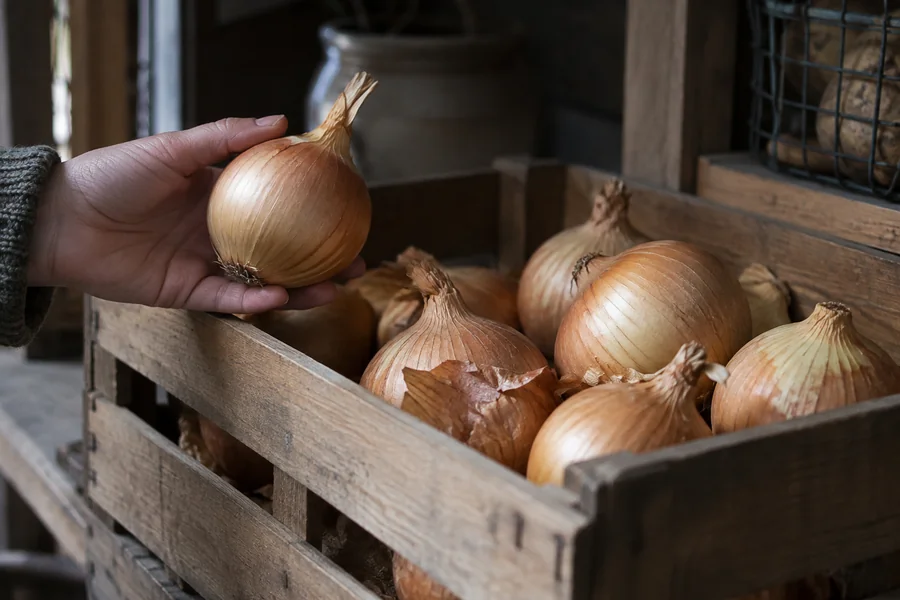
Firm uncut dry yellow onion with intact papery outer skin and closed neck.
The clock does not necessarily start when you carry an onion home. It was harvested, cured, packed, shipped, displayed and perhaps moved between temperatures before you bought it. A firm onion received from an early-season lot may have a different remaining life from a similar-looking bulb that has already spent weeks in distribution. For a commercial buyer, a promised harvest or pack date is useful context, but inspection at receipt and periodic checks still decide usable life. A precise remaining-day claim from appearance alone would overstate what the buyer can know.
Do not apply this four-week rule to a peeled or cut onion. Removing the dry skin or exposing flesh changes the moisture and microbial situation. Our separate cut-onion storage guide covers that different question. This page stays with intact bulbs until the final sourcing section, where frozen processed forms are compared for kitchens that do not want to peel and dice every day.
The simplest operating rule is to buy an amount that fits the real menu cycle, keep the bulbs sound and dry, and inspect them as stock turns. If your cupboard is warm or damp, plan a shorter rotation rather than assuming that a published "three months" belongs to your premises. If your onions are individually packed and the supplier gives storage instructions, follow those instructions as well. The range is a planning tool; the onion's condition remains the release decision.
Why one onion lasts weeks and another lasts months
The type of onion matters. A dry, pungent storage onion with well-cured papery outer scales and a closed neck was built, agriculturally, for longer holding. A sweet onion usually carries more water and tends to be less durable. A young or freshly harvested onion may look attractive and taste mild, but a green or incompletely cured neck is not the same protective barrier as a dry closed one. The Kitchn's storage discussion distinguishes ordinary whole onions from cut ones and gives a shorter practical household range than ideal cool-storage figures.
Curing is a real postharvest step, not an adjective for flavor. The outer scales and neck dry after harvest, reducing the routes by which moisture and decay can reach the bulb. University of Maine Extension explains the role of curing, variety and sorting in storage life. For a buying brief, "whole onion" therefore does not describe enough: variety or class, maturity, curing state, visible defects and destination conditions all affect the usable window.
Consider two cases received on the same morning. Case A contains firm, dry bulbs with intact skins and closed necks. Case B contains bulbs with bruised shoulders, damp outer layers and several soft spots. Printing the same receipt date on both cases cannot make their remaining life equal.

Dry storage onion, lighter sweet onion and a visibly sprouted onion side by side.
Case B needs sorting and likely a faster use decision, while Case A may suit a normal planned rotation. A single damaged bulb also should not be left in contact with sound stock; removing it promptly helps limit further loss.
Temperature interacts with moisture. Cool conditions slow sprouting and decay, but a damp space can still cause trouble. A warm dry shelf may avoid condensation yet push the bulbs to sprout sooner. Moving onions repeatedly from cold to warm air can make surfaces wet, especially in humid settings. That is why an appropriate store room is a combined condition: cool, dark, dry, ventilated and reasonably stable. The nominal thermostat setting by itself is not an adequate storage plan.
Buyers often ask whether red, yellow and white onions have one fixed hierarchy of life. The color alone is a weak shortcut because cultivar, maturity, curing and distribution history vary within each color. Specify the eating and cooking use first, then inspect a representative sample of the offered lot. Ask how it was held before dispatch and whether the packaging lets air pass through. That information will help your kitchen forecast loss more honestly than a universal "red lasts X days" statement.
The lesson for a household is modest: choose firm dry bulbs and plan to use them. The lesson for a foodservice business is operational: measure the amount you actually peel, trim and cook from a delivered lot, and compare that yield with the purchasing assumption. If loss is rising before the planned menu date, shorten the ordering interval or consider a prepared frozen cut where its texture suits the recipe.
Store whole onions for airflow and low moisture
Keep dry whole onions in a cool, dark place where air can move around the bulbs. A mesh bag, perforated crate or open basket is usually more suitable than a tightly sealed plastic bag. The protective skins should stay dry, and water should not collect beneath the bottom layer. Avoid stacking so deep that the center of the load stays humid and difficult to inspect. University of Maine Extension emphasizes dry cured stock and sorting during storage; these principles matter even when the holding period is relatively short.
Do not wash storage onions before placing them in the pantry. Washing removes neither an internal defect nor the need for cooking hygiene, but it adds surface moisture to a product that keeps best when dry. Keep loose soil from contaminating other ingredients by using a clean storage container and preparing the bulbs at a proper food-prep station when needed. If a supplier delivers washed, peeled or otherwise prepared onions, treat that as a different product and use its label or specification rather than the dry-bulb advice here.
A household may ask whether the refrigerator is better. Very cool, humid refrigerator air is often designed for fresh produce that needs moisture.
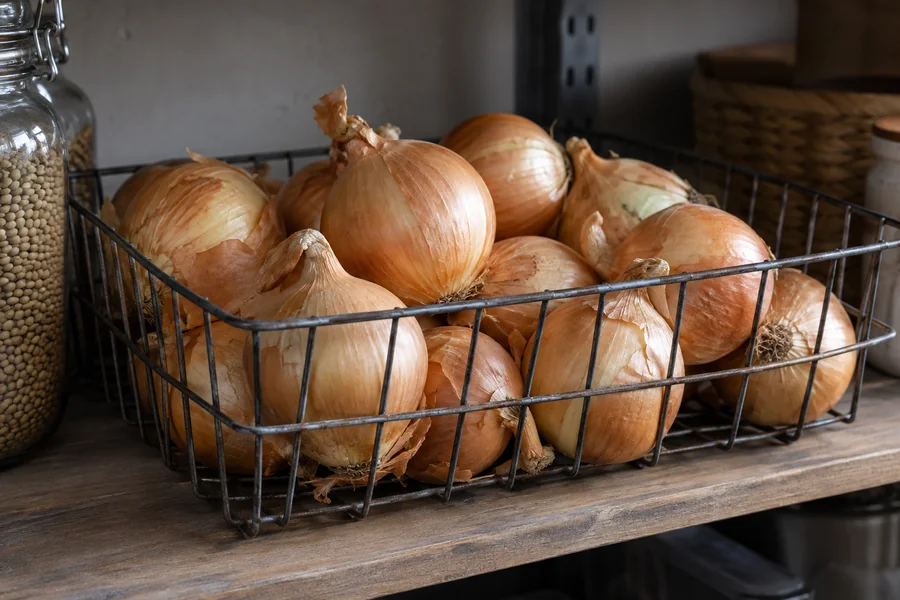
Whole dry onions in an open wire pantry basket with air space.
Dry storage onions need low humidity and ventilation. A suitable cool dry room is generally the more relevant target for intact cured bulbs. Some specialty or sweet onions can need different handling; follow their supplier's directions. Do not force a wet onion into a dry-onion rule simply because both are called whole.
For a restaurant, a practical layout puts cases off the floor and away from splash, drain lines, hot equipment and direct sunlight. Let air move around a rack rather than pushing cartons tightly against a damp wall. If stock is brought from a colder store into a hot kitchen, check for condensation and avoid leaving the case in the work area longer than required for that shift. The "cool and dark" recommendation loses its value if the final holding stage is a warm corner beside the range.
Keep potatoes and other produce in their own assigned locations according to your storage program. The immediate onion issue is simpler than any folklore about one vegetable "poisoning" another: preserve airflow, prevent moisture contact, make defects visible and avoid a packed corner where a failing bulb goes unnoticed. A separate container also makes it easier to clean the area when papery skins accumulate. Staff should be able to reach the oldest sound case first without unpacking the newest shipment.
Record the actual storage condition if large volumes are involved. A "cool room" that reaches summer temperatures every afternoon is not equivalent to controlled cool storage in the longer shelf-life references. If the facility cannot hold the conditions needed for months, order for weeks, inspect often and count the cost of prep waste. Storage is a chain of actual conditions from supplier to service, not the name printed on a room door.
Inspect firmness, neck, sprouts and decay
Pick up a few bulbs from more than the top of a case. A sound dry onion should generally feel firm for its size, with dry outer scales and no wet or collapsing areas. Check the neck, the root end and shoulders, where damage may first become noticeable. A dry papery peel can be imperfect without the edible layers being spoiled; a soft wet patch, seepage, visible mold or a strong off odor is a different matter. Set suspect bulbs aside and follow your food-safety policy for disposal.
Sprouting is a useful signal about age and storage, but it is not the same observation as rot. A green shoot can appear while much of the bulb is still firm. Evaluate the onion's texture, smell and internal condition when preparing it; discard it if decay is present. For quality-sensitive applications, a sprouted bulb may be undesirable even before it is unsafe because the internal texture and flavor can change. Do not represent "still usable" as "the same quality as a fresh sound bulb."
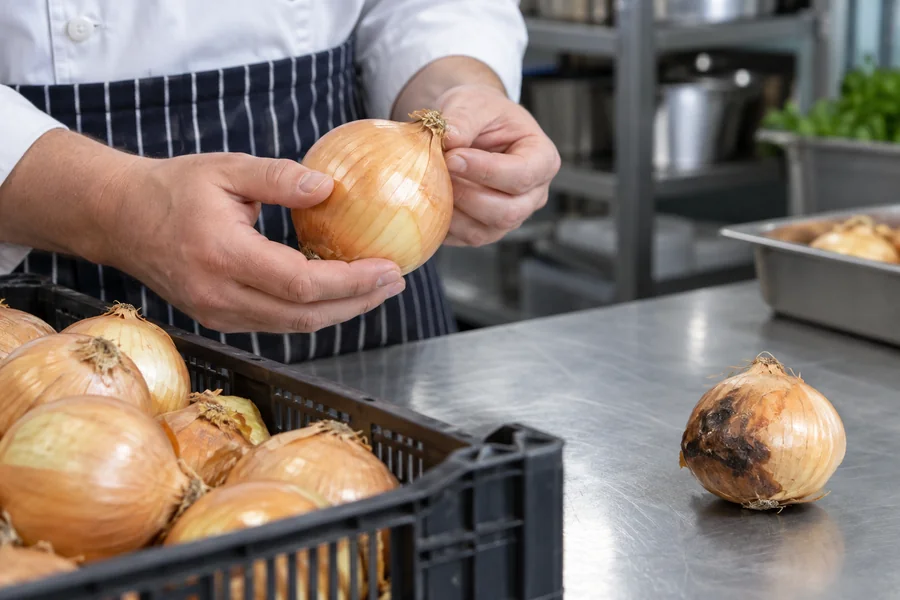
Cook checks a whole onion while a visibly decayed onion is separated.
Cutting one representative onion can reveal internal issues that the outside hides. For a receiving lot, a small sampling procedure is better than assuming all bulbs look like the top layer. Document how many bulbs were checked and what portion had defects. That gives purchasing and kitchen teams a shared basis for accepting a delivery, sorting it or asking the supplier about a recurring quality problem. It also makes loss measurable rather than anecdotal.
Watch the container as well as the bulbs. A damp carton bottom, staining, condensation or a cluster of soft onions points to a storage or transport issue, even if neighboring bulbs remain firm. Remove the affected product, clean the storage surface and check stock beside it. Do not simply lift out the visibly worst onion and declare the rest good without inspection. Decay can progress at different speeds within a case.
For home use, inspection is a quick routine when cooking. For a commissary, it belongs in receiving and a scheduled stock check. The goal is not to promise a fixed "safe until" date, but to keep only sound material in the preparation flow. Any onion that is cut for examination must then be handled as cut produce, with the appropriate refrigeration and use plan. Return only intact dry bulbs to dry-bulb storage.
The practical result is less waste and fewer surprises. A team that catches damp or bruised stock early can change the production order while some bulbs are still usable. A team that waits for a planned calendar date may find that quality has already fallen. Shelf-life estimates help schedule checks; checks determine the fate of the actual food.
Manage bulk whole-onion inventory before prep
Commercial kitchens often receive onions by the case, but their usable quantity is determined after peeling and trimming. Start with the menu's likely onion demand, preparation labor and actual historic yield rather than ordering only by gross weight. A case that appears cheaper per kilogram may be less economical if a large share must be discarded for soft spots or if the team spends much longer peeling irregular small bulbs. The relevant number is cost per usable prepared kilogram.
At receipt, log the supplier lot, quantity, arrival condition and storage location. If a case is held in a different room or moved for service, keep that movement visible. First-in, first-out is a useful default, but an older case with defects should not be used merely because it arrived first. Rotate sound stock, inspect suspect cases and keep disposal records. This is a practical quality-control rule, not an excuse to extend a failing onion's life.

Kitchen buyer checks whole onions in separate ventilated receiving crates.
Match order frequency to the actual holding environment. A kitchen that goes through onions rapidly may need small regular deliveries rather than trying to maximize a theoretical long shelf life. A processor with controlled storage may work from a longer inventory horizon, provided the incoming variety and curing are suitable. Ask a fresh-produce supplier for consistent size and condition, not only a nominal grade. Inconsistent bulb size changes peeling yield, slicer setup and final cut appearance.
Plan for work-in-process separately. Once onions are peeled or diced, the dry outer skin no longer protects them. Move them into the facility's prepared-vegetable controls and do not keep using the whole-bulb date. This is also where our cut-onion storage article becomes relevant. It answers the handling question after the knife has changed the product. The present article addresses the intact bulb and the decision to process it.
Keep a simple yield record for representative deliveries: received weight, rejected whole weight, peel and trim waste, usable prepared weight, and the dish or production batch. A few accurate records reveal whether quality is drifting or whether one onion form is labor-heavy. If the menu needs a large volume of consistent dice rather than raw whole-onion presentation, compare those figures with a frozen prepared specification. The comparison should include flavor, texture, cooking method, pack size and handling convenience, not just invoice price.
Whole onions remain appropriate when a kitchen needs freshly cut rings, particular raw bite or control over exact cut shape. Prepared frozen onions can be practical for cooked sauces, soups and batch production. Neither form is universally "better." The decision follows the operation's use, storage, labor and waste. A buyer who communicates those details can receive a much more useful product proposal than one who simply asks for the longest possible shelf life.
If receiving records show a recurring shortfall, review the chain before changing the menu. Compare defect rates by supplier lot, season and storage location. Check whether hot deliveries sit near the kitchen before being put away, whether cases are stacked too tightly, and whether employees are removing a damaged bulb as soon as it appears. A stock problem caused by a damp corner will not be cured by ordering a supposedly longer-lasting variety. Conversely, a consistently poor incoming condition should be discussed with the supplier using photographs and lot details, not hidden in the kitchen's trim allowance.
Seasonality also changes the buying decision. A processor might contract for a particular size and grade during a period when dry storage bulbs are plentiful, then adjust its fresh buying rhythm as remaining storage age rises. A restaurant buying smaller quantities may never need that level of forecasting, yet can still check whether it is ordering more than its next few weeks of use. The process can be simple, provided it is based on real throughput and a realistic place to hold the product.
When frozen cut onions simplify the kitchen plan

Genuine GreenLand photograph of peeled whole red frozen onions, a different product from raw dry storage bulbs.
GreenLand-food offers frozen onion forms, including a whole peeled onion product and diced onion. The phrase "whole frozen onion" on a product page describes a processed frozen ingredient, not a cured raw pantry bulb. It belongs in the frozen chain and follows its product specification and label. The fresh whole-onion shelf-life ranges earlier in this article must not be transferred to it.
For a cooking line that dices onions every morning, a frozen dice can remove some peeling, trimming and cutting work while making portioning more predictable. A whole peeled frozen format may suit a different process where the buyer wants the whole shape or intends to cut after controlled handling. Confirm how the product is prepared, its cut size if diced, color, defect limits, pack configuration and intended cooking application. Ask whether the kitchen can use it from frozen and how water release affects the recipe. We should not promise the same raw crunch or appearance as a newly cut onion.
The product photographs here show a distinct whole peeled red-onion form and a diced frozen form. They are visual evidence of available shapes, not proof of a storage duration or a particular microbiological result. Request current specifications and documents for the offered lot, and judge the sample in your own recipe. Frozen cut onion works especially well where onions will be heated into sauces, soups, stir-fries or savory fillings; a fresh raw garnish may need a different source and process.
If you are comparing costs, count the same usable output on both sides. Fresh whole onions involve potential storage loss plus peel, trim and labor. Frozen prepared product has a different purchase price, freezer space and possible cooking-water considerations. Testing a production-size batch is more informative than comparing one whole-onion price to one frozen-onion price. Include the pack sizes and daily drawdown the kitchen actually needs, so the proposal fits the line rather than the brochure.
Specify the receiving and preparation decision together. For a whole frozen onion, ask whether the offered onion is peeled, its approximate size range, the allowed surface defects and the packing count. For dice, ask for the target dimensions, tolerance, variety or color, and the balance of separated pieces versus clumps on opening. A sample should be checked after the intended cooking step, because a beautiful frozen photograph cannot tell a chef how much moisture the ingredient releases into a sauce. The same written specification gives quality staff a basis for checking repeat shipments.

Genuine GreenLand photograph of diced frozen onions for cooked applications.
The central answer remains straightforward: expect roughly a month from a sound whole dry storage onion in a suitable ordinary space, with longer life only when variety, curing and cooler controlled conditions support it. Check the bulb and rotate sound stock. When the menu calls for predictable cooked-onion volume, a documented frozen form can shift the work from daily prep to a specification-based purchase. Share your application and target cut with GreenLand-food so we can discuss the appropriate frozen onion option.
Source Frozen Onions with GreenLand-food
GreenLand-food is a professional frozen onions supplier and manufacturer in China, providing factory-direct wholesale supply for importers, food manufacturers, foodservice distributors and private-label programs.
Send your product form, specification, packing, quantity, application, destination, private-label needs and requested documents so we can discuss a relevant sample and quotation.