


Spinach Bread from Frozen Spinach: Put the Greens in the Dough, Not the Filling
Sep 28, 2026
Leave a message


A good first trial is modest. Start with the flour, yeast or starter, salt, fat and baking method already known to produce the desired loaf. Change the spinach form and added water as measured variables, then compare the baked bread against that control. Green color alone says little about whether the dough proofed evenly or whether the center will slice cleanly after cooling. Frozen spinach may make a useful ingredient for a foodservice or retail bread program, but the result depends on the leaf cut, thaw yield, blending method and the bread's own structure.
Start with the frozen spinach form and a moisture ledger
Frozen spinach arrives in several forms. Loose IQF chopped leaf can be weighed out in small increments and tends to leave visible pieces. Compact bricks or balls make portioning simple, but the baker still needs to thaw enough material to learn how much liquid comes out and how the leaves separate. A larger cut leaf may remain recognizable in a rustic loaf yet tear or pull at a thin sandwich slice. A small chop gives more even distribution. A puree made after thawing can color the dough more uniformly, though it is harder to judge added water by sight once the leaves have been blended into a liquid.
Record four weights before changing the bread formula: frozen spinach issued from storage, spinach after thawing, liquid separated by a consistent drain or gentle press, and spinach retained for mixing. Keep the recovered liquid in its own covered vessel. The difference between frozen weight and drained weight is a practical processing observation, but it is not a direct measure of the water available to the flour. Some moisture remains inside the leaf and will move during mixing and baking. That is why a drained-weight record must be paired with a dough test rather than converted into an automatic water subtraction.
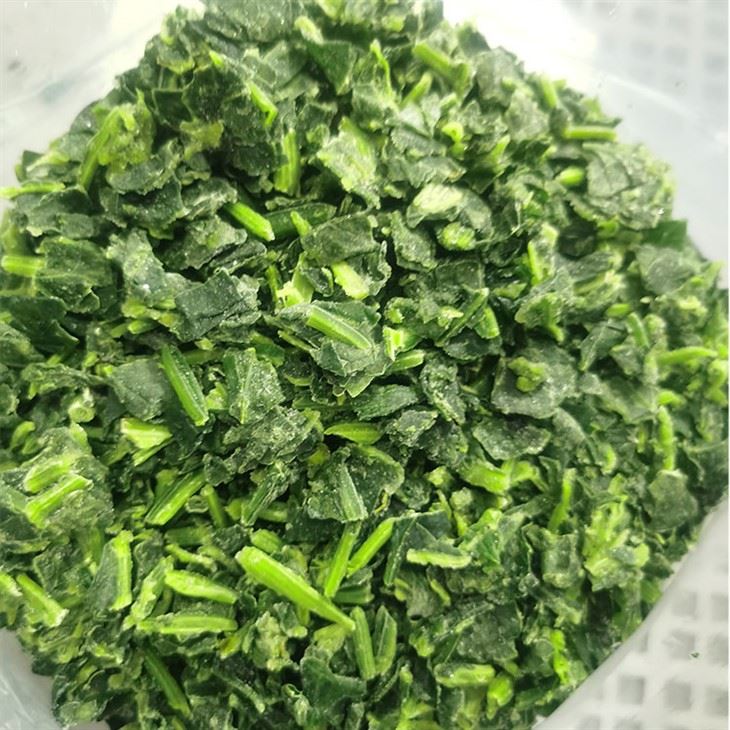
IQF chopped spinach form for bread dough trial
The thaw method needs to be repeatable. A small bakery trial can thaw spinach under refrigeration in a food-safe container, then drain it through the same sieve for the same time and apply the same pressure. A production line may use its own validated thaw and dewatering process. The important point is to avoid comparing one loosely drained sample with another squeezed hard: their apparent spinach addition rates would differ even if the frozen input weight were identical. Keep the thawed ingredient and its liquid protected under the operation's food-safety plan, and use it within the plan's time and temperature limits.
Inspect the spinach itself before the dough trial. The pieces should be identifiable as the requested leaf cut and free from an unexpected clump of stems or foreign matter. Confirm whether the supplier's product is chopped leaf, cut leaf, balls, cubes or block material, and whether it was blanched. GreenLand-food's IQF chopped spinach page presents the forms buyers can discuss. A product-page picture establishes the form available for inquiry; the actual lot still needs a sample and agreed specification before it becomes a bakery input.
For the first bake, write a simple ledger beside the mixing bowl. Note flour weight, retained spinach weight, liquid already in the spinach puree or drain, liquid added to the dough, mixing time and final dough feel. Repeat the same ledger for each trial. This seems mundane, but it separates a leaf-cut problem from a hydration problem. A loaf with isolated wet pockets may need finer spinach distribution or gentler drainage; an overall slack loaf may need less added liquid. Changing both at once makes the next result hard to interpret.
Choose puree or visible leaf particles for the intended crumb
The choice between puree and chopped leaf starts with the slice the buyer wants to sell or serve. Smooth puree can produce a relatively even green field through the crumb. It works when the color itself is part of the product identity and the bread should cut without large leaf fragments. Fine chopped spinach leaves a lighter dough with recognizable flecks. That route can suit a savory roll, flatbread or rustic sandwich loaf where the ingredient is meant to be visible. Neither appearance proves better flavor or structure; those must be assessed in the finished bread.
To compare the routes fairly, use one thawed spinach lot and one base dough. Divide the spinach by retained weight, process one portion into a smooth puree and leave the other as a consistent fine chop. Measure any liquid used to help the blender turn. It belongs in the puree trial's water record. If a blender needs substantial extra liquid, the puree route may alter dough handling before any benefit from smooth color can be judged. A coarse puree can also leave strands that behave more like chopped leaf than a true uniform suspension.

Portioned frozen spinach for measured thawing
Leaf pieces interrupt the dough at their own scale. Large pieces can fold over one another and form local seams. A very fine mince may spread evenly but disappear visually after mixing. The right particle size is therefore a function of loaf size, slice thickness and the expected bite. If a finished slice shows a dark, damp cluster, first check whether the cluster came from a frozen portion that did not fully separate or from a cut specification with too many long leaves. Do not assume a longer bake will correct a concentrated pocket of excess moisture.
Color also changes with the complete process. A puree may make raw dough look vividly green, while the baked crumb becomes softer or more olive in tone. Chopped leaves can retain darker specks even if the surrounding crumb stays pale. The oven, baking time, formula acidity, flour, added fat and loaf thickness all affect the visual impression. The trial should therefore compare cooled center slices under consistent light. Judging only the raw dough may encourage an excessive spinach addition that weakens the bread or makes the flavor stronger than intended.

Puree and leaf particle routes for spinach bread
Portioned frozen spinach can still be useful for either route. The real GreenLand product photo beside this section shows spinach balls before thawing. A ball gives a convenient frozen unit, but it does not decide the final dough texture. After thawing and draining, the ingredient can be dispersed as leaf particles or blended for an even crumb. Record how quickly the portion separates under the bakery's handling method and whether any dense core remains. A visible undispersed core in the bowl is a warning for uneven distribution in the loaf.
Mix the dough with measured liquid adjustments
Begin with the control bread's flour and mixing process, then introduce spinach as a measured ingredient. A practical first trial keeps some of the normal dough water in reserve. Blend or fold the drained spinach into part of the liquid already planned for the dough, or add the fine chop after the dough has begun to organize. The precise stage depends on the mixer and the desired appearance. Puree mixed early colors the dough more evenly. Leaf pieces added later can remain more distinct, but must still be dispersed before dividing and shaping.
Do not treat a single percentage as a universal spinach-bread hydration target. Frozen spinach varies by form and dewatering, while flour absorption and a particular bread process also vary. One way to structure a controlled bench test is to start with the bakery's proven flour weight and total usual added water, reserve a measured portion of that water, and add it in small increments only after the spinach has dispersed. Write down exactly how much went in. If the trial dough is too tight, use the reserve rather than introducing an unmeasured splash. If it is already slack, the unadded reserve identifies how far the starting formula may need to move on the next bake.

Mixing spinach dough while keeping liquid in reserve
Evaluate the dough after enough mixing for gluten development, not immediately after the spinach hits the bowl. Leaves and puree can initially make the mass look lumpy or slippery. A useful dough becomes cohesive and can be stretched or folded without liquid pooling in the bottom. The mixer should gather the mass rather than smear it continuously along the bowl. This is a handling observation, not a substitute for the bakery's normal dough-temperature and mixing controls. Excessive mixing to chase a smooth appearance can damage a dough that already has adequate structure.
If leaf particles are visible, inspect whether they are distributed from edge to edge. A dough ball with spinach concentrated on one side will make uneven slices even if its total percentage is correct. Pause and fold the dough once if the normal process allows, then reassess. For a puree route, look for consistent color without wet streaks. A green puddle at the bottom of the bowl suggests added liquid or puree was not absorbed as expected. It is more useful to stop and record that condition than to bury it under more flour; extra flour changes the whole bread formula and obscures the original water question.
Salt, yeast or starter, fat and other inclusions should follow the bakery's existing formula in the first comparison. Once the spinach route works mechanically, flavor adjustments can be tested separately. A different flour, extra cheese and a new fermentation schedule introduced in the same trial may produce a pleasant bread, but they will not reveal what frozen spinach changed. For an importer or ready-meal producer developing a consistent bread component, one-variable trials make sample approval and later purchasing decisions much clearer.
Judge fermentation, shaping and baking by the dough
Spinach changes more than the color of raw dough. The extra vegetable solids and their retained water can change how the dough feels during folding and shaping. The baker should use the normal fermentation controls for the base bread, then watch the trial dough's actual expansion, surface tension and handling. A fixed time copied from a spinach recipe on another site cannot account for the flour, yeast activity, room temperature, spinach temperature or loaf size in this batch. Keep the dough temperature and proofing environment within the bakery's established plan and compare the spinach trial to its control under the same conditions.
When shaping, look for an even roll or fold without spinach-rich seams. A dense streak along the center may become a weak slice line after baking. An excessively wet dough can cling to the bench and lose tension; adding loose flour at this stage can create pale dry layers inside the green crumb. If the dough cannot be shaped in the usual manner, record the handling failure and reduce the initial water in the next trial. The aim is a reproducible dough, not a one-off loaf rescued with an unmeasured amount of bench flour.

Compare shaped and proofed spinach bread dough
The paired pans in the illustration show the kind of volume comparison a baker can make, although actual proof limits belong to the bakery's own process. Watch the surface and the way the dough fills the pan. Underproofed dough can split sharply in the oven and show a tight center. Overproofed dough can lose strength before the crust sets. Spinach may make surface texture harder to read when leaves are prominent, so volume, touch and the behavior of a control loaf together give a better picture than green color alone.
Bake to the established endpoint for that loaf size and formula, confirming the center is set by the bakery's normal method. A browned crust does not prove that the center has released enough moisture to slice well. Large loaves and dense spinach clusters deserve particular attention. If a trial has a gummy line despite a suitably baked control, examine its spinach distribution and water record before simply extending the bake. More oven time may darken the crust without correcting a wet inclusion pocket.
Cool the loaf fully on a rack before the main slice inspection. Cutting hot bread can compress an otherwise acceptable crumb and create a false impression of gumminess. Cooling also allows moisture to redistribute; a slice that looks good immediately after leaving the oven may behave differently when packed or held. For commercial evaluation, set a repeatable cooling interval and record the slice temperature or defined process stage so each trial is judged on comparable terms.
Cut and hold the loaf to test the real result
A finished spinach bread should be evaluated as bread, not only as a colorful bakery photograph. Cut a center slice and one near an end after the normal cooling period. Look for even crumb set, the intended distribution of green color or leaf flecks, and the absence of a wet band or a concentrated spinach knot. The slice should survive the thickness used in the final channel. A loaf can look attractive intact yet tear when a foodservice kitchen cuts it thinly for sandwiches.
Touch and bend the slice gently. A soft sandwich loaf should recover enough to handle filling; a crusty artisan loaf will have a different expected response. Record the intended product before judging strength. Visible spinach pieces can be part of the design, but they should not pull out as long strands or leave holes that make the slice fragile. A uniformly green puree loaf should not have streaks of under-mixed puree. Those observations are more diagnostic than a general score such as "good texture."

Spinach bread slice test for crumb structure
Assess the bread again after its intended hold. For a bakery counter, that may mean the following day in the normal packaging. For a ready-meal component, it may mean a chilled or frozen assembly followed by the specified reheat. The holding route must be defined before testing because refrigeration, freezing, sauce contact and reheating can each change the apparent strength of the crumb. If the bread will touch a moist filling, inspect the contact surface after a realistic interval. A formulation that slices cleanly when dry may soften quickly in a packed sandwich.
Keep a simple sensory record as well. Frozen spinach should contribute the intended vegetable character without a harsh or stale note. A strong spinach flavor might be desirable in a savory bread yet overpower a neutral sandwich application. Salt and other flavor ingredients can be adjusted after the structural route is stable. Compare aroma and flavor at the serving temperature, since a warm tasting sample may give a different impression from bread eaten cold.
Photographs of the same center slice under consistent light are useful for approval, but they should be paired with written observations and the formula ledger. A buyer cannot infer water addition, cut size or handling performance from a picture alone. When a trial fails, name the failure precisely: slack dough, uneven leaf dispersion, weak proof, gummy center, torn slice or softening after hold. Each points toward a different next change. This makes development faster than repeating the recipe with several uncontrolled adjustments.
Specify frozen spinach for a repeatable bakery program
Once the desired loaf has been demonstrated in the buyer's process, the ingredient specification can be written around that result. Tell the supplier whether the spinach will be pureed or left as particles, the target cut or leaf size, preferred IQF or portioned form, the need for consistent drained yield, packing size and the final bread application. A bakery that uses a fine puree may tolerate a different leaf appearance from one that advertises visible flecks. Both still need clean, stable raw material that can be sampled and checked against agreed limits.
Ask for a representative sample from the proposed supply form, then run the same thaw, drain, mix and bake test used to approve the first lot. Keep a reference loaf or documented slice criteria where practical. Confirm the supplier's product specification, process description, microbiological and other documents required for the destination market and application, and the lot-traceability information that will accompany orders. Do not assume a product-page image or a broad certificate claim establishes compliance for every shipment. The purchasing team should agree on actual document names and limits before issuing a production order.

Spinach bread ingredient trial comparison
GreenLand-food can discuss IQF chopped spinach, other cut-leaf forms and compact portions for different applications. Our broader frozen spinach product range gives a starting point for format selection. The existing guide to thawing frozen spinach extends the handling discussion, while this article keeps the bread dough and final slice at the center. We would confirm the form, cut, packing and destination requirements with the buyer before treating any material as interchangeable in an approved formula.
For a recurring bakery program, record the lot received, frozen condition on arrival, storage and thaw controls, retained spinach weight, liquid released, mixer observation, baked yield and slice result. A small shift in one of these measures may be tolerable; the acceptable range must be set through actual production trials. If a lot releases more liquid than the approval sample, the baker may need to hold back more added water or investigate whether the ingredient is outside the agreed condition. It is better to make that decision from a measured result than from a vague instruction to "squeeze until dry."
The final choice of spinach form is therefore a bread design decision and a sourcing decision at the same time. The right material is the one that repeatedly produces the desired crumb and flavor under the buyer's mixing, baking, packing and serving route. Send GreenLand-food the intended loaf type, spinach appearance, target cut, trial quantity, packing, destination and document needs so that a suitable frozen-spinach sample can be discussed against a concrete acceptance test.
Source Frozen Spinach with GreenLand-food
GreenLand-food is a professional frozen spinach supplier and manufacturer in China, providing factory-direct wholesale supply for importers, food manufacturers, foodservice distributors, and private-label programs.
Send the product form, specification, packing, quantity, application, destination, private-label needs, and requested documents.