


Sprout Acrylamide: Stable Bulk Asparagine Does Not Rule Out Reaction
Oct 09, 2026
Leave a message
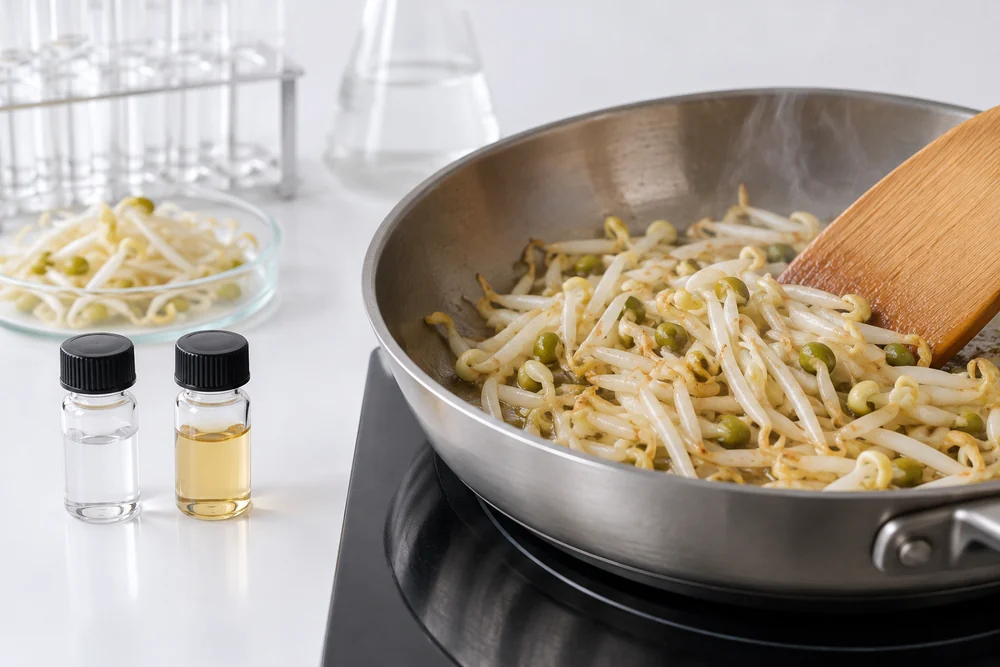
State the absence claim before reading the precursor
The first step in reading a laboratory report is to state the claim being tested. "No acrylamide formed" is a claim about acrylamide in the cooked food. A measurement of free asparagine, however accurate, answers how much of one precursor was detected under its extraction method and reporting basis. Those are not the same analyte. Reducing sugars, heat and moisture also affect the pathway. An unchanged precursor figure therefore cannot certify the reaction product's absence. If absence below a specified analytical capability matters, the product needs a method with an appropriate detection limit and sampling design.
The distinction resembles a mass-balance problem, but the food matrix makes it more complex than a simple subtraction. A large precursor pool may feed several reactions. Only a small fraction may become the specific product of interest, and some material may change through other pathways. Heating also changes water content, so concentrations expressed per mass of cooked food can move even if the absolute amount in the original sample does not. A buyer needs to know whether the lab used raw-sample mass, cooked mass or another basis before comparing columns in a report.
The original mung bean sprout pan-frying study analyzed asparagine, sugars and acrylamide in retail sprouts heated under laboratory conditions. The paper reported increasing acrylamide during its heating trial while the change in asparagine on its reported raw-sample basis was not significant. The authors explicitly discussed how a product measured on a microgram scale can be hard to explain by subtracting from a precursor measured on a milligram scale. That is the evidence for the article's central interpretation. It is not a test of GreenLand frozen sprouts or every commercial pan process.
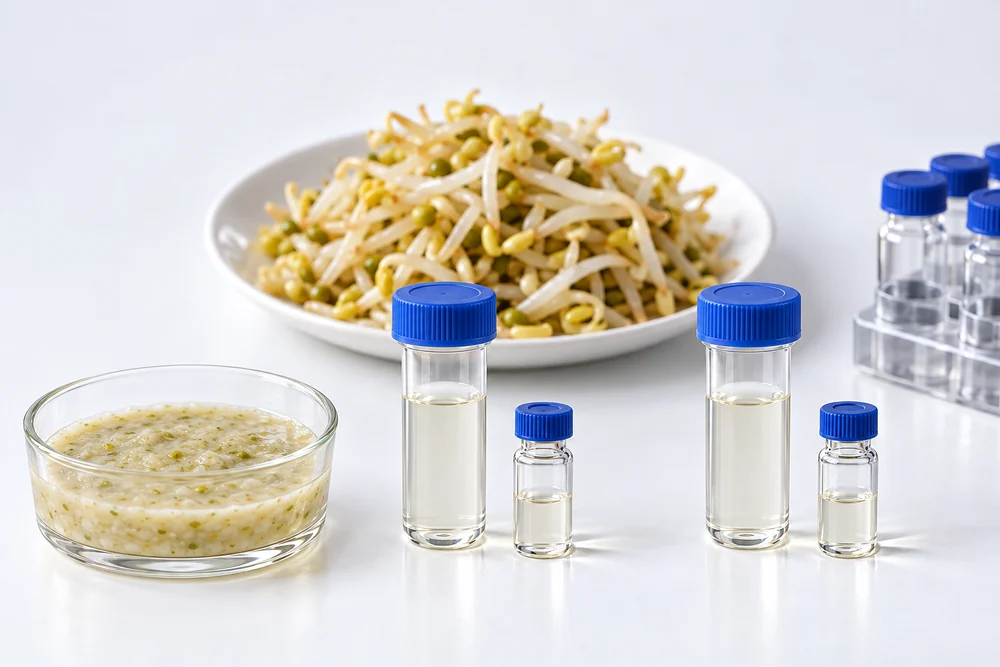
Stable bulk asparagine does not establish the absence of acrylamide.
The buyer should also be precise about "unchanged." A statistical result of no significant decrease does not prove an exact zero change. It says the study did not establish a decrease under its data, variability and method. The precursor may have changed modestly, or the measurement may not resolve a conversion small relative to the starting amount. If another lab reports the same rounded value before and after heating, that too does not prove identical molecular inventories. Method precision, replicate variation and the reporting basis all matter. The right next question is what the product assay shows.
This framing prevents a misleading safety shortcut. If a processor has only a precursor report, it should not describe the cooked product as free of acrylamide. If it has a product report below a detection or quantification limit, it should describe the result with the method and limit, not as absolute chemical absence. Food-safety and labeling teams should interpret the result in the destination market context. GreenLand can provide ingredient information, while the processor's qualified personnel assess the finished process and any applicable requirements.
Ask whether the report examined free asparagine or a broader protein or nitrogen pool. The specific free amino acid relevant to the reported reaction pathway is not interchangeable with total protein. A large total-protein number does not reveal how much free asparagine was available at the food surface during heating. The reverse is also true: a free-asparagine result cannot describe all nutritional nitrogen in the sprouts. This matters when several departments pass around a laboratory spreadsheet and use the word "precursor" loosely. Every column should retain the named analyte and extraction method so a later absence claim is not built on the wrong measurement.
The original experiment reported different endpoint responses
The published experiment followed the formation of acrylamide as mung bean sprouts were pan-fried. The paper measured free asparagine and reducing sugars alongside the reaction product. Its reported acrylamide amount increased during the laboratory time course; the reported asparagine decline did not reach statistical significance. That combination is chemically plausible because the amount of acrylamide detected was much smaller than the amount of asparagine present. The observation supports the conclusion that precursor depletion is a poor proxy for the product in this setting. It does not mean the precursor is irrelevant; the same paper's separate enzyme experiment supported asparagine's role in product formation under a different preparation.
There is a source-reading limit concerning sugars. The abstract says sugar content decreased during pan-frying, while part of the results describes no significant change after correction to the raw-sprout basis. These statements may reflect different ways of expressing or discussing the data, but the discrepancy does not justify a universal quantitative sugar-depletion trend. The safe and useful statement is that reducing sugars are relevant reactants in the pathway and should be measured in a process-specific investigation. A buyer should read the paper's full tables and method before repeating any numerical claim or designing a trial around sugar depletion.
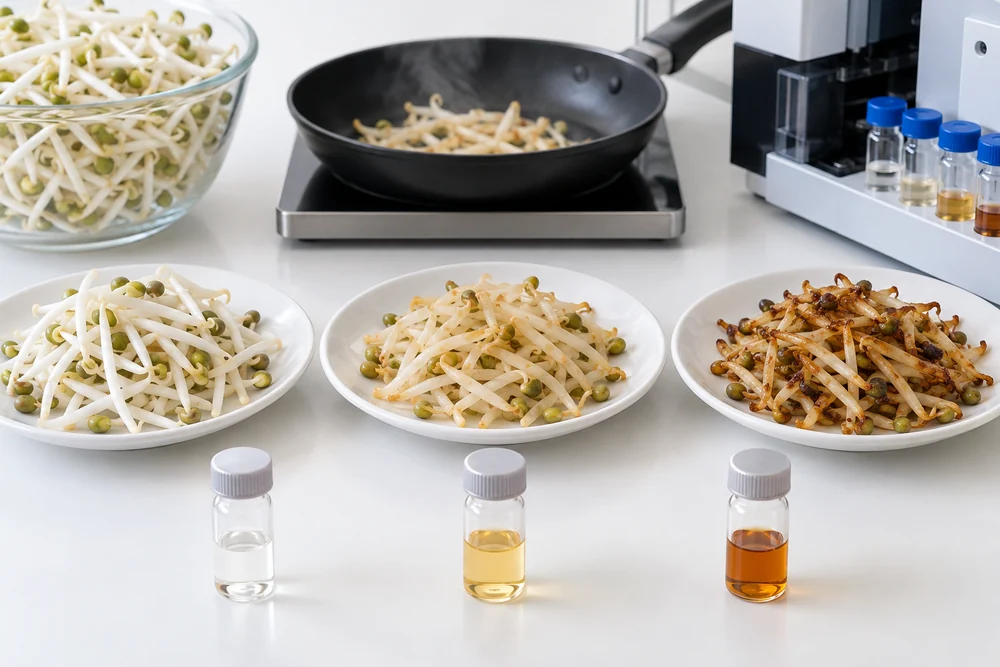
Collect samples across the actual process instead of inferring chemistry from color.
The research used retail mung bean sprouts and an experimental pan protocol. It did not study frozen GreenLand product through an industrial cooking line, nor did it validate a commercial safety process. The reported temperature and heating times describe the experiment; they are not instructions to use for food service. The asparaginase intervention was performed under defined laboratory conditions, including a homogenate, and does not become a ready-to-adopt supplier or kitchen treatment. Any process mitigation would need separate technical, safety, sensory and regulatory validation by the processor.
An independent Food Safety study of cooked mung bean sprouts reported a broad range of acrylamide outcomes across its cooking conditions and used product-specific analytical methods. Its authors emphasized the difficulty of selecting one representative concentration from variable preparations. That does not authorize copying a lower value for another process; it reinforces the need to sample the actual cooking route. Different heating, moisture, mixing and raw material can alter the outcome, and a frozen ingredient may enter the process differently from fresh retail sprouts.
The source evidence also limits what can be concluded from color. Browning is related to heat-driven chemistry but is not a calibrated assay for acrylamide in a sprout batch. Some browned products may differ for reasons beyond the pathway of interest, and an apparently pale cooked sample cannot be declared analytically clear without measurement. Visual inspection helps document the process and identify unusual heating, but a laboratory result is needed for a quantitative product claim. A processor should not treat the paper's illustrative time course as a universal color chart.
For procurement, keep the endpoint names on every document: raw sprout asparagine, cooked sprout acrylamide, sample mass basis and analytical method. If a supplier provides an ingredient specification, it may include identity, form, quality and handling data. The customer's cooked-food result belongs to the customer's process. This division of evidence avoids blaming or clearing an incoming frozen ingredient on the strength of a report that measured a different material at a different stage.
Frozen and fresh sprouts should not be silently combined in one data series. Freezing, thawing and draining can change where water and soluble material sit before cooking, and the buyer's pan load may differ from the fresh retail samples used in the paper. This is a reason to document the actual material, not a claim that freezing necessarily raises or lowers acrylamide formation. If the buyer receives a frozen sprout, it should use that frozen form in a representative trial and record whether it was cooked directly from frozen or after thawing. A fresh-sprout literature value is background context only.
A small reaction can be hidden in a large substrate pool
Imagine a container holding a large amount of free asparagine, of which a comparatively small amount participates in one reaction pathway during heating. The product can be analytically detectable even though the remaining substrate still looks almost unchanged relative to its original mass. The original authors discussed a difference of several orders of magnitude between the scales of asparagine and acrylamide in their data. The point is not to derive a conversion percentage for commercial sprouts. It is to recognize that a bulk precursor assay may lack the resolving power to answer whether a small reaction product appeared.
Statistical significance is another layer. A measured mean can decrease slightly, while natural variation among samples and analytical uncertainty prevent the study from establishing that decrease. At the same time, a separate assay may show a clear rise in the product because it is optimized for the trace compound. There is no contradiction in those two results. They have different analytes, concentration ranges and sources of variation. A buyer should ask for replicate counts, detection capability and sample handling when a report is being used to make a strong absence claim.
Moisture changes can create a false comparison when numbers are expressed per 100 grams of food. Cooked sprouts can lose water, so a compound's concentration per 100 grams cooked food may rise even if the total amount in the starting batch changes less. Conversely, expressing a cooked result per original raw mass requires the raw and cooked weights to be recorded accurately. The original study took care to report values on a raw-sample basis for relevant comparisons. A commercial investigation should specify the basis in advance, preserve raw and cooked weights and avoid placing values from different bases side by side without conversion.
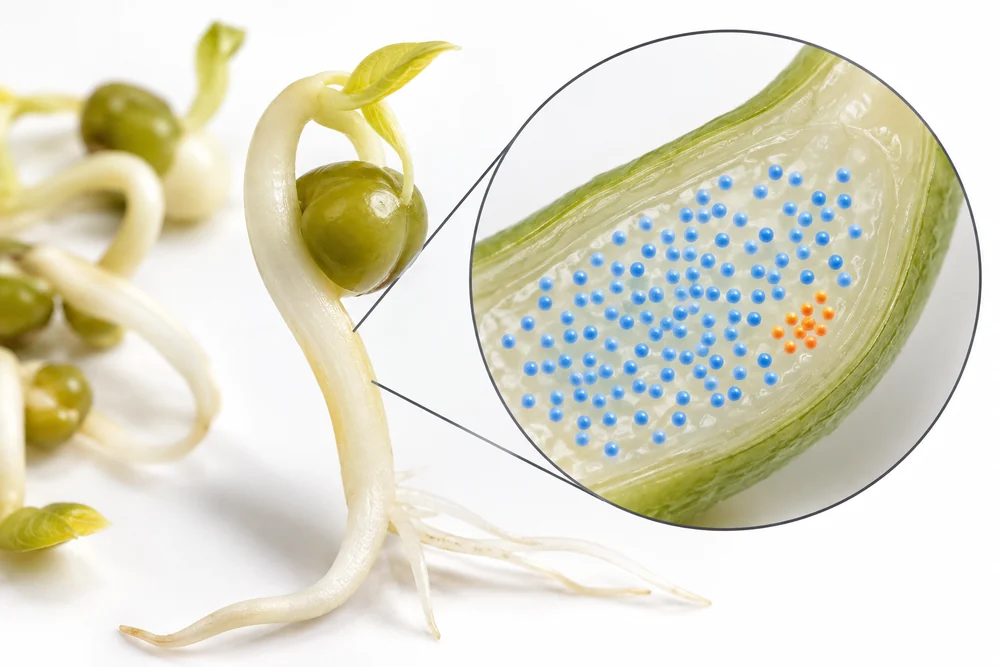
A small conversion can coexist with no significant change in the larger precursor pool.
One can also confuse a limit of detection with absence. A product result below the method's detection limit means the method did not detect the compound above that threshold in the tested sample. A result below a quantification limit may still indicate a signal too small to report precisely. Neither statement is identical to "no molecule formed." For a buyer decision, the laboratory should state its method, matrix validation and reporting limits. A method suitable for potato crisps may need verification in a high-moisture sprout matrix. The technical team should ask a qualified analytical laboratory to choose or validate the method.
The original study's enzyme experiment further separates reaction mechanism from a simple depletion test. Lowering available asparagine under its laboratory conditions was associated with less subsequent acrylamide formation. That supports a precursor role. It does not follow that every normal cooking trial must show a large asparagine drop to have formed product. The enzyme treatment changed the substrate before heating under a specific preparation, whereas the main pan trial followed a different route. Combining those results into a kitchen recipe would exceed the evidence and could affect other food-safety and quality requirements.
A report that measures both precursor and product can therefore be useful without forcing a perfect mass balance. The precursor result helps characterize the starting material and compare controlled trials. The product result answers the formation question. A moisture and mass record lets the two results be interpreted on compatible bases. If the finished product varies, the processor can then investigate actual heat exposure, raw material, mixing and process variation. The goal is a reliable decision about the product, not a subtraction that appears elegant but has insufficient analytical resolution.
There is a procurement reason to keep the scale difference visible. If a buyer demands that every incoming lot show a measurable drop in asparagine after a standard heating test, it may reject acceptable material for an irrelevant reason while failing to detect product formation. If the true decision is whether a finished food meets an internally set contaminant objective, a direct product measurement is more aligned. Precursor profiling can still support formulation comparisons or root-cause work. A good specification states what each measurement is meant to control. It does not turn one convenient assay into a certificate for a different compound.
Investigate the actual sprout process analytically
Consider an illustrative procurement scenario: a processor asks GreenLand whether unchanged asparagine after a sprout trial proves that the reaction product was absent. This is a hypothetical buyer question, not a historical case or a GreenLand laboratory result. We would clarify the offered frozen bean sprout form and how it entered the processor's test, then ask for the raw and cooked sample records, the asparagine method and any acrylamide assay. If no direct product assay was performed, the absence claim remains unresolved. The processor should commission a suitable product-specific analysis rather than infer absence from the precursor result.
The sample plan begins with identity and traceability. Record whether the sprouts are mung bean sprouts or another species, whether they were frozen, the pack and lot, the thaw procedure if any, and the mass entering the pan or line. Record cooked mass and any added ingredients that affect browning or moisture. Take representative samples from the process, not only the most or least browned portion. If a batch is mixed unevenly, consider positions or time points that could experience different heat exposure. The sampling plan should reflect the finished food whose result the buyer needs to defend.
Analytical work should be assigned to a laboratory with a validated method for the relevant food matrix. The original research used methods suited to its study, but a commercial laboratory may select another validated approach. The report should identify the analyte, extraction method, calibration, detection and quantification limits, units and mass basis. If a customer compares suppliers, keep the cooking and analytical protocol constant across ingredient samples. Otherwise a difference in pan loading, mixing or moisture can be incorrectly attributed to the frozen sprout lot.
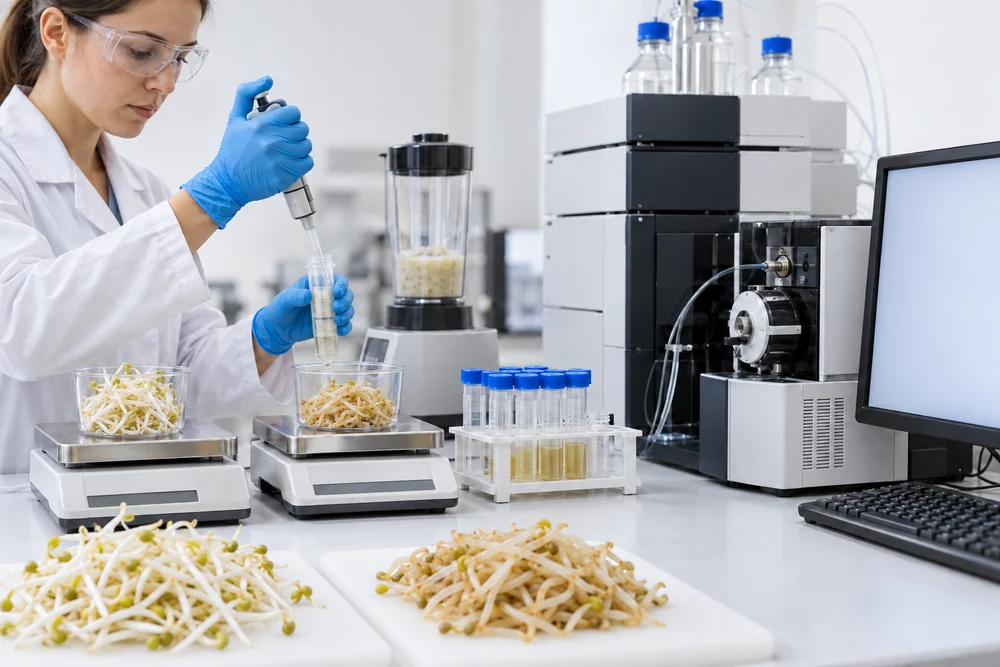
Keep sample basis, extraction and direct product analysis in one traceable record.
The processor may also need a controlled time-course investigation when a particular operation appears to change the result. Set sampling points within an approved cooking process, measure the product directly and record actual food temperature or process parameters as applicable. Do not copy the research paper's pan settings. An industrial line, a restaurant wok and a laboratory pan have different heat transfer and mixing. A process change intended to reduce a contaminant must be evaluated together with microbiological safety, sensory quality and applicable requirements. Qualified personnel should own that validation.
If a product measurement is unexpectedly high, the technical team can inspect whether the raw material, storage, added ingredients, cooking surface, batch load or mixing changed. The science points to precursor supply and heat-driven chemistry, but it does not identify which factor caused one customer's result. Replicate a suspect condition with proper controls before changing the purchase specification. The supplier can provide available product and lot information; the processor must examine its own downstream transformation. This is a shared evidence problem, not a reason to infer responsibility from an unchanged precursor line on a report.

Mung bean sprouts are the ingredient form to carry into a cooking trial.
GreenLand's frozen bean sprout page supports discussion of the offered ingredient form and wholesale supply. The buyer should specify application, packing, quantity, destination and requested documents. The frozen vegetable category offers broader sourcing context. Neither page is a substitute for product-specific analytical results after the buyer cooks sprouts. A purchasing approval can state what is known about the incoming ingredient and what remains the processor's validation task.
When a customer sends two laboratory reports for comparison, make sure they refer to matched food. A precursor assay on raw sprouts from one carton and a product assay on cooked sprouts from a different crop cannot establish the reaction path in either lot. Align lot, sample preparation and processing run as closely as feasible, and retain enough material for repeat work if a result is disputed. Record additions such as sauces or sugars because they can alter the food matrix and the interpretation of an analytical result. This traceability allows a buyer and supplier to discuss evidence rather than speculate from two unrelated numbers.
Keep chemistry and safe cooking decisions separate
The acrylamide question concerns a chemical reaction product. Safe cooking decisions also concern microbiological hazards and the validated condition of the finished food. A processor should not shorten a required cooking step merely because a shorter heated sample might form less of one compound. Any alteration to time, temperature, mixing or serving instructions needs qualified food-safety evaluation. The existing bean sprout cooking guide covers preparation with safety ahead of texture. The existing cooking controls still apply while a suitable product assay answers the acrylamide question.
The FDA's acrylamide background and EFSA's scientific topic page describe high-temperature food formation in general terms. Their broad context does not give a result for a specific frozen sprout lot or a validated processing change. The original mung bean study supplies a focused analytical example; the official sources help frame why the compound is evaluated. Destination-market requirements and any current mitigation or labeling obligations should be assessed by the buyer's qualified regulatory team, not inferred from a general article.
The purchasing decision should separate three files. First is the ingredient specification: bean sprout identity, frozen form, packing, lot traceability and agreed quality attributes. Second is the customer's validated cooking or manufacturing procedure, including its microbiological safety evidence. Third is the analytical record for acrylamide in the finished product, when that question is material. The three are connected through lot and process history, but no one file replaces the others. An asparagine number belongs as supporting input characterization, with its method and basis attached.
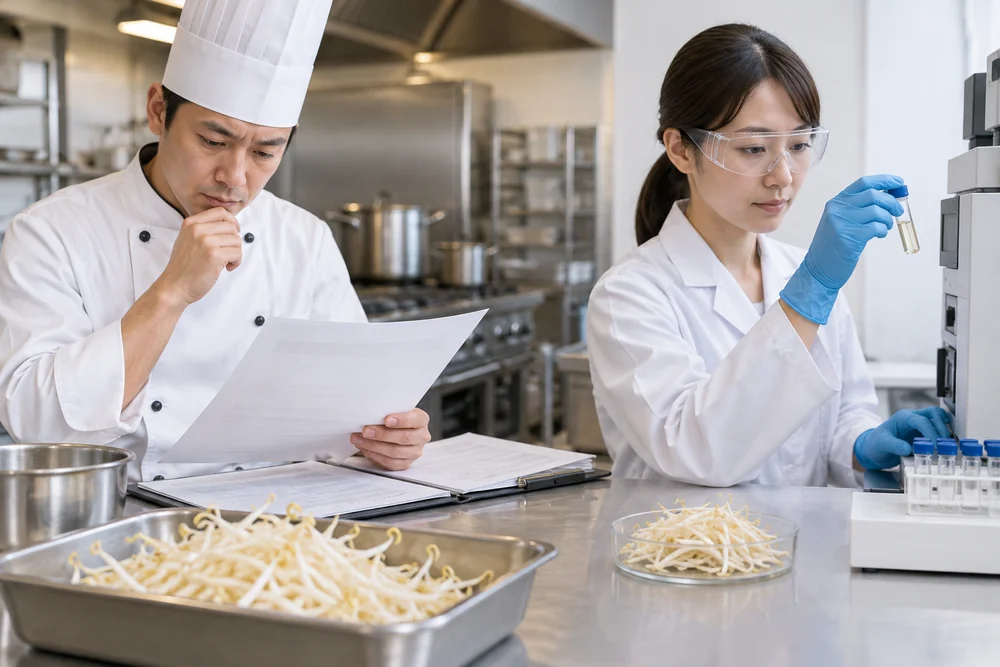
Cooking validation and an acrylamide assay remain separate decisions.
A low-acrylamide claim or quantified risk statement needs product measurements and a destination-specific review. A result from one pan trial cannot certify every commercial process. If the customer asks only whether an unchanged asparagine line proves absence, the answer is already clear: it does not. A suitably validated product assay and a traceable cooking record are the appropriate evidence. That narrow, testable answer keeps chemistry honest while leaving safe preparation under the processor's established controls.
For a GreenLand frozen bean sprout inquiry, identify the actual sprout species and frozen form, the intended cooked food and the analytical claim at issue. We can provide the agreed ingredient specification and lot information. The processor should preserve a matched raw-and-cooked sample record, measure acrylamide directly with a suitable method when that is the question, and maintain its separately validated cooking controls. A stable asparagine result describes one precursor measurement; it cannot certify absence of reaction product or justify a shorter cooking step.

Use this sprout form in a defined cooking trial before drawing process conclusions.
Plan frozen bean sprout supply with GreenLand-food
For frozen bean sprout, tell us the intended product form, application, pack, and inspection priorities. GreenLand-food is a China-based frozen-food supplier and manufacturer. We can discuss factory-direct wholesale supply around the specification you need to evaluate.