


Where Do Mandarins Come From? Origins and Crop Seasons
Sep 24, 2026
Leave a message


There is also a third meaning. A named mandarin may have been selected, bred or popularized in a place different from both its ancient ancestry and its present orchard. Satsumas, clementines and other easy-peeling types have different histories. For food buyers, separating lineage, cultivar and shipment origin prevents a misleading answer to a simple question. It also helps explain why fresh mandarin seasons shift with the hemisphere and why frozen peeled segments can be available when a local fresh crop is not being harvested.
Where the mandarin lineage began
The mandarin lineage belongs to the citrus group associated with southern China and neighboring parts of East and Southeast Asia. An older FAO overview of mandarins in Vietnam describes a Southeast Asian origin and long regional cultivation. It is reasonable to give East and Southeast Asia as a short geographical answer. It is less reasonable to point to one modern national border as the single place where every fruit sold as a mandarin first arose.

Diagram connecting southern China and nearby Southeast Asia to cultivated mandarin lineages
Citrus history is difficult to draw as a simple family tree because people moved plants, selected seedlings and crossed related types over many generations. Genome research on mandarin, pummelo and orange diversity found that some mandarins have more ancestry from pummelo than others. An ancestral mandarin lineage and the cultivated mandarins in a supermarket are therefore connected, but they are not necessarily genetically identical. This is why a claim such as "all mandarins originated in one province" sounds more precise than the evidence allows.
The fruit's ancient regional roots also do not determine its current flavor. Climate, cultivar, rootstock, irrigation, harvest maturity and postharvest handling shape the eating experience of a modern lot. A mandarin grown close to an ancestral region can taste different from another cultivar grown on the same farm. Conversely, a cultivar selected elsewhere may grow well in Asia today. Origin is useful context, but a buyer should still assess the actual product against its specification.
Mandarins are often described as small oranges. In common retail language that is understandable, but it can blur their botanical relationship with sweet oranges and with hybrid types. A clementine and a satsuma may both be sold as mandarins because of their size and peelability, even though their cultivar histories and production traits differ. A product description should name the intended type when it affects segment size, peel removal, seed tolerance or flavor. The broad word "mandarin" alone cannot do that work.
When an origin story appears on a finished food label, distinguish it from an ingredient-origin declaration. "Asian roots" describes a long history; "grown in China" describes a specific supply source only if the lot is traceable to China. A frozen fruit product may combine batches from different approved farms or use a different harvest region in another season. Traceability records and the agreed label text need to match the actual lot. Romantic historical language does not substitute for a country-of-origin record.
How cultivated mandarin types spread and diversified
People carried and cultivated citrus across Asia long before modern cold-chain trade. Selection favored useful differences such as peelability, sweetness, acidity, aroma, seed count and the month when a tree bore marketable fruit. Some lines were propagated because growers could repeat a desirable fruit; others arose through crossing or chance seedlings. Over time, different names came to refer to distinct cultivars, cultivar groups, regional selections and commercial classes. That history explains why a modern mandarin display can include very different fruit under one umbrella term.

Three mandarin forms with different peel and segment structures
The satsuma illustrates the difference between ancestral and cultivar origin. The University of Florida extension account describes satsuma mandarin history and its introduction to the United States. A buyer who sees "satsuma" should think of a particular easy-peeling mandarin group and its production characteristics, not assume that the fruit in the box was grown in the place where the name became famous. Today's satsumas may be grown in several countries, and their local harvest windows differ.
Clementines provide another familiar example. They are recognized in trade as a mandarin type with a particular appearance and eating style, but the common name does not specify one current orchard location. Some fruit may be nearly seedless under certain growing conditions, while cross-pollination can change seed occurrence. This matters for processors asking for peeled segments: a cultivar name may set a useful expectation, yet the actual batch still needs a seed-control standard and inspection method. A general historical description cannot establish a processing yield.
Later breeding and regional adaptation widened the range of marketable mandarin fruit. Researchers studying mandarin diversification and hybrid ancestry show that many cultivated types have complex backgrounds. That does not make everyday naming useless; it means the names serve different purposes. A consumer may be happy to know the fruit is a sweet easy-peeler. A factory needs the cultivar or accepted class, harvest area, size band, segment integrity and defect limits if those traits influence its product.
The movement of cultivars also moved technical knowledge. Growers learned which trees tolerate a local winter, how fruit colors under their conditions and when the best picking window occurs. A variety's performance in one region cannot simply be copied to another. This is particularly relevant for frozen fruit: factories near orchards can process during a short harvest run, but the dates and fruit composition change by growing area. A buyer planning a twelve-month ingredient program should compare supply calendars and trial samples from the proposed origins.
For historical writing, it is tempting to give a neat route from one ancient grove to every modern mandarin. Evidence supports a broad Asian origin and a long, branching process of movement and selection. The practical lesson is straightforward. Ask three separate questions when needed: where did the mandarin lineage arise, where was this named type developed or popularized, and where was the purchased fruit grown? Each question can have a different answer without contradiction.
Where mandarins grow today
Modern mandarins are cultivated across temperate and subtropical citrus regions. China is a major source, while other Asian countries, Mediterranean producers, the United States, parts of Latin America, South Africa and Australia supply their own markets and export channels. The relevant map depends on the cultivar, trade route and season. A country that sends fresh mandarins to one destination may have a smaller role in processed mandarin segments for another destination.
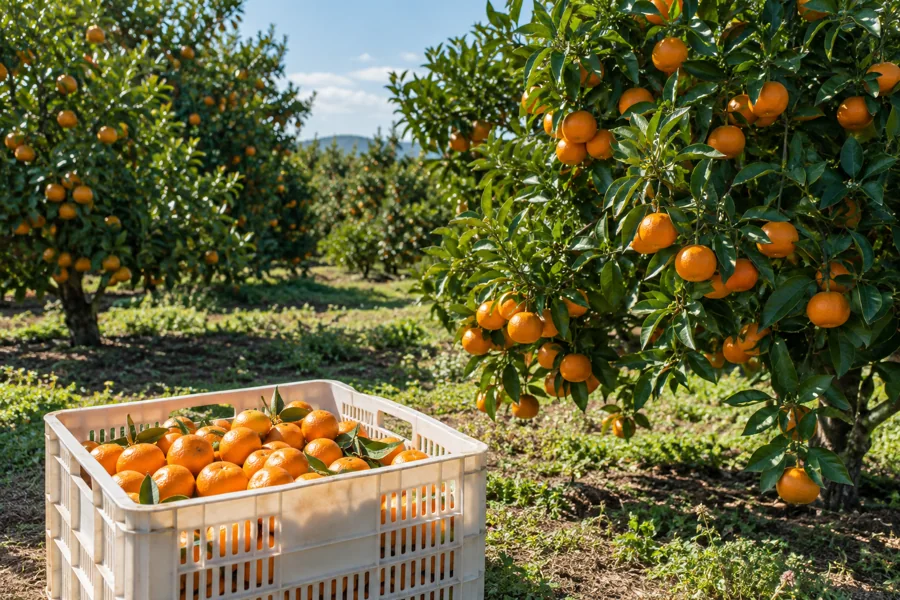
Mandarin orchard with ripe fruit and harvest crate
China's scale does not mean every mandarin-type fruit from China has the same identity or specification. Growing provinces differ in climate and crop calendar. Some fruit is sold fresh, some is processed, and only a share meets the size, peel quality and internal condition required for premium whole segments. For a frozen mandarin orange ingredient, the factory's approved growing area, intake checks and peeling process are more actionable than a headline production ranking. GreenLand-food confirms the relevant origin and lot details against the intended product rather than treating a country's name as a grade.
In the Mediterranean, citrus-growing regions have developed strong fresh-fruit supply networks. Their oranges and mandarins often appear in northern-hemisphere winter programs, though exact months shift by type and local conditions. North American production likewise varies among states and cultivars. The Florida satsuma guide gives a local example of maturity windows extending from early fall toward winter. That calendar should not be copied as a global mandarin season.
Australia is useful to buyers because it shows the other side of the calendar. The Australian Mandarin Industry describes its producing regions and variety mix. A USDA 2025 Australia citrus report places the Australian mandarin harvest roughly from March to October, with much of the crop around June to September. Those are useful planning ranges, not promises that every variety or district is ready throughout the period.
The physical origin on a pack should be read alongside the process location. Fruit might be grown in one region, peeled and frozen near that region, then packed for export under a supplier's program. Alternatively, processing and packing stages may happen in different approved facilities. A buyer should specify which origin statement is required: agricultural origin, manufacturing location or shipping point. A bill of lading's loading port is not an orchard location. Mixing those fields can create avoidable labeling and customs questions.
Climate volatility also makes origin diversification valuable. Heat, rain around harvest, freezes and disease pressure can alter the amount of fruit suitable for fresh retail and for processing. A broad map of producing countries offers options, but qualification takes work: a second origin needs a sample, specification review, food-safety documentation and a trial in the intended application. The goal is a predictable segment, not a rotating map of countries for its own sake.
How regional crop seasons shift supply
There is no single global month when all mandarins ripen. In many northern-hemisphere regions, fresh mandarin programs concentrate in cooler parts of the year, with early and late varieties widening the window. Southern-hemisphere regions harvest at different months, which can supply fresh fruit during a northern off-season. The calendar is a planning tool, then the actual season must be confirmed with the current crop and the selected cultivar.

Illustrative harvest windows for Florida satsuma and Australian mandarins
The Australian example gives concrete dates: the USDA report describes a March-to-October harvest span, concentrated around June-to-September supply. The same calendar month does not imply equivalent fruit from a northern country. Variety mix, weather, tree age and maturity standards all affect sweetness, acidity, color and peel behavior. A buyer comparing June samples with December samples is comparing season and origin together unless the trial controls for those factors.

Mandarin being clipped at harvest beside a ventilated crate
Harvest timing matters for frozen segments because the target fruit is peeled, inspected and frozen during a defined processing campaign. Fruit picked too early may have a sharper balance and lower juice development; overmature or badly handled fruit may break or leak. The grade available for whole segments can be narrower than the total orchard crop. A processor should agree on maturity and quality controls before the season begins, then inspect incoming lots while production is underway. It is difficult to correct a whole year's ingredient specification after the fruit has been frozen.
Frozen supply changes the buyer's purchasing window but does not erase the crop season. IQF mandarin segments can be stored and shipped after the harvest when maintained at the agreed frozen temperature. The quantity and grade in storage still come from a finite crop. Ask when a batch was processed, the production lot, remaining shelf life and the storage history. Those answers are more useful than a vague promise that frozen fruit is "year-round." A factory may offer regular shipments across months while planning its production around a short seasonal intake.
For planning, build a calendar with three lines: fruit availability in the field, processing campaign and customer delivery. The lines overlap but are not identical. Samples for a new specification should ideally be approved before or at the start of the harvest campaign. Packaging materials and label text need sign-off before the factory commits stock. Container bookings, cold storage and import inspection then determine when approved fruit reaches the receiving plant. A delayed purchase order may miss the preferred crop lot even though an alternative frozen lot remains available.
Do not equate "off season" with poor quality. A sound frozen segment processed at an appropriate ripe stage can be a better ingredient for a beverage or dessert line than a fresh fruit shipped a long way and peeled weeks later. The application decides. Fresh fruit may be essential when an intact peel or fresh aroma is central to the product; peeled frozen segments are practical when portioning, labor and consistency are priorities. GreenLand's mandarin freezing guide discusses freezing and use; the season question is about how a crop becomes a reliable supply program.
What origin means for frozen mandarin segment buyers
For frozen mandarin orange segments, origin should lead to specific questions, not a quality ranking by country. First establish the fruit type and intended cut. Then ask where the agricultural fruit was grown, which facility peeled and froze it, and which lot will be shipped. The documentation must connect those steps. If an item is promoted as "from" a region, determine whether that describes the orchard or merely the supplier's address. A clear chain of custody protects the buyer's own ingredient declaration.

Frozen mandarin segments measured for size
Evaluate the fruit in the finished use. A chilled dessert may require intact, bright segments with controlled membrane and seed remnants. A beverage or puree may tolerate more broken segments but need a target sweetness-acidity profile. Bakery heating can change the value of shape and color. GreenLand-food can discuss segment size, broken fraction, peel and pith tolerance, Brix range, packing and export requirements when the application is known. A single country-of-origin claim cannot establish those attributes.
The incoming sample needs representative handling. Thaw a defined amount under the conditions the production line will use and record drip, segment integrity, mouthfeel, aroma and taste. Compare samples at the same temperature. An icy sample can hide acid sharpness; a warm, fully thawed sample can exaggerate softness compared with a frozen dessert application. Measure what matters, but keep a trained sensory check as well. Two lots with similar soluble solids may taste different if their acidity and volatile profiles differ.
Storage and shipping controls are part of origin performance. A well-specified fruit can arrive clumped or dehydrated if the cold chain fails. Agree on frozen transport conditions, pack size, pallet configuration and the evidence required at receipt. Check for broken seals, temperature excursions and signs of thaw and refreeze. If a buyer needs multiple annual shipments from one crop, reserve and track the qualified lot or agree in advance how a replacement lot will be sampled and approved.
Finally, align the commercial paperwork with the story being told. The product specification, invoice, country-of-origin information, certificate requirements and customer-facing label should refer to the same material and lot. A supplier can usually confirm the current harvest and processing origin more precisely than an evergreen website article can. GreenLand-food's frozen peeled mandarin orange product page provides a starting point; ask for a current sample and batch details before treating an origin or season as a purchase commitment.
Consider how a sourcing change should be evaluated. If a processor offers a different growing region because the previous season's inventory is nearly exhausted, request the new lot identity, actual crop year and a matched sample. Compare segment shape and size, membrane level, seed fragments, sweetness-acidity balance and thaw drip against the approved reference. An origin change can be perfectly workable, but it should not arrive unnoticed in the middle of production. A short documented reapproval prevents a marketing statement, ingredient label or recipe yield from drifting away from the material in the carton.
The same discipline applies when the country stays constant but the harvest area or cultivar changes. Large producing countries include multiple climates and harvest windows. A batch from one district may differ from another batch collected weeks later. A contract naming only a national origin can therefore leave substantial room for variation. Set the attributes that matter to the customer, then use origin records to trace and manage those attributes. This is more useful than making a blanket claim that fruit from one country is always sweeter, safer or easier to peel than fruit from another.

Frozen mandarin segments displayed on a plate
For a long program, sample timing should follow the real crop calendar. A pre-season prototype made from an old frozen lot can help establish the desired product form, but it may not represent the new harvest. Ask for a production sample once current fruit is processed, and agree when the final sensory and analytical approval will be made. If a retailer needs pack artwork printed ahead of the campaign, keep variable origin statements out of fixed copy unless the supplier can support them for all intended lots. The purchasing forecast, label approval and fruit season should be managed on the same timeline.
Origin also affects logistics decisions without proving taste. A processing plant close to the orchard may shorten the time from picking to peeling and freezing; a longer journey can still be controlled well when fruit is cooled and handled properly. Ask for the actual process controls and records rather than assuming distance alone determines quality. After freezing, distribution depends on freezer storage, insulated handling and reliable temperature control. A short route with repeated temperature excursions can perform worse than a longer, well-managed route.
When a customer asks where mandarins come from, the clearest answer begins with East and Southeast Asian roots and then names the present lot's growing origin if it is known. If the question concerns harvest timing, give the cultivar and region along with the month range, then flag normal crop variation. If it concerns a frozen ingredient, add the processing lot and current stock position. Those small distinctions make the answer useful for a curious reader and for a procurement decision without turning history into an unsupported supply promise.
The distinction is especially useful for mixed-origin purchasing programs. A customer may approve two growing regions to reduce dependence on one harvest, yet still want the same piece size and flavor profile in every delivery. Keep each origin traceable by lot and compare the finished product after any switch. Where country-of-origin labeling is required, plan packaging or over-label workflows that can state the correct country for each shipment. A pooled inventory without clear identity may be convenient at the warehouse, but it makes both quality investigation and accurate labeling harder.
There is no need for a consumer to learn citrus genomics to enjoy a mandarin. The deeper history matters because the short answer "from China" can be interpreted as an origin of the lineage, a story about a cultivar or a claim about today's fruit. By saying which one is meant, we can be precise without pretending that centuries of cultivation and modern global growing fit on a single arrow on a map.
Source frozen mandarin orange with GreenLand-food
GreenLand-food is a professional frozen mandarin orange supplier and manufacturer in China, providing factory-direct wholesale supply for importers, food manufacturers, foodservice distributors, and private-label programs.
Send the product form, specification, packing, quantity, application, destination, private-label needs, and requested documents.