


Apple-Juice Mycotoxin Reduction: Follow the Receiving Water and Recovered Solids
Oct 09, 2026
Leave a message

Consider an illustrative quality manager whose pilot juice has a lower patulin result after clarification. The manager asks whether the missing patulin was destroyed and whether the retained solids can be used in another product. We would not make either inference. We would ask for the incoming fruit condition, the processing flow, the amount and concentration in every relevant stream, and the destination of each coproduct. That evidence, rather than a clear appearance or one favorable juice number, determines what can be released.
Start with sound incoming fruit
Patulin is associated particularly with mold-damaged apples, making raw-fruit selection a foundational control. An apple can look mostly sound while localized decay creates a concentrated problem, and blending a small amount of badly damaged fruit into a larger lot can distribute the concern. FDA's juice HACCP guidance identifies patulin as a hazard for apple juice and emphasizes excluding rotten, moldy or damaged fruit. The same guidance explains that ordinary heat treatment used for juice does not reliably remove patulin. A buyer should not plan to rescue poor incoming apples by relying on a later pasteurization or filtration step.
The receiving specification should define the relevant defects in practical terms: visible rot, mold, soft or bruised areas, field damage, storage breakdown and evidence of compromised lots. The inspection plan then needs representative sampling across bins or pallets rather than a glance at the top layer. Where the risk warrants it, the QA team can combine visual sorting with toxin testing under a documented sampling method. A negative small sample is not proof that every apple in a heterogeneous lot is sound. The team should understand the limitations of its sampling plan and maintain traceability back to orchard, storage and inbound batch.

Incoming apple acceptance and rejection
Sound fruit is also a broader process-quality issue. Damaged apples can affect flavor, microbial load, clarification behavior and yield. These factors may complicate a toxin investigation because a cloudy, high-solids or unusually low-yield lot changes the proportions of downstream fractions. A receiving sheet that captures defect rate, temperature, storage age, fruit form, lot weight and intended processing route gives the team context for later analytical results. The goal is not to replace testing with paperwork, but to prevent a late-stage concentration from being interpreted without knowing what entered the system.
Our product conversation starts here. GreenLand-food's frozen apple page identifies frozen apple forms for food manufacture. A buyer asking about juice should confirm whether the available frozen form suits its equipment and quality specification; the webpage does not establish a juice SKU, a patulin level for every lot or a claim that freezing eliminates a toxin. Freezing is a preservation and logistics route, not a validated patulin destruction step. If a customer needs a particular fruit form, lot document or incoming testing basis, we should discuss that in the quotation and qualification exchange rather than imply it from generic product imagery.
In the illustrative manager's case, the first follow-up is an incoming-fruit review: defect criteria, sorting records, lot segregation and sample identifiers. If a lot is visibly compromised, the answer is not to send it through more polishing equipment and hope the juice becomes clear. If it is accepted, the process still needs measured controls at the stages relevant to the hazard. This is a layered decision, and its first layer is the condition of the fruit. It makes all subsequent fraction data easier to interpret because the starting material is defined.

GreenLand-food frozen apple chunks
A toxin may move into a receiving stream
Clarification separates phases; separation is not synonymous with destruction. In apple processing, soluble components can remain in juice, adsorb onto a treatment aid, associate with suspended solids, collect in a filter cake, or move into a wash or cleaning stream. The destination depends on the toxin, the matrix and the equipment. A decrease in the juice concentration can be accompanied by a measurable amount elsewhere. An older clarification study indexed by PubMed measured patulin in juice and separated residues, illustrating why process output must be examined as more than one liquid sample.
The flow diagram should name every material that leaves the main product path. For a particular line, those may include rejected fruit, washing water, peel or core waste, press pomace, enzyme-treatment residues, centrifuge sediment, bentonite or activated-carbon solids, filter cake, retentate, filtrate, rework and final juice. Not every plant has every stream. The QA team should draw its actual line and mark where a stream is sampled, weighed, stored, combined or discharged. Once a residue is mixed with another lot, recovering its original mass balance becomes much harder. Sampling at the point of generation avoids that problem.

Apple juice and receiving fractions
It also matters whether a reported reduction is concentration-based or mass-based. A clarification step can make the juice clearer and lower its measured patulin concentration, yet a smaller fraction with a higher concentration may contain a meaningful amount of toxin. If water is removed, the reverse can happen: concentration rises without new toxin formation. A statement such as "80% removed" needs to specify removal from what denominator and into which measured destination. The pilot study should report volumes or masses and concentrations together, with units that can be reconciled. Without this, a buyer cannot tell whether the apparent improvement represents transfer, dilution, transformation or an analytical limitation.
The receiving stream becomes a commercial question when someone proposes to use it. Pomace might be considered for fiber, feed or other applications, while water and filter media have their own disposal routes. None can be released merely because the juice passed a target. Their destination, applicable rules and analytical suitability need separate evaluation. A coproduct is not automatically safe because it is called a byproduct. Conversely, finding toxin in a separated fraction does not by itself tell us how much remains in final juice. Each material needs its own identifier and decision criterion.
For the illustrative manager, we would ask for a simple annotated process map and a table with each receiving stream's batch, mass, sample count, analytes and intended disposition. If a pilot omits the filter cake because it is inconvenient to sample, its conclusion should be limited to "lower measured concentration in the sampled juice." It should not say that toxin was destroyed. That wording distinction protects the team from using a promising clarification result as a disposal or coproduct authorization that the study never tested.
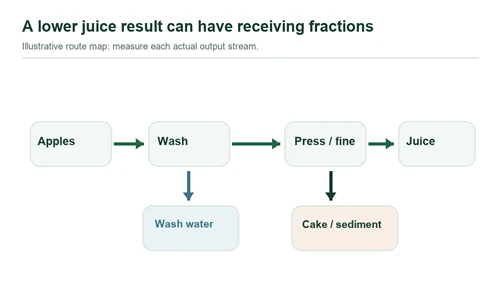
Apple processing receiving stream map
Different mycotoxins need not share a removal route
Patulin is important in apples, but it is not a stand-in for every mycotoxin a research study might measure. Molecules differ in solubility, stability, adsorption and interactions with juice solids. A treatment aid that binds one compound may be much less effective for another. A 2021 pilot study of clear and cloudy apple juice tested patulin, ochratoxin A and alternariol under a specific activated-carbon, bentonite and ultrafiltration sequence. In that experiment, the authors reported that ochratoxin A and alternariol fell below their respective quantification limits after treatment, while patulin fell from about 396 to 318 micrograms per liter, roughly a 20% reduction. Those are results for a spiked experimental system, not a universal recipe for commercial apple juice.
The quantitative details matter because "below quantification" is not the same as zero. The study's limits were approximately 1.4 micrograms per liter for ochratoxin A and 4.6 micrograms per liter for alternariol. A buyer reading only the headline "removed" could miss the method boundary. A final lot may need a different reporting limit, depending on the destination market, intended use and the customer's acceptance criterion. If the analytical method cannot measure below the decision threshold, a favorable-looking report may not answer the release question. The team should agree on analyte list and laboratory capability before running the trial.

Different mycotoxins show different pilot outcomes
It would also be unsound to copy the pilot's percentage into a purchasing claim. The starting concentrations, spiking approach, treatment doses, pH, turbidity, contact time, filtration membrane and juice matrix all affect the observed outcome. A commercial line may use different materials or process conditions. The paper helps form a hypothesis: toxin-specific behavior should be expected and measured. It does not prove that a customer's clarification stage will achieve the same reduction or that any toxin has been destroyed. If a treatment removes toxin from the liquid by adsorption, the spent material becomes a receiving stream to manage.
A useful test plan lists each analyte independently. For each one, the team identifies why it matters for the apple source and destination, where it is expected to partition, which matrix the lab can measure, the reporting limit and how non-detects will be handled. Juice, pomace and filter media are analytically different matrices; a method validated for clear juice may not work unchanged on wet solids. A single multi-analyte certificate may be efficient, but the validation and recovery information should still be checked by matrix. Otherwise an apparently clean residue might reflect poor extraction rather than absence.
From the supplier side, we can discuss the apple ingredient and the documents available for a proposed frozen form. We should not offer activated-carbon treatment, ultrafiltration or toxin removal as GreenLand capabilities unless separately verified for a specific service or product. If a buyer asks whether our frozen apples will yield a particular mycotoxin result in its juice, the honest answer depends on lot qualification and downstream validation. The buyer's processing line and destination criteria remain central. The research provides a warning against using one toxin as a proxy for another, not a substitute for the buyer's QA program.
Reconcile concentrations with the actual fractions
Mass balance turns a collection of laboratory results into a process account. At a minimum, record the starting mass of apples and the mass or volume of each output fraction, then multiply each measured concentration by its corresponding amount on a consistent basis. Compare the summed measured amounts with the estimated input amount, allowing for sampling, moisture changes, method recovery and unmeasured streams. A perfect 100% recovery is not expected in every pilot, but a large unexplained gap should be described as an evidence gap rather than labeled destruction. The calculation is only as good as the measurements and the definition of each fraction.

Mycotoxin amount requires fraction mass and concentration
Consider a simple, illustrative arithmetic example unrelated to a specific study. If ten liters of juice at 100 micrograms per liter contain an estimated 1,000 micrograms of an analyte, a later eight-liter juice stream at 50 micrograms per liter contains about 400 micrograms. The liquid concentration has halved, but the account still needs to explain the remaining estimated 600 micrograms among removed solids, other liquids, degradation, volatilization if relevant, losses or analytical uncertainty. Treating the concentration change alone as "600 micrograms destroyed" assumes the conclusion that the experiment is meant to test. The actual pilot must use its measured weights, volumes and toxin-specific methods.
For wet residues, concentration basis is especially easy to confuse. A cake may be reported in micrograms per kilogram wet weight, another lab may use dry weight, and a juice result may be in micrograms per liter. Record moisture content and density if converting between bases. A highly concentrated small cake and a dilute large wash-water stream can carry similar total amounts. A residue's safety decision may depend on its own concentration and intended use, while the overall process explanation depends on its total analyte mass. The two questions overlap but are not identical.
Sampling can dominate the uncertainty. A filter cake may be heterogeneous across a run; a settling tank has layers; a combined pomace bin may receive multiple fruit lots. A composite sample should follow a documented method that matches the decision, and the sample should be collected before material is diluted or mixed with other batches. Process timings matter too: a start-up fraction can differ from steady-state output. If the manager has only one final juice sample, we would not call the mass balance complete. We would design the next pilot so the fractions are measurable at the points where they arise.
Analytical uncertainty should appear in the reconciliation, not disappear into rounded percentages. Laboratories can report recoveries, duplicate variability and quantification limits. Values below a limit cannot be assigned zero without a stated rule. If the input estimate is based on a small, heterogeneous apple sample, its uncertainty may be large. A gap between input and output might be a measurement problem rather than chemistry. Conversely, an approximate balance does not prove that every particle of toxin is located or that every stream is safe. It shows how well the measured account closes under the pilot's assumptions.
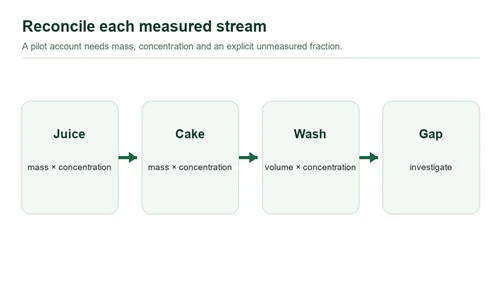
Apple fraction mass reconciliation
For a buyer, the most valuable output is a fraction table that QA, operations and the laboratory can read together: stream name, quantity, basis, collection time, sample ID, patulin result, other analyte results, method limit, calculated amount and disposition. The table exposes missing streams and ambiguous units immediately. It also helps prevent a separate sales or sustainability team from promoting a coproduct before the QA decision has been made. A process claim should be no broader than the fractions and operating range actually measured.
Release neither product nor coproduct from appearance alone
Clear juice can still contain a dissolved contaminant, and a visually clean press cake can still carry material removed from juice. Appearance is a quality observation, not a toxin result. The final release decision needs representative samples of the actual commercial product and any coproduct proposed for use, analyzed for the relevant hazard with a suitable method. It also needs the destination market's applicable requirements and the customer's own specification. A pilot reduction is a development observation until it is validated on the intended line and supported by routine controls.
An approval file should tie the result to incoming fruit lots, sorting and rejection records, processing conditions, treatment-aid lots, equipment settings, fraction weights, sampling times and laboratory reports. If an out-of-spec result occurs, this traceability lets the team hold the connected streams and investigate rather than release a coproduct that happened to sit outside the main juice tank. The release decision for juice may differ from the decision for pomace, filter cake or wash water. Each stream needs an owner, a documented destination and a hold/dispose/use rule. A favorable main-product number cannot authorize all side streams by implication.
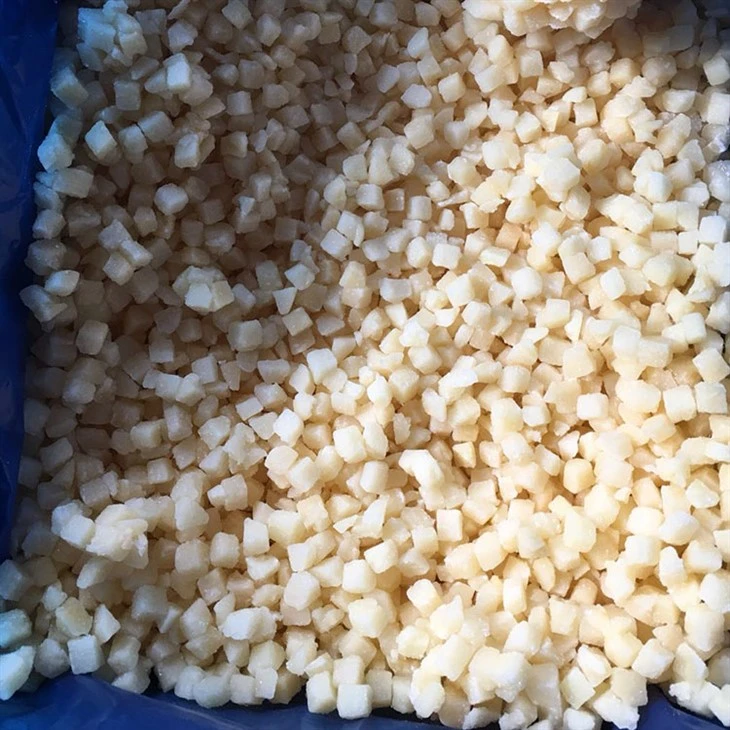
GreenLand-food frozen diced apples
The manager's concrete next step is to run a controlled pilot with sound, identified incoming apples and a written process map. Before processing, QA and the laboratory agree on patulin and any other justified analytes, validated matrices, reporting limits and sample containers. During processing, operations records every stream's quantity and collects representative samples before mixing or disposal. After results arrive, the team reconciles amounts and makes separate decisions for final juice and each intended coproduct. If a fraction is not sampled or cannot be analyzed reliably, the report states that limit and the fraction remains outside the release claim.
The pilot should also specify what would trigger a repeat. If the apple source changes, sorting performance falls, the clarification aid is substituted, or the filtration equipment runs outside its validated range, a previous reduction percentage may no longer describe the new run. Routine monitoring can track the settings that proved important during validation, while periodic analytical checks test whether the control still produces the expected outcome. A manager should know who has authority to hold material when a monitoring value is missing or outside range. That governance matters as much as the graph in a development presentation: it turns a one-time result into a usable operating decision.
Disposition must be practical, not merely analytical. A residue placed in an open bin before its result returns needs identification and segregation so that it cannot accidentally enter a feed or ingredient route. If a stream is destined for disposal, the plant should use the appropriate local procedure and keep the record linked to the production lot. If a coproduct is proposed for sale, its intended customer and use should be declared before sampling; otherwise the laboratory may have measured the wrong hazards or used a reporting limit unsuitable for that use. These are decisions for the processor and its regulatory team, supported by actual results for the specific material.

Separate apple juice and coproduct release gates
We can support the upstream ingredient discussion by confirming available frozen apple form, packing, quantity and documents for the buyer's application. We would ask whether the fruit is intended for direct food use, further processing or a pilot juice comparison, because that affects the qualification conversation. We would not represent our apples as a finished juice or say that freezing, clarification or a clear appearance removes patulin. The customer's QA program must decide what is acceptable for the destination and intended use. Our useful contribution is a well-defined ingredient and honest boundary around what the downstream process has actually demonstrated.
This distinction also makes communication to other departments safer. Procurement can say the fruit lot was qualified to its incoming specification. Operations can say a particular stage reduced the measured concentration in sampled juice under stated conditions. QA can say which finished product and coproduct batches met their own release criteria. Those are precise, compatible statements. "The toxin disappeared" collapses them into a claim the data may not support. Keeping the streams visible gives the buyer both a better safety decision and a clearer route to improve the process if the pilot result is unsatisfactory.
When a receiving stream is difficult to test, the team should not quietly omit it from the flow diagram. It can first determine whether a laboratory has a validated extraction method for that matrix, whether the material can be sampled before it is mixed, and whether a conservative hold or disposal decision is needed meanwhile. A missing value is an explicit uncertainty in the account. If a pilot loses liquid in a rinse line or combines cake with a previous batch, the reconciliation should show that pathway as unmeasured rather than assign its amount to degradation. This discipline prevents a tidy percentage from appearing more conclusive than the plant records allow.
The same care applies when comparing two processing options. A method that yields a lower juice concentration but creates a larger, harder-to-manage residue may be less attractive than a method with a slightly higher, still acceptable juice result and a well-controlled waste route. The buyer should compare product yield, quality, treatment costs, analytical burden and coproduct disposition alongside toxin results. A single reduction percentage cannot capture these tradeoffs. The process that makes commercial sense is the one the plant can run consistently, document, and verify for every material it intends to release.
Related reading
Fruit storage context before processing. Read How Long Do Apples Last in the Fridge?.
Applications and handling for a frozen apple ingredient. Read What to Do With Frozen Apples.
Source frozen apple with GreenLand-food
GreenLand-food is a professional frozen apple supplier and manufacturer in China, providing factory-direct wholesale supply for importers, food manufacturers, foodservice distributors, and private-label programs.
Send the product form, specification, packing, quantity, application, destination, private-label needs, and requested documents.