


Apricot Glaze for Pastry: Fruit Puree, Pectin and a Smooth Surface Finish
Sep 28, 2026
Leave a message


For a bakery buyer, the deciding sample is the finished pastry after the intended holding cycle. The coating must cover the surface at the planned application temperature, adhere without heavy ridges, and retain an acceptable appearance when the pastry is cut, packed or served. A glossy photograph of a fresh tart cannot prove that the coating will survive chilled display or a freeze-and-thaw program. Use the actual pastry and compare matched samples under the same conditions.
GreenLand-food supplies frozen apricot in confirmed forms for bakery and fruit processing, including pieces and puree options subject to the current specification. We can discuss fruit form, pit control, Brix, packing and documents for the ingredient. The bakery or fruit-preparation producer designs and validates its own glaze. This distinction matters when a sourcing inquiry says "apricot glaze": the ingredient and the ready-to-use coating are different products with different responsibilities.
Define the glaze finish before choosing a formula
A surface glaze should form a thin, reasonably uniform film. The target might be a clear amber shine over cut fruit, a subtle apricot tint on a Danish, or a smooth coating that helps a bakery finish a tart without covering the fruit underneath. Describe the particular pastry first: fruit type, exposed surface area, pastry temperature, desired visual clarity, method of application, and the time between finishing and sale. A glaze that looks appropriately light on an apricot tart could look too orange or too sticky on a pale pear tart. The right appearance belongs to the finished product, not to a generic jar of glaze.
There are at least three systems that a kitchen may call "apricot glaze." A strained jam glaze carries the sugar, acid, fruit and gelling history already built into the purchased jam. A puree-and-pectin nappage starts with measured fruit and a separately designed setting system. A pulp-rich apricot sauce may taste excellent, yet its pieces and body can leave an uneven layer that hides a fruit arrangement. A sauce can be the correct topping for a plated dessert; it is a poor substitute when the brief asks for a smooth thin film. These products cannot share an assumed recipe merely because apricot appears in each name.
| Route | Fruit input and system | Likely visual direction | First bakery check |
|---|---|---|---|
| Warmed jam glaze | Purchased apricot jam, loosened and strained as needed | Translucent coating, sweetness fixed partly by the jam | Does a thin layer leave even coverage without sticky buildup? |
| Puree-and-pectin nappage | Measured smooth apricot puree, sugar, acid and specified pectin | Fruit-led coating with body set by the full formulation | Does it flow at application and set acceptably after holding? |
| Pulp-rich sauce | Apricot puree or fruit pieces with little screening | Opaque, textured topping rather than a fine film | Is this intentionally a sauce, or does it obscure the pastry? |
The traditional jam method answers many small-batch needs. Leiths Education's jam-glaze method describes warming, sieving and adjusting the flow until it coats a brush; its warning about excess water is useful because a very thin glaze may not stay where placed. Those observations provide a starting point, not a fixed industrial ratio. Jams differ in fruit content, sugar, added pectin and cooking history. If the incoming jam changes, the bakery should repeat its finish check instead of assuming that the previous water addition remains correct.

Illustrative comparison: a strained jam glaze, smooth puree nappage and pulp-rich sauce make different coatings.
The word "clear" also needs a decision. A filtered apricot glaze usually has an amber color and some fruit identity; a colorless neutral glaze is a different system. A buyer may prefer the fruit flavor and accept a warm tint, or may need the color of berries to remain dominant. Ask for a reference pastry photograph and a physical accepted sample. Put them beside the development sample under the lighting used at approval. Shine under studio lights can hide a thick edge that is obvious in a bakery display case.
Surface finish is only one acceptance dimension. A film may look glossy while it is warm and become gummy after cooling. A thin coat may reveal bare patches where it beads on a waxy fruit surface. A heavier coat may fill the spaces between fruit pieces and leave a wet line at the tart shell. Name these failures before trial so the team can record them consistently. Then the coating can be chosen for coverage, adhesion and handling, instead of selecting the brightest photograph.
Choose jam, puree or frozen apricot pieces
Jam is convenient because it has already been processed into a sweet, spreadable fruit preparation. Read its ingredient declaration and check what is already present before adding sugar, acid or pectin. Some preserves contain visible fruit; these need a screen if the finish must be fine. The useful output from the screen is the amount of smooth material actually available for coating, not the weight of the unopened jar. A small, consistent loss may be acceptable; a large or variable loss changes cost and could signal a mismatch between the jam and the application.
Prepared apricot puree is a more direct input when the bakery wants to design its own pectin system. Confirm whether it is sweetened or unsweetened, whether skins are present, how smooth it is, and the declared soluble-solids or fruit specification. "Puree" does not prove a single particle size or sweetness. Request the current product sheet and an actual lot sample. A formulation calculated for one puree can change if the next puree has a different solids level, acidity or pulp distribution. Those variations matter most when a thin film has little thickness to conceal a grainy particle or an uneven set.

Real GreenLand frozen apricot halves. The usable screened puree must be measured in the processor's own preparation route.
Frozen apricot halves or dice are an ingredient route when the processor already has cooking and screening equipment or wants tighter control of the fruit preparation. GreenLand's frozen apricot range includes halves, slices, dice and puree subject to the order specification. For a glaze trial, ask which form is available for the current crop, what pit control and peel condition are specified, and whether the supplier can provide the chosen Brix and packing information. Do not infer a smooth ready-made puree from a carton of IQF halves. The processor must define its own thaw, heating, milling or screening route within its approved food-safety process.
Weigh a representative frozen sample as received, record visible surface frost or clumps, then prepare it under the proposed production route. Record the mass before and after pitting or any inspection, and measure what passes through the chosen screen. A rough puree from a blender and a fine puree after sieving are different bases. Screen aperture, pressure and number of passes can change both yield and the amount of coarse fiber retained. A comparison is meaningful only when the same method is used for the approval sample and later lots. The input specification and the glaze formula should be connected by the measured usable puree, not by an assumed one-to-one substitution of frozen fruit mass.
Measure soluble solids on the prepared puree using the operation's standard method and instrument. Brix describes soluble solids in that sample; it is not the whole solids content, acidity, flavor or viscosity. A tart lot and a sweet lot can give different flavor impressions even at similar Brix, so taste the puree and record the acidity target if the formulation depends on it. Skin and fiber affect the film even when they contribute little to a refractometer reading. Note color and aroma as well, particularly if the desired finish should have a natural apricot tint rather than a dark cooked-jam look.

Illustrative process view: frozen halves become a screened puree stream after coarse pulp is removed.
If the puree is heated before pectin addition, document the heat history. A long cook may darken the fruit and change its fresh character; a short route may leave coarse material that makes brushing difficult. The desired endpoint is not necessarily a perfectly transparent liquid. It is a reproducible smooth base that supports the required coating. Retain an approved puree sample and a finished glazed pastry sample. When a new frozen-fruit lot arrives, compare both stages before deciding whether the change belongs to raw material or to the bakery process.
Cost comparisons should use usable output. Price per kilogram of frozen halves cannot be compared directly with price per kilogram of finished puree without accounting for screening loss, water adjustment, processing labor and the coating's actual pickup per pastry. Keep these calculations internal to the buyer's real trial. GreenLand can discuss the frozen apricot form and supply terms; it cannot determine the bakery's screened yield or glaze cost without the buyer's process data.
Match the pectin to the complete formula
A formulated puree glaze may use a pectin selected for fruit nappage, but the word "pectin" is not a recipe. Product grades differ in how they hydrate, set, melt again, and respond to sugar, acidity and other ingredients. For example, Sosa's Fruit NH Pectin product page identifies that particular grade for fruit nappage and describes hot hydration, formula-dependent dosage and a reversible set. Those specifications belong to Sosa's product. They do not establish that every powder labeled NH, every apricot puree, or every bakery glaze will behave identically.
Start with the current technical sheet for the exact purchased pectin and a complete formula by weight. Record prepared apricot puree, any added water, each sugar or syrup, acid, pectin and other ingredients. The total mass and the order of addition matter. A supplier may instruct the baker to disperse pectin with part of the sugar before adding it to liquid so it does not form lumps. The illustration shows that preparation concept, but the actual temperature, hydration, boil, acid timing and dose must follow the selected grade's instructions and the validated pilot. Copying an attractive percentage from another brand's recipe is not a substitute for this check.
Sugar is more than a sweetness adjustment here. It changes the complete solids balance and can be part of the conditions under which a particular pectin works. An unsweetened puree and a sweetened commercial puree therefore require separate calculations. Acidity can also affect set and flavor; apricot already brings its own acid profile, so a fixed lemon-juice addition copied from a household jam glaze may overshoot the intended taste or pectin conditions. Write down measured values where the product specification calls for them and evaluate the finished coating. A well-set beaker sample with harsh acidity is still the wrong glaze for a delicate pastry.

Illustrative sugar-and-pectin dispersion step. Follow the exact purchased grade's current technical sheet.
Check the dispersion stage and finished smoothness separately. White specks or small rubbery grains in the warm glaze may indicate poor hydration or undissolved particles, while coarse orange pieces may come from the puree screen. A finer screen will not repair a badly dispersed pectin, and more whisking will not remove an apricot skin fragment. Identify the source of the defect before changing the formula. If a commercial glaze concentrate is used, its own label and processing directions replace assumptions made for a scratch puree formula.
The formulator should note the coating's working window: how long it remains brushable after heating, how it changes in a held pot, and whether a cooled portion can be brought back to the approved application condition. A pectin described as thermoreversible may allow reheating under its stated conditions, but repeated heating can still change fruit color, flavor and water content. Track the number of reheat cycles actually allowed by the bakery. Do not describe "re-meltable" as unlimited reuse or as evidence of microbiological safety.
Where the glaze is destined for a frozen pastry, test the named product in that full route. Sosa describes freeze resistance for its specified pectin, yet the finished glaze also contains apricot, sugars, acids and water and sits on a pastry surface. Resistance of one ingredient does not prove absence of ice damage, weeping or dulling in the final dessert. The technical sheet helps choose a promising material; the bakery trial decides whether the complete formulation passes.
Avoid a universal dosage in the purchasing specification. Ask the glaze developer to record the grade and maker, approved formula revision, puree specification and the acceptance result on the pastry. If an alternate pectin supplier is proposed, treat it as a controlled formulation change. A quote for frozen apricot can be evaluated in parallel, but the pectin decision belongs to the processor or its glaze supplier.
Test flow and pickup on the actual pastry
A glaze has to travel from a vessel or depositor onto a surface, spread far enough to cover it, and remain in place as it cools. The temperature of the glaze, the tart, the fruit and the room can all influence that sequence. Define the application method before running a test. A brush gently dabbed over arranged fruit differs from a pour over a flat mousse. A gel that looks perfect in a cup may grab the brush, disturb the fruit or leave too much at the edge of a crust.
Prepare matched pastry samples from one production batch. Keep pastry size, fruit layout, starting temperature, glaze batch, applicator and operator method as steady as practical. Weigh each item before and after coating to estimate pickup. Record the amount used per piece and any glaze left on the brush, tray or applicator. A surface that appears evenly coated at a very high pickup may be commercially unacceptable because it masks fruit flavor and changes portion weight.
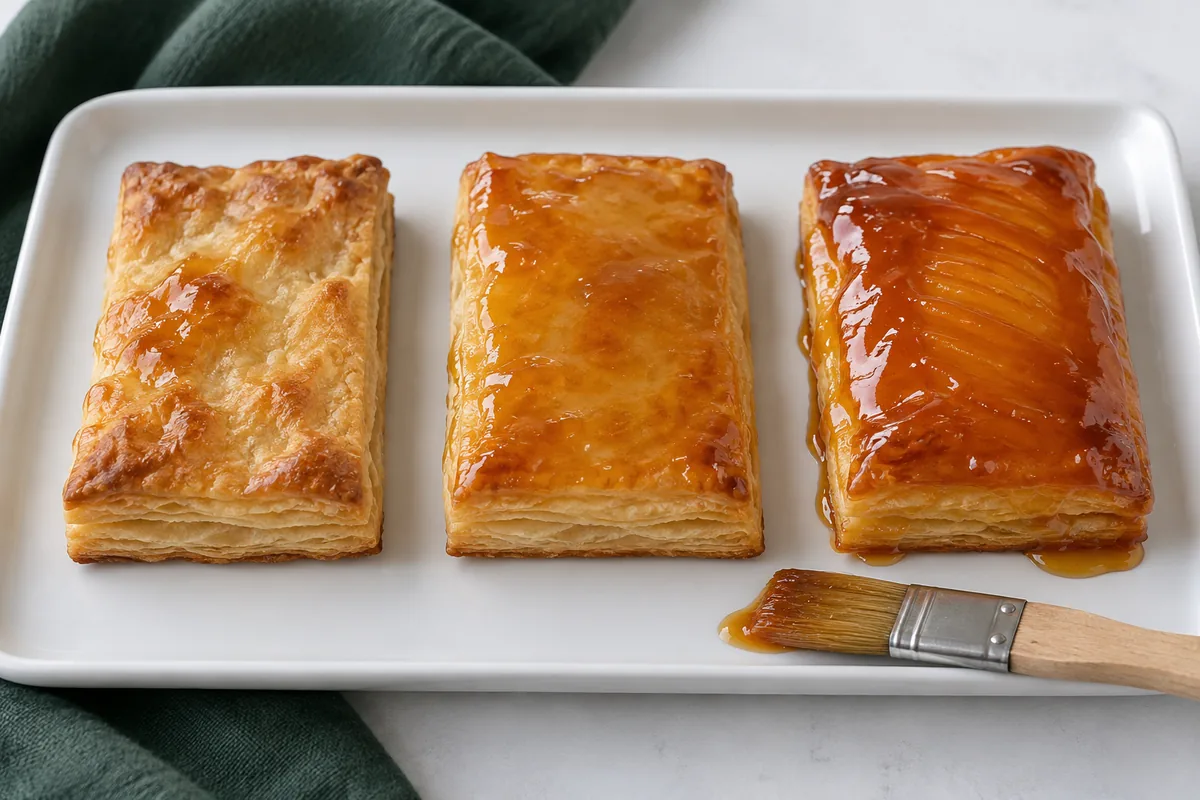
Illustrative matched pastry samples: patchy, even and overly heavy glaze films.
A low pickup can be economical but leave dry patches. The accepted reference should balance coverage with a defined thin finish.
Photograph each sample under comparable light, including a side view of the pastry edge. From above, a thick pool in a fruit hollow may still reflect light attractively. From the side, it can look like a sticky gel cap. Note brush marks, bubbles, streaks, bare spots, run-off and displaced fruit. Cut a representative piece after the coating has set and see whether the surface tears or drags. These observations are more useful than a single instruction to "brush until shiny." The image here is illustrative; the bakery must create its own actual reference photographs.
Use an application range, not a single convenient temperature recorded without context. Warm glaze may flow more readily, yet a hotter coating can affect a chilled cream, soften an underlying finish, or make condensation harder to interpret. A cooler glaze may set before it reaches all of the fruit. The appropriate conditions come from the selected glaze system and pastry. Record vessel temperature at the start and end of the run, pastry surface condition, elapsed working time and the point at which the coating stopped applying acceptably. This information is especially valuable when a small kitchen method is transferred to a larger line.
Compare more than one surface when the product family requires it. Apricot halves, berries, a smooth mousse, baked puff pastry and a dry tart shell expose different textures and amounts of moisture. A neutral or apricot-colored glaze may wet one surface well and bead on another. The glaze should be approved on every important product category rather than assuming that a successful apricot tart proves a strawberry tart or a laminated pastry. If a coating is intended only for one SKU, state that limit in the internal formulation record.
Brushes and depositing equipment can create their own defects. A coarse brush may drag fruit or leave ridges; a nozzle may demand a finer screen and a different flow window. Before adding more water to cure a difficult deposit, check the screen, equipment and temperature. Water changes the full formula and may weaken the film after cooling. If repeated hand brushing yields variable pickup, a simple measured application tool and a weight target may improve repeatability without immediately changing the ingredients.
At the end of the application trial, choose the smallest set of observable acceptance points that operators can actually check: a photo of correct coverage, a pickup range, absence of visible lumps or heavy edge pools, and an agreed appearance after the next hold. Put the rejected examples beside the approved one. A practical visual standard gives production and purchasing a common language when a new apricot lot or glaze formula is proposed.
Approve shine, adhesion and moisture after holding

Illustrative holding comparison: check adhesion and released moisture in the actual finished pastry.
The finish is not approved when the last tart leaves the brush. Inspect matched pastries after the route the customer will experience: immediate sale, chilled display, packed distribution, or a specified freeze-and-thaw cycle. Record the time and temperature at each stage and the packaging used. A fruit tart held uncovered in a display case and a frozen pastry thawed inside a carton have different moisture environments. The bakery's test should match its real product, while food safety and shelf life follow a separate validated program.
Set an approved reference beside each trial piece after holding. Look for loss of shine, haze, weeping droplets, glaze lifting at the fruit edge, a wet pastry seam, color darkening and a sticky touch that affects packaging. Cut the pastry where handling will expose the film. A coating that looks good until the first slice may pull away as a sheet or drag the fruit. Record whether a defect appeared during application, during cooling, during frozen storage, or after thaw. That timing points to different causes and prevents a reflex change to pectin whenever moisture appears.
Weeping deserves a measured observation. If free liquid appears on the plate or inside the pack, photograph the location and, where practical, weigh it or the affected component. Compare a matched unglazed pastry or the accepted glaze under the same route. Released moisture may originate in the fruit, glaze, pastry filling or condensation in the package. The surface photograph alone cannot identify the source. If the actual aim is a crisp pastry shell, inspect the shell texture and its contact line as well as the visible top. Shine does not guarantee that the pastry underneath stays crisp.
For a frozen program, take the glaze through the intended freezing rate, package, storage interval and thaw route. Inspect the coating both while cold and at service temperature. A film may look smooth frozen but show droplets or a dull surface as it warms. A sample made on a bare pastry board is not enough: fruit, cream and crust can transfer moisture to the film. Use the complete dessert and enough matched pieces to see repeatability. Do not declare a universal freeze-life or a shelf-life extension from a small visual trial.

A second real GreenLand apricot product photograph for discussion of the incoming ingredient specification.
Food safety requires its own controls. A glossy coat is not evidence that pathogens are controlled or that cut fruit can be held longer. The glaze may contain water, fruit puree, dairy-adjacent pastry components or ingredients with specific declaration rules. The processor must validate its heat treatment, cooling, hygienic handling, packaging, labeling and shelf life for the destination market. Store the technical sheets for the selected pectin and any commercial jam or glaze concentrate with the formulation file. Keep the visual acceptance record separate from the HACCP or equivalent safety record, even though both describe the same finished product.
When the trial uses GreenLand frozen apricot, the purchase specification should state the form, pitting and peel requirement, accepted size or irregularity, Brix direction, natural color, defect tolerance, packing, lot code and destination documentation. GreenLand's diced apricot page gives an ingredient form to discuss; it does not promise a finished pastry glaze. Request a current-lot sample, screen it under the documented method, and compare usable puree and finished pastry performance with the approval reference. This connects a fruit supplier discussion to a coating outcome without confusing the two specifications.
If a new lot gives a different glaze, first compare the prepared puree: screened yield, visible pulp, Brix, acidity, color and aroma under the same process. If the puree matches but the finish changes, look at pectin lot, application temperature, coating pickup and pastry surface. If the puree itself changed, discuss the frozen apricot input with GreenLand using actual lot and sample evidence. A traceable test record lets the bakery identify a practical correction and lets the supplier investigate a concrete ingredient difference.
The useful final specification is a paired record: a confirmed frozen apricot input, and an accepted glaze on the pastry after its real holding route. Begin with a small matched trial, preserve the reference sample and photo, and then scale the application method while checking the same visible endpoints. That is how an attractive apricot finish becomes a repeatable bakery result.
Source frozen apricot with GreenLand-food
GreenLand-food is a professional frozen apricot supplier and manufacturer in China, providing factory-direct wholesale supply for bakery, dessert and fruit-preparation producers, importers and foodservice distributors.
Send the fruit form, pitting and peel requirements, target Brix, packing, quantity, application, destination and requested documents. We can discuss an ingredient sample for your own glaze trial.