


Carrot Bitterness: Separate Ethylene-Related Isocoumarins from Normal Terpene Aroma
Oct 09, 2026
Leave a message

A carrot puree can smell characteristically of carrot and still taste more bitter than expected. Normal aroma does not rule out bitterness, and a broad volatile profile does not establish its cause. Research on ethylene-exposed fresh carrots distinguished induced bitter phenolic compounds, including 6-methoxymellein, from compounds associated with characteristic carrot flavor. For a frozen ingredient investigation, use that distinction to choose a focused question, not to assume an unrecorded ethylene history.
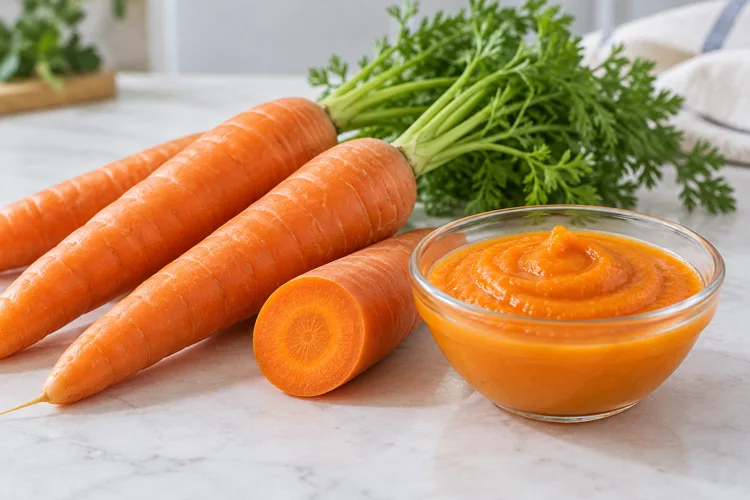
Illustrative carrots and puree; appearance does not diagnose bitterness.
The first decision is what the buyer actually perceives in the intended product. Confirm the complaint with comparable coded samples, then investigate the lot history and appropriate chemical evidence. We would connect any sourcing change to the repeated application failure and the limits of the test. A plausible scientific mechanism is useful background; it is not a diagnosis of a particular frozen carrot lot.
Name the sensory complaint before choosing a test
Bitterness is a taste complaint, while characteristic carrot aroma concerns volatile impressions. A buyer may describe both casually as flavor, but that broad word is insufficient when selecting an investigation. Ask whether the problem is a bitter aftertaste, an unusually harsh carrot impression, weak sweetness, or an objectionable odor. The terms do not have to become elaborate, but the people evaluating the product should understand the same complaint.
Consider a hypothetical example. A puree developer finds a new carrot ingredient more bitter in a prepared product, although its aroma seems normal. We would compare the new and reference samples in the same application before selecting a chemical test. The developer would assess bitter taste and characteristic aroma separately, using the same fruit inclusion, processing and serving state for both samples.
Use the same preparation for the first comparison. Carrot concentration, other ingredients, processing, and the serving state can affect how the product is perceived. If the reference is tasted as a diluted soup while the new sample is tasted as concentrated puree, the difference does not isolate the ingredient. A fair comparison should reproduce the product in which the complaint matters and retain the preparation details needed to repeat it.
Coding samples helps limit expectations from a supplier name or a technical hypothesis. Assess the complaint before revealing which lot was suspected or which mechanism was proposed. A panel told that one sample contains an induced bitter compound may interpret a general carrot note differently. The goal is to establish whether the perceived failure repeats under the agreed conditions, not to produce a tasting account that confirms the first explanation offered.
Sweetness, harshness, and bitterness should also remain distinct in the notes. A lower sweet impression can make a product less acceptable without proving that a named bitter compound increased. A stronger characteristic carrot note can be undesirable in one recipe and suitable in another. Researcher discussion of carrot flavor has long considered these different attributes. USDA ARS carrot flavor reference.
The sample form needs a clear name. A fresh root, frozen dice, thawed pieces, and processed puree are not the same test material. The GreenLand frozen carrot product page is the starting point for the commercial form discussion. If the complaint arises after pureeing the supplied pieces, identify that preparation rather than describing the laboratory sample simply as carrot. It helps the laboratory understand what its result needs to explain.

Hypothetical coded tasting preparation with equivalent puree samples.
Once the complaint is reproducible, choose the analytical question that could reduce uncertainty about it. A broad volatile screen may characterize aroma, but it may not be the appropriate test for a suspected nonvolatile bitter component. A targeted chemical measurement may be more relevant, depending on the hypothesis and laboratory capabilities. Ask the laboratory to explain method suitability for the actual prepared ingredient rather than choosing a test only because it produces a familiar chromatogram.
The developer could begin with two separate tasting entries: bitter taste in the finished puree application and characteristic carrot aroma at the same serving state. A sample may pass the second entry while failing the first. That record is more informative than a single unusual-flavor note, because it tells the laboratory which aspect remains acceptable and which needs explaining. It also lets the developer see whether a recipe adjustment changes perceived bitterness while the underlying aroma remains much the same.
What the ethylene experiment did and did not establish
The original experiment behind this topic examined fresh carrot roots from three cultivars under controlled storage conditions, with and without ethylene exposure. It measured multiple chemical groups and used trained sensory evaluation. The reported ethylene treatment increased 6-methoxymellein and other phenolic compounds, while its effects on other measured groups differed. The study associated the induced bitterness with the induced bitter phenolics, rather than treating all carrot flavor compounds as one response. Original study abstract and highlights.
That is a controlled fresh-root experiment. It is not evidence that any particular frozen carrot lot encountered the same atmosphere, temperature, duration, or sequence. The materials and treatment should remain in the description when the study is used in a commercial discussion. Removing them turns a bounded result into a general statement that a bitter frozen puree must have been exposed to ethylene, which the paper cannot establish.

Conceptual controlled-atmosphere comparison for fresh roots; not frozen-lot history.
The study also examined a pretreatment that affected responses under its experimental conditions. Such treatment research should not be converted into a supplier recommendation without considering the product, process, and applicable market requirements. This article uses the experiment to distinguish possible mechanisms and measurement targets. It does not recommend a chemical treatment for GreenLand carrots or claim that a research intervention is authorized for commercial use in the buyer's market.
In this scenario, the paper would justify asking a focused history question and discussing a suitable targeted test with a laboratory. It would not justify recording ethylene exposure as a fact in the complaint report. If the supplier's records do not establish that exposure, state that it remains a hypothesis. A useful investigation can examine a plausible cause without pretending the cause has already been proven.
Fresh-root handling guidance provides relevant background. The University of California Davis describes ethylene-related bitter-compound development in carrots and the importance of raw-product storage context. That supports attention to exposure history before freezing. It does not supply a commercial frozen-lot diagnosis or a ready-made acceptance method for puree. UC Davis carrot postharvest guidance.
The route from raw roots to the buyer's prepared ingredient matters because several stages intervene. Harvest, raw storage, handling, processing, freezing, and preparation can distinguish the commercial sample from the experimental root. An analytical result on the prepared ingredient should be interpreted in that actual context. If a study measured fresh roots while the complaint concerns heated puree, do not imply that the matrices or sensory effects are automatically identical.
The appropriate conclusion is therefore conditional. Ethylene-related induction is a scientifically supported possibility in fresh carrot research, and it can inform a targeted investigation. Whether it explains this lot requires evidence from the lot's history, the actual sampled ingredient, and the sensory complaint. Each part answers a different question. A literature reference explains why the hypothesis is reasonable; the commercial evidence determines how strongly it applies.
An indexed abstract can identify a relevant treatment and its reported response, but it is not a complete laboratory instruction. For a quantitative comparison, obtain the original method details and the laboratory's validation for the submitted matrix. Check how the target was measured and how uncertainty will be reported before discussing a commercial limit. If those details remain unavailable, use the study to frame the hypothesis and request further information; do not infer unreported operating conditions or a receiving tolerance from the research summary.

Actual GreenLand carrot product-page photograph of a supplied cut form.
A supplier record might establish the raw-root storage period but contain no measured atmospheric history. In that case, the period is known and ethylene exposure is not. Retain that distinction when comparing the lot with the controlled research. Asking whether roots shared a relevant storage environment can be worthwhile, but an answer about proximity is still different from a quantified exposure record. The investigation should preserve the strength of each piece of information rather than making all history entries sound equally certain.
Terpenes and induced bitter phenolics played different roles
Carrot chemistry includes compounds with different sensory roles. Terpenes are important to characteristic carrot flavor, while an ethylene-related investigation may focus on induced bitter phenolics such as 6-methoxymellein. Treating all these compounds as one total-aroma number loses the distinction that makes the research useful. A normal carrot aroma and an increased bitter taste can coexist because they need not reflect the same compounds or the same measurement.
In the controlled experiment discussed here, the investigators related induced bitterness to the induced phenolic response and distinguished it from compounds associated with characteristic carrot taste. This finding addresses that experiment's treatment and sensory comparisons. It does not prove that terpenes never contribute to an undesirable flavor impression in any carrot variety, concentration, or preparation. The narrower claim is both more accurate and more useful for selecting an investigation.
Earlier work on ethylene-exposed carrots reported sensory and compositional associations under a different cultivar and storage design. Its relationships involving sweetness and terpene flavor are a reminder that different studies can address different aspects of carrot quality. They should not be combined into a single universal formula for bitterness. Earlier carrot sensory-quality study81:1%3C54::AID-JSFA781%3E3.0.CO;2-K).
Other primary research examined a bitter sensometabolome across six carrot genotypes under waterlogging and drought conditions. It found a more complicated set of genotype-dependent responses involving multiple bitter compounds. That study broadens the list of plausible questions; it does not diagnose the history of an untested commercial pack. Original genotype and stress study.
For the buyer, these distinctions change the laboratory request. If the complaint is bitterness with otherwise expected carrot aroma, asking only for a total volatile comparison may leave the main hypothesis untested. The laboratory should explain whether its method measures the proposed compound in the prepared matrix and what the result can establish. A named target is useful only when the method, sample, and interpretation support the intended question.
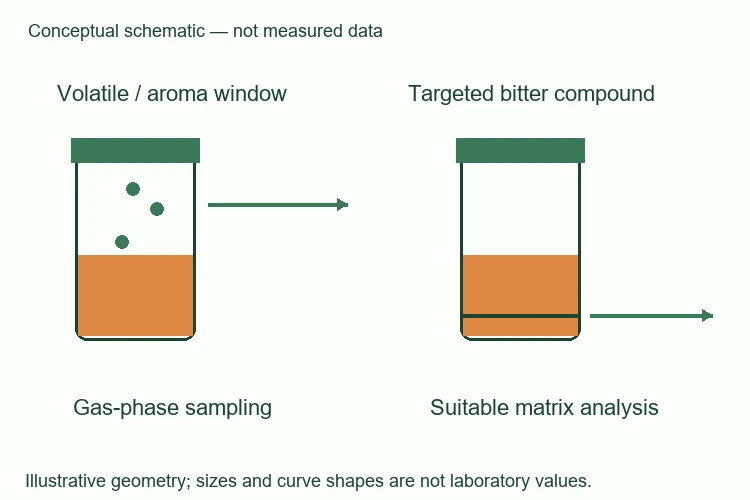
Different analytical windows address volatile aroma and a targeted bitter hypothesis.
| Evidence | What it describes | Limit to preserve |
|---|---|---|
| Sensory comparison | The complaint in a coded prepared product | Does not prove lot history |
| Targeted chemical result | The named compound in a suitable matrix | Does not alone prove causation |
| Handling records | Documented events for the commercial lot | Unknown exposure remains unknown |
Avoid turning a detected compound into a sole cause without the necessary comparison. A compound can be present while the application remains acceptable, and an application can be bitter for reasons a limited target test does not resolve. The strength of the explanation depends on the result's relationship with the reference sample, the sensory observation, and other relevant evidence. A single detection is not equivalent to proof that the compound caused the buyer's complaint.
Reporting units and analytical scope matter here too. A quantified result with suitable validation is different from a qualitative identification or a relative instrumental signal. The buyer should not compare unlike units or infer concentration from a display that was not designed for quantification. If the laboratory reports uncertainty or matrix limitations, retain them in the purchasing summary. They determine how confidently a measured difference can support a lot decision.
A targeted result also needs an appropriate comparison sample. If the suspect material is prepared puree and the reference is a fresh root, their difference may reflect more than the suspected pathway. Ask the laboratory whether the submitted matrix and preparation allow the proposed comparison. If the method's target list omits other plausible bitter components, state that limitation. The result can still be useful, but a negative finding should not be rewritten as proof that no chemical contributor to bitterness is present.
Investigate the lot without assuming its history
The lot investigation should begin with records that can establish what happened, rather than a story assembled around the first chemical hypothesis. Ask about harvest and raw-root storage, handling before processing, relevant processing stages, and the identity of the sampled material. The supplier should distinguish documented conditions from information that is unavailable. A gap in a record is uncertainty; it should not be filled with an assumed ethylene exposure simply because that exposure is a known mechanism.

Illustrative sample forms for a lot investigation.
For the developer, we would request the commercial lot identification and clarify whether the complaint sample came from an unopened pack, retained material or a previously handled container. If puree was made from frozen pieces, retain the preparation details and handle the comparison sample equivalently. Send that information with the samples so the laboratory knows which material is being assessed. The result can then be tied to the supplied lot and the prepared application, rather than a jar whose identity or handling has become uncertain.
Raw storage history can be relevant even when the supplied product is frozen. The useful question is whether records support a plausible condition before freezing, not whether freezing automatically explains or removes every earlier sensory change. University extension guidance is a reason to ask about the history. Its storage recommendations should not be repurposed into an operating rule for a frozen commercial ingredient whose process differs from raw-root storage.
Processing information should be specific enough to identify the sampled matrix. A whole-root measurement and a heated puree measurement may answer different questions. If a laboratory requires a certain preparation, record the changes it makes to the sample. The buyer needs to understand whether the result describes the ingredient as received, the ingredient after the buyer's process, or a selected preparation used for analysis. That scope affects the conclusion the result can support.
A targeted result should be compared with the actual sensory record. If the new lot shows a repeatable bitter complaint and a suitable test shows a relevant difference from the reference, the evidence may strengthen the proposed explanation. If chemistry differs but the application is acceptable, purchasing should consider the actual requirement before rejecting the lot. If bitterness repeats but the selected target does not differ, the investigation should remain open to other explanations.
This is where broad claims often fail. A statement such as "the bitter lot had more carrot aroma" may combine unrelated observations. A statement that it "must have been stored with ethylene" converts a mechanism into an undocumented event. The report should instead state the sensory result, the chemical result on its defined basis, and what the records do or do not establish. That format gives the buyer an intelligible reason for the proposed action.
If sample handling is uncertain, repeat the comparison with controlled material before expanding the conclusion. A new sealed pack or a properly retained sample may provide a stronger basis than the remainder of a handled jar. The trial should remain proportionate to the purchasing decision, but the buyer needs enough traceability to know what was assessed. A technically sophisticated test cannot repair an unidentified or unrepresentative sample after the fact.

A second distinct GreenLand carrot product-page photograph; it is not sensory evidence.
Preserve alternative explanations that remain plausible. Variety-related differences, raw-material stress, preparation effects, and other bitter compounds may require attention depending on the evidence. This is not a demand to test everything indiscriminately. It is a reason to let each result narrow the next question rather than force every finding into one favored narrative. The investigation is successful when it reduces uncertainty about the application failure, even if the first hypothesis is not confirmed.
Cold-chain records help establish the handled sample's identity and condition even though they do not diagnose the bitter mechanism. Retain shipment receipt, pack opening, thawing, and preparation notes beside the raw-history information. A frozen pack used immediately for a controlled trial should not be treated as equivalent to a repeatedly opened puree jar without acknowledging the difference. If the sample history is unclear, a new matched comparison is often more useful than adding another chemical explanation to an uncertain material.
Make a justified sourcing decision
A sourcing decision should follow the buyer's requirement and the evidence available for it. If the prepared product has a repeatable unacceptable bitter taste under the agreed conditions, an alternative ingredient may be justified while the cause is still being investigated. The purchasing record should distinguish that performance decision from a definitive chemical diagnosis. Rejecting an application failure and proving its mechanism are related tasks, but they require different evidence.
If the complaint is not reproduced, avoid a broad rejection based only on a proposed compound pathway. Review the original sample and preparation, then decide whether a further trial is needed. If a chemical difference is established without an unacceptable application result, evaluate whether it matters to the negotiated specification. The result may support monitoring or further inquiry rather than an automatic ingredient change. The buyer's practical requirement should remain visible throughout.
For GreenLand, we would connect a sample request to the intended puree or meal preparation and the specific sensory complaint. Our team would clarify the carrot form, available records and comparison needed for the buyer's decision. If the buyer accepts an alternative sample, retain its preparation and the observations that supported approval. Future lots can then be assessed against a defined reference. A chemical requirement should remain attached to its method and matrix, while a sensory requirement should remain attached to the application in which it was evaluated.
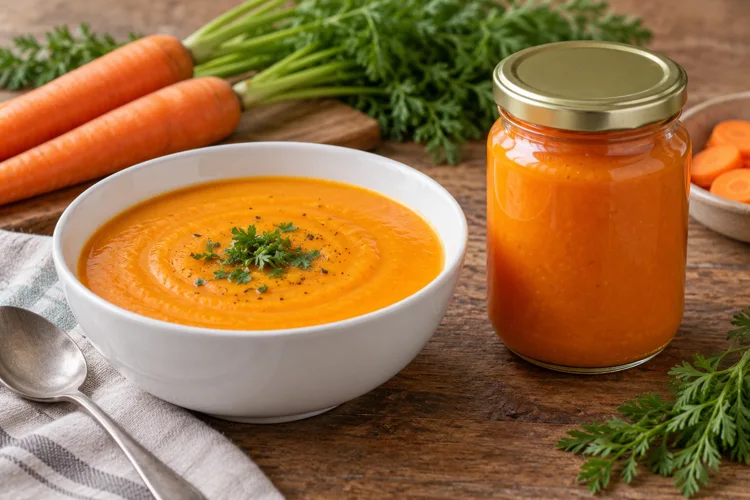
Hypothetical finished application and ingredient reference.
Where a targeted chemical requirement is proposed, agree the method and its commercial meaning. The relevant matrix, preparation, units, uncertainty, and relationship with the application should accompany any limit. A research treatment response is not a ready-made receiving tolerance. A number can be measured precisely while remaining poorly connected to the failure the buyer wants to control. Establish that connection before treating the number as an acceptance rule.
Treatment proposals need their own review. A research paper may show that an intervention altered a response under experimental conditions, but commercial use raises separate technical and market questions. The buyer and responsible technical team should examine those questions before recommending it. This article does not turn an experimental pretreatment into a GreenLand production claim or a universal remedy for a bitter frozen puree.
The approval statement should name the application and the evidence. An alternative lot may be accepted because the prepared product meets the agreed sensory requirement under the tested sequence. The record can also state whether the chemical investigation supports a particular cause or remains inconclusive. That bounded conclusion is more useful than declaring the ingredient universally free of bitterness or claiming that normal terpene aroma guarantees acceptable taste.
Keep the reference sample and preparation available for later comparisons. If the recipe, product form, or processing sequence changes, reconsider the acceptance basis. A successful trial of one puree preparation should not silently cover every soup, sauce, or blend. The original record provides a concrete starting point for the next decision and makes it easier to explain whether a change concerns the ingredient or the application's requirements.
For an inquiry, state the carrot form, intended puree application, required packing, trial quantity, destination, and the sensory complaint in plain language. Attach any targeted report with its method and units. Those details let our team review a supply option and the evidence needed for the buyer's acceptance decision. A request for a less bitter ingredient is workable when the reference preparation and failure are clear; a request to eliminate every terpene would address a different question and could remove characteristic carrot aroma unnecessarily.
How to Cook Frozen Carrots: Easy Methods and Times
Keep the cooking preparation comparable during a flavor trial.
How Long to Blanch Carrots by Cut and Use
Review cut and preparation context without assuming a bitterness remedy.
Frozen Carrots for Halwa: Test Strand Texture and Milk Reduction | GreenLand-food
See a separate carrot application where ingredient form matters.
Discuss frozen carrots supply with GreenLand-food
Send your application, product form, packing, quantity and destination. We will confirm the supplier and manufacturer scope, factory-direct options and wholesale order details applicable to your request.