


Crushed Plum Browning: A Native Inhibitory Fraction Can Change the Catechin Reaction
Oct 09, 2026
Leave a message
A native plum fraction can reduce browning in a controlled catechin reaction even when the system contains an active enzyme source and phenolic material. The original crushing study supported an inhibitory contribution from Santa Rosa plum extract. It did not identify a specific inhibitor or demonstrate that every frozen plum lot will behave that way. A buyer investigating unexpectedly low browning should examine the prepared fruit environment alongside the usual enzyme assay.

crushed-plum-reaction-environment - conceptual illustration.
In an illustrative scenario, a fruit processor asks GreenLand why one crushed plum trial browns less even though its usual PPO result is similar. This scenario represents a purchasing question, not a recorded GreenLand transaction or laboratory case. We would clarify the supplied ingredient, its preparation history and the reports being compared before suggesting a material decision. The difference may justify investigating a native inhibitory contribution; it does not establish that contribution by itself.
The useful commercial question is whether the offered plum gives acceptable colour in the customer's defined preparation. Research on exchanged extracts offers a way to investigate causes. Its solvents, isolated powders and reaction conditions remain laboratory methods, with no role here as a food manufacturing recipe or a claim about our current supply.
Locate the unexpected reduction in the crushed system
Start with the actual observation. Less browning may mean a smaller increase in absorbance, a different instrumental colour change or a panel's preference for a lighter prepared pulp. These observations are related but not interchangeable. The buyer should state what changed, when it was measured and how the sample was presented. A fruit that begins with a darker red skin contribution may also disguise a brown component in a photograph, making a casual visual ranking difficult to interpret.
The comparison needs a defined material. Record the plum species and cultivar where confirmed, the maturity description, whether skin is present, the pitting status and the supplied cut. Frozen halves, slices and a prepared puree bring different particle sizes and tissue exposure to the customer process. We confirm the offered form and order specification rather than assume the study cultivar is the material shipped. A supplier page showing red plums does not establish cultivar identity or a particular native inhibitor.
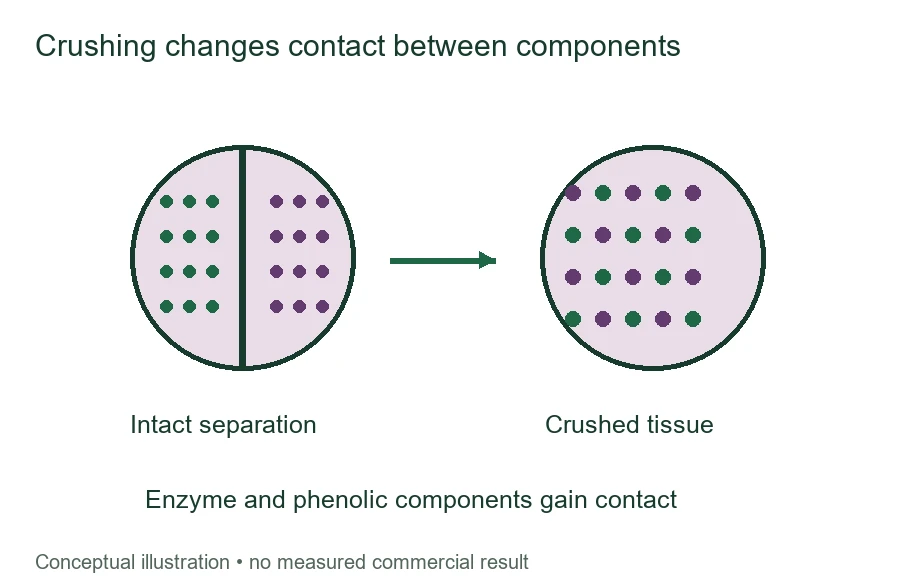
Crushing changes contact between components - conceptual illustration.
Crushing changes the opportunities for components to meet. A fruit's tissues contain enzymes and reaction partners within a structured environment. Preparing pulp disrupts that arrangement and exposes material to oxygen. The extent and timing of disruption therefore belong in the record. A small sample crushed vigorously in an open vessel can experience a different history from fruit milled through a closed industrial line. An observed difference between the two says little about the chemical cause unless those histories are considered.
Freezing and subsequent preparation add further variables. The customer may thaw fruit fully, crush it while partly frozen, collect the released liquid separately or include that liquid in the pulp. Each operation changes the material reaching the measurement. If a possible inhibitory component partitions with the liquid, discarding that liquid could alter the prepared reaction environment. That is a question to test in the actual lot; it is not evidence that the historical inhibitory fraction survives freezing or follows a particular partition in commercial production.
Set a shared starting point for the observation period. Time from tissue disruption matters more than time from removing the carton from storage when the question concerns browning during crushing. The record should identify the crushing event, the prepared sample temperature and the hold before reading. Different initial delays can make one trial seem more resistant simply because its first reading was taken after much of its early change had already occurred.
There are ordinary alternative explanations worth controlling before pursuing a native fraction. Differences in oxygen exposure, sample dilution, pH, instrument preparation or skin distribution can change the result. Any intentionally used colour-protection ingredient should be declared with its preparation record. A lower colour reading alone cannot identify which factor acted. The investigation should retain several possibilities until controlled comparisons narrow them.

Actual supplied product form for representative preparation and acceptance
For the illustrative buyer, we would request the intended use, the two trial reports and their measurement basis. A dairy fruit preparation, bakery filling and clear juice do not have identical visual priorities. The purchasing question becomes more useful when the processor describes the final food and the point at which colour matters. It may need a stable visible fruit piece after a short preparation, or a repeatable puree colour throughout a longer holding stage.
The first decision is therefore whether the observed difference remains after preparation and measurement are aligned. If it disappears, the customer can standardise those operations. If it remains, the material warrants a closer reaction investigation. This sequence keeps the inquiry grounded in the real product and avoids assigning an inhibitor merely because a routine assay did not predict the colour ranking.
The original study exchanged extracts to probe the reaction
Komiyama, Harakawa and Tsuji examined crushing-related browning in three Japanese-grown Prunus salicina cultivars in their 1980 paper. They compared enzyme-containing preparations and polyphenol extracts, exchanging the extracts among enzyme sources. They also evaluated catechin browning with an enzyme preparation from Sordum. The Santa Rosa extract reduced that reaction relative to the comparison conditions. The authors suggested an inhibitor in the material; they did not chemically identify it. Read the original study.
The exchange design matters because it asks which part of a mixed system contributes to the outcome. A simple whole-fruit comparison changes many things together. By keeping an enzyme preparation and changing the accompanying extract, a laboratory can examine whether the extract environment influences the response. The method remains a model system, but it provides more focused evidence than comparing total phenol numbers against a photograph of two different fruits.
An extract contains what its preparation method recovers. It is not a transparent copy of everything in the intact fruit. The laboratory procedure may retain, remove or change components and their relative concentrations. The enzyme-containing powder also differs from fresh or thawed pulp. The question answered by the exchange is therefore about the behaviour of those preparations under their controlled conditions. The customer must assess how much of that behaviour is relevant to its actual food preparation.

Exchange extracts while keeping enzyme source - conceptual illustration.
The catechin comparison narrows the question further by providing a defined reaction partner. Keeping that partner and the enzyme source fixed while changing the native extract helps distinguish a general shortage of substrate from an effect contributed by the extract. A lower response in that comparison supports functional inhibition within the system. It does not determine whether the component acts directly at the enzyme, changes the reaction environment or affects later colour-forming events without additional evidence.
Read the endpoints with the same care. Oxygen uptake indicates one aspect of the reaction, while colour development indicates another. A laboratory investigation that observes both has more information than a single colour reading. Yet neither endpoint alone identifies a compound. The most defensible language preserves the observed functional contribution and the authors' interpretation without converting that interpretation into a confirmed molecular identity.
The paper's laboratory solvents and isolation operations are not purchasing recommendations. They were used to investigate a scientific question, rather than define a food-grade plum treatment. A buyer cannot apply the extraction method to a production line simply because it helped reveal an inhibitory effect. Any commercial intervention would need its own technical, safety and destination-market assessment, with the actual food ingredient and legally permitted process inputs.
For commercial development, the useful analogy is controlled substitution. The customer's technical team can ask which component of its preparation changes when the browning response changes. That may involve comparing retained liquid with drained pulp or comparing two clearly identified lots through one matched preparation. The design should be appropriate to food handling and the intended process. It should avoid imitating laboratory extraction where a simpler and relevant comparison answers the buying question.
The research therefore gives procurement a more precise question to take to its development team: does the prepared material contain a contribution that suppresses this particular reaction under the conditions of use? It does not justify selecting a cultivar solely from the paper or promising the same inhibition in IQF fruit. A confirmed food preparation result can support a supply decision even while the molecular cause remains uncertain, provided that uncertainty is recorded honestly.
An inhibitory contribution was supported but not identified
A functional effect and a chemical identity are different levels of evidence. A fraction may reduce a measured reaction, yet contain several possible active components. Demonstrating which compound is responsible generally requires further separation, identification and confirmation. The historical plum result supports a contribution associated with the extract. Calling that contribution a named inhibitor would go beyond what the original investigation established.

An effect does not identify the compound - conceptual illustration.
This distinction matters in supplier communication. Terms such as natural inhibitor can sound like a defined ingredient claim even when the evidence concerns an unresolved mixture. A buyer should ask whether the statement describes a demonstrated extract effect, an identified compound, a whole-fruit observation or a current lot test. Each has a different relevance to purchasing. We keep a sourcing specification tied to the offered material and verified attributes rather than attach an untested mechanism to a product name.
A routine PPO assay is performed under a chosen set of conditions. It uses a specified preparation, substrate, concentration, temperature and measurement basis. Its output is useful for the purpose for which the method was selected. The customer should not expect it automatically to represent the complete crushed pulp, particularly if preparing the assay removes components that influence the food reaction. A similar activity number can coexist with different prepared-food behaviour.
Total phenols also describe a measured aggregate rather than every reactive species and interaction. Two materials with similar totals may contain different mixtures, and the method can report compounds according to a common calibration equivalent. The number remains meaningful within its method, but it does not tell the purchasing team which phenol acts as a substrate or which other component changes the response. Detailed characterization is justified when it changes a meaningful material decision, not simply to generate a longer report.
The inhibitory path should also remain distinct from a facilitating path. A reaction partner that enables colour development and a fraction that reduces the observed reaction can both alter the behaviour of a food system, but they lead to different hypotheses and experiments. Here the specific question is the contribution of the native plum fraction associated with reduced catechin browning. Broadly restating that enzymes do not equal colour would lose the distinctive evidence and leave the buyer without a focused investigative question.
If a processor observes lower browning after freezing, it still needs to establish which event caused the difference. An assay preparation may change recovery, a thawing operation may change liquid distribution, or a treatment may change contact among components. Native inhibition is one plausible avenue informed by the study. The original work does not specify freezing stability, storage duration or the survival of its active contribution in a particular industrial process.

Follow the fraction without naming its compound - conceptual illustration.
The same restraint applies to commercial benefits. Less browning is an appearance or quality observation under defined conditions. It does not demonstrate microbiological safety, a health benefit or an approved preservative action. The buyer should retain the normal hazard controls for its product and judge colour within the specified application. A supplier should not use an unexplained browning reduction to justify a claim about antioxidant value or a longer safe shelf life.
Uncertainty can be managed without solving every molecular detail. If multiple representative lots consistently meet a defined application test, the buyer may approve them on observed performance. The supplier and customer can continue investigating causes if that work has practical value. What should remain separate is the approval of the material for a known preparation and a claim that a particular unidentified chemical guarantees that performance across every form and future process.
Investigate the actual frozen-plum preparation
Bring the comparison back to the supplied frozen form. GreenLand's frozen plum pages describe order discussions for forms such as halves, pitted material, slices and processing options. Confirm the exact offered format before sending samples. A requirement for puree behaviour should include the customer's preparation method; a requirement for visible fruit pieces should describe the serving and inspection conditions. These distinctions help avoid approving one type of sample and buying another.
Keep lot identity intact during the trial. A bag label, retained sample and preparation record should connect the observed colour to the ingredient being assessed. Mixing fruit from several cartons or blending an old retained sample with a current shipment can obscure a meaningful difference. If the commercial programme will use multiple source lots, evaluate that range deliberately. A trial designed to compare lots should state which ones are included and how representative samples are collected. Review our frozen plum supply options.
Standardise the crushing operation sufficiently to make the test repeatable. Record equipment, batch size, particle endpoint and time to transfer into the measurement vessel. The purpose is to reproduce the customer's relevant exposure, not demand a particular laboratory machine. Two samples crushed to visibly different particle sizes may differ in contact, surface exposure and skin distribution. Those differences should be part of the design rather than accidental variation.
Define how thaw liquid is handled. Some applications include all released liquid; others drain the fruit to control texture or concentration. Either choice can be commercially appropriate, but the assay and application comparison need the same basis. Collecting both pulp and liquid for an investigation may help identify where a colour-related contribution resides. The result concerns those sampled streams and does not establish an unidentified component's distribution in all plum lots.
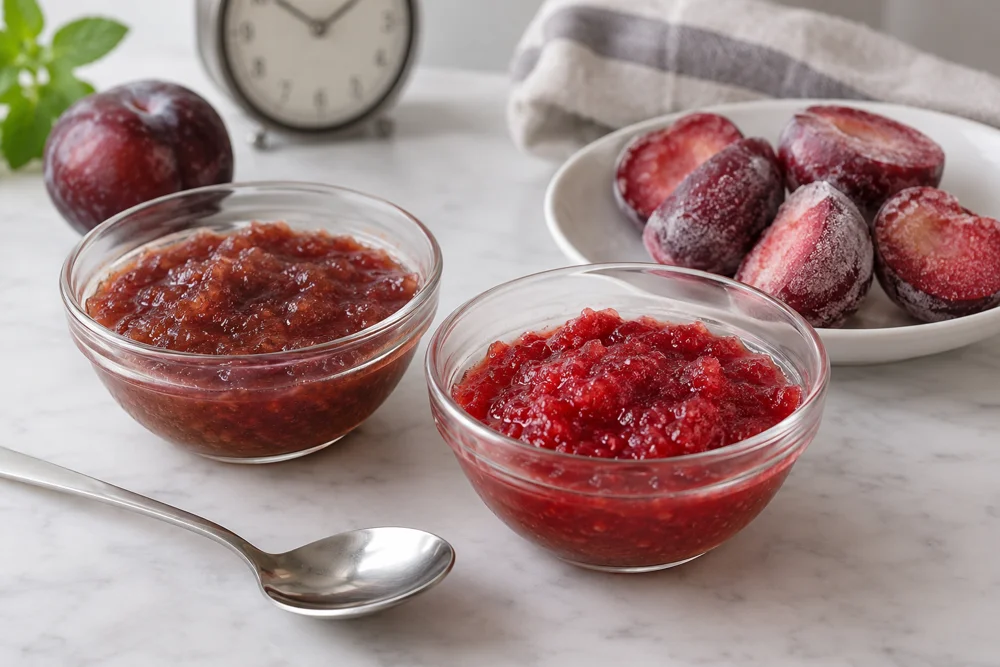
plum-prepared-pulp-colour-comparison - conceptual illustration.
The temperature and hold should follow the customer's controlled food preparation, with relevant handling and safety requirements maintained. Record the actual values used in each trial instead of adopting a published reaction setting as a standard. A processor using partly frozen fruit at a brief mixing stage needs a different comparison from one making a thawed puree that waits before further processing. The study question guides what to observe; the intended application determines the responsible trial conditions.
Compare the prepared baseline and subsequent change under a shared colour method. Where red skin makes browning difficult to interpret, a suitable instrumental approach can describe several colour coordinates rather than relying on a single visual label. Keep vessel depth and surface preparation consistent. Where pigment background interferes with an absorbance result, the laboratory should select appropriate controls and report that limitation. The purchasing team should request an interpretable comparison rather than an isolated number.
If PPO activity is measured, retain the assay details with the prepared-food observations. The laboratory may need to clarify whether activity is expressed per gram of original fruit, per gram of prepared pulp or per unit of extracted protein. Report a recovery or preparation difference where it affects interpretation. Comparing numbers with different denominators can create an apparent contradiction that disappears when the sample basis is aligned.
Use the finished application to decide whether a difference matters. A darker cooked filling may remain suitable because colour is partly masked by the recipe, while a light dairy preparation can expose the same difference visibly. Judge flavour, texture and skin distribution alongside colour where those attributes determine usability. A material that performs well in one application can be approved for that use without claiming the same result for a clear beverage, retail fruit bowl or another untested product.
Keep the material decision within the demonstrated effect
Approve the ingredient for the preparation and acceptance window actually demonstrated. The specification should identify product form, the relevant sampling method and the application result that matters. It may include a starting colour requirement, a controlled prepared-pulp comparison or an agreed visual reference. It should not name an unidentified inhibitor as a guaranteed property unless subsequent evidence establishes and verifies that property in the supplied material.
An acceptance method needs a clear decision rule. For a colour-related trial, specify the assessment time and whether the comparison uses final colour or change from a baseline. A material with excellent initial colour can still change rapidly, while another may start darker but change slowly. Those distinctions can matter to a processor's hold time and product appearance. A requirement that says only low browning leaves too much room for incompatible interpretations at receiving inspection.

Compare the same preparation history - conceptual illustration.
The illustrative buyer's next useful request is a representative sample of the confirmed plum form and the information needed to prepare it reproducibly. We would discuss specification, packing, quantity, application, destination and requested documents. If the customer's question relies on cultivar, ask what is verified for the offered programme. If it relies on an enzyme or pigment analysis, confirm the test panel and sample basis before treating a routine lot document as evidence for that mechanism.
Where the native fraction remains uncharacterized, a supplier can still contribute by clarifying material changes. A different cut, skin proportion, raw-material source or preparation history may help explain why two trials behave differently. Those factors should be discussed according to actual records. They should not be invented retrospectively to give a neat mechanism for an inconvenient result. An unresolved cause can be recorded while practical application testing continues.
Sampling across relevant lots helps assess consistency. The buyer should choose a plan appropriate to its order size and risk, rather than rely on a single attractive demonstration. Retain an agreed reference where useful and state how it will be prepared when compared with a later shipment. Include the handling of released liquid and any recipe additions. This creates a fair basis for approving repeat supply without implying that the laboratory effect has become an unrestricted frozen-fruit guarantee.

Actual supplied product form for representative preparation and acceptance
If the customer changes its preparation, review whether the prior approval still answers the same question. Removing skin, discarding thaw liquid, extending the hold or changing oxygen exposure may alter the reaction environment. A new trial can then focus on the changed feature. This is a practical change-control step: the buyer does not need to restart every scientific investigation, but it does need to know when its original acceptance evidence no longer represents use.
Do not let a promising colour result bypass normal food safety and destination-market checks. Confirm the ingredient declaration and any intentionally applied treatment through the appropriate records. The historical extract effect supplies no authorization for adding a chemical or using an experimental extraction solvent in food. Any future commercial treatment has its own approval requirements and should be assessed in the actual formulation rather than inferred from a scientific paper's reaction vessel.
The strongest purchasing statement remains specific: this identified frozen plum material met the agreed appearance and application criteria when prepared under the recorded conditions. The original study explains why a native inhibitory contribution deserves consideration when routine PPO and phenol totals do not resolve the observation. The customer trial determines whether that insight helps select the ingredient, while further analysis determines how confidently the cause can be described.
Continue reading about frozen plum
Choose a plum form suited to processing after thawing.
Compare finished applications before setting a colour acceptance requirement.
Assess cultivar and maturity effects on flavour alongside appearance.
Source frozen plum with GreenLand-food
GreenLand-food is a professional frozen plum supplier and manufacturer in China, providing factory-direct wholesale supply for importers and food processors.
Send your product form, specification, packing, quantity, application, destination, private-label needs and requested documents. Include your representative preparation and acceptance conditions so we can clarify the offered material.