


How to Peel Chickpeas: Hand, Batch and Processing Methods
Sep 24, 2026
Leave a message


Peel chickpeas after they are fully cooked and tender enough for the skin to loosen. For a small batch, pinch each bean between your fingers. For a larger cooked batch, rub the beans gently in a bowl of water, skim off the floating skins, and repeat until the remaining skin level suits the recipe. The point of peeling is usually a finer puree; whole-bean salads, curries and soups rarely need the extra work. A commercial buyer should specify the acceptable skin content and finished texture rather than assuming that every frozen chickpea arrives peeled.
The starting material changes the method. A drained canned chickpea is already cooked, though its firmness varies. Dried chickpeas need sorting, soaking and cooking before the kitchen methods below will work reliably. Frozen cooked chickpeas should be thawed or warmed under the product's handling instructions before peeling; rubbing hard frozen beans will not remove the seed coat cleanly. If you are making hummus, test the puree after cooking a representative sample before adding a labor-intensive peeling step. Under-cooked beans can stay grainy even when their skins are removed.
What the skin changes in the finished food
A chickpea has a thin seed coat around two cotyledons. Once the bean is cooked, the coat can become loose enough to slip off. Its effect is most noticeable when the finished food must be very smooth and uniform, because small pieces of coat may remain visible or detectable after blending. The size and cooking degree of the bean, the blender or mill, the fat and liquid in the formulation, and the desired particle size also shape the result. Peeling can help, but it does not correct an undercooked center or an unsuitable puree process.
This is why a side-by-side trial is more useful than a universal rule. Cook a representative bean lot to the same endpoint, divide it into two equal portions, peel one, and blend both with the same formula and equipment settings. Assess the surface of the puree, mouthfeel after a few minutes of rest, visible dark flecks, and whether the difference persists after chilling or freezing. A premium smooth dip may justify the added labor or a peeled ingredient specification. A rustic spread may not. Some processors may achieve their target with controlled cooking and fine milling while retaining the coats.

Cooked chickpea seed coat beside smooth puree.
The coat also affects yield. If a kitchen removes it, the edible bean mass available for the recipe falls slightly, and the labor, water and handling time rise. This tradeoff is easy to overlook when comparing an unpeeled bag with a peeled one by price per kilogram alone. A meaningful comparison uses the kilograms of finished acceptable puree produced from a known input weight, after any skin removal, cooking, blending and screening. For foodservice, that measurement should be repeated across more than one lot, because bean size and tenderness influence how readily the coat separates.
Peeling is not a food-safety treatment. It does not replace sorting, hygienic handling, validated cooking where required, or cold storage. A seed coat that slips off easily tells you about structure and cooking; it does not confirm that a bean is microbiologically safe. For a ready-to-eat product or a chilled dip, the manufacturer's food-safety plan, process control and finished-product specification remain the governing documents. At home, handle cooked beans with clean utensils and avoid leaving a warm batch standing while working through an unnecessarily large pile by hand.
The GreenLand guide to cooking garbanzo beans covers how tenderness should change with the final dish. That decision comes before skin removal: a bean for a salad should hold its shape, while a bean for a fine puree can be cooked softer. Deciding the final texture first prevents peeling from becoming a ritual applied to every batch.
Hand peeling a small cooked batch
Hand peeling gives the best visibility over individual beans and is practical when the batch is small or when you want to compare peeled and unpeeled texture. Drain a portion of cooked chickpeas and let them cool enough to touch comfortably while they remain moist. Place one bean between thumb and forefinger, press gently, and let the bean slip out of its coat. Put the kernels and skins in separate bowls. If you crush many beans before their coats release, the beans may be undercooked, too cold, or too dry for an efficient hand method.
Do the work over a clean bowl or tray with enough space to see both streams. A small amount of cooking liquid can keep the beans from drying while you work. A bean that has a damaged coat may need little pressure, while an intact, firmer bean may need a second pinch. Do not squeeze hard simply to maintain speed: broken kernels can be acceptable for hummus but are a defect if the same lot is intended for a whole-bean garnish. Keep the target application in view as you choose which beans to peel and how much breakage to accept.
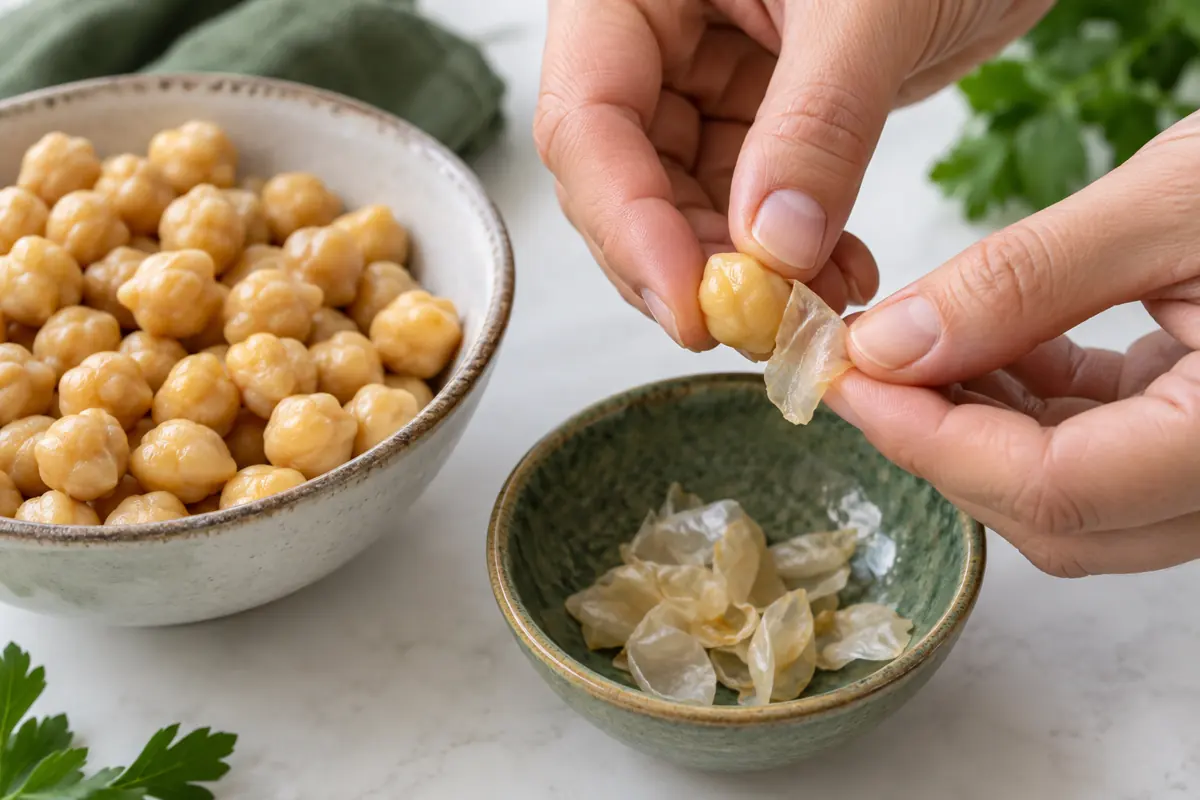
Hand removing the thin skin from a cooked chickpea.
This method is especially useful for a trial. If the recipe calls for a fine puree, peel a measured portion and leave an equal portion unpeeled. Blend under matched conditions, taste blind if possible, and record the difference. The result may surprise a kitchen that has been peeling every bean while the real source of coarse texture is the cooking endpoint or equipment. It may also confirm that skin fragments are visible in a particular formulation. A ten-minute kitchen trial can give a better answer than an online promise that peeling is always essential.
Hand peeling is a poor routine for a restaurant or central kitchen handling many kilograms. Repeated handling increases labor and can complicate temperature control. If demand is regular, consider a batch separation method, a finer finishing step, or a purchased peeled cooked ingredient. The decision belongs in a costed process trial: compare labor minutes, skin separation, broken-bean rate, drained weight, puree yield and finished sensory quality. Record the numbers for your own operation rather than importing someone else's one-can timing into a production schedule.
For canned beans, first check the drained weight and condition. Some cans contain very soft beans whose skins release readily; others remain firm. Rinse only as needed for the recipe and account for the water added by that rinse. If baking soda was used during cooking or warming to encourage softening, rinse and taste the beans before seasoning. An excessive alkaline treatment can soften the bean beyond the texture required for salads or other whole-bean uses. Treat recipes that use baking soda as kitchen techniques, not as an automatic commercial process specification.
Water agitation and skin separation for larger batches
For more than a small bowl of cooked chickpeas, water makes loose coats easier to separate. Put warm, fully cooked beans in a wide food-safe container and cover them with clean water. Rub a handful gently between your palms or stir with a motion that moves the beans against each other without grinding them. Detached skins often rise or gather near the surface. Skim them with a fine sieve, pour off the upper water carefully, and repeat with clean water until the remaining coats meet the recipe's visual and texture target.
The water must be deep enough for skins to move away from the beans, but a huge water volume is unnecessary if the container is wide and agitation reaches the whole batch. Work in manageable portions. If the bowl is crowded, the same beans receive repeated friction while others hardly move. If agitation is too forceful, soft beans split or turn to paste and skin pieces become harder to separate from the slurry. The right action loosens the thin coat while leaving the usable bean form intact.

Chickpea skins separating in a bowl of water.
Drain and inspect a sample after each pass. Look at beans from the top, middle and bottom of the container, since a surface skim can make the batch appear cleaner than it is. Count visible intact coats in a known handful, or blend a small sample to test the actual puree. A kitchen does not need to remove every microscopic skin fragment for a smooth result, but it should have a repeatable stopping point. In a production setting, a written acceptance limit or sensory reference sample is better than the instruction to peel 'well'.
Water separation adds a second moisture-management task. Drain the beans consistently before weighing them for a recipe. If one shift weighs a wet batch and another weighs a well-drained batch, the same recorded ingredient weight can contain different amounts of chickpea solids. That variation changes hummus thickness, salt concentration and packaged weight. For foodservice, set a drainage method and time appropriate to the operation, then verify the cooked weight before adding the rest of the formulation. In a factory, the validated process and its records take precedence over an informal kitchen method.
Some guides use a clean towel to rub cooked beans. It can loosen coats without adding water, but fragments may cling to fabric and the pressure can damage very soft beans. A towel also needs suitable hygiene control in a commercial kitchen. Compare it with water agitation on the same starting lot, then use the method that meets the actual texture, throughput and sanitation needs. The Great British Chefs cooking guide describes both water and towel approaches; neither removes the need to inspect the result.
Industrial dehulling and process choices
Large processors use the word dehulling for removing the chickpea seed coat. This can begin before the bean is fully cooked and may use conditioning, abrasion, splitting and separation equipment. Research on chickpea processing distinguishes wet and dry conditioning routes because moisture changes the bond between coat and cotyledon. The aim is to remove the coat efficiently while controlling broken kernels, flour formation and usable yield. It is a different operation from squeezing a cooked bean between two fingers.
The route depends on the intended form. A processor making split chickpeas or flour may tolerate a very different kernel shape from a producer selling whole cooked chickpeas for salads. Hummus manufacture may accept broken kernels if the finished puree is smooth, stable and meets its composition target. A ready-meal producer may need intact whole beans with a moderate skin tolerance because appearance and bite matter in the finished tray. The phrase 'peeled chickpeas' therefore needs a form definition: whole peeled, split dehulled, cooked peeled, puree input, or another agreed condition.
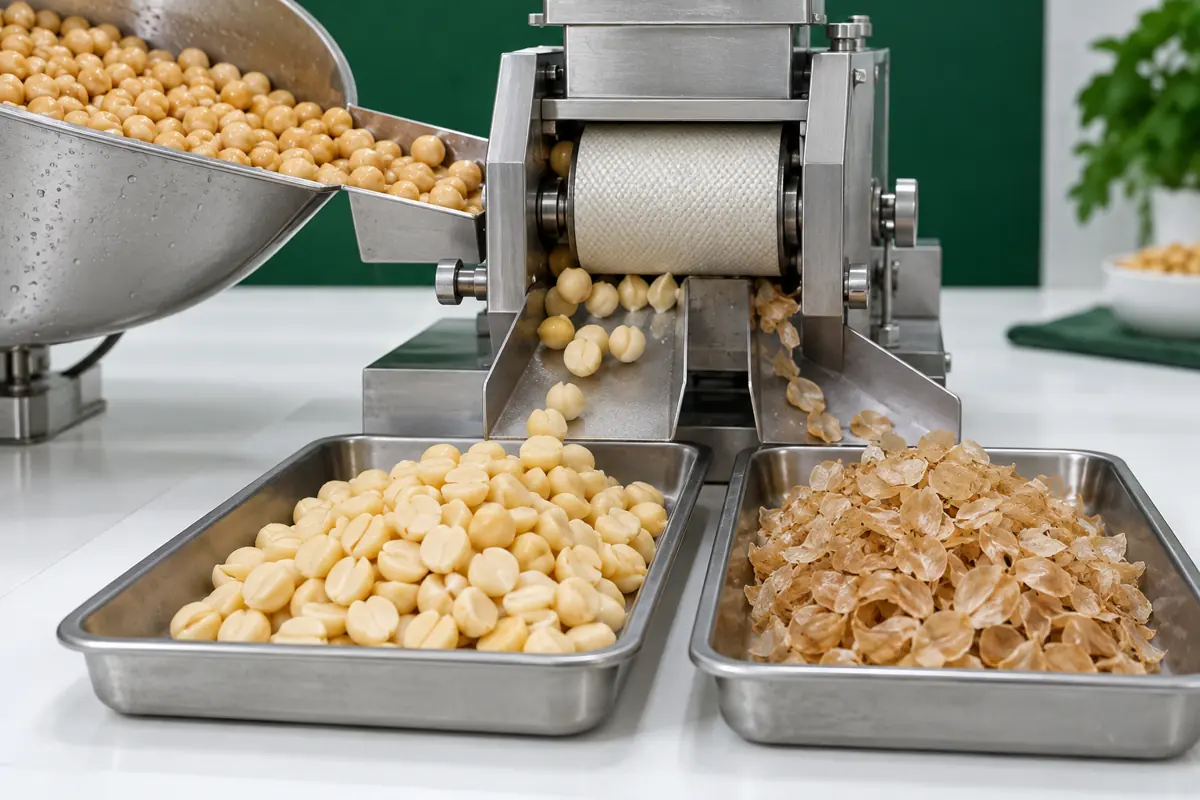
Illustrated chickpea dehulling with kernels and coats separated.
Ask how the supplier measures the outcome. Relevant specifications can include residual skin percentage, whole-bean integrity, broken or split rate, foreign matter, color, tenderness after heating, and moisture or drained weight where relevant. The test method matters as much as the number. A defect limit measured before cooking may not predict what appears in a hot sauce or after a freeze-thaw cycle. Request a representative sample and evaluate it using the same preparation path as the finished product.
Dehulling can also change the visual character of a bean. A smooth peeled surface may look cleaner in a premium puree, while a whole bean with its coat can have a more familiar appearance in a salad. This is an application choice, not a generic quality hierarchy. If the buyer's product is served whole, compare both forms after the complete heat and hold cycle. If it is milled, compare the finished puree after packaging and intended storage. A purchasing team should avoid paying for a peeled claim without a measured benefit at the point of use.
Commercial handling has other controls that the peel step does not solve. Chickpeas require raw-material sorting, foreign-matter control, a validated thermal process appropriate to the product, hygienic post-process handling, traceability and suitable packaging. For a frozen ingredient, the buyer also needs the frozen storage condition and an agreed plan for transport and receiving. We can discuss a peeled or whole frozen chickpea form, but feasibility, process status and actual batch specifications should be confirmed before an order is placed. A marketing description should never substitute for the signed product specification.
When peeling is unnecessary
Leave the coats on when the recipe benefits from recognizable whole beans and the skin does not cause an objectionable bite. A chickpea salad, grain bowl, curry or soup may use a tender bean with its coat intact. Peeling every bean in those dishes adds work without automatically improving the eating experience. The same applies to roasted chickpeas if the intended result is a rustic surface, though drying and roasting performance should be tested separately because a loose coat may detach during handling.
Even for hummus, texture can be adjusted in more than one way. Softer cooking, a suitable mill, adequate liquid and mixing time, and a finishing sieve can each affect smoothness. The most useful trial changes one variable at a time. If an unpeeled, well-cooked bean produces the required puree under the real production conditions, peeling may add no practical value. If visible coat flecks remain despite good cooking and milling, then skin removal or a finer screen may be justified. The target is the finished product, not compliance with a recipe habit.
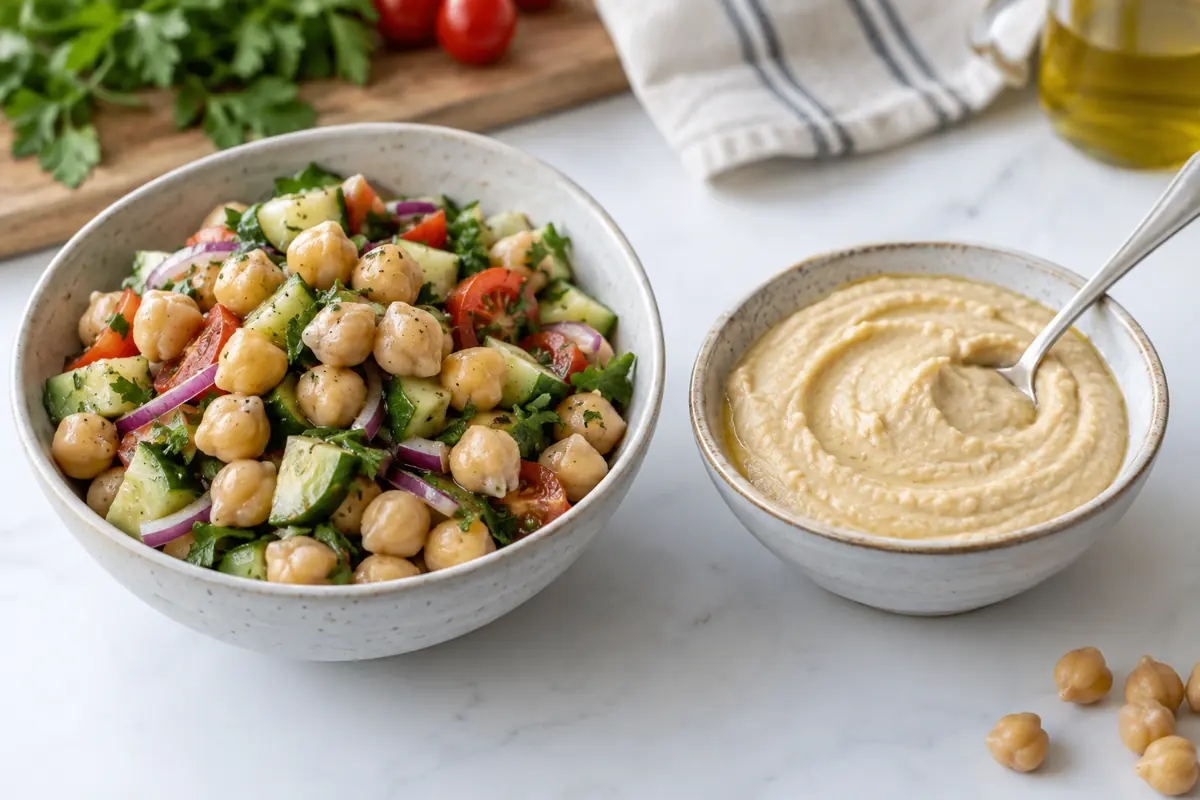
Whole chickpeas in a salad beside a smooth puree.
Peeling can be counterproductive when whole-bean appearance is the priority. A vigorous batch method may remove skin but also split cotyledons and leave starch in the rinse water. Those losses matter in a salad bar, chilled bowl or frozen ready meal where customers expect intact beans. Select a milder separation method or accept a modest retained-skin level if the sensory result is better. Document the choice so the next lot is judged against the same standard.
Some buyers also need to understand ingredient labeling or nutrition consequences. Removing the coat removes material from the bean, but it does not justify an unmeasured claim about fiber, digestibility or health. If those claims matter to a finished product, use a validated composition analysis and destination-market labeling rules. For routine menu planning, focus on drained yield, texture and portion size. Describing peeled chickpeas as intrinsically healthier or safer than intact cooked chickpeas would overstate what the process establishes.
The decision becomes easier when the buyer names the use clearly. A fine, pale retail dip has a different tolerance from a spiced soup, a restaurant mezze plate or a meal-kit garnish. Write down which visible and sensory defects matter, then test both bean forms in that food. That brief prevents a supplier from optimizing a feature the buyer never needed and gives the kitchen a consistent standard for future orders.
Specify peeled chickpeas for frozen food production
Frozen cooked chickpeas can reduce the soaking, cooking and portioning work at the point of use, but 'ready to use' has to be read with the product's actual process status and handling directions. The GreenLand IQF frozen chickpea page describes whole, cooked and peeled forms as options to discuss by application. Before treating a pack as suitable for a chilled dip or a ready meal, confirm whether it has been fully cooked, how it is intended to be heated or thawed, and what post-thaw holding rules apply.
Start the inquiry with the final recipe. Tell us whether the chickpeas will be blended into hummus, kept whole in a salad, added to a hot curry, or used in a frozen prepared meal. Then provide the required whole or peeled form, tenderness, acceptable broken beans and residual skins, size range if important, packing weight, annual or order quantity, destination and planned storage conditions. A representative sample should be heated or thawed exactly as the production line will handle it, then checked for both appearance and texture.

Chickpeas visible during GreenLand frozen product preparation.
For puree, define an outcome that can be judged. A reference sample or agreed texture test is stronger than 'extra smooth'. Record the particle appearance after the actual blender or mill, viscosity at filling temperature, free water after chilling, and sensory texture after the intended shelf life. A peeled bean may improve one attribute while its cooking level changes another. If the puree is frozen later, include the complete freeze-thaw and mixing cycle in the trial. Those checks help distinguish ingredient quality from processing differences in the buyer's own line.
For whole-bean applications, the acceptance sample should show the allowed skin, breakage and color after reheating. Compare the amount of loose skins in the sauce or pack, not just the beans in a frozen photograph. Check whether the pack is free flowing enough for dosing, whether pieces separate without excessive force, and whether the specified weight represents net chickpeas rather than surface ice or free water. If the product is a block rather than IQF, the line may need a different thawing and metering plan. A matching pack format can matter more than a nominal peeled designation.

Chickpeas photographed during GreenLand frozen product listing.
The final order should link the approved sample to a signed specification and lot documentation. Confirm ingredient declaration, processing status, quality and safety criteria, packaging, labeling, batch coding, traceability and destination-market documents. Match the cold-chain plan to the agreed frozen storage condition and check cartons for damage or thaw history at receipt. Peeling is one specification line within that larger acceptance decision. We help purchasing teams compare feasible frozen chickpea forms against the recipe and the shipment plan before they fix the order.
One useful acceptance exercise is to make two reference batches from the same chickpea lot. Leave one intact and remove skins from the other, keeping cooking, hydration and seasoning identical. Weigh both after draining and again after the finished preparation. The difference shows how much material and labor the peeling step costs in that recipe. Photograph the puree or whole-bean result under the same lighting, then have the production and purchasing teams agree on which defects justify that loss. Without this comparison, "peeled" can become a specification that raises cost while producing no visible benefit at the serving point.
For recurring orders, write the result as a measurable tolerance. Examples include maximum loose-skin count in a defined sample, permitted broken-bean percentage, or an approved reference for puree smoothness after a named mixing method. Agree how the sample is taken and who evaluates it. A tolerance that cannot be repeated at receiving is difficult for either buyer or supplier to manage. Recheck it when the recipe, mill, pack size or thawing method changes; a different process can make the same ingredient look different.
Plan a dependable frozen chickpeas supply
GreenLand-food is a professional frozen chickpeas supplier and manufacturer in China. We discuss factory-direct wholesale supply, product form, packing and shipment details against your application.