


How to Dehydrate Ginger: Slices, Powder and Quality Control
Sep 24, 2026
Leave a message


Ginger can also be frozen, but freezing and drying solve different formulation problems. Dry ginger offers a concentrated, low-water ingredient for tea blends, seasoning and dry mixes; frozen ginger gives a wetter ingredient with a fresher aromatic profile for cooking and beverage bases. Neither is a universal substitute for the other. GreenLand-food's verified ginger product pages show frozen ginger forms, not dehydrated ginger. This guide explains the drying decisions and then gives buyers a practical way to compare a dry ingredient with available frozen supply without confusing the two processes.
Select and prepare ginger for drying
Good drying starts before the dehydrator is switched on. Choose rhizomes that are sound, firm and free from decay, visible mold, deep bruising or an off odor. A soft spot is not repaired by removing water. Inspect the whole batch under clean light, separate suspect pieces and follow the applicable food-safety decision rather than trying to hide defects in a powder. Ginger with heavy soil also raises the burden on washing and trimming. The aim is a clean, reasonably uniform raw material that will dry and taste consistently.
Wash ginger thoroughly under the site's produce procedure, paying attention to crevices where soil can lodge. Drain it before cutting; free water on the surface lengthens the first part of drying and can conceal poor slicing control. Peeling is optional for some applications and specifications, but the decision should be deliberate. A clean, tender skin may be acceptable in a rustic tea slice, while a pale powder specification may call for peeling. Peeling affects yield, appearance and waste. If a buyer wants a particular color or particle specification, test both prepared forms before committing to a raw-material assumption.
Trim tough or damaged ends with clean tools. Cut away any material that fails incoming inspection, and keep sound trimmed ginger separate from rejected material. A sharp knife, mandoline with an appropriate guard, or a controlled slicer can produce consistent pieces. Handle the rhizome carefully: its irregular shape makes it easy to create a wedge that is thin at one end and thick at the other. A flat, stable cutting surface reduces slip and helps operators control the cut. For larger runs, record the slicer setting and check actual pieces at intervals because blades and feed orientation can change the result.
The cut should suit the intended final form. Thin slices expose more surface and dry faster, but they may break easily during handling. Thicker slices may be useful when visible ginger pieces are the product, yet they require more time and are more likely to hide residual moisture at the center. Minced ginger can dry quickly if spread thinly, but small particles are easier to lose through a coarse tray and more vulnerable to scorching or uneven airflow. If the goal is powder, dry sound slices or granules completely before grinding. Milling wet or leathery pieces creates clumps and an unstable finished powder.
Foodservice and industrial buyers should define the incoming sample as well as the output. Record rhizome condition, origin or lot identification, whether the peel remains, cut orientation, slice thickness range and visible defects. Those details explain later differences in drying time, powder color and aroma. If two samples disagree, the issue may be raw ginger variety or maturity as much as equipment. A simple preparation record makes troubleshooting possible without pretending that every ginger rhizome behaves identically.

Start with sound ginger and a clean, repeatable slice before drying.
Sanitation matters because drying is not a reliable kill step by itself. Clean contact surfaces, wash hands and follow a validated process suited to the intended market. Do not assume that a dry texture removes every microbial or chemical hazard present in the raw ginger. For commercial powder, the supplier's hazard controls, test plan and any required treatment should be reviewed separately from the visual drying sequence. This distinction keeps a practical kitchen method from being mistaken for a complete factory specification.
Set slice thickness and air movement
Even thickness is the single easiest way to reduce within-batch variation. Select a target slice that the equipment can repeat, then check the actual cut rather than relying on a dial number. A thin slice around a few millimeters is a practical starting trial for many dehydrators, but there is no universal setting: the ideal thickness depends on ginger texture, the desired whole-slice appearance, dryer design and the finished application. Record the range you use and reject pieces that are much thicker than the rest. One heavy slice can remain damp after its neighbors appear finished.
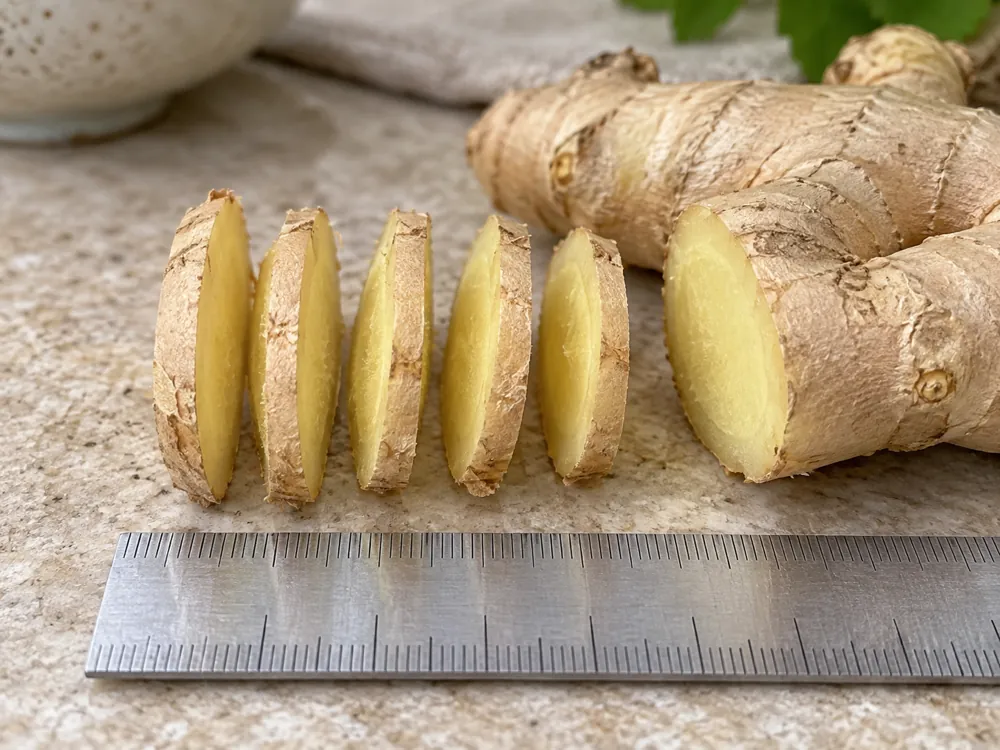
Compare slices for even thickness; the photo does not establish a numeric specification.
Spread the pieces in one layer. Leave small gaps so moving air can contact the exposed surfaces. Overlap creates a local wet pocket and delays drying where pieces touch. A tray that looks efficiently filled may actually spend longer in the dryer and produce more variable moisture. For grated or minced ginger, use a suitable fine-mesh liner or tray approved for the appliance, keep the layer shallow and break up clumps. Avoid an impermeable sheet that blocks intended airflow unless the equipment manufacturer specifically supports that setup.
Follow the dehydrator manufacturer's temperature guidance for herbs or produce and verify what the product experiences. A moderately warm setting is generally used to remove moisture without unnecessarily dulling aroma or darkening edges; a precise time or temperature claim is not reliable across machines and slice sizes. An oven can also work if it can hold a low enough temperature and allow moisture to leave, but domestic ovens often cycle widely and may dry unevenly. Keep the door arrangement within the appliance maker's safety instructions. Do not use an improvised setup that risks contamination or an uncontrolled hot spot.
Load pattern should be repeatable. A commercial operator should record tray mass or surface loading, slice thickness distribution, airflow setting, inlet and product temperature if monitored, and the position of the wettest zone. In a small dehydrator, rotate trays if the manual recommends it and compare edge and center pieces. In a larger system, identify locations where air velocity differs. Equal clock time does not mean equal drying if one tray has a crowded center and another has clear gaps. Representative sampling needs to include the slowest-drying positions.
Ginger's aroma changes during drying because volatile compounds respond to heat, oxygen and exposure time. Higher heat may shorten a run, yet it can shift the flavor away from the fresh, bright character a buyer expects. Extremely gentle drying may retain a preferred note but take longer and raise throughput costs. Treat this as a product-development choice, not a single best temperature. Compare small runs under the same raw-material and packing conditions. Taste the dried sample in its intended recipe, because the aroma of a jar of dry slices does not always predict the flavor released in hot water or sauce.
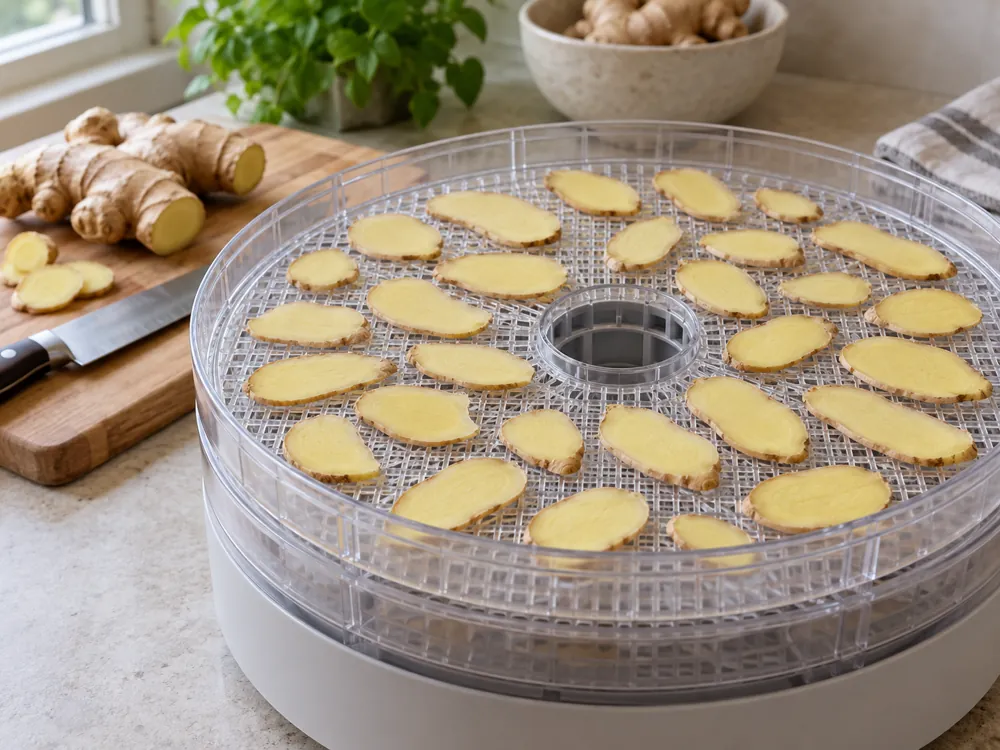
Visible gaps on a single tray allow moving air to reach individual slices.
Keep a record of start weight and dried weight, but do not turn that ratio into a stand-alone safety claim. Yield is useful for estimating cost and spotting unexpected variation, while moisture or water-activity measurements answer a different question. A batch that loses a great deal of weight may still hold damp thick pieces. Conversely, a darker batch is not necessarily drier. Visual color, final mass, slice break and instrumental measurements each provide different evidence. Use them together under a defined acceptance plan.
Dry to a verified endpoint
The practical home check is to cool a few representative slices and break them. Fully dry ginger slices generally feel hard and snap or crumble rather than fold like fresh ginger. Check the thickest slices from several tray positions, not only the small pieces at the edge. A warm slice may feel more flexible than it does after cooling, while a damp center may be masked by a dry surface. Break a sample and inspect the interior. If it is leathery, tacky or visibly moist, return the batch to drying and recheck. Do not pack the entire batch because a few thin pieces passed.
For commercial release, define the endpoint in measurable terms appropriate to the product and market. Moisture content and water activity are related but not identical: one measures total water in the material, while the other indicates the water available for microbial growth and chemical changes. Product specifications often set both, along with sampling and test methods. The correct limits depend on the formulation, packaging, shelf-life plan and applicable requirements; they should be established by the producer's qualified technical team. Do not borrow a number from a consumer recipe and present it as a general ginger standard.
Check the load after drying for uneven pieces. Separate visibly under-dried or very thick slices instead of blending them into the accepted lot. If the line uses staged drying, keep traceability through each pass. A small conditioning period in a clean closed container can expose residual differences as moisture redistributes, but conditioning is a check under a controlled process, not a replacement for reaching the drying endpoint. If condensation appears inside a test container or slices soften after cooling, investigate the lot before packing. Never treat visible mold after storage as a simple redry-and-release case.
Packaging begins as soon as the product has cooled enough to avoid condensation. Dry ginger can reabsorb moisture from humid air. Letting a finished tray sit open in a damp room can undo part of the controlled process. Move product through clean, dry equipment into packaging with an adequate moisture barrier for the intended storage conditions. A transparent jar may be convenient for a home pantry, while commercial shipping requires tested packaging, closures and handling instructions. Keep the proposed shelf life linked to real product and pack validation rather than an assumed number of months.
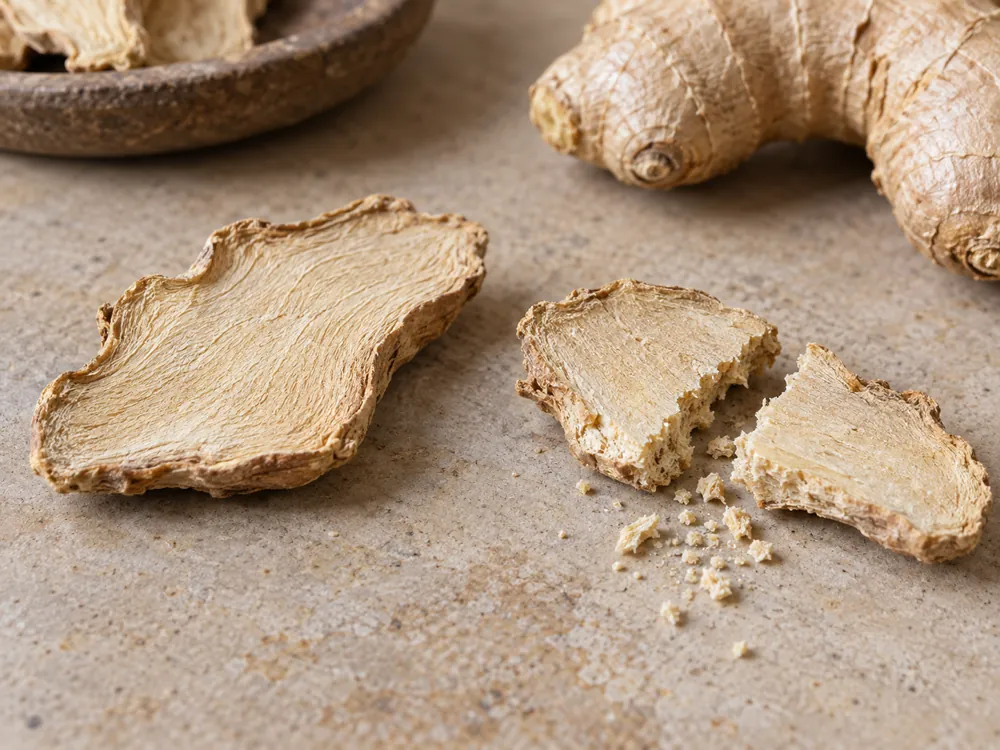
A cooled dry slice should break with a firm interior; commercial release also needs measurements.
Make the release decision on the finished form. A whole slice may pass a break check, but a powder made from that lot has more exposed area and can cake if it encounters moisture. It may also show color change faster. Test a representative packed sample of the actual sale format. For a buyer, ask for a certificate of analysis or specification that names the endpoint method, lot, particle size if powdered, microbiological controls, and storage conditions. A single photograph of crisp slices cannot substitute for those records.
When a batch fails, diagnose the process before changing the label. Compare the thickest cuts, crowded areas, tray positions, air temperature, ambient humidity and time after unloading. This step identifies whether the remedy is a longer run, thinner cut, lighter load, improved airflow or different packing. If the raw material had defects or the lot was contaminated, additional drying may not solve the underlying problem. A clear hold-and-investigate rule protects the buyer as well as the producer.
Grind, sieve and pack powder
Ginger powder should be made from slices or granules that have reached the validated dry endpoint and cooled in a clean environment. Grinding adds surface area and can warm the product. Both effects matter: the powder may pick up water faster, release aroma during milling and flow differently from the original slices. Use a clean grinder designed for the batch size and intended food use. A home spice mill can work for small amounts; a commercial mill needs controls for equipment condition, foreign material and particle-size consistency.
Break large dry slices into manageable pieces if the grinder requires it, then mill in short runs to avoid unnecessary heating. Do not add liquid to make a stubborn piece move. If ginger bends or gums up the blades, that may be a drying or load issue. Stop and inspect rather than forcing it through. A powder that begins with wet flecks is likely to clump and may not meet the intended storage specification. Keep incoming dried pieces and finished powder identified by lot so a problem can be traced back to the dryer run.
Sieve the powder to the particle size the application needs. A fine beverage or bakery powder may need a different distribution from a rustic spice blend. The material retained on the sieve can be re-milled only if the procedure allows it and the material remains sound. Some fibrous particles resist becoming fine powder; repeated grinding can add heat without improving the useful yield. Define an acceptable coarse fraction before quoting a buyer. "Ginger powder" is not a complete specification when mouthfeel or visual specks matter in the finished product.
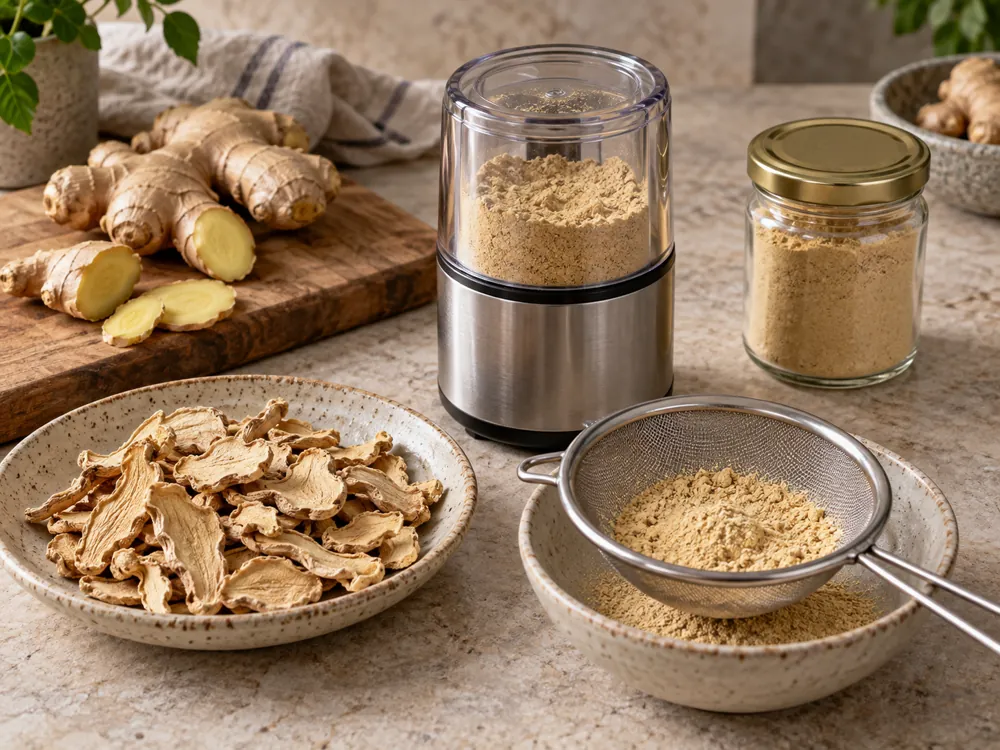
Mill only adequately dried material, then sieve and pack to the intended particle specification.
Compare aroma and color against an approved reference sample. Fresh ginger's bright top notes can be less prominent after drying and milling, while warmer or more pungent notes may seem stronger. The strength of the powder also depends on how much is dosed and whether it has been stored well. Do not state that one spoonful of powder always replaces a fixed weight of fresh ginger. Develop an application trial: add measured amounts to the actual tea, sauce, bakery mix or seasoning, then assess flavor after the normal process. The right conversion is a recipe decision.
Pack the powder quickly into a clean, dry, moisture-protective container. Control headspace and closure integrity according to the packaging design. Small packs opened repeatedly in a humid kitchen behave differently from sealed bulk bags kept under controlled storage. If the powder cakes in an opened container, that observation may reflect handling as well as production. For bulk purchasing, agree on pack size, liner, closure, pallet protection and expected conditions during transit and at the receiving warehouse. Verify that samples taken after transport still meet the agreed flow and aroma requirements.
Label the product form honestly: sliced dried ginger, granules and powder are different ingredients. If powdered ginger has a specific mesh range or treatment, put it on the specification. A supplier should also identify whether any other ingredient or anti-caking aid is present, when relevant. Buyers of clean-label formulas often care about this distinction. Store retained samples from each lot under defined conditions so later color, caking or flavor complaints can be compared with the original shipment rather than guessed from memory.
Control aroma, color, moisture and food safety
Quality control should start with the application, then turn that outcome into measurable checks. A tea manufacturer may value a visible slice that infuses consistently and looks clean in a sachet. A sauce producer may prefer a fine powder that disperses smoothly. A spice blender may prioritize strong ginger aroma and predictable particle size. These are related but different targets. One broad "premium dried ginger" claim does not tell the buyer what to test or how to accept a lot.
Set a reference sample and compare new production against it under the same conditions. Inspect slices for size, shape, scorch marks, fibrous inclusions and evidence of incomplete drying. For powder, compare color and uniformity, look for lumps or foreign specks, and test flow after the pack has acclimated to the receiving environment. Aroma assessment should use a defined method. Open a fresh pack of the reference and sample at similar temperatures, or prepare both at the same dose in hot water or the actual recipe. Otherwise a recent grind can seem stronger simply because it was opened first.

The image shows the sampling context; actual release limits and test results come from the lot records.
Moisture control spans processing and logistics. Drying endpoint, room humidity after unloading, pack-barrier performance, seal integrity, storage temperature and transit handling all affect the final ingredient. A lab result at packing is useful but does not prove the bag stayed dry during a long route. For export, align the specification, packing construction, inspection plan and shipping conditions. Ask what happens if an outer carton gets wet or if a liner seal is damaged. Receiving staff need a clear check for pack integrity and a hold process for suspect material.
Food safety is a separate gate from sensory acceptance. Drying lowers available water when done properly, but it does not automatically remove pathogens, pesticide residues, allergens from shared equipment or foreign material. A producer's plan should cover incoming supplier approval, washing or preparation controls, sanitation, preventive controls, testing where appropriate and traceability. Microbiological limits and any kill step should match the product's intended use and applicable market. A ready-to-eat sprinkle and an ingredient that will receive further heat may call for different risk decisions. Those decisions belong in the buyer-supplier specification and quality agreement.
Avoid reading too much into color. Pale dried slices can be attractive, but color alone cannot establish moisture, flavor strength or safety. Very dark edges may point to excessive heat or long exposure; an unusually pale powder may come from peeled raw material or other process choices. Investigate differences with batch records and an application test. Likewise, a strong pungent smell when opening a pack is promising but not a validated measure of freshness or potency. If a formula requires a quantified flavor or active-compound marker, define a suitable analytical method rather than relying on descriptive language.
Document the trade-offs before ordering volume. Ask for cut and size range, moisture and water-activity limits, particle distribution, foreign-matter criteria, sensory reference, microbiological plan, packing, shelf-life evidence and documents required at destination. Request a production-representative sample and run it through the normal recipe and storage path. If the first sample fails, state whether the issue is cut, drying endpoint, aroma, powder flow or packaging. This gives the supplier a solvable change request and prevents another ambiguous round of samples.
Choose dehydrated or frozen ginger by application
Dehydrated and frozen ginger begin with the same crop but deliver different water levels and flavor behavior. Dried slices and powder are low-water forms made by removing moisture. They can be convenient in a dry blend or a tea sachet and may simplify dosing when the recipe is designed for them. Frozen ginger retains much more of the original water and can be used as a prepared fresh-like input in cooking or beverage manufacture. It still needs a frozen chain, and thawing may release liquid. Calling either one a direct equivalent hides the formulation work required.

This genuine GreenLand product photograph shows frozen peeled ginger, not dehydrated ginger.
In a bakery dry mix, powder can distribute through flour without adding the water that a frozen puree or piece would add. Its taste may also be warmer or less bright than freshly grated ginger, so the baker should test dosage and aroma after baking. In a stir-fry sauce or broth, frozen ginger pieces or granules may provide the fresh-ginger impression and wet texture the recipe expects. In a tea blend, dry slices can sit in the pack with other dry botanicals; frozen ginger would require a very different product and cold-chain design. The intended process makes the choice clearer than a general question about which is "better."
Compare samples on equal finished-recipe terms. Weigh the dry and frozen ginger separately, account for their very different water contents, and test each at a suitable dose rather than assuming a one-to-one weight replacement. Prepare them with the same other ingredients and evaluate aroma, pungency, color, visible particles, viscosity and final yield. If the product is filled hot, frozen ginger may add water that changes solids or cook time. If the product is a powder blend, dried ginger particle size and flow may be decisive. Record both the sensory result and the operational effect.
GreenLand-food's frozen ginger range and frozen ginger product detail document frozen forms. Their product photographs here are evidence of frozen ginger supply only. They do not show drying, powder manufacturing or a dehydrated ginger SKU. Buyers looking for a dry ingredient should request a separate dry-product specification from a qualified source. Buyers considering frozen ginger can ask GreenLand about available cut forms, packing, target use, quantity, destination and supporting documents.

This genuine GreenLand tray photograph shows frozen ginger pieces, not dried ginger.
Storage comparisons should be made as systems. A sealed dry powder under suitable dry conditions avoids freezer space, but may lose aroma or cake after moisture exposure, especially once opened. Frozen ginger can preserve a different aroma profile but depends on an intact frozen chain and appropriate handling after opening or thawing. An apparent unit-price advantage can disappear if a recipe uses more material, produces waste or needs extra processing. Calculate delivered cost in the finished product, including yield, labor, logistics and flavor performance.
The final buying question is specific: which form gives the required ginger character in the actual formula with a manageable process and documented quality? Use a sample comparison, not an assumed equivalence. Agree on the dry material's endpoint and pack integrity or the frozen material's cut, frozen condition and cold-chain checks. That approach keeps dehydration, freezing and application in their proper roles and gives the buyer a repeatable acceptance decision.
Source Frozen Ginger with GreenLand-food
GreenLand-food is a professional frozen ginger supplier and manufacturer in China, providing factory-direct wholesale supply for importers, food manufacturers, foodservice distributors and private-label programs. We review frozen ginger forms against the application, sample and production plan; this page does not claim dehydrated ginger supply.
Send the frozen ginger form, cut and size needs, packing, quantity, application, destination, private-label needs and requested documents so we can confirm available options.