


Mushroom Ketchup from Frozen Mushrooms: Extract, Reduce and Chill the Condiment
Sep 28, 2026
Leave a message

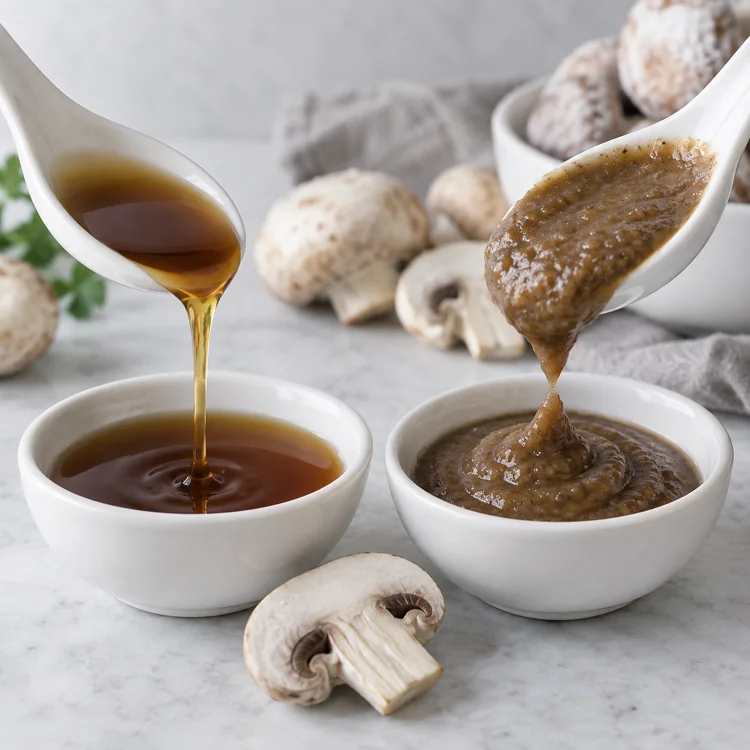
Choose a mushroom essence or a spoonable ketchup
The name mushroom ketchup covers visibly different condiments. One is a relatively thin, dark liquid used in small quantities to season a gravy, stew or sauce. Another retains finely blended mushroom solids and can be served as a spoonable condiment. The difference affects nearly every development decision: which mushroom form to purchase, whether to filter, how far to reduce, which package to use and how to calculate usable recovery.
Sainsbury's mushroom ketchup describes a thin seasoning liquid and uses straining. The Great British Chefs version cooks mushrooms and then blends the mixture smooth. These are useful culinary reference points for defining the finished texture. Their household recipes and storage statements do not establish performance or safety for a changed frozen ingredient, larger batch or commercial package.
Write down how the condiment enters the final food. A liquid added by the teaspoon to a gravy may need to disperse quickly and avoid visible sediment. A sauce placed beside a cooked vegetable or protein may need to hold a clean shape on the plate. A squeeze bottle requires a smooth enough product to pass through its nozzle. A product that succeeds in one of these jobs may fail in another even when tasters like the flavor.
Choose an approved reference and a repeatable tasting format. If the reference is a commercially available mushroom condiment, record its ingredient declaration and intended use without assuming the formula is known. Match the serving concentration when comparing it with a pilot. Tasting a concentrated essence neat can make it seem excessively salty or acidic even when it works well at the planned dose in a finished dish.
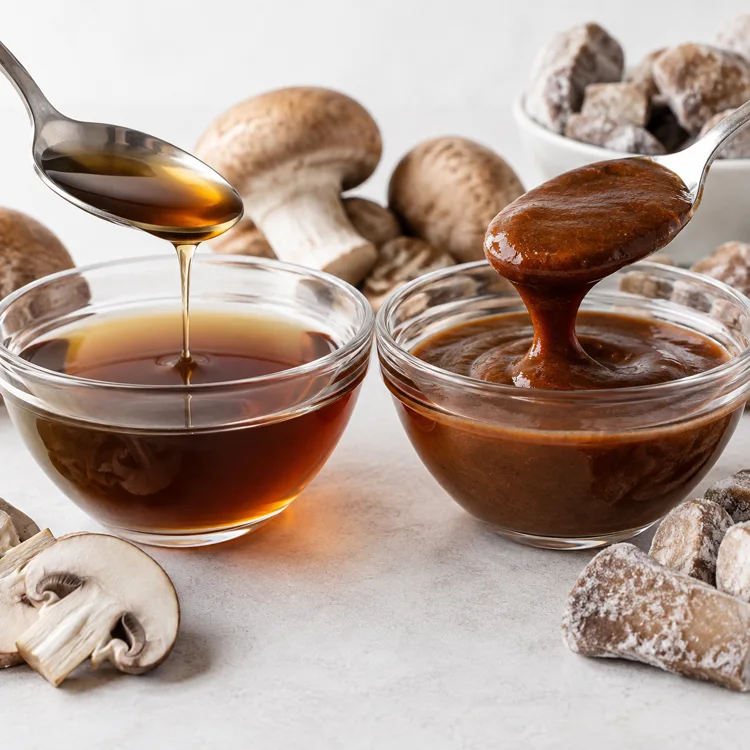
Flow and retained solids distinguish the two condiment styles.
For a liquid condiment, define acceptable clarity, sediment, flow and aroma after the intended chilled hold. For a blended sauce, describe particle size, smoothness, adhesion and separation. These are practical quality descriptions that a development team can turn into test methods. They are more useful than an instruction to make the sauce "rich" or "premium," because different people can interpret those words very differently.
Decide early whether dried mushrooms, soy sauce, wine, Worcestershire sauce or other flavor ingredients are part of the concept. They can change the sensory result and the product declaration. A strong dried-mushroom addition may mask differences between frozen lots, making the trial a poor test of the ingredient you are actually buying. Keep the reference formula stable while assessing the frozen input; test additional flavor adjustments as separate versions.
Specify species, cut and frozen input condition
Begin with named edible mushrooms from an approved supply chain. A recipe's "chestnut mushroom" normally refers to the brown cultivated button type in this culinary context; it is not a reference to chestnut fruit. If the supplier's product is white button mushroom, record that identity instead of quietly treating it as the same reference ingredient. A mixture should identify its component species and agreed proportions rather than relying only on the phrase mixed mushrooms.
The current GreenLand-food button mushroom page describes whole, sliced, diced and chopped forms according to specification. For ketchup development, the choice concerns preparation effort, consistency of cooking and the amount of material that the final texture can use. Whole caps may offer little practical advantage when every piece will be chopped and filtered, but the actual available grade and price still need confirmation.

Slice geometry affects preparation and the texture visible in the finished food.
Cut size should be controlled enough to make comparisons meaningful. A bag containing large pieces and substantial fines may cook or drain differently from a more uniform cut. If the pilot team chops every sample to a common size, record that preparation and its losses. Otherwise, a difference attributed to mushroom flavor may partly reflect how much surface was exposed during the extraction or cooking step. Keep the test method close to the eventual line wherever possible.
Confirm whether the frozen mushrooms are raw, blanched or otherwise pretreated, and follow the supplied intended-use instructions. Freezing does not mean that the ingredient is ready to eat. A prior treatment can also affect the starting moisture and flavor characteristics being compared. Ask for the product specification and relevant process information before building a trial around an assumed fresh-to-frozen equivalence.
Inspect the actual sample condition when it arrives. Record package integrity, lot identity, frozen state, unusual ice accumulation and obvious damage. Any temperature concern should be assessed under the receiving procedure before the sample enters a development trial. A sauce can conceal broken pieces visually, but that does not make a compromised ingredient acceptable. Quality development starts with suitable material and a traceable handling history.

Whole button mushrooms show cap and stem form; confirm the intended cut for the trial.
For a liquid-focused application, photograph the mushroom sample and the liquid recovered during the defined preparation. Use the same drainage interval and container arrangement for each lot. The record does not need an invented target percentage. It needs enough detail for the team to reproduce the observation and distinguish ordinary lot behavior from a change in handling. Measure the actual trial before deciding which characteristic belongs in a purchase tolerance.
Pack size affects the practical process as well. A large industrial bag may suit a full kettle while a smaller pack can reduce partial-pack handling in a restaurant kitchen. Confirm the requested packing, expected order quantity, destination and sample arrangement with the supplier. We help purchasing teams match these ingredient details to the application, while the sauce manufacturer defines and validates the finished condiment.
Compare controlled extraction with direct cooking
Two development routes are worth comparing when the intended condiment is clear. One begins with a controlled refrigerated preparation that allows liquid to be collected before cooking. The other cooks the mushrooms directly as part of the sauce process and collects or concentrates the liquid there. Use equal, defined frozen input weights and the same lot if the purpose is to compare the routes. Changing the mushroom lot at the same time makes the result harder to interpret.
Some historical or household ketchup recipes hold salted mushrooms overnight. Do not reproduce an unspecified room-temperature hold in a commercial trial. If an extraction stage is part of the proposed process, its time, temperature, salt addition and hygiene controls need to be defined by the responsible technical team. Refrigeration is a handling control, not automatic validation of the resulting sauce or permission to assign it an extended shelf life.
Record frozen net input, recovered mushroom solids and collected liquid separately. Note whether the sample was thawed in its closed package or transferred to another vessel. If the method includes salt, identify its mass and when it was added. Keep any rinsing step explicit because it changes both the retained seasoning and the amount of water that reaches the pan. A trial that discards a salty extract and another that retains it are testing different ingredient systems.
The direct-cooking route also needs a mass record. Use a defined pan or kettle load and record any added water. A large quantity of frozen material can release liquid before the desired cooking condition develops. If the operator drains that liquid to speed the process, weigh and describe it. In this application, it may contain part of the flavor the developer is trying to recover, so automatic disposal deserves investigation rather than routine acceptance.

Measure the liquid streams retained or removed during each preparation route.
Our cooking methods guide explains the broader choice to use, reduce or remove mushroom moisture. Ketchup narrows that decision to the recovery of a concentrated seasoning. A dry sauté target is useful for some applications, but this trial should retain the liquid streams needed to understand flavor and yield. The best route is the one that produces the agreed condiment reliably under the operation's controls.
Keep observation points consistent between routes. A useful comparison can include the mass entering heat treatment, the mass before straining, the recovered filtrate and the residue. For a blended sauce, replace filtrate recovery with the final usable blend and any material rejected by screening. Record sample withdrawals and obvious transfer losses. Without those records, an apparent gain in yield may simply mean more water remained in one batch.
Assess aroma and flavor after the complete intended process. A strong raw or partly cooked mushroom aroma in an intermediate sample does not establish the quality of the finished condiment. Use the approved safe preparation and tasting procedure, and compare samples at the same temperature and dilution. A route that extracts more liquid may still require additional reduction to reach the accepted taste, so liquid volume alone should not decide the winner.
Reduce flavor and measure acidity separately
Reduction changes several sensory attributes at once. As water leaves, mushroom flavor, salt, vinegar character and any added sweetness may become more prominent. The process therefore needs a defined endpoint beyond a cooking time. Record final mass and assess the sauce in its actual use. A concentrated condiment can seem impressive on a tasting spoon but overpower the dish at a practical serving dose.
Establish a measurement point after all planned ingredients have been added. If the formula calls for a late addition, record it separately and account for its effect on final mass. Keep vessel size, lid use, agitation and heat input in the trial notes. These details help explain why a larger batch behaves differently from a small saucepan, and they give the production team something concrete to review when scaling the process.
Taste mushroom intensity, salt, acidity, sweetness and spice separately before making a correction. If the sauce is too salty after reduction, adding water may improve salt perception while weakening the desired mushroom concentration. If acidity becomes too forceful, a sweetness adjustment may change the intended style. Each correction should have a stated purpose and its own recorded quantity. Repeated unmeasured additions prevent the next batch from starting from the same formula.

Track finished mass alongside flavor when choosing a reduction endpoint.
A pH reading is useful for characterizing a development sample when it is taken with a suitable method. Record the instrument, calibration, sample temperature and sampling stage. For a sauce containing particles, the technical team must establish how the sample is prepared and what represents the finished product. One convenient reading from a clear liquid at the top of a container does not necessarily describe the whole condiment.
Safety classification and preservation require a separate technical assessment. The FDA's acidified-food information describes requirements for relevant commercial shelf-stable products sold in the United States, including scheduled processes. Applicability depends on the actual product and process. Use qualified support for the target market instead of interpreting a pleasant sour taste or a single laboratory number as permission for ambient distribution.
Keep spice identity and handling in the development record. Whole spices that are removed later behave differently in the finished texture from finely ground spices that remain. A coarse particle may be acceptable in a cooking ingredient and objectionable in a smooth squeeze-bottle condiment. If spice levels are adjusted during reduction, write down the actual final formula rather than leaving the original reference recipe attached to a substantially changed batch.
Color can support the intended mushroom character, but darkness is not a measure of extraction quality. Different species, pretreatments, added ingredients and cooking conditions can all influence appearance. Review it alongside aroma and flavor at the planned dose. If the target is a relatively clear essence, sediment and turbidity also matter. If the target is a blended sauce, a uniform appearance and appropriate spoon coating may be more relevant than transparency.
Choose filtration or blending for the serving job
Filtration decides how much suspended material remains in a liquid condiment and how much product stays with the residue. A coarse sieve, a cloth and a fine filter can give different clarity and recovery. Start with the simplest method that can meet the intended use, then compare a finer stage only if there is a clear defect to resolve. Extra filtration consumes handling time and can increase loss without improving the customer's experience.
Record filter type, batch temperature, loading and drainage time. If pressing is permitted, define the method so one operator does not recover a much cloudier extract than another. Observe whether the liquid continues to settle during chilled holding. A sauce that looks clear immediately after filtering may develop a sediment layer later, so the acceptance observation should include the intended storage and dispensing condition.
Weigh the recovered liquid and the retained residue. The residue can hold a considerable amount of liquid, but squeezing harder is not automatically the right correction. It may increase fines in the sauce or alter the handling process. Any proposed use of that residue is a separate product decision requiring its own formulation and safety assessment. Do not count it as saleable recovery merely because a household recipe suggests drying or reusing it.

Filtration removes solids; blending keeps more mushroom material within the sauce.
Blending keeps more mushroom material within the condiment and changes the eating experience. The objective may be a completely smooth sauce or a controlled fine texture. Record equipment, batch size, blending duration and any liquid added to allow circulation. Examine the finished sauce for grit, fibrous pieces and uneven particles. A dark color can make defects less visible in the container, so spread a small sample thinly on a white plate during the quality review.
The Gourmet Traveller recipe includes a small-sample observation for liquid seepage alongside sieving and blending. A standardized plate observation can be useful during development, provided it is described as a quality test. It does not provide microbiological evidence. Use the same amount and observation period for each sample, and keep the storage conditions of the samples controlled.
| Attribute | Strained mushroom essence | Blended mushroom ketchup |
|---|---|---|
| Intended texture | Pourable liquid with agreed clarity | Smooth or deliberately fine particulate sauce |
| Main recovery record | Filtrate mass and retained wet residue | Usable blend and screen loss, if screened |
| Useful service test | Dispersion at planned dose and sediment | Spoon coating, nozzle passage and separation |
| Purchase emphasis | Recoverable flavor under the defined extraction | Flavor plus acceptable processed particle texture |
| Safety requirement | Validate the actual formula and process | Validate the actual formula and process |
Choose the method after tasting both products in their intended dishes. If both routes are acceptable, compare recovery, labor, packaging and consistency before making the purchasing decision. If one route is clearly better, preserve the rejected sample notes because they explain why the final process includes particular controls. The final specification should describe the accepted condiment clearly enough that a later operator does not unknowingly change its identity.
Chill the sauce and approve repeatable yield
Treat development samples as perishable and manage them under the operation's documented cooling and refrigerated handling procedure. Use an appropriate shallow container or other validated cooling arrangement for the batch size. Record identity and handling times. A small recipe bottle is not a reliable model for cooling a production vessel, and a tightly closed package does not compensate for an unsuitable process.
The distinction is particularly important for mushroom ketchup because recipe sources make inconsistent preservation claims. In an Ask Extension response about mushroom ketchup, the specialist declined to invent a canning process for the proposed mushroom liquid and suggested concentration followed by freezing for household use. That is a useful boundary: a recipe's salt, vinegar or bottle treatment should not be converted into an unsupported commercial shelf-stable claim.
A chilled quality review should use the product exactly as the customer will handle it within the approved process. Observe surface liquid, sediment, thickening, flavor and how easily it can be dispensed. If stirring restores uniformity, record the amount of mixing needed and whether that instruction is realistic for the intended customer. For a production ingredient, also test whether the condiment disperses evenly at the selected addition point in the next food.

Review the chilled condiment in its intended package and dispensing condition.
Compare repeated trials using the same definitions. Input mushroom mass, added liquid, reduced mass, filtered or blended output and packaged usable mass should remain separate fields. Report actual values instead of a generalized "high yield" claim. The important recovery figure for costing is the accepted usable product made under the agreed process, not the maximum volume obtained before concentration or the weight of all wet residues combined.
A repeat can reveal whether a promising first batch depended on an unusual operator adjustment. If a second batch needs more cooking, different filtration or extra water, examine the records before changing the mushroom specification. The cause may be a different pan load, an inconsistent drainage method or a change in the reference formula. Correct the test method first so the purchasing team is comparing ingredients fairly.
Then repeat with another appropriate lot to examine the proposed ingredient window. Keep one accepted reference available under a suitable retention procedure and use neutral sample codes where practical. Record sensory judgments in specific terms: mushroom intensity in the finished dish, unwanted bitterness, vinegar dominance, sediment or nozzle blockage. Avoid a single overall score that hides a defect important to the customer's use.
For the final RFQ, specify mushroom species, cut, pretreatment, packing, expected volume and destination. Include the development method and the acceptance observations that actually influenced the choice. Ask for the relevant lot traceability and agreed documents. We confirm frozen mushroom supply details against the order; the condiment producer confirms its formula, process, packaging and release criteria. That division allows the ingredient approval to support a repeatable finished sauce.
An ambient bottle can be considered only after the actual product and process have received the necessary technical assessment for its market. Until then, the useful output of this work is an identified mushroom ingredient and a measured, controlled condiment trial. Its value is the evidence it gives the developer about flavor recovery, texture and operating cost, with no borrowed shelf life hiding an unresolved product decision.
Source frozen button mushrooms with GreenLand-food
GreenLand-food is a professional frozen button mushrooms supplier and manufacturer in China, providing factory-direct wholesale supply for food manufacturers, foodservice distributors and private-label programs.
Send your product form, specification, packing, quantity, application, destination, private-label needs and requested documents. Include the sample preparation and finished-food acceptance method when these affect ingredient approval.