


Raspberry Detachment Force: Easier Harvest Release Is Not Stronger IQF Drupelet Cohesion
Oct 09, 2026
Leave a message
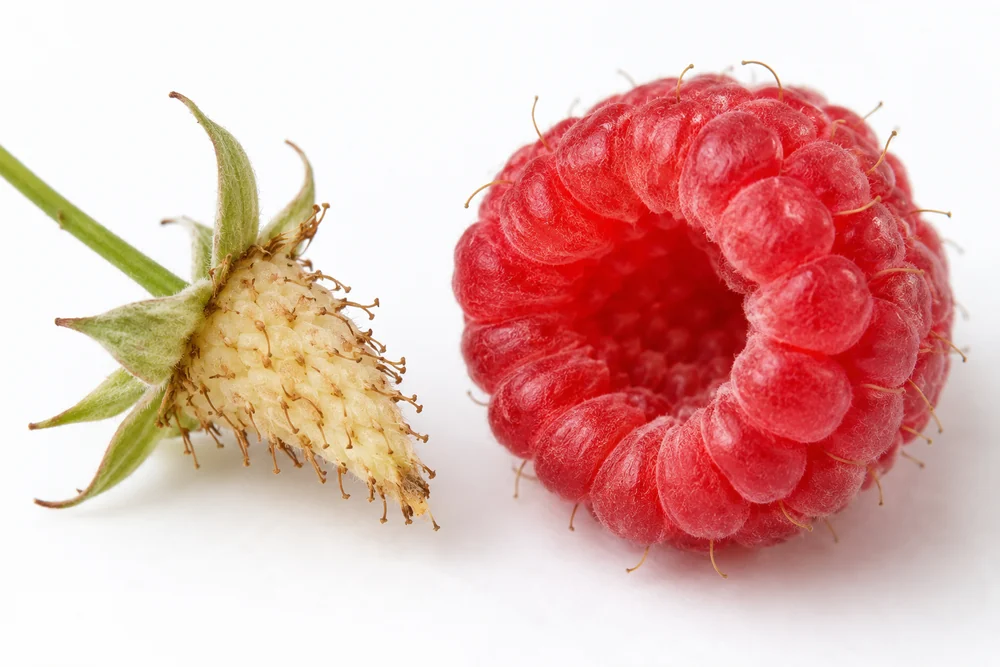
Name the interface behind the force result
In the living fruit, the receptacle supports a cluster of drupelets. Each drupelet is a small fruit with its own fleshy tissue and seed, and the cluster makes the familiar raspberry shape. When someone removes a ripe raspberry, the berry comes away while the cone-shaped receptacle stays with the plant. The hollow cavity visible in the picked raspberry shows where that support used to be. In an IQF whole raspberry made from picked fruit, the central receptacle is absent. The physical connection challenged during picking is therefore not a connection that the finished hollow berry can later use to resist bag handling.
The phrase "fruit strength" needs equal care. A laboratory may compress a whole fruit, pull an aggregate of drupelets apart, pull a berry off its receptacle, or score the number of intact berries after a process. Each may be reported as a force, a percentage, or a visual grade, yet each describes a different event. Robbins and Sjulin's raspberry morphology study recorded compression and cohesion as separate strength measures and related them to fruit morphology. That distinction matters more to an ingredient buyer than the apparent precision of a single number. A result is interpretable only after the contact surfaces, fruit state, direction of loading, and failure point are named.
The same words can also conceal a change of stage. A fresh raspberry still attached to the plant has access to its receptacle. A picked berry in a shallow harvest container has a hollow center but has not necessarily been frozen. A packed IQF berry is cold, receives contact from other pieces and packaging, and may later be poured, blended, folded into a formulation, or thawed. A measured harvest separation says something about the first transition. It cannot by itself predict how many separated drupelets a manufacturer will find after the later transitions. The question for the buyer is about the delivered state, so the observation must eventually reach that state.
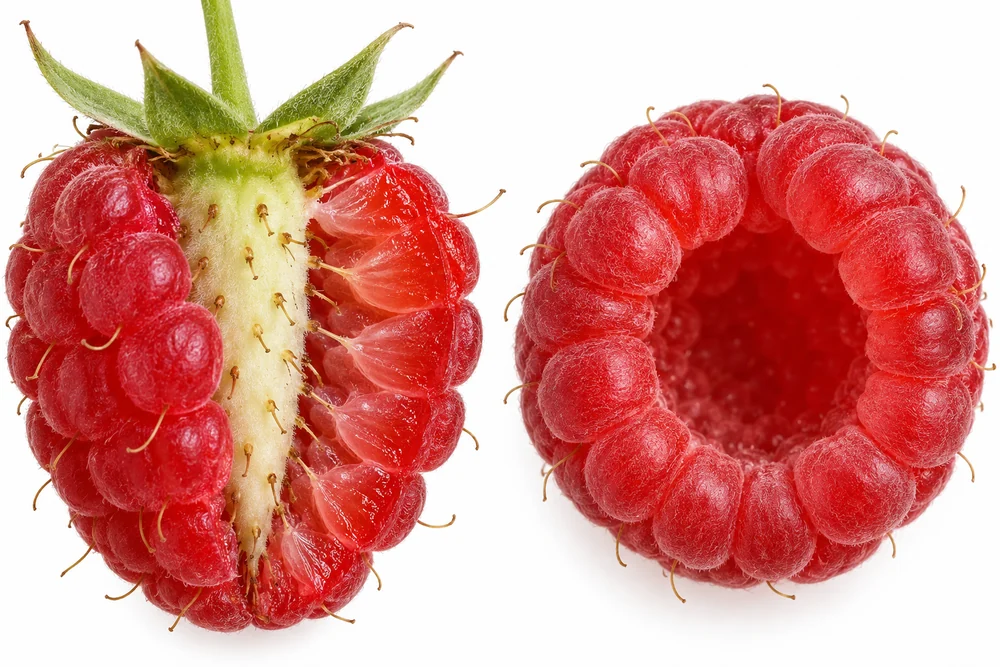
Picking removes the central support; neighboring drupelets form the sold hollow berry.
The anatomy does suggest why more than one trait can matter. A well-formed berry needs drupelets that developed and remain associated closely enough to preserve shape. It also needs tissue that can tolerate the handling used for its particular product form. The USDA Agricultural Research Service project description lists drupelet cohesion, cavity dimensions, surface features, firmness, and impact response among traits proposed for fresh and IQF quality research. It is a research plan, not a published acceptance threshold. Its useful message for commercial interpretation is that the team treats these features as separate variables to investigate. One harvest pull result should not stand in for all of them.
Visible berries also differ in the kind of defect they show. A fruit with missing or poorly developed drupelets may already be misshapen before picking. A visually sound berry may lose drupelets when it is moved or contacted. Another may stay together yet become compressed, leak juice after thawing, or break only when mixed into a thick dairy base. Those outcomes require different observations. Calling all of them "weak raspberries" would obscure whether the relevant problem began in fruit development, picking, freezing, packing, or use. A buyer can start with an intact-piece requirement, then define the defect classes that affect the actual application.
Our frozen raspberry supply page distinguishes whole fruit, whole-and-broken grades, crumble, pieces, and puree as possible commercial forms. That product vocabulary provides a practical anchor: the required intact proportion depends on the form being quoted and the work the fruit will do. A decorative whole berry on a dessert may need a different visual tolerance from fruit intended for jam, and a puree does not need the same shape criterion at all. These are application decisions to confirm in a specification. They cannot be settled by a force measurement taken at a different interface.
Read the original harvesting endpoint accurately
The original raspberry study examined a preharvest experimental treatment and several fresh-fruit quality observations. Its pulling-force endpoint was the tension required to remove a berry from its receptacle. The investigators also used electron microscopy to examine structural details, including hairs at the receptacle tip. The reported difference in pulling force belongs to those treated and control fruit under the authors' conditions. It is not a direct measurement of the force needed to tear apart the picked hollow berry, and it is not a trial of packed IQF fruit. That boundary is the foundation for a responsible reading of the paper.
The paper's purpose and conditions matter because a convenient number can travel far beyond its origin. The experimental fruit grew under a specified preharvest treatment and was assessed as fruit, rather than as a commercial lot subjected to a customer's frozen handling path. The researchers' frozen preservation of analytical material for biochemical work does not change the status of the pulling-force endpoint into an IQF performance test. Sample preservation and product freezing answer different needs. A purchaser who sees "frozen" somewhere in the methods should ask which sample was frozen, for which analysis, and whether the reported mechanical result came from that frozen sample. In this case, the buyer should not use the analytical storage step as a bridge to a packaged frozen ingredient claim.
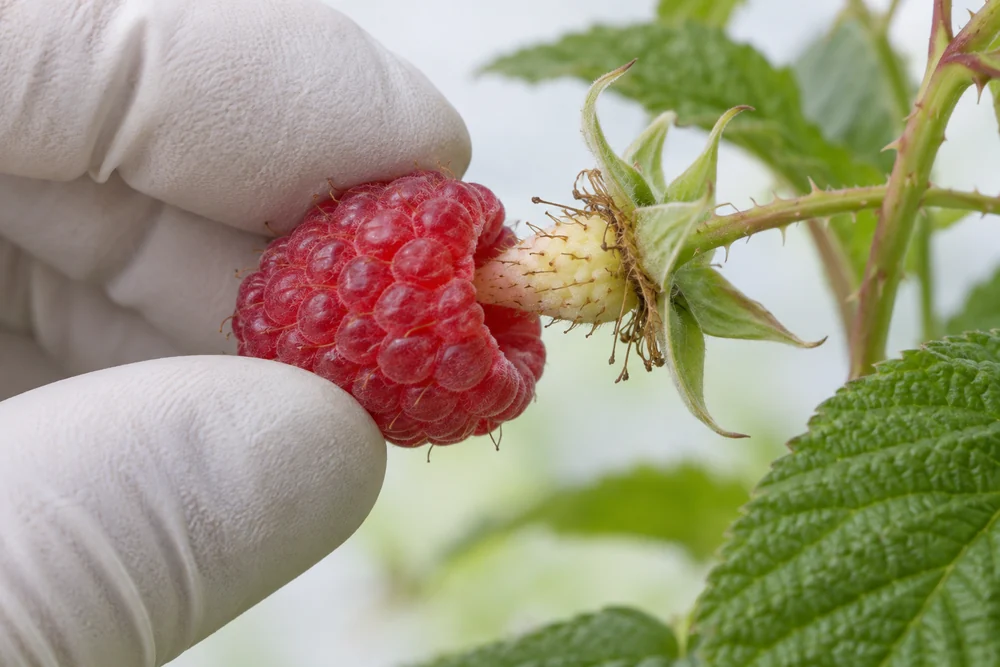
The reported pull endpoint concerns release from the receptacle during fresh-fruit handling.
Microscopic observations require the same restraint. The authors associated particular surface features with stronger attachment to the receptacle in their study. Hairs may participate in more than one aspect of raspberry structure, but the location and measured endpoint determine what this experiment demonstrated. A photograph of hairs at the receptacle tip does not itself quantify cohesion between neighboring drupelets after the receptacle has been removed. It would be especially easy to overstate causality by saying that more hairs guarantee a stronger IQF berry. The original finding is narrower: under the tested fresh-fruit conditions, the treatment and observed structures accompanied a difference in release behavior.
The experimental treatment belongs to the fresh-fruit study, while an IQF purchase needs evidence from the offered frozen fruit. If a buyer wants to investigate that treatment as a separate production proposal, it would require its own product declaration, destination-market review and validated process evidence. For the current sourcing decision, ask which interface the force test measured and whether representative hollow berries remain intact through the planned handling. That keeps the useful scientific observation connected to a measurable ingredient outcome.
If a report is being used to justify a whole-IQF specification, the purchasing team should request the full test description, even when the headline number looks persuasive. The report should identify whether the sample was fresh or frozen, whether the receptacle was attached, how the fruit was held, where the force was applied, what failed first, and how many fruit were examined. It should name cultivar or source material and maturity where relevant, because a force result detached from its sample definition is difficult to compare. It should also identify the distribution of observations and any excluded damaged fruit. These details allow the team to decide which conclusion the test permits. They do not require reproducing the paper's particular apparatus as a purchasing standard.
Sometimes the useful action is to keep the study as background rather than reject it. A fresh-fruit detachment result may inform a research discussion about harvest timing or the mechanics of release from the plant. It may point to factors worth examining in a separate commercial trial. It is still evidence about a different step. A buyer can cite the study accurately while declining to put its force result into an IQF contract as proof of the whole-piece ratio. That is a more productive distinction than calling the paper irrelevant or accepting every inference attached to it.
Detachment and drupelet cohesion answer different questions
Imagine two possible measurements on fruit from the same harvest. In the first, a technician pulls a berry away from the receptacle and records the release force. In the second, the already picked berry is challenged so that neighboring drupelets separate, or its condition is scored after representative freezing and handling. The first measure asks how strongly the fruit remains connected to the central core before or during picking. The second asks whether the remaining aggregate stays together. A higher first result does not logically require a higher second result. Even if both traits were associated in a particular variety or experiment, that association would need to be measured rather than assumed for another lot or process.
The difference is visible in the failure surface. Harvest release leaves the plant's receptacle behind and a hollow berry in hand. Drupelet loss exposes gaps in the wall of that hollow berry and creates loose small pieces. Compression may instead flatten or bruise the cluster without any one drupelet fully separating. An image of an apparently intact whole fruit cannot measure all three. Raspberry morphology research explicitly treated cohesion and compression as distinct fruit-strength observations. Its reported associations with morphology should not be converted into a numerical IQF grade, but they support naming the mechanical endpoint before comparing results.
This is where a supplier conversation becomes more useful than a generic claim of firmness. An industrial buyer may mean one of several things by "intact." They may need a whole raspberry that looks complete when frozen, a product that pours freely from a carton, pieces that remain recognizable after thawing, or a fruit preparation that survives mixing without an unattractive amount of fine debris. Those are related but not interchangeable. The team can define a primary outcome, such as whole berries as a share of a representative frozen sample, and supporting observations, such as detached drupelets, broken clusters, clumping, drip, or discoloration. An application trial can then reveal whether the agreed grade actually performs in the process.
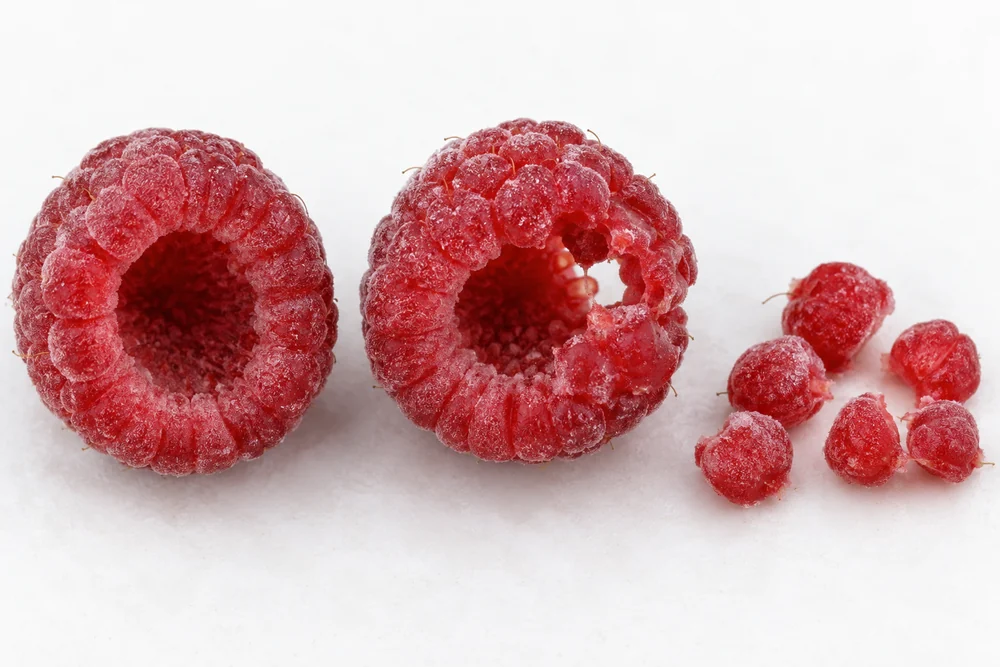
Whole berries, partial clusters and detached drupelets are different inspection outcomes.
Consider an illustrative buyer question, not a past GreenLand-food customer case. A purchaser asks whether a published high raspberry detachment force supports an intact-piece claim for an IQF berry. We would first ask for the report that produced the force figure and the offered frozen product form. If the report concerns pulling a fresh berry from its receptacle, we would explain that the interface is absent from the commercial hollow berry. We would then request the buyer's intended use, the handling conditions that matter, and the proposed acceptance definition for whole pieces and loose drupelets. Only a product-specific observation could support the final claim. The article's science helps frame that conversation; it does not supply a passing result for a GreenLand lot.
The distinction has consequences for an incoming comparison. One supplier might quote a whole-and-broken grade; another might show a freshly picked berry's mechanical force. Those reports cannot be ranked as if they test the same property. The first may still need a representative sample method and a common defect definition, while the second needs a different commercial endpoint altogether. Even two "whole percentage" figures may diverge if one is measured before shipping and the other after a customer transfers the product into a hopper. Agreement on test stage is as important as agreement on the noun used for the defect.

Whole frozen raspberries are the form to specify when intact pieces matter.
There is also a risk of confusing developmental crumbly fruit with breakage caused later. Iowa State University Extension describes how incomplete drupelet development can create crumbly, misshapen fruit in the field. That page is aimed at growers and does not diagnose a commercial frozen lot. It demonstrates why the timing of the first defect matters. If gaps were present before harvest, a later packaging adjustment may not solve the underlying cause. If sound fruit loses pieces only after a particular transfer or mixing step, the investigation moves toward that exposure. Keep photographs and counts tied to each stage before naming a cause.
Test the supplied berry through the intended handling
Qualification should begin with the ingredient actually being offered. Record its stated form, size range if relevant, whole-and-broken grade, packing arrangement, frozen condition on arrival, and the application in which the fruit will be used. A dessert topping with visible berries may require a close look at the hollow shell and attached drupelets; a fruit base destined for milling may prioritize Brix, seed handling, and flavor instead. Our specific frozen raspberry product page lists whole and broken formats, crumble, pieces, and puree among forms to confirm with a buyer. These are possibilities to specify, not a promise that one tolerance fits every program.
Sampling needs to represent the lot and the point of decision. If a buyer takes only pristine berries from the top of an opened carton, the result will understate the damaged fraction. If they deliberately shake one small bag far beyond normal handling, the result may overstate it. A sensible protocol defines where units are drawn, the number of packs or pallets represented, when sampling occurs, and how the frozen fruit is handled during inspection. The team should agree whether it wants an arrival condition check, a process-simulation check, or both. It should document any transfer, pouring, vibration, mixing, or thawing exposure that it adds, because those choices change the outcome.
At inspection, separate whole hollow berries, partial clusters, loose drupelets, and fine fragments into categories that the purchaser can recognize consistently. The protocol should say how a berry with one missing drupelet is classified and whether attached frost, clumps, or crushed juice affect the classification. Photographs beside the written category definitions can reduce disagreement between inspectors. A single total "breakage" figure may hide a shift that matters to the application: a larger number of loose drupelets may be more troublesome for a decorative topping than a modest number of still recognizable partial berries. The measured share of each category, and the way it is measured, belong in the acceptance discussion.
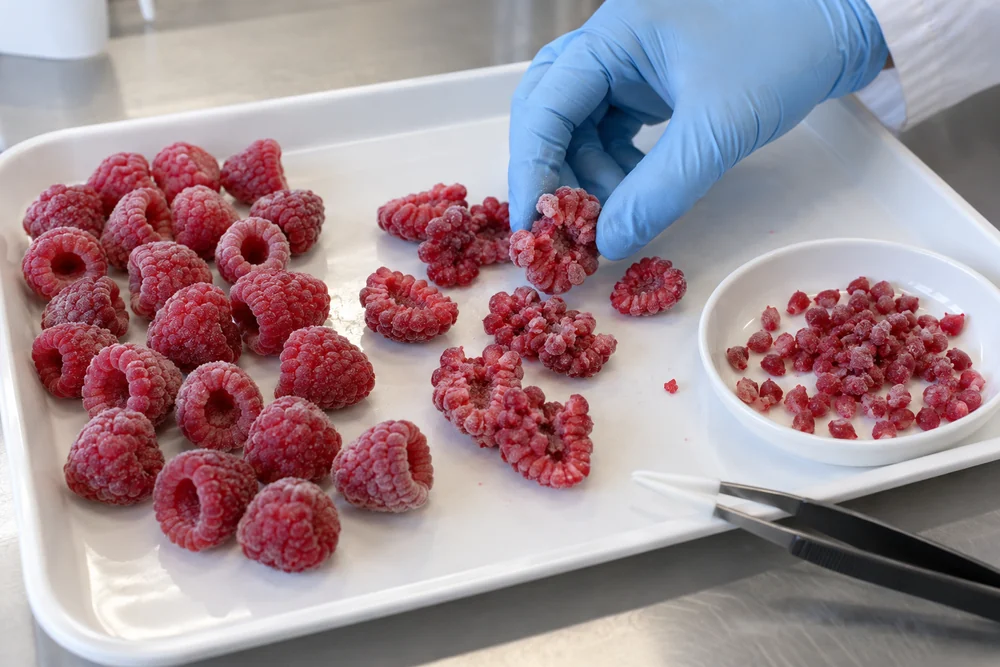
Frozen inspection should distinguish whole pieces from detached drupelets.
The frozen state matters operationally. Free-flowing fruit can be examined without treating a block as hundreds of broken berries, while an unintended clump may need its own recorded defect category. Opening and manipulating a sample can itself damage fragile raspberries. Inspectors should use a defined gentle method and record whether pieces separated while the pack was opened. For a thaw evaluation, collect observations under a defined time and temperature appropriate to the customer's safe product protocol, then distinguish pre-existing detached drupelets from later collapse or drip. No universal numerical threshold can be derived from the fresh-fruit pull study; the acceptance range must be negotiated and supported by representative samples of the offered form.
The customer's process can then challenge the sample in a relevant way. A frozen fruit blend poured into retail packs has a different transfer path from fruit folded into a stirred yogurt or placed individually on a pastry. If the product is a visibly whole ingredient, compare the count or mass of whole pieces before and after a representative process step, using the same classification rules. If the fruit is deliberately macerated, focus instead on flavor, seeds, color, Brix, or other attributes that affect the finished product. Choose endpoints from the real use rather than from the available laboratory gadget. That choice makes the test economical and keeps an attractive but irrelevant force number from dominating approval.

Check this supplied berry form after the handling step the buyer intends to use.
Where the buyer needs greater certainty, a controlled side-by-side trial can compare candidate grades or lots under the same process and sampling plan. Keep pack age, temperature, transfer path, operator method, and outcome definitions comparable. When a difference appears, repeat enough representative units to see whether it persists across the material being purchased. A single photographed berry shows a possibility, not a lot distribution. Likewise, a paper's reported average of fresh-fruit detachment force is not an estimate of the future broken share in an unrelated frozen lot. The purchasing decision needs evidence at the same material and process stage as the intended claim.
GreenLand-food can help buyers express that request in supply terms. The RFQ should state whether the target is whole IQF berries, an agreed whole-and-broken grade, crumble, or puree; what the fruit will be used for; which pack size and order quantity are planned; which physical defects need limits; and where inspection will take place. Ask for current product specifications and agreed documents appropriate to the destination market. Lead time, crop availability, sample selection, and cold-chain handling should be reviewed for the actual order. None of those commercial controls substitutes for an endpoint test, but together they make the test result actionable and reproducible.
Keep the claim attached to its anatomical endpoint
A good quality statement has a subject, a state, a method, and an outcome. "Fresh raspberry release force under this protocol" has all four if the source describes them. "IQF raspberry cohesion after handling" requires a different method and a result from the commercial fruit. Rewriting the first as the second erases the structure that was actually tested. The buyer should preserve the anatomical endpoint in notes, data tables, image captions, presentations, and procurement decisions. This discipline is useful beyond raspberry: any test result becomes fragile when the named material or failure surface changes along the supply chain.
The conclusion should also match the evidence level. A fresh-fruit experiment can support a statement about the experiment's fresh-fruit treatment comparison. A separate morphology study can show that researchers distinguish compression from cohesion and study their relationship to fruit features. A current USDA project description can show the questions researchers plan to test for fresh and IQF quality, while proving no commercial threshold yet. A GreenLand product page can show available or reviewable frozen raspberry forms, but it cannot transform those independent scientific results into a tested strength guarantee for a particular order. Each source contributes one defined part of the reasoning; none supplies every missing link.
For an approval document, write the unresolved point plainly when the material has not been tested. A suitable statement might say that a cited fresh-fruit paper measured berry removal from the receptacle, and that the proposed whole-IQF specification will be assessed separately on representative supplied fruit. This wording protects both buyer and supplier. It avoids asking the supplier to certify a property from an unrelated experimental setup and avoids telling a processor that harvest release data predict its bag loss. Once representative frozen samples have been inspected under agreed conditions, the document can add the observed outcome and its limits.
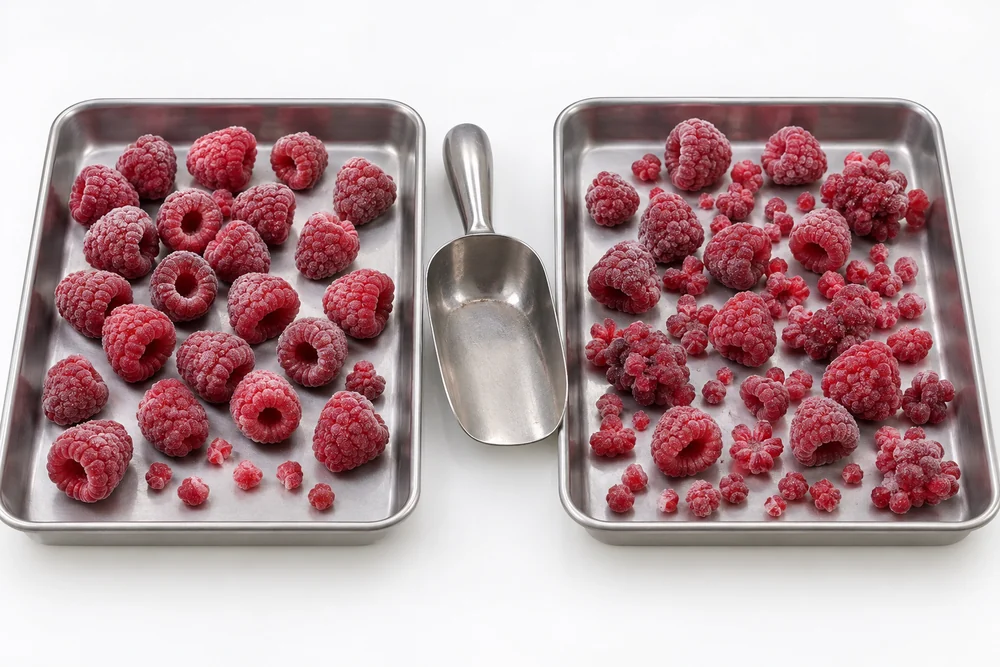
A commercial handling claim requires observations on the supplied frozen fruit.
The exact commercial form should remain visible in that final claim. A whole-IQF berry and a raspberry crumble are useful for different applications. A supplier could meet a crumble specification while failing a decorative whole-berry requirement, or meet a whole-piece inspection criterion while a customer's aggressive mixing still causes unacceptable breakdown. The form, packing, handling, and application should travel with the result. A performance statement stripped of those conditions becomes difficult to reproduce and easy to misuse when the next crop, pack format, or production line changes.
We would treat a proposed link between pull force and frozen breakage as a hypothesis until both endpoints had been observed on relevant material. If a buyer wants to investigate it, a paired study could record release force and subsequent frozen-product integrity for fruit with traceable origin and comparable handling. The design would need enough material to distinguish ordinary fruit variability from a meaningful pattern. Even a correlation within that study would not automatically set a universal pass limit for other cultivars and processes. The immediate purchasing decision rarely needs that entire research program; it needs a defensible acceptance trial on the supplied berry.
The practical closing question is therefore the one that can be answered at receipt or in the factory: what proportion of the offered raspberries remains in the form your product needs after the handling your process will impose? Define and measure that outcome, and keep the fresh harvest result in its proper place as background evidence. For a quote or sample discussion, send GreenLand-food the desired raspberry form, whole-and-broken expectation, packing, quantity, destination, and intended application. We can align the supply conversation with that specification and the documents required for the order, while the buyer's product trial establishes the performance of the actual ingredient.
Plan frozen raspberry supply with GreenLand-food
For frozen raspberry, tell us the intended product form, application, pack, and inspection priorities. GreenLand-food is a China-based frozen-food supplier and manufacturer. We can discuss factory-direct wholesale supply around the specification you need to evaluate.