


Frozen Shiitake Sulfur Aroma Can Develop During Thawing
Oct 09, 2026
Leave a message


For a foodservice buyer, the useful question is how the supplied mushrooms perform through the approved preparation and cooking sequence in the intended dish. Compare the reference and candidate through that same sequence, document the meaningful stages and keep sensory findings separate from microbiological release. We would ask for the product form, freezing history available, thaw sequence and finished dish before interpreting an open-bag observation. Unexpected deterioration still requires investigation; characteristic shiitake sulfur aroma cannot clear a questionable lot for use.
Thawing can change aroma chemistry
A bag of frozen shiitake is one observation point in a changing ingredient. Its aroma after opening can differ from the aroma after controlled preparation, and the cooked dish can differ again. The receiving state should therefore be named when an observation is recorded. "Strong mushroom smell" without that state tells the development team little about whether the sample is suitable for soup, filling or a ready meal. A useful description identifies the cut, preparation stage and particular odor character that prompted the comparison.
Simple volatile loss is only one possible explanation for a change. Aroma can also develop through transformations of compounds already present in the mushroom material. The original shiitake freezing study provides direct evidence that lenthionine can form during thawing under its tested conditions. The implication for purchasing is to avoid a one-direction assumption that thawing only removes flavor. It is also a reason to keep preparation consistent when evaluating lots. The observed direction and size of a change still need evidence from the actual samples being considered.
Lenthionine is a sulfur-containing compound associated with characteristic shiitake aroma in the cited research. It is one part of a wider volatile profile. The odor experienced in a dish cannot be reduced to its presence alone, and an assessor cannot identify or quantify it reliably by describing a bag's smell. If a technical investigation requires a specific compound result, use an appropriate laboratory method. Keep the sensory observation as its own evidence: what was smelled, at which stage and how it compared with the approved reference.

Frozen shiitake slices in a blue-lined pack with visible brown cap edges.
The product form changes the comparison too. Whole caps, slices and chopped pieces have different geometry and may be prepared differently in an operation. Pretreatment, packaging and the condition of the delivered frozen product also belong in the record. A buyer comparing a sliced candidate with a whole-cap reference has changed more than the lot. Confirm the agreed form first, then determine whether the application's approved handling can compare those forms fairly. We help purchasing identify the supplied cut and relevant records before treating a sensory difference as a lot effect.
A hypothetical foodservice buyer might ask GreenLand about frozen shiitake that develops a different sulfur aroma during the sample-use sequence. The buyer wants a controlled thaw-and-cook comparison while keeping microbiological decisions independent. We would ask them to describe that sequence and the dish, then identify where the aroma first changed. If the reference was assessed directly after opening and the candidate after preparation, a comparison at matched stages is needed before the team can decide whether the difference persists in the meal.
The meaningful use state follows the operation's actual approved procedure. Some applications may cook the product directly from frozen; others may include a controlled preparation stage. The article does not prescribe a new thawing or holding temperature to increase aroma. A laboratory experiment designed to study compound formation has a different purpose from a commercial food-safety procedure. The buyer should reproduce its authorized process for both samples and record any deviation. The comparison becomes useful when it reflects the way the ingredient will really be used.
The released liquid also needs a consistent role. If the operation drains one sample but keeps the associated liquid from another, the two dishes may receive different portions of the ingredient. The trial record should state whether released liquid is retained, discarded or incorporated into the application according to the approved recipe. That detail helps interpret both aroma and texture observations. It also prevents a handling change from being hidden inside a simple statement that one frozen-shiitake lot tastes different from another.
What the shiitake experiments observed
Suiko and colleagues studied the physical and chemical effects of freezing and thawing on shiitake fruit bodies. The primary abstract reports formation of a characteristic sulfur odor and lenthionine during thawing, with the amount varying according to freezing and thawing conditions. This is a measured observation within the experiment. It supports the article's main explanation that thawing can change sulfur-aroma chemistry. It does not demonstrate that every commercial frozen shiitake product will show the same increase or that the experiment's conditions are suitable operating instructions. Read the primary study.
The temperature that produced the most compound in an experimental comparison answers an aroma-formation question. It does not establish a safe preparation temperature, holding time or release criterion for a factory or kitchen. Those decisions belong to the operation's approved hazard controls and product requirements. A buyer should therefore take the study as a reason to standardize a comparison, rather than a reason to adjust the process to maximize a single odorant. Aroma intensity has value only when it suits the dish and is obtained through an acceptable process.
The research material and procedure should remain visible in any technical discussion. The study's mushroom source, freezing conditions, sample preparation and analytical measurement define the observation. Commercial products may differ in cut, pretreatment and freezing history. The accessible primary evidence gives a clear mechanism-related question to investigate, but a current lot requires its own comparison. Avoid using the paper as a certificate of the supplied ingredient's behavior. GreenLand's order specification and traceability information describe the confirmed product; they do not replicate an academic experiment by implication.
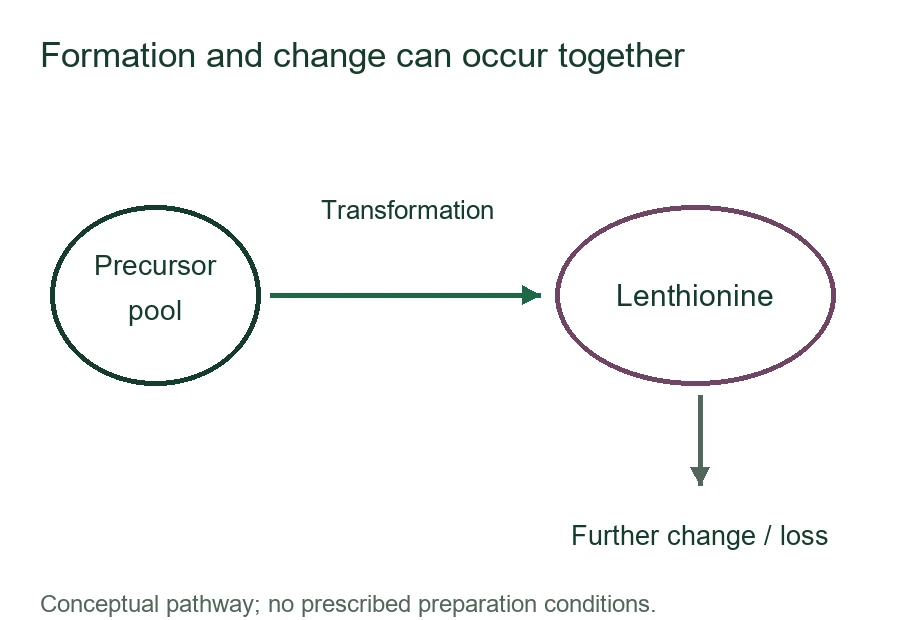
Conceptual precursor transformation to lenthionine and further change or loss.
Other processing research shows that shiitake volatile profiles can change during heating or drying. A primary paper on fresh and processed shiitake compared volatile compounds under its own treatments. The relevant lesson is that the final aroma depends on the processing state being measured. Its heating observations should not be converted into a fixed forecast for a commercial soup or a frozen lot. Use the paper to justify checking the actual cooked application, with its own ingredients and processing history. Read the primary study.
A dried-shiitake rehydration-and-heating study examined gamma-glutamyltransferase activity and lenthionine content over the tested conditions. It reported changing lenthionine behavior during heating. That experiment concerns dried material and its rehydration sequence, so it is a separate evidence system from frozen shiitake thawing. It can help a technical team understand why aroma formation and disappearance may both matter during preparation. It cannot supply a thaw-and-cook instruction or a direct substitution ratio for the frozen product discussed here. Read the primary study.
Later primary work on hot-air drying likewise followed volatile and sensory changes across processing stages. Its data belong to drying, rather than frozen-product release. Reading these studies together supports a careful boundary: sulfur aroma is affected by material and process, and a specific treatment observation remains specific to the experiment. A purchasing team does not need to adopt all of the analytical methods. It needs a comparison that controls the stages relevant to its own ingredient and keeps any interpretation within the evidence obtained. Read the primary study.
This evidence also prevents an excessive promise of consistency. A supplier can agree a product form, documented controls and an application-based sensory reference. It should not promise that no natural aroma change will occur between the frozen bag and the cooked dish. The commercially useful requirement is acceptable performance under the agreed use sequence. If a buyer needs a narrower chemical requirement, identify the analyte, method and preparation explicitly and establish its relationship with the intended dish before it becomes part of the purchase specification.
Compare lots through the same sequence
Start a lot comparison with traceable current reference and candidate samples. Confirm the product name, cut, pretreatment where declared, pack identity and lot codes. Use representative portions from the packs, avoiding a reference made only from attractive caps while the candidate includes the normal distribution of pieces and stems. The objective is to compare the materials that production will use. Sample selection should be consistent enough that an observed aroma difference is not simply a difference in which parts of the product were taken.
Apply the same authorized preparation sequence to both materials. Record the actual conditions used by the operation, including any controlled tempering stage, cooking procedure and treatment of released liquid. If the product is cooked from frozen, reproduce that route for both samples. If an approved preparation step is required, use it consistently. The record should identify when each sample entered and left a stage. It should not replace the operation's safety procedure with temperatures selected from an aroma study.
Observe aroma at the stages that can explain the commercial problem. Receiving-state odor, the odor after approved preparation and aroma in the cooked application can serve different purposes. Keep those observations separate. A candidate may smell more strongly at an intermediate stage yet produce an acceptable dish, while another may develop an unwanted note only after cooking. The stage record lets development identify where a difference emerges and decide whether it matters to the customer's meal or to an incoming-quality requirement.

Aligned reference and candidate sequences through received, prepared and cooked states.
Cooking conditions need enough control to make the comparison useful. Match mushroom dose, the amount of other ingredients, cooking vessel, recipe and evaluation point as appropriate to the application. A soup with more water or a more aromatic seasoning base can mask an ingredient difference. A filling with a different reduction step can change both moisture and aroma. Record the conditions that affect the relevant result, so the ingredient decision is not based on two meals prepared in materially different ways.
The sensory reference should express the intended role of shiitake in the dish. A clear broth might require a recognizable but balanced mushroom note; a strongly seasoned filling may use the mushroom primarily for texture and savory contribution. The buyer should identify the required attributes and unacceptable deviations in language the assessment team can apply. Avoid treating the strongest sulfur impression as automatically desirable. The accepted profile is the one that serves the confirmed application under the approved preparation conditions.
| Material or evidence | Object being evaluated | Comparison requirement |
|---|---|---|
| Received | Ingredient condition and odor | Lot identity, pack condition and frozen state |
| Prepared | Aroma after the approved preparation | Same authorized sequence and liquid handling |
| Cooked | Finished dish acceptance | Same recipe, dose and evaluation state |
Blind or coded comparisons can help avoid expectations from directing the assessment. The person evaluating the dish should not be told that one sample is expected to produce more lenthionine because of a study or a laboratory result. Evaluate the actual product first, then use chemical evidence where necessary to investigate a reproducible difference. The aim is to determine acceptance against the application's reference. An analytical explanation can support that decision, but it should not supply a predetermined sensory verdict.
Keep repeated observations comparable without averaging away a problem. If the difference appears only on one trial, review the preparation record before deciding it represents the lot. If it persists under matched conditions, state which attribute differs and at which stage. Where the commercial consequence is significant, a further representative sample or application run may be justified. We would ask the buyer to share that stage-specific record, the available freezing history and the finished dish description so follow-up can address the observed issue directly.
Keep abnormal odors and safety checks separate
Characteristic sulfur aroma does not provide microbiological clearance. A lot with an unexpected odor or evidence of deterioration still needs the operation's normal investigation and release process. The fact that research observed natural lenthionine formation is not a reason to excuse a new sour, fermented, musty or otherwise abnormal impression. Record the actual observation and assess it against the agreed product reference and lot evidence. Keep the sensory explanation provisional until the relevant investigation has resolved the concern.
Absence of an objectionable smell also cannot demonstrate that a lot is safe. Safety decisions rely on the approved hazard controls, relevant records and tests appropriate to the product and use. An assessor's nose has a different task: describing whether the sample's odor meets its sensory requirement under a defined preparation. The two assessments can inform a shared release decision, but one cannot substitute for the other. Development should avoid wording that turns an acceptable shiitake aroma into an assurance of freedom from contamination.

Matching cooked shiitake soups in an application comparison.
Review the cold-chain and pack evidence when the observation is unusual. Confirm the lot code, received condition, available temperature records, package integrity and handling history after receipt. A sample that was prepared differently from the reference may need a controlled repeat, while evidence of a genuine deviation needs the prescribed disposition. The buyer's quality team should decide whether the material is held, investigated or rejected according to its procedures. A supplier can support the investigation with relevant traceability and order records without improvising a safety decision from aroma alone.
The record should distinguish observed evidence from its possible explanation. "Sulfur note increased after the approved preparation stage" is an observation when documented by the assessment team. "Lenthionine caused the difference" requires suitable chemical evidence. "The lot is safe" requires the release basis defined by the operation. Keeping these statements separate helps prevent a plausible chemical mechanism from becoming an unsupported conclusion. It also gives the laboratory a specific question if targeted analysis is needed to investigate the sensory change.
Testing should match the problem. A targeted volatile analysis might help explain aroma formation, but it is not a substitute for the microbiological or other hazard assessment required for release. Conversely, a passing safety test does not prove that the ingredient meets the flavor reference for a premium dish. Agree which team owns each assessment, what evidence is required and how the findings will enter the final disposition. This avoids a supplier-buyer discussion in which both sides use the word "quality" to mean different acceptance questions.

Independent sensory evidence and hazard-control branches in lot assessment.
Use only the approved safe preparation sequence for samples that will be evaluated as food. Do not hold mushrooms under experimental aroma-maximizing conditions because a paper reports a stronger lenthionine response. The academic measurement and the foodservice operation have different controls and objectives. If a technical investigation needs conditions outside the production procedure, it belongs in a properly designed laboratory context and should not be presented as tasting or handling advice. The routine application comparison should remain within the buyer's authorized procedure.
We help purchasing connect the issue to the supplied frozen-shiitake form, confirmed specification and available lot records. The buyer should send the stage at which the odor appeared, photos of the pack and product where relevant, the lot identity and preparation details. Original test reports are more useful than isolated result screenshots. That information helps establish whether the concern relates to the material, handling or comparison method, while the responsible quality team retains authority for the actual release decision.
Write a use-state sensory specification
A sensory specification becomes more useful when it identifies the preparation behind the accepted reference. State whether assessment concerns the frozen receiving sample, material after the approved preparation stage or the cooked application. Where several stages matter, give each a purpose. The receiving check can identify abnormal odor and product condition; the finished-dish check can confirm the intended flavor performance. Naming those roles prevents a strong intermediate smell from being treated as a failure when the commercial reference concerns the meal after cooking.
Define the product form alongside the sensory requirement. Whole caps, slices, chopped pieces and stems have different application roles, and a change in cut can alter portioning and cooking behavior. GreenLand's verified shiitake range includes forms to be confirmed against the order specification. We ask the buyer to identify the cut, size or tolerance needed, the intended dish and whether any pretreatment is required. The aroma requirement should apply to the form that was actually sampled and approved, rather than an unspecified mushroom product.

Frozen sliced shiitake with a ruler illustrating piece size.
For the hypothetical foodservice inquiry, include the available freezing history, approved thaw sequence, relevant sulfur odorant results if tested and the finished dish. Describe the reference and candidate reports on their original basis. If no chemical testing was performed, say that the concern is a sensory observation. A laboratory result should not be implied merely because an assessor uses the word sulfur. The supplier and buyer can then decide whether a controlled application repeat is sufficient or whether a targeted investigation has a clear decision benefit.
The RFQ should also identify packing, trial quantity, expected commercial quantity, destination, delivery window and requested documents. Explain whether the product will be used in soup, filling, sauce or a visible meal component. These inputs help us confirm the appropriate frozen-shiitake specification and supply plan. Private-label packing and shipment documentation should be agreed for the actual order. A development comparison is one part of approval, alongside physical requirements, hazard controls, traceability, commercial terms and a workable cold-chain arrangement.
Keep the accepted reference traceable over time. Record its lot identifier, preparation and retention conditions, and the date or basis of approval. Repeated preparation or different storage can make an old sample a poor reference for a new shipment. If the operation changes its recipe, cooking route or mushroom dose, review whether the prior sensory approval still represents the application. A reference should help purchasing make consistent decisions rather than preserve a historical smell disconnected from the current dish.

Ingredient and cooked-dish references connected by the approved preparation.
Routine release and investigation can use different depths of testing. A defined sensory check and standard quality controls may be sufficient for normal deliveries. A recurring aroma deviation or a significant process change may justify more detailed comparison or chemical analysis. If a specific odorant becomes a contractual parameter, agree the method, sample state, reporting basis, laboratory responsibility and action for an unacceptable result. Avoid adopting a paper's experimental maximum as a universal target; the specification should serve the application and be practical to verify.
The buyer's final decision should follow the finished application prepared through the agreed sequence, supported by the appropriate lot evidence. Frozen shiitake can develop aroma during use, and the observation deserves a controlled explanation. We help your purchasing team confirm the form, records and sample information required for that comparison. The accepted reference, the preparation behind it and the independent release controls together provide a clear basis for approving supply and investigating a meaningful change.
Source frozen shiitake mushrooms with GreenLand-food
GreenLand-food is a professional frozen shiitake mushrooms supplier and manufacturer in China, providing factory-direct wholesale supply for importers, food manufacturers, foodservice distributors, and private-label programs.
Send the product form, specification, packing, quantity, application, destination, private-label needs, and requested documents.