


Banana in Yeast Bread: Sugar-Driven Gas Production and Fraction-Driven Gas Retention Are Different Jobs
Oct 09, 2026
Leave a message

Separate fermentation from loaf expansion
Gas production describes the carbon dioxide made by yeast as it ferments available sugars. Gas retention describes how much of that gas remains in the dough as bubbles grow, merge, stretch surrounding material and encounter heat. A loaf may show vigorous early bubbling but modest final volume if the matrix cannot accommodate expansion. It may also expand during proofing and then lose height during transfer or baking. Counting bubbles, recording proof height, measuring the baked loaf and inspecting crumb answer related but different questions. The distinction matters when banana is a substantial ingredient because banana contributes more than sweetness.
Ripe fruit usually brings soluble sugars and water along with fibre, pectic substances and other solids. Frozen banana pieces introduce another handling variable: thawing can release free liquid, while direct mixing from frozen changes the local temperature and the time before the fruit disperses. A bakery that measures the mass of fruit but ignores the water recovered after thawing may unintentionally change hydration. This can make a sweeter trial appear to have a weaker structure even if the banana's fermentable sugars increased. The apparent contradiction is a formulation effect that needs a controlled comparison, not a verdict about all ripe bananas.
Yeast activity can be observed in a small, standardized dough test, but a baker also needs to know what the expanding bubble walls can endure. In a wheat dough, developed gluten is a major part of that structure. In a starch-based formulation without a conventional gluten network, viscosity and the behavior of dissolved or dispersed ingredients become especially consequential. The published banana fraction experiment used a wheat-starch base and measured both fermentation ability and bread properties. It is useful because the researchers did not treat loaf volume as a direct proxy for sugar supply. Yet the experimental base, banana preparation and proof method must be kept attached to the result.
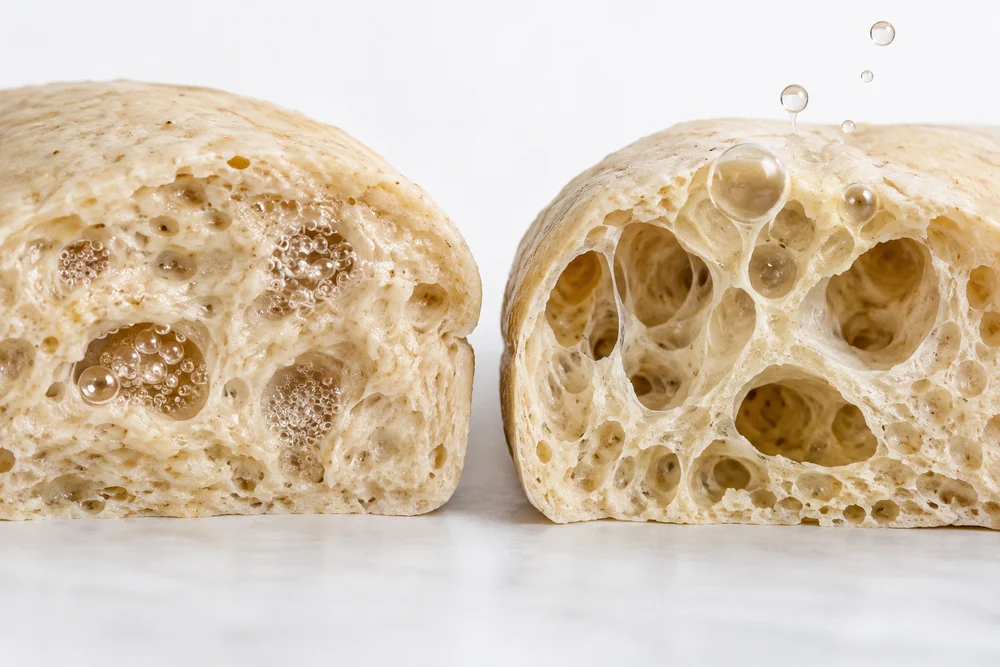
Producing bubbles and keeping them in the dough are different functions.
A useful development sequence begins with a control formula and a clearly recorded banana input. Keep yeast source, flour or starch lot, added sugar, salt, pan geometry, mixing energy and proof environment consistent across comparative runs. Record banana solids and the recovered thaw liquid rather than using an imprecise phrase such as one cup of banana. Observe how quickly dough begins to expand, whether the surface holds its shape, and whether it collapses before baking. After cooling, compare loaf mass and volume, then cut the loaf to inspect cell size and distribution. These measurements let a team see where the trial changed instead of assigning all differences to yeast.
The same practical distinction applies to commercially useful outcomes. A beverage or sauce customer may value banana sweetness and flavor while having no need for gas retention. A yeast-bread buyer needs the fruit's flavor to coexist with a stable dough and a sliceable crumb. A dense loaf is not necessarily evidence of low banana sugar; a gassy dough is not proof of a successful finished bread. We would therefore ask which bakery base and final texture the buyer is targeting before discussing whether a frozen banana sample is appropriate.
There is also a timing issue. Yeast may produce gas faster when more fermentable sugar is present, yet the proof schedule may not be adjusted to that faster trajectory. A dough left to reach the old time target can become overextended and fragile. Conversely, a colder banana addition may delay early activity even though the eventual sugar supply is adequate. The developer should therefore compare dough temperature and expansion at matched points, not just the clock time written in the standard recipe. A change in proof timing can be an application adjustment, but it should be demonstrated on the line and recorded separately from the ingredient specification.
The banana fraction experiment separated two functions
In the original Food Science and Technology Research paper, the researchers prepared ripe banana flour and separated it into a water-soluble low molecular fraction, a water-soluble high molecular fraction, and a water-insoluble fraction. The low molecular material consisted mainly of sugars. They evaluated fractions and combinations in a bread system based on wheat starch and yeast, and included a sucrose substitution comparison. The design allowed them to ask whether fermentable carbon and gas-holding behavior were supplied by the same material. Their conclusion associated the small soluble fraction with yeast fermentation and the larger soluble fraction with a structural function in that experimental bread.
That is a stronger inference than simply observing that riper bananas taste sweeter and one loaf rises. Fractionation changes what is present in the test material. Recombination asks whether the fractions regain a behavior when returned together. Substituting sucrose helps show whether ordinary fermentable sugar can replace one fraction's contribution to gas generation while leaving a different contribution unresolved. Each control narrows the interpretation of the particular experiment. It still does not isolate every molecule, and it does not make a commercial frozen fruit piece equivalent to a freeze-dried research fraction.
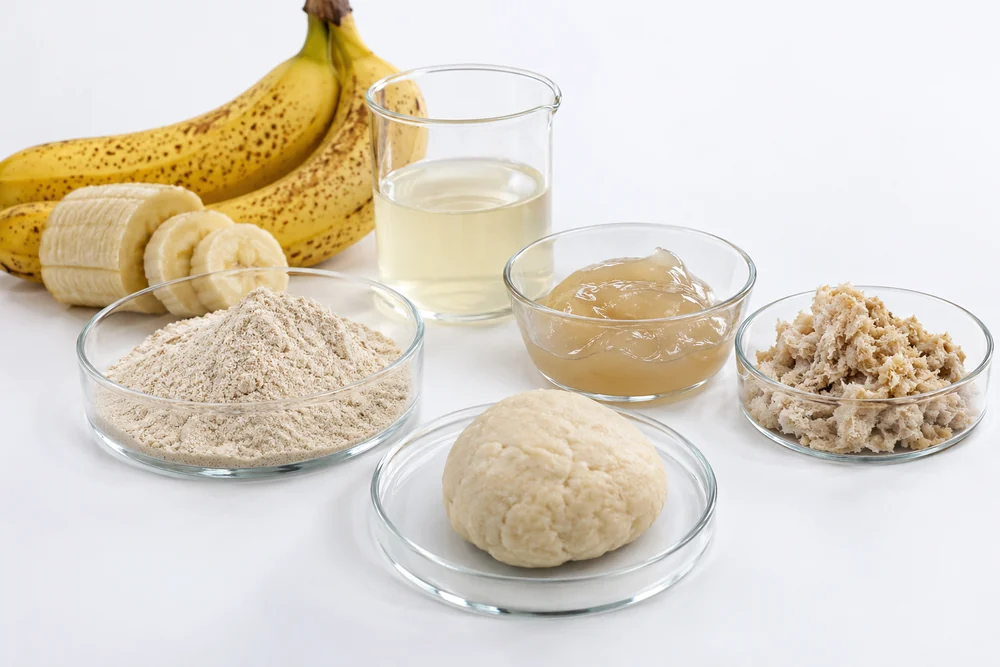
Soluble and insoluble banana fractions can contribute different functions.
The paper's language about a gluten substitute describes the performance of the soluble high molecular fraction in the researchers' starch loaf. It is a functional breadmaking comparison. It does not establish that GreenLand sells isolated banana fractions or banana flour. It also does not establish an allergen or celiac-safety claim for a bakery product. The paper used wheat starch in its experimental formula, and gluten-related labeling depends on controlled inputs, cross-contact management, applicable rules and product testing. Bakery procurement should not convert a paper title into a finished product certification.
An ingredient developer can borrow the experimental logic without copying the laboratory formula. One comparison may hold banana solids constant while adjusting added sugar to produce the same measured fermentable sugar. Another may keep total water and fruit solids constant while comparing two banana forms. The observations should be chosen to answer a precise question: does this input change the rate of gas generation, the ability to keep shape while the gas expands, or the sensory contribution of banana after baking? Such a design is more informative than changing fruit percentage, water and yeast together and then attributing the outcome to banana ripeness.
The role of aqueous-phase constituents in gas-cell stability has been discussed more broadly in bread science. The published review describes how nonstarch polysaccharides, proteins and lipids can affect films around gas cells, especially when a conventional gluten network is absent. That background makes the banana result plausible as a research question, but it does not identify which component controlled a particular bakery formula. A wheat loaf, a starch loaf and a mixed-grain loaf can respond differently because their gas cells sit in different matrices. The bakery's own base must therefore stay in the trial record.
For purchasing, this means a banana specification should describe what is supplied rather than promise a universal loaf volume. Cut size, maturity range, color, sweetness target where agreed, allowed defects, packing format and the condition of the fruit after thawing can all be defined. A development sample should then be tested in the bakery's process. If a buyer wants a banana flour or purified fraction, that is a different ingredient request requiring confirmation of availability; the frozen fruit page cannot be treated as evidence that such a form is supplied.
The paper is sometimes easiest to misuse when its fractions are paraphrased as a simple recipe instruction: add more banana sugar for gas and more banana pectin for structure. The experiment did not test a broad commercial dose range for every bread type, and a fraction produced in a laboratory is not a standalone supplier product. If the bakery changes ripe fruit percentage, it changes sugars, water and solids together. If it adds isolated pectin, it creates a different ingredient system with its own hydration and labeling questions. The practical lesson is to design a comparison that reveals which function shifted, then choose a formulation correction supported by that comparison.
A proposed pectin role is not the entire mechanism
The banana study examined pectic substances because pectin can contribute to viscosity, and the authors proposed that such material may help explain the high molecular fraction's effect. Their fraction data support a functional distinction in the tested dough. They do not prove that total pectin concentration alone predicts gas retention across banana cultivars, ripeness stages, flour bases or frozen forms. Pectic substances vary in solubility and molecular characteristics, and the complete dough contains starch, water, yeast metabolites and other fruit components. A bulk pectin number would leave much of that interaction unmeasured.
The visible behavior of a banana preparation provides a more practical starting point for a bakery. After thawing and mixing, does fruit remain as soft pieces, disperse as a smooth puree, or separate into liquid and fibrous pulp? A preparation that disperses evenly may change the continuous phase of a batter differently from large fruit pieces that interrupt its structure. The same fruit mass can yield different local hydration if some of the thaw liquid is discarded. These are professional formulation inferences; they should be checked through controlled trials rather than described as outcomes already demonstrated for GreenLand stock.
Water is central to the interpretation. Pectin and other polysaccharides interact with water, while starch hydration and gluten development also depend on available water. If a trial adds frozen banana puree without correcting for its water, a softer dough may simply reflect a changed water balance. If the bakery compensates with extra flour, it changes solids and perhaps gluten content as well. A meaningful comparison records both the banana's drained mass and total added liquid, then adjusts only the variable under investigation. That discipline is what makes a difference in gas retention interpretable.
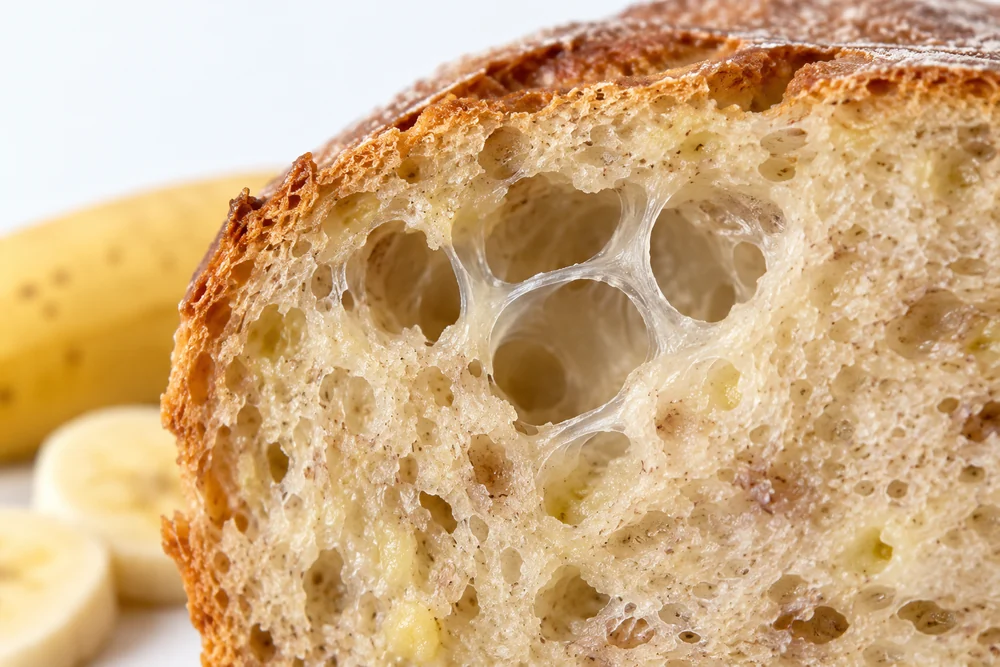
A gas-cell film illustrates a matrix hypothesis; it does not identify the active component.
Ripeness is another coupled variable. As banana ripens, its sweetness, softness and composition change, but sensory maturity is an imperfect measure of functional polymers. A very ripe fruit may provide more readily fermentable sugar and a softer puree; the structural consequences depend on the surrounding formula and processing. It would be tempting to designate an ideal color stage from the paper. The study used its own ripening and flour preparation conditions, so an industrial buyer should qualify a practical maturity range against the actual frozen form and application. A photographic maturity standard can help sampling, but it cannot replace a bakery trial.
This distinction also guards against overinterpreting a failed loaf. If a sample ferments slowly, check yeast viability, dough temperature, added sugar balance and the banana preparation before assigning the problem to low fermentable sugar. If it ferments strongly but collapses, inspect hydration, mixing, pan support, proof endpoint and matrix behavior. If a baked loaf is tall but coarse or gummy, compare slice structure and moisture after cooling. These are different failure paths. One pectin claim cannot explain each of them, and a corrective action should follow the observed path.
When a buyer requests a material certificate, the relevant supplier document is the specification for the actual frozen banana, including form, packing and quality attributes. A pectin assay might be an additional development measurement if the buyer's research question justifies it; it is not automatically a routine commercial approval metric. We can help align fruit samples with the agreed specification, while the bakery's formulation team decides whether a functional pectin question merits further testing.
Trial the actual banana preparation in the intended bread
The gap between a ripe banana flour fraction and a frozen banana piece is large enough to warrant a fresh trial plan. Frozen slices, chunks and a comminuted preparation differ in surface area, dispersion and how much thaw liquid joins the dough. The buyer should first name the offered form and the desired finished bread. A soft sandwich loaf, dense fruit bread and starch-based specialty loaf can make different demands on banana distribution and crumb integrity. We should also confirm whether the trial is using wheat flour, another grain system or a controlled gluten-free formulation, because those bases do not share a single gas-holding mechanism.
An illustrative scenario makes the decision concrete. A bakery developer asks GreenLand why a sweeter banana trial produced an ordinary or disappointing rise. This is a hypothetical buyer situation, not a historical customer case or a GreenLand test result. We would ask for the banana form, ripeness target, fruit inclusion rate, actual sugar and water adjustments, starch or flour base, yeast and proof conditions, and photos of the cooled crumb. The first question is whether the new formula produced less gas, lost more gas, or changed both. An ingredient substitution cannot be diagnosed from sweetness and final height alone.
For a fair pilot, draw comparable samples from identified lots and condition them using one documented thaw method. Weigh fruit, collect and record free liquid, and decide in advance whether that liquid returns to the mix. Maintain equal total formula mass and adjust added water to a defined target. If the bakery changes sugar to compare sweetness, record it separately. Keep batch size, mixer, pan and proof criteria stable. This does not promise a perfect laboratory experiment, but it prevents the largest avoidable confounders from hiding the ingredient effect. Repeat the most promising comparison before adopting a specification.
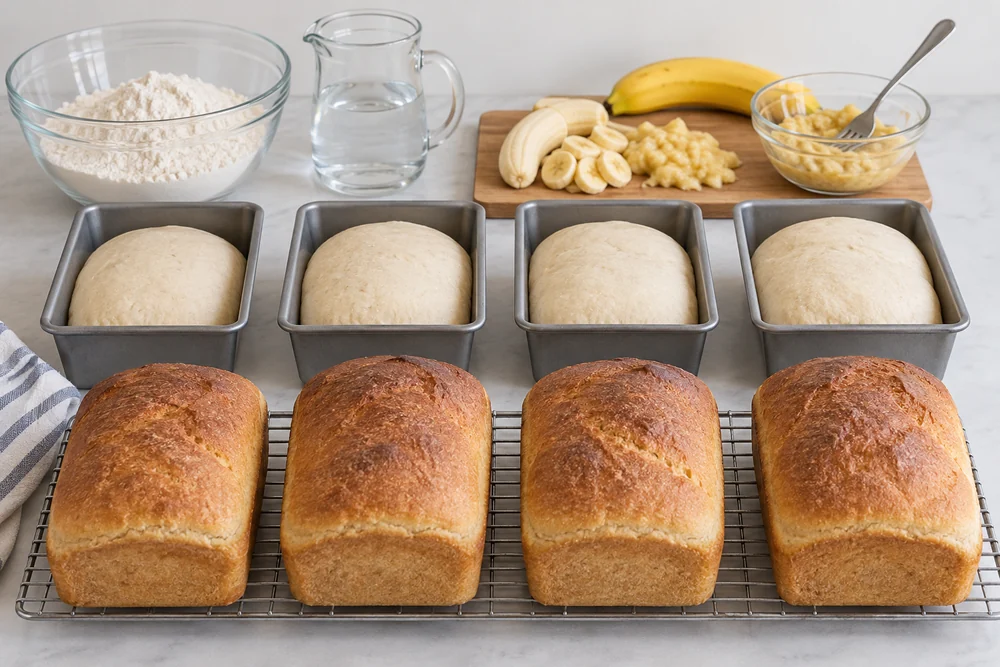
Compare banana preparations in the same base recipe and water balance.
During proofing, record time, dough temperature and expansion at a consistent reference point. Photographs of a marked container can show shape and bubble behavior, but they do not substitute for a gas-production measurement if that is the question. In a development lab with suitable equipment, a fermentation gas test can separate yeast output from loaf expansion. In an ordinary bakery pilot, comparing proof trajectory with baked loaf and crumb gives a practical diagnosis. A loaf that inflates early and collapses later tells a different story from one that never develops gas.
After baking, let samples cool under the same conditions and assess sliceability, crumb cell pattern, moistness and flavor at the intended serving time. A loaf that looks tall while warm may compress after cooling; a loaf with a fine, even crumb may be commercially preferable to one with a few large voids. If the product will be sliced, wrapped, frozen or transported after baking, include those later steps in the trial. The useful outcome is the finished product's performance through its actual route, not a proof photograph chosen for its dramatic rise.
Procurement can then translate the winning banana input into supply terms. Agree on the fruit form, cut tolerance, maturity and sweetness range if relevant, color and defect limits, pack size, quantity, delivery destination and documents required for the market. Confirm how a sample from a new crop or lot will be compared with the approved reference. Our frozen banana product page identifies the category and available commercial discussion; any specific format or function still needs confirmation in an RFQ. A bakery may also consult the frozen fruit category when consolidating other fruit ingredients.

Frozen peeled banana pieces are a practical starting form for a bakery trial.
Keep the approved reference sample under conditions that make later comparison meaningful. A photo of ripe fruit color can help, but it does not capture thaw liquid, dispersibility or taste. A small retained pack, receiving specification, sample preparation method and bakery trial sheet provide a more useful record. If one shipment arrives with a different distribution of small pieces or free liquid, the bakery can compare the incoming material with its reference before changing the full production formula. That comparison helps the buyer and supplier identify whether the question concerns fruit consistency, storage handling or the bakery's own process settings.
Approve function without inventing a dietary claim
The bread study's primary value for commercial development is a disciplined question about function. A banana ingredient can contribute fermentable material, flavor, moisture and physical solids, while the matrix that holds gas is determined by the complete formula. Approval should be based on the outcome the bakery sells: consistent loaf structure, sensory character and processing reliability. A single favorable research result cannot guarantee those outcomes across different banana forms, factory lines or formulations. The decision becomes stronger when each claim is tied to its own measured endpoint.
If the bakery markets a gluten-free loaf, it needs a separate ingredient and process controls review. The fact that one experiment described a banana fraction as a substitute for gluten's technological role does not establish absence of gluten in a commercial product. The starch source, all other ingredients, shared equipment, sanitation, analytical verification and destination-market labeling rules matter. GreenLand's frozen banana supply should be represented by its actual specification and documents, with no implied dietary certification from a breadmaking mechanism. This protects the buyer's product claim and keeps the supplier's role accurate.
The same discipline applies to nutrition and wellness language. Adding banana does not by itself establish a health benefit for bread, nor does a larger loaf mean a better nutritional profile. If a buyer wants nutrient or fibre claims, the complete finished formulation and applicable testing would need to support them. The purpose of the fruit trial discussed here is functional and sensory: what does the offered banana do in this bread? That question can be answered without turning an experimental fraction into an unsupported consumer claim.
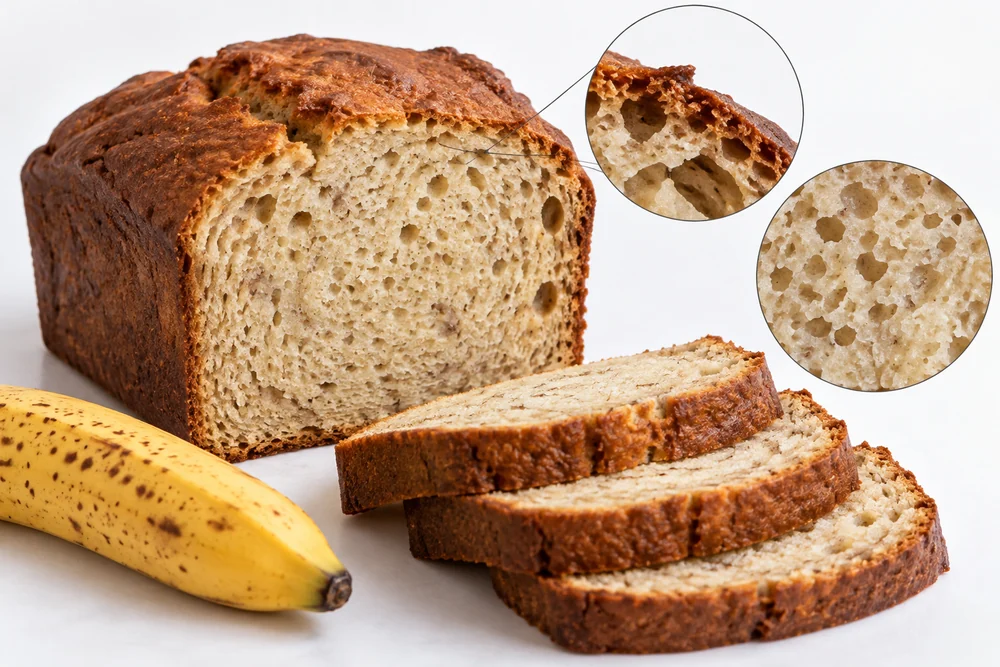
Check crumb, crust separation and collapse as well as loaf volume.
For a purchasing team, a good approval record includes the reference formula, the approved fruit sample, measured input conditions and agreed finished-bread observations. It should note what has not been tested: a different cut, maturity range, another flour base or a new proof process. If those variables change later, the buyer can run a focused confirmation instead of assuming the first loaf result transfers. This is especially useful when a bakery scales from bench mixers to production equipment, where mixing, temperature rise, proof handling and oven loading change the experience of the dough.
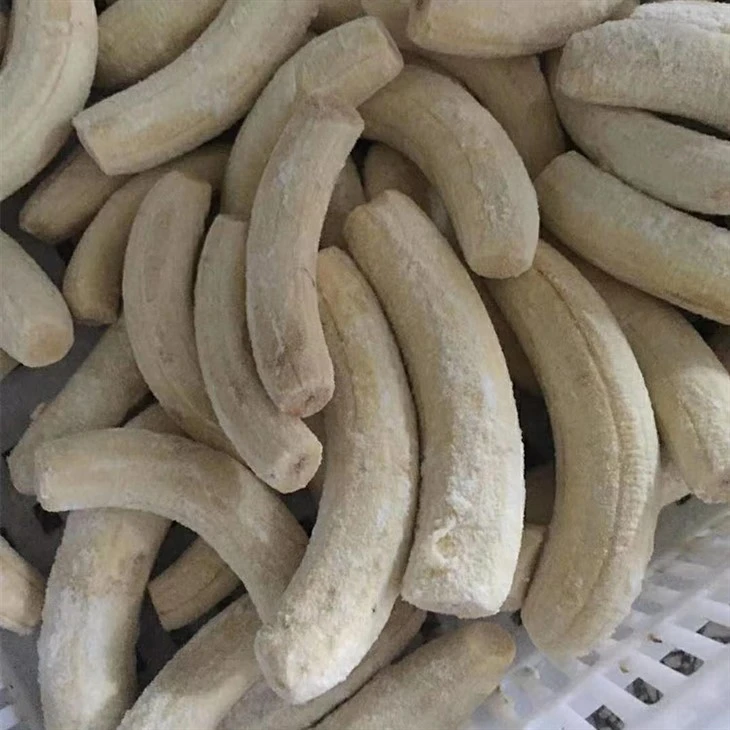
Judge the banana ingredient in the actual batter and baking process.
For a GreenLand frozen banana inquiry, send the exact offered form, maturity and sweetness target, thaw-liquid handling, pack requirements, and the bread base in which the fruit will be tested. We can align a representative frozen-fruit sample with that specification. The bakery can then compare gas production, proof stability, cooled crumb and slice quality in its own formula. A sweeter input is valuable only if the finished loaf meets its intended flavor and structure; the fractionation paper cannot certify that outcome for a frozen slice.
Plan frozen banana supply with GreenLand-food
For frozen banana, tell us the intended product form, application, pack, and inspection priorities. GreenLand-food is a China-based frozen-food supplier and manufacturer. We can discuss factory-direct wholesale supply around the specification you need to evaluate.