


Can You Freeze Onion Soup? Freeze the Broth Base Before the Cheese Toast
Sep 28, 2026
Leave a message


Separate caramelized onion base from the served bowl
French onion soup is built in stages. Sliced onions are cooked until they develop the intended sweet, savory depth; stock and seasonings turn them into a soup; bread and cheese are added at or near service. That staging gives a useful boundary for freezing. A frozen onion-only base allows the kitchen to decide later whether it needs beef, chicken or vegetable stock and how concentrated the finished broth should be. A frozen cooked soup holds the tested onion-to-broth ratio in each portion. A frozen assembled bowl locks in the bread, cheese and bowl format before the final heat treatment.
The choice depends on the kitchen's bottleneck. If caramelization takes the most labor and stock is readily available, freeze a concentrated cooked onion base in measured portions. If rapid service and consistent dilution matter more, freeze the broth soup at a finished or deliberately concentrated strength. Record the dilution needed after reheating. A frozen gratinated ready meal may make sense when the operator has a validated reheating appliance and accepts a softer bread layer, but it needs a full trial rather than an assumption based on the broth's performance.

Cooked onions, lidded broth and unassembled cheese toast on separate surfaces
Keep the input onion specification tied to the target soup. GreenLand-food lists frozen onion in several forms, including cuts that may be useful for different processing plans. A buyer should confirm the actual cut, color, defect limits, frozen condition, packing and availability of the offered lot. A photo of frozen pieces cannot establish that they have been caramelized. If a recipe needs long, visible onion ribbons, a fine dice is unlikely to deliver the same spoon texture even if its flavor is acceptable. Test the proposed cut through the actual cooking stage.
Frozen onion pieces release moisture as they heat, and the pan must have enough capacity to evaporate it before the desired browning develops. An overfilled pan can hold the onions in a steaming phase longer than the recipe developer expects. A kitchen that uses previously cooked frozen onions has a different starting point and should specify that product explicitly. We should not imply that the offered GreenLand-food frozen onion is a finished caramelized base unless the exact product and preparation have been confirmed. The menu team is responsible for turning an ingredient into its own soup.
Compare the three possible frozen units on the factors that matter to your line: portion accuracy, freezer volume, reheating time, stock flexibility, onion identity and topping quality. An onion-only base offers the most recipe flexibility. A broth soup often offers a convenient balance of speed and quality. A completed cheese-topped serving offers the least assembly at service but makes a fresh crisp topping difficult. Make that selection before selecting container size or freezing method, because the package must fit the chosen unit.

Real GreenLand diced frozen red onion with cut-size reference
Test onion flavor after freeze and reheat
Freezing generally works well for a cooked soup, but flavor should be judged after the complete freeze and reheat cycle. The National Center for Home Food Preservation notes that onion seasoning can change flavor during frozen storage. Its general freezing guidance says onion may lose flavor and suggests seasoning prepared foods toward service. These are cautions for the trial, not a prediction that every onion soup will become bland. Broth concentration, cooked onion color, fat, salt, herbs, packaging and storage duration can change what a taster perceives.
Develop a reference batch served without freezing. Freeze matched portions of the same base under the intended package and storage conditions. Reheat a portion by the planned method and taste it at the normal service temperature. Compare onion aroma, sweetness, savory depth, bitterness from over-browning, broth body and aftertaste. If the soup is served with cheese, taste a second sample with the actual topping. Cheese contributes salt, fat and aroma, and may hide or exaggerate a change noticed in plain broth.
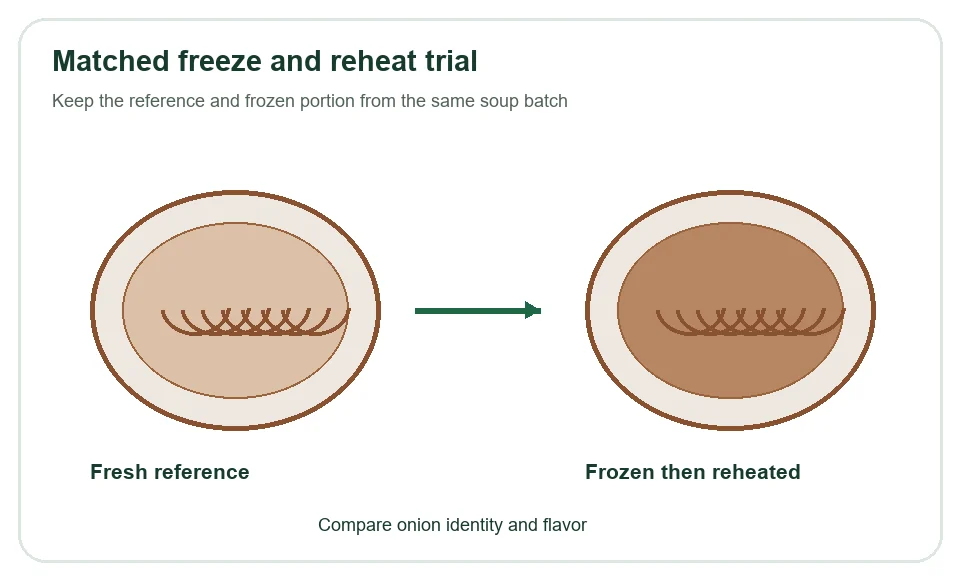
Matched bowls compare fresh-reference soup with frozen and reheated soup
Avoid compensating for a poor frozen trial by adding an arbitrary amount of salt at the production stage. Salt perception can shift with concentration and with the cheese added later. First confirm that the portion was diluted correctly and heated evenly. Then adjust the recipe or a service-stage seasoning instruction and repeat the test. A concentrated base may need a clear target weight or volume of water or stock per portion. Without that instruction, differences among kitchens can be mistaken for freezer damage.
Inspect the onion pieces as well as flavor. A long slice may become softer after cooking, freezing and reheating; the goal may be tender ribbons rather than a crisp vegetable bite. A diced onion may disperse into the broth, making the soup seem thicker while reducing visible onion identity. Those outcomes can be acceptable for a different menu style, but they should be named. Record the cut, cooked yield, portion weight and visible onion load per bowl so that purchasing and kitchen production are aligned.
If stock includes meat, wine or other ingredients, evaluate the complete formula. The stock's own freeze stability, fat separation and allergens require attention. Alcohol added to deglaze the pan has a recipe function and may carry labeling or menu implications; do not assume all alcohol disappears in cooking. Bread contains wheat unless a verified alternative is used, and cheese adds milk. None of those ingredients are represented by the frozen onion product page. The responsible kitchen should review them in its finished-product specification.
Cool, portion and pack the broth base
Cooling is a food-safety and quality control step, especially for a large pot of soup. Follow the operation's approved rapid-cooling procedure rather than leaving a deep vessel to cool on a bench. Smaller shallow pans or an ice bath can remove heat more efficiently than a full stockpot. Record the actual cooling temperatures and times required by the applicable food code and the kitchen's plan. The same attention is needed after reheating if the product will be cooled again for distribution; repeated thermal cycles should be intentional and validated.
For liquid soup, choose a container that is designed for frozen food and leave enough headspace for expansion. The NCHFP's soup guidance gives different allowances for mostly solid and mostly liquid soups and emphasizes packaging only after cooling. A container filled to its rim can distort or break during freezing. A large portion can also freeze and reheat slowly. Match portion size to the number of bowls served per heating cycle, and label the container with the product identity, batch and preparation date under the kitchen's traceability system.

Cross-section shows shallow cooling vessel and freezer container headspace
Packaging should protect flavor as well as prevent leaks. A tight closure limits evaporation and the exchange of freezer odors, but it does not repair a poor starting soup. Remove avoidable air where the chosen package allows it, while retaining the required expansion space. For a concentrated onion base, record the intended reconstitution instructions on the production specification rather than trusting a cook to judge by appearance. If glass is used, it must be suitable for freezing and handled to avoid thermal shock; a freezer-safe foodservice container is often simpler for repeated service cycles.
The freezing load matters. Stacking warm or large soup containers together can slow cooling of the center and warm nearby stock. Arrange portions so the freezer can remove heat at the planned rate, and monitor the equipment. For a commercial product, define the target core temperature, maximum time to that condition, storage temperature and distribution temperature according to the validated process. For a small catering kitchen, the same principle applies even if the batch is modest: a written method should say how quickly the base is cooled, packed and frozen.
Reheating should reach the operation's required endpoint throughout the soup, with stirring to avoid cold zones and scorching. NCHFP advises reheating frozen soup directly and heating it to a rolling boil or at least 165°F in its household guidance. The actual commercial operation should apply its governing code and validated method. Reheating a frozen block in a narrow pan may burn the outside before the center loosens; portion geometry and stirring can solve that practical problem. Inspect the reheated broth before adding toppings, so a separated fat layer, unexpected dilution or off aroma is visible.
Add bread and cheese at service
The bread and cheese topping is part of the eating experience, but it behaves differently from onion broth in frozen storage. Bread absorbs liquid. If it sits on soup before freezing, the starch structure and trapped moisture will meet a second heating cycle after it has already softened. Cheese can melt, cool and remelt with a different surface and stretch from freshly broiled cheese. A frozen assembled crock may still be acceptable for a planned ready meal; it needs a sensory test at the actual heating endpoint. For a freshly gratinated service bowl, hold these components separately until the broth is hot.
The Martha Stewart onion soup recipe illustrates the separation clearly: the soup can be frozen, while cheese toast is prepared for serving. The Kitchn's version also treats the soup and its bread and cheese as separate service stages. Those recipes are useful product examples, but a commercial kitchen still needs to confirm its own serving equipment, portion weights and holding time. A cheese toast that is crisp when it leaves a broiler can lose that quality if it waits in a covered delivery container.

Plain reheated onion broth beside a bowl finished with browned cheese toast
Test at least two practical service paths. In one, reheat the broth, fill the bowl and broil fresh bread and cheese on top. In another, broil a cheese toast separately and set it on the hot soup immediately before dispatch. The first can create a joined crust over the bowl; the second may be easier for an operation with limited oven-safe crocks. Assess how quickly the bread takes up liquid and whether the cheese remains attractive during the actual time between kitchen and table. Neither path is universally best; equipment and service distance determine the better choice.
If the product is intended for a sealed ready meal, choose a different trial design. Freeze assembled samples in the actual bowl or tray, then reheat them with the appliance and instructions the customer will use. Check heating uniformity, bread softness, cheese coverage, leakage and consumer handling. The package must be compatible with the heating method. Do not approve the ready meal from a reheated broth sample alone. A frozen unit that looks excellent on a test plate may perform poorly when heated in a lidded tray that traps steam.
Keep the topping specification clear. Bread slice thickness and toasting level change absorption. Cheese type, grate size and loading affect melt and browning. A service instruction that says only "add cheese" leaves a wide range of outcomes. Record the portion of broth, bread and cheese separately and inspect the finished bowl, including the time it spends waiting for pickup. The topping is a menu component and an allergen-bearing component, so it needs its own procurement and labeling controls.

Diagram connects hot broth to a freshly topped service bowl
Approve a menu or ready-meal cycle
An approval trial should reproduce the full path from frozen storage to the consumer. Start with a known soup batch and a reference bowl made without freezing. Freeze production-sized portions in the proposed package, hold them under the intended conditions, then reheat through the planned method. Finish the topping at the proposed point. Record the endpoint and holding interval. Compare broth clarity or desired opacity, onion identity, seasoning, mouthfeel, topping crispness and cheese quality against the reference.
Use acceptance language a cook and buyer can apply. "Good soup" is too broad. Define whether the onions should remain visible as ribbons, whether there is an acceptable amount of free fat on the broth, and how long the bread should retain a pleasant bite after service. If the soup is shipped to several outlets, check consistency across the actual containers and equipment. The trial can reveal that a broth base works well while an assembled ready meal does not, or that a specific onion cut loses too much identity after two heating stages. Those observations should change the specification before purchase volume rises.

Real GreenLand frozen sliced red onions visible as long strips
For a frozen onion ingredient order, we can help confirm the offered cut, grade, packing, quantity, documents, lead time and cold-chain conditions. The GreenLand article on freezing onions explains the ingredient side of the question. This soup article extends the decision into broth formulation, cooling, packaging and service. A buyer should send the intended onion cooking method and desired visible cut along with the forecasted volume so that sample selection addresses the actual recipe rather than a generic frozen onion quote.
Separate ingredient acceptance from finished-meal validation. GreenLand-food can supply frozen onions to an agreed specification. The kitchen or meal producer must control stock ingredients, caramelization, cooling, freezing, reheating, topping and allergen communication. If a selected onion lot meets its agreed limits yet the soup becomes too sweet or loses definition after reheat, the remedy may be a changed cooking profile or portion geometry rather than a different supplier. Conversely, inconsistent onion cut or high defect levels need attention at the input stage. Good records make that difference visible.
The most useful outcome is a repeatable service instruction: which component is frozen, how it is portioned, how it is reheated, what is added fresh, and what finished bowl is acceptable. That instruction is more valuable than a generic statement that onion soup freezes well. It lets a menu team plan labor and freezer space while protecting the familiar combination of rich onion broth and a newly finished cheese toast.
Questions that remain after the soup trial
Can caramelized onions be frozen before broth is added?
Yes, a cooked onion base can be portioned and frozen under the kitchen's approved cooling and packing method. This can save freezer space and preserve freedom to choose the stock at service. Record the cooked onion yield and the amount needed per bowl. Test a reheated portion in the intended broth before scaling up, because the texture of the onion pieces and the final seasoning may differ from a freshly cooked reference batch. If the purchased frozen ingredient is raw or blanched onion, the kitchen still needs to caramelize it; do not describe the ingredient as a finished base.
How much room should a soup container leave for freezing?
Leave the headspace required by the container design and the proportion of liquid in the soup. The National Center for Home Food Preservation distinguishes mostly solid from mostly liquid soups and notes that liquids expand during freezing. A kitchen should test its actual container with the planned portion weight and follow the manufacturer's filling limits. Label the fill line in the production instruction so that staff do not rely on an approximate visual guess. The same test can expose leaking seals or packages that are awkward to stack and reheat.
Should onion soup be thawed before reheating?
The route depends on the operation's equipment and validated method. NCHFP's household soup guidance describes reheating directly from frozen, while other safe plans may include controlled refrigerator thawing. A commercial kitchen should follow its governing code and food-safety plan, then verify a uniform heating endpoint through the whole portion. Avoid room-temperature thawing. For a thick onion base, stirring during reheat helps prevent scorching and cold pockets. The method should say when the bread and cheese are added, so the topping is never used to hide an incompletely heated soup.
Can the cheese toast be frozen separately?
It can be tested as its own component, but a frozen cheese toast still needs a service trial for moisture pickup, browning and texture. A freshly prepared toast is usually easier to control when crispness is a menu requirement. If labor or equipment favors a frozen topping, specify its bread and cheese, packaging and reheating method and compare it with the fresh reference after the normal service wait. Freezing the topping separately at least allows the broth to be heated and assessed on its own, and keeps allergen-bearing components clearly identified.
Does GreenLand-food supply frozen French onion soup?
The referenced GreenLand-food offering is frozen onion as an ingredient. Its exact cut, packing and order specification need confirmation for each request. Soup formulation, stock, caramelization, cooling, cheese toast and finished ready-meal validation belong to the buyer's kitchen or processor unless a separate, explicitly confirmed product is offered. An inquiry should describe the required onion form and intended cooking method, not assume that an ingredient product page represents a complete soup.
Source Frozen Onion with GreenLand-food
GreenLand-food is a professional frozen onion supplier and manufacturer in China, providing factory-direct wholesale supply for importers, processors and foodservice buyers.
Send the product form, specification, packing, quantity, application, destination, private-label needs and requested documents so we can confirm the suitable offer.