


Fruit Leather from Frozen Fruit: Puree Solids, Sheet Thickness and Tackiness
Sep 28, 2026
Leave a message
Research This Article & Topic with AI
Verify key claims, compare reliable sources, and explore GreenLand-food's practical frozen food knowledge.
Article details and research questions are prepared in the links. Sign-in or sending may be required.
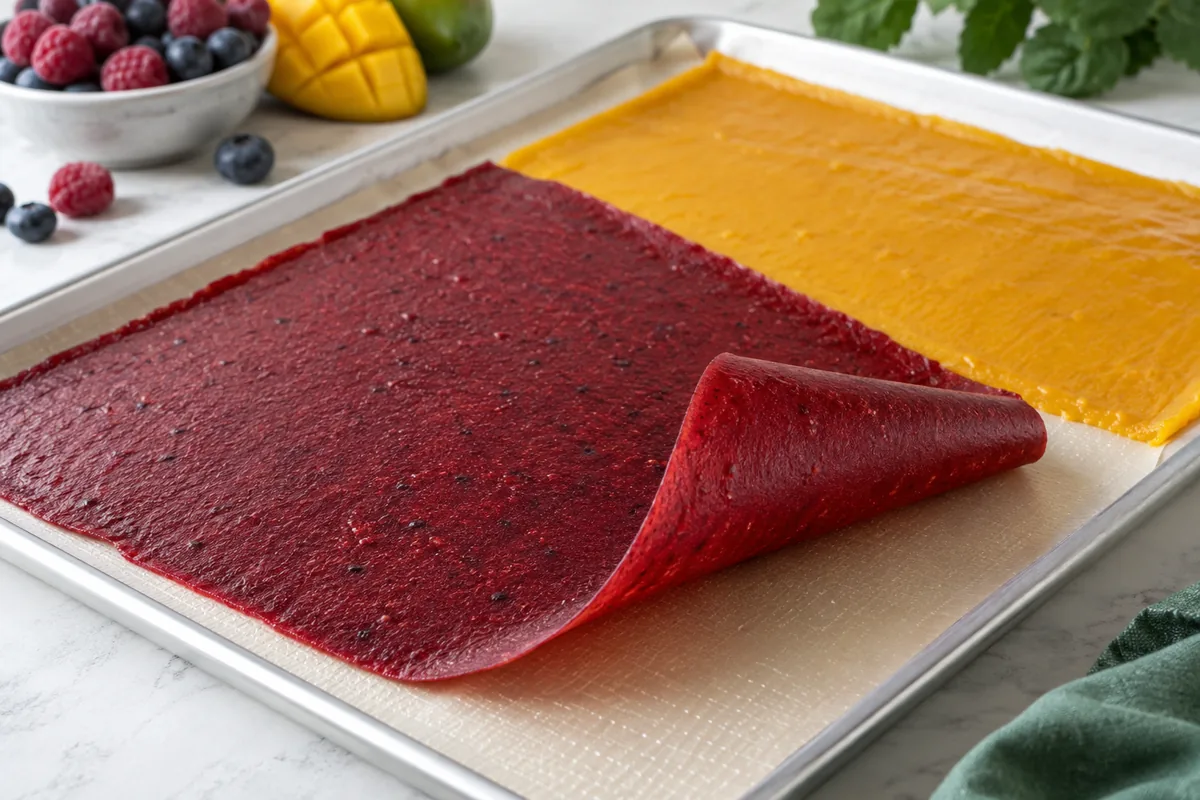
Choose a flexible fruit sheet, not a dried fruit piece
Fruit leather starts as a continuous puree layer. Drying turns that layer into a sheet that can be peeled, cut, folded or rolled. This structure differs from dried fruit pieces, whose intact tissue is the product, and from freeze-dried fruit, whose porous crisp texture comes from a different process. A developer should describe the desired chew and shape before choosing fruit inputs. "Dried fruit snack" is too broad to decide whether the final product should bend, stretch, crack cleanly or remain in a flat strip.
Define the eating occasion. A small school snack may need a sheet that releases easily from a wrapper and can be bitten without tearing awkwardly. A bakery component may need a narrow strip that stays flexible when folded into a filling. A decorative dessert sheet may prioritize color and surface smoothness. These formats impose different limits on stickiness, thickness, seed visibility and surface gloss. A leather can be appealing on a drying tray but fail when it adheres to its own layers in the pack or pulls a paper liner apart on opening.

Diagram contrasts one cast flexible puree sheet with separate dried fruit pieces
Use a reference sample to make the language concrete. Bend a cooled strip through the angle it will experience in packing and service. Press two pieces together under the expected pack pressure, then separate them. Cut a strip to the proposed retail width and check whether the edge crumbles. Taste for fruit identity and any cooked note caused by the drying method. Those simple observations make a sensory target that can later be connected to measured thickness, solids and water activity.
The fruit input affects more than color. Mango can make a smooth, dense puree; berries may bring seeds and a sharper acid impression; apple can contribute body in some blends. These are design possibilities rather than a ranking of GreenLand lots. Test each proposed fruit and blend with the same tray area and mass accounting. If the final product needs a clean berry sheet, decide whether seeds are acceptable. Screening them out changes yield and removes some solids, so the screened formula should be weighed rather than compared as if it were identical to the unscreened one.
A process brief should also distinguish the method used for drying. Hot-air drying, a commercial belt dryer and an oven may expose the sheet to different airflow and temperature distributions. A recipe's duration cannot be transferred directly from one device to another. The finish must be established in the equipment that will make the product, with the chosen tray or belt liner, loading density and batch size. For a commercial line, add an agreed appearance and pack-release standard so production can recognize a sheet that is flexible enough to handle without being wet.
Prepare frozen fruit on a measured solids basis
Begin with the frozen fruit that the processor is allowed to use for this application. Confirm the supplier's intended-use statement, origin, grade, pack, defects and foreign-material controls. GreenLand-food's frozen fruit range gives buyers several fruit forms to discuss, including whole and cut fruit. We would confirm the exact offered form and lot before a trial; a generic category photograph does not establish puree yield or ready-to-eat status. If the product requires a pretreatment or heat step, integrate it into the responsible process plan before sampling the finished leather.
Weigh the fruit while frozen, then thaw it under approved conditions in a covered, food-safe container. Weigh the fruit and released liquid separately. The NCHFP home guidance saves that liquid and adds back only what is needed to make the puree pourable. A commercial trial should keep the same mass record even if it decides to retain all of the liquid. Discarding liquid without recording it makes one fruit appear to dry faster simply because less water was loaded on the tray. Adding unmeasured water has the opposite effect and weakens fruit flavor.

Thawed berries, released juice, screened seeds and smooth puree shown separately
Puree the fruit to the texture required by the sheet. Record the puree mass after any peel, pit, seed or fiber screening. For a berry blend, a fine screen can reduce gritty seeds but may remove colored pulp and change the fruit yield. For mango, fibrous pieces can leave raised ridges that dry differently from the smooth surface around them. For apple or stone fruit, larger fragments may interrupt the sheet when it is peeled. A sample that is smooth to the eye can still contain particles that create pinholes once a thin layer is spread.
Measure soluble solids where useful, but do not treat a Brix number as the whole fruit solids story. Brix reflects dissolved material in the sample liquid; insoluble fiber, skins and seeds affect spreading and final bite as well. Record the measurement method and sample temperature, especially when comparing a thawed pulp with a blended puree. A consistent mass balance is more useful than a single target copied from another formula: incoming frozen fruit, drain liquid, screen loss, added ingredients, cast puree and dry sheet yield.
For application details, see A Refining Screen Is Not a Particle-Size Report: Comparing Frozen Fruit Purees.
The relationship between puree viscosity and loading deserves a trial. A very fluid puree may run toward tray corners and create a thick center or edge lip. A paste that barely moves may hold spatula ridges and trap a deep pocket. Adjust the amount of retained thaw liquid, blend ratio or approved thickening strategy one variable at a time. Record the change and spread the same mass across the same area before comparing the dry result. The aim is a repeatable casting behavior, not a descriptive claim such as "thick enough."

Real GreenLand frozen mango pieces as a potential fruit puree input
Keep the first comparison manageable. A mango, apple and berry input can share the same tray-size and recording method, but each will need its own formula and acceptance range if behavior differs. Do not announce that one fruit is inherently best for leather from a single demonstration. The finished texture depends on fruit maturity, puree preparation, sweetener, acid, tray geometry, airflow and drying endpoint. Qualified frozen fruit lots should be tested in a way that lets those effects be separated.
Cast an even sheet and check both center and edge
Even thickness is a process control because moisture leaves through the exposed surface while heat reaches the layer through the dryer environment and liner. A thick center has farther to dry than a thin edge; if drying continues until the center is acceptable, the edge may become hard or brittle. The NCHFP suggests a thin, even puree spread for home fruit leather. The number is a useful starting trial dimension, not a fixed commercial setting. Select a thickness and load that the actual equipment can hold consistently.
Measure tray area and cast puree mass so loading can be expressed per area. Check thickness at the center, corners and a few intermediate points immediately after spreading. A calibrated spreader, leveling bar or controlled depositor can reduce operator variation, but the equipment must suit the puree's particles and viscosity. If the liner curls or the tray is not level, even a measured scoop can form a deep patch. A photograph taken just after casting can reveal ridges, bubbles and uneven edges before drying obscures their cause.

Cross-section shows thick wet center and thin brittle sheet edges
During the first trial, note when the surface stops looking wet at the edge and at the center. Inspect the underside when the sheet is nearly ready. It may remain tacky against the liner after the top appears dry. A flexible strip should peel in one piece without a wet smear or a brittle fracture at the edge. The UC Master Food Preserver discussion describes this center-and-edge balance in household work and encourages notes on thickness, time and storage feel. Commercial production should pair such observations with its validated endpoint measurements.
Do not use clock time as the sole release criterion. Drying rate shifts with puree solids, added sugar, loading, room humidity, dryer airflow, temperature and the number of trays or belt zones. A short run that works for one berry lot may leave wet pockets in another. Record process conditions and finished mass, then measure the product property required by the safety and quality plan. If the edge is finished while the center is not, improve layer uniformity or loading before simply extending the entire batch's drying exposure.
Cooling also changes the judgment. A warm sheet may feel softer and less sticky than a cooled piece in a humid room. Cool a sample under controlled conditions and test the actual strip after it reaches packing temperature. Bend it, peel it and check whether two pieces adhere to each other. If a sheet is rolled around a liner, test release after the planned storage interval. These observations belong beside the thickness map so the developer can see whether defects originate during casting, drying or later handling.
Diagnose tackiness, brittleness and color loss
Tackiness is a symptom, not a single cause. A wet center may indicate uneven loading or incomplete drying. A sheet that is dry when packed but becomes sticky later may have absorbed moisture through the package or at a warm packing station. A formula rich in particular sugars may remain slightly tacky even after an appropriate process, while still needing objective safety verification. Touch alone cannot distinguish all of these conditions. Measure the finished sheet, record the packing environment, and repeat the feel test after a defined hold.
If the center stays wet while the edge cracks, map thickness before changing the dryer. A thicker center and thinner edge can explain both defects at once. If thickness is uniform, examine airflow, tray position and local heat exposure. A sheet with brittle edges throughout the tray may have been cast too thin or dried past the desired eating endpoint. The remedy may be different from the remedy for an under-dried center, so each defect should be located and photographed before a revised run.

Close comparison of tacky thick fruit leather and an even flexible sheet
Fruit blend and sweetener change texture. Apple puree may add body to a berry formula; mango can contribute a dense fruit phase. Liquid sweeteners can alter tack and drying behavior. Change one factor at a time while keeping cast mass and area comparable. If sweetness is adjusted between trials, taste the finished dry sheet rather than only the puree, because concentration during drying changes the perceived fruit and sugar balance. A formula that tastes bright as a puree can become too tart when water is removed.
Color loss can arise during preparation, exposure to air, heating and storage. A pale fruit can brown before it reaches the dryer; a red berry blend can look darker after concentration. Use an approved process and ingredient strategy suited to the fruit and market, and compare samples under consistent light after cooling. Do not claim a universal antioxidant dose or color result from a household recipe. Record the initial puree color, the sheet color at release and the color after the intended pack hold.
Seeds, pulp particles and fruit pieces can also make a sheet appear defective even when moisture is controlled. A raised particle dries differently from the thin puree around it and can become a weak point when the leather is rolled. An aggressive screen removes those particles but reduces yield and can make the fruit character less recognizable. Set a target mouthfeel and inspect the screen loss as part of the economics. The appropriate choice for a berry snack may differ from a smooth decorative dessert sheet.

Real GreenLand frozen strawberries as a berry input for a screened puree
Validate packaging and the intended storage route
Flexible texture is a quality target, not proof of shelf stability. A commercial process must identify the hazards of its actual fruit and formulation, then validate its drying, water activity, microbiological controls and packaging for the intended market. The University of Minnesota Extension's commercial kitchen guidance is useful for separating home-style dehydration advice from a controlled foodservice process. An operator should work with its qualified food-safety team and applicable authority rather than assigning an ambient shelf life from a strip's feel.
Measure water activity with a calibrated method on representative finished material, including a point from the thickest area or a validated sampling plan. Moisture content and water activity are related but answer different questions. A sheet can carry considerable bound moisture while having a lower water activity, and a small wet pocket can be missed by a sample drawn only from the driest edge. Set a finished-product limit as part of the responsible process validation. We should not invent a universal numerical limit for every fruit leather formula or market.

Package cross-section shows moisture moving toward a fruit leather sheet
Packaging must protect the tested endpoint from humidity during distribution. Compare candidate films or wrappers for moisture barrier, seal quality, release from the sheet and resistance to the expected handling. A pack that looks tight can have a poor seal; a high-barrier film can still fail if the product enters it while warm and releases condensation. Record product temperature and room conditions at packing. Test the finished pack after a planned humidity and temperature exposure, checking tackiness, surface wetness, color and ease of opening.
Shelf-life validation should cover the actual product form and storage route. A flat sheet, a roll with paper interleaf and individually wrapped strips offer different contact areas and moisture exchange paths. If the product is refrigerated or frozen rather than ambient, specify those conditions and test the route the buyer will use. Household guides can describe practical storage ideas, but their durations do not become an export product's expiry date. The formulation, process, packaging, market and distribution conditions must support the printed date.
For an ingredient purchase, we can confirm available frozen fruit form, pack, quantity, crop and documents and coordinate a representative sample. We cannot claim that GreenLand-food produces the finished leather unless that product is separately confirmed. The processor should share the chosen fruit or blend, desired puree texture, planned pretreatment and target application when requesting a quote. It should retain the development records that join incoming fruit properties to sheet thickness, final mass, water activity and pack performance. Those records make the next lot easier to assess and keep a pleasant chew connected to a responsible production method.
Questions that remain after the sheet trial
Should thaw liquid be poured back into the puree?
Keep it and measure it before deciding. The liquid contributes fruit color and flavor but also adds water that must leave during drying. Add back only the amount required by the chosen formula and casting behavior, then record the mass. If two fruit inputs are compared with different amounts of returned liquid, the trial must show that difference. A batch that seems to dry faster after liquid was discarded may simply have received less water per tray. The same accounting is needed when concentrate, puree or another ingredient is added.
Is a flexible, nonsticky sheet safe to store at room temperature?
That appearance alone cannot establish safety or shelf life. The operator needs a validated process for the actual fruit, ingredients and market, including the relevant pretreatment, drying controls, finished water activity, microbiological assessment and moisture-barrier package. Test the thickest area and the packaged product after the intended distribution exposure. A dry-feeling surface can cover a wetter center, while a sheet that passes at packing can take up moisture later. Texture is an important acceptance observation, but it is only one part of release.
Why are the edges brittle while the center remains tacky?
The first suspect is uneven sheet thickness. A thin edge dries rapidly while a thick center retains water, especially when puree flows before it sets. Measure the layer immediately after casting and inspect whether the tray is level or the liner curls. If the layer is even, map airflow and heating across the tray or dryer. Change one condition at a time and compare the finished sheet after cooling. Extending the run without fixing the gradient may dry the edge further while the center still misses the target.
Which frozen fruit works best for a first commercial trial?
Start with a fruit or blend that matches the intended flavor and offers a manageable puree texture. Mango, apple and berry inputs can all be tested, but their seed load, fiber, acidity, color and released liquid differ. Choose a representative offered lot, measure puree yield and cast the same known mass per area. The first trial should establish what the target sheet feels and tastes like, then identify which input reaches it consistently within the validated process. There is no responsible universal ranking without the actual formula and equipment.
For application details, see Mango Puree for Ice Cream From IQF Mango: Solids, Fiber and Freeze Texture.
Does GreenLand-food sell finished fruit leather?
The pages cited here describe frozen fruit ingredients. We can discuss fruit form, pack, quantity, origin, sample and documents for an ingredient inquiry. A finished fruit leather would need its own confirmed offer and specification. The buyer's processor is responsible for the puree formulation, pretreatment, sheet casting, drying endpoint, packing and expiry validation. Stating the intended fruit leather application helps us select an input sample; it does not transfer finished-snack approval to the frozen fruit supplier.
Source Frozen Fruit with GreenLand-food
GreenLand-food manufactures frozen fruit in China. We fill factory-direct wholesale orders for importers, processors and foodservice buyers.
Send the product form, specification, packing, quantity, application, destination, private-label needs and requested documents so we can confirm the suitable offer.