


Frozen Carrot Beta-Carotene: Total Content or Isomer Profile?
Oct 09, 2026
Leave a message


For an ingredient developer planning another heating step, the first decision is what the comparison needs to establish. A total may be sufficient for an agreed composition target; a profile is useful when the target concerns particular forms or their proportions. At GreenLand-food, we recommend matching the analytical request to that development question and comparing incoming and cooked samples on a common basis. The research provides useful method boundaries, but it does not establish an isomer specification or cooking-performance guarantee for our frozen carrot lots.
Separate carotenoid amount from molecular conformation
Beta-carotene can occur in different geometric configurations around its double bonds. All-trans names one configuration, while cis forms place a different arrangement at specified positions. Names such as 9-cis and 13-cis identify particular forms; the analytical method should state which it distinguishes and quantifies. These forms remain beta-carotene, but a result for all-trans alone is not automatically the same as a sum including cis forms. When a COA says total beta-carotene, ask what total means in that method. The answer belongs in the interpretation before a buyer compares the figure with another report.
The amount and the proportion are also different quantities. A method might report mass of all-trans beta-carotene per kilogram of sample and separately the percentage it represents within a defined quantified beta-carotene sum. That percentage uses a denominator. If some peaks are unresolved or unquantified, the denominator may be limited to the forms included in the reported calculation. Ask the laboratory whether a proportion uses calibrated masses, peak areas or another stated convention. A percentage derived from detector areas should not be treated as a mass fraction without the appropriate response assumptions and method explanation.
Total carotenoids adds another naming issue. Carrots can contain compounds other than beta-carotene, and a total-carotenoid assay does not necessarily isolate beta-carotene. A buyer comparing total carotenoids, total beta-carotene and all-trans beta-carotene has three distinct analytical targets. Similar orange extracts or similar report units do not make them interchangeable. The laboratory should name the components included and the calibration used. This is particularly relevant when a supplier's generic composition sheet is compared with a research chromatogram. The apparent difference may start with the quantity being summed, before the product or process contributes any difference.
Visible orange colour supplies another observation. It reflects the product's pigment composition together with tissue structure, surface condition and the way light interacts with the sample. It cannot identify a cis/all-trans distribution by inspection. A bright cooked carrot can still require a chromatographic assay when the specification concerns a particular form. Conversely, a molecular profile does not describe all visual properties of a plated ingredient. Our existing carrot guidance covers broader colour and texture questions. In this article, the focus is the chemical identity within a reported beta-carotene quantity and whether that distinction matters to the buyer's comparison. Our Delta E colour-report guide addresses that separate visual measurement question.

A total can conceal a profile. The relationships shown are schematic and do not represent a tested GreenLand lot.
Extraction recovery must remain visible. The laboratory analyzes the portion of material recovered under its procedure, with validation intended to establish suitable recovery for the named target. Tissue disruption can change how readily compounds enter an extract. A higher recovered amount after processing can therefore have more than one explanation, including changes in accessibility and sample mass. The result should be interpreted with the extraction method and product state, rather than described as automatic pigment synthesis. The developer needs to distinguish what the assay recovered from what the process changed in the molecular profile.
Method demonstrations show why separation matters. The C30 beta-carotene application note separates all-trans beta-carotene and induced isomers under a defined chromatographic procedure. Its standards and model preparation support the separation principle, rather than a conclusion about food processing. Buyers can use that distinction to ask a laboratory whether its method resolves the forms required. The mere presence of an HPLC instrument is insufficient; the separation, identification and quantification need to be suitable for the target and actual carrot sample.
Interpret heating evidence from frozen carrot research
The original industrially frozen carrot cooking study compared raw and frozen Napoli carrot slices under defined boiling, steaming and microwaving treatments. Its methods describe an 8 mm slice preparation, industrial blanching and freezing, a defined frozen-storage period and cooking of frozen samples without prior defrosting. The investigators measured microstructure, texture and colour. These details establish a specific experiment. Its reported ranking cannot be turned into a universal instruction for all carrot cuts, factories or recipes, and its colour measurements should not be presented as direct chromatographic isomer results.
The paper's discussion refers to separate work by Camorani and colleagues concerning carotenoid isomerization under related cooking conditions. That citation needs to remain separate from the measurements made in the texture-and-colour paper. Reading a discussion statement does not mean the citing paper performed the assay. For a buyer, the safe use of this evidence is to recognize that tissue observations and pigment composition can be connected, while confirming the original method behind any claim about specific forms. A process comparison should state what was actually measured, rather than merging several papers into one apparent dataset.
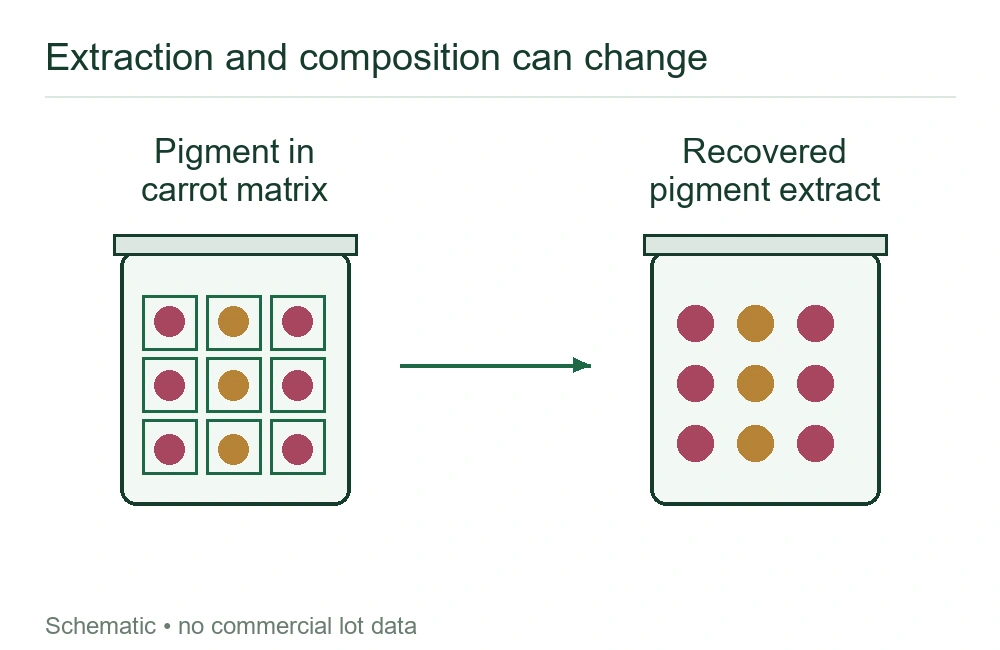
Extraction and composition can change. The relationships shown are schematic and do not represent a tested GreenLand lot.
A second study followed carrot slices of the lycopene-rich Nutri Red cultivar through blanching, freezing and frozen storage. Its publisher abstract and exposed sections describe increased extractability of some all-trans components after blanching. Nutri Red is a red cultivar with a different carotenoid context from an ordinary orange carrot purchase. The bounded lesson is that extraction accessibility can change with tissue treatment. Its numerical composition and storage findings cannot set an acceptance limit for a different product, and the accessible excerpts do not establish validation details that are only available in the full methods.
Three mechanisms need separate language in the trial record. Tissue disruption can make a compound more accessible to the extraction procedure. Isomerization can redistribute beta-carotene among configurations. Degradation can reduce the recovered quantity of defined compounds or produce other material. These mechanisms can occur alongside changes in water content and sample yield. A single total result cannot separate them all. If the development question concerns redistribution, collect a suitable profile. If it concerns overall amount retained in the defined product fraction, establish both the analytical amount and the mass represented by that fraction.
Heating intensity includes more than an oven setting. The actual product history depends on cut size, initial state, sample load, equipment, medium, time and cooling. A commercial carrot cube receiving heat in a sauce does not reproduce a laboratory slice cooked in water. Trials should describe the conditions that are relevant to the product, including the endpoint and any holding period before analysis. Research can guide which variables to record, but it should not be used to assign a universal carotene response to the name boiling, steaming or microwaving. A process name is too broad to define a repeatable comparison.

Keep the carrot cut and heating history consistent when preparing a matched pigment comparison.
At GreenLand-food, our useful contribution is to help establish the supplied carrot form and the buyer's intended comparison. The buyer's development team and laboratory can then design the appropriate trial. We do not claim that the published cultivar is our commercial cultivar or that an exposed research result is a confirmed GreenLand isomer value. When a heating study changes the analytical question, record that change before testing. The comparison may require total beta-carotene, named isomers and yield observations together, while the product specification still needs its own agreed composition and performance criteria.
Decide whether an isomer profile changes the buying question
An isomer profile earns its place when the developer has a stated composition objective. A formulation project may need to compare the all-trans portion before and after a particular heating step, or determine whether two processing routes produce different quantified distributions. In that case, specify the forms and reported proportions required. A general statement that profile testing is more advanced does not justify the expense. The laboratory output should change a concrete decision, such as selection between defined process conditions or evaluation of an agreed target, with the criteria established before the trial results are available.
A total can serve a narrower question well. If the agreed requirement concerns the defined beta-carotene sum in the supplied material, a validated total method may provide the needed evidence. It does not need to identify every minor isomer unless the specification or development question requires that resolution. Conversely, an all-trans requirement cannot be checked using an unspecified total alone. The correct choice follows the quantity the buyer needs to establish. A clear brief allows the laboratory to recommend the appropriate method and reporting format, instead of producing a costly profile with peaks the purchasing team has no agreed way to interpret.
Avoid turning this composition decision into a health promise. A laboratory profile describes chemical composition under its method. Bioaccessibility, bioavailability, nutritional conversion and human outcomes involve additional evidence and definitions. A higher extractable result after heating does not demonstrate superior absorption in consumers. An altered isomer proportion does not establish a finished-product health benefit. If a nutrition claim or regulatory declaration is planned, obtain the current destination requirements and appropriate evidence separately. This article uses the profile to clarify an ingredient-development comparison, and the cited studies should remain within the measurements and materials they actually examined.
Suppose a buyer plans to use frozen carrot slices in a product that receives another heating step and sends us an incoming beta-carotene total beside a cooked-sample profile. The buyer wants to know whether the figures demonstrate pigment retention. Our response would be to ask which forms the total includes, how the profile is calibrated, how each sample was prepared and what mass each result represents. The comparison could then be designed around the stated target.

Equal totals can have different profiles. The relationships shown are schematic and do not represent a tested GreenLand lot.
The RFQ followup should identify carotenoid identity, isomer profile requirements, extraction accessibility concerns and heat history. Ask whether the buyer needs the supplied ingredient's composition or the composition after its own processing step. Those are different sample states, and a supplier report cannot automatically certify the latter. Send the intended use, product form, trial conditions, both complete reports and the basis of every result. Include quantity, packing and destination for the commercial discussion. We can then discuss the supply specification while the laboratory confirms the work needed to answer the development question.
A proportion target also needs a reporting rule. Define the named denominator, treatment of unquantified peaks and relevant uncertainty. A chromatogram with a large all-trans peak may look persuasive, but the purchasing decision needs a stated calculation. If the target cannot yet be expressed responsibly, use the development trial to establish what the method can measure rather than inventing a contractual limit. The comparison table distinguishes several common outputs by their question and remaining limitations. It helps the team select useful information without interpreting every available analytical number as an interchangeable indicator of carrot quality.
| Output | Question answered | Definition to confirm | Remaining limitation |
|---|---|---|---|
| Total beta-carotene | Defined recovered beta-carotene amount | Included forms and calibration | Does not resolve configuration proportions |
| All-trans beta-carotene | Recovered amount of the named configuration | Identity and reference standard | Does not include all cis forms |
| Isomer profile | Named component amounts or proportions | Quantified forms and ratio denominator | Unresolved peaks may remain outside the sum |
Compare incoming and cooked samples on a common basis
Define the material before defining retention. The incoming sample can represent the full frozen product after controlled homogenization, while the cooked sample can represent retained solids, solids plus liquid or a complete finished formula. Each choice answers a different question. Record what is included, what is discarded and whether the sample contains ingredients added during the trial. For a comparison of carotene retained in the whole prepared carrot portion, the analyzed material and its measured mass need to represent that portion. Testing only a selected solid fraction and calling it the full product would change the question.
Retained liquid deserves explicit treatment. If thaw or cooking liquid is included in the intended product, define how it enters the whole homogenate. If the process intentionally drains liquid, record the removed fraction and the mass of the retained product. The issue is material accounting, not an assumption that beta-carotene behaves like a freely dissolved water-soluble compound. Pigment can be associated with tissue and other fractions, so its distribution should not be inferred without analysis where the mass balance requires it. A clear fraction description lets the laboratory interpret the sample and lets developers reproduce the trial.

Match the incoming and cooked basis. The relationships shown are schematic and do not represent a tested GreenLand lot.
Concentration and retained amount are different calculations. A result per kilogram of cooked product can rise when water loss reduces the denominator even if the total amount recovered from the original portion does not rise. To evaluate retained amount, relate the measured concentration to the mass of the defined product fraction and compare it with the incoming portion on the corresponding basis. Keep all units compatible. This arithmetic can help isolate water effects, but it still depends on extraction suitability and sample representativeness. A precise yield calculation cannot correct an undefined pigment sum or mismatched analytical procedure.
Keep the extraction procedure consistent where the method allows it, and ask the laboratory how it validates both incoming and cooked matrices. Tissue disruption after heating may change the efficiency of recovery even with the same solvent procedure. The laboratory should assess whether that difference affects the interpretation. Standards, calibration and identification rules also need consistency. If a different procedure is used for one sample, describe why and whether the outputs can be compared. The purpose is to understand the result's meaning, not to require identical operations when the method owner has a justified matrix-specific preparation.
Record paired trial conditions with enough detail to repeat them. Identify the lot, carrot cut, sample load, frozen or thawed starting condition, heating route, endpoint, cooling and time before extraction. Include any cooking medium or added fat that affects the sample definition. A development comparison between sliced and diced carrots should acknowledge both form and process changes. Our carrot freezing and form guide provides broader product context. Here, the analytical record needs to preserve the specific history behind the incoming and cooked materials, so differences are not attributed to configuration alone.

Keep the carrot cut and heating history consistent when preparing a matched pigment comparison.
Replicates and sampling should fit the decision. Ask the laboratory and development team what variation the trial needs to characterize and which repeat measurements address it. Analytical repeats from one homogenate assess a different part of the system from independent cooking trials or separate lot samples. A buyer should identify that level when interpreting a small difference. Avoid declaring a change meaningful solely because two rounded numbers differ. The relevant method uncertainty and trial variation should inform the qualified interpretation, particularly when the proposed target depends on a ratio of several quantified components.
Read a total result beside an isomer-resolved result
Start with the names on both reports. Identify whether each result concerns total carotenoids, total beta-carotene, all-trans beta-carotene or a defined profile. Then identify the quantified forms, reference standards, units and sample state. A profile may show more peaks than it quantifies, and the report should distinguish confirmed components from tentative identities or unidentified material. A chromatogram is evidence of separation, but it does not guarantee that every peak has been assigned correctly or calibrated as an individual mass. Ask the laboratory what confidence and quantification scope apply to each reported component.
Reference materials and response factors matter to the sum. A method may use authentic standards for selected forms, an established response relationship or a stated equivalent for another component. Those choices need to remain visible when the buyer compares the profile with a total. The dietary carotenoid method application includes a thermally processed carrot example with tentative identifications. That wording is a useful reminder that identification status should survive into the buyer's interpretation. A tentative peak cannot be silently converted into a confirmed specification component because its appearance seems plausible.
Unresolved or unquantified peaks should be described without invented composition. If a named isomer is below the method's quantification limit, retain that qualifier and ask how it enters any reported total or ratio. If peaks overlap, ask whether the method reports a combined quantity or leaves them outside the sum. A buyer should not fill gaps with values from a published carrot study. The commercial lot may have a different profile, and the laboratory method may have different resolution. Keeping the unknown portion visible is more defensible than producing a complete-looking chart unsupported by the measurement.
Reconciliation can then state exactly what is comparable. A total and a profile sum may agree within their defined scope, or differences may require review of extraction, calibration, species coverage and mass basis. Unequal values are not automatic evidence of a failed process. They may reveal a difference in the analytical question or sample preparation. The laboratory should assess that explanation, while the development team decides whether the available results answer the target. Retain original reports and any explanatory calculations together so the final interpretation can be traced without losing the forms or qualifiers excluded from the comparison.

A reported total is a defined calibrated sum. The resolved peaks provide additional component information; their schematic heights and areas are not analytical values.
For frozen carrot sourcing, establish the form, dimensions, application, packing and destination alongside the analytical request. A measured isomer profile is not a standard supplier capability unless it has been explicitly agreed for the product and program. Research can help design a useful comparison of the actual ingredient, including its additional heating step. The resulting specification should name what is measured, how it is reported and which sample state it governs. That gives procurement a usable composition requirement and gives R&D a trial whose results can support the decision it was designed to make.
Ask the laboratory how its procedure protects the analytical target during preparation. Light exposure, oxygen and temperature are relevant variables for carotenoid work, and the method should control them appropriately. The report interpretation needs to distinguish a profile associated with the food's processing history from changes that may occur during laboratory extraction or storage of the extract. A buyer does not need to prescribe solvent handling or chromatographic settings; the useful request is evidence that the procedure is suitable for the comparison and that any limitation affecting the named isomers has been communicated.
The retention calculation should also identify its reference point. A comparison beginning with an already blanched frozen ingredient describes the buyer's additional processing step. It does not measure the complete history from harvested raw carrot through industrial preparation. If that broader question matters, a different sampling design is needed. Keep the reference sample and process boundary on the trial sheet so the recorded result refers to the measured processing step instead of the entire route from harvest. This makes the finished analytical record useful to a later developer who must understand exactly which step was compared and which earlier changes were outside the experiment.
Source Carrot with GreenLand-food
GreenLand-food is a professional carrot supplier and manufacturer in China, providing factory-direct wholesale supply for importers, food manufacturers, foodservice distributors, and private-label programs.
Send the product form, specification, packing, quantity, application, destination, private-label needs, and requested documents. Include the analytical target and complete method and sample-state details when your purchasing requirement depends on a laboratory report.