


FOB vs CIF for Frozen-Food Reefers: Cost, Risk, Insurance and Temperature Evidence
Sep 27, 2026
Leave a message


Before selecting either term, identify how the container is handed to the carrier. The International Chamber of Commerce's Incoterms 2020 checklist directs buyers of containerized or multimodal cargo toward FCA when the buyer pays main carriage and toward CPT or CIP when the seller pays it. FOB and CIF remain common requests in food quotations, but the parties should confirm that the agreed on-board delivery model fits the physical handoff. A reefer placed at a terminal days before ship loading creates a different practical control point from cargo delivered directly onto a vessel.
We will use one hypothetical frozen-blueberry shipment to keep the comparison consistent. The illustration assumes the same SKU, case size, net weight, loaded quantity, reefer size, route window, and currency. "FOB Shanghai Port, Incoterms® 2020" names a port of loading; "CIF Port of Rotterdam, Incoterms® 2020" names a destination port. The names and prices are examples for comparison, not GreenLand-food's current quotation or a recommendation to select those rules for every container. Confirm actual terminal handoff and contract wording with the forwarder and qualified trade advisers.
Name both ports and the Incoterms edition
An offer that says only "FOB China" or "CIF Europe" leaves the transfer point and cost comparison unclear. FOB requires a named port of shipment. CIF requires a named port of destination, while its risk-transfer point remains at the on-board delivery in the origin country. The edition matters because the parties need one shared set of rule definitions. Put the full rule, named port, and "Incoterms® 2020" in the RFQ, quotation, and purchase order, then check that booking instructions and commercial invoice use the same language.
The cargo basis needs equal precision. For the hypothetical blueberry load, record whether the product is cultivated or wild blueberry, its size range, packaging, net case weight, pallet pattern, container type, and agreed loading quantity. A quote for smaller fruit in bulk cartons cannot be compared fairly with a branded retail pack at the same headline rate per tonne. Include the offered crop or production window and the quotation's validity period. Reefer freight, equipment access, and insurance pricing may change between shipping windows, so two offers dated weeks apart are not a controlled comparison.
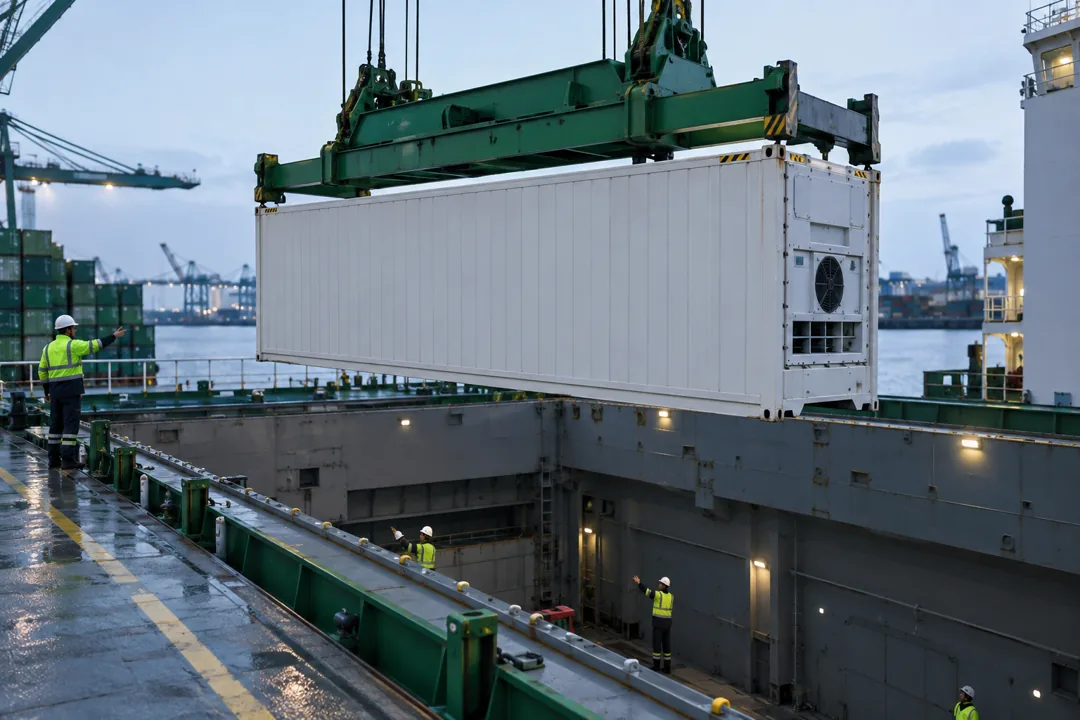
See the physical on-board delivery point

Real blueberry SKU example for matched quote basis
The GreenLand frozen blueberry range shows product forms a buyer can specify. The real berry photograph here illustrates the commodity in the example. It does not show an actual FOB or CIF shipment, set point, or insurance arrangement. Use the current product specification and a written offer to establish those facts. We can help confirm fruit size, grade, packing, quantity, and requested documents before a logistics comparison. The buyer's freight team should then request routing and local charge details on the same basis.
Check where the reefer physically enters the carrier's custody. A container is often received at a terminal before it is loaded on board. The ICC checklist distinguishes this container or terminal delivery from traditional goods placed directly aboard a vessel. If the commercial intent is for risk to transfer when the container is handed to the buyer's carrier at a terminal, FCA with a named place may describe the movement more accurately. If the seller arranges main carriage for a container, CPT or CIP may fit the desired payment and insurance arrangement. The named place, carrier receipt, and any on-board bill of lading need to be considered together; simply changing three letters on an invoice is insufficient.
Port naming also affects the insurance question. "CIF Rotterdam" means the seller pays the agreed carriage and minimum insurance toward that named port under the rule. It does not describe onward trucking to a warehouse or specify unloading, destination terminal fees, customs, and inland temperature monitoring. The buyer should ask which charges are included and where the seller's service ends. The same inquiry belongs on an FOB offer, where the buyer's own forwarder may arrange a different sailing or destination service. Match the destination endpoint before comparing total landed cost.
Separate payment for freight from transfer of transit risk
Under FOB, the seller delivers the goods on board the named vessel at the named origin port; the buyer then bears the risk after that delivery point and arranges the main carriage under the usual FOB allocation. Under CIF, the seller has an additional duty to contract carriage to the named destination port and obtain the minimum insurance required by the rule. Risk still transfers upon the on-board delivery at the origin port. That split is why a CIF invoice includes freight and insurance without making the seller the risk bearer throughout the sea voyage.
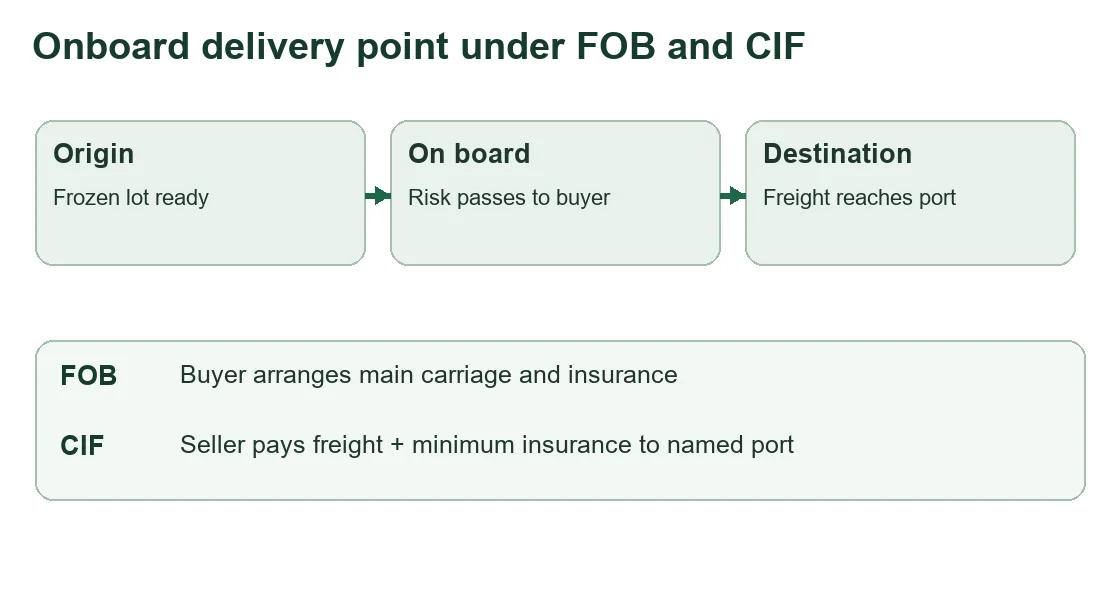
Separate risk passage from the freight payer
For the hypothetical reefer, draw two lines across the same voyage. The cost line shows who contracts and pays the ship and insurance premium. The risk line marks the on-board delivery under the chosen sea rule. A buyer who sees a warm container at Rotterdam must determine when and how the loss occurred and use the correct claim route; the mere fact that the supplier paid a CIF freight bill does not answer that question. Conversely, FOB does not excuse a seller from delivering the contracted product in the required condition at its delivery point. Contractual quality obligations, the trade term, carrier liability, and insurance are related but distinct inquiries.
The distinction becomes more complicated when a refrigerated container waits in a terminal. Who has the unit, who provides electrical power, who monitors alarms, and what record shows the carrier's acceptance? Those operational facts may not align neatly with an on-board point several days later. The ICC's container guidance is a reason to agree the correct rule before booking. Ask the forwarder to draw the actual factory-to-terminal-to-vessel sequence and identify the document that proves each handoff. Then choose a term that expresses the intended allocation with a clear named place.
Incoterms do not set the exact product temperature, guarantee a vessel schedule, determine title to the fruit, or replace the sales contract's quality clause. The parties can agree added obligations, but the wording should be specific and reviewed by the people managing the shipment. A purchase order can require pre-cooling, a reefer set point, a loading record, a logger, and timely sharing of data. Those controls should appear in the booking instructions and supplier/forwarder handoff. A generic clause saying "maintain frozen condition" leaves too much uncertainty about who records the evidence and when deviations must be reported.
The buyer's choice therefore depends partly on operational capability. A buyer with a trusted reefer forwarder may prefer to manage booking and policy directly. Another buyer may value seller-arranged carriage, provided the route, policy, and evidence can be reviewed before dispatch. Neither preference changes the risk-transfer rule by itself. The decision becomes defensible when the commercial team compares the same shipment basis and the logistics team confirms the actual handoff and documents.
Inspect reefer insurance and temperature wording
The word "insurance" in CIF is only a starting point. ICC's 2020 checklist states that the seller's default CIF insurance obligation is minimum cover, commonly equivalent to Institute Cargo Clauses C. A buyer should not assume that this default will pay a claim for every temperature deviation, machinery breakdown, delay, or deterioration of frozen fruit. The applicable certificate and underlying policy determine covered risks, exclusions, conditions, deductibles, insured value, claims notice, and documentary requirements.
Prompt policy scope questions without promising cover
Ask for the actual certificate or a policy specimen before purchase-order acceptance, and the issued certificate for the actual shipment before loading or as the contract requires. Compare the named assured or beneficiary, voyage, cargo description, insured amount and currency, effective period, territorial limits, and cargo clauses with the sales terms. If temperature damage is a material exposure, discuss explicit refrigeration machinery breakdown and temperature-variation wording with a qualified insurance broker or insurer. The names of endorsements differ; the policy has to be read, not inferred from a seller's statement that the shipment is "fully insured."
Temperature cover may be conditional. A policy might distinguish physical machinery failure from operator error, require a minimum interruption period, exclude ordinary delay, or impose specific monitoring and notification duties. Those are possibilities to check in the issued wording, not universal exclusions asserted here. A buyer should ask the insurer how its policy treats a disconnected terminal plug, incorrect set point, blocked airflow, a vessel delay, or fruit loaded warmer than agreed. The answer may depend on causation and records. If the proposed CIF cover is too narrow, the parties can discuss enhanced cover or a separate buyer policy before the shipment starts.
The cost of enhanced insurance belongs in the matched quote. A FOB price plus the buyer's broad reefer policy should be compared with a CIF offer plus any needed coverage upgrade, rather than with the CIF headline price alone. Ask for the premium, deductible, claims jurisdiction or contact, and who pays for surveys. A buyer may value control over policy wording even if its premium is higher. A seller-arranged policy may simplify the purchase if it is issued on acceptable terms and the buyer can claim directly as intended. The right answer is documented for that voyage, not guessed from the Incoterm label.
The presence of insurance does not certify food safety or saleability after a warm event. A logger graph can show a temperature history but cannot alone tell whether product cores warmed, whether a microbiological risk arose, or whether the policy covers the loss. The receiver's quality team should quarantine suspect cargo, preserve the cold chain where feasible, and follow an agreed sampling and disposition protocol. The insurance team should preserve rights and notify the appropriate parties promptly. Keep those decisions coordinated while maintaining separate quality and claims records.
Assign cold-chain evidence at each handoff
Most reefer disputes become harder when basic facts are missing. Before loading, document the product's agreed condition and check that cartons are already at the required product temperature; a reefer container is designed to maintain an appropriate cargo environment, not to repair a warm incoming lot. Record the container identifier, equipment pre-trip status where available, set point and operating mode, packing pattern, seal number, and who checked them. A loading photograph should show door condition and airflow clearance without exposing an unrelated customer's private information.

Identify loading temperature and logger evidence points
Independent data loggers can help, but their location and calibration matter. A logger beside a door may experience a different environment from cartons in the center of a pallet. One device cannot prove every package stayed within an agreed range. State the placement and retrieval responsibility in the shipping instruction, and preserve any reefer controller downloads, carrier events, terminal power records, and vessel information that become available. TT Club's temperature-controlled cargo guidance identifies incorrect instructions, operating errors, and equipment faults as recurring sources of claims. A precise evidence plan helps distinguish them.
At the terminal and vessel, the freight party should know who receives alarms and how quickly an intervention is requested. The seller's loading team, the buyer's forwarder, the terminal, and the carrier may each hold a different part of the record. Under a CIF sale, the seller may have contracted the carrier while the buyer bears voyage risk after on-board delivery, so access to carrier documents and claims cooperation should be agreed in the sales contract. Under FOB, the buyer's forwarder may control booking but still needs origin loading evidence from the seller. The trade term alone will not create a complete audit trail.
At arrival, record seal condition, container number, air and product measurements under the agreed inspection method, carton condition, frost or thaw signs, and unloading time. Keep the container connected to power until the approved unloading procedure begins where possible. If a deviation is suspected, follow the carrier and insurer's notice requirements, arrange any necessary independent survey, preserve representative samples, and document mitigation or salvage decisions. Avoid claiming that one logger spike automatically proves carrier fault or insurance recovery. Causation and coverage require the full chain of records.
The handoff plan should name a person and deadline for each record: origin QC for product and loading checks; forwarder or carrier for booking and transit events; receiver for arrival inspection; insurer contact for notice and survey instructions. A shared folder with controlled file names linked to container and lot codes is more useful than scattered screenshots. The purpose is to make a real deviation investigable while maintaining timely product-safety decisions. The records also support continuous improvement when no claim arises, by exposing recurring terminal or loading weaknesses.
Compare matched FOB and CIF quotations
Use the same blueberry SKU, pack, reefer, loaded quantity, shipping week, currency, and arrival port in both quotes. Break each offer into product and origin handling, export documentation, main ocean carriage, cargo insurance, origin and destination terminal charges, customs-related charges, and inland delivery. For the CIF quote, ask which carrier and routing are contemplated and whether transshipment is expected. For the FOB quote, obtain the buyer forwarder's current booking offer on the same sailing window. Leave price cells blank until both parties provide live numbers; historic online freight rates are not reliable for this decision.

Real blueberry product under one consistent quote example
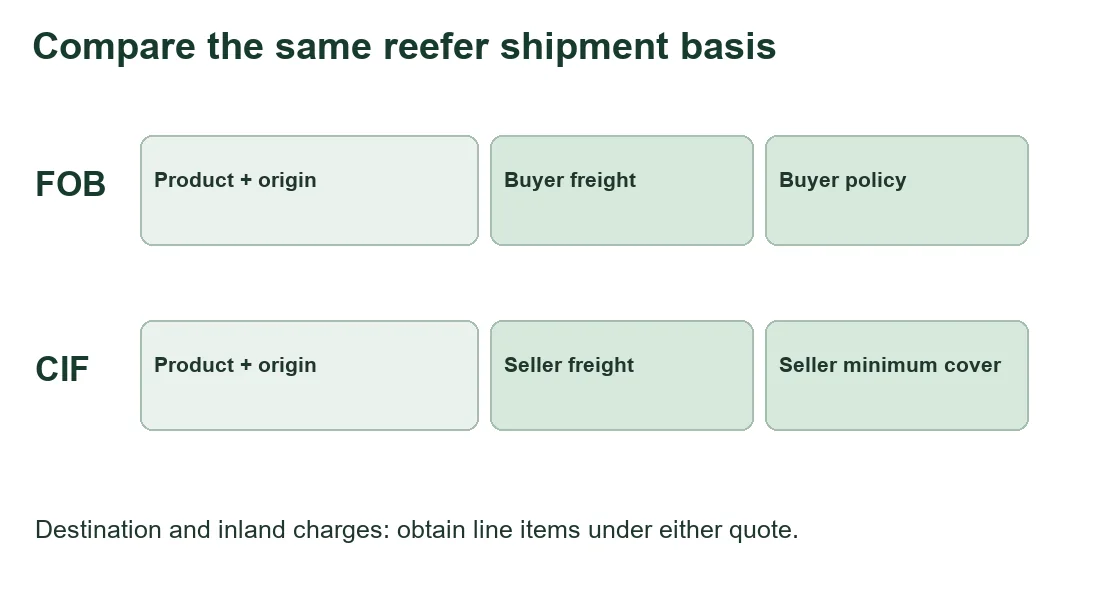
Compare cost legs on one shipment basis
| Item on the same reefer | FOB Shanghai Port, Incoterms® 2020 | CIF Port of Rotterdam, Incoterms® 2020 |
|---|---|---|
| Frozen blueberry specification | Identical agreed lot, pack and quantity | Identical agreed lot, pack and quantity |
| Main ocean carriage | Buyer arranges and pays | Seller arranges and pays to named destination port |
| Cargo insurance | Buyer chooses and pays | Seller obtains minimum cover; buyer reviews any upgrade |
| Sea-voyage risk under the rule | Transfers at on-board delivery | Transfers at on-board delivery |
| Destination and inland charges | Verify quoted inclusions and local tariff | Verify quoted inclusions and local tariff |
| Temperature records | Seller loading file plus buyer carrier access | Seller loading file plus agreed buyer access to carrier data |
The table compares obligations, not total landed cost. Add actual quote figures for each charge line, use one exchange rate basis, and identify which party bears surcharges that are unknown at order time. Detention, demurrage, plug-in, inspection, and local delivery can alter the amount payable even when the ocean freight number looks attractive. The finance team should compare the same delivery endpoint and payment timing. The quality team should compare the same packing and inspection scope. A cheaper quotation is meaningful only after those differences are reconciled.
For a frozen-food program with repeated shipments, review variation as well as one price. Who chooses the vessel and transshipment route? How often will the quoted equipment be available? Can the party contracting carriage obtain controller downloads promptly after an alarm? Can the insurance wording remain consistent across shipments, or will it be issued case by case? A buyer may accept a slightly higher nominal charge for clearer access to these controls, but that judgment belongs to the actual offers. Record the reasons in the approval file rather than declaring one Incoterm universally cheaper.
GreenLand-food's frozen vegetable import guide explains wider import steps, and the frozen mushroom RFQ guide helps buyers normalize product quotation details. This page addresses the narrower reefer decision: the relationship among a named trade term, matched freight costs, the actual policy, and temperature evidence. We can prepare a product and loading brief for our frozen-food supply. Final freight, insurance, customs, and legal terms require the actual counterparties' review.
Approve the term, policy and evidence plan
Before accepting the purchase order, have both sides confirm the rule and edition, named place or port, container handoff, cargo specification, booking route, temperature instruction, insurance certificate or policy wording, and responsibility for each loading and transit record. If the container is handed over at a terminal, ask the forwarder whether FCA, CPT, or CIP better describes the movement than FOB or CIF. The ICC checklist is a useful decision aid, but the full Incoterms rule and actual contract should be reviewed for the transaction.

Trace record custody from origin to arrival
Create a small contact table in the contract file: supplier QC, seller booking agent, buyer forwarder, carrier, receiver, insurance broker or claims desk, and destination customs representative. Include response times for a reefer alarm and a suspected arrival loss. Agree who can request a controller download and who pays for a survey. Also agree how the receiver will hold the lot pending a quality decision. The practical value of this table appears when an incident happens outside office hours and the parties need records before they disappear.
The policy should be reviewed against the product's actual risk. Frozen berries may have quality losses from partial thaw, package damage, or extended exposure even when a container subsequently returns to its set point. The insurer must confirm whether the issued wording addresses the risks the buyer wants to transfer and what evidence is required. A broad title on a certificate does not settle an exclusion, waiting period, deductible, or notice condition. Seek qualified insurance and legal advice for contract wording that affects a high-value shipment.
At GreenLand-food, we help purchasing teams specify frozen-food form, packing, quantity, destination, and the requested product and loading documents for factory-direct wholesale supply from China. We are a frozen-food supplier and manufacturer; the commercial offer should state the exact SKU and agreed scope rather than suggest a standing freight or insurance promise. The buyer can then place the logistics terms alongside the product specification and approve them as one shipment plan. That is the point at which an FOB or CIF comparison becomes useful for a reefer, rather than a shortcut based on three letters.
Source Frozen Food with GreenLand-food
GreenLand-food is a professional frozen food supplier and manufacturer in China, providing factory-direct wholesale supply for importers, food manufacturers, foodservice distributors, and private-label programs.
Send the product form, specification, packing, quantity, application, destination, private-label needs, and requested documents. We will confirm the current offer and documentation for your order.